ISSN 1225-6552, eISSN 2287-7630 http://dx.doi.org/10.7853/kjvs.2014.37.4.225
< Original Article >
Veterinary Service
Available online at http://kjves.org
*Corresponding author: Jae-Keun Cho, Tel. +82-53-760-1303, Fax. +82-53-760-1302, E-mail. [email protected]
대구지역 폐수처리장에서 분리한 cefotaxime-resistant Escherichia coli 의 특성
김환득ㆍ박대현ㆍ이미리ㆍ김은정ㆍ조재근*
대구광역시보건환경연구원
Characterization of cefotaxime-resistant Escherichia coli isolated from wastewater treatment plant in Daegu
Hwan-Deuk Kim, Dae-Hyun Park, Mi-Ree Lee, Eun-Jeong Kim, Jae-Keun Cho*
Metropolitan Health & Enviornmental Research Institute, Daegu 706-732, Korea (Received 19 August 2014; revised 10 October 2014; accepted 21 November 2014)
Abstract
In this study, 185 cefotaxime-resistant Escherichia coli were isolated from different stages of a waste- water treatment plant (WWTP) in Daegu in Korea. Among them, 99.5% (184 isolates) originated from raw sewage and 0.5% (1 isolates) from the final effluent. Cefotaxime-resistant E. coli were high re- sistant to ampicillin, piperacillin, cefazolin, cephalothin, cefachlor and cefamandole (99.5∼100%).
About 93% of the cefotaxime-resistant E. coli were extended-spectrum -lactamases (ESBL)- producing E. coli. The blaTEM+CTX gene was the most predominant of the ESBL genes (72.5%), followed by blaCTX-M (16.2%), blaTEM (8.7%), blaTEM+CTX+SHV (1.1%), blaTEM+SHV, blaTEM+OXA, and blaTEM+CTX+SHV
(respectvely 0.5%). Class 1 and 2 integron were found in 49.7% and class 3 integron was not found.
All of integron positive isolates were multiresistant (i.e. resistant to four or more antibiotics). Our find- ings showed WWTP is contaminated with antibiotic resistant bacteria with resistance genes.
Key words : WWTP, CTX-resistant E. coli, ESBL genes, Integrons
서 론
도시 하수처리장은 사람과 동물 병원체의 중요한 서식지로 완벽하게 처리되지 않은 방류수는 하천 내 항생제 내성 세균을 발생시키는 주요한 원인이다 (Ferreira da Silva, 2007; Reinthaler 등, 2010; Michal 등, 2013). 이들 균들은 수중 환경 내에서 존재하면서 수평전파에 의해 서로 다른 세균들과 내성 유전자를 교환하면서 항생제에 대한 더 강한 내성을 키운다 (Baquero 등, 2008; Martínez, 2008). E. coli를 포함한 항생제 내성 세균은 수중환경에 존재할 수 있으며, 인간은 수계와의 직ㆍ간접적인 접촉을 통해 항생제
내성균에 감염될 수 있어 공중보건학적으로 문제가 될 수 있다.
Integron은 이동 가능한 유전자 cassette를 인지하고 포획 활 수 있는 장소 특이적인 재조합 체계의 구성 요소를 가진 유전자로, 내성 유전자의 출현과 전파에 중요한 역할을 하며 다약제 내성과 관련이 있다 (Martinez, 2009; Cambray 등, 2010). 또한 integron은 integrase 단백질의 상동성에 근거를 두어 6종류의 class로 분류되며, 그 중 extended-spectrum -lacta- mases (ESBL) 내성을 암호화하는 유전자(bla genes)를 포함하고 있는 class 1은 가장 흔한 구조이며, Entero-
bacteriaceae에서 주로 발견되고 있다(Frank 등, 2007).
최근 들어 integron과 ESBL을 생성하는 E. coli는 임상가검물에서만 국한되지 않고, 하천, 생활하수, 도
축장, 폐수처리장과 같은 인간의 생활과 밀집한 환경 에까지 확산되고 있어(Ash 등, 2002; Moura 등, 2007;
Ferreira da Silva 등, 2010; Reinthaler 등, 2010) 문제가 되고 있다. 특히 ESBL 생성균주는 기존의 -lactam계 항균제뿐만 아니라 cefotaxime (CTX), ceftazidime (CAZ) 과 aztreonam 같은 제 3세대 항균제들에 대해서도 내 성을 가지고 있다(Bradford, 2001; Paterson과 Bonomo, 2005). 국내에서는 2006년 식품의약품안전청에서 환 경 중 항생제 내성균 모니터링을 실시하여 국내 하천 및 하수처리장 내의 항생제 내성균의 실태를 조사한 이후(식품의약품안전청, 2006), 여러 연구자들이 한 강, 낙동강, 영산강 등 전국 주요 하천에서 분리된 E.
coli에서 integron과 ESBL의 특성에 대해 보고가 되고
있다(Kim 등, 2008; Jang 등, 2013; Cho 등, 2014). 그 러나 항생제 내성균의 발원지로 알려진 폐수처리장 같은 곳에서 이들에 대한보고는 거의 없다. 따라서 이번 연구는 대구지역에 있는 하수처리장의 유입수 와 방류수에서 cefotaxime 내성 E. coli를 분리하고, 이 들 균주를 대상으로 항생제 내성양상, integron 및 ESBL 내성 유전자의 분포를 조사하기 위해 실시하였 다.재료 및 방법
Cefotaxime 내성 E. coli의 분리
2013년 8월부터 11월까지 대구시에 위치한 폐수처 리장 11개소를 대상으로 매월 1회씩 4회에 걸쳐 총 88개(유입수와 방류수 각각 44개)의 시료를 멸균 채 수병을 이용하여 각각 500 mL씩 채취하였다. 채취한 시료는 확산집락을 방지하기 위해 적당히 희석(100, 101 및 102) 한 다음, CTX (4 g/mL, Sigma, USA)이 첨가된 MacConkey agar (Oxoid, England) 평판배지에 고르게 도말한 다음 37oC에서 18시간 배양하였다. E.
coli로 의심되는 집락을 평판 당 4∼5개를 선택하여
EMB agar (Oxoid, England)에 37oC에서 18시간 배양 한 후, 금속성 광택을 나타낸 집락을 선택하여 생화 학 검사와 Vitek 2 compact (BioMerieux, S.A., France) 를 이용하여 동정하였다.항생제 감수성 시험
항생제 감수성 시험은 Bauer 등(1996)의 디스크 확
산법을 이용하여 실시하였고, 내성 여부는 Clinical and Laboratory Standards Institute (CLSI, 2012)의 기준 에 따라 판독하였다. 사용한 항생제 디스크(Oxoid, UK)는 ampicillin (10 g), piperacillin (100 g), ampi- cillin/sulbactam (10/10 g), piperacillin/tazobactam (100/10 g), ticarcillin/clavulanic acid (75/10 g), ceph- alothin (30 g), cefepime (30 g), cefotaxime (30 g), cefoxitin (30 g), ceftazidime (30 g), cefamandole (30
g), aztreonam (30 g) 및 imipenem (10 g) 등 14종 이었다. 항생제 감수성 시험을 위한 표준균주로 E.
coli ATCC 25922를 사용하였다. 한편 ESBL 생성 균
주의 확인을 위해 cefotaxime/clavulanic acid (CTX-CA, 30/10 g)와 ceftazidime/clavulanic acid (CAZ-CA, 30/10 g)에 대해서도 항생제 감수성 시험을 실시하 였다. 한편 동일 시료에서 분리된 균주 중 항생제 감 수성 양상이 동일할 경우 1개의 균주만을 실험 결과 로 이용하였다.Genomic DNA 추출
공시균에 대한 genomic DNA 추출은 boiling법 (Mazel 등, 2000)으로 실시하였다. 간단히 설명하면, tryptic soy broth (Oxoid, UK)에 접종하여 37oC에서 18
∼24시간 진탕 배양하여 얻은 균 부유액 1.0 mL를 13,000 rpm에서 2분간 원심분리한 후 상층액을 제거 한 다음 멸균 증류수 0.5 mL로 재 부유하였다. 균 부 유액은 끓는 물에 10분간 가열한 다음 13,000 rpm에 서 10분간 원심분리한 후 상층액을 취하여 template DNA로 사용하였다.
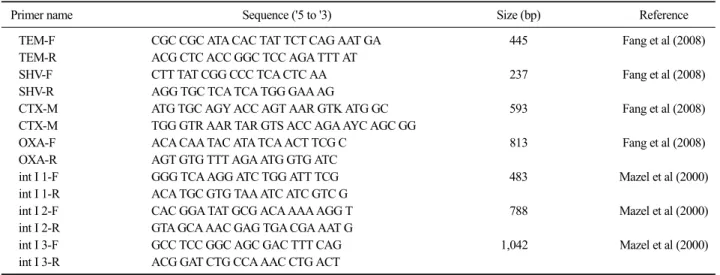
Integron 및 -lactamase 유전자의 검출을 위한 PCR
-lactamase 유전자와 integron 검출을 위한 primers 는 제조사(Bioneer, 한국)에 의뢰하여 합성 제작하였 다(Table 1). PCR 반응은 2X TOPsimple DyeMix (aliquot)-HOT (Enzynomics, Korea)에 각각의 10 pmol primer 1 L와 template DNA 1 L를 넣은 후 멸균된 증류수를 첨가하여 최종 반응량이 20 L가 되게 하 여 Tprofessional Thermal Cycler (Biometra, Germany) 를 이용하여 수행하였다.
blaTEM, blaOXA, blaSHV 및 blaCTX-M 유전자의 동시 검 출을 위한 multiplex PCR은 Fang 등(2008)의 방법에 따라 95oC에서 15분간 초기 denaturation 후, 94oC에서
Table 1. Primers used for detection of -lactamases genes and integrons in the multiplex PCR
Primer name Sequence ('5 to '3) Size (bp) Reference
TEM-F CGC CGC ATA CAC TAT TCT CAG AAT GA 445 Fang et al (2008)
TEM-R ACG CTC ACC GGC TCC AGA TTT AT
SHV-F CTT TAT CGG CCC TCA CTC AA 237 Fang et al (2008)
SHV-R AGG TGC TCA TCA TGG GAA AG
CTX-M ATG TGC AGY ACC AGT AAR GTK ATG GC 593 Fang et al (2008)
CTX-M TGG GTR AAR TAR GTS ACC AGA AYC AGC GG
OXA-F ACA CAA TAC ATA TCA ACT TCG C 813 Fang et al (2008)
OXA-R AGT GTG TTT AGA ATG GTG ATC
int I 1-F GGG TCA AGG ATC TGG ATT TCG 483 Mazel et al (2000)
int I 1-R ACA TGC GTG TAA ATC ATC GTC G
int I 2-F CAC GGA TAT GCG ACA AAA AGG T 788 Mazel et al (2000)
int I 2-R GTA GCA AAC GAG TGA CGA AAT G
int I 3-F GCC TCC GGC AGC GAC TTT CAG 1,042 Mazel et al (2000)
int I 3-R ACG GAT CTG CCA AAC CTG ACT
Table 2. Antimicrobial resistance patterns of 185 cefotaxime-resistant E. coli
Classification Antimicrobial agents Zone diameter* (mm) No. (%) of resistant strains
S I R S (%) I (%) R (%)
Penicillins Ampicillin ≥17 14∼16 ≤13 0 (0) 0 (0) 185 (100)
Piperacillin ≥21 18∼20 ≤17 0 (0) 2 (1.1) 183 (98.9)
-lactamase inhibitors Ampcillin/clavulanic acid ≥18 14∼17 ≤13 115 (62.2) 39 (21.1) 31 (16.8) Ampicillin/sulbactam ≥15 12∼14 ≤11 45 (24.3) 54 (29.2) 86 (46.5) Ticarcillin/clavulanic acid ≥20 15∼19 ≤14 67 (36.2) 103 (55.7) 15 (8.1)
Cephems Cefazolin ≥23 20∼22 ≤19 0 (0) 0 (0) 185 (100)
Cephalothin ≥18 15∼17 ≤14 0 (0) 0 (0) 185 (100)
Cefachlor ≥18 15∼17 ≤14 0 (0) 2 (1.1) 183 (98.9)
Cefamandole ≥18 15∼17 ≤14 1 (0.5) 0 (0) 184 (99.5)
Cefoxitin ≥18 15∼17 ≤14 159 (85.9) 5 (2.7) 21 (11.4)
Ceftazidime ≥21 18∼20 ≤17 91 (49.2) 38 (20.5) 56 (30.3)
Cefepime ≥18 15∼17 ≤14 68 (36.8) 74 (37.8) 43 (23.2)
Carbapenems Imipenem ≥23 20∼22 ≤19 185 (100) 0 (0) 0 (0)
Monobactams Aztreonam ≥21 18∼20 ≤17 20 (10.8) 70 (37.8) 95 (51.4)
*S, susceptible; I, intermediate; R, resistant.
30초, 62oC에서 90초, 72oC에서 60초 조건으로 총 30 cycle을 수행한 다음 72oC에서 10분간 최종 extention 을 실시하였다. Class 1, 2 및 3 integron의 동시 검출 을 위한 multiplex PCR은 Mazel 등(2000)의 방법에 따 라 94oC에서 5분간 초기 denaturation 후, 94oC에서 30 초, 62oC에서 30초, 72oC에서 60초 조건으로 총 30 cycle을 수행한 다음 72oC에서 8분간 최종 extention을 실시하였다. 증폭된 산물은 1.2% agarose gel에서 100 V로 30분간 전기영동을 실시한 후 UV transiluminator (Biometra, Germany)를 이용하여 확인하였다.
결 과
항생제 감수성 시험
폐수처리장 11개소의 유입수와 방류수로부터 총 185주(유입수, 184주; 방류수, 1주)의 CTX 내성 E.
coli를 분리하였다. 이들 균주를 대상으로 대한 항생
제 감수성 시험을 실시한 결과는 Table 2와 같다.Penicillin계 항생제의 경우 ampicillin에 100%, piper- acillin에 98.9%의 높은 내성률을 나타내었다. -lacta- mase 억제제의 경우 ampicillin/sulbactam에 46.5%, am- picillin/clavulanic acid에 16.8%, 그리고 ticarcillin/clav-
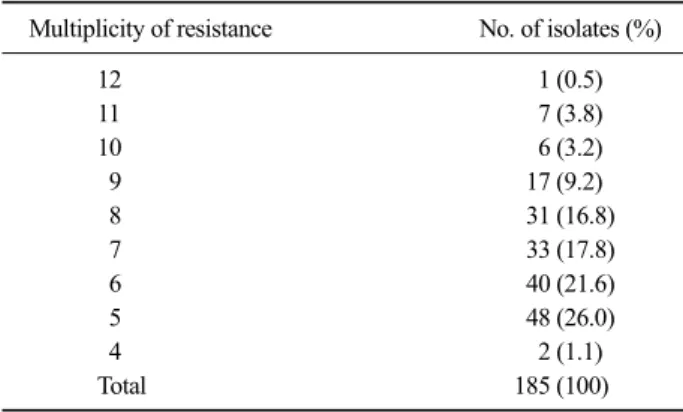
Table 3. Phenotypes of antimicrobial resistance in 185 CTX- resistant E. coli
Multiplicity of resistance No. of isolates (%)
12 1 (0.5)
11 7 (3.8)
10 6 (3.2)
9 17 (9.2)
8 31 (16.8)
7 33 (17.8)
6 40 (21.6)
5 48 (26.0)
4 2 (1.1)
Total 185 (100)
Table 4.Prevalence of -lactamase genes and integrons in 185 cefotaxime-resistant E. coli
No. of -lactamase genes (%) No. of integrons (%)
blaTEM 16 (8.7) int I 1 90 (48.7)
blaCTX-M 30 (16.2) int I 2 1 (0.5)
blaTEM+CTX-M 134 (72.5) int I 3 -
blaTEM+OXA 1 (0.5) int I 1+int I 2 1 (0.5) blaTEM+SHV 1 (0.5) Not detected 93 (50.3) blaTEM+CTX+SHV 2 (1.1)
blaTEM+CTX+OXA 1 (0.5)
Total 185 (100) Total 185 (100)
ulanic acid에 8.1%의 내성률을 나타내었다. Cephem계 의 경우 cefazolin과 cephalothin에 대하여는 전 균주가 내성을 나타내었고, cefamandole과 cefachlor에 대하여 는 각각 99.5%와 98.9%의 높은 내성률을 나타내었다.
반면 ceftazidime, cefepime 및 cefoxitin에는 각각 30.3%, 23.2% 및 11.4%의 낮은 내성률을 나타내었다.
Monobactam계인 aztreonam에는 51.4%의 내성률을 나 타내었으나, carbapenems계인 imipenem에 대하여는 공시균 모두 감수성을 나타내었다. 공시균 185주 중 171주(92.4%)는 CTX과 CTX-CA 또는 CAZ과 CAZ- CA 디스크 사이에서 상승효과에 의한 억제대의 크기 가 5 mm 이상으로 관찰된 ESBL 생성균주로 유입수 에서 170주(91.9%), 방류수에서 1주(0.5%)가 검출되 었다.
이번 연구에서 CTX 내성 E. coli는 모두 4종 이상 의 약제에 내성을 나타내었으며, 그 중 5제 내성균이 26.0%로 가장 많았으며, 다음 6제(21.6%), 7제(17.8%).
8제(16.8%), 9제(9.2%) 순이었다(Table 3).
Integron 및 -lactamase 유전자의 검출을 위한 PCR
총 185주의 CTX 내성 E. coli를 대상으로 integrons (class 1, 2 및 3 integron)과 -lactamase 유전자(blaTEM,
bla
SHV, blaOXA 및 blaCTX-M)의 검출을 위해 multiplex PCR을 실시한 결과는 Table 4와 같았다.Integron은 CTX 내성 E. coli의 92주(49.7%)에서 검 출되었으며, 이 중 class 1 integron이 90주(48.7%)로 가장 많이 검출되었고, 다음 class 2 integron 및 class 1+2 integron이 각각 1주(0.5%)에서 검출되었다. 반면 class 3 integron은 검출되지 않았다.
CTX 내성 E. coli의 전주가 한 종류 이상의 -lacta- mase 유전자를 가지고 있었다. blaTEM+CTX-M 유전자가 134주(72.5%)로 가장 많이 검출되었고, 다음 blaCTX-M
30주(16.2%), blaTEM 16주(8.7%), blaTEM+CTX-M+SHV 2주 (1.1%), blaTEM+SHV, blaTEM+OXA 및 blaTEM+CTX-M+OXA 유전 자가 각각 1주(0.5%)의 순으로 검출되었다.
고 찰
대구지역에 있는 11개 하수처리장의 유입수와 방 류수로부터 총 185주의 CTX 내성 E. coli가 분리되었 다. -lactam계 항생제는 -lactam환의 가수분해로 인 해 하수처리장에서 생물학적 처리과정 동안 상당히 감소한다고 알려져 있다(Li와 Zhang, 2011). 비록 이 번 연구에서 폐수처리장의 유입수와 방류수에서 CTX 내성 E. coli에 대한 균수는 측정하지 않았지만, 185주의 CTX 내성 E. coli 중 단지 1주 만이 방류수 에서 검출되어 항생제 내성 관점에서 검사 유출수는 공중보건학적으로 비교적 양호한 것으로 생각된다.
이번 연구에서 CTX 내성 E. coli는 ampicillin, piper- acillin, cefazolin, cephalothin, cefachlor 및 cefamandole 에 대해서는 99.5∼100%에 이르는 높은 내성률을, ampicillin/sulbactam과 aztreonam에는 각각 46.5%와 51.4%의 중등도의 내성률을 그리고 나머지 약제에 대해서는 낮은 내성률(0∼30.3%)을 나타내었다. 최근 까지 국내에서 폐수처리장을 대상으로 분리된 CTX 에 내성인 E. coli를 대상으로 항생제 내성 양상에 관 한보고는 없다. 그러나 대구시 폐수처리장에서 처리 된 최종 방류수는 낙동강과 금호강으로 흘러 들어간 다는 것을 고려해 볼 때, 이러한 결과는 Kim 등(2012) 과 Cho 등(2014)이 보고한 성적과 비교 시 유사한 결 과를 나타내었다.
Integron은 균주 간 여러 가지 내성 유전자를 전달 함으로서 다제내성균의 발현에 중요한 역할을 하는 것으로 알려져 있다(Mokracka 등, 2012; Koczura 등, 2012). 이번 연구에서도 CTX 내성 E. coli는 모두 4종 이상의 약제에 내성을 보인 다제내성균이었다. 한편 integrons은 CTX 내성 E. coli의 49.7%에서 검출되었 으며, 이러한 결과는 도시 하수처리장에서 Koczura 등(2012)이 E coli에서 11.0%, 도축장 하수처리장에서 Moura 등(2007)의 Enterobacteriaceae와 Aeromonas spp.에서 35%의 성적보다 높았다. 반면 중국의 양쯔 강에서 65.2% (Chen 등, 2010) 및 낙동강과 금호강에 서 61.4% (Cho 등, 2014)보다는 낮았다. 그러나 이번 연구에서는 CTX 내성 E. coli만을 대상으로 integron 을 검출한 관계로 타 연구자들의 결과와 비교 시 신 중을 기할 필요가 있다.
이번 연구에서 integrons 중 class 1 integron이 가장 많이 검출되어, integrons의 유래에 상관없이 class 1 integron은 class 2와 3 integron 보다 더 많이 검출되었 다고 보고한 이전 연구자들의 결과와 일치하였다 (Moura 등, 2007; Laroche 등, 2009; Koczura 등, 2012).
한편 이러한 성적을 국내 임상가검물 및 가축에서 검 출된 결과와 비교 해 볼 때, Yu 등(2003)이 대구지역 대학병원에서 분리된
E. coli에서 54% 및 Kang 등
(2005b)이 돼지에서 분리된 E. coli에서 64.4%의 성적 보다는 낮았으나, Kang 등(2005a)이 사람과 동물에서 분리된 E. coli에서 11.4∼42.3%보다는 높거나 비슷하 였다.수중환경 내 존재하는 E. coli에서 class 2와 3 in- tegrons의 검출에 관한보고는 거의 없다. 그러나 class 2 integron은 북유럽에 위치한 Seine estuary로부터 분 리된
E. coli의 1.4% (Laroche 등, 2009), 사람과 동물
유래에서 분리된E. coli의 1.4% (Kang 등, 2005b;
Cocchi 등, 2007)의 성적과는 유사하였다. 이번 조사 에서 class 3 integron은 검출되지 않았다(Laroche 등, 2009; Su 등, 2012) 한편 이번 연구에서 integrase gene 내 gene cassettes에 대한 분석은 실시하지 않았다. 향 후 추가적인 연구가 이루어져야 될 것으로 생각된다.
CTX 내성 E. coli의 92.4%는 CTX와 CTX-CA 또는 CAZ와 CAZ-CA 디스크사이에서 상승효과에 의한 억 제대의 크기가 5 mm 이상으로 관찰된 ESBL 생성균 주이었다. 이는 이번 연구에서 CTX에 내성인 E. coli 대부분이 ESBL 생성에 의하여 내성을 획득하였음을 의미한다. 또한 CTX 내성 E. coli에서 blaCTX-M, blaTEM,
bla
OXA 및 blaSHV 같은 -lactamase 유전자가 검출되었으며, 이들 유전자는 이미 임상가검물 뿐만 아니라 국내의 강, 하천 등에서 보고되고 있다(Kim 등, 2008;
Jang 등, 2013; Cho, 2014; Kang 등, 2005b; Lee 등, 2009; Cho 등, 2011).
Plasmid에 의해 매개 되는 TEM 및 SHV형 효소는 과거 ESBL 중 가장 흔히 발견되었으나, 1983년 독일 에서 CTX에 내성인 균주가 처음 보고된 이후 CTX-M 형 유전자의 발생빈도는 계속 증가하고 있다. CTX-M 형 ESBL은 plasmid에 의해 매개 되며 가수분해 기질 특이성 및 억제특이성이 TEM형이나 SHV형 ESBL과 유사하지만, ceftazidime보다는 cefotaxime에 대한 가수 분해 활성이 더 강한 특성이 있다(Paterson과 Bonomo, 2005). 이번 연구에서도 CTX 내성 E. coli는 ceftazi- dime에 대해서는 30.3%만이 내성을 나타내었다.
이번 연구에서 blaCTX-M (90.3%)과 blaTEM (83.2%)형 유전자가 가장 많이 검출되었으며, 일부 균주에서는
bla
OXA 및 blaSHV형 유전자도 검출되었다. 이러한 결 과는 이전 연구자들의 결과와 일치하였다(Lu 등, 2010; Chen 등, 2010; Dhanji 등, 2011; Jang 등, 2013;Cho, 2014). 특히 CTX 내성 E. coli의 82%는 두 종류 이상의 -lactamase 유전자를 동시에 가지고 있었다.
이는 ESBL 유전자가 plasmid를 통하여 다른 균으로 쉽게 전파될 수 있음을 의미한다(Bradford, 2001). 이 번 연구에서 검출된
bla
TEM, blaCTX-M blaSHV 및 blaOXA형에 대해서는 추가적인 조사를 통한 유전형의 규명 이 필요할 것으로 생각된다.
이번 연구의 결과 폐수처리장 유입수는 CTX 내성
E. coli로 오염이 되어 있었고 또한 이들 균은 병원이
나 임상가검물에서만 국한되지 않고 수중환경에까지 확산되어 존재하고 있음을 확인하였다. 수중 환경은 내성균과 내성 유전자의 저장고 역할뿐만 아니라 환 경으로 내성균의 전파에 중요한 역할을 한다. 따라서 하수처리장의 최종 방류수가 강과 하천으로 흘러들 어가 식수와 농업용수 등으로 사용되어지는 것을 고 려할 때 하수처리장에서의 항생제 내성균의 배출 감 소를 위한 대책 마련이 요구된다.결 론
대구지역에 있는 폐수처리장 11개소의 유입수와 방류수에서 총 185주(유입수, 184주; 방류수, 1주)의 CTX 내성 E. coli를 분리하여, 이들 균주를 대상으로 항생제 감수성 시험, integrons 및 -lactamase 유전자
의 검출을 실시한 결과는 다음과 같다.
CTX 내성 E. coli는 ampicillin, cefazolin, cepha- lothin, cefamandole, piperacillin 및 cefachlor에 높은 내 성을 나타내었고, 전주가 4종 이상의 약제에 내성을 나타내었다. CTX 내성 E. coli의 92.4% (171주)가 ESBL 생성균주이었으며, 공시균 모두가 한 종류 이 상의 -lactamase 유전자를 가지고 있었다. blaTEM+CTX-M
유전자가 134주(72.5%)로 가장 많이 검출되었고 다음
bla
CTX 30주(16.2%), blaTEM 16주(8.7%), blaTEM+CTX+SHV2주(1.1%), blaTEM+SHV, blaTEM+OXA 및 blaTEM+CTX+OXA 유 전자가 각각 1주(0.5%)의 순으로 검출되었다. Integron 은 92주(49.7%)에서 검출되었으며, 이 중 class 1 in- tegron이 90주(48.7%)로 가장 많이 검출되었고, 다음 class 2 integron 및 class 1+2 integron이 각각 1주 (0.5%)에서 검출되었다. 이번 조사에서 class 3 in- tegron은 검출되지 않았다.
참 고 문 헌
식품의약품안전청. 2006. 환경 중 항생제 내성균 모니터링.
Ash RJ, Mauck B, Morgan M. 2002. Antibiotic resistance of gram-negative bacteria in rivers, United States. Emerg Infect Dis 8: 713-716.
Baquero F, Martínez JL, Cantón R. 2008. Antibiotics and anti- biotic resistance in water environments. Curr Opin Biotechnol 19: 260-265.
Bradford PA. 2001. Extended-spectrum -lactamases in the 21st century: Characterization, epidemiology, and detection of this important resistance threat. Clin Microbiol Rev 14:
933-951.
Bauer AW, Kirby WM, Sherris JC, Turck M. 1966. Antibiotic susceptibility testing by a standardized single disk method. Am J Clin Pathol 45: 493-496.
Cambray G, Guerout A, Mazel D. 2010. Integrons. Annu Rev Gen 44: 141-166.
Chen H, Shu W, Chang X, Chen JA, Guo Y, Tan Y. 2010. The profile of antibiotics resistance and integrons of ex- tended-spectrum beta-lactamase producing thermotolerant coliforms isolated from the Yangtze River basin in Chongqing. Environ Pollut 158: 2459-2464.
Cho JK, Sung MS, Kim JH, Kim KS. 2011. Detection of CTX-M and TEM type extended-spectrum -lactamases in Escherichia coli isolated from livestocks in Korea. Kor J Vet Serv 34: 37-43.
Cho JK, Kim HD, Kwon SH, Kim JH, Jang SI, Park CK, Kim KS. 2014. Prevalence of antimicrobial resistance and in- tegrons in extended-spectrum -lactamases producing Escherichia coli isolated from Nakdong and Gumho riv- er in Korea. Korean J Vet Serv 34: 19-27.
CLSI. Clinical and Laboratory Standards Institute. 2012.
Performance standards for antimicrobial susceptibility testing; Twenty-second informational supplement.
M100-S22. Wayne, Pa, USA.
Cocchi S, Grasselli E, Gutacker M, Benagli C, Convert M, Piffaretti JC. 2007. Distribution and characterization of integrons in Escherichia coli strains of animal and hu- man origin. FEMS Immunol Med Microbiol 50:
126-132.
Dhanji H, Murphy NM, Akhigbe C, Doumith M, Hope R, Livermore DM, Woodford N. 2011. Isolation of fluo- roquinolone-resistant O25b:H4-ST131 Escherichia coli with CTX-M-14 extended-spectrum -lactamase from UK river water. J Antimicrob Chemother 66: 512-516.
Fang H, Ataker F, Hedin G, Dornbusch K. 2008. Molecular epi- demiology of extended-spectrum beta-lactamases among Escherichia coli isolates collected in a Swedish hospital and its associated health care facilities from 2001 to 2006. J Clin Microbiol 46: 707-712.
Frank T, Gautier V, Talarmin A, Bercion R, Arlet G. 2007.
Characterization of sulphonamide resistance genes and class 1 integron gene cassettes in Enterobacteriaceae, Central African Republic (CAR). J Antimicrob Chemo- ther 59: 742-745.
Ferreira da Silva M, Vaz-Moreira I, Gonzalez-Pajuelo M, Nunes OC, Manaia CM. 2007. Antimicrobial resistance patterns in Enterobacteriaceae isolated from an urban wastewater treatment plant. FEMS Microbiol Ecol 60: 166-176.
Jang J, Suh YS, Di DY, Unno T, Sadowsky MJ, Hur HG. 2013.
Pathogenic Escherichia coli strains producing ex- tended-spectrum -lactamases in the Yeongsan river ba- sin of South Korea. Environ Sci Technol 47: 1128-1136.
Kang HY, Jeong YS, Oh JY, Tae SH, Choi CH, Moon DC, Lee WK, Lee YC, Seol SY, Cho DT, Lee JC. 2005b.
Characterization of antimicrobial resistance and class 1 integrons found in Escherichia coli isolates from humans and animals in Korea. J Antimicrob Chemother 55:
639-644.
Kang SG, Lee DY, Shin SJ, Ahn JM, Yoo HS. 2005a. Changes in patterns of antimicrobial susceptibility and class 1 in- tegron carriage among Escherichia coli isolates. J Vet Sci 6: 201-205.
Kim J, Kang HY, Lee Y. 2008. The identification of CTX-M-14, TEM-52, and CMY-1 enzymes in Escherichia coli iso- lated from the Han River in Korea. J Microbiol 46:
478-481.
Kim JH, Zheng XH, Cho JK, Sung MS, Kim KS. 2012.
Prevalence and characterization of extended-spectrum
-lactamase among Escherichia coli isolated from Geumho river in Korea. J Pure and Appl Microb 6:
989-1000.
Koczura R, Mokracka J, Jabłońska L, Gozdecka E, Kubek M, Kaznowski A. 2012. Antimicrobial resistance of in- tegron-harboring Escherichia coli isolates from clinical samples, wastewater treatment plant and river water. Sci
Total Environ 414: 680-685.
Laroche E, Pawlak B, Berthe T, Skurnik D, Petit F. 2009.
Occurrence of antibiotic resistance and class 1, 2 and 3 integrons in Escherichia coli isolated from a densely populated estuary (Seine, France). FEMS Microbiol Ecol 68: 118-130.
Lee SG, Jeong SH, Lee H, Kim CK, Lee Y, Koh E, Chong Y, Lee K. 2009. Spread of CTX-M- type extended-spec- trum beta-lactamases among bloodstream isolates of Escherichia coli and Klebsiella pneumoniae from a Korean hospital. Diagn Microbiol Infect Dis 63: 76-80.
Li B1, Zhang T.2011. Mass flows and removal of antibiotics in two municipal wastewater treatment plants. Chemosphere 83: 1284-1289.
Lu SY, Zhang YL, Geng SN, Li TY, Ye ZM, Zhang DS, Zou F, Zhou HW. 2010. High diversity of extended-spectrum beta-lactamase-producing bacteria in an urban river sedi- ment habitat. Appl Environ Microbiol 76: 5972-5976.
Martínez JL. 2008. Antibiotics and antibiotic resistance genes in natural environments. Science 18: 365-367.
Martinez JL 2009. Environmental pollution by antibiotics and by antibiotic resistance determinants. Environ Pollut 157:
2893-2902.
Mazel D, Dychinco B, Webb VA, Davies J. 2000. Antibiotic re- sistance in the ECOR collection: integrons and identi- fication of a novel aad gene. Antimicrob Agents Chemother 44: 1568-1574.
Michael I1, Rizzo L, McArdell CS, Manaia CM, Merlin C, Schwartz T, Dagot C, Fatta-Kassinos D. 2013. Urban
wastewater treatment plants as hotspots for the release of antibiotics in the environment: a review. Water Res 47:
957-995.
Mokracka J, Koczura R, Kaznowski A. 2012. Multiresistant Enterobacteriaceae with class 1 and class 2 integrons in a municipal wastewater treatment plant. Water Res 46:
3353-3363.
Moura A, Henriques I, Ribeiro R, Correia A. 2007. Prevalence and characterization of integrons from bacteria isolated from a slaughterhouse wastewater treatment plant. J Antimicrob Chemother. 60: 1243-1250.
Paterson DL, Bonomo RA. 2005. Extended-spectrum beta-lacta- mases: a clinical update. Clin Microbiol Rev 18:
657-686.
Reinthaler FF, Feierl G, Galler H, Haas D, Leitner E, Mascher F, Melkes A, Posch J, Winter I, Zarfel G, Marth E.
2010. ESBL-producing Escherichia coli in Austrian sew- age sludge. Water Res 44: 1981-1985.
Su HC, Ying GG, Tao R, Zhang RQ, Zhao JL, Liu YS. 2012.
Class 1 and 2 integrons, sul resistance genes and anti- biotic resistance in Escherichia coli isolated from Dongjiang River, South China. Environ Pollut 169:
42-49.
Yu HS, Lee JC, Kang HY, Ro DW, Chung JY, Jeong YS, Tae SH, Choi CH, Lee EY, Seol SY, Lee YC, Cho DT.
2003. Changes in gene cassettes of class 1 integrons among Escherichia coli isolates from urine specimens collected in Korea during the last two decades. J Clin Microbiol 41: 5429-5433.