129
and Safety
Available online at http://www.foodhygiene.or.kr
https://doi.org/10.13103/JFHS.2017.32.2.129
국내 유통중인 생닭 및 닭가공품에서 병원성 대장균의 분리 및 특성
조용선1*·이다연1·김희언1·이명기2·이주영1
1한국식품연구원 식품분석센터, 2한국식품연구원 전통식품연구센터
Prevalence and Characterization of Diarrheagenic Escherichia coli Isolated from Raw Chicken and Chilled Chicken in Korea
Yong-Sun Cho1*, Da-Yeon Lee1, Hee-Eon Kim1, Myung-Ki Lee2, and Joo-Young Lee1
1Food Analysis Center, Korea Food Research Institute, Gyeonggi, Korea
2Traditional Food Research Group, Korea Food Research Institute, Gyeonggi, Korea (Received January 13, 2017/Revised January 28, 2017/Accepted February 15, 2017)
ABSTRACT - Diarrheagenic Escherichia coli is now recognized as an important cause of diarrhea, hemorrhagic colitis and hemolytic-uremic syndrome (HUS) worldwide. E. coli were isolated from 80 of 356 (22.5%) chicken and chilled chicken products in Korea. Fifteen virulence genes specific for pathogenic E. coli, including Shiga toxin-pro- ducing E. coli (STEC), enteropathogenic E. coli (EPEC), enterotoxigenic E. coli (ETEC), enteroinvasive E. coli (EIEC) and enteroaggregative E. coli (EAEC), were examined by multiplex PCR. STEC virulence markers were detected for eaeA (20.0%), escV (21.3%), stx1 (3.8%), ent (2.5%), EHEC-hly (1.3%), stx2 (1.3%), EAEC virulence marker (astA) was detected in 32.5%. ETEC and EIEC were not detected. STEC serotypes O152, O1, O116, O26, O25, O119 and O153 were found in chicken samples. This suggests the importance of diarrheagenic Escherichia coli control in raw chicken and chilled chicken food for food safety.
Key words : Diarrheagenic Escherichia coli, Prevalence, Chicken, Multiplex PCR, STEC O-serogroup
병원성 대장균(Pathogenic Escherichia coli)는 전세계적 으로 식중독을 발생시키는 중요한 병원균으로 알려져 있 다. 인간에게 감염되면 심한 설사 증상을 일으키며 특히 개발 도상국에서 유아 사망률이 높아 공중 보건의 문제로 대두되고 있다1). 병원성 대장균은 병원성을 일으키는 독성 원인에 따라 구분이 된다: 시가독소생성 대장균(Shiga toxin- producing E. coli: STEC), 장독소형 대장균(Enterotoxigenic E. coli: ETEC), 장병원성 대장균(Enteropathogenic E. coli:
EPEC), 장출혈성 대장균(Enterohemorrhagic E. coli: EHEC), enteroinvasive E. coli (EIEC), 장부착성 대장균(entero- aggregative E. coli: EAEC)2,3).
STEC는 stx1 또는 stx2 유전자 변이에 의해 shiga toxin 을 생성하며, 장부착 유전자인 eae를 수반하기도 한다. 때 로는 enterohemolysin (EHEC-hly) 유전자에 의해서 추가 적인 독성을 지니기도 한다4). STEC는 급성 대장염이나 용
혈성 요독성 증후군을 일으키며(HUS) 소아에게 급성 신 부전증을 발생시킨다. STEC 중 EHEC는 30개국 이상에 서 사람에게 식중독이 발병한 보고가 있으며, 한국에서도 2012년 1,844명에게 31건이 발생하였으며 2015년에는 2,138 명에게 38건이 발병하여 꾸준히 증가하고 있다5). ETEC는 여행자 설사와 소아 설사로 주로 개발도상국가의 설사 질 환의 원인균으로, 설사의 중요한 원인은 heat-labile (LT)과 heat-stable (ST) enterotoxins으로 발병한다6). EPEC는 HeLa 세포나 HEp-2세포에 부착성을 나타낸다. 이러한 성상은 fimbria가 HEp-2 세포에 달라붙는 성질로 다른 E. coli와 감별되며 adherence (EAF) plasmid에 의해 생성되고 장점 막 상피세포에 달라붙는 Attaching-and-Effacing (AE) 부착 인자는 염색체 유전자(eaeA)에 의해 조절된다7). 주로 분변 에 의해서 전이되며 개발도상국에서는 유아의 혈변의 주 요한 원인이며 선진국에서도 유아의 설사를 빈번하게 일 으킨다8). EIEC는 Shigella와 유사하며 심한 경우 수양성 설사와 이질을 유발하며 전이는 오염된 식품이나 물을 통 해서 유발된다. EAEC는 전형적인 부착 패턴을 보이며9) 장독소형 ETEC의 내열성독소(Heat-stable toxin: ST)와 유 사한 특성을 가지는 Enteroaggregative Escherichia coli
*Correspondence to: Yong-Sun Cho, Korea Food Research Insti- tute, 516 Baekhyeon-dong Bundang-gu, Seongnam-si Gyeonggi- do 13539, Korea
Tel: 82-31-780-9242, Fax: 82-31-780-9280 E-mail: [email protected]
heat-stable enterotoxin 1 (EAST1)을 확인 보고하였다. 후속 연구에서 38개의 아미노산으로 구성된 EAST1가 EAEC뿐 만 아니라 장독소형 ETEC, EPEC에서도 발견됨으로써 식 중독을 일으키는 대장균의 주요한 병원성 인자로 주목 받 고 있다10). 대장균의 혈청형은 50,000종 이상으로 많으나, 전세계적으로는 O26, O103, O111, O145, O157: H7의 O 혈청형으로 부터 유래된 STEC에 의한 식중독 사고는 매 우 빈번하게 발생한다고 보고되고 있으며, 공중보건학적 으로 중요한 병원성 균주로 고려된다11). 국내 연구에는 식 육에서 분리된 대장균에 대한 병원성 특성 대한 연구 결 과는 있으나, 생닭 및 가공 조리된 식품에서 분리된 대장 균에 대한 병원성 특성에 대한 연구는 미흡한 실정이다.
또한 우리나라 병원성 대장균 식중독의 경우 환자에서의 규명 비율은 높은 반면에 식품에서 원인 규명 비율은 낮 은 것이 문제점으로 지적되고 있다12). 따라서 본 연구는 유통중인 생닭 및 가열 조리된 닭가공품에서 병원성 대장 균의 오염도를 조사하고 병원성 유전자 및 혈청형을 분석 하여 병원성 대장균의 특성을 파악하고자 하였다. 이러한 결과는 병원성 대장균에 의한 식중독 발생의 원인 파악의
기초 자료로 활용될 수 있다고 생각된다.
Materials and Methods
Collection of samples
생닭(N = 132) 및 가열 조리된 닭가공품(N = 224)를 슈퍼 마켓이나 대형 유통매장에 유통중인 시료를 구입하였다.
구입된 시료는 교차오염을 방지하기 위해 멸균백에 담아 냉장 운반하였으며 구입 후 4시간 이내 시험을 실시하였다.
Strain isolation and identification
대장균은 Bacteriological Analytical Manual13)및 식품공 전14) 시험방법으로 분리하였다. 시료 25 g에 225 ml of mTSB broth (Difco, Detroit, MI., USA) 증균배지를 가해서 stomacher (400 Circulator, Seward, London, UK) 로 260 rpm, 1 min 균질화 한 후 배양하였다. 배양액은 37oC에서 18~24 h 배양한 후 endo agar (Merck, Darmstadt, Germany) 와 CHROM agar STEC (CHROMagar, Paris, France)에 37oC에서 18 h 배양하였다. 배양 후 전형적인 집락을 선별
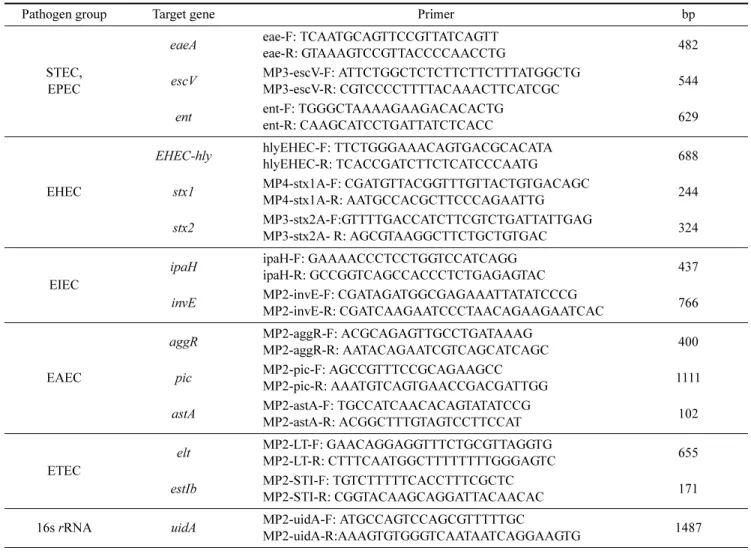
Table 1. Oligonucleotide primers used for detection of the virulence genes1)
Pathogen group Target gene Primer bp
STEC, EPEC
eaeA eae-F: TCAATGCAGTTCCGTTATCAGTT
eae-R: GTAAAGTCCGTTACCCCAACCTG 482
escV MP3-escV-F: ATTCTGGCTCTCTTCTTCTTTATGGCTG
MP3-escV-R: CGTCCCCTTTTACAAACTTCATCGC 544
ent ent-F: TGGGCTAAAAGAAGACACACTG
ent-R: CAAGCATCCTGATTATCTCACC 629
EHEC
EHEC-hly hlyEHEC-F: TTCTGGGAAACAGTGACGCACATA
hlyEHEC-R: TCACCGATCTTCTCATCCCAATG 688
stx1 MP4-stx1A-F: CGATGTTACGGTTTGTTACTGTGACAGC
MP4-stx1A-R: AATGCCACGCTTCCCAGAATTG 244
stx2 MP3-stx2A-F:GTTTTGACCATCTTCGTCTGATTATTGAG
MP3-stx2A- R: AGCGTAAGGCTTCTGCTGTGAC 324
EIEC
ipaH ipaH-F: GAAAACCCTCCTGGTCCATCAGG
ipaH-R: GCCGGTCAGCCACCCTCTGAGAGTAC 437
invE MP2-invE-F: CGATAGATGGCGAGAAATTATATCCCG
MP2-invE-R: CGATCAAGAATCCCTAACAGAAGAATCAC 766
EAEC
aggR MP2-aggR-F: ACGCAGAGTTGCCTGATAAAG
MP2-aggR-R: AATACAGAATCGTCAGCATCAGC 400
pic MP2-pic-F: AGCCGTTTCCGCAGAAGCC
MP2-pic-R: AAATGTCAGTGAACCGACGATTGG 1111
astA MP2-astA-F: TGCCATCAACACAGTATATCCG
MP2-astA-R: ACGGCTTTGTAGTCCTTCCAT 102
ETEC
elt MP2-LT-F: GAACAGGAGGTTTCTGCGTTAGGTG
MP2-LT-R: CTTTCAATGGCTTTTTTTTGGGAGTC 655
estIb MP2-STI-F: TGTCTTTTTCACCTTTCGCTC
MP2-STI-R: CGGTACAAGCAGGATTACAACAC 171
16s rRNA uidA MP2-uidA-F: ATGCCAGTCCAGCGTTTTTGC
MP2-uidA-R:AAAGTGTGGGTCAATAATCAGGAAGTG 1487
하여 Vitek 2 (Biomeriux, Marcy L'Etoile, France)를 이용 하여 생화학 시험 후 동정하였다.
PCR assays for detection of diarrheagenic E. coli 분리한 대장균에 대해서 독성 유전자 존재를 분석하였 다. 독성 유전자는 1) uidA, invE, escV, aggR, stx1, 2) eaeA, elt, ipaH, stx2, estIb, 3) pic, EHEC-hly, ent, astA 로 tgradient PCR (Biometra, Goettingen, Germany) multiplex PCR을 이용하였다1). Primer는 Bioneer (Cheongwon, Chung- buk, Korea)에서 구입하였고 sequence는 Table 1과 같다.
PCR은 총 반응액 20 µL으로 accupower multiplex PCR pre mix (Bioneer, Daejon, Korea)에 1 U의 taq polymerase 250 µM, 각각 dNTPs, 10 mM Tris-HCl, 1.5 mM MgCl2, 2-10 pmol의 primer로 하였으며 단일 집락을 PCR template로 사용하였다. PCR 반응은 98oC에서 30초 반응 후에 98oC 에서 30초, 63oC에서 60초, 72°C에서 90초, 35 cycle 반응 후 72oC에서 10분 연장시켰다. 반응 산물은 2% Seakem agarose gel (Takara, Kyoto, Japan)에서 100 V, 25분 전기 영동 후 ethidium bromide (1 µg/mL) 염색 후 확인하였다.
Serotyping of shiga toxin-producing E. coli
STEC를 분석하기 위해 E. coli Antigen group O sera (Denka Seiken, Tokyo, Japan)을 사용하였고 분석방법은 O antigen의 응집반응을 slide에서 확인하였다. 기타 시험방 법은 제조사의 메뉴얼에 따라 분석하였다.
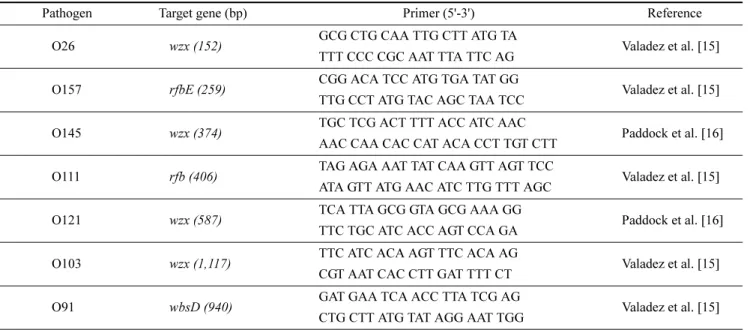
Shiga toxin-producing E. coli (STEC)의 혈청학적 검사 를 위해 O26, O157, O145, O111, O121, O103, O91의 혈 청형에 대해 rfb (o-specific polysaccharide), wzx (o-unit flippase), wbsD (aminotransferase)의 o-항원 유전자에 특이
적으로 결합하는 primer를 사용하였다(Table 2)15,16). PCR 반응액은 1 U Taq polymerase, 250 µM 각 dNTPs, 10 mM Tris-HCl, 30 mM KCl, 1.5 mM MgCl2가 포함된 reaction buffer (AccuPower PCR Pre mix, Bioneer Daejon, Korea) 에 10 pmol의 primer에 순수 분리된 단일 colony를 template 로 총 반응액을 20 µL로 하였다. PCR 반응 조건은 pre- denaturation 94oC에서 5분 후, 35cycles의 94oC에서 30초, 55oC에서 75초, 68oC에서 75초로 반응하였고 최종 extension 은 68oC에서 7분 반응 시켰다. 증폭된 DNA는 2% agarose gel (Takara, Kyoto, Japan)을 100 V로 30분간 전기영동 후 ethidium bromide (1µg/mL)에 염색하여 UV transilluminator 로 확인하였다.
Results and Discussion
Prevalence of E. coli isolates
생닭과 조리된 닭가공품 356시료에서 대장균 80균주 (22.5%)가 분리되었다. 생닭에서는 132시료 중 79(59.8%) 개의 대장균이 분리되었으며 가열 조리된 닭 가공품에서 는 224시료 중 1(0.4%)개에서만 대장균이 검출되었다. Zhao 등17)에 의하면 retail market에서 수집한 닭에서의 대장균 검출은 38.7% 였으며, supermarket에서 수집한 시료에서 는 20.9%가 검출되었으며, Choi 등10)에 의하면 29.6%의 대장균이 검출되었다. 본 연구 결과 생닭에서의 대장균 검 출률은 59.8%로 선행 연구 보다 높게 검출되었다. 대장균 의 경우 유통 과정 중 다양한 경로 의해 교차 오염이 될 수 있으므로 완전 포장되어 유통되지 않고, 구매자의 요 구에 따라 포장 판매가 되거나 절단이 되는 경우는 대장 균이 교차 오염에 의해 검출될 수 있다. 이러한 이유로 논
Table 2. Oligonucleotide primer used various E. coli serogroups
Pathogen Target gene (bp) Primer (5'-3') Reference
O26 wzx (152) GCG CTG CAA TTG CTT ATG TA
Valadez et al. [15]
TTT CCC CGC AAT TTA TTC AG
O157 rfbE (259) CGG ACA TCC ATG TGA TAT GG
Valadez et al. [15]
TTG CCT ATG TAC AGC TAA TCC
O145 wzx (374) TGC TCG ACT TTT ACC ATC AAC
Paddock et al. [16]
AAC CAA CAC CAT ACA CCT TGT CTT
O111 rfb (406) TAG AGA AAT TAT CAA GTT AGT TCC
Valadez et al. [15]
ATA GTT ATG AAC ATC TTG TTT AGC
O121 wzx (587) TCA TTA GCG GTA GCG AAA GG
Paddock et al. [16]
TTC TGC ATC ACC AGT CCA GA
O103 wzx (1,117) TTC ATC ACA AGT TTC ACA AG
Valadez et al. [15]
CGT AAT CAC CTT GAT TTT CT
O91 wbsD (940) GAT GAA TCA ACC TTA TCG AG
Valadez et al. [15]
CTG CTT ATG TAT AGG AAT TGG
문에 따라 대장균 검출률의 차이가 있는 것으로 생각된다.
그러나 대장균은 위생지표세균으로 생닭의 경우는 충분히 가열 조리해야 안전하게 섭취 할 수 있을 것으로 생각된다.
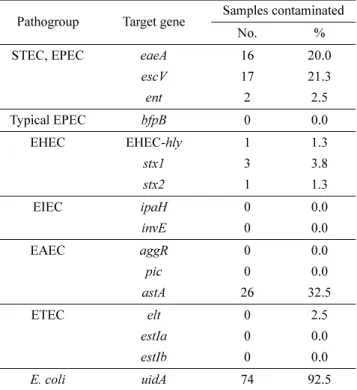
Virulence genes and serotyping of E. coli isolates 시료에서 분리한 대장균 80균주에 대해서 병원성 유전 자를 분석한 결과 astA 유전자가 26균주(32.5%)에서 검출 되었으며, escV 유전자는 17균주(21.3%) eaeA 유전자는 16 균주(20.0%) 검출되었다. 특히 식품에서 문제가 되는 장 출혈성 대장균 유전자 stx1는 3균주(3.8%)와 stx2, EHEC- hly는 각 1균주 (1.3%)로 검출되었다(Table 3).
병원성 유전자를 토대로 STEC, EPEC, EHEC, EIEC or EAEC의 병원성 대장균으로 분류한 결과 대장균 80균주
에서 병원성 대장균45균주 (56.3%)분리되었다(Table 4). 이 중 only EAEC는 20균주(25.0%)로 가장 많이 분리되었으 며, 본 연구에서 식육에서 astA의 유전자가 많이 분리된 시 험 결과는 Choi 등10)의 결과와 유사하였다.
병원성 대장균 STEC, EPEC는 11균주(13.8%)가 검출되 었다. 공존하고 있는 STEC균주는 atypical EPEC에 존재 하는 모든 독성 인자를 보유하기 때문에 STEC와 EPEC 를 구분하는 것은 불가능하다1). 식품에서 위해성이 높은 EHEC는 2균주(2.5%)가 검출되었으며, typical EPEC, EIEC and ETEC의 병원성 대장균은 검출되지 않았다. 6균주 (7.5%)는 두개의 병원성 group (STEC and EAEC) 이 동 시에 검출되었다. Badri 등9)에 의하면 EAEC 식품에서 병 원성 유발에 대한 연구는 미흡하나, EAEC는 저분자량의 특히 heat-stable plasmid encoded enterotoxin (EAST 1)을 유발한다고 알려져 있다10). 본 연구에서도 생닭에서 EAEC 의 검출율이 25.0%로 가장 높다. 따라서 생닭에서의 EAEC 오염원에 대한 추가적인 연구가 필요하여, 닭을 조리 시 에는 대장균이 완전히 사멸 할 수 있도록 하여 안전하게 섭취하여야 한다.
Virulence genes and serotyping of isolated entero- hemorrhagic E. coli (EHEC)
STEC, EHEC로 분리된 병원성 대장균 25균주를 PCR을 이용해서 7종의 혈청형에 대해서 분석한 결과 escV 유전 자를 보유하고 있는 1 균주에서 O26 혈청형이 확인되었 다. PCR을 이용해서 확인되지 않은 병원성 대장균을 antisera 로 분석한 결과 stx1 유전자를 보유한 EHEC에서는 O152, O1 혈청형이 확인되었으며 EHEC-hly 유전자를 보유한 EHEC에서는 O116 혈청형이 확인되었다(Table 5). 그 밖 에 STEC에서는 O26, O25, O119, O153의 혈청형이 각 1 개씩 확인되었으며, O26으로 분리된 시료는 PCR과 동일 한 결과가 나타났다. 그 외 다른 병원성 대장균(O157, O145, O111, O121, O103, O91)은 확인되지 않았다. 분석 한 25 균주 중 7균주만 혈청형을 알 수 있었다. 그 밖의 다른 균주는 O serotyping이 불가능했으며 이는 Kim 등18) Table 3. Prevalence of virulence gene factors among 80 E. coli
isolated from chicken foods
Pathogroup Target gene Samples contaminated
No. %
STEC, EPEC eaeA 16 20.0
escV 17 21.3
ent 2 2.5
Typical EPEC bfpB 0 0.0
EHEC EHEC-hly 1 1.3
stx1 3 3.8
stx2 1 1.3
EIEC ipaH 0 0.0
invE 0 0.0
EAEC aggR 0 0.0
pic 0 0.0
astA 26 32.5
ETEC elt 0 2.5
estIa 0 0.0
estIb 0 0.0
E. coli uidA 74 92.5
Table 4. Prevalence of diarrheagenic E. coli in chicken foods Pathogroup Sample contaminated
No. %
STEC, EPEC 13 16.3
Typical EPEC 0 0.0
EHEC 4 5.0
EIEC 0 0.0
EAEC 20 25.0
ETEC 0 0.0
EHC+EAEC 1 1.3
STEC+EAEC 7 8.8
Total 45 56.3
Table 5. O serotyping of isolated EHEC Sample Pathogroup Virulence
genes
Serotype of PCR
Serotype of O antigen
chicken EHEC stx1 ND* O152
chicken EHEC stx1 ND* O1
chicken EHEC EHEC-hly ND* O166
chicken STEC/EPEC escV O26 O26
chicken STEC/EPEC eaeA ND* O25
chicken STEC/EPEC escV ND* O119
chicken STEC/EAEC eaeA, astA ND* O153 ND*: Not detected
과 유사하게 serotyping이 불가능한 균주들이 분리되었다.
Paton 등19)에 의하면 본 결과와 유사하게 stx 유전자를 가 지고 있어도 사람에게 위해가 되는 O26, O103, O111, O145 and O157 혈청형이 아닐 수도 있으며 stx 유전자를 가지 고 있지 않는 O26, O103, O111, O145 and O157 의 혈청 형도 존재 할 수도 있다. 또한, 위해도가 높은 균주는 stx 유전자를 가지고 있으면서 O26, O103, O111, O145 and O157 혈청형을 가져야 한다고 보고 하고 있다. 따라서 본 시험에서 생닭의 분리한 대장균 중 병원성 대장균 검출률 은 56.3%로 높았으나 그 중 위해성이 높은 균주는 1균주 (0.7%)였다. 조리한 닭의 경우는 대장균의 검출률이 0.4%
로 시중 유통중인 조리된 닭의 경우는 안전하게 조리 가 열되고 있음을 알 수 있었다. 그러나 생닭에 위해성이 높 은 대장균이 존재하므로 생닭은 가공 조리 시 교차오염이 발생하지 않도록 조리 도구, 조리 환경에 대한 철저한 관 리가 필요하다고 생각된다.
Acknowledgement
이 논문은 2016년도 미래창조과학부 재원으로 한국식품 연구원의 지원(E0152202-02)을 받아 수행된 연구성과입니다.
국문요약
병원성 대장균군은 전세계적으로 식중독을 발생하는 중 요한 병원균으로 알려져 있다. 국내 유통중인 생닭과 조 리된 닭가공품 356시료에서 대장균 80균주(22.5%)를 분리 하여 병원성 유전자 multiplex PCR를 이용하여 분석한 결 과 astA 유전자가 26균주(32.5%)에서 검출되었으며, escV 유전자는 17균주(21.3%) eaeA 유전자는 16균주(20.0%) 검 출되었다. 특히 식품에서 문제가 되는 장출혈성 대장균 유 전자 stx 1는 3균주(3.8%)와 stx 2, EHEC-hly는 각 1균주 (1.3%)에서 검출되었다. 병원성 유전자를 토대로 STEC, EPEC, EHEC, EIEC or EAEC의 병원성 대장균으로 분류 한 결과 45균주(56.3%)가 검출되었으며 typical EPEC, EIEC and ETEC의 병원성 대장균은 검출되지 않았다.
STEC 병원성 대장균은 O152, O1, O116, O26, O25, O119, O153 혈청형이 분리되었다. 특히 생닭에서 병원성 대장균 에 대한 검출률이 높으므로 생닭을 가공 조리 시 교차 오 염이 발생하기 않도록 조리 도구, 조리 환경에 대한 철저 한 관리가 필요하다고 생각된다.
References
1. Kagambega, A., Martikainen, O., Lienemann, T., Siitonen, A., Traore, A. S., Barro, N. and Haukka, K.: Diarrheagenic Escherichia coli detected by 16-plex PCR in raw meat and
beef intestines sold at local markets in Ouagadougou, Burkina Faso. Intern. J. Food Microbiol., 153, 154-158 (2012).
2. López-Saucedo, C., Cerna, J. F., Villegas-Sepulveda, N., Thompson, R., Velazquez, F. R., Torres, J. and Tarr, P. I.: Sin- gle Multiplex Polymerase Chain Reaction To Detect Diverse Loci Associated with Diarrheagenic Escherichia coli. Emerg- ing Infectious Diseases, 9, 127-131 (2003).
3. Nataro, J. P. and Kaper, J. B.: Diarrheagenic escherichia coli.
Clinical Microbiology Reviews, 11, 142-201 (1998).
4. Schmidt, H., Beutin, L. and Karch, H.: Molecular analysis of the plasmid-encoded hemolysin of Escherichia coli O157: H7 strain EDL 933. Infection and immunity, 63, 1055-1061 (1995).
5. Food and Drug Statistical Year Book 2016. Ministry of Food and Drug Safety.
6. Barrett, T. J., Kaper, J. B., Jerse, A. E. and Wachsmuth, I. K.:
Virulence Factors in Shiga-like Toxin-Producing Escherichia coliIsolated from Humans and Cattle. J. Infectious Diseases, 165, 979-980 (1992).
7. Kim, S.H., Song, H.J., Chung, J.k., Ha, D.R., Ryu, P.Y. and Lee, J.B.: Genotypic and Phenotypic Characterization of Enteropathogenic Escherichia coli Isolated from Diarrheal Patients in Gwangju. J. Bacteriology and Virology, 36, 167- 174 (2006).
8. Bischoff, C., Lüthy, J., Altwegg, M. and Baggi, F.: Rapid detection of diarrheagenic E. coli by real-time PCR. J.
Microbiol. Methods, 61, 335-341 (2005).
9. Badri, S., Filliol, I., Carle, I., Hassar, M., Fassouane, A. and Cohen, N.: Prevalence of virulence genes in Escherichia coli isolated from food in Casablanca (Morocco). Food Control, 20, 560-564 (2009).
10. Choi, S.K., Lee, M.H., Lee, B.H., Jung, J.Y. and Choi, C.S.:
Virulence factor profiles of Escherichia coli isolated from pork and chicken meats obtained from retail markets. Korean J. Food Sci. Animal Resour., 30, 148-153 (2010).
11. Perelle, S., Dilasser, F., Grout, J. and Fach, P.: Screening food raw materials for the presence of the world’s most fre- quent clinical cases of Shiga toxin-encoding Escherichia coli O26, O103, O111, O145 and O157. Intern. J. Food Micro- biol., 113, 284-288 (2007).
12. Lee, J.K., Park, I.H., Yoon, K., Kim, H. J., Cho, J.I., Lee, S.H. and Hwang, I.G.: An analysis of epidemiological inves- tigation reports regarding to pathogenic E. coli outbreaks in Korea from 2009 to 2010. J. Food Hyg. Saf., 27, 366-374 (2012).
13. Food, U. S. Drug Administration bacteriological analytical manual. AOAC International, Gaithersburg; 1998.
14. Association, K. F. I.: Korean food standards codex. Available from http://fse.foodnara.go.kr/residue/mobile/index.jsp Accessed Jan.13, 2017 (2017).
15. Valadez, A. M., Debroy, C., Dudley, E. and Cutter, C. N.:
Multiplex PCR detection of Shiga toxin-producing Escherichia coli strains belonging to serogroups O157, O103, O91, O113, O145, O111, and O26 experimentally inoculated in beef car- cass swabs, beef trim, and ground beef. J. Food Protection, 74, 228-239 (2011).
16. Paddock, Z., Shi, X., Bai, J. and Nagaraja, T.: Applicability of a multiplex PCR to detect O26, O45, O103, O111, O121, O145, and O157 serogroups of Escherichia coli in cattle feces 1. Veterinary Microbiol., 156, 381-388 (2012).
17. Zhao, C., Ge, B., De Villena, J., Sudler, R., Yeh, E., Zhao, S., White, D. G., Wagner, D. and Meng, J.: Prevalence of Cam- pylobacter spp., Escherichia coli, and Salmonella serovars in retail chicken, turkey, pork, and beef from the Greater Wash- ington, DC, area. Applied Environ. Microbiol., 67, 5431-
5436 (2001).
18. Kim, E.J., Park, Y.C., Cho, J.I., Lee, J.O. and Kim, H.Y.:
Prevalence and characterization of enterohemorrhagic Escheri- chia coli (EHEC) isolated from ground beefs distributed in Gyeong-In region. Korean J. Food Sci. Technol., 38, 773- 778 (2006).
19. Paton, J. C. and Paton, A. W.: Pathogenesis and diagnosis of Shiga toxin-producing Escherichia coli infections. Clinical Microbiol. Reviews, 11, 450-479 (1998).