ISSN 1225-6552, eISSN 2287-7630 https://doi.org/10.7853/kjvs.2017.40.3.193
< Original Article >
Veterinary Service
Available online at http://kjves.org
*Corresponding author: Jae-Keun Cho, Tel. +82-53-760-1300, Fax. +82-53-760-1302, E-mail. [email protected]
대구지역 동물병원에서 입원중인 개와 고양이로부터 분리된 항생제 내성 대장균
조재근 * ㆍ김정미ㆍ김환득ㆍ김경희
대구광역시보건환경연구원
Antimicrobial-resistant Escherichia coli isolated from dogs and cats at animal hospitals in Daegu
Jae-Keun Cho*, Jeong-Mi Kim, Hwan-Deuk Kim, Kyung-Hee Kim
Metropolitan Health & Enviornmental Research Institute, Daegu 42183, Korea
(Received 20 September 2017; revised 22 September 2017; accepted 25 September 2017)
Abstract
This study was carried out to investigate the antimicrobial resistance profiles and resistance genes in 62 Escherichia coli isolated from dogs and cats hospitalized at animal hospitals in Daegu. E. coli iso- lates showed high resistance to nalidixic acid (46.8%) and ampicillin (45.2%). Resistance to the other antimicrobial agents was less than 30%, and no resistant isolates were detected for imipenem and amikacin. Of the 28 ampicillin-resistant isolates, TEM and CTX-M genes were detected in 16 (57.1%) and 11 (39.3%), respectively. The aadA gene was found in 4 (26.7%) of 15 gentamicin-resistant iso- lates, and strA-strB gene was found in 10 (66.7%) isolates. The sul I and sul II genes were detected in 11 (61.1%) and 14 (77.8%) of 18 trimethoprim/sulfamethoxazole-resistant isolates, and tetB gene in 9 (81.8%) of 11 minocycline-resistant isolates, and cmlA gene in 2 (22.2%) of 8 chloramphenicol-re- sistant isolates. The qnrB and qnrS genes were found in 3 (10.3%) and 1 (3.4%) of 28 nalidixic acid-re- sistant isolates, respectively. Whereas, none of the SHV, CMY-2, tetA, dfr Ia and dfr VII, and qnrA genes were found. Our results show a wide variety of resistance genes in E. coli isolates from dogs and cats. This study also represents the first report of qnrB and qnrS gene producing E. coli isolates from dogs in republic of Korea.
Key words : Escherichia coli, Dogs, Cats, Antimicrobial agents, Resistance gene
서 론
여러 가지 항생제에 내성을 나타내는 항생제 내성 균의 출현이 급격히 증가하고 있고, 이들 항생제 내 성균 또는 내성 유전자가 사람에게로 전달될 경우 심 각한 문제가 될 수 있다(Normand 등, 2000).
대장균에서 항생제 내성의 중요한 기전의 하나는
-lactamase의 산생이다. 반려동물에서 penicillin 뿐만 아니라 3, 4세대 cephalosporin계 등의 -lactam 항생제
에 대한 저항을 보이는 extended-spectrum -lactamase (ESBL) 생성 대장균은 세계 도처에서 발견되고 있다 (Carattoli, 2005; O'Keefe 등, 2010; Sallem 등, 2013).
더욱이 ESBL 유전자는 흔히 동일 plasmid 내 다른 내 성 유전자와 공존하며 그 결과 다제 내성을 나타낸 다. 1990년대 이전까지 TEM과 SHV형 ESBL이 유행 하였지만 최근에는 CTX-M형 ESBL이 가장 흔히 발 견되고 있다(Liu 등, 2016). 이들 유전자 외에 CMY-2 같은 plasmid 매개 AmpC -lactamase도 가끔 검출되 고 있다(Tamang 등, 2012a; Liu, 2016).
Quinolone계 항생제는 -lactam 계열의 항생제와 더
불어 가장 많이 사용되고 있는 항생제로 국내에서는 ciprofloxacin과 enrofloxacin이 축산분야에서 사용되고 있고, 사람 및 동물에서 모두 중요한 항생제로 우선 적인 관리가 필요한 항생제로 분류하고 있다(Lim, 2012). Quinolone계 항생제 내성은 이 약제의 표적부 위인 DNA gyrase와 topoisomerase IV 유전자의 일부 인 quinolone 내성 결정 부위(quinolone resistance de- termining region, QRDR)의 변이에 의한 내성이 주요 기전으로 알려져 있다(Jacoby, 2005). 최근에는 plas- mid 상에 존재하는 내성 유전자(plasmid-mediated qui- nolone resistance, PMQR)에 의한 내성기전이 보고되 고 있고, quinolone 내성에 관여하는 유전자로 qnrA,
qnrB, qnrS, aac(6’)-lb-cr 및 qepA 등이 알려져 있다
(Gibson 등, 2010; Rodríguez-Martínez 등, 2011).더욱이 개와 고양이는 오래전부터 인간과 매우 밀 접한 관계에 있어 이들 동물에서 항생제 내성균의 출 현은 동물과 사람 사이 내성균 또는 내성 유전자의 교환과 전파를 가능하게 한다(Guardabassi 등, 2004).
최근까지 전 세계적으로 개와 고양이에서 분리된 대 장균에서 항생제 내성 유전자의 검출에 관한보고는 많지만(Sallem 등, 2012; Costa 등, 2008; Sáenz 등, 2004;
Chang 등, 2015) 국내에서 이에 관한보고는 드물다 (Cho 등, 2013).
이 연구의 목적은 대구지역 동물병원에 입원 중인 개와 고양이로부터 분리된 대장균을 대상으로 항생 제 내성 양상을 조사하고, 또한 한 가지 이상의 약제 에 내성을 보인 균주에 대해서는 여러 가지 항생제에 대한 내성 유전자의 보유현황을 알아보는 것이다.
재료 및 방법
균 분리 동정
2012년 1월부터 2015년 12월까지 대구지역에 있는 동물병원에 입원 중인 개와 고양이에서 총 62주(개, 57주; 고양이, 5주)의 대장균을 분리하여 실험에 공시 하였다. 우선 가검물을 MacConkey agar (Oxoid, UK) 에 도말하여 37°C에서 24시간 배양하였다. 대장균으 로 의심되는 집락은 EMB agar (Oxoid, England)에 도 말한 후 37°C에서 18시간 배양한 후 금속성 광택을 나타낸 집락을 선택하여 순수 분리 후 VITECK 2 compac (BioMerieux, France)를 이용하여 최종 동정하 였다.
항생제 감수성 시험
항생제 감수성 시험은 Bauer 등(1996)의 디스크 확 산법을 이용하여 실시하였다. 사용한 항생제 디스크 (Oxoid, UK)는 ampicillin (AM, 10 g), cefazolin (CZ, 30 g), cefaclor (CEC, 30 g), ceftazidime (CAZ, 30
g), cefotaxime (CTX, 30 g), imipenem (IPM, 10 g), gentamicin (GM, 10 g), amikacin (AK, 30 g), mino- cycline (MC, 30 g), nalidixic acid (NA, 30 g), cipro- floxacin (CIP, 5 g), enrofloxacin (ENR, 5 g), levo- floxacin (LEV, 5 g), moxifloxacin (MXF, 30 g), tri- methoprim/sulfamethoxazole (SXT, 1.25/23.75 g) 및 chloramphenicol (CM, 30 g) 등 16종이었다. 공시균 을 Müeller-hinton broth (Oxoid, UK)에 접종하여 37°C 에서 2∼4시간 배양하여 균 농도를 McFarland No.
0.5로 조정한 후 멸균면봉을 이용하여 Müeller-Hinton agar (Oxoid, UK) 평판배지에 고르게 도포한 다음 항 생제 디스크를 dispenser (Oxoid, UK)로 접종하였다.
35±2°C에서 16∼18시간 배양 후 균 억제대의 크기를 측정하여 Clinical and Laboratory Standards Institute (CLSI, 2012)에 근거하여 내성 여부를 판정하였다. 항 생제 감수성 시험을 위한 표준균주로
E. coli ATCC
25922를 사용하였다.DNA 추출
공시균에 대한 genomic DNA 추출은 boiling법으로 실시하였다. 즉 tryptic soy broth (Oxoid, UK)에 접종 하여 37°C에서 18∼24시간 진탕 배양하여 얻은 균 부 유액 1.0 mL를 13,000 rpm에서 2분간 원심분리한 후 상층 액을 제거한 다음 멸균 증류수 0.5 mL로 재 부 유하였다. 균 부유액은 끓는 물에 10분간 가열한 다 음 13,000 rpm에서 10분간 원심분리한 후 상층액을 취하여 template DNA로 사용하였다.
약제 내성 유전자의 검출
각각의 항생제에 내성을 나타낸 공시균을 대상으 로 TEM, SHV, CTX-M, CMY-2, aadA, strA-strB, clmA,
tetA, tetB, sul I, sul II, DfrIa, Dfr VII, qnrA, qnrB 및
qnrS 같은 내성 유전자의 검출을 실시하였다. 사용된
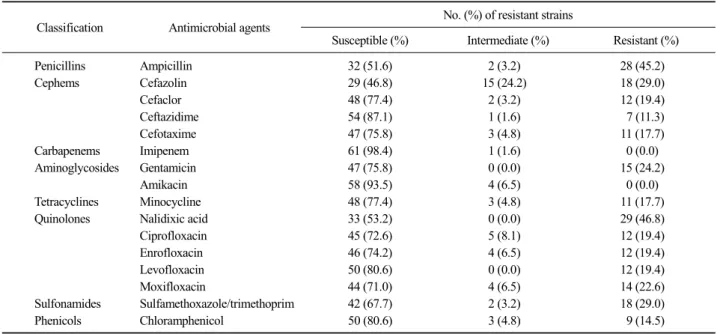
primer와 PCR 반응은 이전 연구자들의 방법(Pagani 등, 2003; Sáenz 등, 2004; Costa 등, 2008; Park 등, 2016)에 준하여 실시하였다. 우선 PCR 반응은 MaximeTable 1. Antimicrobial resistance of 62 E. coli isolates
Classification Antimicrobial agents No. (%) of resistant strains
Susceptible (%) Intermediate (%) Resistant (%)
Penicillins Ampicillin 32 (51.6) 2 (3.2) 28 (45.2)
Cephems Cefazolin 29 (46.8) 15 (24.2) 18 (29.0)
Cefaclor 48 (77.4) 2 (3.2) 12 (19.4)
Ceftazidime 54 (87.1) 1 (1.6) 7 (11.3)
Cefotaxime 47 (75.8) 3 (4.8) 11 (17.7)
Carbapenems Imipenem 61 (98.4) 1 (1.6) 0 (0.0)
Aminoglycosides Gentamicin 47 (75.8) 0 (0.0) 15 (24.2)
Amikacin 58 (93.5) 4 (6.5) 0 (0.0)
Tetracyclines Minocycline 48 (77.4) 3 (4.8) 11 (17.7)
Quinolones Nalidixic acid 33 (53.2) 0 (0.0) 29 (46.8)
Ciprofloxacin 45 (72.6) 5 (8.1) 12 (19.4)
Enrofloxacin 46 (74.2) 4 (6.5) 12 (19.4)
Levofloxacin 50 (80.6) 0 (0.0) 12 (19.4)
Moxifloxacin 44 (71.0) 4 (6.5) 14 (22.6)
Sulfonamides Sulfamethoxazole/trimethoprim 42 (67.7) 2 (3.2) 18 (29.0)
Phenicols Chloramphenicol 50 (80.6) 3 (4.8) 9 (14.5)
PCR PreMix (i-StarTag, Intron, Korea)에 각각의 10 pmol primer 1 L와 template DNA 1 L를 넣은 후, 멸균된 증류수를 첨가하여 최종 반응량이 20 L 되 게 하여 Tprofessional Thermal Cycler (Biometra, Ger- many)를 이용하여 수행하였다. PCR 반응조건은 초기 denaturation 후, denaturation, annealing, extension 과정 을 반복하고 최종 extension을 실시하였다. 증폭된 산 물은 1.2% agarose gel에서 100 V로 30분간 전기영동 을 실시한 후 UV transilluminator (Biometra, Germany) 를 이용하여 확인하였다.
결 과
항균제 감수성
개와 고양이에서 분리된 대장균 62주에 대한 항생 제 감수성 시험 결과는 Table 1과 같다. NA (46.8%) 에 가장 높은 내성을 나타내었고, 다음 AM (45.2%), CZ과 SXT (각각 29.0%), GM (24.2%), MXF (22.6%), CEC, CIP, ENR과 LEV (각각 19.4%), CTX와 MC (각 각 17.7%), CM (14.5%) 및 CAZ (11.3%) 순이었다. 반 면 IPM과 AK에 내성인 균주는 없었다. 공시균 62주 중 39주(62.9%)가 사용된 한 종류 이상의 항생제에 내성을 나타내었고, 이중 24주(38.7%)는 4종류 이상 의 항생제에 내성을 나타내었다. 더욱이 9주(14.5%)
는 10종 이상의 항생제에 내성을 보였다.
약제 내성 관련 유전자
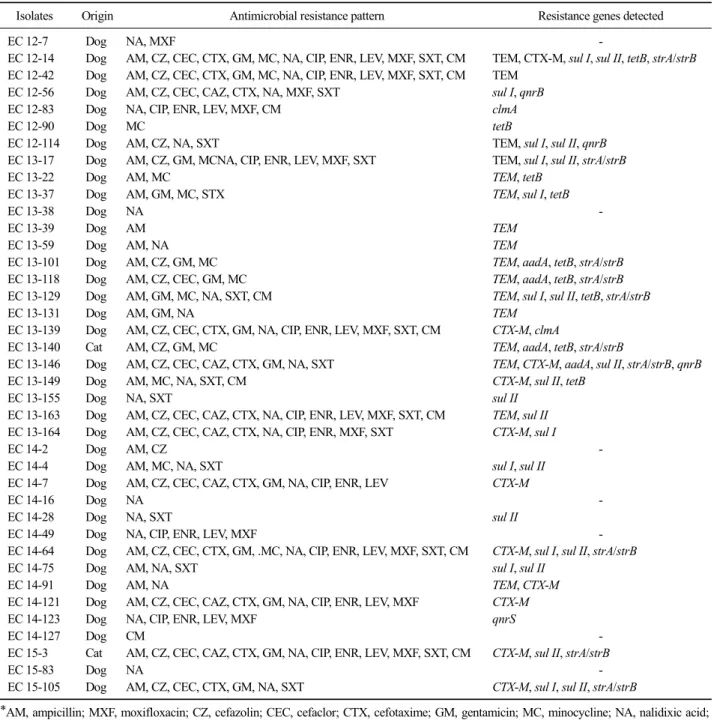
각각의 항생제에 내성을 나타낸 균주를 대상으로 약제 내성 관련 유전자의 검출을 실시한 결과는 Table 2와 같다. AM에 내성을 보인 공시균 28주 중 TEM 유전자는 16주(57.1%)에서, CTX-M 유전자는 11 주(39.3%)에서 발견되었다. 반면 SHV와 CMY-2 유전 자는 검출되지 않았다. GM에 내성을 보인 15주 중
aadA 유전자는 4주(26.7%)에서 strA-strB 유전자는 10
주(66.7%)에서 검출되었다. SXT에 내성을 보인 18주 중 sul I 유전자는 11주(61.1%)에서 sul II 유전자는 14 주(77.8%)에서 검출되었다. 반면 dfr Ia와 dfr VII 유전 자는 한 주도 검출되지 않았다. MC에 내성을 보인 11주 중 tetB 유전자는 9주(81.8%)에서 검출되었지만tetA 유전자는 한 주도 검출되지 않았다. cmlA 유전자
는 CM에 내성인 8주 중 2주(22.2%)에서 검출되었다.한편 NA에 내성을 나타낸 29주를 대상으로 plasmid 에 기인한 quinolone 내성 PMQR 인자인 qnrA, qnrB 및
qnrS 유전자의 검출을 실시한 결과 qnrB와 qnrS
유전자는 각각 3주(10.3%)와 1주(3.4%)가 검출되었지 만qnrA 유전자는 검출되지 않았다.
Table 2. Phenotypes of antimicrobial resistance and resistance genes detected in antimicrobial resistant E. coli isolates
Isolates Origin Antimicrobial resistance pattern Resistance genes detected
EC 12-7 Dog NA, MXF -
EC 12-14 Dog AM, CZ, CEC, CTX, GM, MC, NA, CIP, ENR, LEV, MXF, SXT, CM TEM, CTX-M, sul I, sul II, tetB, strA/strB EC 12-42 Dog AM, CZ, CEC, CTX, GM, MC, NA, CIP, ENR, LEV, MXF, SXT, CM TEM
EC 12-56 Dog AM, CZ, CEC, CAZ, CTX, NA, MXF, SXT sul I, qnrB
EC 12-83 Dog NA, CIP, ENR, LEV, MXF, CM clmA
EC 12-90 Dog MC tetB
EC 12-114 Dog AM, CZ, NA, SXT TEM, sul I, sul II, qnrB
EC 13-17 Dog AM, CZ, GM, MCNA, CIP, ENR, LEV, MXF, SXT TEM, sul I, sul II, strA/strB
EC 13-22 Dog AM, MC TEM, tetB
EC 13-37 Dog AM, GM, MC, STX TEM, sul I, tetB
EC 13-38 Dog NA -
EC 13-39 Dog AM TEM
EC 13-59 Dog AM, NA TEM
EC 13-101 Dog AM, CZ, GM, MC TEM, aadA, tetB, strA/strB
EC 13-118 Dog AM, CZ, CEC, GM, MC TEM, aadA, tetB, strA/strB
EC 13-129 Dog AM, GM, MC, NA, SXT, CM TEM, sul I, sul II, tetB, strA/strB
EC 13-131 Dog AM, GM, NA TEM
EC 13-139 Dog AM, CZ, CEC, CTX, GM, NA, CIP, ENR, LEV, MXF, SXT, CM CTX-M, clmA
EC 13-140 Cat AM, CZ, GM, MC TEM, aadA, tetB, strA/strB
EC 13-146 Dog AM, CZ, CEC, CAZ, CTX, GM, NA, SXT TEM, CTX-M, aadA, sul II, strA/strB, qnrB
EC 13-149 Dog AM, MC, NA, SXT, CM CTX-M, sul II, tetB
EC 13-155 Dog NA, SXT sul II
EC 13-163 Dog AM, CZ, CEC, CAZ, CTX, NA, CIP, ENR, LEV, MXF, SXT, CM TEM, sul II EC 13-164 Dog AM, CZ, CEC, CAZ, CTX, NA, CIP, ENR, MXF, SXT CTX-M, sul I
EC 14-2 Dog AM, CZ -
EC 14-4 Dog AM, MC, NA, SXT sul I, sul II
EC 14-7 Dog AM, CZ, CEC, CAZ, CTX, GM, NA, CIP, ENR, LEV CTX-M
EC 14-16 Dog NA -
EC 14-28 Dog NA, SXT sul II
EC 14-49 Dog NA, CIP, ENR, LEV, MXF -
EC 14-64 Dog AM, CZ, CEC, CTX, GM, .MC, NA, CIP, ENR, LEV, MXF, SXT, CM CTX-M, sul I, sul II, strA/strB
EC 14-75 Dog AM, NA, SXT sul I, sul II
EC 14-91 Dog AM, NA TEM, CTX-M
EC 14-121 Dog AM, CZ, CEC, CAZ, CTX, GM, NA, CIP, ENR, LEV, MXF CTX-M
EC 14-123 Dog NA, CIP, ENR, LEV, MXF qnrS
EC 14-127 Dog CM -
EC 15-3 Cat AM, CZ, CEC, CAZ, CTX, GM, NA, CIP, ENR, LEV, MXF, SXT, CM CTX-M, sul II, strA/strB
EC 15-83 Dog NA -
EC 15-105 Dog AM, CZ, CEC, CTX, GM, NA, SXT CTX-M, sul I, sul II, strA/strB
*AM, ampicillin; MXF, moxifloxacin; CZ, cefazolin; CEC, cefaclor; CTX, cefotaxime; GM, gentamicin; MC, minocycline; NA, nalidixic acid;
CIP, ciprofloxacin; ENR, enrofloxacin; LEV, levofloxacin; SXT, sulfamethoxazole/ trimethoprim; CM, chloramphenicol; CAZ, ceftazidime.
고 찰
항생제 내성균의 출현은 동물의 치료를 어렵게 할 뿐만 아니라 사람에게 전파될 수 있다. 특히 개와 고 양이는 사람과 매우 밀접한 관계를 맺고 있어 이들 동물에서 항생제 내성균의 출현은 공중보건학적으로 중요한 의미를 가진다.
이번 연구에서 개와 고양이 유래 대장균은 NA에 가장 높은 내성률을 보였다. 그러나 국내 개 유래 대
장균에서 NA에 대한 연구 결과는 없다. 따라서 이러 한 결과를 국내 환축 및 소의 분변 유래 대장균에서 내성률인 50%의 성적과 비교해 볼 때 유사한 결과를 얻었다(Tamang 등, 2012b). 반면 이러한 결과는 대만 의 요로감염 증상을 보인 개에서 38.6% (Chang 등, 2015), 포르투갈의 건강한 개와 고양이에서 3.5%
(Costa 등, 2007)의 성적과는 다소 차이가 있었다. 한 편 AM에 대한 높은 내성률은 널리 알려져 있고(Park 등, 2004; Choi 등, 2010; Kim 등, 2011) 이번 연구에
서도 유사한 경향을 나타내었다. 한편 이번 연구의 결과를 우리의 이전 성적(Cho 등, 2013)인 tetracycline (TC)에 53.3%, SXT 43.3%, GM 40%, CIP 33.3%, CTX 30%, AK 26.7%, IPM 20%, CM 16.7% 및 CAZ에 10%
의 성적과 비교해 볼 때 사용된 대부분의 항생제에 대한 내성률은 다소 낮게 나타났다. 특히 이번 연구 에서 IPM과 AK에 내성인 균주는 없었다. 이는 항생 제 사용 감소를 위한 지속적인 홍보와 동물병원에서 항생제 치료 시 원인균 분리와 항생제 감수성 시험을 통한 적정한 치료약제 선택의 결과에 기인된 것으로 생각된다.
한편 Park 등(2004)은 대학 동물병원에 내원한 개 유래 대장균에서 CIP, GM, CM 및 SXT에 76.9%∼
53.8%의 높은 내성률을 보고하였고, Choi 등(2010)은 요로감염증을 가진 개에서 분리한 대장균에서 TC, GM, CM, CIP, ENR 및 CZ에 92.6%∼66.7%의 매우 높은 내성률을 보고하였다. 또한 이번 연구에서 사용 된 약제 외에 lincomycin, erythromycin, spiramycin, ty- losin, penicillin, clindamycin, tiamulin, streptomycin, carbenicillin 및 cloxacillin 등과 같은 항생제에도 매우 높은 내성이 보고(Kim 등, 2004; Choi 등, 2010; Kim 등, 2011)되고 있어, 국내 개와 고양이에서 항생제 내 성 문제는 심각한 수준에 도달하였음을 알 수 있었 다. 더욱이 다른 연구자들이 사용한 항생제의 종류가 이번 연구에 사용한 것과 일치하지 않아 내성 양상에 대해 단순한 비교가 어렵지만 이번 연구에서 높은 내 성을 보인 항생제 또한 다른 연구에서 유사한 경향을 보였다.
이번 연구에서 AM 내성균을 대상으로 TEM, CTX-M, SHV 및 CMY-2형 -lactamase의 검출을 시도 하였다. TEM형 유전자는 AM 내성의 가장 흔한 기전 으로 건강한 동물과 사람에서 분리된 대장균에서 검 출되고 있다(Briñas 등, 2002; Brinas 등, 2005; Carattoli, 2005). 이번 연구에서도 AM에 내성을 보인 대장균에 서 TEM형 유전자가 가장 많이 검출되었다. CTX-M 형 유전자는 새로운 형태의 ESBL로 1986년 일본의 개에서 분리된 대장균에서 최초로 보고된(Matsumoto 등, 1988) 이후 이들 유전자의 출현은 사람과 동물에서 증가하고 있다(O'Keefe 등, 2010). 국내에서도 CTX-M-14 형 유전자는 개 유래 대장균에서 최초로 보고한 이후 지속적으로 확인되고 있다(Lim 등, 2009; So 등, 2012;
Tamang 등, 2012a). 이번 연구에서 CTX-M형 유전자 는 AM 내성균의 39.3%에서 검출되었다. 이는 국내 동물병원 입원 개에서 33.3% (So 등, 2012)와 중국의
반려동물에서 40.4% (Sun 등, 2010)의 성적과 유사하 였다. 반면 우리의 이전 연구(Cho 등, 2013) 및 Tamang 등(2012a)의 1.9%의 성적과는 다소 차이가 있었다.
CTX-M 유전자의 검출율의 차이는 동물병원에서 세 파계의 사용과 관련이 있을 거라고 생각된다. 이번 연구에서 TEM과 CTX-M형 유전자의 세부 cluster는 분석하지 않았으며 이들 유전자의 유행하는 형을 알 기 위해 향후 추가적인 조사가 필요할 것으로 생각된 다. 더욱이 CTX-M 유전자를 갖고 있는 3주는 TEM 형 유전자를 동시에 보유하고 있어 ESBL 유전자는 흔히 동일 plasmid 내 다른 내성 유전자와 공존하는 것으로 생각된다.
한편 외국의 경우 개와 고양이 유래 E. coli에서 SHV형 및 plasmidic class C -lactamase를 암호화하는 CMY-2형 유전자의 검출이 보고가 되고 있고(Carattoli 등, 2005; Sallem 등, 2013; Liu, 2016), 국내 개에서도 CMY-2형 유전자가 보고된 적이 있으나(Tamang 등, 2012a) 이번 연구에서 SHV형 및 CMY-2형 유전자는 검출되지 않았다.
Streptomycin (SM)에 내성을 전달하는 aadA 및
strA-strB 유전자는 가축 유래 대장균에서 흔히 발견
되고 있고 SM 내성에 중요한 역할을 한다(Lanz 등, 2003). 이번 연구에서 SM에 대한 항생제 감수성 시험 을 실시하지 않아 동일 계열의 aminoglycoside계 항생 제인 GM에 내성을 보인 균주를 대상으로 aadA와strA-trB 유전자의 존재를 확인하였다. 한편 가축 유
래 대장균에서 GM 내성은 aac3 (I∼VI) 유전자와 관 련이 있다(Saenz 등, 2004; Costa 등, 2008). 더욱이strA-strB 유전자를 가지는 균주는 aadA 유전자를 가
지는 균주보다 SM에 높은 MIC를 나타나는 것으로 알려져 있다.최근까지 40여종 이상의 TC 내성 유전자가 알려져 있으며, 이번 연구에서 tetA 유전자는 검출되지 않고
tetB 유전자만 검출되었다. 이는 개와 고양이에서 분
리된 E. coli에서 tetB 유전자가 가장 많이 검출되었다 는 Lanz 등(2003)의 결과와는 일치하였다. 반면 Sengeløv 등(2003)은 TC 내성 균주는 tetA 유전자를 가장 많이 보유하고 있다고 하였다. Costa 등(2008)은 TC에 내 성을 나타낸E. coli는 개에서는 tetA, 고양이에서는 tetB 유전자가 많이 검출되었다고 보고하였다. 이번
연구에서는 확인되지 않았지만 TC 내성 균주에서 한 가지 이상의 tet 유전자의 존재는 항생제에 대한 강한 선택압과 관련이 있다(Bryan 등, 2004)CM에 대한 내성은 cmlA과 floR 유전자의 존재와
매우 밀접한 관련이 있다. CM의 efflux pump를 암호 화하는 이들 유전자는 소, 돼지 및 개에서 분리된 대 장균에서 보고가 되고 있다(Sáenz 등, 2004; Chang 등, 2015). 이번 연구에서 cmlA 유전자는 2주에서 검 출되었으며, 이중 한주는 CTX-M 유전자를 동시에 보 유하고 있어 CM 내성 유전자는 다른 유전자와 공존 함을 알 수 있었다(Sáenz 등, 2004).
Sulfonamides에 내성 기전인 sul II와 sul I 유전자는 음성균 사이에서 널리 분포하고 있다. SXT에 내성을 보인 18주 중 sul II 유전자가 sul I 유전자는 보다 많 이 검출되어, 이전 연구자들의 결과와 다소 차이가 있었다(Lanz 등, 2003). 특히 8주는 sul I과 sul II 유전 자를 동시에 보유하고 있었다. 이번 연구에서 dfr Ia와
dfr VII 유전자는 검출되지 않았지만 이전 연구자들에
의해 보고가 되고 있다(Chang 등, 2015; Saenz 등, 2004; Costa 등, 2008).최근 qnrA, qnrB, qnrS 및 aac(6’)-lb-cr 같은 PMQR 유전자는 임상균주뿐 아니라 개와 고양이 유래 대장 균에서 그 존재가 확인되고 있다(Aslantaş, 2007; Gibson 등, 2010; Liu 등, 2012; Liu 등, 2016). 더욱이 이들 PMQR 유전자는 ESBL 또는 AmpC -lactamase와 같 이 동일 plasmid에 위치한다(Yang, 2007). 이번 연구 에서 NA 내성 대장균 29주 중 qnrB 유전자는 3주,
qnrS 유전자는 1주에서 검출되었다. 특히 qnrS 유전
자는 단독으로 나타났지만qnrB 유전자는 TEM과
CTX-M 같은 ESBL 유전자와 조합하여 나타났다. 지 금까지 국내 가축의 분변, 환축 및 시판 식육에서 분 리한 대장균에서 qnrB, qnrS 및 aac(6’)-lb-cr에 관해서 는 보고된 적이 있다(Tamang, 2012b; Park 등, 2016).반면 개와 고양이에서 분리된 대장균에서
qnrB와 qnrS 유전자의 검출에 관한보고는 처음이다. 이번 연
구에서 qnrA 유전자는 확인되지 않았으며 QRDR 같 은 다른 내성기전에 대해서는 조사하지 않았다. 아울 러 이번 연구에서 고양이 유래 항생제 내성균은 2주 뿐이어서 개 유래 내성균과의 비교는 하지 않았다.향후 추가적인 연구가 필요할 것으로 생각된다.
이번 연구의 결과 개와 고양이 유래 대장균에서 다 양한 항생제 내성 유전자의 출현이 확인되었고, 이들 내성 유전자는 단독 또는 다른 유전자와 조합하여 나 타났다. 반려동물에서 사용되는 것과 동일한 항생제 가 사람에게 사용되고 있고 동물유래 항생제 내성균 또는 내성 인자가 사람으로의 전달될 수 있다. 따라 서 동물병원에 입원 치료중인 개와 고양이에서 항생 제의 신중한 사용과 더불어 항생제 내성 관리를 위해
반려동물에 대한 전국적인 항생제 내성 모니터링 조 사가 수행되어져야 할 것으로 생각된다.
결 론
대구지역 동물병원에 입원중인 개와 고양이로부터 분리한 대장균 62주(개 57주, 고양이 5주)에 대한 항 생제 내성 양상 및 내성 유전자의 보유현황을 조사한 결과는 다음과 같았다. 항생제 감수성 시험 결과 NA 와 AM에 각각 46.8%와 45.2%의 높은 내성률을 나타 내었고 나머지 항생제에 대해서는 30%미만의 내성률 을 나타내었다. 반면 IPM과 AK에 내성인 균주는 없 었다. 각각의 항생제에 내성을 나타낸 공시균을 대상 으로 약제 내성 관련 유전자의 검출을 실시한 결과 TEM 유전자는 16주(57.1%), CTX-M 11주(39.3%),
aadA 4주(26.7%), strA-strB 10주(66.7%), sul I 11주
(61.1%), sul II 14주(77.8%), tetB 9주(81.8%), cmlA 2주 (22.2%), qnrB 3주(10.3%) 및 qnrS 유전자는 1주(3.4%) 에서 검출되었다. 이번 조사에서 SHV, CMY-2, tetA,dfr Ia, dfr VII 및 qnrA 유전자는 검출되지 않았다. 공
시균 62주 중 24주(38.7%)가 4 종류 이상의 항생제에 내성을 나타낸 다제 내성균이었고, 9주(14.5%)는 10 종 이상의 항생제에 내성을 나타내었다. 동물병원에 서 항생제의 신중한 사용이 요구된다.REFERENCES
Aslantaş Ö, Yilmaz EŞ. 2017. Prevalence and molecular charac- terization of extended-spectrum -lactamase (ESBL) and plasmidic AmpC -lactamase (pAmpC) producing Escherichia coli in dogs. J Vet Med Sci 79: 1024-1030.
Bauer AW, Kirby WM, Sherris JC, Turck M. 1966. Antibiotic susceptibility testing by a standardized single disk method. Am J Clin Pathol 45: 493-496.
Briñas L, Moreno MA, Teshager T, Sáenz Y, Porrero MC, Domínguez L, Torres C. 2005. Monitoring and charac- terization of extended-spectrum beta-lactamases in Escherichia coli strains from healthy and sick animals in Spain in 2003. Antimicrob Agents Chemother 49:
1262-1264.
Briñas L, Zarazaga M, Sáenz Y, Ruiz-Larrea F, Torres C. 2002.
Beta-lactamases in ampicillin- resistant Escherichia coli isolates from foods, humans, and healthy animals.
Antimicrob Agents Chemother 46: 3156-3163.
Bryan LE. 1984. Aminoglycoside resistance. pp. 241-277. In:
Bryan LE, ed. Antimicrobial Drug Resistance. Orlando:
Academic Press.
Carattoli A, Lovari S, Franco A, Cordaro G, Di Matteo P, Battisti A. 2005. Extended-spectrum beta-lactamases in Escherichia coli isolated from dogs and cats in Rome, Italy, from 2001 to 2003. Antimicrob Agents Chemother 49: 833-835.
Chang SK, Lo DY, Wei HW, Kuo HC. 2015. Antimicrobial re- sistance of Escherichia coli isolates from canine urinary tract infections. J Vet Med Sci 77: 59-65.
Cho JK, Kim JH, Kim JM, Park, KIM KS. 2013. Antimicrobial reisstance and distribution of resistance gene in Enterobacteriaceae and Pseudomonas aeruginosa iso- lated from dogs and cats. Korean J Vet Res 36: 171-180.
Choi DY, Choi DS, Jang HK, Song HJ, Cho JG. 2010.
Antimicrobial susceptibility of bacterial isolates from do- mestic dogs with urinary tract infection. J Vet Clin 27:
6-10.
CLSI. Clinical and Laboratory Standards Institute. 2012.
Performance standards for antimicrobial susceptibility testing; Twenty-second informational supplement. M100- S22. Wayne, Pa, USA.
Costa D, Poeta P, Sáenz Y, Coelho AC, Matos M, Vinué L, Rodrigues J, Torres C. 2008. Prevalence of antimicrobial resistance and resistance genes in faecal Escherichia coli isolates recovered from healthy pets. Vet Microbiol 127:
97-105.
Gibson JS1, Cobbold RN, Heisig P, Sidjabat HE, Kyaw-Tanner MT, Trott DJ. 2010. Identification of qnr and aac(6')- 1b-cr plasmid-mediated fluoroquinolone resistance deter- minants in multidrug-resistant Enterobacter spp. isolated from extraintestinal infections in companion animals.
Vet Microbiol 143: 329-336.
Guardabassi L, Schwarz S, Lloyd DH. 2004. Pet animals as reser- voirs of antimicrobial-resistant bacteria. J Antimicrob Chemother 54: 321-332.
Jacoby GA. 2005. Mechanisms of resistance to quinolones. Clin Infect Dis 41: S120-126.
Kim DK, Shin DH, Kim HY, Byun JW, Lee KH, Lee OS and Jung BY. 2011. Antimicrobial susce-ptibility of gram-negative bacteria from dogs and cats. J Vet Clin 28: 348-351.
Kim MS, Jeong JT, Kang SY, Yun YM, Lee JM, Lee DS, Son WG. 2004. Antibiotic resistance of bacterial isolates from nasal discharges of dogs with respiratory diseases.
J Vet Clin 21: 133-139.
Lanz R, Kuhnert P, Boerlin P. 2003. Antimicrobial resistance and resistance gene determinants in clinical Escherichia coli from different animal species in Switzerland. Vet Microbiol 91: 73-84.
Lim SK. 2012. Veterinary clinically important antimicrobials. J Kor Vet Med Assoc 48: 662-666.
Lim SK, Lee HS, Nam HM, Jung SC, Bae YC. 2009.
CTX-M-type beta-lactamase in Escherichia coli isolated from sick animals in Korea. Microb Drug Resist 15:
139-142.
Liu X, Boothe DM, Thungrat K, Aly S. 2012. Mechanisms ac- counting for fluoroquinolone multidrug resistance Escherichia coli isolated from companion animals. Vet Microbiol 161: 159-168.
Liu X, Liu H, Li Y, Hao C. 2016. High Prevalence of -lacta- mase and Plasmid-Mediated Quinolone Resistance Genes in Extended-Spectrum Cephalosporin-Resistant Escherichia coli from Dogs in Shaanxi, China. Front Microbiol 16:
1843.
Liu X, Thungrat K, Boothe DM. 2016. Occurrence of OXA-48 Carbapenemase and Other -Lactamase Genes in ESBL-Producing Multidrug Resistant Escherichia coli from Dogs and Cats in the United States, 2009-2013.
Front Microbiol 7: 1057.
Matsumoto Y, Ikeda F, Kamimura T, Yokota Y, Mine Y. 1988.
Novel plasmid-mediated beta- lactamase from Escherichia coli that inactivates oxyimino-cephalosporins. Antimicrob Agents Chemother 32: 1243-1246.
Normand EH, Gibson NR, Taylor DJ, Carmichael S. Reid SW 2000. Trends of antimicrobial resistance in bacterial iso- lates from a small animal referral hospital. Vet Rec 146:
151-155.
O'Keefe A, Hutton TA, Schifferli DM, Rankin SC. 2010. First detection of CTX-M and SHV extended-spectrum be- ta-lactamases in Escherichia coli urinary tract isolates from dogs and cats in the United States. Antimicrob Agents Chemother 54: 3489-3492.
Pagani L, Dell'Amico E, Migliavacca R, D'Andrea MM, Giacobone E, Amicosante G, Romero E, Rossolini GM.
2003. Multiple CTX-M-type extended-spectrum beta-lac- tamases in nosocomial isolates of Enterobacteriaceae from a hospital in northern Italy. J Clin Microbiol 41:
4264-4269.
Park JM, Choi SS. 2016. Molecular Characterization of Quinolone Antibiotic Resistance in Escherichia coli Isolated from Retail Meat in Seoul. J Pharm Soc Korea 60: 1-7.
Park SW, Seo KW, Hwang CY, Youn HW, Han HY. 2004.
Isolation of bacteria from clinial specimens in veterinary medical teaching hospital and trend of antimicrobial susceptibility. J Vet Clin 21: 7-14.
Rodríguez-Martínez JM, Cano ME, Velasco C, Martínez-Martínez L, Pascual A. 2011. Plasmid-mediated quinolone resist- ance: an update. J Infect Chemother 17: 149-182.
Sáenz Y, Briñas L, Domínguez E, Ruiz J, Zarazaga M, Vila J, Torres C. 2004. Mechanisms of resistance in multi- ple-antibiotic-resistant Escherichia coli strains of human, animal, and food origins. Antimicrob Agents Chemothe 48: 3996-4001.
Sallem RB, Gharsa H, Slama KB, Rojo-Bezares B, Estepa V, Porres-Osante N, Jouini A, Klibi N, Sáenz Y, Boudabous A, Torres C. 2012. First detection of CTX-M-1, CMY-2, and QnrB19 resistance mechanisms in fecal Escherichia coli isolates from healthy pets in Tunisia. Vector Borne Zoonotic Dis 13: 98-102.
Sengeløv G, Halling-Sørensen B, Aarestrup FM. 2003. Susceptibility of Escherichia coli and Enterococcus faecium isolated from pigs and broiler chickens to tetracycline degrada- tion products and distribution of tetracycline resistance determinants in E. coli from food animals. Vet Microbiol 95: 91-101.
So JH, Kim J, Bae IK, Jeong SH, Kim SH, Lim SK, Park YH, Lee K. 2012. Dissemination of multidrug-resistant Escherichia coli in Korean veterinary hospitals. Diagn Microbiol Infect Dis. 73: 195-199.
Sun Y, Zeng Z, Chen S, Ma J, He L, Liu Y, Deng Y, Lei T, Zhao J, Liu JH. 2010. High prevalence of bla(CTX-M) extended-spectrum -lactamase genes in Escherichia coli isolates from pets and emergence of CTX-M-64 in China. Clin Microbiol Infect 16: 1475-1481.
Tamang MD, Nam HM, Chae MH, Kim SR, Gurung M, Jang GC, Jung SC, Lim SK. 2012b. Prevalence of plas- mid-mediated quinolone resistance determinants among Escherichia coli isolated from food animals in Korea.
Foodborne Pathog Dis. 9: 1057-1063.
Tamang MD, Nam HM, Jang GC, Kim SR, Chae MH, Jung SC, Byun JW, Park YH, Lim SK. 2012a. Molecular charac- terization of extended-spectrum--lactamase-producing and plasmid-mediated AmpC -lactamase-producing Escherichia coli isolated from stray dogs in South Korea. Antimicrob Agents Chemother 56: 2705-2712.
Yang BS. 2007. Multiplex PCR for detection of quinolone resist- ance qnr genes in extended-spectrum -lactamase pro- ducing Escherichia coli and Klebsiella pneumoniae.
Korean J clin Lab Sci 39: 161-166.