Copyright ⓒ 2012, The Microbiological Society of Korea
남조세균 흔들말목(Cyanobacteria, Oscillatoriales) 해양 균주의 16S rRNA와 rpoB 유전자 변이
천주용․이민아․기장서*
상명대학교 그린생명과학과
Molecular Divergences of 16S rRNA and rpoB Gene in Marine Isolates of the Order Oscillatoriales (Cyanobacteria)
Ju-Yong Cheon, Min-Ah Lee, and Jang-Seu Ki*
Department of Green Life Science, Sangmyung University, Seoul 110-743, Republic of Korea (Received November 28, 2012 / Accepted December 14, 2012)
In this study, we investigated molecular divergences and phylogenetic characteristics of the 16S ribosomal RNA (rRNA) and RNA polymerase beta subunit (rpoB) gene sequences from the order Oscillatoriales (Cyanobacteria).
The rpoB of Oscillatoriales showed higher genetic divergence when compared with those of 16S rRNA (p-distance:
rpoB=0.270, 16S=0.109), and these differences were statistically significant (Student t-test, p<0.001). Phylogenetic trees of 16S rRNA and rpoB were generally compatible; however, rpoB tree clearly separated the compared Oscillatoriales taxa, with higher phylogenetic resolution. In addition, parsimony analyses showed that rpoB gene evolved 2.40-fold faster than 16S rRNA. These results suggest that the rpoB is a useful gene for the molecular phylogenetics and species discrimination in the order Oscillatoriales.
Keywords: Oscillatoriales, rpoB gene, Cyanobacteria, DNA similarity, genetic distance
*For correspondence. E-mail: [email protected]; Tel.: +82-2-2287-5449;
Fax: +82-2-2287-0070
남조세균 흔들말목(Cyanobacteria, Oscillatoriales)은 원반상 의 영양 세포들이 하나로 길게 늘어선 분지하지 않는 사상체 (trichome)를 형성하며, 이형세포(heterocyst)가 없다(Broady and Kibblewhite, 1991). 각각의 사상체들은 활주운동(gliding movement)을 통해 이동을 하고 이 운동에 의해 환경 조건에 따라 사상체의 밀도가 조절된다(Jensen, 1985; Stanier, 1988). 또한 사상체 세포를 늘려나가는 세포분열 방식으로 생장을 하고, 사 상체의 일부가 떨어져 나가면서 증식이 이루어진다. 이들 흔들 말목 남조세균은 열대와 아열대 해양 및 담수에 널리 분포하며 이형세포 및 영양세포에서 질소고정을 하여 생태계 질소공급에 크게 기여한다. 흔들말목에 속하는 일부 종은 주로 봄과 가을에 대량 발생 하여 녹조 현상을 유발 하기도 하며, 이로 인한 어류와 갑각류의 피해가 보고되었다(Smith, 1996). 또한 이들이 생성하 는 독소에 의해 많은 피해가 야기되고 있는데, 특히 흔들말목에 속하는 Lyngbya, Oscillatoria, Phormidium, Trichodesmium 등 은 간독소(hepatotoxin)인 microcystin, cylidrospermopsins, 피 부 질환을 일으키는 aplysiatoxin, lyngbyatoxin 등을 생성한다
(Kaebernick and Neilan, 2001).
이형세포가 없는 남조세균 흔들말목은 사상체의 두께, 사상 체의 형태(나선형 또는 직선형), 점질초의 형태에 의해 분류된다 (Broady and Kibblewhite, 1991). 그러나 배양 조건과 환경의 변 화에 따른 세포 형태의 변이로 인해 형태적 분류에 많은 어려움 이 있다(Casamatta et al., 2005). 따라서 형태학적 특성으로 분 류된 이전의 연구 결과는 남조세균의 계통 체계를 명료하게 설 명하기에 충분하지 않았다(Honda et al., 1999; Ishida et al., 2001; Wilmotte and Herdman, 2001). 이에 대한 해결 방법으로 형태적 차이에 의한 분류와 분자 생물학적 분석을 병행하여 남 조세균의 계통 분류학적 연구가 진행되어 왔다(Broady and Kibblewhite, 1991; Ishida et al., 2001; Casamatta et al., 2005).
특히 16S rRNA는 남조세균의 분자계통관계를 구축하는데 널리 사용되어 왔다(Giovannoni et al., 1988; Turner et al., 1999;
Wilmotte and Herdman, 2001). 그러나 남조세균을 포함한 세균 은 일반적으로 유전체 내에 여러 16S rRNA 복사본을 가지고 있 으며, 이것들은 서로 유전자 서열이 달라 분자계통분석에서 혼 란을 야기시킬 수 있다(Case et al., 2007). 또한 16S rRNA 유전 자는 유사한 분류군 내에서 매우 보존되어 분자계통학적 분해능 력이 낮으며, 이것으로 인해 낮은 분류군의 계통관계를 명확하
Species Strain Isolation locality GenBank accession nos.
16S rpoB
Arthrospira maxima CY-023 - KC217543a KC217551a
Arthrospira platensis CY-007 USA: Hawaii Oceanic Institute KC217542 a KC217550a
Arthrospira platensis Paraca - NZ_ACSK02000677 NZ_ACSK01000141
Arthrospira platensis NIES-39 Africa: Lake Chad AP011615 AP011615
Arthrospira sp. PCC 8005 - X70769 CAFN01000676
Leptolyngbya sp. CY-011 Korea: Deukryang bay KC217544a KC217552a
Leptolyngbya sp. CY-013 Cyprus: ? KC217545a KC217553a
Leptolyngbya sp. CY-021 Korea: Busan KC217546a KC217554a
Lyngbya aestuarii CY-025 USA: ? KC217547a KC217555a
Oscillatoria sp. PCC 6506 - NZ_CACA01000066 CACA01000275
Phormidium lucidum CY-001 Korea: Nakdong river KC217549a KC217557a
Phormidium lucidum CY-012 Korea: Younggeun KC217548a KC217556a
Trichodesmium erythraeum IMS101 USA: North Carolina NC_008312 NC_008312
Anabaena variabilis ATCC 29413 - NC_007413 NC_007413
Nostoc sp. PCC 7120 India: ? NC_003272 NC_003272
a Determined in this study
Table 1. Origins of Oscillatoriales strains, including outgroup Anabaena variabilis and Nostoc sp., and DNA sequences from GenBank
게 규명할 수 없다.
RNA polymerase beta subunit (rpoB) 유전자는 이미 여러 종 류의 세균의 계통관계 분석을 위해 신뢰할 수 있는 유전자 마커 로 제안되어 왔다(Hong et al., 2004; Case et al., 2007; Salerno et al., 2007; Volokhov et al., 2007; Ki, 2010; Cheon et al., 2011). rpoB 유전자는 분류군 사이에서 유전자 서열의 삽입/삭 제가 발견됐고, 그 이후로 남조세균과 고세균 간의 진화 관계를 밝혀내기 위해 계통분석학적 마커로 사용되었다(Gupta, 1997, 1998). 또한 16S rRNA와는 달리 염기서열의 길이가 길고, 변이 가 크고, 세포 내에 한 개의 복사본으로 존재하여(Ki, 2010;
Cheon et al., 2011), 남조세균의 식별과 분류뿐만 아니라 자연 환경 내에서의 생물 다양성과 계절에 따른 개체수 평가에 유용 하게 활용 될 수 있다(Gaget et al., 2011).
본 연구에서는 남조세균 흔들말목의 rpoB 유전자 염기서열을 해양에서 분리한 Arthrospira maxima, A. platensis, Leptolyngbya sp., Lyngbya aestuarii와 Phormidium lucidum 균주를 대상으로 규명하여 유전자 변이 특성을 조사하였다. 또한, 16S rRNA 염 기서열과 비교하여 rpoB 유전자의 분자계통분류 및 분자검출용 마커의 유용성을 평가하였다.
재료 및 방법
흔들말목 균주 및 세포 배양
해양 남조세균 유전자 분석을 위하여, 한국해양미세조류은행 (KMMCC)으로부터 흔들말목에 속하는 8개의 해양 균주(CY-001, CY-007, CY-011, CY-012, CY-013, CY-021, CY-023, CY-025) 를 분양 받았다(Table 1). 이들 균주를 f/2 배지에 접종한 후, 25℃, 혼합주기 120 rpm, 12:12시간 명:암 주기, <65 μE/m2/s1의 빛 조 건에서 배양하여 실험에 사용하였다.
흔들말목 16S rRNA 및 rpoB 유전자 염기서열 결정
흔들말목 genomic DNA 추출을 위해 배양중인 세포(50 ml) 를 3,000 rpm에서 10분 동안 원심 분리하여 농축하였다. 농축된 세포는 200 µl 1× TE buffer (10 mM Tris-HCl; pH 8.0, 1 mM EDTA)에 희석하여 -20℃에서 DNA를 추출하기 전까지 보관하 였다. Genomic DNA는 DNeasy Plant mini kit (Qiagen, USA) 를 이용하여 추출하였다.
흔들말목 16S rRNA와 rpoB 유전자 PCR 증폭은 기존에 보 고된 남조세균 특이적인 PCR 프라이머를 이용하였다. 16S rRNA 대상 프라이머는 CYA106F (5′-CGG ACG GGT GAG TAA CGC GTG A-3′)와 CYA784R (5′-GAC TAC AGG GGT ATC TAA TCC C-3′)를 사용하였으며(Nubel et al., 1997), 남 조세균 rpoB PCR 프라이머는 Ma-rpoBF1026 (5′-CAT TCG GGA ACG GAT GAC C-3′), Ma-rpoBR2013 (5′-CTT CGT AGT TAT AGC CTT CC-3′)을 이용하였다(Ki, 2010). PCR은 추출한 genomic DNA 2 µl, 16S rRNA와 rpoB 프라이머를 각각 넣은 PCR 반응액(23 µl)을 혼합하여 실시하였다. PCR 반응액 은 1× PCR buffer, 0.2 mM dNTPs, 0.5 mM forward-reverse 프 라이머, 1 unit Ex Taq polymerase (TaKaRa Bio, Japan)를 사용 하였다. PCR 반응은 MyCycler™ (Bio-Rad, USA)를 이용하여 초기 94℃ 3분간 DNA를 변성시키고, 이후 94℃ 20초, 50℃ 30 초, 72℃ 60초를 35회 반복하여 대상 유전자 영역을 증폭하였 다. PCR 증폭 반응이 종료되면 추가로 72℃ 5분간 유지하여 반 응을 종결하였다. 증폭된 PCR 산물은 1% 아가로스 겔에서 전기 영동 하여 관찰하였다.
DNA sequencing은 PCR 산물을 PCR purification kit (Bionics Co., Korea)로 정제하여, PCR 프라이머(CYA106F, CYA784R, Ma-rpoBF1026, Ma-rpoBR2013)와 ABI PRISM® BigDye™ Terminator Cycle Sequencing Ready Reaction kit
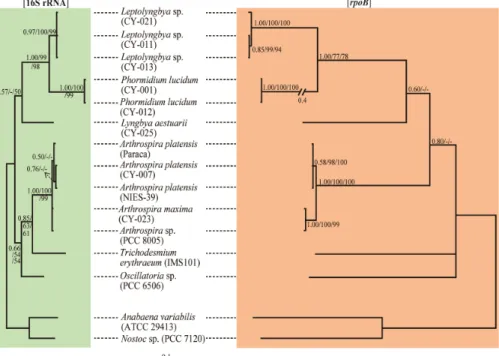
Fig. 1. Bayesian trees inferred from 16S rRNA (left) and rpoB (right) sequences for members of the order Oscillatoriales. In these analyses, nucleotide substitution models were selected as GTR+G in 16S rRNA and SYM+I+G in rpoB gene, respectively. Bayesian likelihood scores of each tree was calculated at –lnL= 2195.7 and –lnL= 5685.3 in 16S rRNA and rpoB gene, respectively. Additional MP and NJ analyses generated similar topologies of the tree compared with the Bayesian tree. Bootstrap proportions (BP) from both analyses were incorporated into the Bayesian tree. The first, second, and third numbers at the nodes display PP (>0.50) in Bayesian, BP (>50%) in NJ, and BP (>50%) in MP, respectively. Anabaena variabilis #ATTCC 29413 and Nostoc sp. #PCC 7120 (Cyanobacteria, Nostocales) were used as outgroup.
(PE Biosystems, USA)를 이용하여 실시하였다. DNA sequencing 단편은 자동 DNA 분석기(Model 3700, Applied Biosystems, USA)로 분석하였다. 각각의 균주로부터 얻은 염기서열 단편을 Sequencher 4.1.4 (Gene Codes, USA)을 이용하여 조합된 단일 염기서열로 만들고, 염기서열을 GenBank에 등록하였다(Table 1).
16S rRNA, rpoB 유전자 염기특성 분석
흔들말목의 16S rRNA 및 rpoB 유전자 특성은 염기 유사도 (DNA similarity)와 유전거리(genetic distance)로 분석하였다.
분석은 새롭게 규명한 염기서열과 GenBank로부터 얻은 염기서 열을 이용하였으며, 유전거리 분석은 alignment된 염기서열의 양 끝을 같은 영역으로 자른 후, MEGA 4.0 (Tamura et al., 2007)에서 Kimura 2-parameter 모델을 이용하여 계산하였다.
또한 MEGA 4.0을 이용하여 parsimony 분석(예, conserved site, variable site, parsimony-informative site)을 실시하였다. 통계분 석은 SPSS 10.0.7 (SPSS, USA)을 이용하였다.
흔들말목 분자계통분석
흔들말목 해양 균주의 16S rRNA와 rpoB 유전자 염기서열을 이용하여 Bayesian tree 분석을 실시하였다. 분석은 16S rRNA 와 rpoB 유전자 염기서열을 ClustalW 1.8 (Thompson et al., 1994)로 재배열하고 이 후 양 끝을 동일한 크기로 자르고 불확실 하게 alignment된 염기서열을 제거하여 dataset을 준비하였다 (16S rRNA, 1,495 sites에서 662 sites 선택; rpoB, 3,474 sites에
서 947 sites 선택). MrBayes 3.1.2 (Huelsenbeck and Ronquist, 2001)을 이용하여 Markov chain Monte Carlo (MCMC) 과정을 100만 번 실시하여 Bayesian tree를 만들고, 각각의 clade에 대한 posterior probability (PP) 신뢰도 값을 구하였다. 또한 MEGA 4.0을 이용하여 동일한 dataset으로부터 neighbor-joining (NJ), maximum parsimony (MP)의 bootstrap proportions (BP)을 계 산하였다.
결과 및 고찰
본 연구에서 남조세균 흔들말목 8개 해양 균주(CY-001, CY-007, CY-011, CY-012, CY-013, CY-021, CY-023, CY-025)의 16S rRNA와 rpoB 유전자 염기서열을 규명하였다(Table 1). 16S rRNA 염기서열을 이용하여 BLAST-N 검색을 실시하여, 본 연 구에서 사용한 모든 균주가 기존에 NCBI (National Center for Biotechnology Information) database에 등록된 흔들말목과 일 치되는 것을 확인하였다. 특히, CY-007, CY-011, CY-021은 각각 Arthrospira platensis (GenBank No. JN831263), Leptolyngbya sp. (HM217074), Leptolyngbya sp. (HM217074)와 100% 유사 도를 보였다. 또한 Leptolyngbya sp. CY-021은 CY-011와 CY-013과 매우 높은 유사도(>99.8%)로 조사되었다. Phormidium lucidum 균주 CY-001과 CY-012는 동일한 16S rRNA 유전형 (100% similarity)을 갖고 있었으며, BLAST-N에서 Phormidium sp. (JQ927355)와 99% 유사도로 가장 일치하였다.
No. Species Strain [1] [2] [3] [4] [5] [6] [7]
16S-662 compared sites
[1] Arthrospira maxima CY-023 99.5 88.8 89.5 90.5 86.7 90.4
[2] Arthrospira platensis CY-007 96.9 88.8 89.0 90.4 86.5 90.4
[3] Leptolyngbya sp. CY-011 72.4 72.5 89.0 90.7 91.8 87.0
[4] Lyngbya aestuarii CY-025 73.9 74.2 72.6 89.5 86.5 86.9
[5] Oscillatoria sp. PCC 6506 72.2 72.8 72.6 72.5 85.8 89.8
[6] Phormidium lucidum CY-001 69.8 69.7 71.9 69.5 68.5 83.7
[7] Trichodesmium erythraeum IMS101 73.1 72.6 69.7 73.0 72.8 70.4
rpoB-947 compared sites
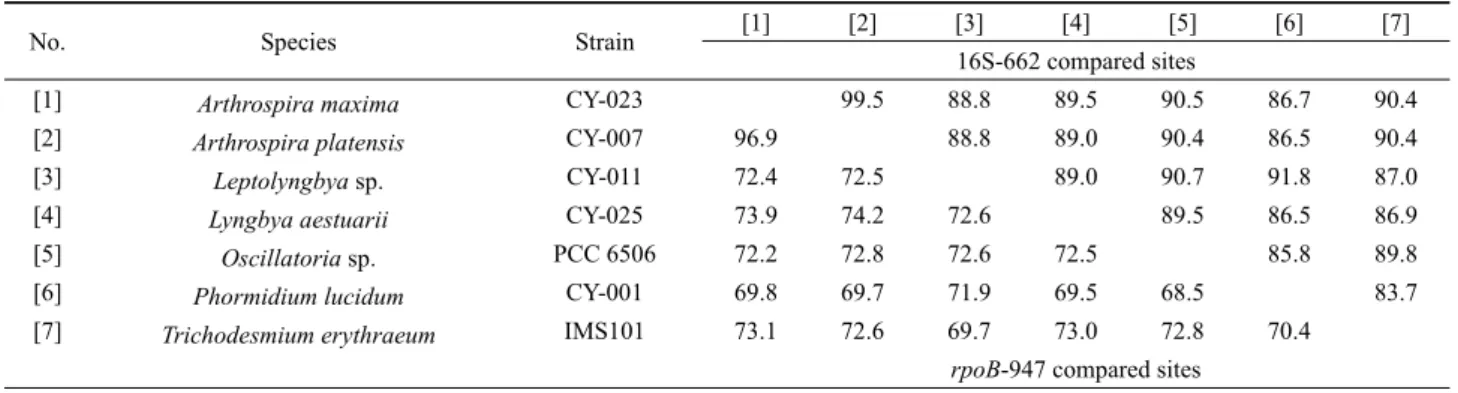
Table 2. Similarity scores of 16S rRNA (above diagonal) and rpoB gene (below diagonal) sequences between each pair of seven Oscillatoriales species
Fig. 2. Inter-generic nucleotide divergences of 16S rRNA and rpoB gene based on corrected p-distances. Genetic distances of each paired sequence between Oscillatoriales species (see Table 1) were calculated by Kimura 2-parameter model. Statistical analysis showed that the divergences of the rpoB gene sequences were significantly different compared from those of the 16S rRNA (Student t-test, p<0.001, N=45).
추가로, 해양 남조세균의 rpoB 유전자 염기서열을 NCBI에서 BLAST-X 검색을 실시하였는데, CY-007과 CY-023을 제외한 나머지 6균주는 16S rRNA의 BLAST-N 검색 결과와 다르게 조 사되었다. 실제로, CY-007는 Arthrospira platensis (GenBank No. ZP_06380841)와 99.9% 유사도와 CY-023는 Arthrospira maxima (ZP_03276107)와 99.4%의 높은 유사도로 조사되었다.
하지만, CY-011는 Acaryochloris sp. (ZP_09248459)와 87%, CY-013는 흔들말목 남조세균(EKQ67445)과 89%, CY-021은 Acaryochloris sp. (ZP_09248459)와 88%, CY-025는 Arthrospira maxima (ZP_03271318)와 88%, CY-012는 흔들말목 남조세균 (EKQ67445)과 85%, CY-001는 흔들말목 남조세균 (EKQ67445) 과 85%로 대체로 낮은 유사도를 보였다. 이것은 NCBI에 등록된 흔들말목의 염기서열이 매우 적고, 본 연구에서 분석한 영역이 기존에 보고된 rpoB 유전자 영역과 다르기 때문에, 흔들말목 분 류군의 다른 종으로 rpoB 유전자와 BLAST-X에서 가장 높은 값 으로 일치된 것으로 파악되었다.
흔들말목 16S rRNA와 rpoB 유전자 사이의 변이를 동일한 균 주로부터 규명된 염기서열을 이용하여 분석하였다. 본 연구에서 사용한 8개 균주와 GenBank로부터 확보한 5개 균주의 염기서 열 정보를 추가로 확보하였다. 본 연구에서 흔들말목 13개 균주 (Table 1)의 16S rRNA와 rpoB 유전자 염기서열 특성을 비교하 였다. 분자계통분석에서 16S와 rpoB 유전자 Bayesian trees의 branch 형태는 매우 유사한 양상을 보였다(Fig. 1). 하지만, 분자 계통학적 해상도(phylogenetic resolution)는 rpoB tree가 16S rRNA Bayesian tree보다 매우 큰 것으로 조사되었다. 또한 16S tree는 크게 두 개의 clade로 구분하였으나, rpoB tree에서는 Trichodesmium erythraeum와 Oscillatoria sp.가 가장 먼저 분 지되어 나오는 것으로 파악되었다. 대체적으로 흔들말목 분자계 통분석에서 세 개의 Leptolyngbya sp. 균주(CY-011, CY-013, CY-021)는 하나의 clade를 형성 하였다(16S tree에서 0.91 PP, rpoB tree에서 1.00 PP). Leptolyngbya는 Phomidinium과 자매 관계(sister relationship)를 성형하였다. 특히 P. lucidum 2개 균 주(CY-001, CY-012)는 하나의 clade를 형성하였고, rpoB tree 에서 가장 긴 branch를 형성하였다. Leptolyngbya는 Lyngbya, Phormidium, Plectonema (LPP-group)에서 Anagnostidis와 Komarek (1988)에 의해 분리되어 새로 만들어진 속으로 아직도 많은 Leptolyngbya는 분류체계가 명확히 확립되지 않아 LPP-group
에 속해 있다(Marquardt and Palinska, 2007). Lyngbya aestuarii 균주(CY-025)는 다른 종과 뚜렷하게 분리하여 독립된 분지형태 를 갖는 것으로 조사되었다(16S tree에서 0.57 PP, rpoB tree에 서 0.60 PP). Arthrospira에 속하는 종은 하나의 clade를 형성하 였으며, 각각의 종(Arthrospira sp. #PCC 8005, A. maxima
#CY-023, A. platensis #CY-007와 A. platensis #NIES-39)에 따 라 뚜렷한 branch 형태를 갖는 것으로 파악되었다.
본 연구를 분석한 자료를 기반으로, 다른 종과 뚜렷이 구분되 는 분지형태를 보이는 7개 균주(CY-001, CY-007, CY-011, CY-023, CY-025, PCC 6506, IMS101)를 대상으로 16S rRNA 와 rpoB 유전자 염기서열 유사도를 비교 하였다(Table 2). 이들 균주의 16S rRNA간에 높은 염기 유사도를 보였으며[평균 89.1% 유사도, Standard deviation (SD)=3.12, N=21], 가장 높 은 값은 A. maxima #CY-023과 A. platensis #CY-007 사이에 99.5%이고 가장 낮은 값은 P. lucidum #CY-001과 T. erythraeum
Gene Characteristics
Nn Nc (%Nc) PI (%PI)
16S rRNA 662 519 (78.4) 87 (13.1)
rpoB 947 501 (52.9) 323 (34.1)
Nn, total number of sites compared; Nc, total number of conserved sites; PI, parsimony informative site
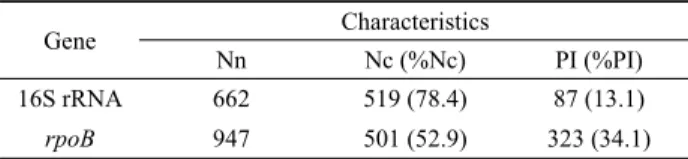
Table 3. Independent parsimony analyses of partial 16S rRNA and rpoB genes. These were calculated from DNA sequences of seven species.
#IMS101사이에 83.7%로 조사되었다. 반면, rpoB 유전자 비교 에서 가장 높은 값은 A. maxima #CY-023과 A. platensis #CY-007 사이에 96.9%이고, 가장 낮은 값은 Oscillatoria sp. #PCC 6506 과 P. lucidum #CY-001 사이에 68.5%로 조사되었다(평균 73.0% 염기 유사도, SD=5.7, N=21). 이것은 흔들말목의 rpoB 유전자가 16S rRNA보다 매우 큰 유전자 변이가 있다는 것을 제 시해 준다.
또한, 위에서 선별한 7개의 흔들말목을 대상으로, 16S rRNA 와 rpoB 유전자의 변이를 Kimura 2-parameter 모델로 계산한 유 전거리를 이용하여 분석하였다(Fig. 2). 16S rRNA 염기서열 변 이는 0.109 (SD=0.0312, N=21)로 계산되었으며, rpoB 유전자 변이는 0.270 (SD=0.0569, N=21)였다. 이것은 흔들말목 rpoB 와 16S rRNA의 유전거리에서 큰 변이가 있는 것으로 나타나며, 통계적으로 유의한 차이를 보였다(Student t-test, p<0.001). 추 가로 유전자 변이를 통해 진화속도를 계산하기 위하여 parsimony 분석을 실시하였다(Table 3). 본 연구에서 분석한 흔들말목의 16S rRNA는 78.4%의 염기서열이 보존되어 있었으며, rpoB 유 전자 염기서열은 52.9%가 보존된 것으로 분석되었다.
Parsimony informative site (PI)는 16S rRNA가 13.1%를 보였 으며, rpoB 유전자는 34.1%로 계산되었다. PI값을 이용하여 유 전자 변이(또는 진화) 속도를 계산하였는데, rpoB 유전자가 16S rRNA에 보다 2.40배 빠르게 변하는 것으로 분석되었다. 본 연구 결과는 흔들말목의 경우 남조세균 Microcystis aeruginosa 보다 빠르게 rpoB 유전자 변이가 진행되었고(2.21배; Ki, 2010), γ -proteobacteria Vibrio와(3.23배, Ki et al., 2009), Anabaena (4.79배, Cheon et al., 2011)보다는 느리게 rpoB 유전자 변이가 진행되는 것으로 분석되었다.
해양 남조세균 분자계통분석에서 rpoB 유전자는 16S rRNA 보다 흔들말목 분류군을 명확하게 분리하였다. 이것은 rpoB 유 전자가 흔들말목 남조세균의 동정뿐만 아니라 자연 환경 내에서 의 다양성을 평가해줄 수 있다는 것을 제시해 준다. 하지만, 현재 까지도 흔들말목 분류군 내에서의 계통분석은 LPP-group 등 몇 가지 문제로 인해 완벽하게 규명되지 않았다. 따라서 기존까지 널리 사용된 16S rRNA 보다 유용한 점을 많이 갖고 있는 rpoB 유전자를 이용한 연구가 절실하다.
적 요
본 연구는 남조세균 흔들말목(Cyanobacteria, Oscillatoriales) 의 16S ribosomal RNA (rRNA) 및 RNA polymerase beta subunit
(rpoB) 유전자를 대상으로 염기서열 변이 및 분자계통학적 특성 을 분석한 것이다. 흔들말목 rpoB 유전자는 16S rRNA보다 유전자 변이(유전거리: rpoB=0.270, 16S=0.109)가 큰 것으로 조사되었 으며, 통계적으로 유의한 차이를 보였다(Student t-test, p<0.001).
흔들말목 16S rRNA와 rpoB의 계통분석에서 유사한 계통 분지 형태를 보였으며, rpoB 유전자가 높은 해상도를 갖고 있어 흔들 말목 분류군을 더 명확하게 구분하였다. 또한, parsimony 분석 을 통해 rpoB 유전자가 16S rRNA 보다 2.40배 빠르게 진화하는 것으로 파악되었다. 본 연구결과는 rpoB 유전자가 흔들말목의 분자계통 및 종 분류 연구에 매우 유용하다는 것을 제시해 준다.
감사의 말
본 연구는 2012년 상명대학교 교내연구비로 수행되었습니다.
연구비 지원에 감사 드립니다.
참고문헌
Anagnostidis, K. and Komarek, J. 1988. Modern approach to the classification system of cyanophytes. 3. Oscillatoriales. Arch.
Hydrobiol. 80, 327–472.
Broady, P.A. and Kibblewhite, A.L. 1991. Morphological characterization of Oscillatoriales (Cyanobacteria) from Ross Island and southern Victoria Land, Antarctica. Antarct. 3, 35–45.
Casamatta, D.A., Johansen, J.R., Vis, M.L., and Broadwater, S.T. 2005.
Molecular and morphological characterization of ten polar and near-polar strains within the Oscillatoriales (Cyanobacteria). J.
Phycol. 41, 421–438.
Case, R.J., Boucher, Y., Dahllof, I., Holmstrom, C., Doolittle, W.F., and Kjelleberg, S. 2007. Use of 16S rRNA and rpoB genes as molecular markers for microbial ecology studies. Appl. Environ. Microbiol. 73, 278–288.
Cheon, J.Y., Lee, M.A., and Ki, J.S. 2011. Analysis of RNA polymerase beta subunit (rpoB) gene sequences for the species discrimination of harmful cyanobacteria Anabaena. Kor. J. Microbiol. 47, 268–274.
Gaget, V., Gribaldo, S., and Tandeau de Marsac, N. 2011. An rpoB signature sequence provides unique resolution for the molecular typing of cyanobacteria. Int. J. Syst. Evol. Microbiol. 61, 170–183.
Giovannoni, S.J., Turner, S., Olsen, G.J., Barns, S., Lane, D.J., and Pace, N.R. 1988. Evolutionary relationships among cyanobacteria and green chloroplasts. J. Bacteriol. 170, 3584–3592.
Gupta, R.S. 1997. Protein phylogenies and signature sequences:
evolutionary relationships within prokaryotes and between prokaryotes and eukaryotes. Antonie. van Leeuwenhoek. 72, 49–61.
Gupta, R.S. 1998. Protein phylogenies and signature sequences: A reappraisal of evolutionary relationships among archaebacteria, eubacteria, and eukaryotes. Microbiol. Mol. Biol. Rev. 62, 1435–
1491.
Honda, D., Yokota, A., and Sugiyama, J. 1999. Detection of seven major evolutionary lineages in cyanobacteria based on the 16S rRNA gene sequence analysis with new sequences of five marine Synechococcus strains. J. Mol. Evol. 48, 723–739.
Hong, S.K., Kim, B.J., Yun, Y.J., Lee, K.H., Kim, E.C., Park, E.M., Park, Y.G., Bai, G.H., and Kook, Y.H. 2004. Identification of Mycobacterium tuberculosis by PCR-linked reverse hybridization
using specific rpoB oligonucleotide probes. J. Microbiol. Methods 59, 71–79.
Huelsenbeck, J.P. and Ronquist, F. 2001. MRBAYES: Bayesian inference of phylogenetic trees. Bioinformatics 17, 754–755.
Ishida, T., Watanabe, M.M., Sugiyama, J., and Yokota, A. 2001.
Evidence for polyphyletic origin of the members of the orders of Oscillatoriales and Pleurocapsales as determined by 16S rDNA analysis. FEMS Microbiol. 201, 79–82.
Jensen, T.E. 1985. Cell inclusion in the cyanobacteria. Algol. 39, 33–73.
Kaebernick, M. and Neilan, B.A. 2001. Ecological and molecular investigations of cyanotoxin production. FEMS Microbiol. Ecol. 35, 1–9.
Ki, J.S. 2010. Divergence analysis of 16S rRNA and rpoB gene sequences revealed from the harmful cyanobacterium Microcystis aeruginosa. Kor. J. Microbiol. 46, 296–302.
Ki, J.S., Zhang, R., Zhang, W., Huang, Y.L., and Qian, P.Y. 2009. Analysis of RNA polymerase beta subunit (rpoB) gene sequences for the discriminative power of marine Vibrio species. Microb. Ecol. 58, 679 –691.
Marquardt, J. and Palinska, K.A. 2007. Genotypic and phenotypic diversity of cyanobacteria assigned to the genus Phormidium (Oscillatoriales) from diVerent habitats and geographical sites. Arch.
Microbiol. 187, 397–413.
Nubel, U., Garcia-Pichel, F., and Muyzer, G. 1997. PCR primers to amplify 16S rRNA genes from cyanobacteria. Appl. Environ.
Microbiol. 63, 3327–3332.
Salerno, A., Deletoile, A., Lefevre, M., Ciznar, I., Krovacek, K., Grimont, P., and Brisse, S. 2007. Recombining population structure
of Plesiomonas shigelloides (Enterobacteriaceae) revealed by multilocus sequence typing. J. Bacteriol. 189, 7808–7818.
Smith, P.T. 1996. Toxic effects of blooms of marine species of Oscillatoriales on farmed prawns (Penaeus monodon and P.
japonicus) and brine shrimp (Artemia salina). Toxicon. 34, 857–869.
Stanier, G. 1988. Fine structure of cyanobacteria. Meth. Enzymol. 167, 157–173.
Tamura, K., Dudley, J., Nei, M., and Kumar, S. 2007. MEGA4: Molecular Evolutionary Genetics Analysis (MEGA) Software Version 4.0. Mol.
Biol. Evol. 24, 1596–1599.
Thompson, J.D., Higgins, D.G., and Gibbson, T.J. 1994. Clustal W:
improving the sensitivity of progressive multiple sequence alignment through sequence weighting, position specific gap penalties and weight matrix choice. Nucleic Acids Res. 22, 4673–4690.
Turner, S., Pryer, K.M., Miao, V.P.W., and Palmer, J.D. 1999.
Investigating deep phylogenetic relationships among cyanobacteria and plastids by small subunit rRNA sequence analysis. J. Eukaryot.
Microbiol. 46, 327–338.
Volokhov, D.V., Neverov, A.A., George, J., Kong, H., Liu, S.X., Anderson, C., Davidson, M.K., and Chizhikov, V. 2007. Genetic analysis of housekeeping genes of members of the genus Acholeplasma: Phylogeny and complementary molecular markers to the 16S rRNA gene. Mol. Phylogenet. Evol. 44, 699–710.
Wilmotte, A. and Herdman, M. 2001. Phylogenetic relationships among the cyanobacteria based on 16S rRNA sequences. Bergey’s Manual of Systematic Bacteriology, 2nd ed., pp. 487–493. Springer-Verlag, New York, USA.