1. Introduction
Generally, maintenance projects brought forth problems such as a lack of public interest, insufficient resident participation, inadequate consideration for the disadvantaged, loss of the city’s identity of its physical environment, and decline and isolation of the original city center triggered by the business means that revolves around private development. Private development remains limited as an institutional foundation that can enhance urban regeneration by reflecting the local characteristics of the pertinent region such as revitalizing the economy of declined old urban areas of small and medium-sized cities outside the metropolitan area that it lacks in producing a relocation means for tenants and residents and a plan for the community’s continuous growth.
As a result, a necessity for urban regeneration as a new city’s paradigm began to rise to the surface; it called for a need to
1) Research Fellow, LH Land and Housing Institute ([email protected]) 2) Researcher, LH Land and Housing Institute, PhD Candidate, University
of Seoul Graduate School ([email protected])
secure a socially integrative urban regeneration technology that can bring about, on top of physically repairing the urban environment, regenerating the residents’ social and economic life through maintenance means that provide a socioeconomic solution including establishing a resident participation support system, a governance system for government-people cooperation, and financing means.
1)1Through such turn of recent events, Special Act on Promotion and Support for Urban Regeneration (will be hereafter referred to as the Urban Regeneration Special Act) was enacted in 2013. This law aims at contributing to enhancing the quality of the public life by securing a self-sustaining growth foundation, strengthening the city’s competitiveness, and restoring regional identity through strengthening the supporting role of public agencies for restoring the city’s economic, social, and cultural vitality. For this purpose, unlike the existing regulations focusing on physical urban improvement, this law focuses on recovering comprehensive functions of a city in economic, social, and cultural aspects, and it institutionally supports establishment of the economic base to
1) Lee, Sang-min et al (2013). “A Study on the Support System for Urban Regeneration and Practice Cases.” Auric Policies, 2013-17.
Pp.1-2.
The Role of Public Developer in Urban Regeneration Projects
Sam-Su Lee
12& Kwang-Jin Jeong
23(Received February 15, 2017 / Revised April 22, 2017 / Accepted April 27, 2017)
ABSTRACT
With the passing of Special Act on Promotion and Support for Urban Regeneration (will be hereafter referred to as the Urban Regeneration Special Act) in December 2013, urban regeneration projects have begun in full scale. 13 regions including Jongno District, Seoul were selected as the urban regeneration leading area in 2014 and 33 regions as urban regeneration general regions in 2015 to push ahead a nationwide urban regeneration front supported by government funds. However, it is not clear if these urban regeneration projects will be revitalized by the sole means of government’s financial support. Above all, cooperation among all interested parties including the central government that is propelling urban regeneration, local governments, state corporations, private entities, and citizens is urgent.
In an urban regeneration project, delegation between state and private entities is absolutely crucial. The central government and the pertinent local government must provide their support by forming new policies and repairing old institutions that are right for urban regeneration, securing the necessary subsidy, and outsourcing government-owned land development. A state corporation must play its part in every aspect that requires public character such as an overall project management of an urban regeneration project, cooperation with the local government, and infrastructure installation. The private stakeholder must share his private capital and know-hows as a construction investor and a development businessman to make possible a successful urban regeneration project. In order for these public and private entities to cooperate with one another, it is necessary to reestablish the role of a public developer and contemplate running an urban regeneration project that permeates public character through a public developer.
Key words : Urban Regeneration, Area Management, Financing, Public Developer, LH
enhance the competitiveness of declined cities and community vitality in neighborhood. The Urban Regeneration Special Act defines urban regeneration as an effort to socially and economically revitalize a city that is declining due to a population decrease, changes in industrial structure, its imprudent expansion, and deterioration of residential environment through utilizing local resources such as strengthening local capacity and instituting and generating new functions. Its goal is to target a declining, deprived old city to improve its quality and secure its competitiveness through physical improvement as well as stimulating social and economic revitalization including restoring its identity and introducing a resident-participation city plan, envisioning regeneration of a competitive city whose citizens are happy. For this purpose, an urban regeneration front focused on four core policies—changing urban policies, expanding subsidization for urban regeneration project, alleviating regulations, and strengthening local capacity and revitalizing community, centered on respecting the pertinent region’s socioeconomic context and residents, and principled on pushing forward regeneration projects, cooperation of related parties, and competitiveness has begun in full scale.
However, an urban regeneration project (or a maintenance project) often operates in an unusual business pattern that includes a long-term project drift, a lack of residents’ trust in a private corporation, and residents’ avoidance to participate in
a high-risk project, which brings the residents, the private contractor, and the local government to call upon a need for a public developer’s capacity. In such case, it is necessary to consider an institutional device in which a public developer is granted administrative rights on a provisional basis to directly produce a business normalization plan and execute means related to improving the business aspects of a project such as adjusting the floor area ratio and zoning if acknowledged by the government. For this cause and in order to systematically and efficiently execute an urban regeneration project, there have been moves to appoint the Korea Land and Housing Corporation and the local government corporation as the project manager.
Thus, through the stream of an urban regeneration project and centered on the public roles in an urban regeneration project, this study aims to shed new light on the role of a public developer and propose a public developer’s urban regeneration project promotion plan.
2. An Urban Regeneration Project and the Role of the Public
2.1 An Urban Regeneration Project Promotion Status Since the enactment of the Special Act on Support for Urban Regeneration in 2013, urban regeneration projects have begun
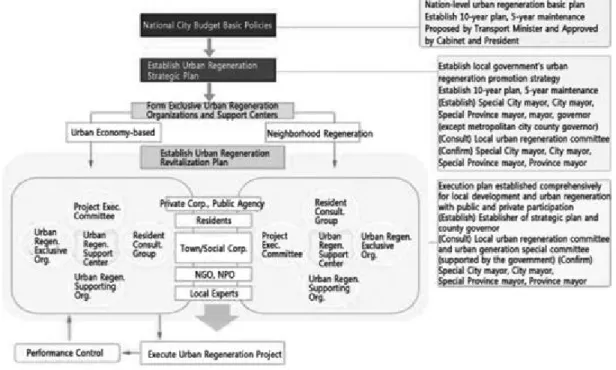
Fig. 1. Promotion System of an Urban Regeneration Project
in full scale. The establishment and support system of the urban regeneration plan is first establish an urban regeneration strategic plan that adheres to the national urban regeneration basic policies and then form an organization and support center exclusive for urban regeneration. Projects are undergoing operation in the two following categories: urban economy-based projects and neighborhood regeneration projects (general and small-sized).
Urban economy-based projects link up with the maintenance and development of urban and military planning facilities such as industrial complexes, ports, airports, railways, general national roads, and streams which play vital roles for the country to provide the pertinent city with new functions and create an employment base. The purpose of these projects is to implement a new economic function, generate employment by strengthening the competitiveness of existing functions, and promote the revitalization of urban economy, expecting to exert a ripple effect upon the core facilities of the pertinent city or the country the adjacent region. Neighborhood regeneration projects focus on improving the life environment of the life zone, establishing a
basic life infrastructure, revitalizing local communities, and reviving the local “alley” economy. The purpose of these projects is to increase and restore the functions of the original urban area and the central area of the city, targeting specific regions of the original urban area where the hollowization is severe and revitalization is highly needed or the potential as the central urban area is high. Fundamentally, an urban regeneration project, unlike an existing redevelopment or reconstruction project, is an integrated, comprehensive vision or a coalition that seeks a continuable economic, physical, social, and environmental improvement of an urban area, which is why the residents or a civic group of the pertinent area or an executive agency must take control as the planning body and establish a plan that pursues common good. However, in terms of planning, an urban regeneration project is a bottom-up model which takes the resident opinion into consideration, from a financial standpoint it is a communal investment project with government funds, exerting direct and indirect influence over the residential environment, culture, and employment status of the pertinent area.
Source : Urban Regeneration Information System (http://www.city.go.kr) Fig. 2. Status of Urban Generation Leading Areas
the deprived central industrial area.
2)Therefore, urban economy- based projects elect an expansion business method that select old government administrative sites, areas adjacent to public transportation station, retirement homes, and old port areas as the economic center and expand into adjacent areas by developing together with the private and public sectors. Neighborhood regeneration projects are carried out by building from the center city area that applies the urban planning method for the sake of revitalizing the original center city that was the administrative, industrial, and office center of the city, and are led by civic groups in the pertinent area in order to reflect the peculiar color of the region. In January, 2016, five sites (Seoul, Daegu, Incheon, Daejeon, and Bucheon) were selected as urban economy-based projects, nine (Busan, Ulsan, Chungju, Jecheon, Jeonju, Kimcheon, Andong, Kimhae, and Jeju) as neighborhood regeneration project center city areas, nineteen (Seoul-Yongsan, Guro, Busan-Jung-gu, Seo-gu, Gangseo-gu, Daegu, Incheon, Gwangju-Seo-gu, Gwangsan-gu, Ulsan-Dong-gu, Buk-gu, Suwon,
2) Ministry of Land, Infrastructure and Transport (2016). “Urban RegenerationProject Support Register Guideline.”
Seongnam, Bucheon, Chuncheon, Asan, Namwon, Naju, and Gwangyang) as neighborhood regeneration project general regions.
2.2. Communal Roles in an Urban Regeneration Project
2.2.1 Financial Support
The basis of financial support for an urban regeneration project can be found in the “Urban Regeneration Special Act” and
“National Urban and Housing Fund Act”. First, based on the former, a basis for national support through national urban regeneration basic policies and urban regeneration special accounting, and the latter provides a basis for a city account to support an urban regeneration project through a loan, investment, and a government insurance.
First, as the basis for public support in accordance with the
“Urban Regeneration Special Act”, Article 3, Responsibilities
of the Central and Local Government clearly states that the
nation and the pertinent local government must secure a
necessary budget and establish and promote related policies for
Fig. 3. Appointment Status of Urban Regeneration General Areasan urban regeneration project. And when a plan is established, the person-in-charge of the pertinent local government must reflect its course of action to the midterm local budget plan according to Article 33 of the “Local Finance Act” in order to secure the effectiveness of an urban regeneration strategic plan or an urban regeneration revitalization plan. Communal effort for such action has led to require the central and local government to partially or wholly support or loan the amount related to the urban regeneration project for revitalizing an urban regeneration through general accounting or a special accounting for local development in adherence to Article 30 of the “Special Act on Balanced National Development”(Article 27 of the Act).
On top of the central and local government’s support and loan, the pertinent local government (establisher of the strategic plan) may install and operate a special accounting for an urban regeneration project in order to enhance and support revitalizing urban regeneration (Article 28 of the Act).
3)Some of the primary means to finance an urban regeneration project proposed in the National Urban Regeneration Basic Policies include utilizing financial support by promoting collaboration among various departments, supporting priming water for urban regeneration revitalization, securing human resources in the central and local government, and supporting an urban regeneration project by utilizing tax and finance strategies. Among them, supporting priming water with the national budget in an urban regeneration leading or general area is representative, and for an urban economy-based project, 25 billion KRW is given per site and 10 billion KRW for a center city area, and below 6 billion KRW for a general area depending on the examination results.
Category
Urban Economy
-based
Neighborhood Regeneration
Misc.
Center City General Leading
(2014)
2, 25B
KRW 11, 10B KRW 4 years
(5:5 matching) General
(2016)
5, 25B KRW
9, 10B KRW
19, 6B KRW
4-6 years (5:5 matching) Table 1. Status of National Financial Support of Urban
Regeneration Leading/General Areas
3) Special Accounting Urban Regeneration can be used for research and development for an urban regeneration project, establishing an urban regeneration strategic plan and an urban regeneration revitalization plan, operating an urban regeneration project, constructing and managing housing within an urban regeneration revitalization area, employing experts, maintaining the special accounting, establishing and maintaining an urban regeneration support center, planning and operating a village corporation, repairing and renovating public buildings, and purchasing and utilizing communal/unused buildings within an urban regeneration project site.
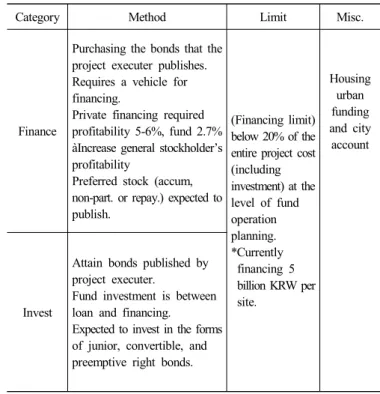
As the support for housing urban funds has been expanded from the old version according to the “National Urban and Housing Fund Act”, a city account has been used for supporting revitalizing urban regeneration. A city account is expected to support financing, investments, loans, and even public guarantees for an urban regeneration project, and the selection criteria for applying for a city account includes all aspects including publicness, projectability, and possibility for actualization. In order to be selected for a city account, a project acknowledge- ment examination conducted by the Korea Land and Housing Corporation is needed. The examination is limited to projects among urban regeneration projects that are considered urban economy-based that require financing, investment, or a loan and other projects that require financing and investment.
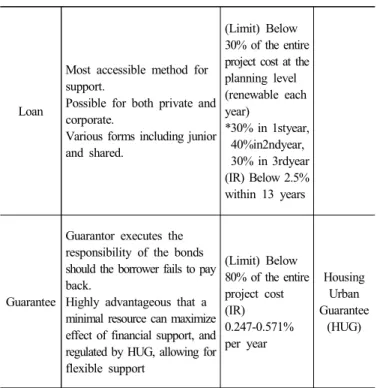
For the city account budget from the housing urban funds, 40.1 billion KRW was allotted in 2016 and 65 billion KRW in 2017 from housing accounts, which is provided in various forms including financing, investment, loans, and guarantees. In order to receive financing, a vehicle is required with private financing required profitability of 5-6% and fund of 2.7% as preferred stock (accumulative, non-participation or repayment preferred stock). An investment is in between financing and loan, and it is expected to go into junior, convertible, and preemptive right bonds, in order. Loans are the most accessible method for support, possible for both private and corporate, and expected to take on various forms including junior and shared.
Category Method Limit Misc.
Finance
Purchasing the bonds that the project executer publishes.
Requires a vehicle for financing.
Private financing required profitability 5-6%, fund 2.7%
àIncrease general stockholder’s profitability
Preferred stock (accum, non-part. or repay.) expected to publish.
(Financing limit) below 20% of the entire project cost (including investment) at the level of fund operation planning.
*Currently financing 5 billion KRW per site.
Housing urban funding and city account
Invest
Attain bonds published by project executer.
Fund investment is between loan and financing.
Expected to invest in the forms of junior, convertible, and preemptive right bonds.
Table 2. Housing Urban Funding Method and Limits
2.2.2 Communal Roles in an Urban Regeneration Project The communal roles in an urban regeneration project outside of Korea can be summarized into establishing a platform for various supports for entities in the project and continuous maintenance of the regeneration results, both of which must be implemented in Korea. Especially the leadership role of the public that is required during the promotion process of an economy-based project in Korea must utilize various resources including the priming water and budget to form suitable conditions to recruit private capital. On one hand, for a core project that anticipates a large amount of funding, a support to secure the minimum profit is necessary with the publicness including relaxing the executer’s burden to provide the funds as the preface. Additionally, it is necessary to enhance recruiting organizations and corporations and also amend the “Urban
Regeneration Special Act” to allow each local government to support in ways that suit its situation. Hence the primary necessity to create a collaboration system for effective execution of the central government support project and a guide for an effective project promotion between the central and local government. In mid to long-term, it is necessary to improve evaluation systems including monitoring results and progress of a project and performance control such as continuous maintenance of the regeneration results.
The local government must establish a platform such as policies and organization in order to secure and revitalize an economic base and set the direction for policies concerning urban economy. At the execution level, the liberty of the people must be enhanced by excavating various support methods for core project executer and a target recruitment corporation, and the supporting roles must be played in consulting and adjusting with the core project executer in order to linchpin the publicness of a core project that considers the ripple effect of economic revival.
For this purpose and to maintain the consistency and durability of urban regeneration, the local government is asked to play the role of a control tower for objective and neutral decision making and agreement adjustment between different parties.
2.3. Roles of LH in an Urban Regeneration Project LH seeks to be a specialized national urban regeneration agency that fulfills its duties as an overall urban regeneration coordinator and a public developer, and the government has defined the urban regeneration front as one of LH’s primary projects in reestablishing the functions of state-owned corporations. As for the basic direction, LH’s primary role is to execute as the general coordinator and public developer in urban regeneration, which can be further broken down into the previously-mentioned titles.
Loan
Most accessible method for support.
Possible for both private and corporate.
Various forms including junior and shared.
(Limit) Below 30% of the entire project cost at the planning level (renewable each year)
*30% in 1styear, 40%in2ndyear, 30% in 3rdyear (IR) Below 2.5%
within 13 years
Guarantee
Guarantor executes the responsibility of the bonds should the borrower fails to pay back.
Highly advantageous that a minimal resource can maximize effect of financial support, and regulated by HUG, allowing for flexible support
(Limit) Below 80% of the entire project cost (IR) 0.247-0.571%
per year
Housing Urban Guarantee
(HUG)
Fig. 4. Roles of LH in Urban Regeneration Project
As the general coordinator, LH acts as the urban regeneration support agency. Appointed as such by the Special Act in December, 2013, LH supported and managed eight the urban regeneration leading areas in 2014 and 22 general regions in 2015. Secondly, it supports and manages urban revitalization and saddle projects. It has been contracted the revitalization project (initialized in 2010, 186 sites, 97.1 billion KRW) and the saddle village project (2015, improving life quality in impoverished areas, 55 sites, 34 billion KRW). Thirdly, it acts as the examining body for city accounts. For the sake of proper operation of housing urban funds (city accounts), LH has been examining and evaluating various financing, investments, and loans for regeneration projects, and it has established a policy base in 2015 (passed in December, 2015) and is expected to conduct project acknowledgement examination for pilot projects including Cheonan (2016). Lastly, it is responsible for establishing an information system and training and commissioning experts. LH has established a collective information system and is managing it for effective management of regeneration projects, and it is also commissioning urban regeneration experts to the urban regeneration support center.
As the public developer, LH promotes small-sized repair projects. It has linked up with various urban regeneration projects to develop small-sized project districts within urban areas, and it is purchasing and reconstructing various housing facilities.
Secondly, LH is a contractor for urban regeneration projects itself. When contracted by the central or local government, LH conducts regeneration. For a pilot project, it has won the contract for the saddle village project in Jinju and is expecting to expand into other regions. Thirdly, LH executes its own projects such as complex development projects. If there is a need to improve
the urban functions within an urban regeneration revitalization area, LH cooperates with the government and private contractors to promote complex development. Lastly, it finds potential region-based urban regeneration sites. LH surveys and excavates potential sites for urban regeneration especially for region-based projects (public transit adjacent areas and state-owned areas) to promote a collaborative business model linking up with complex development and small-sized projects.
2.4 Status of LH Urban Regeneration Projects LH has accumulated a plethora of business know-hows and human network through its extensive experience with various development projects including regeneration projects. LH’s urban regeneration projects have been conducted as the contractor for a mayor or a county governor, and it has participated from a communal point of view due to a conflict and scandal during urban environment repair and reconstruction projects. In order to establish a collective, systematic repair plan, LH participated as the general project manager in 2005 as part of the “Special Act on The Promotion of Urban Renewal”, but the nationwide real estate crisis and a lack of physical repair brought forth the implementation of the “Urban Regeneration Special Act” in 2014.
For repair projects, LH has conducted residential environment improvement and residential building redevelopment projects since 1983, having provided 161,000 new residential facilities in 141 sites across Korea. As of June, 2013, LH is operating in projects in 40 sites, 17 of which are in operation and the other 23 in pre-operation phase.
As an urban regeneration project has been pluralized and expanded from a development project to include a software
Publicness Marketability
Type RMP RIP RRP URP HRP SHRP
Executer
Principle: Mayor, Governor Appoint: LH and
others
Principle: Mayor, Governor Appoint: LH and
others
Principle: Union solo Co-op: Mayor, Governor, LH, and
others Appoint: LH and others
Principle: Union solo Co-op: Mayor, Governor, LH, and
others Appoint: LH and others
Landowner solo
Principle: Union solo Co-op: Mayor, Governor, LH, and
others Appoint: LH and others
Principle: Union solo Co-op: Mayor, Governor, LH, and
others Appoint: LH and others
Method Customize
Customize/
accept/
sub/M&D/
combine
M&D/sub (accept)
M&D/sub (accept)
M&D (sellreq’d)
M&D (sellreq’d)
Status 23 1,028 1,241 720 3,296
LH Run
114 (11%) 89 completed 8 in progress
17 new
12 (1%) 5 completed 3 in progress
4 new
6 (0.7%) 4 completed 1 in progress
1 new
6 (0.2%) 5 completed 1 in progress
0 new Table 3. Progress of LH Repair Projects
project that revitalizes an urban area, LH is currently undergoing small-sized repair projects to overcome the limits of a large-sized repair project. LH has won 40 units linked with Happiness Housing in Samjeon-dong, Seoul and selected target sites in Busan, Seongnam, Changwon, and Seoul to apply various project models and execute through government support and legislation amendments.
All in all, LH is capable of supporting the central and local government, establishing a plan that links with other urban regeneration projects for enhancing project executability, and acting as the mediator.
3. Roles of a Public Developer in an Urban Regeneration Project
3.1 Necessity of a Public Developer in an Urban Regeneration Project
Referring to a real estate project developer, a developer can be categorized into a public or a private developer. A developer accurately predicts the potential of a real estate and the present condition of the market to devise a development method, and goes through the following steps (planning, securing site, and designing) to imbue new value to the real estate.
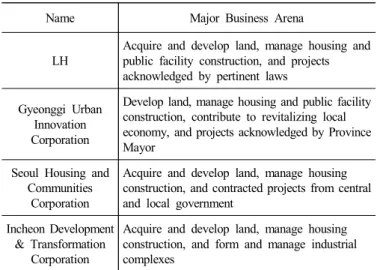
Public developers include the Korea Land and Housing Corporation and local corporations such as the Seoul Housing and Communities Corporation, and they utilize not only public resources but also private funds and pensions to induce collaboration between public and private sectors and communal functions. Through public involvement in development projects such as urban regeneration, the necessity of a public developer to seek balance between publicness and the business aspect of a project is garnering attention.
Currently, business arenas and ranges of public developers in Korea are different per legislations concerning management and the Project Execution Basis Act. Also, as a means to modernize public entities, public developers have been limited to participate in high-business projects such as housing facility reconstruction and redevelopment projects for public agencies, which have crippled these organizations to live up to their fullest potential.
In relation to existing large-sized development projects, the recent real estate recession and failure to acquire licensure for certain projects have driven these corporations away from participating or investing in projects, and even after winning the action for a contract, some of them forfeit their win. In order
to mitigate this issue, it is important to divide business risks and diversify investment structures into attaining licensure from a governing body, loaning and selling land, and acquiring buildings. And in order to secure project executability through negotiation with the pertinent local government, the role and necessity of a public developer for public participation and involvement is absolutely crucial.
Name Major Business Arena
LH
Acquire and develop land, manage housing and public facility construction, and projects acknowledged by pertinent laws
Gyeonggi Urban Innovation Corporation
Develop land, manage housing and public facility construction, contribute to revitalizing local economy, and projects acknowledged by Province Mayor
Seoul Housing and Communities
Corporation
Acquire and develop land, manage housing construction, and contracted projects from central and local government
Incheon Development
& Transformation Corporation
Acquire and develop land, manage housing construction, and form and manage industrial complexes
Table 4. Business Arenas of Major Public Developers
First of all, a public developer is needed to improve projectability through collaboration between public and private sectors. For a project that does not guarantee profitability with the existing business method, the government may offer to take on the base facility that the project executor (public developer) must take on or support adjacent areas for revitalizing the project, minimizing the gap of projectability.
Second of all, a reasonable establishment of a project plan and promotion through discussion and network with the central and local government and the residents of the pertinent region.
In order for a public developer to gain the central government’s support, the developer must establish a plan through communication and discussion across the project executor, local government, and residents, and request the local government for its a public role such as limiting use and making donations for this purpose, playing the role of a balanced project manager of an urban regeneration project.
Third of all, a public developer must provide the funds not
only through a city account of the housing urban funds but also
by utilizing public funds. The developer must play the role of
the priming water for inserting private capital by mezzanine
financing such as financing funds, making providing funds easy
and accessible.
3.2 Roles of a Public Developer in an Urban Regeneration Project
In order to reestablish communal roles in an urban regeneration project and smoothly promote the project, it is utmost important to reconstitute the roles of a public developer.
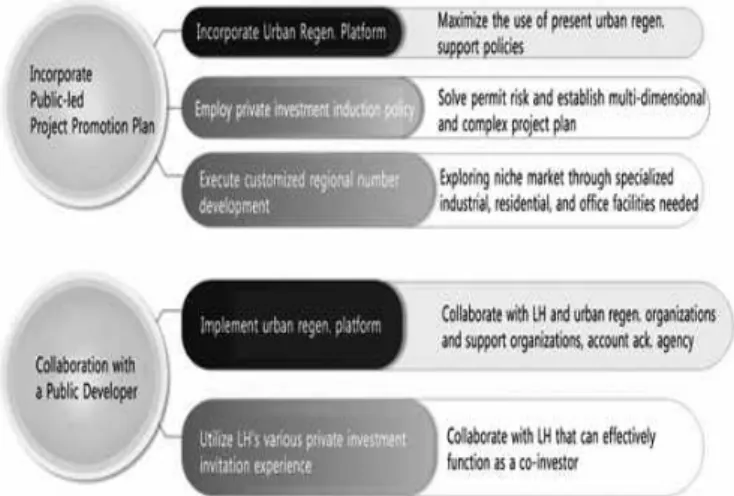
Thus, the roles include resolving the licensing risk of an urban regeneration project, establishing a dynamic, complex business plan led by the public, and promoting an urban regeneration project customized for each region.
First, a public developer must resolve the public licensing risk.
For this, in order to stop the public from refusing to invest for there is a high licensing risk for a business plan established by the public, the developer must recruit private capital and occupants after completing the licensing process. Throughout the licensing process, the public developer must take lead as the project manager.
Second, a public developer must establish a dynamic, complex business plan led by the public. In order to establish a business plan, complete the licensing process, and minimize making changes to the plan after recruiting investors, the developer must research meticulously beforehand. In order to resolve the resistance from the local government and residents of the pertinent area in case of proposing to build a large-sized industrial complex, it is necessary to link up with merchants in the area to run a regional epigyny program.
Third, a public developer must promote an urban regeneration project that is customized for the region. The developer must aim at high profitability and the industrial functions of the highest caliber such as large-sized shopping centers and hotels that are lacking in number in the pertinent area based on meticulous research of the region.
Fig. 5. Roles of LH as a Public Developer
4. Examples of LH’s Projects as the Public Developer
4.1 Cheonan the Urban Regeneration Leading Area The urban regeneration leading area in Cheonan partially belongs to the Dongnam-gu City Hall, Cheonan, and its area is 19,816㎡ wide with the project cost of 228.6 billion KRW.
The original center city area of Cheonan where The urban regeneration leading area is located was severely declining as most of its administrative buildings including the City Hall, police station, and education administration moved to another region, resulting in a population decrease. It was appointed as The urban regeneration leading area in 2014, and a revitalization plan has been established and related regeneration policies have been pushed forward rather actively. Per the “Urban Regeneration Special Act”, LH was appointed as the urban regeneration support agency, and since then it has been finding and carrying out new projects that suit the needs and conditions of Cheonan.
In the past, there had been multiple efforts to build a complex theme park to utilize the pertinent area since the City Hall’s move to Buldang-dong in 2003, but all of them foiled even after recruiting private contractors. As the Special Act was legislated and passed and the pertinent area was selected for urban regeneration which brought forth a solid plan, the city of Cheonan and LH signed a memorandum of understanding to realize the plan into an urban regeneration project.
The project site received an evaluation as a neighborhood regeneration leading area, and it has been expressed in the revitalization plan as an urban regeneration foothold facility construction project. The goal of the plan is to create a multicultural street mall in Cheonan to link keywords such as youth, culture and arts, and utilizing spare lots with local resources, planning various urban regeneration projects.
The project site includes the Dongnam-gu City Hall, health
center, Yeongdeok Building (Munhwa-dong municipal building),
and the Citizen’s Bell, and the plan has been evaluated for the
rate of decay, safety, and possibility for utilization for each
facility. For the City Hall building, it is an 80-year-old building
which requires reconstruction, and the health center was built
recently, allowing its continuous use. The Yeongdeok Building
was built over 20 years ago, but the building was in a decent
shape, allowing it to be used after remodeling, and the Cheonan
Citizen’s Bell called for an evaluation to be moved elsewhere
as it posed a threat as a limiting factor.
The project was carried out as a collaborative effort using the REITs through the city of Cheonan and the housing urban funds financing. With the REITs as the project executor, the project has incorporated core functions for revitalizing a declining region, and it will develop public facilities (City Hall, Children’s Hall, college dormitories, public parking lots, intellectual and industrial center, and etc.) and a residential and industrial complex. In addition, private contractors were recruited to participate in the public-private collaboration for urban regeneration utilizing the public land. Utilizing the public creativity, housing allotment, and industrial complex operation capability, the collaboration was promoted.
The government has appointed regions that are urgent for urban regeneration as primary regions to provide budgetary and financial support, and it signed a business agreement contract with LH, city of Cheonan, and the Sahak Foundation to revitalize the old center city. This marks the very first public-private collaboration for urban regeneration with a private entity participating in the effort for the first time, and it raised anticipation for revitalizing a declining older center city centered on foothold facilities and eventually a ripple effect into adjacent areas. In addition, it seeks to improve resident service and secure a self-sustaining local economy base by repairing retirement government office buildings.
Fig. 6. Cheonan Urban Regeneration Project Structure and Bird’s Eye View
4.2 Urban Regeneration General Region
Out of urban regeneration general regions, LH is participating or expecting to participate as a public developer mostly in urban economy-based urban regeneration projects in large cities including Seoul (Dobong and Nowon), Incheon (Dong-gu and Jung-gu), and Daegu (Seo-gu and Buk-gu).
In Seoul (Dobong and Nowon), the project site is 960,000㎡
wide, 245,000㎡ of which LH is participating, with the cost of 3.4 trillion KRW, of which LH is responsible for 1.9 trillion KRW. The project in which LH is participating is a complex development project around public transit areas, specifically focusing on securing driver’s license driving test lot. In Incheon (Dong-gu and Jung-gu), the project site is 3.9 million ㎡ wide, 410,000㎡ of which LH is participating, with the total cost of 600 billion KRW, 100 billion KRW of which LH is responsible
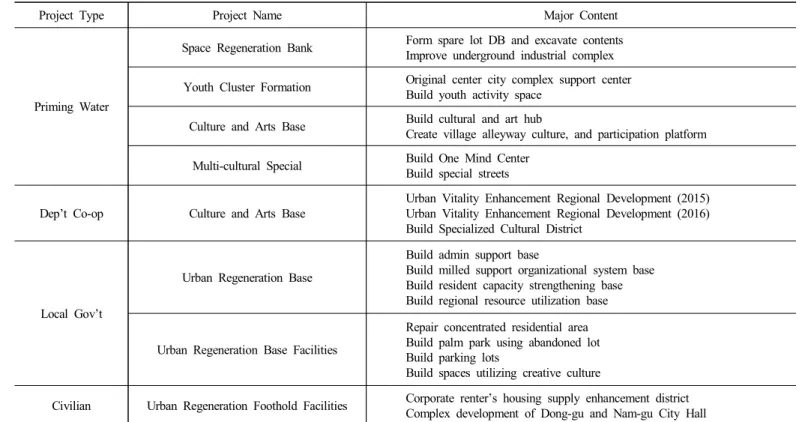
Project Type Project Name Major Content
Priming Water
Space Regeneration Bank Form spare lot DB and excavate contents Improve underground industrial complex
Youth Cluster Formation Original center city complex support center Build youth activity space
Culture and Arts Base Build cultural and art hub
Create village alleyway culture, and participation platform
Multi-cultural Special Build One Mind Center Build special streets
Dep’t Co-op Culture and Arts Base
Urban Vitality Enhancement Regional Development (2015) Urban Vitality Enhancement Regional Development (2016) Build Specialized Cultural District
Local Gov’t
Urban Regeneration Base
Build admin support base
Build milled support organizational system base Build resident capacity strengthening base Build regional resource utilization base
Urban Regeneration Base Facilities
Repair concentrated residential area Build palm park using abandoned lot Build parking lots
Build spaces utilizing creative culture
Civilian Urban Regeneration Foothold Facilities Corporate renter’s housing supply enhancement district Complex development of Dong-gu and Nam-gu City Hall Table 5. Major Contents of the Cheonan The urban regeneration leading area Project
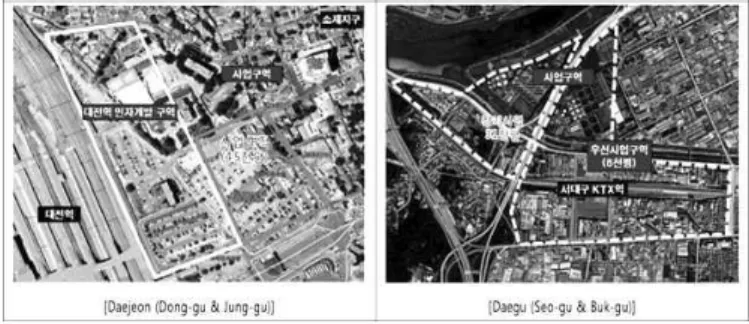
for. LH is working on redeveloping the port area (Piers 1 and 8) and the Passenger Terminal lot, establishing and executing business methods such as recruiting the anchor facility and business structure. LH signed a memorandum of understanding in November, 2016. In Bucheon, Gyeonggi, LH is participating in a lot of 63,000㎡ out of the total project site of 1.2㎡ and the cost of 800 billion KRW, 530 billion KRW of which LH is responsible for. LH is working on creating an intellectual and industrial cluster linked with an urban development project, establishing and executing a masterplan around the public transit area. LH signed a memorandum of understanding in October, 2016. In Daejeon (Dong-gu and Jung-gu), the project site is of 3 million ㎡, 284,000㎡ of which LH is participating, and the its total cost is 2 trillion KRW, 300 billion KRW of which LH is responsible for. LH is working on constructing a complex transfer center for the KTX Daejeon Station, Dokyeong lot, and parking lot building, establishing and co-executing a plan to link the station with adjacent regions. In Daegu (Seo-gu and Buk-gu), the project site is of 11 million ㎡, 26,000㎡ and possibly 1 million ㎡ in the future of which LH is participating, and its total cost is 800 billion KRW, 230 billion KRW of which LH is responsible for. LH is working on developing the Seodaegu KTX Station lot, establishing and executing a systematic business plan including the sewage system. LH signed a memorandum of understanding in October, 2016.
4.3 Capacity of LH as a Public Developer
The necessity and roles of a public developer in an urban regeneration project and the projects in which LH is involved have been discussed earlier. At this time, let us look at LH’s capacity to actually carry out the roles of a public developer.
Appointed as the urban regeneration support agency, LH is currently managing the overall urban regeneration projects, and it has also been appointed as the city account acknowledgement examining body to promote financial support for urban regeneration projects. It is also operating in about 160 separate urban regeneration projects, boasting extensive business experience and expertise. Moreover, it can utilize various private investment recruitment experiences through the PF project, and it has reduced the project cost by leveraging private capital through public-private joint housing development projects, contracted development, and public loan REITs, building its reputation as a good co-investor and a project executor.
With the know-hows it has accumulated over the years, LH is sufficiently fulfilling its position as a public developer, and
it has been adjusting a balanced profitability between public and private sectors, appropriate use plans for the demands of the market, and constructing a governance for adjusting opinions and communication across various parties. It can also guarantee a successful promotion of an urban regeneration project through inducing public participation, private investment, and stable financial support through public funds.
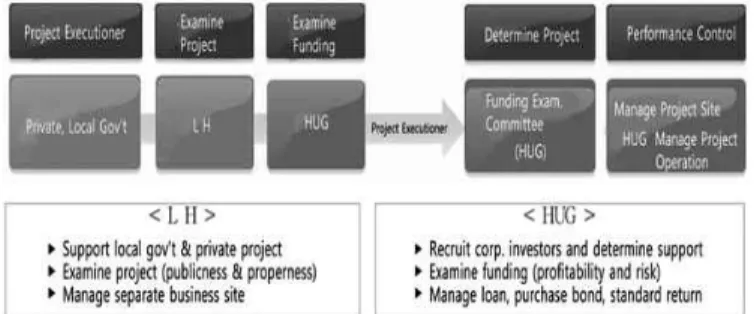
Moreover, for the operation and management of the city accounts of housing urban funds, LH and HUG (Korea Housing and Urban Guarantee Corporation) have delegated the business into two steps: LH acknowledges the project after which it evaluates its publicness and appropriateness, and HUG examines application for financing and profitability and risk. Through this two-step process, LH can provide a one-stop service for project realization, acknowledgement examination, and project management for projects that receive financing or loans through a city account of the housing urban funds.
Fig. 7. City Account Support Process
Fig. 8. Examples of Urban Regeneration General Area
5. Proposal for a Public Developer’s Urban Regeneration Project Promotion Plan
So far, the promotion status of urban regeneration projects and communal roles have been discussed. For an urban regeneration project that accompanies a large-scale complex development, it is going through multiple hardships in execution such as a financing issue due to low projectability, which emphasizes the communal roles such as those of a public developer in an urban regeneration project. However, although many public organizations including LH are currently seeking to transform into a public developer, there yet to remain many hurdles. First of all, I would like to propose a policy that will allow a public developer to effectively and reasonably promote an urban regeneration project.
First, a public developer must take the lead in establishing a public-private collaborative business model. The developer must seek to promote a public-private collaborative urban regeneration project for the sake of multi-angled business methods and financing means and support excavating and promoting new types of projects on top of the existing repair and maintenance projects such as developing areas adjacent to public transit, regenerating industrial complexes, and developing relocated sites. For this, the developer must execute the role of a mediator who can guarantee the profitability of the private sector based on the publicness of an urban regeneration project.
Second, a public developer must clearly differentiate the roles of the central government, the local government, public contractors, and private contractors. The central and local government must provide help at the level of urban planning such as financing, funds for installing basis and facilities, outsource government-owned land development, and applying minimally restricted regions while the public developer such as LH must be the overall project coordinator, collaborating with the local government, planning for and developing areas adjacent
to the regeneration project (install Happy Housing facility, public facilities, and base facilities). The housing urban funds must provide financial support as the priming water to the development project (financing, investment, and loan) while the private contractor does the part that only the private sector can play through participating as a constructor investor and developer.
Third, a public developer must seek to promote a project by various financing means such as public funds. Since an urban regeneration project is low in profitability, the public refuse to invest in such project. In order to prevent this, the public developer must utilize housing urban funds as a priming water to induce private investments. Among the funds, REITs can produce ten times the capital to start the project, serving as the lever for private investments, and investment funds and mezzanine (junior) loans are more than sufficient to prime private investments. The developer can resolve the worries of private investors for loss by participating as the equity investor if needed.
Fourth, a public developer must also play the position of an overall project coordinator. As the overall coordinator and a public developer to link up with various interdepartmental projects related to urban regeneration projects, the developer must be proactive in promoting public-private collaborative urban regeneration projects. In addition, the developer must excavate various financing methods such as levering the housing urban funds and utilize urban planning policies such as minimally restricted regions.
Lastly, a public developer must encompass and overarch all steps of an urban regeneration project from planning to development, management, and operation. In the past, public developers tended to plan, develop, and contract out public projects and collect only short-term commissions, but it is time for a public developer to contemplate his role as a proxy that a local society needs to fill in the gaps and smoothen the arduous process of an urban regeneration project. A public developer must reenlist himself away from the center of urban development to a role that contributes to continuable development of a region through management and operation of the region.
4)References
1. Lee, Sang-min et al (2013). “A Study on the Support System for Urban Regeneration and Practice Cases.” Auric Policies, 2013-17. Pp.1-2.
4) In Japan, the Area Management policy is in effect for the management and operation of the particular region.