• 검색 결과가 없습니다.

Analysis for nucleotide sequence of the membrane protein gene of porcine epidemic diarrhea virus Chinju99

N/A
N/A
Protected

Academic year: 2021

Share "Analysis for nucleotide sequence of the membrane protein gene of porcine epidemic diarrhea virus Chinju99"

Copied!
7
0
0

로드 중.... (전체 텍스트 보기)

전체 글

(1)

Korean J Vet Res (2006) 46(4) : 355~361

355

Analysis for nucleotide sequence of the membrane protein gene of porcine epidemic diarrhea virus Chinju99

Greta Salvae V. Baquilod, Sang-Geon Yeo

1,

*

Provincial Veterinary Office, Borongan, Eastern Samar 6800, Philippines

1
College of Veterinary Medicine, Kyungpook National University, Daegu 702-701, Korea (Accepted: November 20, 2006)

Abstract : Porcine epidemic diarrhea virus (PEDV) strain Chinju99, which was previously isolated from piglets suffering from severe diarrhea was used to characterize the membrane (M) protein gene to establish the molecular information, and the results will be useful in elucidating concepts related to molecular pathogenesis and antigenic structures of PEDV isolates. The Chinju99 M gene generated by reverse transcription and polymerase chain reaction (RT-PCR) consisted of 681 bases containing 22.3% adenine, 22.3% cytosine, 23.1% guanine and 32.3% thymine nucleotides, and the GC content was 45.4%. It had some nucleotide mismatches from M gene of other PEDV strains, such as CV777, Br1/87, KPEDV- 9, JMe2, JS2004-2 and LJB-03 with 97-99% nucleotide sequence homology to these strains. Also, it encoded a protein of 226 amino acids, which had some mismatches from those of CV777, Br1/87, KPEDV-9, JMe2, JS20004-2 and LJB-03, as the amino acid sequence homology showed a 97-98% to these strains. The Chinju99 had a very close relationship to the Japanese strain JMe2 for the nucleotide and amino acid sequences of the M gene. The amino acids predicted from Chinju99 M gene consisted of mostly hydrophobic residues and contained three potential sites for asparagine (N)-linked glycosylation, two serine (S)-linked phosphorylation sites by protein kinase C, and two S- or threonine (T)-linked phosphorylation sites by casein kinase II.

Key words : amino acids, M gene, nucleotides, PEDV

Introduction

Porcine epidemic diarrhea (PED) affects swine of all age of which clinical signs are similar to transmissible gastroenteritis such as watery diarrhea, vomiting and dehydration [16, 18]. The PED virus (PEDV) belongs to the genus

Coronavirus

of the family

Coronaviridae

, and it is a member of the group I coronaviruses on the basis of antigenic properties [16]. The genomic RNA of coronaviruses is a linear, single-stranded molecule that is capped, polyadenylated, and infectious [16]. PEDV possesses a glycosylated peplomer (spike, S) protein with a molecular weight of 180-200 kDa, a glycosylated membrane (M) protein of 27-32 kDa, and an unglycosylated RNA-binding nucleocapsid (N) protein of 57-58 kDa [3, 5, 11, 17, 19, 20].

Among the proteins, M has been suggested for the immune reaction and may play an important role in the induction of protection and in mediating the course of the disease [6, 19, 21]. Furthermore, the M protein of the coronaviruses provides an interesting opportunity for studying the taxonomic position of viruses because of a number of unifying and distinguishing features of the amino acid sequence themselves and of their co- translational and post-translational processing [8, 9, 19].

In the genomic studies for the PEDV strains, the complete nucleotide sequence of the Belgian strain CV777 genome was established [12]. Also, nucleotide sequences of N and S genes of the British strain Br1/

87 were reported [1, 3]. Lee and Yeo [14] isolated a PEDV strain from piglets suffering from severe diarrhea in Korea and named it as Chinju99 after they This study was supported by a grant (No. RTI04-03-07) from Gyeongnam Provincial Foundation for Biotechnology, Republic of Korea.

Nucleotide sequence data reported is available in the GenBank database under accession No. DQ845249.

*Corresponding author: Sang-Geon Yeo

College of Veterinary Medicine, Kyungpook National University, Daegu 702-701, Korea.

[Tel: +82-53-950-5968, Fax: +82-53-950-5955, E-mail: [email protected]]

(2)

characterized biological and physiochemical properties of the strain. They reported the nucleotide sequence of the Chinju99 N gene, which shows a 96.5% homology with that of CV777 [15]. Yeo

et al

. [22] also reported nucleotide sequence of the Chinju99 S gene with 94.5%

homology to CV777.

As regards M gene, nucleotide sequences of Belgian strain CV777, British strain Brl/87, Korean strain KPEDV-9, Japanese strain JMe-2 and Chinese strain LJB-03 were reported [1, 9, 10, 13]. There is, however, no information on the analysis for the nucleotide and amino acid sequences of the M gene of PEDV strains.

Therefore, molecular characterization of the M gene needs further exploration as far as it concerns with immune reaction and pathogenesis of the disease.

The present study gives insights to the sequences of nucleotides and deduced amino acids of M gene from PEDV Chinju99 strain and to be able to characterize the M gene of Chinju99 to provide molecular information.

Materials and Methods

Virus

A strain of PEDV, Chinju99 which was previously isolated from the intestinal tissues of piglets suffering from severe diarrhea in Chinju, Korea was used in this study [14]. The virus was propagated in Vero cells grown in minimal essential medium containing streptomycin (100 µg/ml), penicillin (100 U/ml) and trypsin (10 µg/

ml) in a 5% CO

2

incubator at 37

o

C following the methods of Hofmann and Wyler [7].

Extraction of viral RNA

The medium was removed at 15 h post-infection at the early stage of cytopathic effects such as rounding degeneration and syncytia formation. Viral RNA was extracted from the cells by using commercial kit (RNeasy minikit; QIAGEN, USA) following manufacturer’s sug- gestions. The RNA was dissolved in diethyl pyrocar- bonate-treated distilled water and stored at

70

o

C before use.

Primers used for cDNA synthesis

Sense and antisense primers were designed and aligned to the nucleotide sequences of the M gene of CV777, Br1/87, JMe2 and KPEDV-9 strains from the GenBank database of National Center for Biotechnology Information (NCBI, USA). The sense primer MF1

(5'ACCCCCTCCCCAGTACTGTTA3') and the antisense primer MR1 (5'CCTGAAAGCTGACAGAAGCCA3') were used to generate cDNA for the M gene of Chinju99.

Synthesis of cDNA for M gene

The reverse transcription (RT) for the synthesis of the first strand cDNA was done using the extracted RNA with Superscript II reverse transcriptase kit (Invitrogen, USA) following the manufacturer’s sugge- stions. The viral RNA was mixed with 2 µl of 100 pM antisense primer, 4 µl of 5X first-stand buffer, 1 µl of 10 mM dNTP mixture, 2 µl of 0.1 M DTT, 1 µl of reverse transcriptase (200 U/µl) and brought to 20 µl by adding distilled water. The reaction mixture was incubated at 42

o

C for 50 min and heated at 70

o

C for 15 min to stop the reaction.

Using a reagent kit (Perkin-Elmer, USA), the ds- cDNA for the M gene was synthesized by polymerase chain reaction (PCR). A 3 µl from the first strand cDNA template was added to 5 µl of 10X PCR buffer, 4 µl of 25 mM MgCl

2

, 1 µl of 10 mM dNTP mixture, 1 µl of each 100 pM sense and antisense primers, 1 µl of

Taq

DNA polymerase (5 U/µl) and brought to 50 µl with distilled water. The PCR was carried out in a thermocycler (Biometra, Germany) following the pro- gram of 2 min at 94

o

C and 30 cycles of 1 min at 94

o

C, 1 min at 60

o

C and 1 min at 72

o

C, and a final extension at 72

o

C for 5 min. The PCR products were run in 1%

agarose gel by electrophoresis.

Nucleotide sequencing

Nucleotide sequencing for the M gene was done using the Dye Terminator Cycle Sequencing reagent kit (ABI, USA) by automated DNA analyzer (ABI Prism 3100 DNA analyzer). Direct nucleotide sequencing reaction was done by PCR using the reagent mixture of 1 µl of template cDNA for the M gene, 1 µl each of sense and antisense primers, 2 µl of dye reagent of fluorochrome-labeled ddNTPs, DNA polymerase and buffer, and 5 µl of distilled water. The PCR reaction was carried out in a thermocycler (Perkin-Elmer, USA) following 30 cycles of 10 sec at 96

o

C, 5 sec at 50

o

C and 4 min at 60

o

C.

Analysis of nucleotide and amino acid sequences

The sequences of nucleotides and deduced amino

acids from Chinju99 M gene were analyzed by computer

program ClustalW (version 1.82) using data available

(3)

from NCBI and European Molecular Biology Laboratory

(EMBL). The protein chemistry of Chinju99 M amino acids was analyzed using protein statistic programs PEPSTATS (Pasteur, France), PredictProtein (EMBL) and ProtScale (Swiss Institute of Bioinformatics, Swiss).

Homology of nucleotide and amino acid sequences was determined between Chinju99 and other PEDV strains such as CV777 (NCBI accession No., NC003436) [12], Br1/87 (Z24733) [1], KPEDV-9 (AF015888) [13], JMe2 (D89752) [9], JS2004-2 (AY653205) and LJB-03 (Y60 8890) [10].

Results

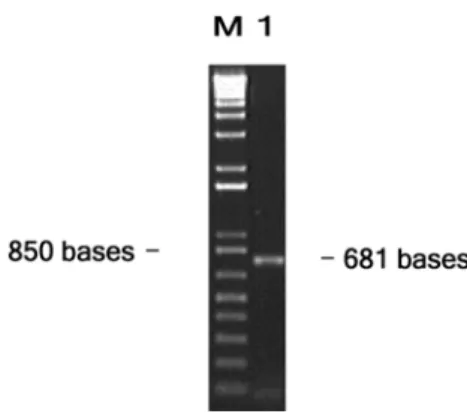
The result in the synthesis of ds-cDNA for Chinju99 M gene by RT-PCR showed specific DNA band of 681 bases (Fig. 1).

The complete nucleotide sequence of Chinju99 M Fig. 1. DNA of PEDV Chinju99 M gene synthesized by

RT-PCR. Lane 1, PEDV M DNA with 681 bases; M, 1 kb plus DNA ladder (Invitrogen, USA).

Fig. 2. Nucleotide sequence of Chinju99 M gene compared to the sequences of other PEDV strains. Start codon ATG

and stop codon TAA were underlined; only the nucleotides of other strains that mismatched the Chinju99 sequence were

included.

(4)

gene showed a single open reading frame (ORF) and consisted of 681 bases containing 152 adenine (22.3%), 152 cytosine (22.3%), 157 guanine (23.1%) and 220 thymine (32.3%) nucleotides, and a GC content was 45.4%. Nucleotide sequence of the Chinju99 M gene had 10 mismatches from those of CV777 and Br1/87;

19 from LJB-03; 8 from KPEDV-9, 14 from JS2004- 2 and 6 from JMe2 strains (Fig. 2). The Chinju99 M gene showed 99% nucleotide sequence homology to JMe2, 98% to CV777, Brl/87 and KPEDV-9, and 97%

to JS2004-2 and LJB-03 (Table 1).

The protein encoded by Chinju99 M gene comprised 226 amino acids, which had 6 amino acids mismatches from those of CV777 and Brl/87; 7 from LJB-03; 5 from KPEDV-9 and JS2004-2 and 3 from JMe2. Among mismatched amino acids, the residues at position 18, 133 and 181 in Chinju99 M protein were cysteine (C),

leucine (L) and valine (V), respectively, whereas those in other PEDV strains were exclusively tryptophan (W), valine (V) and glycine (G). The Chinju99 M protein had three potential asparagine (N)-linked glyco- sylation sites at amino acid position 3, 19 and 188.

There were two potential serine (S)-linked phosphory- lation sites at amino acid position 99 and 219 by protein kinase C. Also, there were two potential S- or threonine (T)-linked phosphorylation sites at amino acid position 63 and 217 by casein kinase II recognized in the protein (Fig. 3). The amino acids of Chinju99 M gene showed 98% sequence homology to JMe2 and 97% to CV777, Brl/87, KPEDV-9, JS2004-2, and LJB- 03 (Table 2). The Chinju99 M protein consisted of mostly hydrophobic amino acids, and there was a stretch of highly hydrophobic residues at position 27- 30 (Fig. 4).

Table 1. Nucleotide sequence homology of M gene between Chinju99 and other PEDV strains Homology %

CV777 Br1/87 JMe2 KPEDV-9 JS2004-2 LJB-03

Chinju99 98 98 99 98 97 97

Fig. 3. Putative amino acid sequence of Chinju99 M gene in comparison to the sequences of other PEDV strains. *, translation termination; three potential asparagine (N)-linked glycosylation sites were in bold letters (NGSI, NFTW, NASS); two potential serine (S)-linked phosphorylation sites by protein kinase C were underlined (SIR, SEK); two potential S- or threonine (T)- linked phosphorylation sites by casein II kinase were italicized (SLFD, TDSE).

Table 2. Homology of deduced amino acid sequences of M gene between Chinju99 and other PEDV strains Homology %

CV777 Br1/87 JMe2 KPEDV-9 JS2004-2 LJB-03

Chinju99 97 97 98 97 97 97

(5)

Discussion

The nucleotide sequence of Chinju99 M gene in full length was established and compared to those of other PEDV strains in this study. The nucleotide sequence of Chinju99 M gene showed a single ORF of 681 bases with 22.3% adenine, 22.3% cytosine, 23.1% guanine and 32.3% thymine. Chinju99 M gene had some nucleotide mismatches from those of CV777, Br1/87, LJB-03, KPEDV-9, JS2004-2 and JMe2, as the nucleotide sequence homology of Chinju99 showed 97-99% to these strains, with highest homology to JMe2.

There was a protein of 226 amino acids deduced from Chinju99 M gene, and the protein had some amino acid mismatches from those of CV777, Br1/87, LJB-03, KPEDV-9, JS2004-2 and JMe2, as the amino acid sequence homology of the Chinju99 M gene showed 97-98% to these strains, with the highest homology to JMe2. Therefore, the Chinju99 M gene had a very close relationship to the Japanese strain JMe2 for the nucleotide and amino acid sequences, that means Chinju99 M gene was clearly homologous to that of JMe2 than to that of KPEDV-9, a Korean strain.

Likewise, the Chinju99 M protein had three amino acids solely different from those of other PEDVs at the position 18, 133 and 181. Therefore, it was supposed that these changes, even minor to the complete sequence of amino acids, would affect function of the Chinju99 M protein, although no further investigation in this aspect was made.

Typically, the membrane glycoproteins of the antigenic

group I coronaviruses are N-glycosylated and a structural component of the virus particle [16, 19]. N-terminus of M protein is accessible at the outside of the virion, whereas the C-terminus is hidden at the inside. In order to be glycosylated, the M protein has to be integrated in the endoplasmic reticulum (ER). In the absence of a cleavable signal sequence, this may be achieved through each one of the three membrane spanning domains common to all the M proteins of coronaviruses [19]. Therefore, the presence of M protein can be a hint to the replication of PEDV and can give an early and accurate diagnoses of PEDV infection as the virus replicates in cytoplasm of the infected cells and mature by budding from membranes of the ER and cytoplasmic vesicles [19].

Chinju99 M protein had three potential N-linked glycosylation sites (N at position 3, 19 and 188). The glycosylation process will enable this protein to be more structurally complex, with a change in shape and a higher molar ratio contributing different immune response and antigenic reactions in the diagnostic investigations than simple proteins. Similarly, M proteins of the CV777 and Br1/87 have one N-linked glycosy- lation site at amino acid position 3 [4]. Also, Chinju99 M protein consisted of mostly hydrophobic amino acids, of which feature should be remained masked in certain serologic assays. Hydrophobic proteins can be the probable cause of nonspecific background reactions while they are used as the antigen in ELISA for the detection of antibodies [2].

Structural features of the Chinju99 M protein unraveled in the present study can help in elucidating concepts related to molecular pathogenesis and antigenic structures of PEDV isolates.

Conclusion

To provide molecular information on the M gene from Korean strain of porcine epidemic diarrhea virus (PEDV), nucleotides and deduced amino acids from M gene of the PEDV Chinju99 were determined and compared to those of other PEDV strains in the present study, and the results were as follows.

The Chinju99 M gene in a single open reading frame encoding 226 amino acids consisted of 681 bases containing 22.3% adenine, 22.3% cytosine, 23.1%

guanine and 32.3% thymine nucleotides. Nucleotide sequence of the gene showed 99% homology to JMe2 Fig. 4. Hydropathicity predicted in Chinju99 M amino acid

sequence by the Kyte-Doolittle scale: a stretch of highly

hydrophobic residues was found at position 27-30 indicated

by an arrow.

(6)

and 97%-98% homology to CV777, Br1/87, KPEDV- 9, JS2004-2 and LJB-03. Amino acid sequence deduced from the gene showed 98% homology to JMe2 and 97% homology to the remainder.

The Chinju99 M protein consisted of mostly hydro- phobic amino acids and had potential asparagine-linked glycosylation sites at amino acid position 3, 19 and 188, and potential serine (S)-linked phosphorylation sites at amino acid position 99 and 219 by protein kinase C.

There also were potential S- or threonine-linked phosp- horylation sites at amino acid position 63 and 217 by casein kinase II.

References

1. Bridgen A , Duarte M , Tobler K , Laude H , Ackermann M . Sequence determination of the nucleocapsid protein gene of the porcine epidemic diarrhoea virus confirms that this virus is a coronavirus related to human coronavirus 229E and porcine transmissible gastroenteritis virus. J Gen Virol 1993, 74 , 1795-1804.

2. Cho HJ, Masri SA , Deregt D , Yeo SG , Thomas EJG . Sensitivity and specificity of an enzyme-linked immu- nosorbent assay for the detection of bovine viral diarrhea virus antibody in cattle. Can J Vet Res 1991, 55 , 56-59.

3. Duarte M , Laude H . Sequence of the spike protein of the porcine epidemic diarrhoea virus. J Gen Virol 1994, 75 , 1195-1200.

4. Duarte M , Tobler K , Bridgen A , Rasschaert D , Ackermann M , Laude H . Sequence analysis of the porcine epidemic diarrhea virus genome between the nucleocapsid and spike protein genes reveals a poly- morphic ORF. Virology 1994, 198 , 466-476.

5. Egberink HF , Ederveen J , Callebaut P , Horzinek MC . Characterization of the structural proteins of porcine epizootic diarrhea virus, strain CV777. Am J Vet Res 1988, 49 , 1320-1324.

6. Fleming JO , Shubin RA , Sussman MA , Casteel N , Stohlman SA . Monoclonal antibodies to the matrix (E1) glycoprotein of mouse hepatitis virus protect mice from encephalitis. Virology 1989, 168 , 162-167.

7. Hofmann M , Wyler R . Propagation of the virus of porcine epidemic diarrhea in cell culture. J Clin Microbiol 1988, 26 , 2235-2239.

8. Holmes KV , Williams RK . Coronaviruses and their

diseases. In: Cavanagh D, Brown TDK (eds.). Advances in Experimental Biology and Medicine. pp. 5-7, Plenum Press, New York, 1990.

9. Ishikawa K , Sekiguchi H , Ogino T , Suzuki S . Direct and rapid detection of porcine epidemic diarrhea virus by RT-PCR. J Virol Methods 1997, 69 , 191-195.

10. Jinghui F , Yijing L . Cloning and sequence analysis of the M gene of porcine epidemic diarrhea virus LJB/

03. Virus Genes 2005, 30 , 69-73.

11. Knuchel M , Ackermann M , Müller HK , Kihm U . An ELISA for detection of antibodies against porcine epidemic diarrhoea virus (PEDV) based on the specific solubility of the viral surface glycoprotein. Vet Microbiol 1992, 32 , 117-134.

12. Kocherhans R , Bridgen A , Ackermann M , Tobler K . Completion of the porcine epidemic diarrhoea coronavirus (PEDV) genome sequence. Virus Genes 2001, 23 , 137-144.

13. Kweon CH , Kwon BJ , Lee JG , Kwon GO , Kang YB . Derivation of attenuated porcine epidemic diarrhea virus (PEDV) as vaccine candidate. Vaccine 1999, 17 , 2546-2553.

14. Lee HK , Yeo SG . Biological and physicochemical properties of porcine epidemic diarrhea virus Chinju99 strain isolated in Korea. J Vet Clin 2003, 20 , 150-154.

15. Lee HK , Yeo SG . Cloning and sequence analysis of the nucleocapsid gene of porcine epidemic diarrhea virus Chinju99. Virus Genes 2003, 26 , 207-212.

16. Murphy FA , Gibbs EPJ , Horzinek MC , Studdert MJ . Veterinary Virology. 3rd ed. pp. 496- 501, Academic Press, San Diego, 1999.

17. Pensaert MB , Yeo SG . Porcine epidemic diarrhea. In:

Straw BE, Zimmerman JJ, D’ Allaire S, Taylor DJ (eds.). Diseases of Swine. 9th ed. pp. 367-372, Blackwell Publishing, Ames, 2006.

18. Timoney JF , Gillespie JH , Scott FW , Barlough JE . Hagan and Brunner’s Microbiology and Infectious Diseases of Domestic Animals. 8th ed. pp. 897-898, Comstock Publishing Associates, Ithaca, 1988.

19. Utiger A , Tobler K , Bridgen A , Ackermann M .

Identification of the membrane protein of porcine

epidemic diarrhea virus. Virus Genes 1995, 10 , 137-

20. 148. Utiger A , Tobler K , Bridgen A , Suter M , Singh M ,

Ackerman M . Identification of proteins spsecified by

porcine epidemic diarrhoea virus. Adv Exp Med Biol

1995, 380 , 287-290.

(7)

21. Vennema H , De Groot RJ , Harbour DA , Horzinek MC , Spaan WJM . Primary structure of the membrane and nucleocapsid protein genes of feline infectious peritonitis virus and immunogenicity of recombinant vaccinia viruses in kittens. Virology 1991, 181 , 327- 335.

22. Yeo SG , Hernandez M , Krell PJ , Nagy E . Cloning

and sequence analysis of the spike gene of porcine

epidemic diarrhea virus Chinju99. Virus Genes 2003,

26 , 239-246.

수치

Fig. 2.  Nucleotide sequence of Chinju99 M gene compared to the sequences of other PEDV strains
Table 1.  Nucleotide sequence homology of M gene between Chinju99 and other PEDV strains Homology %

참조

관련 문서

In this study, we demonstrate that the partial NTD (NTD 231–501 ) of the PEDV S1 protein effectively interacts with M cells, and oral immunization of recombinant NTD 231–501 alone

Sequence analysis of the fusion protein gene of Newcastle disease virus isolated from breeder ducks in Korea.. Mi Na Han 1 , Hyeon Seop Byeon 1 , Cho Yeon Lee 1 , Nam Sin Jo 1

Fig. Complete nucleotide sequence and the deduced amino acid sequences of the ORF of bvtreX gene. The estimated molecular weight of the polypeptide is 84,851 Da. The

S1-Ig containing the PEDV S protein residues 25-738 fused to the Fc region of human IgG1, or truncation variants of S1-Ig containing the indicated S protein residues, and

Variable importance using mean decrease in accuracy for predicting porcine epidemic diarrhea virus by type of management practice during the incursion of the virus in Canadian

The nucleotide and deduced amino acid sequences of the M gene from 22 Korean CCV strains were determined and compared to those for 10 reference coronaviruses obtained from

Comparison of the nucleotide and deduced amino acid sequences of the S1 glycoprotein gene of 12 Korean IBV isolates and non-Korean strains Percent similarity-amino acids 1...