Agric. Chem. Biotechnol. 46(4), 144-147 (2003)
Article
Molecular Cloning and Nucleotide Sequence of a Gene Encoding a Glycogen Debranching Enzyme in the Trehalose Operon from
Brevibacterium helvolum
Chung Ho Kim
Department of Food and Nutrition, Seowon University, Chongju 361-742, Korea Received November 26, 2003; Accepted December 17, 2003
A gene designated bvtreX, located just upstream of bvtreYZ, was isolated from Brevibacterium helvolum (ATCC 11822). B. helvolum bvtreYZ genes encode maltooligosyltrehalose synthase (BvMTS) and maltooligosyltrehalose trehalohydrolase (BvMTH). Open reading frame of bvtreX is 2,265 bp long and encodes 754 amino acid residues. Estimated molecular weight of the polypeptide is 84,851 Da.
Translation termination codon of the bvtreX gene overlaps the translation initiation codon of the bvtreY gene by four nucleotides. Deduced amino acid sequence of B. helvolum bvtreX revealed identity with glycogen debranching enzymes from Arthrobacter sp. Q36, Mycobacterium tuberculosis H37Rv, Corynebacterium glutamicum, Sulfolobus shibatae, Sulfolobus acidocaldarius, and Xanthomonas campestris. These results suggest B. helvolum bvtreX is a glycogen debranching enzyme gene, a component of a bvtreXYZ operon of B. helvolum.
Key words: glycogen debranching enzyme, Brevibacterium helvolum, bvtreXYZ operon, trehalose
Introducrion
Glycogen debranching enzymes hydrolyze the α-1,6- glucosidic linkage specifically in α-glucans such as starch, amylopectin, glycogen and pullulan which are fabricated with α-1,4- and α-1,6-glucosidic linkages.1) Isoamylase (EC 3.2.1.68, glycogen 6-glucanohydrolase), pullulanase (EC 3.2.1.41, pullulan 6-glucanohydrolase) and amylo-1,6- glucosidase (EC 3.2.1.33) belonging to this enzyme group are found in various organisms in nature.1) Some bacteria able to produce the glycogen debranching enzyme include Arthrobacter sp. Q36,2) Saccharomyces cerevisiae,3) Bacillus sp. KSM-1876,4) Pectobacterium chrysanthemi PY35,5) and Sulfolobus acidocaldarius.6) The complete nucleotide sequences of genes encoding the glycogen debranching enzyme, and four regions conserved in α-amylase have also been determined.2-7)
We have discovered that the bvtreY and bvtreZ genes from B. helvolum (ATCC 11822) encode maltooligosyltrehalose synthase (BvMTS) and maltooligosyltrehalose trehalohydrolase (BvMTH), respectively.8) BvMTS catalyzes the conversion of maltodextrin into maltooligosyltrehalose by an intramolecular transglucosylation from α-1,4- into α,α-1,1-glucosidic linkage. BvMTH, on the other hand, catalyzes the hydrolysis of maltooligosyltrehalose to produce trehalose. B. helvolum
produce trehalose through these two enzyme reactions.8) We have also found an open reading frame (ORF) just upstream of bvtreY on the genome of B. helvolum (ATCC 11822). The ORF appears to be connected with the bvtreYZ genes. In this paper, we report the cloning and sequence analysis of the ORF, and demonstrate that the ORF corresponds to bvtreX (glycogen debranching enzyme gene) of B. helvolum.
Materials and Methods
Bacterial strains. B. helvolum (ATCC 11822) was used for the cloning of bvtreX gene encoding the glycogen debranching enzyme. E. coli MC1061 was used for transformation and plasmid propagation. B. helvolum and E.
coli were grown in LB.9)
Enzymes and chemicals. Restriction and DNA
*Corresponding author
Phone: +82-43-299-8745; Fax: +82-43-299-8745 E-mail: [email protected]
Abbreviations: ORF, open reading frame; IPTG, isopropyl β-D-thioga- lactoside
Fig. 1. Restriction map of the B. helvolum (ATCC 11822) DNA containing the tre operon. Arrows indicate genes with the direction of transcription. The translation termination codons of the bvtreX and bvtreY genes overlap the translation initiation codons of the bvtreY and bvtreZ genes, respectively, by four nucleotides. E, B, K, H and S indicate EcoRI, BamHI, KpnI, HindIII and SalI, respectively.
Cloning and Expression of Brevibacterium helvolum Glycogen Debranching Enzyme 145
modifying enzymes were purchased from Promega and used as recommended by the manufacture. Ni2+-NTA-agarose was purchased from Qiagen. Taq DNA polymerase and dNTPs were purchased from Boehringer Mannheim. All other chemicals were purchased from Sigma Chemical Co.
Preparation of bacterial genomic DNA. Bacterial genomic DNA was prepared by the method of Sambrooks et al. (1989)9) with modifications. B. helvolum was grown in LB media and the bacterial cells were suspended in 5.5 ml of lysozyme solution (2 mg/ml of lysozyme in TE) and incubated at 37oC for 1 h. Subsequently, 760µl of 10% SDS
was added into the bacterial mixture, which was then incubated at 65oC for 10 min. Finally, 1 ml of 5 M NaCl and 800µl of 10% CTAB solution (10% CTAB/0.7 M NaCl) were added, and final incubation was carried out at 65oC for 10 min.
After performing phenol/chloroform extraction twice, genomic DNA was precipitated using isopropyl alcohol.
Cloning of bvtreX gene. Bacterial genomic DNA was digested by EcoRI, KpnI and SalI, respectively, separated on a 1.0% agarose gel, and hybridized on a blot with a 0.6-kb DNA fragment including the C-terminal coding region of bvtreX as a hybridization probe. pBvR4.0 and pBv6.0 were previously
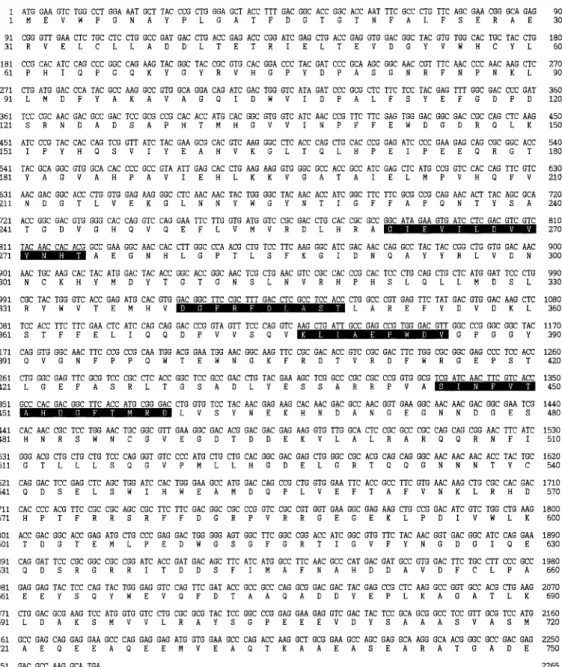
Fig. 2. Complete nucleotide sequence and the deduced amino acid sequences of the ORF of bvtreX gene. The ORF of bvtreX is 2,265 bp long and encodes 754 amino acid residues. The estimated molecular weight of the polypeptide is 84,851 Da. The translation termination codon of the bvtreX gene overlaps the translation initiation codon of the bvtreY gene by four nucleotides. Asterisks indi- cate stop codon. The black-boxed amino acid sequences are four domains that are highly conserved in α-amylolytic enzymes. The nucleotide sequence data reported in this paper have been deposited in the GenBank nucleotide sequence database under the acces- sion number AY485211.
146 Chung Ho Kim
cloned to isolate bvtreY and bvtreZ genes.8) The pBvR4.0 clone is composed of a complete ORF of bvtreY, partial N- terminal region of bvtreZ gene and partial C-terminal region of bvtreX gene (Fig. 1). A 0.6-kb DNA fragment including the C-terminal coding region of bvtreX was prepared from plasmid pBvR4.0 as a hybridization probe. The hybridized band at 2.4 kb that resulted from KpnI digestion was isolated from the gel, inserted into pUC18 at a KpnI site to make partial genomic library. One positive clone, pBvK2.4, was isolated by colony hybridization method.9)
Construction of recombinant expression plasmid. The ORF of bvtreX gene was introduced into the pRSET-B E. coli expression vector through PCR amplification. The bvtreX- specific primers were 5'-GGGGTACCATGTCGTCTGCTGC TGAC-3' and 5'-GGGGTACCTCATGCCTTGGCGTCCTC- 3' containing translation initiation and termination codons (underlined), respectively. The PCR product was digested with BamHI and subcloned into the pRSET-B vector to produce pRBvTreX. The polymerase chain reaction was carried out (100µl total volume) containing 10 mM Tris-HCl (pH 8.3), 1.5 mM MgCl2, 0.2 mM dNTPs, 100 ng of template DNA, 150 ng of each primer, and 2.5 units of Taq DNA polymerase. DNA was amplified as follows: 5 min at 94oC;
followed by 30 cycles of 1 min at 94oC, 1 min at 52oC, 2 min at 72oC; and final extension at 72oC for 10 min.
Expression and purification of bvtreX gene in E. coli.
pRBvTreX was transformed into E. coli BL21, and induced by adding 1 mM IPTG at 37oC for 4 h. The cell pellet was resuspended on 4 ml of lysis buffer [50 mM NaH2PO4 (pH 8.0), 300 mM NaCl, 10 mM imidazole] and sonicated (three cycles of 4 min each) on ice. Crude extract of the recombinant enzyme was purified by Ni2+-NTA-agarose column chromatography and eluted with a gradient of 10 to 250 mM imidazole. Protein samples were analyzed through discontinuous SDS-polyacrylamide gel electrophoresis.8)
Results and Discussion
Isolation of bvtreX gene from Brevibacterium helvolum.
Previously bacterial genomic DNA containing two genes, bvtreY and bvtreZ, encoding BvMTS and BvMTH, was cloned from B. helvolum (ATCC 11822).8) We have also found
an incomplete ORF just upstream of bvtreY on the genome of B. helvolum. The NCBI BLAST search revealed that the partial amino acid sequence of the ORF shows identity with treX genes from various microorganisms, which encoded glycogen debranching enzyme, and was connected with the bvtreYZ genes. To isolate the full-length clone of the bvtreX, a partial genomic library of B. helvolum was screened using a colony hybridization method. A 0.6-kb DNA fragment including the C-terminal coding region of bvtreX was prepared from plasmid pBvR4.0 (Fig. 1) as a hybridization probe. One positive clone, pBvK2.4, containing an DNA fragment of 2.4 kb was obtained (Fig. 1). This clone was composed of a complete ORF of bvtreX gene and partial N- terminal region of bvtreY gene. Figure 1 shows the restriction map and complete location of three genes, bvtreX, bvtreY, and bvtreZ.
Nucleotide and deduced amino acid sequence analyses of bvtreX gene. To determine the structure of bvtreX gene, nucleotide sequencing was carried out. Figure 2 shows the complete nucleotide sequence and the deduced amino acid sequences of the bvtreX gene (GenBank AY485211). The ORF of bvtreX is 2,265 bp long and encodes 754 amino acid residues. The estimated molecular weight of the polypeptide is 84,851 Da. The translation termination codon of the bvtreX gene overlaps the translation initiation codon of the bvtreY gene by four nucleotides. The deduced amino acid sequence of bvtreX had 80, 63, 62, 52, 50 and 51% identities with glycogen debranching enzymes from Arthrobacter sp. Q36 (BAA94842), Mycobacterium tuberculosis H37Rv (NP_216080), Corynebacterium glutamicum (NP_601306), Sulfolobus shibatae (AAM81590), Sulfolobus acidocaldarius (BAA11864) and Xanthomonas campestris (NP_635808), respectively.
GenBank database analysis revealed that the deduced amino acid sequence encoded by the bvtreX gene contains domains that are highly conserved in α-amylolytic enzymes. This family of enzymes includes α-amylases, pullulanases, cyclomaltodextrin glucanotransferases, glycogen branching enzymes, and glycogen debranching enzymes.7,10,11) Table 1 shows the four regions conserved among the proteins belonging to the glycogen debranching enzymes. The conserved domains are known to be the substrate-binding sites Table 1. Four conserved regions among TreXs. TreX from Arthrobacter sp. Q36 (BAA94842), Mycobacterium tuberculosis H37Rv (NP_216080), Corynebacterium glutamicum (NP_601306), Sulfolobus shibatae (AAM81590), Sulfolobus acidocaldarius (BAA11864) and Xanthomonas campestris (NP_635808).
Source of Enzymes Region I Region II Region III Region IV
Brevibacterium helvolum GIEVILDVVYNHT DGFRFDLAST KLIAEPWDV SINFVTAHDGFTMRD
Arthrobacter sp. GIEVILDVVYNHT DGFRFDLAAA KLIAEPWDV SINFVTAHDGFTLRD
Mycobacterium tuberculosis GIEVILDVVYNHT DGFRFDLAST KLIAEPWDV SINFVTAHDGFTLND
Corynebacterium glutamicum GLEVILDVVYNHT DGFRFDLAST KLIAEPWDV SINFVTAHDGFTLND
Sulfolobus shibatae GIEVIIDVVYNHT DGFRFDLAAA KLIAEPWDV SINYVTSHDGFTLED
Sulfolobus acidocaldarius GLEVIIDVVYNHT DGFRFDLASA KLIAEPWDV SINYITSHDGFTLQD
Xanthomonas campestris GLEVLLDVVYNHT DGFRFDLASI KLIAEPWDI SVNFVTAHDGFTLRD
Cloning and Expression of Brevibacterium helvolum Glycogen Debranching Enzyme 147
of the starch hydrolysis enzymes.12,13) These results suggest that B. helvolum bvtreX is a glycogen debranching enzyme gene as well as a component of a bvtreXYZ operon of B.
helvolum.
Expression of bvtreX gene in E. coli. To characterize the biochemical properties of B. helvolum glycogen debranching enzyme, the ORF of the bvtreX gene was amplified by PCR and introduced into E. coli expression vector, pRSET-B. The pRBvTreX was overexpressed in E. coli BL21 and analyzed through discontinuous SDS-polyacrylamide gel electrophoresis. Recombinant glycogen debranching enzyme was overexpressed, and also was soluble in E. coli (Fig. 3).
The recombinant glycogen debranching enzyme was purified by Ni2+-NTA-agarose column chromatography. The estimated molecular weight of recombinant glycogen debranching enzyme containing hexahistidine domain derived from pRSET-B vector was approximately 85,000. This value is in accord with the value calculated from its deduced amino acid sequence. Characterization of the biochemical properties of this enzyme is under progress.
References
1. Urlaub, H. and Woeber, G. (1975) Identification of isoamy- lase, a glycogen-debranching enzyme, from Bacillus amy- loliquefaciens. FEBS Lett. 57, 1-4.
2. Maruta, K., Kubota, M., Fukuda, S. and Kurimoto, M.
(2000) Cloning and nucleotide sequence of a gene encod-
ing a glycogen debranching enzyme in the trehalose operon from Arthrobacter sp. Q36. Biochim. Biophys. Acta 1476, 377-381.
3. Teste, M. A., Enjalbert, B., Parrou, J. L. and Francois, J. M.
(2000) The Saccharomyces cerevisiae YPR184w gene encodes the glycogen debranching enzyme. FEMS Micro- biol. Lett. 193, 105-110.
4. Hatada, Y., Saito, K., Hagihara, H., Ozaki, K. and Ito, S.
(2001) Nucleotide and deduced amino acid sequences of an alkaline pullulanase from the alkaliphilic bacterium Bacil- lus sp. KSM-1876. Biochim. Biophys. Acta 1545, 367-371.
5. Lim, W. J., Park, S. R., Kim, M. K., An, C. L., Yun, H. J., Hong, S. Y., Kim, E. J., Shin, E. C., Lee, S. W., Lim, Y. P.
and Yun, H. D. (2003) Cloning and characterization of the glycogen branching enzyme gene existing in tandem with the glycogen debranching enzyme from Pectobacterium chrysanthemi PY35. Biochem. Biophy. Res. Commun. 300, 93-101.
6. Maruta, K., Mitsuzumi, H., Nakada, T., Kubota, M., Chaen, H., Fukuda, S., Sugimoto, T. and Kurimoto, M. (1996) Cloning and sequencing of genes encoding novel enzymes of trehalose biosynthesis from thermophilic archaebacte- rium Sulfolobus acidocaldarius. Biochim. Biophys. Acta 1291, 177-181.
7. Svensson, B. (1994) Protein engineering in the α-amylase family: Catalytic mechanism, substrate specificity and stabil- ity. Plant Mol. Biol. 25, 141-157.
8. Kim, Y. H., Kwon, T. K., Park, S. S., Seo, H. S., Cheong, J.-J., Kim, C. H., Kim, J.-K., Lee, J. S. and Choi, Y. D.
(2000) Trehalose synthesis by sequential reactions of recombinant maltooligosyltrehalose synthase and maltooli- gosyltrehalose trehalohydrolase from Brevibacterium hel- volum. Appl. Environ. Microbiol. 66, 4620-4624.
9. Sambrook, J., E. F. Fritsch, T. Maniatis, (1989) Molecular Cloning: A Laboratory Manual, 2nd edn., Cold Spring Har- bor Laboratory Press, Cold Spring Harbor, NY.
10. Itkor, P., N. Tsukagoshi, and S. Udaka. (1990) Nucleotide sequence of the raw-starch-digesting amylase gene from Bacillus sp. B1018 and its strong homology to the cytodex- trin glucanotransferase genes. Biochem. Biophys. Res. Com- mun. 166, 630-636.
11. Yong, J., J. N. Choi, S. S. Park, C. S. Park, K. H. Park, and Y. D. Choi. (1996) Secretion of heterologous cyclodextrin glycosyltransferase of Bacillus sp. E1 from Escherichia coli.
Biotechnol. Lett. 18, 1223-1228.
12. Jespersen, H. M., E. A. MacGregor, B. Henrissat, M. R.
Sierks, and B. Svensson. (1993) Starch- and glycogen- debranching and branching enzymes: prediction of struc- tural features of the catalytic (β/α)8-barrel domain and evo- lutionary relationship to other amylolytic enzymes. J.
Protein Chem. 12, 791-805
13. Jespersen, H. M., E. A. MacGregor, M. R. Sierks, and B.
Svensson. (1991) Comparison of the domain-level organiza- tion of starch hydrolases and related enzymes. Biochem. J.
280, 51-55 Fig. 3. Expression and purification of recombinant glycogen
debranching enzyme in E. coli. ORF of the bvtreX gene was introduced into E. coli expression vector, pRSET-B and expressed in E. coli. Protein extracts prepared from induced E.
coli and their purified recombinant enzyme were analyzed and stained by 8.5% SDS-PAGE and Coomassie Blue, respectively.
Lane C: total extract of E. coli BL21 harboring pRSET-B vec- tor, Lane 1: total extract of E. coli BL21 harboring pRBvTreX, Lane 2: soluble fraction of E. coli BL21 harboring pRBvTreX, Lane 3: purified recombinant glycogen debranching enzyme by Ni2+-NTA chromatography