Veterinary Science
http://dx.doi.org/10.4142/jvs.2014.15.4.495
Received: 19 Feb. 2014, Revised: 22 May 2014, Accepted: 18 Jul. 2014
Original Article
*Corresponding author: Tel: +82-33-250-8655; Fax: +82-33-259-5625; E-mail: [email protected]
ⓒ 2014 The Korean Society of Veterinary Science.
This is an Open Access article distributed under the terms of the Creative Commons Attribution Non-Commercial License (http://creativecommons.org/licenses/by-nc/3.0) which permits unrestricted non-commercial use, distribution, and reproduction in any medium, provided the original work is properly cited.
M gene analysis of canine coronavirus strains detected in Korea
Seok-Young Jeoung
1, So-Yun Ann
1, Hyun-Tae Kim
2, Doo Kim
1,*
1
Department of Veterinary Internal Medicine, College of Veterinary Medicine and Institute of Veterinary Science, Kangwon National University, Chuncheon 200-701, Korea
2
Department of Veterinary Internal Medicine, College of Veterinary Medicine, Seoul National University, Seoul 151-742, Korea
The purpose of this study was to investigate the genetic features of canine coronavirus (CCV) strains detected in Korea. M gene sequences obtained for isolates from 22 dogs with enteritis over a 5-year period were evaluated. Sequence comparison revealed that the 22 Korean CCV strains had an 87.2 to 100% nucleotide homology. Comparing to the typical reference CCV strains (type II), the nucleotide sequence of Korean strains had homology ranged from 86.3% to 98.3%
(89.1% to 99.2% for the amino acid sequence) and 87.7% to 97.8% (92.4% to 100% for the amino acid sequence) when compared to FCoV-like CCV strains (type I). Three amino acid variations in the M gene were characteristic for the Korean CCV strains. Phylogenetic analysis demonstrated that the 22 Korean CCV strains belonged to four typical CCV clusters (i.e., a unique Korean CCV cluster, a type II and transmissible gastroenteritis virus cluster, an intermediate cluster between type I and II, and a type I cluster). This study was the first to identify genetic differences of the M gene from Korean CCV strains and provided a platform for molecular identification of different Korean CCV strains.
Keywords: canine coronavirus, M gene, phylogenetic analysis
Introduction
Canine coronavirus (CCV) is an enveloped RNA virus with a positive-sense single-stranded genome of 27∼32 kb in length [21]. This virus belongs to group I of the Coronaviridae family that includes transmissible gastroenteritis virus (TGEV) of swine, porcine epidemic diarrhea virus, porcine respiratory coronavirus, feline infectious peritonitis virus, and human coronavirus 229E [23,30]. The close antigenic relationship between feline coronavirus (FCoV) and CCV
facilitates a potential for cross-species infection [3,13,16,20].
For both FCoV and CCV, interspecies recombinations have been found by sequence analysis in different parts of the viral genome (e.g., the spike [S] gene encoding the ‘spike’ on the viral surface and the membrane [M] gene encoding the
‘membrane’ or ‘integral membrane’ protein) [10,18,19].
A new FCoV type, designated as FCoV type II, has emerged in the field due to recombination (in the S protein gene region) of FCoV type I and CCV [10]. Epidemiological investigations have shown that FCoV type I is the predominant field virus type in the UK, Austria, and Japan [1,5,11]. Furthermore, other studies have demonstrated that FCoV type I strains bind to feline aminopeptidase N (fAPN), a cell surface receptor in the lung, spleen, kidney, and gut while FCoV type II strains do not. The possible clinical and epidemiological impact of these findings is still unclear [5,32]. In a recent study of S gene sequences obtained from field isolates, two types of CCV were identified. Pratelli et al. [24-27] analyzed M gene sequences of CCV strains and found that the isolates belonged to two novel genetic clusters. The newly discovered FCoV-like CCV strain was different from typical CCV strains, and more closely related to FCoV strains than CCV strains [7].
Divergent FCoV-like CCV strains have emerged in
particular from dog kennels and animal shelters. One study
found that some FCoV-like CCV strains are more virulent
than typical CCV strains and cause severe hemorrhagic
diarrhea [4]. FCoV-like CCV stains have been found in
Austria, Italy, and China [4,26,34]. Accurate genotyping
for field CCV strains is undoubtedly important. However,
only one molecular genetic study of Korean CCV strains
has been performed to date [2]. Therefore, the present
investigation was conducted to assess the molecular
genetic features of CCV strains isolated in Korea.
Table 1. Korean canine coronavirus (CCV) strains used for sequence comparison and phylogenetic analysis
Strain GenBank accession number Year of detection Location of isolation
KCC01 KCC02 KCC03 KCC04 KCC05 KCC06 KCC07 KCC08 KCC09 KCC10 KCC11 KCC12 KCC13 KCC14 KCC15 KCC16 KCC17 KCC18 KCC19 KCC20 KCC21 KCC22
HM130573 HM450106 HM450107 HM450108 HM450109 HM450110 HM450111 HM450112 HM450113 HM450114 HM450115 HM450116 HM450117 HM450118 HM450119 HM450120 HM450121
−
HM450122 HM450123 HM450124 HM450125
2007 2006 2003 2003 2007 2007 2004 2005 2003 2003 2003 2003 2003 2004 2004 2003 2006 2006 2006 2004 2003 2003
Jeju, Korea Gangwon, Korea Gangwon, Korea Gyeonggi, Korea Gyeonggi, Korea Seoul, Korea Seoul, Korea Seoul, Korea Gyeonggi, Korea Seoul, Korea Gyeonggi, Korea Seoul, Korea Seoul, Korea Jeju, Korea Jeju, Korea Chungbuk,Korea Gyeongbuk, Korea Gangwon, Korea Gangwon, Korea Incheon, Korea Seoul, Korea Gangwon, Korea
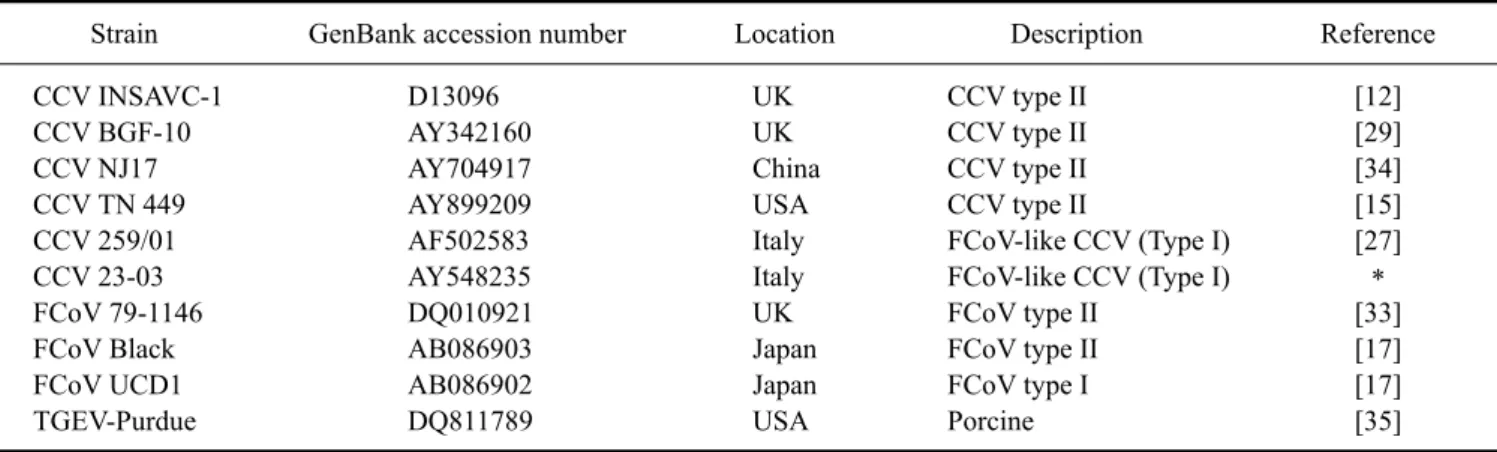
Table 2. Reference coronavirus strains used for sequence comparison and phylogenetic analysis
Strain GenBank accession number Location Description Reference
CCV INSAVC-1 CCV BGF-10 CCV NJ17 CCV TN 449 CCV 259/01 CCV 23-03 FCoV 79-1146 FCoV Black FCoV UCD1 TGEV-Purdue
D13096 AY342160 AY704917 AY899209 AF502583 AY548235 DQ010921 AB086903 AB086902 DQ811789
UK UK China USA Italy Italy UK Japan Japan USA
CCV type II CCV type II CCV type II CCV type II
FCoV-like CCV (Type I) FCoV-like CCV (Type I) FCoV type II
FCoV type II FCoV type I Porcine
[12]
[29]
[34]
[15]
[27]
* [33]
[17]
[17]
[35]
*Unpublished data.
Materials and Methods Clinical specimens
A total of 67 fecal samples of diarrheic dogs from various parts of Korea were collected by rectal swab from 2003 to 2007. The samples were transported on ice as quickly as possible and stored at −80
oC before use. CCV was detected by reverse transcription (RT)-PCR and canine
parvovirus was detected with a SNAP Parvo Antigen Test Kit (IDEXX Laboratories, USA). CCVs were detected in 22 dogs (Table 1). Eight animals were male and 14 were female. The age of the dogs ranged from 5 to 31 weeks.
Only 1 dog had received a CCV vaccination. Eleven dogs
were vomiting and four had symptoms of respiratory
disease such as coughing and nasal discharge. Canine
parvovirus (CPV) was detected in all fecal samples in
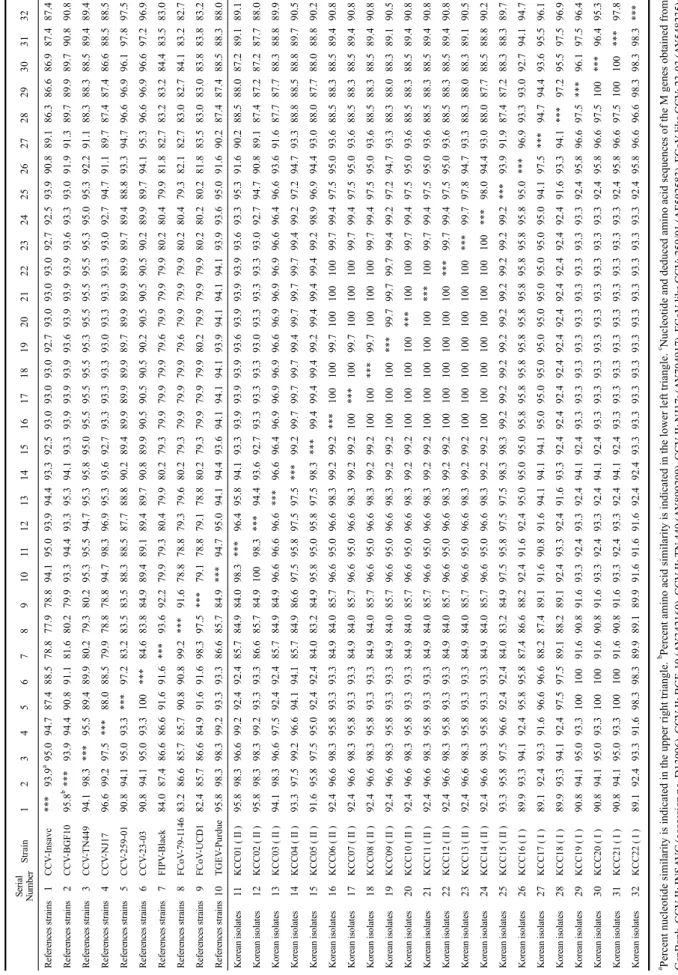
Table 3. Sequence homology of nucleotides and deduced amino acids of the M gene in the Korean CCV isolates and reference strains Serial NumberStrain1234567891011121314151617181920212223242526272829303132 References strains 1CCV-Insavc***93.9a 95.094.787.488.578.877.978.894.195.093.994.493.392.593.093.093.092.793.093.093.092.792.593.990.889.186.386.686.987.487.4 References strains 2CCV-BGF1095.8b ***93.994.490.891.181.680.279.993.394.493.395.394.193.393.993.993.993.693.993.993.993.693.393.091.991.389.789.989.790.890.8 References strains 3CCV-TN44994.198.3***95.589.489.980.279.380.295.395.594.795.395.895.095.595.595.595.395.595.595.595.395.095.392.291.188.388.388.589.489.4 References strains 4CCV-NJ1796.699.297.5***88.088.579.978.878.894.798.396.995.393.692.793.393.393.393.093.393.393.393.092.794.791.189.787.487.486.688.588.5 References strains 5CCV-259-0190.894.195.093.3***97.283.283.583.588.388.587.788.890.289.489.989.989.989.789.989.989.989.789.488.893.394.796.696.996.197.897.5 References strains 6CCV-23-0390.894.195.093.3100***84.683.884.989.489.189.489.790.889.990.590.590.590.290.590.590.590.289.989.794.195.396.696.996.697.296.9 References strains 7FIPV-Black84.087.486.686.691.691.6***93.692.279.979.380.479.980.279.379.979.979.979.679.979.979.980.280.479.981.882.783.283.284.483.583.0 References strains 8FCoV-79-114683.286.685.785.790.890.899.2***91.678.878.879.379.680.279.379.979.979.979.679.979.979.980.280.479.382.182.783.082.784.183.282.7 References strains 9FCoV-UCD182.485.786.684.991.691.698.397.5***79.178.879.178.880.279.379.979.979.980.279.979.979.980.280.280.281.883.583.083.083.883.883.2 References strains10TGEV-Purdue95.898.398.399.293.393.386.685.784.9***94.795.094.194.493.694.194.194.193.994.194.194.193.993.695.091.690.287.487.488.588.388.0 Korean isolates11KCC01 ( II )95.898.396.699.292.492.485.784.984.098.3***96.495.894.193.393.993.993.993.693.993.993.993.693.395.391.690.288.588.087.289.189.1 Korean isolates12KCC02 ( II )95.898.398.399.293.393.386.685.784.910098.3***94.493.692.793.393.393.393.093.393.393.393.092.794.790.889.187.487.287.287.788.0 Korean isolates13KCC03 ( II )94.198.396.697.592.492.485.784.984.996.696.696.6***96.696.496.996.996.996.696.996.996.996.696.496.693.691.687.787.788.388.889.9 Korean isolates14KCC04 ( II )93.397.599.296.694.194.185.784.986.697.595.897.597.5***99.299.799.799.799.499.799.799.799.499.297.294.793.388.888.588.889.790.5 Korean isolates15KCC05 ( II )91.695.897.595.092.492.484.083.284.995.895.095.897.598.3***99.499.499.499.299.499.499.499.298.996.994.493.088.087.788.088.890.2 Korean isolates16KCC06 ( II )92.496.698.395.893.393.384.984.085.796.695.096.698.399.299.2***10010099.710010010099.799.497.595.093.688.588.388.589.490.8 Korean isolates17KCC07 ( II )92.496.698.395.893.393.384.984.085.796.695.096.698.399.299.2100***10099.710010010099.799.497.595.093.688.588.388.589.490.8 Korean isolates18KCC08 ( II )92.496.698.395.893.393.384.984.085.796.695.096.698.399.299.2100100***99.710010010099.799.497.595.093.688.588.388.589.490.8 Korean isolates19KCC09 ( II )92.496.698.395.893.393.384.984.085.796.695.096.698.399.299.2100100100***99.799.799.799.499.297.294.793.388.388.088.389.190.5 Korean isolates20KCC10 ( II )92.496.698.395.893.393.384.984.085.796.695.096.698.399.299.2100100100100***10010099.799.497.595.093.688.588.388.589.490.8 Korean isolates21KCC11 ( II )92.496.698.395.893.393.384.984.085.796.695.096.698.399.299.2100100100100100***10099.799.497.595.093.688.588.388.589.490.8 Korean isolates22KCC12 ( II )92.496.698.395.893.393.384.984.085.796.695.096.698.399.299.2100100100100100100***99.799.497.595.093.688.588.388.589.490.8 Korean isolates23KCC13 ( II )92.496.698.395.893.393.384.984.085.796.695.096.698.399.299.2100100100100100100100***99.797.894.793.388.388.088.389.190.5 Korean isolates24KCC14 ( II )92.496.698.395.893.393.384.984.085.796.695.096.698.399.299.2100100100100100100100100***98.094.493.088.087.788.588.890.2 Korean isolates25KCC15 ( II )93.395.897.596.692.492.484.083.284.997.595.897.597.598.398.399.299.299.299.299.299.299.299.299.2***93.991.987.487.288.388.389.7 Korean isolates26KCC16 ( I )89.993.394.192.495.895.887.486.688.292.491.692.495.095.095.095.895.895.895.895.895.895.895.895.895.0***96.993.393.092.794.194.7 Korean isolates27KCC17 ( I )89.192.493.391.696.696.688.287.489.191.690.891.694.194.194.195.095.095.095.095.095.095.095.095.094.197.5***94.794.493.695.596.1 Korean isolates28KCC18 ( I )89.993.394.192.497.597.589.188.289.192.493.392.491.693.392.492.492.492.492.492.492.492.492.492.491.693.394.1***97.295.597.596.9 Korean isolates29KCC19 ( I )90.894.195.093.310010091.690.891.693.392.493.392.494.192.493.393.393.393.393.393.393.393.393.392.495.896.697.5***96.197.596.4 Korean isolates30KCC20 ( I )90.894.195.093.310010091.690.891.693.392.493.392.494.192.493.393.393.393.393.393.393.393.393.392.495.896.697.5100***96.495.3 Korean isolates31KCC21 ( I )90.894.195.093.310010091.690.891.693.392.493.392.494.192.493.393.393.393.393.393.393.393.393.392.495.896.697.5100100***97.8 Korean isolates32KCC22 ( I )89.192.493.391.698.398.389.989.189.991.691.691.692.492.493.393.393.393.393.393.393.393.393.393.392.495.896.696.698.398.398.3*** a Percent nucleotide similarity is indicated in the upper right triangle. b Percent amino acid similarity is indicated in the lower left triangle. c Nucleotide and deduced amino acid sequences of the M genes obtained from GenBank. CCV-II: INSAVC (accession no. D13096). CCV-II: BGF-10 (AY342160), CCV-II: TN 449 (AY899209), CCV-II: NJ17: (AY704917), FCoV-like CCV: 259/01 (AF502583), FCoV-like CCV: 23-03 (AY548235), FCoV-I: 79-1146 (DQ010921), FCoV-II: Black (AB086903), FCoV-II: UCD1 (AB086902), and TGEV: Purdue (DQ811789).
which CCV was detected.
PCR amplification
Viral RNA was extracted from fecal samples using an RNeasy mini kit (Qiagen, Germany) according to the manufacturer’s protocol for animal cells. The target sequence for amplification was located in a segment of the gene encoding the transmembrane protein M of CCV. The following primers were prepared [22,28]: primer CCV1 (sense) 5´-TCC AGA TAT GTA ATG TTC GG-3´
(337-356 nucleotides) and primer CCV2 (antisense) 5´-TCT GTT GAG TAA TCA CCA GCT-3´ (726-746 nucleotides). The CCV1/CCV2 primer pair was used to amplify a 409-bp fragment [10]. cDNA was synthesized with the commercial kit (Accupower RT PreMix; Bioneer, Korea) as instructed by the manufacturer. cDNA synthesis was performed at 37
oC for 30 min with a final incubation at 94
oC for 5 min. PCR was carried out using the commercial kit (Accupower PCR PreMix; Bioneer, Korea) with the following conditions: 35 cycles of denaturation at 94
oC for 30 sec, annealing at 55
oC for 30 sec, and extension at 72
oC for 1 min followed by a final extension at 72
oC for 10 min.
The amplicons were separated on a 2% agarose gel and visualized by staining with ethidium bromide (10 μL/mL;
Sigma, USA).
The PCR amplicons were purified with a commercial kit (QIAquick Gel Extraction Kit; Qiagen), and sequenced using the dideoxynucleotide chain termination method with the CCV1/CCV2 primer pair and a commercial kit (Big Dye terminator cycle sequencing kit; Applied Biosystems, USA). The nucleotide and deduced amino acid sequences of the M gene from 22 Korean CCV strains were determined and compared to those for 10 reference coronaviruses obtained from GenBank (National Center for Biotechnology Information, USA), and aligned by the Clusteral W multiple sequence alignment algorithm using commercial software (DNASTAR 5.0, MegAlign; DNASTAR, USA) for phylogenetic analysis (Tables 1 and 2).
Results
Analysis of the M gene revealed that the nucleotide sequences of the 22 Korean strains had an 87.2 to 100%
homology. Furthermore, the Korean strains had an 86.3%
to 98.3% sequence homology with the CCV type II reference strains (i.e., CCV INSAVC-1, BGF-10, NJ17, and TN 449) as well as an 87.7% to 97.8% sequence homology with the FCoV-like CCV type I reference strains (i.e., CCV 259/01 and 23-03). M gene sequences of seven Korean strains (i.e., KCC06, KCC07, KCC08, KCC09, KCC10, KCC11, and KCC12) shared a complete identity at the nucleotide level (Table 2 and 3).
Analysis of the M gene deduced amino acid sequence revealed that the Korean strains had a 90.8% to 100%
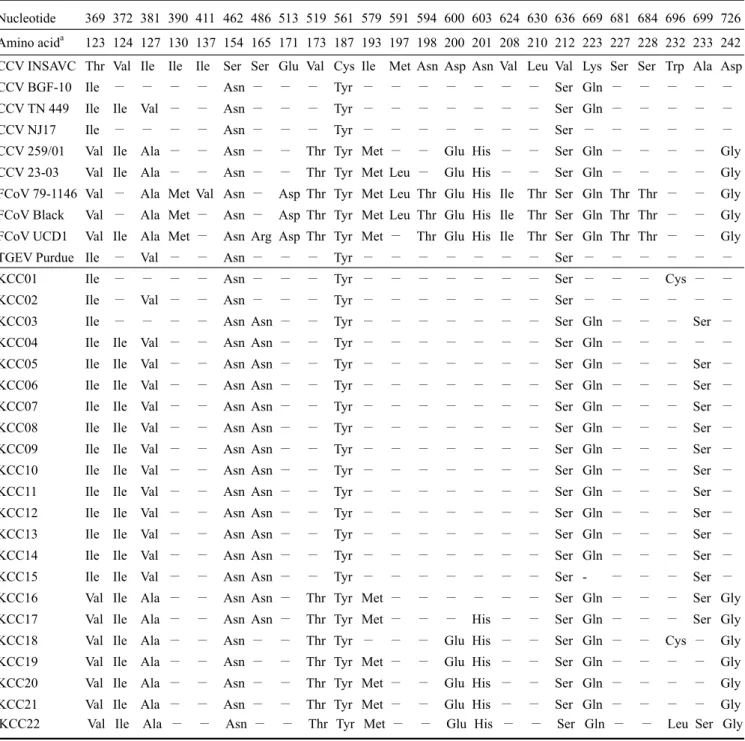
similarity. Furthermore, the Korean strains showed an 89.1% to 99.2% sequence homology with the CCV type II reference strains (i.e., CCV INSAVC-1, BGF-10, NJ17, and TN 449) along with a 92.4% to 100% sequence homology with the FCoV-like CCV type I reference strains (i.e., CCV 259/01 and 23-03). Amino acid sequences of the M gene obtained for nine Korean strains (i.e. KCC06, KCC07, KCC08, KCC09, KCC10, KCC11, KCC12, KCC13, and KCC14) shared a complete identity while those obtained for three Korean strains (i.e. KCC19, KCC20, and KCC21) shared a complete identity with the reference FCoV-like CCV strains (i.e. CCV 259/01 and CCV23-03; Tables 2 and 3). There were characteristic sequence variations of the M gene among the Korean strains (i.e., Ser165Asn, Trp232Cys/Leu, and Ala233Ser).
Although most nucleotide substitutions observed in the Korean strains were synonymous, some substitutions led to amino acid changes (i.e., Ile123Ile/Val, Val124Ile, Ile127Ala, Ser154Asn, Val173Thr, Cys187Tyr, Ile193Met, Asp200Glu, Asn201His, Val212Ser, Lys223Gln, and Asp242Gly; Table 4).
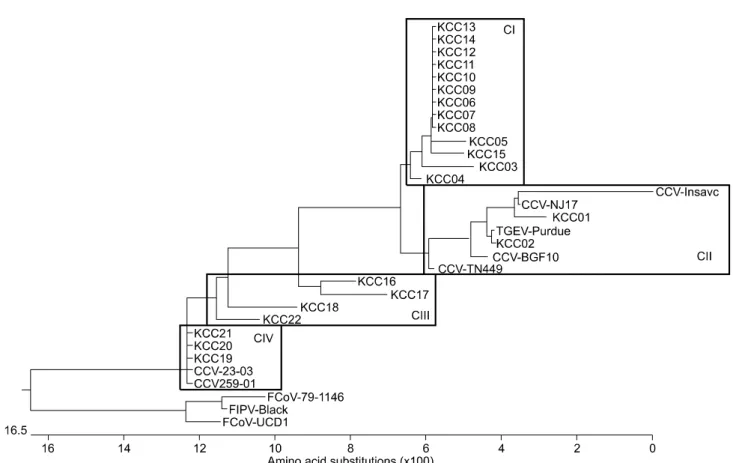
Results of the phylogenetic analysis of the deduced amino acid sequences obtained for the 22 Korean strains and 10 reference coronaviruses are summarized in Fig. 1. The 22 Korean strains belonged to four genetic clusters based on the description of the reference CCV strains of Table 2.
These included a unique Korean CCV cluster (cluster I), CCV type II and TGEV cluster (cluster II), intermediate cluster between CCV type I and II (cluster III), and CCV type I cluster (cluster IV).
Discussion
The M glycoprotein of CCV can elicit strong immune responses [8,21]. The mutations in the M gene might confer some sort of growth advantage or avoiding host immunity [27]. The main purposes of this study were to determine the genetic diversity among CCV strains detected in Korea and examine their relationships to previously characterized strains. Twenty-two CCV strains from domestic dogs with enteritis in Korea were evaluated.
These isolates shared high nucleotide and amino acid identities with each other. The nucleotide and amino acid sequence homologies indicated that most of the Korean strains were more closely related to the CCV type II strain than the FCoV-like CCV (type I) strain. This result is similar to findings from investigations conducted in other countries. Escutenaire et al. [9] showed that Swedish isolates share a higher identity with typical type II CCV based on the deduced amino acid sequences of the 5’ region of the M gene.
Although the number of samples in our study is too small
to yield firm conclusions, we provided evidence that the
circulating CCVs in Korea can be divided into four
Table 4. Amino acid variations of the M gene in the CCV strains analyzed for this study
Nucleotide 369 372 381 390 411 462 486 513 519 561 579 591 594 600 603 624 630 636 669 681 684 696 699 726 Amino acida 123 124 127 130 137 154 165 171 173 187 193 197 198 200 201 208 210 212 223 227 228 232 233 242 CCV INSAVC Thr Val Ile Ile Ile Ser Ser Glu Val Cys Ile Met Asn Asp Asn Val Leu Val Lys Ser Ser Trp Ala Asp CCV BGF-10 Ile − − − − Asn − − − Tyr − − − − − − − Ser Gln − − − − − CCV TN 449 Ile Ile Val − − Asn − − − Tyr − − − − − − − Ser Gln − − − − − CCV NJ17 Ile − − − − Asn − − − Tyr − − − − − − − Ser − − − − − − CCV 259/01 Val Ile Ala − − Asn − − Thr Tyr Met − − Glu His − − Ser Gln − − − − Gly CCV 23-03 Val Ile Ala − − Asn − − Thr Tyr Met Leu − Glu His − − Ser Gln − − − − Gly FCoV 79-1146 Val − Ala Met Val Asn − Asp Thr Tyr Met Leu Thr Glu His Ile Thr Ser Gln Thr Thr − − Gly FCoV Black Val − Ala Met − Asn − Asp Thr Tyr Met Leu Thr Glu His Ile Thr Ser Gln Thr Thr − − Gly FCoV UCD1 Val Ile Ala Met − Asn Arg Asp Thr Tyr Met − Thr Glu His Ile Thr Ser Gln Thr Thr − − Gly TGEV Purdue Ile − Val − − Asn − − − Tyr − − − − − − − Ser − − − − − − KCC01 Ile − − − − Asn − − − Tyr − − − − − − − Ser − − − Cys − − KCC02 Ile − Val − − Asn − − − Tyr − − − − − − − Ser − − − − − − KCC03 Ile − − − − Asn Asn − − Tyr − − − − − − − Ser Gln − − − Ser − KCC04 Ile Ile Val − − Asn Asn − − Tyr − − − − − − − Ser Gln − − − − − KCC05 Ile Ile Val − − Asn Asn − − Tyr − − − − − − − Ser Gln − − − Ser − KCC06 Ile Ile Val − − Asn Asn − − Tyr − − − − − − − Ser Gln − − − Ser − KCC07 Ile Ile Val − − Asn Asn − − Tyr − − − − − − − Ser Gln − − − Ser − KCC08 Ile Ile Val − − Asn Asn − − Tyr − − − − − − − Ser Gln − − − Ser − KCC09 Ile Ile Val − − Asn Asn − − Tyr − − − − − − − Ser Gln − − − Ser − KCC10 Ile Ile Val − − Asn Asn − − Tyr − − − − − − − Ser Gln − − − Ser − KCC11 Ile Ile Val − − Asn Asn − − Tyr − − − − − − − Ser Gln − − − Ser − KCC12 Ile Ile Val − − Asn Asn − − Tyr − − − − − − − Ser Gln − − − Ser − KCC13 Ile Ile Val − − Asn Asn − − Tyr − − − − − − − Ser Gln − − − Ser − KCC14 Ile Ile Val − − Asn Asn − − Tyr − − − − − − − Ser Gln − − − Ser − KCC15 Ile Ile Val − − Asn Asn − − Tyr − − − − − − − Ser - − − − Ser − KCC16 Val Ile Ala − − Asn Asn − Thr Tyr Met − − − − − − Ser Gln − − − Ser Gly KCC17 Val Ile Ala − − Asn Asn − Thr Tyr Met − − − His − − Ser Gln − − − Ser Gly KCC18 Val Ile Ala − − Asn − − Thr Tyr − − − Glu His − − Ser Gln − − Cys − Gly KCC19 Val Ile Ala − − Asn − − Thr Tyr Met − − Glu His − − Ser Gln − − − − Gly KCC20 Val Ile Ala − − Asn − − Thr Tyr Met − − Glu His − − Ser Gln − − − − Gly KCC21 Val Ile Ala − − Asn − − Thr Tyr Met − − Glu His − − Ser Gln − − − − Gly KCC22 Val Ile Ala − − Asn − − Thr Tyr Met − − Glu His − − Ser Gln − − Leu Ser Gly
aAmino acid sequences of the M genes obtained from GenBank. CCV-II: INSAVC (accession no. D13096). CCV-II: BGF-10 (AY342160), CCV-II: TN 449 (AY899209), CCV-II: NJ17: (AY704917), FCoV-like CCV: 259/01 (AF502583), FCoV-like CCV: 23-03 (AY548235), FCoV-I: 79-1146 (DQ010921), FCoV-II: Black (AB086903), FCoV-II: UCD1 (AB086902), and TGEV: Purdue (DQ811789). bAmino acids identical to those in the reference strain are indicated by dashes while amino acids different from those in the reference strain are indicated by letters.