166 http://www.ecevr.org/
CLINICAL
EXPERIMENTAL VACCINE
RESEARCH
Introduction
Porcine epidemic diarrhea (PED) is a common type of viral enteritis in pigs that is caus
ed by PED virus (PEDV). Consistent with the name of the disease, diarrhea is the ma
jor symptom of PED. Additionally, PED presents with various other clinical signs, in
cluding vomiting, anorexia, dehydration, and weight loss (Fig. 1) [1]. PEDV can infect pigs of any age, from neonates to sows or boars; however, the severity of PED in pigs differs according to age [2]. Importantly, PEDV infection in neonatal pigs commonly induces death from watery diarrhea and dehydration. Indeed, in a previous study, re
searchers stated that over 1,000,000 piglets have died from PEDV infection, with a death rate of 80%100% [3]. Such high death rates are associated with huge economic losses.
PED was first observed in Europe in 1971 [4]. The coronaviruslike strain CV777 was isolated from pigs exhibiting diarrhea in a PED outbreak in Belgium in 1976 [1]. This coronaviruslike strain CV777 was designated PEDV and was classified in the genus Alphacoronavirus, family Coronaviridae. During the 1970s and 1980s, the virus spread
© Korean Vaccine Society.
This is an Open Access article distributed under the terms of the Creative Commons Attribution Non-Com- mercial License (http://creativecommons.org/licenses/
by-nc/3.0) which permits unrestricted non-commercial use, distribution, and reproduction in any medium, pro- vided the original work is properly cited.
K O R E A N V A C C I N E S O C I E T Y
K O R E A N K O R E A N A C C I N E O C I E T Y V
S
Clin Exp Vaccine Res 2015;4:166-176 http://dx.doi.org/10.7774/cevr.2015.4.2.166 pISSN 2287-3651 • eISSN 2287-366X
Daesub Song1*,
Hyoungjoon Moon2*, Bokyu Kang2
1Department of Pharmacy, College of Pharmacy, Korea University, Sejong; 2Research Unit, Green Cross Veterinary Products, Yongin, Korea
*These authors contributed equally to this work.
Received: May 23, 2015 Revised: June 20, 2015 Accepted: June 25, 2015
Corresponding author: Bokyu Kang, DVM, PhD Research Unit, Green Cross Veterinary Products, 438 Jungbudae-ro, Yongin 449-903, Korea Tel: +82-283-3423, Fax: +82-281-8814 E-mail: [email protected]
No potential conflict of interest relevant to this article was reported.
This research was supported by the Agricul- tural Biotechnology Development Program, Ministry of Agriculture, Food and Rural affair (No. 114055-03-1-SB010) and BioNano Health- Guard Research Center funded by the Ministry of Science, ICT & Future Planning (MSIP) of Korea as a Global Frontier Project (Grant Number H-GUARD_2013M3A6B2078954, Duration:
2014.01.01~2015.08.31).
Porcine epidemic diarrhea virus (PEDV), an Alphacoronavirus in the family Coronaviridae, causes acute diarrhea, vomiting, dehydration, and high mortality rates in neonatal piglets.
PEDV can also cause diarrhea, agalactia, and abnormal reproductive cycles in pregnant sows. Although PEDV was first identified in Europe, it has resulted in significant economic losses in many Asian swine-raising countries, including Korea, China, Japan, Vietnam, and the Philippines. However, from April 2013 to the present, major outbreaks of PEDV have been reported in the United States, Canada, and Mexico. Moreover, intercontinental transmission of PEDV has increased mortality rates in seronegative neonatal piglets, resulting in 10% loss of the US pig population. The emergence and re-emergence of PEDV indicates that the virus is able to evade current vaccine strategies. Continuous emergence of multiple mutant strains from several regions has aggravated porcine epidemic diarrhea endemic conditions and highlighted the need for new vaccines based on the current circulating PEDV. Epidemic PEDV strains tend to be more pathogenic and cause increased death in pigs, thereby causing sub- stantial financial losses for swine producers. In this review, we described the epidemiology of PEDV in several countries and present molecular characterization of current strains. We also discuss PEDV vaccines and related issues.
Keywords: Porcine epidemic diarrhea , Vaccine, Genetics, Epidemiology
Porcine epidemic diarrhea: a
review of current epidemiology
and available vaccines
throughout Europe. However, during the 1980s and 1990s, the number of PED outbreaks decreased markedly in the re
gion. Only a few severe outbreaks have been reported since the 1980s in Europe. However, PED has become an endemic disease in Asian pig farming countries, such as Korea, China, Vietnam, Japan, the Philippines, Taiwan, and Thailand [59].
Until 2013, PED was thought to have been restricted to Asian countries. However, an outbreak of PEDV infection occurred in the United States in Iowa in April 2013, and within 1 year, PEDV had spread to Canada and Mexico [10], which share borders with the United States. Additionally, PED outbreaks occurred in Korea and Japan, across the Pacific Ocean, also within 1 year of the US outbreak [11,12]. The PEDV strain iso
lated in the United States was genetically related to the Chi
nese PEDV strain reported in 2012 [13]. Interestingly, the Ko
rean and Taiwanese PEDV strains isolated after the US out
break were genetically related to the US PEDV strain [11].
After spring 2013, PED was no longer found only in Asia.
US scientists who had not researched PEDV began to study this disease, which had previously not been a problem in Ame
ri can. From this, a PED vaccine reflecting the genetic charac
teristics of the PEDV strain isolated during the US outbreak was commercialized [14]. Moreover, many veterinary scien
tists have focused on the development of more effective PED vaccines because of the major economic losses associated with PED outbreaks. After the US outbreak, sporadic PED out
Fig. 1. Photographic records of porcine epidemic diarrhea virus (PEDV) outbreaks. (A, B) During a 2006 outbreak on a commercial farm in Gimpo.
South Korean, piglets <1 week of age died from severe watery diarrhoea after showing signs of dehydration. After the acute outbreak, piglets were anorectic, depressed, vomiting, and producing water faeces that did not contain any signs of blood. (C) Necropsies of deceased piglets from the Gimpo outbreak uncovered gross lesions in the small intestines, which were typically fluidic, distended, and yellow, containing a mass of curdled, undigested milk. Atrophy of the villi caused the walls of the small intestines to become thin and almost transparent. (D) Yellowish watery diarrhea in sucling piglets after acute infection of PEDV.
A
C
B
D
breaks occurred in Germany. Therefore, European countries were not isolated from the spread of the US PEDV [15]. Thus, the US outbreak was important turning point in PED research, and PED research can be said to be divided into two eras: be
fore and after 2013.
This review covers the vaccine, epidemiology, genetic struc
ture, and characteristics of PED/PEDV after 2013. This report may improve our understanding of this disease, which is cur
rently the most fatal disease in pigs and one of the most costly health issues in animals. Furthermore, this review may pro
vide insight into important topics for investigation in PED re
search.
Genetic Structure and Characteristics of PEDV
The genome of PEDV is positivesense, singlestranded RNA.
The size of PEDV genomic RNA is about 28 kb. The organiza
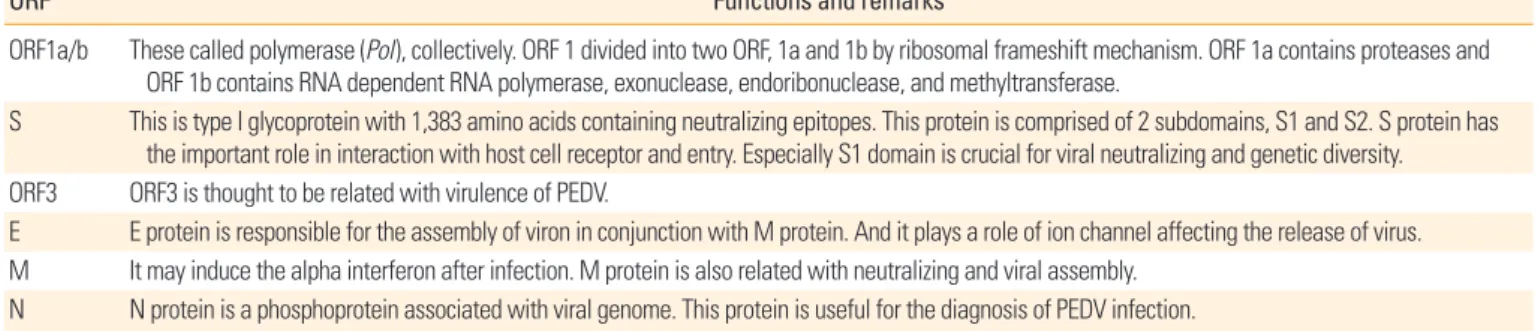
tion of the PEDV genome is presented in Table 1. From the 5′
cap to the 3′ poly A tail, PED genomic RNA contains seven open reading frames (ORFs) encoding viral proteins. ORF1a and ORF1b encode the viral polymerase. ORF3 encodes a non
structural protein with an unknown function; this protein is thought to be related to viral pathogenicity [16]. Additionally, the other ORFs have specific names according to the proteins encoded in these regions, i.e., spike (S), envelope (E), matrix (M), and nucleocapsid (N) proteins [7,17]. Table 1 presents the characteristics of the PEDV proteins as described in pre
vious articles.
Of the PEDV proteins, the S protein is considered the most antigenic. As summarized in Table 1, the S protein is respon
sible for the interaction with host cellular receptor molecules [18,19]. This interaction is crucial for the entry of the virus and is related to induction of neutralizing antibodies against the virus [18,20,21]. Additionally, these critical characteristics of
the S protein are used for analysis of the molecular epidemi
ology of PEDV.
Thus, PEDV researchers have started to analyze the geno
types of PEDV using the S gene [22]. While other genes, such as the gene encoding the M protein and the gene encoded in ORF3 [2325] have been used for phylogeny or molecular epi
demiological studies, genetic diversity of the S gene is the fo
cus of this review. One of the most interesting characteristics of the S gene is the diversity in this gene that has occurred from the end of 1970s to the present. Genotypes in the S gene of PEDV could be important because this gene may affect the pathogenicity of novel PED outbreaks based on variations in the S gene [3,1012,16,2629]. Moreover, the Chinese PED out
break in 2011 involved the presence of new variants based on the nucleotide similarities in the S gene. This variant PEDV exhibited 93% similarity with the CV777 prototype PEDV strain in the S gene [29]. Moreover, the PEDV isolated after the US outbreak also exhibited 89%92% similarity with the S protein of CV777 [26,27]. Phylogenetic analyses of PEDV RNA have been reported in many previous studies [7,16,26,27,30].
Whether the 10% nucleotide difference often observed in the S gene can affect the pathogenesis of PEDV has not been clarified. However, the similarities in the S gene, which is re
sponsible for the host interaction and normalization, the S1 region in particular could be important in vaccine efficacy and development strategies [7,17]. Neutralizing epitopes of the PEDV S protein have been investigated [20]. In particular, the CO26K equivalent (COE) is a neutralizing epitope within the CO26K collagenase fragment in transmissible gastroen
teritis virus (TGEV) [31,32]. In the prototype PEDV (CV777) and vaccine strains, certain COEs are different from field iso
lates that were isolated after 2011. The different COEs are 549T and 594G in the prototype and vaccine strains, respectively (Table 2); however, other COEs that differ from that of CV777 have been shown to be identical to the vaccine strains 83P5
Table 1. Summary of the genomic organization and its functions of PEDV
ORF Functions and remarks
ORF1a/b These called polymerase (Pol), collectively. ORF 1 divided into two ORF, 1a and 1b by ribosomal frameshift mechanism. ORF 1a contains proteases and ORF 1b contains RNA dependent RNA polymerase, exonuclease, endoribonuclease, and methyltransferase.
S This is type I glycoprotein with 1,383 amino acids containing neutralizing epitopes. This protein is comprised of 2 subdomains, S1 and S2. S protein has the important role in interaction with host cell receptor and entry. Especially S1 domain is crucial for viral neutralizing and genetic diversity.
ORF3 ORF3 is thought to be related with virulence of PEDV.
E E protein is responsible for the assembly of viron in conjunction with M protein. And it plays a role of ion channel affecting the release of virus.
M It may induce the alpha interferon after infection. M protein is also related with neutralizing and viral assembly.
N N protein is a phosphoprotein associated with viral genome. This protein is useful for the diagnosis of PEDV infection.
PEDV, porcine epidemic diarrhea virus; ORF, open reading frame; S, spike; E, envelope; M, matrix; N, nucleocapsid.
100th or attenuated DR13 [33]. In PEDV isolates acquired af
ter 2011 in China, these amino acids were changed to serine;
similar observations were made for the PEDV strain from the US outbreak [29]. The new variant PEDV strains have similar mutational patterns for the neutralizing epitope. In contrast, PEDV strains isolated from 2002 to 2009 exhibit different pat
terns in 549T and 594G compared to strains isolated after 2011.
Interestingly, at amino acid position 549, some strains exhibit no changes; however, in most strains, amino acid 549 is chang
ed to arginine (R). Additionally, most strains exhibit a change from G to S at amino acid position 594, similar to current stra
ins [22].
In order to elucidate the positive correlations between chan
ges in the S protein and virulence or vaccine efficacy, further studies involving animal models are needed.
In addition to the changes in the S protein described above, more variations have been discovered. For example, Park et al. [34] reported large deletion in the S protein from amino acid 713 to amino acid 916, within the S1 and S2 domains.
This virus was detected in 2008, and other regions of the S protein share 92.8%96.9% amino acid identity in the partial S1 domain with other strains isolated in Korean in 2008 and 2009. In the United States, a deletion in the S gene was also
reported after the United States outbreak. In December 2013, a strain with deletion of the S gene was detected and isolated in Ohio [35]. This strain exhibited patterns that were different from those of the Korean strain with the S gene deletion. The US deletion mutant contains a large deletion (197 amino ac
ids in length, from amino acid 34 to amino acid 230) in the S1 domain [35]. The effects of deletion in the S protein should be further investigated and are reminiscent of porcine respirato
ry coronavirus arising from S protein deletion in the genome of TGEV [34,35].
Through PEDV research, unique genetic characteristics other than those in the S gene have been reported. Fulllength analysis of the ORF3 gene of PEDV revealed a 51bp deletion in the cellattenuated PEDV strain DR13 [23]. This deletion in the ORF3 gene has not been identified in wildtype PEDV;
however, in addition to the attenuated PEDV DR13 strain, live PEDV vaccine strains available in Korea exhibit similar dele
tion patterns by reverse transcription polymerase chain reac
tion (RTPCR) comparisons [23]. This deletion pattern is clin
ically useful for differentiation of live vaccine strains from wild
type PEDV casing diarrhea.
The final genetic mutation we will discuss is deletion of the E gene in the cellattenuated PEDV strain DR13. Genetic anal
ysis has focused on the S, N, and M genes. From analysis of the E gene, a unique deletion was found. Moreover, compar
ed to other PEDV strains, including the wildtype and vaccine strains, only the attenuated PEDV strain DR13 has been shown to have a 21bp deletion in this gene [30]. The E protein of the coronavirus is responsible for the assembly of the virus and cell stress responses [36]. The effects of the E gene deletion are under investigation.
Recent Epidemiology in Several Countries
Europe
In the Czech Republic, Rodak et al. [37] reported that 27 out of 219 fecal samples from diarrheic piglets (<21 days old) were positive for PEDV. This outbreak occurred between May 2005 and June 2006 in an area densely populated with pigs in the Po Valley in northern Italy [38]. Some PEDVpositive farms (35 out of 476) were detected between mid2006 and the end of 2007; however, the disease progressively disappeared [39].
During the period from 2007 to 2014, mild clinical signs were report in pigs of all ages, and mortality was observed in pig
lets only in PEDVpositive farms [40].
Table 2. Comparison of the COE region of PEDV S gene Strains (year/country) Accession
number or reference
Amino acid COE in CV777 (AF353511)
549T 594G
83P-5 100th (1985/Japan) AB548621 - -
SM98 (1998/Korea) GU937797 - -
Chinju99 (1999/Korea) AY167285 R -
Attenuated DR13 (2001/Korea) JQ023162 - -
DBI1825 (2002/Korea) (19) - S
BI1482 (2003/Korea) (19) - S
E1695 (2003/Korea) (19) - S
BI1166 (2003/Korea) (19) S S
JS-2004-2 (2004/China) AY653204 S S
M2503 (2005/Korea) (19) R S
E2540 (2005/Korea) (19) R S
KNU-0802 (2008/Korea) GU180143 R S
MF3809 (2008/Korea) KF779469 S S
KNU-0904 (2009/Korea) GU180147 R -
KNU-0905 (2009/Korea) GU180148 R S
CHGD-01 (2011/China) JX261936 S S
CH-GDHY-2011 (2011/China) JX145339 S S
USA/Colorado/2013 (2013/USA) KF272920 S S
COE, CO-26K equivalent; PEDV, porcine epidemic diarrhea virus.
Asia
In the last decade, PEDV outbreaks have been reported in se
veral Asian countries, including Thailand [4144], Taiwan [12], the Philippines [45], South Korea [46], and the southern prov
inces of Vietnam [47]. In October 2010, a largescale outbreak of PEDV was reported in several provinces in southern China.
PEDV also spread to other regions of the country, particularly in northwest [48]. PEDV is now circulating in at least 29 Chi
nese provinces [49]. In October 2013, Japan reported a PEDV outbreak to the World Organization for Animal Health (OIE) [15] after a period of 7 years without an outbreak. According to the information provided by Japan’s National Institute of Animal Health, PEDV isolates from this outbreak are geneti
cally related to the PEDV isolates recovered from China and the United States in 2013. In addition, in late 2013, PEDV out
breaks were reported in South Korea and Taiwan [12,50,51].
America
The US PEDV strains identified during the US outbreak were genetically related to the Chinese strains (China/2012/AH2012) reported in 20112012 [13,26]. PEDV was first identified with
in the United States in Iowa in May 2013, although testing of historical samples showed that PEDV occurred the month before in Ohio. PEDV rapidly spread throughout the country and was confirmed on farms from 32 states, including Ohio, Indiana, Iowa, Minnesota, Oklahoma, Illinois, and North Car
olina, by the end September 2014 [15]. PEDV was detected in Mexico for the first time in July 2013 [52]. In October 2013, PEDV was identified for the first time in Peru [53]. In Novem
ber 2013, PEDV was also identified as the cause of outbreaks of diarrhea in farms in the Espaillat province, Dominican Re
public. By September 2014, PED outbreaks were reported in seven of the 31 provinces in the Dominican Republic [54]. In April 2014, Canada reported outbreaks of PEDV to the OIE;
these outbreaks started in January and affected 58 herds in four provinces [15]. An acute outbreak of diarrhea and death in lactating piglets was observed in Columbia in March 2014.
By September 2014, 54 samples from six departments were confirmed via laboratory testing [55].
Detection of PEDV Antigen
Several reports have described the development of RTPCR as a diagnostic technique for detection of both laboratory and field isolates [5659]. Primers derived from the M gene can be used in an RTPCR system to obtain PEDVspecific
fragments [57], and duplex RTPCR has been used to differ
entiate between TGEV and PEDV [60]. Within the past few years, several useful modifications of the basic RTPCR meth
od have been reported. For example, it is possible to estimate the potential transmission of PEDV by comparing viral shed
ding load with a standard internal control DNA curve [61]
and by multiplex RTPCR to detect PEDV in the presence of various viruses [62]—a technique that is particularly useful for rapid, sensitive, and costeffective diagnosis of acute viral gastroenteritis in swine. The commercial dual priming oligo
nucleotide system (Seegene, Seoul, Korea) (Fig. 2) has been developed for the rapid differential detection of PEDV. This system employs a single tube onestep multiplex RTPCR with two separate primer segments to block nonspecific priming [63]. Recently, a proteinbased enzymelinked immunosor
bent assay (ELISA) system was developed to detect PEDV.
Using this technique, a polyclonal antibody is produced by immunizing rabbits with purified PEDV M gene after its ex
pression in Escherichia coli. Immunofluorescence analysis can then be carried out with the antiPEDVM antibody in order to detect PEDVinfected cells among other enteric vi
ruses [64].
Another useful reverse transcriptionbased diagnostic tool is RT loopmediated isothermal amplification. This assay, which uses 46 primers that recognize 68 regions of the tar
get DNA, is more sensitive than gelbased RTPCR and ELI
Fig. 2. The multiplex RT-PCR assay and dual priming oligonucleotide (DPO) system can be used in diagnosis of porcine epidemic diarrhea virus (PEDV). PEC, porcine enteric calici virus; TGEV, transmissible gas- troenteritis virus; PoTV, porcine torovirus; RotaA, rotavirus type A.
Figure 2.
.
Internal control, 1,000 bp
PEC, 623 bp PEDV, 502 bp TGEV, 438 bp PoTV, 352 bp Rota A, 239 bp
SA, largely because this method produces a greater quantity of DNA [65]. Immunochromatographic assay kits can be used at farms in order to detect the N (nucleocapsid) protein of PEDV with 92% sensitivity and 98% specificity. Moreover, a rapid technique for differential detection of PEDV and por
cine rotavirus (RV) has recently been commercialized and is now widely used in the field (Fig. 3). This technique is less sensitive than RTPCR, but allows for diagnosis within 10 min
utes. Thus, it is particularly effective for quickly determining quarantine or slaughter policies in the field.
Interestingly, some reports have commented on the detec
tion of PEDV genomic DNA in sera. Genomic detection in gno
tobiotic piglets has been reported for serum viral RNA con
centrations ranging from 4.8 to 7.6 log10 genomic equivalents (GE)/mL after inoculation of the US PEDV strain. Similar de
tection of the PEDV genome has been observed in diarrheic pigs at age 1320 weeks (4.06.3 log10 GE/mL) [17]. However, no infectious PEDV has been recovered from genomeposi
tive sera samples. Unfortunately, after intensive screening and trials to isolate the PEDV genome from serum samples, we have not succeeded in this endeavor (data not shown).
Immunoprophylaxis
Enteropathogenic viruses can be divided into two types (type I and II) according to their infection site in the intestine [66].
Viruses infecting villous enterocytes, including TGEV, PEDV, and RV, are type I viruses and can be suppressed by local gut
associated immunity. Diseases caused by type II viruses, which infect crypt enterocytes basolaterally (e.g., canine parvovirus), can be prevented by inducing systemic or mucosal immuni
ty. In this review, we discuss control strategies for reducing viral shedding, mortality, and the transmission of PEDV in swine herds, such as transmission occurring from artificial oral exposure (i.e., the feedback method) and vaccines.
In naïve swine herds, PED is characterized by vomiting and acute diarrhea and results in high mortality rates in piglets less than 2 weeks of age. Neonatal pigs are born without ma
ternal antibodies if they are not infected in utero, and they should receive passive lactogenic immunity (IgG and IgA) through intake of colostrum and milk to promote survival af
ter birth. Therefore, maternalderived immunity at an early age is critical for passive protection of neonatal pigs; for this purpose, immunization of the dam preparturition has been used successfully [66]. IgG is the major immunoglobulin com
ponent in pig colostrum, consisting of more than 60% of all immunoglobulins, but is not found in milk. IgA accounts for a substantially reduced percentage of colostrum immunoglob
ulin content; however, IgA is more effective than IgG or IgM at protecting animals from orally infected agents because it is more resistant to the activity of proteolytic enzymes in the in
testine and has a higher neutralizing ability than IgG and IgM [67]. Bohl et al. [68] and Saif et al. [69] demonstrated that oral inoculation of seronegative sows with live virulent TGEV re
sults in high rates of protection in suckling piglets. In these sows, passive protection is associated with high titers of se
cretory IgA (sIgA) in colostrum and milk. This investigation suggested the presence of a gutmammary glandsIgA axis;
that is, IgA plasmablasts stimulated in the gut by virulent path
ogens migrate to the gut lamina propria and mammary glands.
Several highly attenuated oral TGEV vaccines, which repli
cate lower in the gut, induce poor milk sIgA titers compared with virulent TGEV in sows and result in lower protective effi
cacy in piglets [68,69]. This research could be employed to maternal immunization strategies for PEDV.
In areas where no effective PED vaccines are available, some veterinarians have recommended artificial infection of sows (i.e., the feedback method) during pregnancy to supply lacto
Fig. 3. Results of an immunochromatographic assay kit that can be used for porcine epidemic diarrhea virus (PEDV) detection. (A) The up- per and lower panels show positive and negative results, respective- ly. (B) Dual-detecting immunochromatographic kit for the detection of PEDV and porcine rotavirus.
A
B
genic immunity to their piglets [70]. The recommended feed
back material is pooled feces collected from infected piglets during the first 18 hours of infection. Every sow on the farm should be simultaneously administered feces containing high titers of PEDV, allowing all sows and gilts to recover at approx
imately the same time and stop shedding the virus.
One of advantage of this type of feedback method is strong stimulation of mucosal immunity in the gut and a quick re
sponse after immunization. After successful feedback, the piglets will be protected during the first few days after birth by passive antibodies through colostrum and milk. However, there is a potential risk of transmission of the contaminated viral or bacterial agents in the inoculum (e.g., porcine circovi
rus type 2 [PCV2] infection, porcine reproductive and respi
ratory syndrome virus [PRRSV], and salmonellosis) [71,72].
Additionally, it is possible that PEDV may spread rapidly in pigs of all ages in the index farms. The severity of the disease may vary with unknown factors, such as stress, nutrition, or coinfection. In addition, there is a risk that the virulent virus used for feedback materials may spread to and produce dis
ease in other herds. Irregular immune responses in sows after feedback may also be a major concern for optimal induction of herd immunity for protection. All of these possibilities em
phasize the need for a safe and effective PEDV vaccine to pro
tect both sows and piglets.
Vaccine, Efficacy, and Controversies
For the prevention of PEDV infection, several vaccines have been reported in Asian countries; the predominance of vac
cines in Asian countries, but not in Europe or America, is thou
ght to be related to the occurrence of severe PED outbreaks and major economic losses in Asia [7]. Commercial PEDV vaccines include live attenuated vaccines and binary ethyl
enimine (BEI) inactivated vaccines. Some of these vaccines have been combined with vaccines for TGEV (a bivalent vac
cine) and porcine RV (a trivalent vaccine) and used in China and South Korea [7,25]. Moreover, an attenuated virus vac
cine using cell cultureadapted PEDV has been administered to sows in Japan since 1997. Oral vaccination with a cellat
tenuated vaccine has been used in South Korea since 2004 and in the Philippines since 2011 [7]. Although these commer
cial vaccines are considered effective and have been widely used, not all animals develop solid lactogenic immunity. Sev
eral factors are thought to be associated with the poor lacto
genic immunogenicity of the commercial vaccine, including
the immunizing route of the vaccine. Song et al. [73] demon
strated that oral inoculation of PEDVseronegative pregnant sows with live attenuated PEDV reduces the mortality of suck
ling piglets more effectively rather than injection after chal
lenge, and this protection is associated with elevated IgA con
centrations in colostrum and milk. Despite the reduction in mortality rates in piglets delivered from orally vaccinated sows, there was no shortening of the duration of virus shedding and no reduced severity of diarrhea after challenge between vac
cinated and control pigs. Thus, some researchers may con
clude that passive immunity by vaccination with the highly attenuated PEDV strain DR13 does not prevent virus shedding after challenge. Protection against virus challenge in conven
tional pigs is related to the inoculation dose of the virus in the vaccine and the challenge dose of the virulent virus. At low doses of the attenuated PEDV, 25% of pigs are protected against PEDV challenge; however, this proportion increases to 50%
when pigs are inoculated with a dose 20 times higher [74].
Moreover, loss of body weight and the content of viral shed
ding decrease in orally vaccinated pigs compared with those in intramuscularly vaccinated and unvaccinated pigs follow
ing challenge with a low dose of virulent virus (1 LD50, 103.0 TCID50/dose). Additionally, the lethal dose of PEDV changes depending on the body weights of the infected piglets and in
fection of sows with the challenge virus (data not shown).
However, several publications have questioned the efficacy and/or safety of PEDV vaccines used in Asia [3,28,44,75,76].
In particular, after the US outbreak, the efficacy of commer
cial PED vaccines in Korea became controversial, and simul
taneously, there was an urgent need for a new vaccine in or
der to establish solid immunity in sow herds prior to farrow
ing to protect piglets. Furthermore, many groups have debat
ed the appropriate standards for evaluation of the efficacy of vaccines after official challenge tests using currently available PEDV vaccines in South Korea in 2014. Information on PEDV mucosal immunity is limited. Moreover, due to the complex characteristics of mucosal viral diseases, simple criteria, such as serum neutralizing antibodies, severity of diarrhea, and mortality after virulent challenge, are insufficient for the ac
curate and optimal evaluation of PEDV vaccine efficacy. For detailed identification of standards for the evaluation of PEDV vaccines after virulent challenge, the following criteria, which may not be controllable, should be taken into consideration:
Characteristics of piglets used in the challenge test: con
ventional or specific pathogenfree piglets, weight of pig
lets
Characteristics of sows: parity number, existence of aga
lactia or coinfection with other viral and bacterial patho
gens, number of delivered piglets
Quantity of challenged virus: amount of viral load for the challenge virus may result in discrepancies in the observ
ed mortality rates of piglets
Cohabitation with sows: the conditions of piglets challeng
ed with virulent virus could be affected by the occurrence of viral shedding by sows
Duration of the challenge test
The vaccine strains commonly used in Korea display a max
imum difference of 10% at the amino acid level compared with field viruses. Additionally, using SN assays, the SM98 vaccine strain was shown to exhibit variable crossreactivity with several antisera against other vaccines and field viruses, implying that these vaccines would confer protection against the vaccine prepared using wildtype PEDVs from the field [77]. However, the crossprotection between vaccine strains and field viruses should be elucidated through animal exper
iments, which can show protection based on lactogenic im
munity after vaccination. For the ideal development of PEDV vaccines, new vaccine strains that are genetically related to field viruses are critical. Furthermore, several criteria, includ
ing factors related to the reduction in virus shedding and loss of body weight in piglets as well as the details of mucosal im
munity and the relationships between protection and immu
nity, should be considered and identified during the develop
ment of nextgeneration PED vaccines.
Conclusion
PEDV research has become a hot topic in veterinary virology since the US outbreak in 2013. PED had been a regional dis
ease primarily found in Asian countries. However, PED was transmitted to the United States and subsequently to neigh
boring countries, including Mexico and Canada. European countries have also encountered PEDV. Accordingly, with the spread of the PED outbreak area, research on PEDV has in
creased rapidly. Veterinarians and veterinary scientists are striving to breakthroughs to combat current PED outbreaks worldwide, and remarkable advances have been made in the relatively short time after the 2013 outbreak.
Therefore, reasonable methods for PED vaccine evaluation, along with the development of new vaccines, are urgently need
ed, and this complicated process could provide valuable in
formation on PEDV, immune responses to PEDV infection,
and PEDV pathobiology. Furthermore, rational evaluation procedures can help swine farmers understand and control PED more efficiently.
ORCID
Daesub Song http://orcid.org/0000-0002-2759-1061 Hyoungjoon Moon http://orcid.org/0000-0001-6211-8758 Bokyu Kang http://orcid.org/0000-0001-5840-468X
References
1. Pensaert MB, de Bouck P. A new coronaviruslike particle associated with diarrhea in swine. Arch Virol 1978;58:2437.
2. Shibata I, Tsuda T, Mori M, Ono M, Sueyoshi M, Uruno K.
Isolation of porcine epidemic diarrhea virus in porcine cell cultures and experimental infection of pigs of differ
ent ages. Vet Microbiol 2000;72:17382.
3. Sun RQ, Cai RJ, Chen YQ, Liang PS, Chen DK, Song CX.
Outbreak of porcine epidemic diarrhea in suckling pig
lets, China. Emerg Infect Dis 2012;18:1613.
4. Oldham J. Letter to the editor. Pig Farming 1972;10:723.
5. Jinghui F, Yijing L. Cloning and sequence analysis of the M gene of porcine epidemic diarrhea virus LJB/03. Virus Genes 2005;30:6973.
6. Kusanagi K, Kuwahara H, Katoh T, et al. Isolation and se
rial propagation of porcine epidemic diarrhea virus in cell cultures and partial characterization of the isolate. J Vet Med Sci 1992;54:3138.
7. Song D, Park B. Porcine epidemic diarrhoea virus: a com
prehensive review of molecular epidemiology, diagnosis, and vaccines. Virus Genes 2012;44:16775.
8. Kweon CH, Kwon BJ, Jung TS, et al. Isolation of porcine epidemic diarrhea virus (PEDV) in Korea. Korean J Vet Res 1993;33:24954.
9. Takahashi K, Okada K, Ohshima K. An outbreak of swine diarrhea of a newtype associated with coronaviruslike particles in Japan. Nihon Juigaku Zasshi 1983;45:82932.
10. Vlasova AN, Marthaler D, Wang Q, et al. Distinct charac
teristics and complex evolution of PEDV strains, North America, May 2013February 2014. Emerg Infect Dis 2014;
20:16208.
11. Cho YY, Lim SI, Kim YK, Song JY, Lee JB, An DJ. Complete genome sequence of K14JB01, a novel variant strain of por
cine epidemic diarrhea virus in South Korea. Genome An
nounc 2014;2:e0050514.
12. Lin CN, Chung WB, Chang SW, et al. USlike strain of por
cine epidemic diarrhea virus outbreaks in Taiwan, 2013
2014. J Vet Med Sci 2014;76:12979.
13. Huang YW, Dickerman AW, Pineyro P, et al. Origin, evolu
tion, and genotyping of emergent porcine epidemic diar
rhea virus strains in the United States. MBio 2013;4:e00737
13.
14. PED vaccine gains conditional approval. J Am Vet Med Assoc 2014;245:267.
15. ESFA Panel on Animal Health and Welfare (AHAW). Sci
entific opinion on porcine epidemic diarrhoea and emerg
ing porcine deltacoronavirus. EFSA J 2014;12:3877.
16. Sun R, Leng Z, Zhai SL, Chen D, Song C. Genetic variabil
ity and phylogeny of current Chinese porcine epidemic diarrhea virus strains based on spike, ORF3, and mem
brane genes. ScientificWorldJournal 2014;2014:208439.
17. Jung K, Saif LJ. Porcine epidemic diarrhea virus infection:
etiology, epidemiology, pathogenesis and immunopro
phylaxis. Vet J 2015;204:13443.
18. Bosch BJ, van der Zee R, de Haan CA, Rottier PJ. The coro
navirus spike protein is a class I virus fusion protein: struc
tural and functional characterization of the fusion core complex. J Virol 2003;77:880111.
19. Cruz DJ, Kim CJ, Shin HJ. The GPRLQPY motif located at the carboxyterminal of the spike protein induces antibo
dies that neutralize porcine epidemic diarrhea virus. Virus Res 2008;132:1926.
20. Chang SH, Bae JL, Kang TJ, et al. Identification of the epit
ope region capable of inducing neutralizing antibodies against the porcine epidemic diarrhea virus. Mol Cells 2002;
14:2959.
21. Godet M, Grosclaude J, Delmas B, Laude H. Major recep
torbinding and neutralization determinants are located within the same domain of the transmissible gastroenteri
tis virus (coronavirus) spike protein. J Virol 1994;68:8008
16.
22. Park SJ, Moon HJ, Yang JS, et al. Sequence analysis of the partial spike glycoprotein gene of porcine epidemic diar
rhea viruses isolated in Korea. Virus Genes 2007;35:321
32.
23. Park SJ, Moon HJ, Luo Y, et al. Cloning and further sequence analysis of the ORF3 gene of wild and attenuatedtype porcine epidemic diarrhea viruses. Virus Genes 2008;36:
95104.
24. Chen JF, Sun DB, Wang CB, et al. Molecular characteriza
tion and phylogenetic analysis of membrane protein genes
of porcine epidemic diarrhea virus isolates in China. Virus Genes 2008;36:35564.
25. Chen J, Wang C, Shi H, et al. Molecular epidemiology of porcine epidemic diarrhea virus in China. Arch Virol 2010;
155:14716.
26. Chen Q, Li G, Stasko J, et al. Isolation and characterization of porcine epidemic diarrhea viruses associated with the 2013 disease outbreak among swine in the United States. J Clin Microbiol 2014;52:23443.
27. Meng F, Ren Y, Suo S, et al. Evaluation on the efficacy and immunogenicity of recombinant DNA plasmids express
ing spike genes from porcine transmissible gastroenteritis virus and porcine epidemic diarrhea virus. PLoS One 2013;
8:e57468.
28. Luo Y, Zhang J, Deng X, Ye Y, Liao M, Fan H. Complete ge
nome sequence of a highly prevalent isolate of porcine epidemic diarrhea virus in South China. J Virol 2012;86:
9551.
29. Li W, Li H, Liu Y, et al. New variants of porcine epidemic di
arrhea virus, China, 2011. Emerg Infect Dis 2012;18:13503.
30. Park SJ, Song DS, Park BK. Molecular epidemiology and phylogenetic analysis of porcine epidemic diarrhea virus (PEDV) field isolates in Korea. Arch Virol 2013;158:1533
41.
31. Correa I, Jimenez G, Sune C, Bullido MJ, Enjuanes L. Anti
genic structure of the E2 glycoprotein from transmissible gastroenteritis coronavirus. Virus Res 1988;10:7793.
32. Delmas B, Rasschaert D, Godet M, Gelfi J, Laude H. Four major antigenic sites of the coronavirus transmissible gas
troenteritis virus are located on the aminoterminal half of spike glycoprotein S. J Gen Virol 1990;71(Pt 6):131323.
33. Hao J, Xue C, He L, Wang Y, Cao Y. Bioinformatics insight into the spike glycoprotein gene of field porcine epidemic diarrhea strains during 20112013 in Guangdong, China.
Virus Genes 2014;49:5867.
34. Park S, Kim S, Song D, Park B. Novel porcine epidemic di
arrhea virus variant with large genomic deletion, South Korea. Emerg Infect Dis 2014;20:208992.
35. Oka T, Saif LJ, Marthaler D, et al. Cell culture isolation and sequence analysis of genetically diverse US porcine epi
demic diarrhea virus strains including a novel strain with a large deletion in the spike gene. Vet Microbiol 2014;173:
25869.
36. Ruch TR, Machamer CE. The coronavirus E protein: as
sembly and beyond. Viruses 2012;4:36382.
37. Rodak L, Valicek L, Smid B, Nevorankova Z. An ELISA op
timized for porcine epidemic diarrhoea virus detection in faeces. Vet Microbiol 2005;105:917.
38. Martelli P, Lavazza A, Nigrelli AD, Merialdi G, Alborali LG, Pensaert MB. Epidemic of diarrhoea caused by porcine epidemic diarrhoea virus in Italy. Vet Rec 2008;162:30710.
39. Sozzi E, Luppi A, Lelli D, et al. Comparison of enzymelink
ed immunosorbent assay and RTPCR for the detection of porcine epidemic diarrhoea virus. Res Vet Sci 2010;88:1668.
40. Sozzi E, Papetti A, Lelli D, et al. Diagnosis and investiga
tions on PED in Northern Italy. In: The 8th Annual EPI
ZONE Meeting; 2014 Sep 2325; Copenhagen, Denmark.
41. Temeeyasen G, Srijangwad A, Tripipat T, et al. Genetic di
versity of ORF3 and spike genes of porcine epidemic diar
rhea virus in Thailand. Infect Genet Evol 2014;21:20513.
42. Puranaveja S, Poolperm P, Lertwatcharasarakul P, et al.
Chineselike strain of porcine epidemic diarrhea virus, Thailand. Emerg Infect Dis 2009;15:11125.
43. Olanratmanee EO, Kunavongkrit A, Tummaruk P. Impact of porcine epidemic diarrhea virus infection at different periods of pregnancy on subsequent reproductive perfor
mance in gilts and sows. Anim Reprod Sci 2010;122:4251.
44. Ayudhya SN, Assavacheep P, Thanawongnuwech R. One worldone health: the threat of emerging swine diseases.
An Asian perspective. Transbound Emerg Dis 2012;59 Suppl 1:917.
45. Morales RG, Umandal AC, Lantican CA. Emerging and re
emerging diseases in Asia and the Pacific with special em
phasis on porcine epidemic diarrhoea. Conf OIE 2008;2007:
1859.
46. Lee DK, Park CK, Kim SH, Lee C. Heterogeneity in spike protein genes of porcine epidemic diarrhea viruses isolat
ed in Korea. Virus Res 2010;149:17582.
47. Duy DT, Toan NT, Puranaveja S, Thanawongnuwech R.
Genetic characterization of porcine epidemic diarrhea vi
rus (PEDV) isolates from southern Vietnam during 2009
2010 outbreaks. Thai J Vet Med 2011;41:5564.
48. Wang H, Xia X, Liu Z, et al. Outbreak of porcine epidemic diarrhea in piglets in Gansu province, China. Acta Sci Vet 2013;41:1140.
49. Feng L. The updated epidemic and controls of swine en
teric coronavirus in China. In: International Conference on Swine Enteric Coronavirus Diseases; 2014 Sep 2325;
Chicago, IL, USA.
50. Lee S, Lee C. Outbreakrelated porcine epidemic diarrhea virus strains similar to US strains, South Korea, 2013. Emerg Infect Dis 2014;20:12236.
51. Choi JC, Lee KK, Pi JH, et al. Comparative genome analy
sis and molecular epidemiology of the reemerging por
cine epidemic diarrhea virus strains isolated in Korea. In
fect Genet Evol 2014;26:34851.
52. Fajardo R, Alpizar A, Martinez A, et al. Two cases report of PED in different states in México. In: Proceedings of the 23rd International Pig Veterinary Society (IPVS) Congress;
2014 Jun 811; Cancun, Mexico.
53. QuevedoValle MV. Porcine epidemic diarrhea outbreak in Peru. In: International Conference on Swine Enteric Coronavirus Diseases; 2014 Sep 2325; Chicago, IL, USA.
54. Gomez L. Diarrea epidémica porcina (DEP) en Republica Dominicana. In: International Conference on Swine En
teric Coronavirus Diseases; 2014 Sep 2325; Chicago, IL, USA.
55. Rativa N. Situacion de la diarrea epidemica porcina en Colombia. In: International Conference on Swine Enteric Coronavirus Diseases; 2014 Sep 2325; Chicago, IL, USA.
56. Ishikawa K, Sekiguchi H, Ogino T, Suzuki S. Direct and rapid detection of porcine epidemic diarrhea virus by RT
PCR. J Virol Methods 1997;69:1915.
57. Kweon CH, Lee JG, Han MG, Kang YB. Rapid diagnosis of porcine epidemic diarrhea virus infection by polymerase chain reaction. J Vet Med Sci 1997;59:2312.
58. Tobler K, Ackermann M. PEDV leader sequence and junc
tion sites. Adv Exp Med Biol 1995;380:5412.
59. Tobler K, Ackermann M. Identification and characteriza
tion of new and unknown coronaviruses using RTPCR and degenerate primers. Schweiz Arch Tierheilkd 1996;
138:806.
60. Kim SY, Song DS, Park BK. Differential detection of trans
missible gastroenteritis virus and porcine epidemic diar
rhea virus by duplex RTPCR. J Vet Diagn Invest 2001;13:
51620.
61. Song DS, Oh JS, Kang BK, et al. Fecal shedding of a highly cellcultureadapted porcine epidemic diarrhea virus af
ter oral inoculation in pigs. J Swine Health Prod 2005;13:
26972.
62. Song DS, Kang BK, Oh JS, et al. Multiplex reverse transcrip
tionPCR for rapid differential detection of porcine epide
mic diarrhea virus, transmissible gastroenteritis virus, and porcine group A rotavirus. J Vet Diagn Invest 2006;18:278
81.
63. Lee CS, Kang BK, Lee DH, et al. Onestep multiplex RT
PCR for detection and subtyping of swine influenza H1, H3, N1, N2 viruses in clinical samples using a dual prim
ing oligonucleotide (DPO) system. J Virol Methods 2008;
151:304.
64. Ren X, Suo S, Jang YS. Development of a porcine epidemic diarrhea virus M proteinbased ELISA for virus detection.
Biotechnol Lett 2011;33:21520.
65. Ren X, Li P. Development of reverse transcription loopme
diated isothermal amplification for rapid detection of por
cine epidemic diarrhea virus. Virus Genes 2011;42:22935.
66. Saif LJ. Enteric viral infections of pigs and strategies for in
duction of mucosal immunity. Adv Vet Med 1999;41:429
46.
67. Offit PA, Clark HF. Protection against rotavirusinduced gastroenteritis in a murine model by passively acquired gastrointestinal but not circulating antibodies. J Virol 1985;
54:5864.
68. Bohl EH, Gupta RK, Olquin MV, Saif LJ. Antibody respons
es in serum, colostrum, and milk of swine after infection or vaccination with transmissible gastroenteritis virus. In
fect Immun 1972;6:289301.
69. Saif LJ, Bohl EH, Gupta RK. Isolation of porcine immuno
globulins and determination of the immunoglobulin class
es of transmissible gastroenteritis viral antibodies. Infect Immun 1972;6:6009.
70. Schwartz K, Henry S, Tokach L, Potter M. Davidson D, Eg
nor C. Exposing sows to PEDV to build herd immunity [Internet]. Minneapolis, MN: National Hog Farmer; 2014 [cited 2014 Mar 13]. Available from: http://nationalhog
farmer.com/business/exposingsowspedvbuildherd
immunity.
71. Park JS, Ha Y, Kwon B, Cho KD, Lee BH, Chae C. Detec
tion of porcine circovirus 2 in mammary and other tissues from experimentally infected sows. J Comp Pathol 2009;
140:20811.
72. Ha Y, Shin JH, Chae C. Colostral transmission of porcine circovirus 2 (PCV2): reproduction of postweaning multi
systemic wasting syndrome in pigs fed milk from PCV2in
fected sows with postnatal porcine parvovirus infection or immunostimulation. J Gen Virol 2010;91:16018.
73. Song DS, Oh JS, Kang BK, et al. Oral efficacy of Vero cell attenuated porcine epidemic diarrhea virus DR13 strain.
Res Vet Sci 2007;82:13440.
74. de Arriba ML, Carvajal A, Pozo J, Rubio P. Mucosal and systemic isotypespecific antibody responses and protec
tion in conventional pigs exposed to virulent or attenuat
ed porcine epidemic diarrhoea virus. Vet Immunol Im
munopathol 2002;85:8597.
75. Pan Y, Tian X, Li W, et al. Isolation and characterization of a variant porcine epidemic diarrhea virus in China. Virol J 2012;9:195.
76. Tian Y, Yu Z, Cheng K, et al. Molecular characterization and phylogenetic analysis of new variants of the porcine epidemic diarrhea virus in Gansu, China in 2012. Viruses 2013;5:19912004.
77. Kim SH, Lee JM, Jung J, et al. Genetic characterization of porcine epidemic diarrhea virus in Korea from 1998 to 2013. Arch Virol 2015;160:105564.