• 검색 결과가 없습니다.

Variation of the Relationship Between Arctic Oscillation and East Asian Winter Monsoon in CCSM3 Simulation

N/A
N/A
Protected

Academic year: 2021

Share "Variation of the Relationship Between Arctic Oscillation and East Asian Winter Monsoon in CCSM3 Simulation"

Copied!
8
0
0

로드 중.... (전체 텍스트 보기)

전체 글

(1)

Variation of the Relationship Between Arctic Oscillation and East Asian Winter Monsoon in CCSM3 Simulation

Jieun Wie, Byung-Kwon Moon*, and Hyomee Lee

Division of Science Education/Institute of Fusion Science, Chonbuk National University, Jeonju 54896, Korea

Abstract: Although recent reports suggest that the negative correlation between the Arctic Oscillation (AO) and the East Asian winter monsoon (EAWM) has been strengthened, it is not clear whether this intermittent relationship is an intrinsic oscillation in the climate system. We investigate the oscillating behavior of the AO-EAWM relationship at decadal time scales using the long-term (500-yr) climate model simulation. The results show that ice cover over the East Siberian Seas is responsible for the change in the coupling strength between AO and EAWM. We found that increased ice cover over these seas strengthens the AO-EAWM linkage, subsequently enhancing cold advection over the East Asia due to anomalous northerly flow via a weakened jet stream. Thus, this strengthened relationship favors more frequent occurrences of cold surges in the EAWM region. Results also indicate that the oscillating relationship between AO and EAWM is a natural variability without anthropogenic drivers, which may help us understand the AO-EAWM linkage under climate change.

Keywords: Arctic Oscillation, East Asian Winter Monsoon, cold surge, sea ice cover, climate change

Introduction

The Arctic Oscillation (AO), characterized by a periodic change in surface pressure anomalies with opposite signs between the Arctic and middle latitudes (Thompson and Wallace, 1998), is known to have a large effect on the East Asian climate (Gong et al., 2001; Jeong and Ho, 2005; Wu and Wang, 2002). A negative AO phase associated with higher atmospheric pressure over the Arctic causes a stronger East Asian winter monsoon (EAWM) and vice versa (Park et al., 2011). Specifically, during a negative AO, the mid- latitude jet becomes weaker, and thus, the Arctic’s cold air is easily advected southward by anomalous northerly flow, resulting in a strong EAWM.

Contrarily, during a positive AO, the Arctic’s cold air cannot move southward due to a stronger jet stream, leading to a milder EAWM. It has been reported that

AO often changes the Siberian High, thereby affecting EAWM (Gong et al., 2001; Jeong and Ho, 2005).

However, this influence of the AO on the EAWM is not stable and may differ on a decadal time scale. For example, the negative surface temperature anomalies of the Eurasian region mainly occurred during negative AO phases in the 1980s and the 2000s, and such anomalies also tended to occur during the positive AO phase in the 1990s (Woo et al., 2012).

This indicates that the negative correlation between the AO and EAWM (i.e., a stronger-than-normal EAWM is associated with the negative AO phase and vice versa) varies over time. Li et al. (2014) also reported that the AO-EAWM relationship has become stronger since the 1980s, which was attributed to the extent of sea ice reduction in the Barents and Kara Seas. However, as their analysis was based on short- term observations, the oscillating relationship between the AO and EAWM remains unclear. Moreover, it is important to decipher whether the relationship is intrinsically variable in the climate system.

In addition, as the observation data contained information on anthropogenic factors affecting climate change, including the recent increase in temperature and the extent of sea ice reduction in the Arctic, the

*Corresponding author: [email protected]

*Tel: +82-63-270-2824

This is an Open-Access article distributed under the terms of the Creative Commons Attribution Non-Commercial License (http://

creativecommons.org/licenses/by-nc/3.0) which permits unrestricted

non-commercial use, distribution, and reproduction in any medium,

provided the original work is properly cited.

(2)

natural variability of the AO-EAWM relationship could be more accurately understood using a long- term climate model simulation. Thus, we identified and analyzed the natural variability of the AO-EAWM relationship in a climate model run without anthro- pogenic forcing and explored the related mechanism.

Detailed descriptions of the model and methodology are provided in section 2. The simulated AO-EAWM variability based on the model simulation is also discussed in section 3. Section 4 concludes this paper.

Model and Observational Data

This study analyzed long-term integrated data of the Community Climate System Model Version 3 (CCSM3), which is a fully coupled climate system model including the atmosphere (Community Atmosphere Model version 3; CAM3), land (Community Land Model version 3; CLM3), ocean (Parallel Ocean Program; POP), and sea ice (Community Sea Ice Model; CSIM) models. The atmosphere model has a finite volume dynamic core with a horizontal resolution of 2º×2.5º and consists of 26 vertical levels. The horizontal resolution of the land model is identical to that of the atmosphere model. The ocean and ice models share the same horizontal grid, with the North Pole displaced into Greenland. The ocean model has 40 vertical levels, with thickness gradually increasing from 10 to 250 m. A more detailed description of the CCSM3 can be found in Collins et al. (2006). To investigate the natural relationship between the AO and EAWM, we conducted an unforced CCSM3 simulation for 600 years with a fixed CO

2

mixing ratio of 355 ppmv. The first 100-year run was assumed to be spin-up time, and the simulated data for the last 500 years (model years 101-600) were analyzed.

The NCEP/NCAR atmospheric reanalysis datasets (1948-2014) with 2.5º×2.5º resolution (Kalnay et al., 1996) were used for comparison with model simulations, including the winter (December-January-February) mean sea level pressure (PSL), surface air temperature (T1000), surface wind (UV1000), 200 hPa geopotential

height (GPH200), temperature (T200), and wind (UV200).

The AO index (AOI) representing the variation of

AO is defined as the principal component (PC) time

series of the leading empirical orthogonal functions

(EOF) of PSL anomalies in the Northern Hemisphere

poleward of 20ºN (Thompson and Wallace, 1998). To

examine the AO-EAWM linkage, a new EAWM index

was obtained by averaging three conventional EAWM

indices. The first EAWM index (EAWMI (1)) captured

the difference of area-averaged zonal wind at 300 hPa

in winter between a particular region (27.5ºN-37.5ºN,

110ºE-170ºE) and another region (50ºN-60ºN, 80ºE-

140ºE) (Jhun and Lee, 2004), and reflected the

meridional wind shear associated with EAWM

variability. The second index (EAWMI (2)) was

associated with winter 500-hPa mean geopotential

anomalies of a region (25ºN-45ºN, 110ºE-145ºE)

(Wang and He, 2012), that is, the intensity of the East

Asian trough. The third index (EAWMI (3)) captured

the differences in winter area-averaged zonal wind

anomalies between a certain region (30ºN-35ºN, 90ºE-

160ºE) at 200 hPa and two other regions (50ºN-60ºN,

70ºE-170ºE, and 5ºS-10ºN, 90ºE-160ºE) at 300 hPa (Li

and Yang, 2010), representing the upper tropospheric

zonal wind shear. Figure 1 shows the regions

employed to calculate the indices. The fourth index

(EAWMI (4)) was the mean value of the above three

Fig. 1. Representation of the regions used to calculate the

EAWM indices.

(3)

indices. Here we used this averaged index to characterize integrated EAWM variabilities. All these indices were normalized by their standard deviations.

Results and Discussion

The climate model shows a stronger anomaly in the North Pacific than the observations. However, the spatial pattern of the AO with relatively low pressure over the polar region and high pressure in Northern Europe and the North Pacific, corresponding to the positive AO phase, was captured well (Fig. 2a and 2b). During the positive AO phase, the Arctic’s cold air cannot move to the middle latitudes because of the strengthened polar jet stream, which results in a

milder winter in the East Asian region. Compared to the observations, our model provided a good simulation of the negative AO-EAWM relationship (Fig. 2c and 2d), and thus, it was considered to be suitable for identifying the long-term changes associated with it.

Figure 3 shows the sliding correlation coefficient between the four EAWM indices (EAWMI (1-4)) and negative AOI (hereafter, nAOI), indicating the long- term variability of the AO-EAWM relationship, which can hardly be identified by short-term observational data (Fig. 1 in Li et al. (2014)). Here, the sign of the AOI was reversed to use nAOI, so that the higher correlation represents the fact that the EAWM is more strongly tied to the AO. As the three EAWMIs exhibited a similar temporal variation in the AO-

Fig. 2. Linear regression patterns of sea level pressure (PSL, hPa) for (a) model and (b) NCEP observation against the normal- ized AO index (AOI) during winter (December-January-February). Note that the AOI is defined as the principal component (PC) time series of the first empirical orthogonal functions (EOF) of PSL anomalies in the Northern Hemisphere poleward of 20ºN.

(c) and (d) are the same as (a) and (b) except for surface temperature (T1000, K). Dotted areas indicate statistical significance at

the 95% confidence level.

(4)

EAWM relationship (Fig. 3a, 3b, and 3c), we defined the correlation coefficient between EAWM (4) and nAOI (Fig. 3d) as the Arctic Oscillation and EAWM relation index (AERI), and used it to examine possible reasons for the strengthening and weakening of the AO-EAWM linkage.

To explore the atmospheric circulation associated with the coupling strength of the AO-EAWM linkage, we applied a regression analysis of the AERI on atmospheric variables at the surface and 200 hPa levels (Fig. 4). The Arctic region showed a positive surface pressure anomaly (Fig. 4a), similar to the observation of the recent strengthening of the AO- EAWM relationship (Li et al., 2014). Specifically, the East Siberian Seas developed a strong anticyclonic circulation, leading to prevailing northeasterly flows in the East Asian region. These anomalous winds favor intrusion of cold advection into East Asia, thus causing cooling in the EAWM region (Fig. 4b). In the upper atmosphere, a strong high-pressure anomaly is found over the Bering Sea, while a low-pressure anomaly is located in East Asia (Fig. 4c). Simultaneously, the East Asian polar jet weakens along with the reduced meridional temperature gradient (Fig. 4c and

4d) through the thermal wind relationship. This weakened jet stream results in the anomalous meridional wind, as shown in Fig. 4a, eventually providing favorable conditions for a colder winter over East Asia. It is noteworthy that when the AO and EAWM are closely connected, the East Asian climate is strongly affected by the Arctic, and thus, the frequent occurrence of cold waves is expected.

The Siberian region is strongly cooled (Fig. 4b), but the sea level pressure of this region does not change significantly (Fig. 4a). Generally, the Eurasian continent is strongly cooled when the Siberian High develops (Jhun and Lee, 2004). Moreover, the Siberian High connects the AO and EAWM (Gong et al., 2001).

Thus, a strong Siberian High occurs during a negative AO phase, and a consequential high-pressure flow brings strong cold waves or surges to the East Asian region, including the Korean Peninsula.

However, a different picture comes to light in Fig.

4a and 4b, wherein the East Asian region seems to be

directly affected by the Arctic, excluding the effect of

the Siberian High, while the AO and EAWM share a

strong relationship. In this case, temperature advection

by meridional winds plays a key role in the variation

Fig. 3. The 25-yr sliding correlation coefficients between EAWMI (1-4) and negative AOI. The horizontal lines appear at 0.506

and indicate the statistically significant at the 99% confidence level.

(5)

of the AO-EAWM linkage, and cold surges associated with a negative AO easily reach East Asia, including the Korean Peninsula, even without the development of the Siberian High. In fact, some AO events have already been known to directly affect East Asia rather than through Siberian high (Wu and Wang, 2002).

Here, we argue that a stronger AO-EAWM relationship occurs when the AO directly affects the EAWM, and that the AO and Siberian High often impact the EAWM independently with low-frequency variability.

The above result provides a different perspective on the relationship between the AO and EAWM compared to previous studies. For example, cold surges in East Asia are considered to occur more frequently during a negative AO phase (Park et al., 2010; Woo et al.,

2012; Yu et al., 2015). This study, however, shows that cold surges depend not only on the AO phase but also the strength of the AO-EAWM linkage.

To identify the cause of the decadal variability in

the AO-EAWM relationship, the regressed winter sea

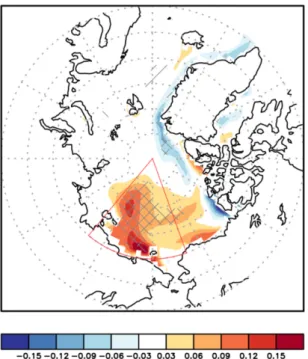
ice thickness on the AERI was analyzed (Fig. 5). It

appears that the East Siberian Seas have statistically

significant positive anomalies of sea ice. This indicates

that when the sea ice thickness increases in the East

Siberian Seas, the AO-EAWM linkage becomes stronger

and East Asia becomes more sensitive to the influence

of the Arctic. Li et al. (2014) pointed out that the

decline in the extent of sea ice in the Barents and

Kara Seas is the cause of the recently strengthened

AO-EAWM relationship. The climate model of this

Fig. 4. Linear regression coefficients of winter (a) PSL (hPa: shaded) and UV1000 (m s

−1

: vector), (b) T1000 (K), (c) GPH200

(m: shaded) and UV200 (m s

−1

: vector), and (d) T200 (K) on the AO and EAWM relation index (AERI). Only statistically sig-

nificant values at the 90% confidence level are shown.

(6)

study also shows the reduction of sea ice in the Barents and Kara Seas, which is, however, not prominent (Fig. 5).

Figure 6 illustrates atmospheric changes with respect to an increase in the sea ice extent in the East Siberian Seas. The Arctic develops high pressures (Fig. 6a) and the Eurasian continent is cooled (Fig.

6b). In the upper atmosphere, as the meridional temperature gradient decreases, the polar jet weakens (Fig. 6c and 6d). Such an atmospheric change according to sea ice variation is similar to the characteristic of a strong AO-EAWM relationship, as shown in Fig. 4. In other words, as the extent of sea ice in the East Siberian Seas increases, high pressure is developed in the Arctic and the polar jet is weakened, thereby helping Arctic air masses move southward more easily. In this situation, the AO- EAWM linkage becomes stronger, and thus, East Asia becomes more susceptible to the impact of the Arctic.

Conclusions

This study examined the natural variability of the AO-EAWM linkage using a long-term (500-yr) unforced free-run simulation of the CCSM3 climate model, and it identified the role of Arctic sea ice on this linkage. The model simulation produced alternating epochs of strengthening and weakening relationships between the AO and EAWM. This indicates that the AO-EAWM relationship is basically unstable over time, a fact that has not been clarified by previous analyses of short-term observational data. Accordingly, the strengthened AO-EAWM relationship, which was reported through observations (Li et al., 2014), could be partially attributed to natural variability rather than anthropogenic forcing.

A linear regression analysis using the AERI was conducted to identify the atmospheric conditions under a strong AO-EAWM relationship. When AO was strongly linked to EAWM, the Arctic’s atmospheric pressure increased, and both the meridional pressure gradient and the temperature gradient decreased, thereby weakening the zonal steering flow (i.e., polar jet) through the thermal wind relationship. In this situation, significant negative temperature anomalies appear over the EAWM region owing to anomalous cold advection, favoring cold surges. Likewise, when the AO-EAWM linkage is stronger, the impact of the Arctic is more likely to cause severe winter in East Asia.

The sea ice variation in the East Siberian Seas of the Arctic is responsible for the changes to the AO- EAWM relationship; an increase in sea ice thickness in these Seas strengthens the AO-EAWM relationship.

This result is somewhat different from that of Li et al.

(2014), who argued that the reduction in the sea ice of the Barents and Kara Seas strengthened the AO- EAWM relationship. This difference in findings could be attributed to two possible causes: (1) Li et al.

(2014) examined the impacts of the observed reduction of Arctic sea ice thickness due to anthropogenic forcing (unlike this study, which ran the model without anthropogenic forcing), and (2) this study Fig. 5. Linear regression coefficients of winter sea ice thick-

ness (m) on the AERI. Hatched areas denote statistical sig-

nificance at the 95% confidence level using the Student’s t-

test. The area encompassed by the red cone (140ºE-160ºW,

70ºN-90ºN) indicates the East Siberian Sea regions consid-

ered in the analysis.

(7)

investigated the long-term (rather than the short-term) simulated internal variability.

Finally, our results indicate that the EAWM response may differ depending on regions where an Arctic sea ice variation occurs. For example, if sea ice melts in the East Siberian Seas due to global warming, it is unclear whether the AO-EAWM relationship will be weakened, as expected from our modeling study.

Therefore, a more precise modeling experiment needs to be performed.

References

Collins, W.D., Bitz, C.M., Blackmon, M.L., Bonan, G.B., Bretherton, C.S., Carton, J.A., Chang, P., Doney, S.C., Hack, J.J., Henderson, T.B., Kiehl, J.T., Large, W.G., McKenna, D.S., Santer, B.D., and Smith, R.D., 2006,

The Community Climate System Model version 3 (CCSM3). Journal of Climate, 19, 2122-2143.

Gong, D.Y., Wang, S.W., and Zhu, J.H., 2001, East Asian winter monsoon and Arctic oscillation. Geophysical Research Letters, 28, 2073-2076.

Jeong, J.H. and Ho, C.H., 2005, Changes in occurrence of cold surges over east asia in association with arctic oscillation. Geophysical Research Letters, 32, https://

doi.org/10.1029/2005GL023024.

Jhun, J.G. and Lee, E.J., 2004, A new East Asian winter monsoon index and associated characteristics of the winter monsoon. Journal of Climate, 17, 711-726.

Kalnay, E., Kanamitsu, M., Kistler, R., Collins, W.,

Deaven, D., Gandin, L., Iredell, M., Saha, S., White,

G., Woollen, J., Zhu, Y., Chelliah, M., Ebisuzaki, W.,

Higgins, W., Janowiak, J., Mo, K.C., Ropelewski, C.,

Wang, J., Leetmaa, A., Reynolds, R., Jenne, R., and

Joseph, D., 1996, The NCEP/NCAR 40-year reanalysis

project. Bulletin of the American Meteorological

Fig. 6. Same as Fig. 4 but on the sea ice thickness of the East Siberian Seas (area under the red cone in Fig. 5). Only statisti-

cally significant values at the 90% confidence level are shown.

(8)

Society, 77, 437-471.

Li, F., Wang, H.J., and Gao, Y.Q., 2014, On the strengthened relationship between the East Asian winter monsoon and arctic oscillation: A comparison of 1950- 70 and 1983-2012. Journal of Climate, 27, 5075-5091.

Li, Y.Q. and Yang, S., 2010, A dynamical index for the East Asian Winter monsoon. Journal of Climate, 23, 4255-4262.

Park, T.W., Ho, C.H., and Yang, S., 2011, Relationship between the Arctic Oscillation and cold surges over East Asia. Journal of Climate, 24, 68-83.

Park, T.W., Ho, C.H., Yang, S., and Jeong, J.H., 2010, Influences of Arctic Oscillation and Madden-Julian Oscillation on cold surges and heavy snowfalls over Korea: A case study for the winter of 2009-2010.

Journal of Geophysical Research-Atmospheres, 115, https://doi.org/10.1029/2010JD014794

Thompson, D.W.J. and Wallace, J.M., 1998, The Arctic Oscillation signature in the wintertime geopotential height and temperature fields. Geophysical Research

Letters, 25, 1297-1300.

Wang, H.J. and He, S.P., 2012, Weakening relationship between East Asian winter monsoon and ENSO after mid-1970s. Chinese Science Bulletin, 57, 3535-3540.

Woo, S.H., Kim, B.M., Jeong, J.H., Kim, S.J., and Lim, G.H., 2012, Decadal changes in surface air temperature variability and cold surge characteristics over northeast Asia and their relation with the Arctic Oscillation for the past three decades (1979-2011). Journal of Geophysical Research-Atmospheres, 117, https://doi.org/

10.1029/2011JD016929.

Wu, B.Y. and Wang, J., 2002, Winter Arctic Oscillation, Siberian High and East Asian winter monsoon.

Geophysical Research Letters, 29, https://doi.org//

10.1029/2002GL015373.

Yu, Y.Y., Ren, R.C., and Cai, M., 2015, Comparison of the mass circulation and AO indices as indicators of cold air outbreaks in northern winter. Geophysical Research Letters, 42, 2442-2448.

Manuscript received: December 31, 2018

Revised manuscript received: February 13, 2019

Manuscript accepted: February 14, 2019

수치

Figure 3 shows the sliding correlation coefficient between the four EAWM indices (EAWMI (1-4)) and negative AOI (hereafter, nAOI), indicating the  long-term variability of the AO-EAWM relationship, which can hardly be identified by short-term observational
Figure 6 illustrates atmospheric changes with respect to an increase in the sea ice extent in the East Siberian Seas

참조

관련 문서

The daily variation of the extreme temperature, correlation between continentality and oceanity, and extreme value occurrence time were studied for the

to grasp the knowledge about the role of Kim Chi-nam and other Chosŏn interpreters in the Kangxi period by the theory of translation studies and East

Furthermore, because of an economic leadership rivalry between China and Japan, Korea can play an important role as facilitator to ensure that East

Plummer, M, “The Global Economic Crisis and Its Implications of Asian Economic Cooperation,” Policy Studies 55, East-West Center, 2009.. United Nations, World Economic

In the existing database construction covering Sinoxenic words in various East Asian languages, the vocabulary of different languages was connected

1 John Owen, Justification by Faith Alone, in The Works of John Owen, ed. John Bolt, trans. Scott Clark, "Do This and Live: Christ's Active Obedience as the

- Russia (East Siberia and Russian Far East), Caspian and Central Asian Region - Build up Strategic Business Partnership with NOCs. (Rosneft, Gazprom, KazMunaiGaz,

- Through its energy development and supply, Russia has tried to join dynamic Northeast Asian economy in order to boost the depressed economies of East