Received: May 08, 2019 Revised: May 30, 2019 Accepted: May 31, 2019
대한 고찰 : 한국, 일본 일부 치위생학과 사례를 중심으로
신보미 ・배수명 ・신선정
강릉원주대학교 치과대학 치위생학과 및 구강과학연구소
Analysis of a clinical dentistry course to study the need for integrated curriculum : in the case of dental hygiene department in Korea and Japan
Bo-Mi Shin ・Soo-Myoung Bae ・Sun-Jung Shin
Department of Dental Hygiene, College of Dentistry & Research Institute of Oral Science, Gangneung- Wonju National University
Corresponding Author: Sun-Jung Shin, Department of Dental hygiene, College of Dentistry, Gangneung- Wonju National University, 7, Jukheon-gil, Gangneung-si, Gangwon-do, 25457, Korea. Tel: +82-33-640-2469, Fax: +82-33-642-6410, E-mail: [email protected]
Abstract
The purpose of this study is to analyze the clinical dentistry curriculum in Korea and Japan in order to review the application of integrated curriculum in the field. We collected the clinical dentistry syllabi for 2015-16 of the department of dental hygiene of Korea G University and Japan N University. Using the data from Korea, items that were duplicated and integrated were classified by the subjects covered in clinical dentistry. In addition, through case studies conducted in Korea and Japan, we analyzed and compared the credits, class hours, teaching methods, and evaluation methods, by subject. In Korea the total class hours in clinical dentistry, including clinical practice, was 1,095, and in Japan it was 1,104. In Korea, the syllabus covered by each department consisted of about 200 hours centering on theoretical lectures. In Japan, the integrated form of clinical dentistry was taught, and the instructions included all the contents of clinical dental study and also problem-based learning for approximately 100 hours.
To strengthen the competence of dental hygienists as professionals, who are actively involved in dental practice, it is necessary to integrate the education contents of segmented clinical dentistry from the perspective of dental hygiene. It is also important to apply teaching methods that can help students improve their ability to solve problems.
Key Words : Clinical dentistry course, Dental hygiene, Dental hygienists, Integrated
curriculum
색인 : 임상치과교과목, 치과위생사, 치위생학, 통합교육과정
서론
우리나라 치과위생사제도는 1965년 지헌택 박사에 의해 구강질환의 예방 및 관리의 중요성이 강조되면 서 미국의 치과위생사 제도를 도입하여, 연세대학교 의과대학 부속 세브란스 병원 내에 의학기술수련원의
2년 교육과정에 의해 시작되었다[1]. 1967년 개정된 의료보조원법시행령에 의거하여 법정 치과진료인력 으로 인정되었고, 이후 1970년대 후반부터 치과위생사 양성 교육기관이 증가하였다. 당시 치과의사 역시 치과의료분야 전문교육과정을 이수한 치과진료인력에 대한 요구가 증가하여 치과진료현장에 치과위생사 를 적극 활용하였으나, 치과진료의 협조 업무에 대한 요구가 높아 치과위생사는 주로 치과진료협조 업무 를 담당한 것으로 보고되었다[2,3]. 이에 치위생학과 양성 기관에서는 시대적 요구에 따라 치과위생사의 치과임상 역량을 강화하기 위한 임상치과학 영역의 교육과정을 운영해왔고, 한국치과위생사교육협의회 및 대한치위생학과교수협의회에서도 임상치과학 영역의 과목별 학습목표를 개발하여 치위생학과 교육과 정 학습목표로 제시해왔다[4]. 현재 임상치과학 영역의 교과는 치과보존학, 치과보철학, 치주학, 구강악안 면외과학, 치과재료학, 소아치과학, 치과교정학, 구강내과학, 치과방사선학, 치과임상학실습 또는 임상전 단계실습 등의 교과목으로 구성 및 운영되고 있다.
치과의료기술의 성장과 발전은 치과진료의 세분화 및 전문화를 촉진시킴으로써 치과진료협력자로서 치과위생사의 전문가적 역량 강화가 요구됨에 따라 2000년대에 대한치과위생학회의 주관으로 전문치과 위생사 교육과정이 운영된 바 있다[5]. 당시에 운영되었던 교육과정은 스케일링, 교정 및 보철, 임플란트, 치과경영관리 등 치과위생사의 임상 역량 강화를 위한 과정으로 구성되었다. 임상 역량을 강화하고 수행 업무의 전문성을 확립하기 위해서는 치위생학과 교육과정에서부터 임상 현장에 대한 적용성을 높일 수 있 도록 이론과 경험을 통합할 수 있고, 역량 중심의 효율적인 교육이 이루어져야 한다. 그러나 치위생학 교 육과정은 치의학의 학문체계와 치과대학의 교육과정에 근거하여 개발됨에 따라 교과목이 세분화되어있 고[6], 특히, 치과임상학 영역 교과목명이 통합되어 운영되는 학교의 경우 45% 수준이나, 현재 통합된 형 태의 교과서도 개발되어 있지 않으며, 실제 수업에서 사용하는 교과서는 기존의 치의학에 기초하여 개발 된 치과보철학, 치과보존학, 소아치과학 등의 치의학 교과목명의 교과서를 사용하고 있는 실정이다[7]. 또 한 임상현장실습을 제외하고 총 375시간이 투입되어 임상치위생 영역 교과목(총 495시간) 다음으로 가장 많은 교육시간이 투입되나 교과목별로 개설되어 분절된 형태로 이론중심 교육이 이루어고 있어 과목 간 연계성 및 통합성이 부족한 실정이다[8]. 이러한 교육과정의 문제점을 해소하고 치과위생사 역량을 강화 하기 위해 치위생학 교육과정의 통합교육과정 도입에 대한 검토가 지속적으로 이루어져왔다. 보건의료 영 역에서 활용되는 통합교육과정은 교과의 경계 없이 지식과 기술을 통합하여 실제 임상현장에 적용할 수 있고, 현장에서 요구하는 문제해결능력을 함양하는 교육과정으로 받아들여짐에 따라[9,10], 황[6]은 치과 위생사 역할 중심의 통합교육과정을 제안하였고, 한[11]은 Tyler 및 Jacobs의 교육과정 모형에 기반하여 구강보건교육학, 지역사회구강보건학, 예방치과학 교과를 중심으로 한 통합교육과정 모형을 개발하였다.
임상 치위생영역의 교육과정에서도 유사 과목에서 분절된 방식으로 이루어졌던 교육내용을 임상치위생 학 또는 임상치위생학 및 실습 등과 같이 과목명의 통합을 시작으로 하여 교육내용을 통합하고 이를 치위
생과정에 기반한 대상자 실습과 연계함으로써 치위생학의 관점에서 임상 역량을 강화하기 위한 교과목 개 편을 위한 노력이 이루어지고 있다[12].
배 등[13]은 의료행위를 판단하는 기준에 따라 치과위생사 직무의 타당도를 평가하였는데, 치주·외과·임 플란트 수술 보조, 배농과 교환, 임플란트 보철 스크류 제거 등은 응답자의 83.3%가 보건위생상 위해가 발 생할 가능성이 있는 행위로 응답하였고, 임시충전하기, 임시충전 제거하기 등은 응답자의 91.7% 이상이 질병예방 및 치료 행위이자 전문성이 요구되는 행위로 생각하였다. 뿐만 아니라, 치과위생사의 업무에 대 해 의료행위의 수행난이도를 평가하였는데 치주·외과·임플란트 수술 보조 대다수의 일반치과진료 보조업 무가 Level 3영역으로 분류되면서 치과진료현장에서 환자의 안전과 건강권을 보장하고 치과진료의 전문 성을 강화하여 효율적인 치과진료 분담을 위해서 수행 행위에 따라 필요한 지식수준과 자격 기준에 따른 가이드가 필요하다고 주장하였다. 즉, 임상치과 영역의 교육과정은 대다수가 전문성이 요구되는 의료행 위에 대한 역량함양 과정으로 치과의료의 질 향상과 더불어 전문치과진료인력으로서 역할을 강화하기 위 해 역량 중심의 효율적인 교육과정 개발이 시급히 요구된다.
따라서 본 연구에서는 한국 및 일본의 일부 치위생학과에서 운영 중인 임상치과 영역 교육과정에 대해 심층 분석함으로써 국내 실정에 맞는 임상치과 영역 통합교육과정 운영방안에 대해 고찰하고자 한다.
본론
1. 연구도구 및 자료수집
한국 G대학 및 일본 N대학 치위생학과에서 2015-2016년도에 운영하였던 임상치과 영역 교과목을 분석 대상으로 정하였다. 임상치과 영역 교과목은 치위생과정을 제외한 임상치과진료 지원 업무를 주되게 다루 는 교과목으로 구강내과학, 구강영상학, 구강악안면외과학, 소아치과학, 치과교정학, 치과보존학, 치과보 철학, 치주학, 치과임상학실습(임상전단계), 현장실습 등의 과목으로 정의하여 조사하였다. 국내 임상치과 영역 교육과정을 확인하기 위하여 G대학에서 운영 중인 임상치과 영역 교과목별로 2015년도에 운영하였 던 강의계획서를 조사하였고, 이를 중심으로 하여 교육목표, 강의시간, 수업방법, 주차별 수업주제 및 학 습목표를 조사하였고, 해당 교과목에서 사용하고 있는 교과서 별로 각각의 세부 내용을 조사하여 정리하 였다. 우리나라와 치과위생사의 법적 업무가 가장 유사한 일본의 사례를 확인하기 위하여 일본 N대학교 에서 활용한 2016년도 강의계획서 자료집을 수집하여 조사하였고, 이를 중심으로 하여 관련 교과목별로 교육목표, 강의시간, 수업방법, 주차별 수업주제 및 학습목표를 조사하여 정리하였다.
2. 자료분석
본 연구에서는 임상치과 영역의 교육과정 분석을 통해 통합교육과정 개발 및 도입의 적정성을 검토하기 위하여 첫째, 한국의 사례를 중심으로 임상치과 영역 교과목별 교육내용의 중복 항목과 과목별 통합 항목 을 분류하였다. 임상치과 영역 교과목에서 사용된 각 교과서의 절을 목록화한 후, 전문가 검토를 통해 과 목 간 모든 절의 중복 여부, 추가 여부 등을 분석하였다. 과목별 중복 항목을 1차 분류한 후, 전문가 3인의
2차 검토를 통해 최종 분류를 진행하였고, 중복 항목의 내용과 교과목 전체의 교육목표와의 연관성을 고 려하여 과목별 통합 항목의 재분류를 진행하였다. 둘째, 한국과 일본의 사례를 중심으로 임상치과 영역 교 과목의 학점 및 수업시간, 운영방법, 평가방법 등을 비교분석하였다.
3. 연구승인
본 연구는 OO대학교 기관생명윤리심의위원회의 심의를 거쳐 심의면제(GWNU IRB-R2016-11) 허가를 받은 후 진행하였다.
결론
1. 국내 일부 대학의 임상치과 영역 교육내용 분석
치과임상 진료과별 교과목에서 사용하고 있는 교과서의 절을 중심으로 교육내용을 분석하고 전문가검 토를 거쳐 분류한 결과, 각 과목별 중복 내용을 삭제 및 과목 간 이동을 통해 추가 여부를 검토하여 재분류 한 결과는 <Table 1, 2>와 같았다.
구강내과학 교재는 전체 69절로 구성되어 있었고, 이중 의무기록의 형태와 관리, 멸균과 소독 등의 내용 은 이미 해당 내용을 다루고 있는 의료관계법률 관련 교과 및 감염관리학의 교과에서 보다 심층적으로 다 루는 것이 효율적일 것으로 분류되어 해당 교과에서 삭제되었고, 구강악안면외과학 교재에 포함된 진찰 과 진단, 전신질환 관련 이론, 악관절 질환 등은 기존 구강내과학에서 보다 심층적으로 다루는 것이 효율 적일 것으로 분류되어 추가됨에 따라, 구강내과학의 교육내용은 최종 분류 결과 기존 절 대비 약 17% 증 가한 것으로 나타났다. 소아치과학 교재는 전체 56절로 구성되어 있었고, 소아의 치아우식증과 치료방법, 소아환자 치료 시의 진정요법과 외과적 치료, 유치열과 혼합치열기의 교합과 치열공간관리, 악습관 등의 내용은 해당 내용을 중점적으로 다루고 있는 치과보존학, 구강악안면외과학, 치과교정학 등의 교과에서 동일한 원리의 치료방법에 대해 연령대별 차이 및 적용을 체계적으로 다루는 것이 효율적일 것으로 분류 되어 해당 교과에서 삭제됨에 따라, 소아치과학 교육내용은 최종 분류 결과 기존 절 대비 약 64%가 감소 한 것으로 나타났다.
치주학 교재는 전체 44절로 구성되어 있었고, 치면세균막 조절과 관련 술식, 비외과적 치주치료 등의 내 용은 치과위생사의 주된 임상 업무로서 치면세균막 관리를 포함하여 전문가치아세정술과 비외과적 치주 치료를 중점적으로 다루고 있는 임상치위생학 교과에서 심층적으로 다루는 것이 효율적일 것으로 분류되 어 해당 교과에서 삭제됨에 따라, 치주학 교육내용은 최종 분류 결과 기존 절 대비 약 27%가 감소한 것으 로 나타났다.
Table 1. The analysis of overlapping contents in clinical dentistry in dental hygiene Curriculum subject Number
of verse
After analysis of contents Reduced
number of verse Added number
of verse Number of verse
after adjust Variation
Oral medicine 69 4 16 81 17.4 (%)
Ora l& maxillofacial radiology 101 0 0 101 0.0
Pediatric dentistry 56 39 3 20 -64.3
Orthodontics 52 4 15 63 21.2
Operative dentistry 51 2 3 52 2.0
Prosthodontics 44 4 2 42 -4.5
Periodontology 44 14 2 32 -27.3
Ora l& maxillofacial surgery 99 21 15 93 -6.1
Table 2. The suggestion of integrated curriculum to overlapping contents in clinical dentistry in dental hygiene Curriculum
subject Contents of textbook
: chapter Contents of textbook : verse
Suggestion after adjust Change to
another subject
Integrated curriculum in clinical dentistry in
dental hygiene Oral medicine Medical/dental
history taking - Type of medical records, medical law, etc.
- Contents of medical records Medical law -
Sterilization &
disinfection - Sterilization, disinfection, classification of instruments by infection risk, instrument sterilizati on, infect control, etc.
Infection
control -
Pediatric dentistry Oral disease Periodo ntitis, Acute gingivitis, etc.
Dental caries - Operative dentistry
Operative treatment - Operative treatment for child - Technique of exclusion of moisture - Restoration in primary teeth
- Operative dentistry
Sedation Sedation with medicine
Type of sedation & clinical application - Oral & maxillofacial surgery
Surgery Local anesthe sia for child
Odontog enic Infecti on, Minor surgery , etc. - Oral & maxillofacial surgery
Occlusion in primary
and mixed dentition - Occlusion in before primary dentition
- Occlusion in primary and mixed dentition Orthodontics Management of tooth
space - Management of tooth space Space maintenance
Analysi s of space
Removable space maintenance
Orthodontics
Oral parafunctional
habits Type of oral parafunctional habits
Treatment of oral parafunctional habits Orthodontics Management
for patients with disabilities
Causes of disabilities
Type of disabil ities of effect to dental disease Dental treatment for children with disabilities Prevention of oral disease for children with disabilities
Clinical dental hygiene
Behavior control Theory of psychological for child
Charact eristics of dental treatment for child Charact eristics of behaviour by age Role of dental team
Type of child patients by dental treatment behavioral
Methods of behavioral control
Education with child patient s and parents in dental clinic
Behavioral
dentistry -
Orthodontics Education/
Instruction Oral hygiene instruction and preventive
treatment for orthodontics patients Clinical dental
hygiene -
Periodontology Treatment of
periodontitis cause Plaque control & Oral hygiene treatment Non-surgery periodontitis treatment Use antibiotics for periodo ntitis treatment
Clinical dental
hygiene -
Oral &
maxillofacial surgery
Examination&
Diagnosis - Examination, diagnosis, vital sign checking,
etc. - Oral medicine
Relationship with systemic diseases and dental treatment
Cardiov ascular disease, pulmonary disease, endocrine system disease, Hemorrhagic disease, kidney disease, pregnancy, infectious disease, etc.
- Oral medicine
Temporomandibular
joint disease Definition, structure of anatomical, charact
eristics of anatomical, type of TMJ - Oral medicine
2. 한국 및 일본의 임상치과 영역 교과목 운영 현황
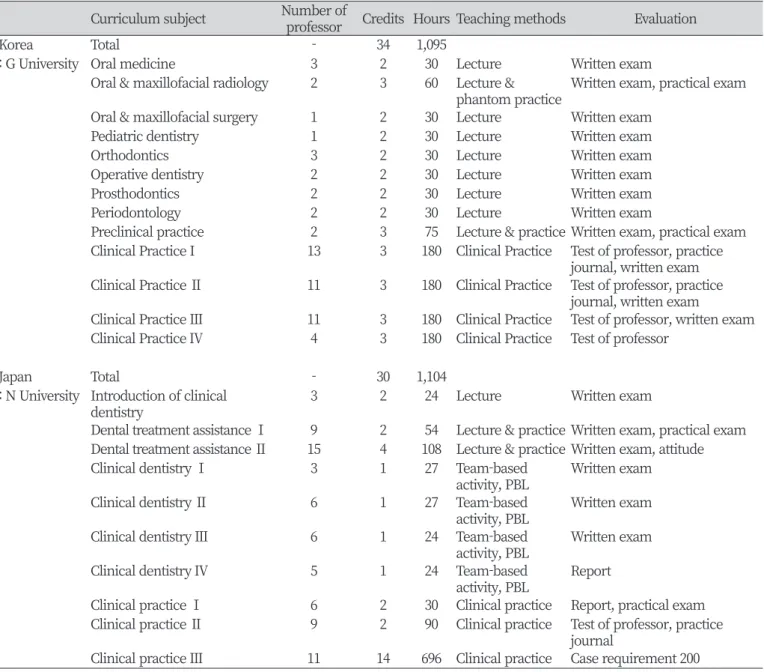
한국과 일본 일부 치위생학과 임상치과 영역의 교과목 운영 현황을 분석한 결과는 <Table 3>과 같다. 임 상실습을 포함하여, 임상치과 영역의 교과목 이수 총 학점은 한국 34학점, 일본 30학점으로 유사한 규모의 학점과 시간으로 운영되고 있었다. 진료과별 교과목은 한국의 경우 이론 강의를 중심으로 약 200시간 구성 되어있는 반면, 일본의 경우 진료과별 교과의 기본 내용은 치과임상개론을 통해 이론 강의를 이수하였고, 이후에는 임상치과학의 통합교과목 명칭을 사용하여 약 100시간으로 구성된 문제중심학습(PBL, Problem-
based learning)으로 구성 및 운영되고 있었다. 문제중심학습 운영을 위해 평균 5명의 교수자가 투입되었 고, 학습자성취도는 필기시험으로 평가하는 것으로 나타났다. 임상실습은 두 개 학교 모두 병원현장실습 으로 운영되고 있었는데, 일본의 경우 총 18학점으로 구성되며 약 800시간 실습을 진행하고 있었다.
Table 3. Current state of clinical dentistry in dental hygiene : Korea vs Japan Curriculum subject Number of
professor Credits Hours Teaching methods Evaluation
Korea Total - 34 1,095
: G University Oral medicine 3 2 30 Lecture Written exam
Oral & maxillofacial radiology 2 3 60 Lecture &
phantom practice Written exam, practical exam
Oral & maxillofacial surgery 1 2 30 Lecture Written exam
Pediatric dentistry 1 2 30 Lecture Written exam
Orthodontics 3 2 30 Lecture Written exam
Operative dentistry 2 2 30 Lecture Written exam
Prosthodontics 2 2 30 Lecture Written exam
Periodontology 2 2 30 Lecture Written exam
Preclinical practice 2 3 75 Lecture & practice Written exam, practical exam Clinical Practice I 13 3 180 Clinical Practice Test of professor, practice
journal, written exam Clinical Practice Ⅱ 11 3 180 Clinical Practice Test of professor, practice
journal, written exam
Clinical Practice Ⅲ 11 3 180 Clinical Practice Test of professor, written exam Clinical Practice Ⅳ 4 3 180 Clinical Practice Test of professor
Japan Total - 30 1,104
: N University Introduction of clinical
dentistry 3 2 24 Lecture Written exam
Dental treatment assistance Ⅰ 9 2 54 Lecture & practice Written exam, practical exam Dental treatment assistance Ⅱ 15 4 108 Lecture & practice Written exam, attitude
Clinical dentistry Ⅰ 3 1 27 Team-based
activity, PBL Written exam
Clinical dentistry Ⅱ 6 1 27 Team-based
activity, PBL Written exam
Clinical dentistry Ⅲ 6 1 24 Team-based
activity, PBL Written exam
Clinical dentistry Ⅳ 5 1 24 Team-based
activity, PBL Report
Clinical practice Ⅰ 6 2 30 Clinical practice Report, practical exam Clinical practice Ⅱ 9 2 90 Clinical practice Test of professor, practice
journal
Clinical practice Ⅲ 11 14 696 Clinical practice Case requirement 200
3. 일본의 임상치과 영역 교과목 운영내용
일본 N대학교 치위생학과의 임상치과 영역 교과목 운영내용을 분석한 결과는 <Table 4, 5>와 같다. 일 본의 사례에서는 치과재료학, 치과방사선학, 감염관리 등의 이론을 별도의 교과목에서 다루지 않고, 치과 진료협조업무와 직결된 내용을 중심으로 구성하여 치과진료보조 Ⅰ,Ⅱ 교과목에서 통합하여 교육하고 있 었다<Table 4>. 수업방식은 이론 강의 후 상호실습으로 이루어졌고, 필기 및 실기시험을 통해 학습자성취 도를 평가하였다. 임상치과학 Ⅰ~Ⅳ 교과에서는 다양한 질환이나 건강상태를 가진 사례를 중심으로 그룹 토의를 진행하여 문제를 해결하는 문제중심학습으로 운영되고 있었고, 이를 통해 학습한 치과질환의 원 인, 진단, 치료방법과 치과위생사의 역할에 대한 내용은 필기시험을 통해 평가하고 있었다<Table 5>.
치과의료기술의 발전에 따라 임상 역량 중심의 효율적인 교육과정 개발을 위한 기초자료로 활용하기 위 해, 본 연구에서는 한국 및 우리나라와 치과위생사의 역할과 업무가 유사한 일본의 일부 치위생학과에서 운영하고 있는 임상치과 영역 교육과정의 사례를 중심으로 심층분석함으로써 국내 실정에 맞는 임상치과 영역 통합교육과정 운영방안에 대해 고찰해 보고자 하였다.
Table 4. Contents of ‘dental treatment assistanceⅠ~Ⅱ’ course in department of dental hygiene of N University in Japan
Variable Contents
Overview Explain and instruct the type, purpose, and handling of basic medical equipment so that students can use it safely.
Learning objective Students acquire basic knowledge, skills and attitudes about dental treatment assistance and cooperation to promote dental teamwork in dental clinical setting.
Competency objective Be able to describe the contents of dental treatment assistance duties.
Be able to describe the type, structure, function of dental treatment devices.
Be able to use dental treatment devices safely.
Be able to operate oral irrigation and suction.
Be able to sterilize dental instruments.
Be able to take on glove and clean hands.
Be able to describe infection control and using method sterilized material in dental clinic.
Be able to describe type, ingredient, function of dental material.
Be able to use dental cement, impression material, stone.
Be able to take a impression by elastomeric impression materials.
Be able to make a study cast.
Be able to take a bite registration by bite wax. study cast.
Be able to delivery treatment instruments.
Be able to describe systemic management and pain control.
Be able to describe principle of radiography and distinguish between normal and abnormal.
Be able to do dental bleaching.
Be able to describe dental material offer system.
Be able to use periodontal assessment instruments and PTC instruments safely.
Be able to describe dental implant.
Be able to describe use method of denture material.
Be able to operate microscope and magnifying glass.
Teaching methods Lecture and mutual practice (students be in groups of two or three) Learning methods Please read the textbooks and practical tutorials before class.
Listen to lectures in the classroom.
Mutual practice in the practice room.
Textbooks Dental treatment assistance, pediatric dentistry, oral & maxillofacial radiology, operative dentistry, orthodontics, oral & maxillofacial surgery, dental anesthesia, etc.
Evaluation Ⅰ: practical exam 60%, written exam 40%
Ⅱ: Pre time - written exam 80%, attitude 20%
Post time – Achieving requirement case by observation records 70%, attitude 30%
세계보건기구의 치과진료보조인력에 관한 전문위원회(Expert Committee on Auxiliary Dental Personnel)에서는 한정된 자원으로 치과의료서비스를 효율적으로 증대시키기 위하여 치과진료인력 (dental auxiliary personnel)을 최대한 활용하도록 권장하며, 진료를 직접 분담하는 인력으로 구강질환 예방진료 업무를 수행하는 치과위생사(dental hygienist)와 진료를 직접 분담하지 않고 치과의사의 수행 을 보조하며 진료를 준비하는 치과조무사(chairside assistants)를 제시하였다[14]. 그러나 우리나라의 경 우 치과전문교육과정을 이수한 법정 치과진료인력은 치과위생사가 유일함에 따라, 치과위생사는 치과임 상현장에서 진료준비에서부터 진료협조 및 진료분담 등의 치과진료 업무를 포괄적으로 수행하며 치과팀 기반의 효율적인 치과의료서비스 생산에 기여해왔고, 임상가로서의 역할을 점진적으로 확대해왔다. 2017 년 대한치과위생사협회에서 조사한 결과에 따르면 임상 현장에서 치과위생사 업무에 대한 전체 관찰 시간 중 약 17%가 예방치과진료 업무로 나타났고, 약 48%가 치과진료의 협조 업무를 수행하고 있는 것으로 나 타났다[15].
미국이나 캐나다에서는 치과진료협조 업무를 전담하는 치과조무사 인력이 6개월~1년의 이론 및 실습 교육과정을 통해 별도로 양성 및 활용되고 있어[16], 치위생학과 교육과정에서는 소아치과학, 치과보철학 등의 일부 임상치과 영역의 교과를 제한적으로 다루고 있다. 이에 반해, 우리나라 치과위생사의 역할모형 은 치과위생사 제도가 도입된 초창기부터 직업적 모형(occupational model)[17]을 토대로 도입됨에 따라 치과진료협조자의 역할 뿐만 아니라 치과위생사 본연의 업무인 예방진료를 수행하는 임상가이자 교육자, 치과병의원경영관리 등의 다양한 역할을 수행할 수 있는 전문가적 직업 모형으로 확장되어 왔다. 임상현 장에서의 치과위생사 전문성을 강화하기 위해서는 이를 뒷받침할 수 있는 교육과정이 개발되어야 하며, 치위생학의 관점에서 지식과 술기를 통합적으로 적용할 수 있는 역량이 요구된다.
현재 임상치위생 영역은 치위생관리를 적용한 전문가적 모형의 강화와 구강건강증진 전문가로서의 역 할 확대를 모색하기 위해 2000년대부터 치위생과정에 기반한 치위생관리를 교육과정에 도입 및 적용해왔 고, 교육과정의 표준화를 위한 지속적인 노력이 이루어지고 있다[12]. 치과병의원경영관리 등의 영역에서 도 치과건강보험 청구와 관련된 독립 교과목을 개설하여 이론과 실습 교육과정을 개설 및 운영해왔고[18],
Table 5. Contents of ‘clinical dentistryⅠ~Ⅳ’ course in department of dental hygiene of N University in Japan
Variable Contents
Overview Students discuss and presentation after that they study and investigate the causes, diagnosis and treatment methods of dental diseases in small group.
Learning objective Students discuss on specific cases with various diseases or health conditions in order to acquire the knowledge with clinical situations in group discussions.
Students work with group members to solve the task. Therefore students understand the treatment of oral disease, systemic and oral diseases.
Competency
objective Be able to describe operative dentistry, prosthodontics, periodontology, oral & maxillofacial surgery, orthodontics, pediatric dentistry, cause and dental disease with disabilities, treatment, role of dental hygienist in dental clinic.
Teaching methods Scenario presentation – independent study – mini lecture – group discussion – Q&A - seminar Learning
methods We present specific examples to students as tasks, and group discussions among students to organize problems.
Students use self-paced learning using materials in the library or on the internet and discuss groups based on their learning. The professor can help the student answer the question. Therefore students develops their own ability to find problems and find solutions.
Textbooks We do not designate textbooks, but self-study using all educational resources such as textbooks, literature, libraries, and the Internet.
Evaluation Written exam(objective & subjective test), attendance
학사 교육과정 이외에도 치과건강보험 관련 자격 제도가 개발 및 활용되는 등의 다양한 변화가 시도되고 있다. 반면 임상치과 영역의 교육과정은 진료과목에 따라 분류된 각 교과목에서 진료술식에 대한 이론 강 의 중심의 고정된 틀을 유지하고 있다. 진료협조자로서의 역할을 수행하기 위해 각 치과진료의 술식과 재 료, 기구 등의 이론을 정확하게 이해하는 것도 중요하지만, 이를 바탕으로 하여 수동적인 보조자로서의 역 할이 아닌 능동적으로 치과진료과정에 개입하며 협력하는 전문가로서의 역량을 강화하기 위해서는 치위 생학의 관점에서 분절된 형태의 임상치과 영역의 교육내용을 통합하고, 임상현장에서 요구하는 문제해결 능력을 함양할 수 있도록 하기 위한 교육과정 개편이 요구된다.
본 연구에서 확인된 바와 같이, 임상치과 영역의 교과목은 교과목 간 중복 내용이 존재하며, 일부 내용 은 임상치과 영역 외의 타 영역 교과목에서 보다 심도 있게 다룰 수 있는 것으로도 검토되었고, 일부 내용 은 임상치과 영역 교과목 내에서 과목 간 경계 없이 다룰 수 있는 것으로도 검토되었다. 임상치과 영역에 서는 치과질환을 중심으로 하여 상태에 따른 치료술식과 재료, 기구 및 지원인력의 역할 등을 다루고 있기 때문에 과목 간 경계가 없이 내용을 통합하면 불필요한 학점 및 시간을 줄여 효율적으로 수업을 운영할 수 있고, 학생들도 통합적인 관점에서 전체 치과진료의 개념을 이해할 수 있기 때문에 현장에서 요구되는 문 제해결능력을 배양하는데 도움이 될 것으로 생각된다. 본 연구에서 검토한 일본 치위생학과 일부 사례에 서는 임상치과 영역의 교육과정을 실기 중심 및 이론 중심의 교과목으로 운영하되, 실기 중심 교과목은 술 기 역량이 요구되는 항목에 대한 짧은 형태의 강의와 실습 위주로 구성하였고, 이론 중심 교과목에서는 임 상치과학 이론을 통합하여 문제해결능력을 배양하기 위한 문제중심학습을 적용한 수업으로 운영하고 있 었다. 그러나 현재 우리나라 치과위생사 국가시험 출제범위에는 임상치과지원 영역에서 구강악안면외과, 치과보철, 치과보존, 소아치과, 치주 및 치과재료 영역이 모두 포함되어 있으며, 해당 영역에서 제시하는 세부 영역은 각 과목에서 다루는 대다수의 교육 내용을 포함하고 있다. 따라서 치위생학 교육과정 개발 시 국가고시를 고려할 경우, 다양한 교육 형태와 교육 내용의 개편을 시도하는데 한계가 있다. 치위생학 교육 의 패러다임은 사회환경적 요인과 함께 변화되어야 함에 따라 우리나라 실정을 고려하여 임상치과 영역 교육과정에 대한 점진적인 변화의 모색과 새로운 시도가 요구된다. 먼저 기존 임상치과 영역 교육내용에 대한 전면적 검토가 필요하다. 과목별 중복된 내용을 삭제하고, 보다 심도 있게 다룰 수 있는 영역으로 교 육내용의 재배치 및 조정을 통해 효율적인 구성으로 개편이 요구된다. 즉, 치주학에서 다루는 외과적 치주 수술은 외과적 치료와 수술로 연계 및 확장됨에 따라 치주학과 구강악안면외과학의 통합이 가능하며, 치 아우식증의 보존적 치료는 보철 치료로 연계 및 확장됨에 따라 치과보존학과 치과보철학의 과목 연계 및 통합이 가능할 것으로 검토된다. 또한, 소아치과학에서 다루는 혼합치열기, 치아배열 및 소아교정은 치과 교정치료와 연계 및 확장됨에 따라 치과교정학과의 통합이 가능할 것으로 생각된다. 예를 들어, 임상치과 학 영역 통합교과목을 운영할 경우 임상치과학 교과목을 4개 학기로 편성하여 ‘임상치과학 I’에서는 검사 와 진단을 중심으로 학습하는 구강내과학과 구강악안면방사선학을, ‘임상치과학 II’에서는 치주조직의 구 조와 기능을 바탕으로 치주치료 및 구강악안면외과적 수술과 이에 대한 진료협조와 관련한 내용을 학습 하는 것으로 편성할 수 있다. ‘임상치과학 III’에서는 수복치료와 보철치료에 관한 내용과 이에 대한 진료 협조와 관련한 내용을, ‘임상치과학 IV’에서는 소아치과학과 치과교정학 그리고 구강내과학의 진단 외 측 두하악관절장애 치료, 코골이 및 이갈이 치료 등의 구강내과학적 진료와 이에 대한 진료협조 부분을 학습 할 수 있도록 교과내용을 편성할 수 있겠다.
과목의 연계를 통해 유사 과목으로 통합이 이루어지면 해당 교과의 내용을 관련 질환과 치료방법, 협조 자로서의 역할을 중심으로 전체 맥락을 통합적으로 이해하고, 적용 능력을 기를 수 있도록 통합교육 내용
의 개발이 요구되며, 이를 효과적으로 학습할 수 있도록 하기 위해 다양한 교수방법의 개발 및 적용이 이 루어져야 한다. 정 등[19]은 임상치과학 교과목 운영을 위한 문제중심학습(PBL) 모듈을 개발하여 적용한 사례를 제시하며, 여러 임상치과학 교과목에서 다루고 있는 개념들을 연계하여 나타난 ‘구강건강문제’를 해결하는 과정을 통해 실무에 활용할 수 있는 포괄적이고 전문적인 업무역량 달성을 위한 교육과정이 필 요하다고 주장하였다. 치위생(학)과에 한정된 개설학점 내 다양한 교과목이 운영되는 현실에서 교과목의 통합교육과정은 새로운 교육모듈을 도입할 수 있는 방안이 되며, 이를 통해 문제중심학습 등 임상현장에 서 요구되는 역량중심의 교육과정 운영이 가능할 것으로 판단된다. 치과진료현장에서 문제해결 능력을 가 진 능동적인 치과지료협조자가 되기 위해서는 치과진료협조자로서 요구되는 역량과 역할을 명확히 하고 이를 표준화하기 위한 치위생계의 합의된 임상실무가인드라인이 개발될 필요가 있다. 병원간호사회에서 는 간호분야의 실무지침을 개발하여 근거기반의 표준화된 임상간호실무지침을 개발하여 활용하고 있다 [20]. 이와 같이 치위생분야에서도 표준화된 실무지침의 개발 및 활용이 요구되며, 실무지침에 기반하여 임상가로서의 업무와 역할이 구체적으로 제시됨에 따라 역량 중심의 임상치과 영역 교육내용 개발이 효율 적으로 이루어질 수 있다.
본 연구는 한국 및 일본의 일부 치위생학과 교육과정의 사례를 분석함에 따라 치위생학과에서 운영하고 있는 임상치과 영역의 교육과정을 일반화하여 설명할 수 없고, 강의계획서를 분석함에 따라 실제 운영 시 고려되는 사항이 충분히 반영되지 못하였다는 한계를 가진다. 일부 사례에 한하여 검토하였음에도 불구하 고, 임상치과 영역 교육과정에 대한 내용 분석을 통해 통합교육과정에 기반한 임상치과 영역의 교육과정 개편을 고찰함으로써 향후 우리나라 임상치과 영역 교육과정 운영방안을 모색하기 위한 기초 자료로 활 용될 수 있을 것으로 기대한다.
본 연구에서는 한국 및 일본의 일부 치위생학과에서 운영 중인 임상치과 영역 교육과정에 대해 심층분 석함으로써 국내 실정에 맞는 임상치과 영역 통합교육과정 운영방안에 대해 고찰해 보고자 하였다. 연구 결과를 요약하면 다음과 같다.
1. 임상현장실습을 포함하여 임상치과영역 교과목 운영시간은 한국 1,095시간, 일본 1,104시간으로 유 사하였다.
2. 진료과별 교과목은 한국의 경우 이론 강의를 중심으로 약 200시간 구성되었고, 특히 소아치과학, 치 과보존학, 치주학, 구강악안면외과학 교과목 간 중복 내용이 존재하였다.
3. 일본의 경우 임상치과학의 통합교과목 명칭을 사용하여 약 100시간으로 구성된 문제중심학습(PBL, Problem-based learning)으로 구성 및 운영되고 있었다.
통합교육과정에 기반한 임상치과 영역의 교육은 불필요한 시간과 내용을 줄이면서, 학생들이 통합적인 관점에서 전체 치과진료의 개념을 이해할 수 있기 때문에 현장에서 요구되는 문제해결능력을 배양하는데 도움이 될 것으로 검토된다. 능동적으로 치과진료과정에 개입하며 협력하는 전문가로서의 역량을 강화하 기 위해서는 치위생학의 관점에서 분절된 형태의 임상치과 영역의 교육내용을 통합하고, 임상현장에서 요 구하는 문제해결능력을 함양할 수 있도록 하기 위한 교육과정 개편이 요구된다.
Conflicts of interest
The authors declared no conflict of interest.
Acknowledgements
본 연구는 강릉원주대학교 학술연구조성비(2014R1A1A2058262)를 지원받아 수행하였음.
References
[1] Korea Dental Hygienists Association, Korean Dental Hygienists Professor Conference.
The history of Korean dental hygiene education for the last 50 years. 1st ed. Seoul:
Daehannarae; 2015: 4-223.
[2] Lee KH, Kim JB. A study on the utilization and consciousness of dental hygienists in Korea. J Korean Acad Oral Health 1980;5(1):104-17.
[3] Yoo EM, Han HJ. A study on the work and turnover of clinical dental hygienists. J Dent Hyg Sci 2011;11(1):41-6.
[4] Korea Dental Hygienists Association, Korean Dental Hygienists Professor Conference.
Department of dental hygiene learning objectives. 5th ed. Seoul: Komoonsa; 2017:
3-212.
[5] Bae SS. A basic study for establishment of specialized dental hygienist system around the duties of dental hygienist. J Korean Soc Dent Hyg 2007;7(3):301-16.
[6] Hwang MY. The development of an intergrated curriculum model for dental hygienist[Doctoral dissertation]. Seoul: Univ. of Sungshin, 2002.
[7] Lee SM, Yoo JS, Ahn SY, Lim MH, Won YS, Han JY. Clinical dental hygiene curriculum developed on the basis of dental hygienist job description. J Korean Acad Dent Admin 2016;4(1):55-66.
[8] Bae SM, Shin SJ, Jang JH, Chung WG, Shin BM. Analysis of current status of a dental hygiene science curriculum according to the dental hygienist competency. J Korean Soc Dent Hyg 2016;16(2):173-83. https://doi.org/10.13065/jksdh.2016.16.02.173
[9] Koo MS. A comparative study on the integrative curriculum of liberal social medicine in major medical school. JCI 2010;4(1):115-49.
[10] Roh YS, Kim SH, Yang SH, Kang YS. Clinical competence and self-confidence of new graduate nurses with an integrated nursing curriculum of simulation with problem- based learning. JKAIS 2013;14(7):3349-57. https://doi.org/10.5762/KAIS.2013.14.7.3349 [11] Han HJ. A case study on the intergrated approach for the improvement of dental
hygienics curriculum and instruction[Doctoral dissertation]. Seoul: Univ. of Konkuk, 2011.
[12] Choi YK, Han YK, Bae SM, Kim J, Kim HJ, Ahn SY, et al. Study on current curriculum analysis of clinical dental hygiene for dental hygiene students in Korea. J Dent Hyg Sci 2017;17(6):523-32. https://doi.org/10.17135/jdhs.2017.17.6.523
[13] Bae SM, Shin SJ, Lee HJ, Shin BM. Evaluation of dental hygienist job validity according to judgment standard of medical practice in medical law. J Dent Hyg Sci 2018;18:357-66.
https://doi.org/10.17135/jdhs.2018.18.6.357
[14] World Health Organization IRIS. Expert Committee on Auxiliary Dental Personnel:
first report [Internet]. World Health Organization Executive Board.[cited 2019 April 23].
Available from: http://www.who.int/iris/handle/10665/132629
[15] Han YK, Kim EK, Kim SH, Bae SM, Yang JY, Yoo JS, et al. A dentist's opinions of law duties and actual duties of the dental hygienist. Seoul: Korea Dental Hygienists Association; 2017: 14-32.
[16] Lee HJ, Shin SJ, Bae SM, Shin BM. Issues and challenges of dental hygienist workforce policy in Korea. Jour of KoCon a 2019;19(2):409-23. https://doi.org/10.5392/
JKCA.2019.19.02.409
[17] Darby ML, Walsh MM. Dental hygiene theory and practice. In: The evolving profession of dental hygiene. 3th. Darby ML, Walsh MM: St. Louis: Elsevier: 2010: 1-12.
[18] Park SY, Lee GH, An SY. Review of the status of organizing and managing health care insurance courses at college departments of dental hygiene. JKAAGD 2017;6(2):47-51.
[19] Jeong AY, Shin SJ, Shin BM, Bae SM. The development of problem-based learning module for clinical dentistry in dental hygiene. J Dent Hyg Sci 2017;17(5):383-97.
https://doi.org/10.17135/jdhs.2017.17.5.383
[20] Hospital nurses association[Internet]. [cited 2019 Apr 25]. Available from: http://
www.khna.or.kr/main.php