• 검색 결과가 없습니다.

A Study of Improvement in Trust and Purchase Intention Through Utilization of Familiarity in Product

N/A
N/A
Protected

Academic year: 2021

Share "A Study of Improvement in Trust and Purchase Intention Through Utilization of Familiarity in Product"

Copied!
18
0
0

로드 중.... (전체 텍스트 보기)

전체 글

(1)

투고일_2021.02.10 심사기간_2021.03.01-14 게재확정일_2021.04.01 DOI https://doi.org/10.47294/KSBDA.22.2.28

A Study of Improvement in Trust and Purchase Intention Through Utilization of Familiarity in Product Display Page Images

- focused on HMR products in online shopping environment for elderly consumers 제품 디스플레이 이미지의 친밀성을 활용한 제품 품질 신뢰 및 구매의도의 향상을 위한 연구 - 고령층 소비자를 위한 온라인 쇼핑 HMR 제품 중심으로

Yoon, Jungwoo_Catholic University of Korea, Media Technology Contents /

Lee, Younjoon(Corresponding author)_Visual Communication Design, Hongik University

윤정우, 가톨릭대학교 미디어기술콘텐츠학과 / 이연준(교신저자), 홍익대학교 시각디자인

차례 1. Background and purpose of the study 1.1. Background

1.2. Purpose and aim of the study 1.3. Method of the study

2. Literature review

2.1. HMR in South Korea and 5

th

generation of HMR 2.2. Characteristics of elderly consumers

2.3. Familiarity and its relation to trust in online sales environment

3. Case study

3.1. Types of visual representation of HMR products in product display pages 3.2. Analysis method and selection standards of examples

3.3. Result of the analysis

4. Method of the study

4.1. Construction of test and creation of stimulant 4.2. Methodology

5. Test results

5.1. Validity and reliability of measuring tool 5.2. Analysis of actual proof

5.3. Verification of structural cause and effect relationship 5.4. Effectiveness analysis

5.5. Modified model analysis 5.6. Multi-group analysis 5.7. Case comparison

6. Conclusion

6.1. Summary of the test analysis 6.2. Summary of the study conclusion 6.3. Implication of the study

6.4. Conclusion of the study

References

(2)

A Study of Improvement in Trust and Purchase Intention Through Utilization of Familiarity in Product Display Page Images

- focused on HMR products in online shopping environment for elderly consumers 제품 디스플레이 이미지의 친밀성을 활용한 제품 품질 신뢰 및 구매의도의 향상을 위한 연구 - 고령층 소비자를 위한 온라인 쇼핑 HMR 제품 중심으로

Yoon, Jungwoo_Catholic University of Korea, Media Technology Contents /

Lee, Younjoon(Corresponding author)_Visual Communication Design, Hongik University

윤정우, 가톨릭대학교 미디어기술콘텐츠학과 / 이연준(교신저자), 홍익대학교 시각디자인

ABSTRACT

Keywords HMR

elderly consumers online trust

online display image online purchase intention

Along with the continuing pandemic situation, companies and restaurants have been introducing care food HMR(Home Meal Replacement) products targeting elderly consumers, which is recognized as the 5

th

generation of HMR products. This study sought to overcome and improve product quality trust for elderly consumers in HMR products sold online, for both familiar and unfamiliar menus. The study analyzed the effect of product quality trust due to familiarity of images on product display pages that ultimately lead to purchase intention, and suggests display page image for elderly consumers for online sold HMR products. For study method, first, literature review has been conducted to investigate how familiarity influence product quality trust and affect purchase intention, second, a case study of display pages of online HMR shopping environment has been conducted. As a result, three types of display image types (food image type, package image type, and food and package mixed type) for online HMR market have been suggested. Third, a survey was conducted with the types applied to the structure of the test to empirically investigate display page in both familiar and unfamiliar menu kinds, and study model and hypothesis have been set for verification. The result of the survey revealed that familiarity had significant positive effects on elderly consumers' product quality trust as well as purchase intention. Furthermore, the food and package mixed type for display page was most desirable, and this result is most pronounced in unfamiliar menu types. Therefore, the study proved that an increase in product quality trust or purchase intention can be expected with the addition of considerable improvement in display page images, and such improvement is essential in marketing strategy. The study results can be used to improve elderly consumers' trust in product quality and to ultimately trigger purchase intention, which can not only be beneficial for online markets but also provide convenience in shopping in an aging society.

요약

중심어 HMR 고령층소비자 온라인신뢰

온라인디스플레이이미지 온라인구매의도

지속되는 팬데믹(pandemic) 상황과 더불어, 기업 및 식당들은 고령층을 겨냥한 제 5세대 HMR(Home meal replacement)장르로 연화식 HMR 제품들을 앞 다투어 선보이고 있다. 연구목표는 고령층을 대 상으로 온라인에서 판매되는 익숙한 메뉴, 그리고 익숙하지 않은 메뉴의 HMR 제품들의 제품 품질 신 뢰 극복에 대한 방안을 모색하고자 하였다. 본 연구는 디스플레이 페이지의 익숙한 이미지가 제품 품 질 신뢰 및 구매의도에 미치는 영향에 대한 분석을 담고 있으며, 고령층을 위한 온라인 HMR 제품들 의 디스플레이 페이지 이미지를 제시한다. 연구방법으로 첫째, 익숙함이 제품 품질 신뢰와 구매의도에 미치는 영향에 관한 문헌연구 및 사례분석이 진행 되었고, 둘째, 온라인 마켓의 HMR 제품을 위한 디 스플레이 페이지에서의 세 가지 이미지 타입(식품 이미지 타입, 패키지 이미지 타입, 식품과 패키지 혼합형 타입)을 제시하였으며, 셋째, 제시된 이미지를 바탕으로 실증조사를 위한 설문조사가 이루어졌 다. 설문조사 결과, 익숙함은 고령층 소비자의 제품 품질 신뢰 및 구매의도에 긍정적인 영향을 미치는 것이 밝혀졌다. 또한, 익숙한 식품 그리고 익숙하지 않은 식품 모두 디스플레이 페이지에서는 식품과 패키지 혼합형 타입이 가장 효과적인 것으로 밝혀졌으며, 이는 익숙하지 않은 메뉴 타입에서 가장 확 고하다. 따라서, 디스플레이 페이지 이미지의 추가적인 발전은 제품 품질 신뢰나 구매의도의 향상을 가져 올 수 있고, 이러한 발전은 마케팅 전략에 있어 필수적이라고 할 수 있다. 본 연구 결과는 고령층 소비자의 제품 품질 신뢰의 발전 및 최종적인 구매의도의 유도로 활용될 수 있으며, 이는 온라인 마켓 에 유용할 뿐 만 아닌 고령화 시대의 쇼핑에서의 편의를 제공 할 수 있다.

이 논문은 윤정우의

박사학위논문을 재정리한

것입니다.

(3)

1. Background and purpose of the study 1.1. Background

Along with massive demand for HMR (Home Meal Replacement) products and as the pandemic situation continues, genres and types of HMR products are expanding continuously, and online markets now carry menus with familiar and unfamiliar types of HMR products. Consumers are encouraged to shop without actual contact with one another, and online shopping is becoming the only choice in our daily life (Foodbank, 2019). As the elderly population grows, South Korea is in its preliminary stage of the 5

th

generation of HMR products, which is the care food type for the elderly population (Greenend, 2019).

Online shopping for food and groceries can be easy for young consumers but it can be challenging for elderly consumers in many ways, especially when they are known to have lack of product quality trust tendencies when shopping online. Due to this tendency, elderly consumers prefer offline shopping (Daily consumer news channel, 2020).

Regardless of the preferences, food and grocery shopping platforms are shifting to online markets, and the change is becoming more dramatic as people are encouraged to stay indoors and shop online without physical interaction in the current pandemic situation.

Therefore, the current study focuses on the problem of elderly consumers' lack of product trust in online HMR products.

1.2. Purpose and aim of the study

This study is aimed at supporting elderly populations through improved trust in product quality and purchase intention through familiarity and in product display page images in online HMR display pages in South Korea's online HMR shopping. The study investigates product display page images that can be supportive in improving elderly consumers' product quality trust that lead to purchase intention, utilizing familiarity as the study variable, for both familiar menu kind and unfamiliar menu kind.

1.3. Method of the study

Familiarity and its effect on product quality trust and purchase intention have been set for hypothesis. To verify the hypothesis, a survey has been conducted via “Online Google Survey”. SPSS 25.0 and AMOS 25.0 statistical software packages were used for the analysis. First, frequency analysis was used to identify general characteristics of samples.

Second, exploratory factor analysis was used to analyze validity and trust of measuring

tool. Then, Cronbach’s alpha was calculated to analyze internal consistency of the

measuring tool. Suitability of the observed model was measured through confirmatory

factor analysis and structural equation modeling (SEM). Third, as basic analysis,

descriptive statistics were presented including mean and standard deviation of study

variables. Pearson's correlation coefficient was presented to analyze correlation of study

variables. Fourth, the mediating effect of trust was analyzed after applying an SEM

casualty model to test structural cause and effect of study variables. Multi-group analysis

was conducted to test the moderation effect of familiar and unfamiliar types of HMR,

monthly number of HMR product purchases, and yes or no to shopping experiences just

by looking at display page images without any information of the specific HMR product

in the past. Lastly, Pearson  test was conducted via crosstabs analysis to investigate

differences according to HMR purchase type variables of survey demographics.

(4)

2. Literature review

2.1. HMR in South Korea and 5

th

generation of HMR

The home meal replacement (HMR) category was created in the mid 90s by savvy retailers and grocers as a project to outpace the restaurant industry. Ken Berg, the chairman and CEO of Koo Koo Roo California Kitchen, stated that “HMR really means not just eating at home, but replacing what you would have made yourself at home”, emphasizing that HMR products are different from re-heatable food in the past, and it is expected to be a convenience food that is much like that made at home (Larson, 1998).

The description of genres in HMR and distinction of boundaries of HMR is quite vague, as its types and genres are constantly expanding. Variations in the definition of HMR yield different estimates of the market size. Although its boundary and kinds are vague and constantly expanding, As explained in <Table 1>, HMR can be divided into four meaningful segments that include, Ready-to-Eat (RTE), Ready-to-Heat (RTH), Ready-to-Cook (RTC), and Ready-to-Prepare (RTP) items (Bishop & Willard, 1997).

HMR has gone through stages of generations with different concepts. HMR generation 1 started around the early 80s as “3 minute-ready” curries and instant rice products, with emphasis on convenience. HMR generation 2 was from around 2000 through 2010, focusing on frozen and cold HMR food such as frozen dumplings and refrigerated stored noodles. HMR generation 3 started from early 2010, when a diverse range of genres and menus were added. HMR generation 4 started around late 2010 focusing on premium daily meal products such as lunch boxes and meal kits. As iterations in HMR generations developed, growth and demand of HMR has risen constantly. The HMR market doubled from 1.5 trillion won in 2014 to 2.3 trillion won this year (Asia Economy, 2019).

2.2. Characteristics of elderly consumers

One of the reasons elderly consumers have difficulty in online shopping is due to decline of cognitive abilities, and certain characteristics of cognitive ability can be directly related to what can be experienced in online shopping.

First, working memory is particularly vulnerable to aging effects, such that tasks that rely heavily on working memory exhibit the greatest age-related performance declines (Yoon et al., 2010). This can be relatable to HMR product display page where the page provides minimal information on products, mostly composed of product related photos with a short sentence, and consumers are required to understand and collect necessary information while scrolling the page.

Second, diminished working memory may be problematic when older consumers need to compare a number of options (Drolet et al., 2018). This means that when elderly shoppers are in the process of purchasing products online, it may be challenging for them to compare between options, that is, within displayed HMR product images.

Third, older adults have difficulty in locating relevant information in complex contexts (Yoon & Carpenter, 2011) and are often easily side-tracked, unable to stick to facts when going through product information (Petty & Cacioppo, 1986). This makes it difficult for elderly consumers to make decisions in shopping online, and it can be frustrating for older consumers when they are to make decisions via minimal related product display images. In short, it can be difficult for elderly consumers to compare and make decisions between products in display pages, and that the product display images must have design strategies, as a way to simplify comparison and decision making processes for elderly

RTE: Ready to eat

Consumed right away without any additional process.

(Lunch box, sandwich, kimbap, salad etc.)

RTH: Ready to heat

Consumed after heating.

(Instant rice, instant porridge, retort products etc)

RTC: Ready to cook

Consumed through simple cooking process.

(Frozen dumpling, frozen cutlet, frozen fried rice etc.)

RTP: Ready to prepare

Often referred as meal-kit, which include sauces and ingredients needed to complete the menu with a recipe.

(Stew kit, soup kit, jjigae kit etc.)

<Table 1> HMR Genres

and Types

(5)

consumers.

The study focuses on improving trust and purchase intention through applying visual solutions in the aspect of cognitive difficulties that elderly consumers have, including difficulty in comparing between options of products, difficulty in complex contexts and tendency to be side-tracked when going through list of information.

2.3. Familiarity and its relation to trust in online sales environment

Familiarity not only makes information more favorable or appealing to consumers, but it also increases the information’s effect of persuasion (McGuire, 1985). Furthermore, familiarity shapes how stores are defined in the minds of consumers, partly through the stores’ functional quality and partly by the consumers’ psychological attributes (Martineau, 1958).

Familiarity in product sales has been described by a number of scholars. Alba and Hutchinson defined it as the number of consumer experiences, and argued that consumers themselves would develop strong confidence and good intention toward a brand as their experience and knowledge gradually increases (Alba & Hutchinson, 1987). These experiences include those obtained from advertising, interaction with sellers, word-of-mouth communication, and through product trials and consumption (Vo et al., 2015). In short, these studies defined familiarity as being acquired from accumulated experiences and exposure through time. That is, familiarity is an understanding, often based on previous interactions, experiences, and understanding of what, why, where, and when others do what they do (Luhmann, 1988).

According to the aforementioned studies, familiarity could influence both product display pages in online markets as well as menu types in HMR products. When the menu items are familiar, it could be beneficial to display images of the food since consumers already know about these items or already recognize these items. However, when a novel, unfamiliar HMR product is introduced to the online market, food images may not trigger any past interactions or experiences and therefore may not be as effective as when used for familiar menu items.

Correspondingly, utilization of familiarity in product display images depending on whether they are familiar or unfamiliar menu items could be helpful in the creating an effective product display page for HMR products sold online.

Building trust requires extensive and consistent interactions, a prerequisite which is often missing from interactions in online environment. Accordingly, this study seeks to examine whether another type antecedent of trust - one not base extensive previous interactions - is applicable to the unique online environment. One such antecedent, suggested in Luhmann's theory of trust and power, is familiarity (Luhmann, 1979). Familiarity deals with an understanding of the current actions of other people or of objects, while trust deals with beliefs about the future actions of other people, that are often based on familiarity (Luhmann, 1988). According to this theory, familiarity is a prerequisite of trust since it creates a framework as well as understanding of the environment.

Trust reduces uncertainty by letting people have “relatively reliable expectations” about

other people’s favorable future actions (Gulati, 1995). Hsu also argues that social

uncertainty is reduced by familiarity through increased understanding of current actions

(Hsu, 2008). Trust, on the other hand, reduces other aspects of complexity by a priori

ruling out unethical behavior, such example as misuse of credit card information. Trust

(6)

and familiarity, however, cannot be recognized as equal importance, explains Luhmann, since trust relates to the future actions of others that are unknown, and these are inherently more complex, general, dynamic, risky and less specific.

Although familiarity and trust are distinctly different, they are related. The reason is that trust in another organization or person is built when the other organization or person behaves in accordance with one’s favorable expectations of them. Since these favorable behavioral expectations (trust) are naturally context-dependent, understanding the given context involved (familiarity) is often an important antecedent (Luhmann, 1988).

Conversely, trust cannot be anchored adequately to specific favorable behaviors without familiarity with the context, and thus cannot be as strongly achieved. Komiak and Benbasat generalize that familiarity relies on experiences and preceding interactions and this promotes the idea that it serves as a precondition for trust, and therefore enables individuals to develop confidence in trustworthiness of each other (Komiak & Benbasat, 2006).

Another reason that familiarity can build trust is that familiarity not only provides a framework for future expectations, but also lets people create concrete ideas of what to expect based on previous interactions (Blau, 1964). The reason for this is that familiarity gauges the degree that prior experience has been understood.

The above studies emphasize the direct relation of familiarity with trust, and effective utilization of familiarity in product display images in designing of online product display pages may be helpful in improving product quality trust.

3. Case study

3.1. Types of visual representation of HMR products in product display pages

According to the most recent study by Goeun Kim (2020), product display images of HMR products are divided into food image type, package type, and mixed type with both package and food image, and package with a figure, with the types in display settings being either stylized or non-stylized. As Kim's study is the most recent study in many related fields, although her study focuses on the self-image of consumers, the display image types from Kim’s study have been adopted as the foundation of the proceeding analysis.

3.2. Analysis method and selection standards of examples

HMR product display images from domestic online food and grocery shopping malls were

gathered from May 4, 2020 to May 11, 2020, and a total of seven online malls were

selected according to the rankings from the Open Survey of 2019 on online food and

grocery purchase trend reports (Opensurvey, 2019). Only next-day food delivery and

grocery malls were analyzed as other types of malls were not suitable for the study

because diverse categories of HMR products are not available in such mall types, and

they either tend to sell already well-known HMR items or sell already well-known HMR

products in bundles. Seven online store display pages, including Oasis Market, Market

Kurly, SSG Emart, Hello Nature, Coupang Fresh, GS fresh, and Thebanchan were analyzed

according to the types of display images, including package type, food type, mixed type,

and figure type, under the stylized and non-stylized category. All of the pouch-type HMR

products of the care food variety were gathered and analyzed, as a previous study found

pouch-type packages to be the dominant type of package in the care food category, which

(7)

was also confirmed by the analysis of the present study. Display image types were examined in terms of visual expression elements to confirm the types of images used in current markets and determine the most suitable image types to be utilized in the subsequent test.

3.3. Result of the analysis

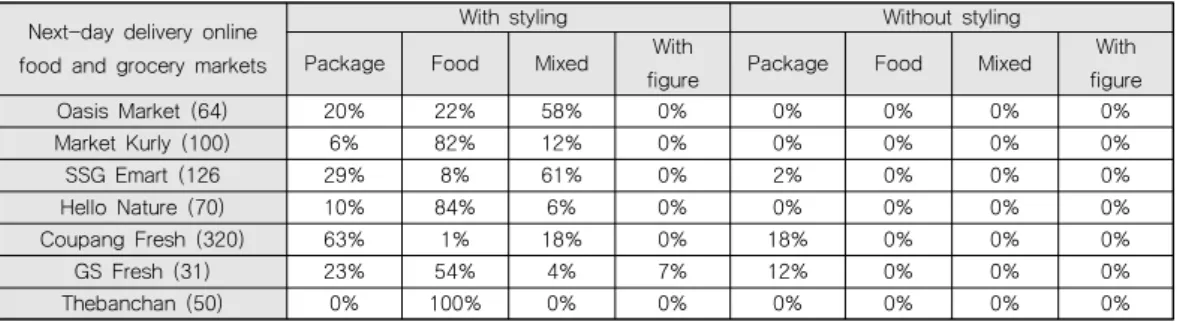
The results of the analysis are presented in <Table 3-1> and <Figure 3-2> Oasis Market and SSG Emart predominantly used mixed images in 58% and 61% of their total display images, respectively; while Market Kurly, Hello Nature, and GS Fresh predominantly used mixed images in 82%, 84%, and 54% of their total display images, respectively. Coupang Fresh predominantly used mixed images in 63% of their total display images. Lastly, Thebanchan used food-only images in 100% of their display images.

Some display image types from previous literature studies were excluded based on the results of the case study. For instance, display images with figure were excluded because only one of the markets used it and for just 7% of their display images, and the figure in the display image could have bias depending on the selection of the figure (i.e., that there may be different views and perceptions in the model used). Furthermore, non-stylized display image types were left out, as the results indicate that next-day food delivery and online grocery malls mainly used stylized displays.

Therefore, three display image types were set as examples that could be applied to the test, namely food type, package type, and mixed type, which consist of both food and image on the display page image. <Table 2> shows the display image types that will be utilized in the survey, which are based on the results of the product display page analysis.

Next-day delivery online food and grocery markets

With styling Without styling

Package Food Mixed With

figure Package Food Mixed With

figure

Oasis Market (64) 20% 22% 58% 0% 0% 0% 0% 0%

Market Kurly (100) 6% 82% 12% 0% 0% 0% 0% 0%

SSG Emart (126 29% 8% 61% 0% 2% 0% 0% 0%

Hello Nature (70) 10% 84% 6% 0% 0% 0% 0% 0%

Coupang Fresh (320) 63% 1% 18% 0% 18% 0% 0% 0%

GS Fresh (31) 23% 54% 4% 7% 12% 0% 0% 0%

Thebanchan (50) 0% 100% 0% 0% 0% 0% 0% 0%

<Table 2> Case Study Results

4. Method of the study

A study model has been set to verify influence of display image types on purchase intention and product quality trust of elderly consumers in HMR products in online market.

Independent variable are HMR product display image types in familiar and unfamiliar menu kinds, mediating variables are familiarity and trust in product quality and the dependent variable is purchase intention. <Figure 1> illustrates the study model. Along with the study models, hypothesis have been set in relation to investigate the study questions, and <Table 3> is the hypothesis chart for the product display page image.

Study questions:

1) Which type of image in display page of online sold HMR product provide improvement of trust that lead to purchase intention?

<Figure 1> Study Model

of the Product Display

Page

(8)

2) Is there a difference in display image types according to familiar and unfamiliar menu kinds?

Hypothesis

H1

There is cause and effect relationship between familiarity, trust, purchase intention in display images of HMR product display pages.

H1.1 Familiarity in display images of HMR product display page has positive(+) influence on trust.

H1.2 Trust in display images of HMR product display page has positive(+) influence on purchase intention.

H1.3 Familiarity in display images of HMR product display page has positive(+) influence on purchase intention.

H1.4 Trust has positive(+) mediating effect between familiarity and purchase intention.

H2

There is difference in familiarity, trust and purchase intention, according to visualization type in display images of HMR product display page in the familiar menu kind.

H2.1 There is difference in familiarity according to visualization type in display images of HMR product display page in the familiar menu kind.

H2.2 There is difference in trust according to visualization type in display images of HMR product display page in the familiar menu kind.

H2.3 There is difference in purchase intention according to visualization type in display images of HMR product display page in the familiar menu kind.

H3

There is difference in familiarity, trust and purchase intention, according to visualization type in display images of HMR product display page in the unfamiliar menu kind.

H3.1 There is difference in familiarity according to visualization type in display images of HMR product display page in the unfamiliar menu kind.

H3.2 There is difference in trust according to visualization type in display images of HMR product display page in the unfamiliar menu kind.

H3.3 There is difference in purchase intention according to visualization type in display images of HMR product display page in the unfamiliar menu kind.

<Table 3> Hypothesis Chart for Product Display Page Image

4.1. Construction of test and creation of stimulant

The study aimed to investigate purchase intention and trust in product quality in relation to familiarity in visualization types in HMR display images. Stimulants have been developed based on the standards that have been set through the results of the case study.

Marketkurly has been selected as sample online market as the template for creating stimulants due to a number of reasons. It is the store which carries most HMR products in South Korea in great variety, including most up to date unfamiliar items, as well as familiar items. The store is number one selling online food and grocery market in South Korea. Furthermore, the display pages lack advertisements or visual clutters like SSG, Emart or Homeplus, so the study can be focused into the test itself.

As for manipulating standard of display page images, food image types were filled in square box display frames all placed in round-shaped bowls, no additional treatments were added in a way to focus just on the mere characteristic of the specific image type, which is to express, a ready-made food image. Package image types were filles in square box display frames all placed in rectangular-shaped pouch packages, as the shape is most typical in the care food package kinds, no additional treatments were added in a way to focus just on the mere characteristics of the specific image type, which is to express, unmodified package image.

Lastly, mixed image types were filled in square box display frames all placed with 50%

to 50% scale ratio of food and package images, which exact shape characteristics, round

bowl food images with rectangular box package images, no additional treatments were

added in a way to focus just on the mere characteristics of specific image type, which

(9)

is to express, a mixture of ready-made food image and unmodified package image. Images followed simplest format of stylized display images in MarketKurly, with minimal food ingredients around bowls or cloth under the bowls that were also in adopted from stylization of MarketKurly.

The test included the investigation of visualization image type in HMR display pages, in 1) familiar menu kind and 2) unfamiliar menu kind. Both familiar and unfamiliar kinds’

samples were composed of 3 types of display images, that include a) food image only b) package image only c) food and package image. Representing HMR samples have been selected in care-food kinds such as soups and stews, as the study aims at elderly consumers and it is what seniors shop the most in HMR categories. Menu, Galbi-tang, was selected as representative HMR product in the familiar kind, as it was the most top selling product in the store in 2019, and that the menu itself has long history and tradition to Koreans that it is generally familiar type of food in South Korea. Menu, Kolhapuri masala curry, was selected as representative HMR product in the unfamiliar kind, since not only that the menu is exotic, the kind of menu is not sold in most online food and grocery stores including MarketKurly. Furthermore, curry itself have been favored by South Koreans for a long period of time and its genres is expanding and adding its kinds rapidly. Below Tables <Table 4> and <Table 5>, are the stimulant images used for the survey.

One among six stimulant images was provided to each participant in a random order, and all participants were provided with guidelines with full explanation and understanding of HMR product display pages. The participants were asked to do the survey as if performing actual online shopping.

4.2. Methodology

5 point Likert-type scale was used for the survey as Likert-type scales are useful for measuring latent constructs, that are generally thought of as unobservable individual characteristics, without concrete, objective measurement, that are believed to exist and cause variations in behavior (Converse & Stanley, 1986). The response scales used in the survey are 1 being strongly disagree, 2 disagree, 3 neutral, 4 agree and 5 strongly agree.

Likert-type scales are used for responding to questions that require levels of agreement of disagreement and the answer is not peremptory such as current study that require how a participant feels familiar or useful towards an image type in online HMR shopping environment. Survey variables, familiarity, trust, and purchase intention adapted 5 point Likert-type scale in the survey.

The survey have followed self-administered survey method via Google survey from October 19th, 2020 to October 26th, 2020. Stimulant images were attached to the Google survey form itself. As explained in <Table 6>, both male and female young-old and middle-old participants in ages between 55-75 with experiences shopping food and groceries online have participated in the survey.

As shown in the <Table 7>, there were total of 89 elderly participants submitted 534 responses (89 responses for display page image type A, 89 responses for display page image type B, 89 responses for display page image type C for familiar menu kind, and 89 responses for product information page type A, 89 responses for product information page type B, 89 responses for product information page type C for unfamiliar menu kind.

A1 Food image only

A2 Package image only

A3 Food and package

<Table 4> Stimulant

Images for Familiar Menu

Kind

(10)

All 6 samples were presented in random links in order for improved accuracy of the survey result. Furthermore, as the participant number is relatively low, bootstrap method has been used for resampling method, which is the process that extract sample from empirical cumulative distribution, and at 200 count of simulation.

<Table 8> is organized table of survey respondents’ characteristics of online shopping.

According to the table, in the case of display page survey, monthly shopping frequency of less than once was highest with 36.0%, next was 2-3 times with 26.7%, then 4-5 times was 24.4%. Number of HMR products purchased monthly was less than one for 45.3% of participants, 2-3 was next with 27.9%, 4-5 was next with 14.0%. Genres of HMR shopped online showed gook/tang/jjigae as mostly shopped genre with 32.6%, next was boonsik genre of 26.7% and dumplings in 15.1%. 57.0% answered yes for having shopping experience by just seeing display image only, and 68.6% answered yes for having shopping experience by just seeing product information page.

<Table 9>, <Table 10> and <Table 11> are the operating definition of variables of familiarity, trust and purchase intention for product display page image survey.

5. Test results

5.1. Validity and reliability of measuring tool

Classifi

cation Categorization Display page Number Percentage

Sex Male 31 36.0

Female 53 61.6

Age

Late 50’s 7 8.1

60’s 76 88.4

70’s 3 3.5

Family type

Single 10 11.6

Couple without

children 6 7.0

Nuclear family 59 68.6

Extended family 7 8.1

Other 3 3.5

Occu pation

Specialized job 16 18.6

Office worker 9 10.5

Sales/Service 1 1.2

Production 2 2.3

Self-employed 11 12.8

Housewife 34 39.5

Other 13 15.1

Educati on

Highschool 9 10.5

Junior college 10 11.6

Undergraduate 42 48.8

Graduate 25 29.1

<Table 7> Demographical Characteristics of Survey Participants

Classifi

cation Categorization Display page Number Percentage

Frequency in monthly online shopping

Under 1 31 36.0

2-3 23 26.7

4-5 21 24.4

6-10 0 0 

More than 10 11 12.8

Monthly purchase count of

HMR

Under 1 39 45.3

2-3 24 27.9

4-5 12 14.0

6-10 3 3.5

More than 10 7 8.1

Genre preference

in HMR

Frozen rice 5 5.8

Noodles 13 15.1

Boonsik 1 1.2

Gook/tang/

jjigae 28 32.6

Porridge/

Soup 0 0 

Curry/Jjajang 3 3.5

Frozen bread 0 0 

Dumplings 13 15.1

Other 23 26.7

Purchase only by display image

Yes 49 57.0

No 37 43.0

Purchase only by product information

Yes 59 68.6

No 27 31.4

<Table 8> Online Shopping Characteristics of Survey Participants

Exploratory factor analysis have been conducted to analyze validity and trust of measuring instrument, Cronbach have been measured in order to investigate internal consistency of measuring tool. For exploratory factor analysis, factor loading was estimated by principal component and Varimax was used for rotation.

Young-old Ages between 55~65, most of whom are capable of working, with economical ability and social

acknowledgement is at highest.

Middle-old Ages between 65~75, mostly retired from work.

Old-old Ages 75 and up, isolated and impoverished age of seniors with physical illness.

<Table 6> Distinguishing of Elderly Groups According to Neugarten

B1 Food image only

B2 Package image only

B3 Food and package

<Table 5> Stimulant

Images for Unfamiliar

Menu Kind

(11)

Factor1, ‘purchase intention, factor2, ‘trust’, factor3, ‘familiarity’ have been recognized as result of exploratory factor analysis, factor load value were all higher than 0.7, eigenvalue of each factor were all above 1.0, cumulative variation explained by 3 factors explained by 3 factors were satisfactory with 88.449%, all higher than 50.0%, that proved validity and trust of display group <Table 12>. Results of Cronbach were satisfactory in terms of internal consistency with all above 0.7, with familiarity 0.905, trust 0.947, purchase intention 0.927.

Data processing have been conducted, with 2 participants who did not respond in survey being processed as missing values among 88 respondents. Bootstrap method has been used for resampling method, which is the process that extract sample from empirical cumulative distribution, and at 200 count of simulation. Statistics package used in the analysis were SPSS 25.0 and AMOS 25.0. Detailed statistics methodology is as follows.

First, frequency analysis have been conducted to identify general characteristics of samples.

Second, exploratory factor analysis have been conducted to analyze validity and trust of measuring tool, then Cronbach  have been calculated to analyze internal consistency of measuring tool. Next, suitability of observed model have been measured through confirmatory factor analysis with observed model of SEM: Structural Equation Modeling.

Third, as basic analysis, descriptive statistics were presented including, standards and standard deviation of study variables, Pearson correlation coefficient was presented in order to analyze correlation of study variables.

Fourth, Pearson  test have been conducted via crosstabs analysis in order to investigate differences according to HMR purchase type variables of survey demographics.

Fifth, mediating effect of trust was analyzed to after applying SEM casualty model in order to test structural cause and effect of study variables. Multi-group analysis have been conducted to test moderation effect of familiar and unfamiliar kinds, sex, family type, occupation, education level, monthly income, monthly number of HMR product purchase, and yes or no to shopping experiences just by looking at display page images and just by reading product information pages without any information of the specific HMR product in the past.

Construct Items Factor 1 Factor2 Factor 3 Cronbach 

Familiarity

Familiarity1 0.286 0.405 0.783

0.905

Familiarity2 0.281 0.410 0.802

Familiarity3 0.169 0.117 0.890

Trust

Trust1 0.422 0.743 0.395

0.949

Trust2 0.429 0.801 0.305

Trust3 0.434 0.790 0.301

Purchase intention

Purchase intention1 0.823 0.436 0.221

0.927

Purchase intention2 0.848 0.264 0.316

Purchase intention3 0.780 0.457 0.212

Model statistics

Eigenvalue 2.746 2.632 2.583

% explained 30.506 29.245 28.699

Total % explained 30.506 59.750 88.449

<Table 12> Measuring Tool for Exploratory Factor Analysis

Purchase intention Engle et al, (2013) Spears & Singh (2004) Oliver (1980)

I will willing to purchase a product through product information page layout such as this in online.

I am willing to purchase a product through product information page layout such as this in online for a trial.

I will continue to purchase a product through product information page layout such as this in online.

<Table 11> Operating Definition of Variables, Purchase Intention

Familiarity Luhmann N. (1979), Gefen R. (1995), Gulati R. (1995)

This display image feels sense of closeness.

This display image feels close.

This display image is familiar.

<Table 9> Operating Definition of Variables, Familiarity

Trust Harp P & Saunders C (1997),

Luhmann N (1979)

Information provided in this display image is trustworthy.

Information provided in this display image is truthful.

I can constantly make transaction by trust of this display image.

<Table 10> Operating

Definition of Variables,

Trust

(12)

5.2 Analysis of actual proof

<Table 13> is a Table which organized basic descriptive statistics which include standards and standard deviation of study variables in display page. According to the Table, trust in display page survey was highest with average of 3.37, purchase intention was 3.13 in average which was marked higher than ‘neither agree nor disagree’, familiarity was 2.23 in average which as marked close to ‘disagree’. <Table 14> organizes Pearson correlation coefficient which analyzes correlation between study variables in display pages. According to the table, familiarity, trust, purchase intention all have highly positive(+) correlation.

As shown in the <Table 15> below, in purchase experience by only seeing the display page image, there were significant differences in sex with  =18.154 (p<.001), family kind with  =4.837 (p<.05), profession kind with  =9.870 (p<.05), and education level with  = 6.711(p<.05). In sex, male had higher percentage rate of 79.2% and female had 41.8%

of experience of purchasing HMR product by seeing only the display page image. In family kind, non-nuclear family type was higher with 71.8% and nuclear family type was 51.1%.

In profession kind, housewife type was relatively low with 40.0% whereas other professions showed over 60.0% experience of purchasing HMR product by seeing only the display page image. In education level, below highschool education was relatively low with 35.7% whereas junior college and undergraduate and above education level of participants showed 60.0% of experience in purchasing HMR product by seeing only the display page image.

Classification Categorization Yes No  p

Sex

Male 42 11

18.154 0.000***

(79.2) (20.8)

Female 33 46

(41.8) (58.2)

Family type

Nuclear family 48 46

4.837 0.028*

(51.1) (48.9)

Non-nuclear family 28 11

(71.8) (28.2)

Occupation

Professional/ office worker 28 12

9.87 0.020*

(70) (30)

Sales/service/ self-employed 12 7

(63.2) (36.8)

Housewife 20 30

(40) (60)

Other 16 8

(66.7) (33.3)

Education

Below highschool 10 18

6.711 0.035*

(35.7) (64.3)

Junior college 39 26

(60) (40)

Above undergraduate 27 14

(65.9) (34.1)

Total 75 57

(56.8) (43.2)

<Table 15> Purchase Experience by Only Seeing Display Page Image Variable Familiarity Trust Purchase

intention

Familiarity 1

Trust .624** 1

Purchase

intention .559** .765** 1

<Table 14> Correlation of Study Variables Variable ave. s.d.

Familiarity 2.23 0.49

Trust 3.37 0.88

Purchase

intention 3.13 0.91

<Table 13> Descriptive

Statistics of Study

Variables

(13)

5.3. Verification of structural cause and effect relationship

<Table 16> organizes analysis result of structural cause and effect relationship of display group. As result, influence of familiarity toward trust had significantly positive effect with b=0.767(p<.001). In the case of display page, trust raised significantly when familiarity raised. Therefore hypothesis H1.1 have been accepted. Influence of trust toward purchase intention had significant positive effect with b=0.844(p<.001). Therefore hypothesis H1.2 have been accepted as well.

However affect of familiarity toward purchase intention was in significant level with 0.05, therefore hypothesis H1.3 have been rejected. Fidelity of casualty model or display page was under 3.0 with /df=2.658 and under 0.8 with GFI=0.950, NFI=0.977, TLI=0.977, CFI=0.986 and over 0.9, RMSEA=0.08 that suitability of casualty model was proven satisfactory.

5.4. Effectiveness analysis

<Table 17> is a Table of effectiveness analysis with direct effect, indirect effect and total effect. According to the table, direct effect of familiarity towards purchase intention was b=0.013(p>.05) which was not significant, however, hypothesis H1.4 has been accepted, as purchase intention had significant positive effect when trust was mediated by familiarity. Also, the total effect with both direct effect and indirect effect had significant positive effect with b=0.735(p<.001). That is, when familiarity was raised 1  , overall raise of purchase intention was 0.722  .

5.5. Modified model analysis

<Table 18> organizes analysis result of modified structural cause and effect relationship of display group. As result, influence of familiarity toward trust had significantly positive effect with b=0.767(p<.001). In the case of display page, trust raised significantly when familiarity raised. Therefore hypothesis H1.1 have been accepted. Influence of trust toward purchase intention had significant positive effect with b=0.854(p<.001).

Therefore hypothesis H1.2 have been accepted as well. Fidelity of casualty model or display page was under 3.0 with /df=2.544 and under 0.8 with GFI=0.950, NFI=0.977, TLI=0.978, CFI=0.986 and over 0.9, RMSEA=0.078 that suitability of casualty model was proven satisfactory.

Independent

variable Dependent variable Non standard

Standard b t

B s.e.

Familiarity Trust 0.708 0.047 0.767 15.195

***

Trust Purchase intention 1.033 0.054 0.854 19.131

***

Fitness 

=58.517***, 

/df=2.544, GFI=0.950, NFI=0.977, TLI=0.978, CFI=0.986, RMSEA=0.078

<Table 18> Result of Casualty Model in Display Group Independ

ent variable

Depend ent variable

Nonstandard Stand ard b t

B s.e.

Familiarity Trust 0.707 0.047 0.767 15.165

***

Trust

Purchas e intentio

n

1.021 0.082 0.844 12.456

***

Familiarity

Purchas e intentio

n

0.013 0.070 0.012 0.193

Fitness

=58.48***, 

/df=2.658, GFI=0.950, NFI=0.977, TLI=0.977,

CFI=0.986, RMSEA=0.080

<Table 16> Result of Casualty Model

Independent variable(a) Familiarity Parameter

(b) Trust

Dependent variable(c)

Purchase intention Direct effect

a->c 0.013 Indirect effect

a->b->c 0.722***

Total effect (Direct + Indirect)

0.735***

<Table 17> Effectiveness

Analysis

(14)

<Table 19> is a Table of effectiveness analysis of modified model with direct effect, indirect effect and total effect. According to the Table, indirect effect with b=0.731 (p<.001) had significantly positive effect.

5.6. Multi-group analysis (Test of moderation effect)

Multi-group analysis has been conducted in order to test the moderation effect of general characteristics and shopping characteristics of the survey demographics, monthly HMR purchase count as well as purchase experience of HMR just by seeing product display page. Furthermore, verification of positive difference relation of structural equation between familiar menu kind and unfamiliar menu kind.

<Table 20> is a list of chart which include test result of moderation effect in familiarity towards trust in groups of categories according to sex, family type, occupation, level of education, monthly income, monthly online shopping frequency, number of HMR purchase, within product display page group. According to the chart, all of the groups did have significant positive effect, however the effect of familiarity towards trust was stronger in the unfamiliar menu kind with  =0.868(p<.001) than the familiar kind with 

=0.707(p<.001), and the difference in effect was z=2.030(p<.05). Furthermore, group of 1 or less in monthly HMR purchase had stronger positive effect of familiarity towards trust with  =0.861(p<.001), compared to the group of 2 or more in monthly HMR purchase with  =0.786(p<.001), while the difference being z=-1.972(p<.05). No significant positive moderation effect was found in the rest of the variables.

Variable Classification Familiarity -> Trust

 Difference verification z

Menu kind Familiar menu 0.707***

2.030*

Unfamiliar menu 0.868***

Sex Male 0.799***

1.113

Female 0.950***

Family type

Nuclear family

(family of 4 or more) 0.891***

-1.579 Non nuclear family

(family of 2 or less) 0.785***

Occupation Housewife 0.842***

-0.279 Office worker / etc. 0.764***

Education Below undergraduate 0.788***

1.113

Above undergraduate 0.939***

Monthly income Below 3 million won 0.844***

-0.244

Above 4 million won 0.806***

Online shopping frequency

Less than 1 0.856***

1.461

More than 2 0.882***

HMR purchase count

Less than 1 0.861***

-1.972*

More than 2 0.786***

<Table 20> Moderation Effect of Demographics and Shopping Characteristics

5.7. Case comparison

<Table 21> is the result of variance analysis to investigate significant differences in study variables by its kinds. In the familiar menu kinds, there was significant positive difference in familiarity with F=74.319(p<.001), however, there were no positive differences in trust with purchase intention with 0.05 significance level. Therefore H2.1.

was accepted but H2.2 and H2.3 have been rejected. Meanwhile in unfamiliar menu kind, there were significant differences in familiarity with F=64.680(p<.001), trust with F=4.727(p<.05), purchase intention with F=3.766(p<.05). Therefore, all H3.1, H3.2,

Independent variable(a) Familiarity Parameter

(b) Trust

Dependent variable(c)

Purchase intention Direct effect

a->c 0 Indirect effect

a->b->c 0.731***

Total effect (Direct + Indirect)

0.731***

<Table 19> Effectiveness

Analysis

(15)

H3.3 have been accepted.

In familiar menu kind, mixed image type was the highest with average of 2.54 in familiarity, then package image type and food image type was the last. Mixed image type was the highest in unfamiliar menu kind as well, with average of 2.88 in familiarity, then package image type followed with average of 2.40, food image type was 1.99. Mixed image type was also the highest with 3.59 average in trust, package image type was 3.11 in average, food image type was 2.92 average, and lastly in purchase intention, again, the mixed image type was the highest with average of 3.47, package image type with average 2.96, and food image type with average 2.89.

Kind Variables Types Mean s.d. F p

Familiar menu

Familiarity

Food image 1.76 0.36

74.319 0.000***

Package image 2.06 0.32

Mixed image 2.54 0.33

Trust

Food image 3.49 0.83

1.780 0.172

Package image 3.30 0.72

Mixed image 3.59 0.93

Purchase intention

Food image 3.04 0.80

2.380 0.096

Package image 3.03 0.84

Mixed image 3.36 1.00

Unfamiliar menu

familiarity

Food image 1.99 0.33

64.680 0.000***

Package image 2.40 0.31

Mixed image 2.88 0.29

trust

Food image 2.92 0.91

4.727 0.011*

Package image 3.11 0.90

Mixed image 3.59 0.90

Purchase intention

Food image 2.89 0.87

3.766 0.027*

Package image 2.96 0.99

Mixed image 3.47 0.91

<Table 21> Difference Analysis of Types in Study Variables in Display Page

6. Conclusion

6.1. Summary of the test analysis.

Result for <Hypothesis 1: There is cause and effect relationship between familiarity, trust, purchase intention in display images of HMR product display pages> was as follows.

According to the structural cause and effect relationship of display group, hypothesis1.1

‘familiarity in display images of HMR product display page has positive(+) influence on trust’ was accepted, as result, influence of familiarity toward trust had significantly positive effect with b=0.767(p<.001). Hypothesis 1.2 ‘trust in display images of HMR product display page has positive(+) influence on purchase intention’ have been accepted, as influence of trust toward purchase intention had significant positive effect with b=0.844(p<.001). However, affect of familiarity toward purchase intention was in significant level with 0.05, therefore hypothesis H1.3, ‘familiarity in display images of HMR product display page has positive(+) influence on purchase intention’ have been rejected. H1.4, ‘trust has positive(+) mediating effect between familiarity and purchase intention’ has been accepted, as purchase intention had significant positive effect when trust was mediated by familiarity.

<Hypothesis 2: There is difference in familiarity, trust and purchase intention, according

to visualization type in display images of HMR product display page in the familiar menu

kind> had the following results. According to the result of case comparison through

variance analysis to investigate significant differences in the study variables by its kinds

in the familiar menu kinds, there was significant positive difference in familiarity with

F=74.319(p<.001), however, there were no positive differences in trust with purchase

(16)

intention with 0.05 significance level. Therefore H2.1 ‘There is difference in familiarity according to visualization type in display images of HMR product display page in the familiar menu kind’ was accepted but H2.2 ‘There is difference in trust according to visualization type in display images of HMR product display page in the familiar menu kind’ and H2.3 ‘There is difference in purchase intention according to visualization type in display images of HMR product display page in the familiar menu kind’ have been rejected.

Meanwhile in unfamiliar menu kind, there were significant differences in familiarity with F=64.680(p<.001), trust with F=4.727(p<.05), purchase intention with F=3.766 (p<.05), therefore, H3.1, ’there is difference in familiarity according to visualization type in display images of HMR product display page in the unfamiliar menu kind’, H3.2, ‘there is difference in trust according to visualization type in display images of HMR product display page in the unfamiliar menu kind’, and H3.3, ‘there is difference in purchase intention according to visualization type in display images of HMR product display page in the unfamiliar menu kind’ have been accepted. Therefore, all of <Hypothesis 3: There is difference in familiarity, trust and purchase intention, according to visualization type in display images of HMR product display page in the unfamiliar menu kind> have been accepted. <Table 21> is the result of the hypothesis organized in a chart format.

6.2. Summary of the study conclusion

Although familiarity had significant positive effect on product quality trust, and product quality trust had significant positive effect on purchase intention, familiarity did not have direct significant effect toward purchase intention. That is, when familiarity is raised, trust in product quality raises together, and when trust in product quality is raised, purchase intention of HMR within elderly consumers raises as well in the case of display page images. Even when familiarity was raised in display pages, it did not raise purchase intention directly. However, there was considerable significant positive effect in purchase intention when product quality trust was composed as mediator in trust of display page test.

Influence of purchase intention by familiarity was not significant, although familiarity had positive effect on trust in product quality, and although trust in product quality had positive effect on purchase intention in both familiar and unfamiliar menu kinds. Difference in effectiveness was also not significant.

As for effect of familiarity toward product quality trust, unfamiliar menu kind had higher effect than familiar menu kind with unfamiliar menu kind at b=707(p<.001), and familiar menu kind at b=0.867(p<.001), with difference in effectiveness of z=1.843(p<.1), which was significant in significance level of 0.1. That is, in unfamiliar menu kind, when display image is composed in familiar setting, certain raise in product quality trust can be expected.

Fourth, there was no significant difference in trust in product quality and purchase

intention although there was significant difference in familiarity in familiar menu kind

when level of all variables, that include, familiarity, product quality trust, purchase

intention, were compared in the display page test. Meanwhile, there were significant

differences in all variables, that are, familiarity, trust and purchase intention in the

unfamiliar menu kind. Mixed type had the highest score in the case of significance, next

was package image type, then was food image type, and in the familiar menu kind, mixed

type had the highest evaluation, even with insignificant results of trust or purchase

(17)

intention. In short, in display pages, mixed type of display image was proven to be most desirable in both familiar menu type and unfamiliar menu type, especially even more effective in unfamiliar menu kind.

6.3. Implication of the study

In hopes of supporting elderly consumers with their online food shopping, the study investigated structural relationship between purchase intention and improvement of trust in product quality through familiarity in product display images of online HMR products.

According to the result of the study, possible implication of study can include the following.

First, product quality trust have marked relatively high although provided familiarity of display page image was yet, considerably low, in basic descriptive statistics of perceived familiarity, product quality trust, and purchase intention of display page examination. That is, it may be explained that after actual purchase, elderly were satisfied as the quality of products were higher than what they have expected, although they have low trust with the display page images in online shopping environment. Raise in product quality trust or raise in purchase intention can be expected with addition of considerable improvement in display page images.

Second, doubts on whether such improvements in display page images of online HMR package environments lead to actual improvement in elderly consumers’ purchase intention, the study has proven that it does bring considerable effect in product quality trust that ultimately bring increase in purchase intention. The result has been equivalent in both familiar and unfamiliar menu kinds. It verified that the mixed type is the most effective type of image provided in display pages, more effective than the food or package image type, according to the differences analysis of perceived familiarity, product quality trust and purchase intention. This effect was especially remarkable in unfamiliar menu kind than the familiar menu kind.

Therefore, improvement of online HMR image in display pages is quite useful marketing strategy, and that the mixed type image would be most effective than food or package alone image types, and this can demonstrate most intensive effect in unfamiliar menu kinds.

6.4. Conclusion of the study

The present study is meaningful as South Korea is in its preliminary phase of 5

th

generation in the care food kind, and that there are not sufficient study resources yet investigated in such field for elderly consumers. Therefore, study in the field of HMR care food is urgent as South Korea enters aging society and faces various societal problems related to seniors. Present study can be a supportive resource for further studies focused toward seniors’ well living, and how they can successfully adapt to this rapidly changing society.

The study is unique as it presents utilization of familiarity for improving trust in product quality, while trust is known to be established through time and interaction. The present study can be applicable to the fields that require improvement of trust in the area where time and interaction cannot be established, which will be required in diverse areas of studies as we live in this rapidly changing, untact society.

Senior’s successful transition into online shopping environment, especially in the field of

(18)

purchasing food is critically important as their preference to shop offline for food and groceries will not always be available as more stores now focus their sales in online markets, and according to the change of the society, seniors, along with the rest of the age groups, must change.

Although defined problem targets elderly group and senior’s online shopping, the problem is not faced only by the elderly, this is what can be solved through the effort of the society as a whole. Therefore, strategies must be gathered from diverse fields of academical studies, and through plentiful studies, variety of support should be constantly presented.

The effort is also required in the field of visual communication design. Through seeking and finding solutions in what our society confronts, visual communication will further evolve.

References

Alba & Hutchineson. (1987). Dimensions of consumer expertise, Journal of consumer research , 13 (4):411-54

Bishop & Willard. (1997). Meal Solutions Idea Exchange Breakfast. Presentation at the Food Marketing Institute Annual Convention in Chicago, IL.

Blau, P. (1964). Exchange and power in social life. Wiley.

Converse & Stanley (1986). Survey questions . Sage Publications.

Drolet, Jiang, Mohammad, Davis. (2018). The influence of aging on consumer decision-making, Society for consumer psychology, 2 (1), 3-16

Gulati, R. (1995). Does familiarity breed trust? The implications of repeated ties for contractual choice in alliances. Academy of Management J, 38(1), 85-112.

Hsu, C. J. (2008). Dominant Factors for Online Trust. Proceedings of the 2008 International Conference on Cyberworlds , 165–172.

https://www.asiae.co.kr/article/2019051310242056848

https://www.foodbank.co.kr/news/articleView.html?idxno=57430 https://www.greened.kr/news/articleView.html?idxno=101143 https://www.dailycnc.com/news/articleView.html?idxno=101959

Komiak, S. Y. & Benbasat, I. (2006). The Effects of Personalization and Familiarity on Trust and Adoption of Recommendation Agents. MIS Quarterly, 30 (4), 941–960.

Larson, R. B. (1998). The home meal replacement opportunity: A marketing perspective. The retail food industry center applied economics department University of Minnesota

Luhmann, N. (1988). Familiarity, confidence, trust: problems and alternatives. In: Gambetta DG, editor. Trust. Basil Blackwell.

Luhmann, N. (1979). Trust and power. Chichester, Wiley, [translation from German].

Martineau, P. (1958). The personality of the retail store. Harvard Business Review, 36 , 47-55.

McGuire, W. J. (1985).  Attitudes and attitude change. In Lindzey, G., Aronson, E. (Eds.), Handbook of social psychology (3rd ed. Vol. 2) Random House. 233–346. 

Petty & Cacioppo. (1986). The elaboration likelihood model of persuasion. Advances in experimental social psychology. 19, 123-205

Vo, Hong. Nhung. & Nguyen, Thuy (2015). The Impact of Corporate Governance on Firm Performance: Empirical Study in Vietnam. International Journal of Economics and Finance, 6 (6), 1-13

Yoon & Carpenter. (2011). Aging and consumer decision making, Ann N Y Acad Sci. 1235 (1), E1-E12

Yoon, C., Feinberg, F., Schwarz, N. (2010). Older consumers and satisfaction. The Aging Consumer:

Perspectives from Psychology and Economics. Taylor and Francis.

수치

figure Package Food Mixed With

참조

관련 문서

Recognizing that a S&amp;T Co–operation Fund of 10 million USD, contributed for the period 2011–15, has been utilized to implement joint research.. projects in the

South Korea Ambassador to India Shin Bongkil says he is “cautiously optimistic” about North Korea’s denuclearisation promise, hopes for gradual integration of the two

- CERAGEM center owners, staffs and customers from Bihar state participated by donation to support daily necessities &amp; living expenses

Rule 6(1)에 따라 원칙적으로 매입 재료 또는 서비스가 면세 재화의 제조 또는 면세 서비스의 공급에 사용될 경우 Cenvat Credit를 이용할 수 없다. 따라서

To answer the first question, we built the integration model, in which purchase and loyalty are influenced by not only business factors of product assortment, price, and

The index is calculated with the latest 5-year auction data of 400 selected Classic, Modern, and Contemporary Chinese painting artists from major auction houses..

Previous literature informs six factors (satisfaction, reputa- tion, relational capital, knowledge quality, compati- bility, personalization) as candidates influencing

어떤 거센 태풍이 몰아친다 해도 우리는 잘사는 국민, 따뜻한 사회, 강한 나라를 향해 뚜벅뚜벅 우리의 길을 걸어갈