INTRODUCTION
The subfamily Hippoglossinae (family Pleuronectidae) composes five genera and eight species (Nelson et al., 2016). Among them, the genus Atheresthes Jordan and Gilbert, 1880 includes two large (over 84 cm) species, A.
evermanni Jordan and Starks, 1904, and A. stomias (Jor
dan and Gilbert, 1880), which are distributed in the North Pacific and Bering Sea (Mukhametov and Orlov, 2002).
Because of their commercial importance and morphologi
cal similarities, many studies on the above mentioned genus have been conducted on external morphology (Yang, 1988; Mukhametov and Orlov, 2002), molecular phylogene tics (Ranck et al., 1986; Suzuki et al., 2001), food habits (Yang and Livingston, 1986), early life (Tsukamoto et al., 1995; Forest et al., 2014), and biology and distribution (Zimmermann and Goddard, 1996). These two species briefly described by Lee et al. (1999), e.g., the Korean name, distribution, and morphological characteristics using distant water samples.
During a fisheries resources survey in the middle East Sea, we collected two unique and large pleuronectid speci
mens by gillnet of commercial vessel at 550~650 m depth from coastal waters off Goseonggun, Korea. They were identified as A. evermanni, on the basis of morphological characters such as mouth size, gill raker shape, width of interorbital space, and shape of caudal fin. This species has not yet found in Korean waters. Therefore, we describe the morphological and additional genetic characteristics of A.
evermanni in detail as the first record from Korea.
MATERIALS AND METHODS
Counts and measurements follow those of Hubbs and Lagler (2004). Each body part, except for standard length, body depth, dorsal, and anal fin base length, was mea
sured to the nearest 0.1 mm using digital Vernier calipers.
The specimens were deposited at the East Sea Fisheries Research Institute of National Institute of Fisheries Science (NIFS), Korea.
Molecular identification of these specimens was per
formed using the COI barcode. The PCR amplifications for the COI gene were conducted in 20 μL reaction mix
tures containing 2.0 μL of a 10X reaction buffer, 0.25 mM of dNTP, 0.2 μM each primer, 1 U of Top DNA polymerase (Bioneer Co., KOREA), and 2 μL of Template DNA. Ther
—245 — http://www.fishkorea.or.kr
저자 직위: 박정호(해양수산연구사), 장요순(책임기술원), 김진구(교수)
* Corresponding author: JinKoo Kim Tel: 82516295927, Fax: 82516295931, Email: [email protected]
First Occurrence of a Pleuronectid Atheresthes evermanni (Pleuronectiformes) from the Middle East Sea, Korea
By Jeong-Ho Park, Yo-Soon Jang
1and Jin-Koo Kim
2,*
Research Planning Division, National Institute of Fisheries Science, Busan 46083, Republic of Korea
1East Sea Research Institute, Korea Institute of Ocean Science & Technology, Gyeongbuk 36315, Republic of Korea
2Department of Marine Biology, Pukyong National University, Busan 48513, Republic of Korea
ABSTRACT
Two specimens (407~438 mm in standard length) of a pleuronectid Atheresthes
evermanni were collected by a gill-net from the coastal waters off Goseong-gun, middle East Sea ofKorea. These specimens are characterized by a large mouth, narrow interorbital space, invisible eye at blind side, long and slender gill rakers, emarginated caudal fin, and almost straight lateral line. This is the first record of A. evermanni in Korean waters; we therefore add it to the Korean fish fauna and propose new Korean name, “Hwa-sal-chi-ga-ja-mi-sog” for the genus and “Hwa-sal-chi-ga-ja-mi” for the species, respectively.
Key words: Pleuronectidae, Atheresthes, Atheresthes evermanni, first occurrence, East Sea
mocycling conditions were as follows: initial denaturation for 5 min at 94℃, followed by 35 cycles of denaturation for 30 s at 94℃, annealing for 30 s at 51℃, and extension for 1 min at 72℃, followed by a final extension for 10 min at 72℃. The PCR product was electrophoresed on a 1.5%
agarose gel to check integrity, and then it was purified by using the Universal DNA purification Kit (TIANGEN, China). The purified fragments were sequenced using the ABI 3730xL DNA Analyzer (Applied Biosystem, Foster City, USA). DNA sequences were analyzed using BioEdit (Version.7.0.5). Identification of DNA sequences at species level was accomplished using both the BOLDSYSTEMS (http://www.boldsystems.org) selecting ‘species level barcode records’ database and the BLAST on the NCBI (http://www.blast.ncbi.nlm.nih.gov/Blast.cgi). The evolu
tionary history was inferred using the NeighborJoining method (Saitou and Nei, 1987). Evolutionary analyses were conducted in MEGA X (Kumar et al., 2018). The COI sequence of A. evermanni used in this study was assigned
the registration number from NCBI (MW036486 and MW036487).
TAXONOMIC ACCOUNTS
Genus Atheresthes Jordan and Gilbert, 1880 (New Korean name: Hwasalchigajamisog) Atheresthes Jordan and Gilbert, 1880: 51 (type species:
Platysomatichthys stomias).
Description. Mouth very large, maxillary extending be
yond eye; both jaw with sharp teeth; interorbital space narrow; caudal fin emarginated; lateral line almost straight (Jordan and Gilbert, 1880).
Atheresthes evermanni Jordan and Starks, 1904 (New Korean name: Hwasalchigajami)
(Fig. 1; Table 1)
Atheresthes evermanni Jordan and Starks, 1904: 621, pl. 5,
A
B
Fig. 1. Atheresthes evermanni, NFRDIFIIS0008430, 438mm SL, Goseonggun, East Sea, Korea(A; ocular, B; blind side).
fig. 1 (type locality: Matsushima Bay, Japan); Sakamoto in Masuda et al., 1984: 351, pl. 314A (Japan); Yang, 1988: 608, fig. 2B (Bering Sea, USA); Mukhametov and Orlov, 2002: 178 (Kuril Islands and Kamchatka, Russia);
Evseenko, 2004: 3 (North Pacific); Nakabo and Doiuchi in Nakabo, 2013: 1678 (key, description, Japan); Lea, 2013: 244, fig. 1 (California); Amaoka, 2016: 141, fig.
441 (Japan).
Material examined. NFRDIFIIS0008430, one speci
men, 438 mm in standard length (SL), 38°29.50′N, 128°33.
15′E, Daejin, Goseonggun, Gangwondo, East Sea, Korea, 600~650 m depth, 29 January 2015, F/V Munchangho, red snow crab gillnet, collected by B.S. Yoon; NFRDIFI
IS0008708, one specimen, 407 mm in SL, 38°29.00′N, 128°32.70′E, Hawjinpo, Goseonggun, Gangwondo, East Sea, Korea, 550~600 m depth, 26 May 2015, F/V Mun
Table 1. Comparison of meristic and morphometric characters of Atheresthes evermanni(O, ocular; B, blind side) Present study Jordan and Starks
(1904) Mukahametov and Orlov
(2002) Amaoka
(2016)
Number of specimens 2 1 35 -
Standard length(mm) 407~438 270 283~520 -
Counts
Dorsal fin rays 104~106 114 98~117 100~106
Anal fin rays 85 94 81~93 78~85
Pectoral fin rays(O) 14~15 - 13~16 14~15
Pectoral fin rays(B) 14(n=1) - 13~16 14~15
Pelvic fin rays(O) 6 - - -
Pelvic fin rays(B) 6 - - -
Total Gill rakers
(upper+lower) 12~14
(2~3+10~11) 14
(3+10) 10~13
(2~3+7~11) -
(2~4+8~10) In % of Standard length
Body depth 38.8~39.1 33.3 28.2~33.6 33.3~38.5
Body width 8.7~9.0 - - -
Head length 21.8~28.5 30.3 22.8~26.8 26.3~28.6
Caudal peduncle length 11.2~11.5 - 9.1~11.4 -
Caudal peduncle depth 9.4~9.5 - - -
Predorsal length 9.3~9.7 - 6.7~9.4 -
Prepectoral length 28.2 - - -
Preanal length 28.2~37.0 - 26.7~33.3 -
Prepelvic length 27.4~28.6 - 21.2~24.8 -
Preanus length 31.1~31.4 - - -
Pectoral fin length(O) 9.9~13.0 14.4 11.2~14.6 -
Pectoral fin length(B) 10.1(n=1) 9.3 7.8~12.0 -
Pelvic fin length(O) 5.9(n=1) - - -
Pelvic fin length(B) 5.7~6.0 - - -
Dorsal fin length 8.8~11.5 - - -
Dorsal fin base length 80.6~82.8 - - -
Anal fin length 10.1~11.1 - - -
Anal fin base length 59.6~60.2 - - -
In % of Head length
Snout length 31.6~32.2 25.0 21.9~27.5 22.2~31.3
Eye diameter 23.7~24.7 21.1 13.0~17.1 -
Postorbital length 76.1~79.4 - 52.8~59.2 -
Upper jaw length(O) 67.2~71.1 52.6 51.2~57.3 52.6~83.3
Upper jaw length(B) 71.0~75.8 - 54.6~60.7 55.6~58.8
Interorbital width 9.3~10.6 - 4.4~8.8 5.9~8.4
Suborbital length 2.3~2.6 - - -
changho, red snow crab gillnet, collected by B.S. Yoon.
Description. Meristic and morphometric characters are shown in Table 1. Body deep and compressed; snout short;
mouth very large and oblique, posterior end of upper jaw exceeding far beyond eye; upper eye bigger than lower eye, the former does not interrupt the profile of head;
inter orbital space narrow and convex; two pairs of nostrils, ante rior them at ocular side tubetype; upper jaw at blind side longer than it at ocular side; single row of long canine at anterior upper jaw and several rows of small teeth at posterior it of ocular side; mediumsized canine sparse
ly at upper jaw of blind side; two rows of long canine at lower jaw both sides, the exterior small; dorsal fin start at middle of the upper eye; dorsal and anal fin bases long;
middle part of dorsal and anal fin rays the longest; pectoral fin located to just above anus; pelvic fin inserted anterior to pectoral fin; pectoral fin at ocular side larger than it at opposite side; posterior margin of pectoral fin at ocular and blind sited truncated and rounded, respectively; anus located between pelvic and anal fin; gill rakers long; lateral line almost straight; posterior margin of caudal fin emargi
nated.
Color of specimens. When fresh, body and all fins overall blackish on ocular side, with several black blotch and scaly markings; body on blind side somewhat pale blackish, with scaly. After fixation, body coloration almost similar to fresh them.
Distribution. Goseonggun, Gangwondo, middle East Sea, Korea at 550~650 m depth (present study), Japan at 60~900 m (Amaoka, 2016), Russia (Mukhametov and Orlov, 2002), and North Pacific (Evseenko, 2004).
Remarks. The present specimens were identified as be
longing to the genus Atheresthes, based on the following characteristics: mouth very large, maxillary extending beyond eye; both jaw with sharp teeth; interorbital space narrow; caudal fin emarginated; lateral line almost straight (Jordan and Gilbert, 1880). And then, based on compari
sons with Atheresthes from the Pacific Ocean, the speci
mens was identified A. evermanni Jordan and Starks, 1904 on the basis of a narrow interorbital space, invisible eye at blind side, and long slender gill rakers (Jordan and Starks, 1904; Yang, 1988; Mukahametov and Orlov, 2002).
Meristic characters of present specimens agree well with those of previous descriptions of A. evermanni. However, some of morphometric characters, especially cephalic parts, were different from those of both Mukahametv and Orlov (2002) and Amaoka (2016) in snout length (31.6~32.2 vs.
21.9~27.5 and 22.2~31.3), eye diameter (23.7~24.7 vs.
13.0~17.1), postorbital length (76.1~79.4 vs. 52.8~59.2), and upper jaw length (blind) (71.0~75.8 vs. 54.6~60.7 and 55.6~58.8). Therefore, in order to clarify the exact species and difference in some above mentioned charac
ters, additional molecular genetic studies were conducted.
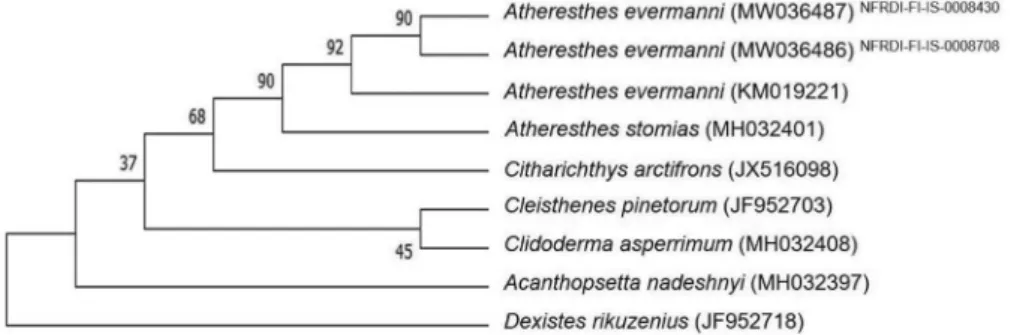
We analyzed the cytochrome c oxidase subunit I (COI) barcode region. As a result, COI barcode sequences of our specimens corresponded to them of Atheresthes evermanni.
These COI barcode sequences showed 97.95% similarity with them of Atheresthes stomias (Fig. 2). Therefore, this is considered a geographic variation or allometric growth in the same species. However, it is necessary to followup study more specimen of the species from various localities in order to clarify geographic variation.
This species is readily distinguished from congener A.
stomias (Jordan and Gilbert, 1880), by the eye on blind side (visible in the former vs. invisible in the latter) and number of gill rakers on ocular side (10~13 in the former vs. 14~18 in the latter). In addition, this species is easily distinguished from Hippoglossoides dubius in Korean waters by the shape of caudal fin (emarginated vs. double trun
cated) and mouth size (far beyond the eye vs. just beyond it).
This species’ Korean name and brief description were previously reported by Lee et al. (1999), using Pacific Ocean samples instead of Korean’s them. This species has
Fig. 2. NeighborJoining(NJ) tree based on the COI barcode sequences of two specimens, ingroups(Atheresthes evermanni, A. stomias) and out
groups.
not yet found in Korean waters. Therefore, we describe morphological characters of A. evermanni in order to regi
ster on the Korean fish fauna. We follow ‘Hwasalchiga
jami’ previously provided by Lee et al. (1999) for the Kor
ean name of A. evermanni.
ACKNOWLEDGEMENTS
We would like to deeply thank B.S. Yoon for help with collecting samples. This work was supported by a grant from the National Institute of Fisheries Science (R2020 026).
REFERENCES
Amaoka, K. 2016. Flatfishes of Japan(Citharidae, Paralicthyidae, Bothidae, Pleuronectidae, Poecilopsettidae, Samaridae).
Tokai Univ. Press, Kanagawa, Japan, 229pp.
Evseenko, S.A. 2004. Family Pleuronectidae Cuvier 1816righteye flounders. Calif. Acad. Sci. Annotated Checklists of Fishes, 37: 137.
Forest, L.D., J.T. DuffyAnderson, R.A. Heintz, A.C. Matarese, E.C.
Siddon, T.I. Smart and I.B. Spies. 2014. Taxonomy of the early life stages of arrowtooth flounder(Atheresthes stomias) and Kamchatka flounder(A. evermanni) in the eastern Bering Sea, with notes on distribution and condition. DeepSea Res.
II, 109: 181189. https://doi.org/10.1016/j.dsr2.2014.05.005.
Hubbs, C.L. and K.F. Lagler. 2004. Fishes of the Great Lakes Region, revised ed. Michigan Univ. Press, Ann Arbor, U.S.A., 332pp.
Jordan, D.S. and C.H. Gilbert. 1880. Description of a new flounder (Pleuronichthys verticalis) from the coast of California, with notes on other species. Proc. U.S. Natl. Mus., 3: 4951.
Jordan, D.S. and E.C. Starks. 1904. List of fishes dredged by the steamer Albatross off the coast of Japan in the summer of 1900, with descriptions of new species and a review of the Japanese Macrouridae. Bull. U.S. Fish Comm., 22: 577630, pls. 18.
Kumar, S., G. Stecher, M. Li., C. Knyaz and K. Tamura. 2018.
MEGA X: Molecular Evolutionary Genetics Analysis across computing platforms. Mol. Biol. Evol., 35: 15471549.
https://doi.org/10.1093/molbev/msy096.
Lea, R.N. 2013. Record of the Kamchatka flounder, Atheresthes evermanni, in California waters. Northwest Nat., 94: 244
246.
Lee, J.U., Y.U. Kim, Y.C. Park, D.Y. Moon, J.B. Kim and J.K. Kim.
1999. Fishes of the Pacific Ocean, 1st ed. Hanguel-graphics, Busan, Korea, 512pp.
Mukhanmetov, I.N. and A.M. Orlov. 2002. On the morphology of arrowhead flounders of the genus Atheresthes in the Pacific waters of the northern Kuril Islands and southeastern Kam
chatka. Rus. J. Mar. Biol., 28: 178185.
Nakabo, T. and R. Doiuchi. 2013. Family Pleuronectidae. In: Nakabo, T.(ed.), Fishes of Japan with pictorial keys to the species, 3rd ed. Tokai Univ. Press, Kanagawa, Japan, pp. 16751683.
Nelson, J.S., T.C. Grande and M.V.H. Wilson. 2016. Fishes of the world, 5th ed. John Wiley & Sons Inc., New Jersey, U.S.A., 707pp.
Ranck, C.L., F.M. Utter, G.B. Milner and G.B. Smith. 1986. Genetic confirmation of specific distinction of arrowtooth, Atheresthes stomias, and Kamchatka flounder, A. evermanni. Fish. Bull., 84: 222226.
Saitou, N. and M. Nei. 1987. The neighborjoining method: A new method for reconstructing phylogenetic trees. Mol. Biol.
Evol., 4: 406425. https://doi.org/10.1093/oxfordjournals.
molbev.a040454.
Sakamoto, K. 1984. Family Pleuronectidae. In: Masuda, H., K.
Amaoka, C. Araga, T. Uyeno and T. Yoshino(eds.), The fishes of the Japanese archipelago. Tokai Univ. Press, Tokyo, Japan, pp. 351355.
Suzuki, N., M. Nishida and K. Amaoka. 2001. The phylogenetic position of the genus Atheresthes(Pleuronectidae) and its classification: a molecular phylogenetic approach using mito
chondrial sequence data. Bull. Fish. Sci. Hokkaido Univ., 52:
3946.
Tsukamoto, Y., Y. Ueno, T. Minami and M. Okiyama. 1995. Trans
forming specimens of two righteye flounders, Atheresthes evermanni and Reinhardtius hippoglossoides. Jap. J. Ichthyol., 41: 469473.
Yang, M.S. 1988. Morphological differences between two conge
neric species of pleuronectid flatfishes: arrowtooth flounder, Atheresthes stomias, and Kamchatka flounder, A. evermanni.
Fish. Bull., 86: 608611.
Yang, M.S. and P.A. Livingston. 1986. Food habits and diet overlap of two congeneric species, Atheresthes stomias and Atheresthes evermanni, in the eastern Bering Sea. Fish. Bull., 82: 615
623.
Zimmermann, M. and P. Goddard. 1996. Biology and distribution of arrowtooth, Atheresthes stomias and Kamchatka, Atheresthes evermanni, flounders in Alaskan waters. Fish. Bull., 94: 358- 370.
한국 동해 중부 해역에서 채집된 가자미과 (Pleuronectidae) 어류 첫기록종 , Atheresthes evermanni
박정호
·
장요순1·
김진구2국립수산과학원 연구기획과, 1한국해양과학기술원 동해연구소, 2국립부경대학교 자원생물학과
요 약 :
가자미목 가자미과에 속하는 Atheresthes evermanni 2개체(표준체장 407~438mm)가 동해 중부 고성군 연안에서 자망으로 채집되었다. 본 개체는 입이 크고 양안간격이 좁으며, 무안측에서 눈이 보이지 않고 새파는 가늘고 길며, 꼬리지느러미는 만입형이고 측선은 거의 직선인 특징을 가지고 있다. 우리나라 해역에서 A. evermanni
는 처음 기록되고, 본 종을 우리나라 어류상에 포함시키며 새로운 속명과 국명으로 각각 ‘화살치가자미속’ 및 ‘화살
치가자미’를 제안한다.