R E S E A R C H A R T I C L E Open Access
Factors affecting patient safety culture in terms of compliance with preventing
bloodborne pathogens among general hospital nurses
Na Young Kim and Kyoung Ja Moon *
Abstract
Background: The present study aims to investigate the relationship between patient safety culture and the prevention of transmitting bloodborne pathogens among nurses at a general hospital.
Methods: The participants were 284 nurses working at a general hospital located in a city, and the data were collected between April 26 and May 15, 2019. Questionnaires on patient safety culture and the prevention of bloodborne pathogens were used, and SPSS version 22.0 was used for descriptive and hierarchical regression analysis.
Results: The results showed that the following factors affected the prevention of bloodborne pathogens:
experience with needle stick and sharps injuries ( β = − 0.94), teamwork (β = 0.41), knowledge and attitude toward patient safety ( β = 0.34), leadership (β = 0.15), and priority of patient safety (β = 0.14). The model’s explanatory power was 53% (F = 32.26, p =< 0.001).
Conclusions: To increase the compliance of general hospital nurses with practices that promote the prevention of bloodborne pathogens, it is necessary to actively prevent needle sticks and sharps injuries. It is also necessary to prioritize patient safety and to develop and verify the effects of various programs that emphasize factors of patient safety culture, such as leadership, teamwork, knowledge, and attitude.
Keywords: Patient safety, Patient safety culture, Bloodborne pathogen, Nurses
Background
As the standard of living has improved and the provision of medical services and public interest in health have in- creased, patients and caregivers who use hospitals have increasingly demanded high-quality medical services in safe environments [1]. Access to appropriate medical services is regarded as a basic patient right [2]; however, the increasing severity of patient conditions and com- plexity of medical services still threaten patient safety.
Improving patient safety and the quality of care has be- come a critical public health issue [3, 4].
Patient safety policies aim to minimize potential risks in medical services to prevent errors and to minimize risk factors, with the ultimate goal of decreasing the inci- dence of medical malpractice [5, 6]. Incidents of medical malpractice cause financial loss, distrust in healthcare professionals and hospitals, and longer hospital stays, directly influencing patient health and lives; therefore, medical malpractice is an important factor that de- creases the quality of care [7, 8]. The American Institute of Medicine [9] emphasized the need to mitigate medical
© The Author(s). 2021 Open Access This article is licensed under a Creative Commons Attribution 4.0 International License, which permits use, sharing, adaptation, distribution and reproduction in any medium or format, as long as you give appropriate credit to the original author(s) and the source, provide a link to the Creative Commons licence, and indicate if changes were made. The images or other third party material in this article are included in the article's Creative Commons licence, unless indicated otherwise in a credit line to the material. If material is not included in the article's Creative Commons licence and your intended use is not permitted by statutory regulation or exceeds the permitted use, you will need to obtain permission directly from the copyright holder. To view a copy of this licence, visit http://creativecommons.org/licenses/by/4.0/.
The Creative Commons Public Domain Dedication waiver (http://creativecommons.org/publicdomain/zero/1.0/) applies to the data made available in this article, unless otherwise stated in a credit line to the data.
* Correspondence: [email protected]
College of Nursing, Keimyung University, Daegu 42601, South Korea
malpractice and suggested fostering a culture that priori- tizes patient safety.
Patient safety culture is an organizational culture in which hospital staff recognize patient safety as a priority.
This is guided not only by patient safety policies and im- proved organizational systems but also by the manage- ment of patient safety through active communication and teamwork between the members [10]. Nurses’ per- ceptions of patient safety culture have been seen to in- crease their compliance with safe nursing practices, thus creating a safe medical environment [11]. Nurses often encounter situations requiring them to make critical judgments and independent decisions and where factors such as teamwork, knowledge, techniques, attitude, lead- ership, and communication are necessary for efficient workflow and problem solving [12].
Among the various healthcare-associated infections (HAIs), bloodborne infections are caused by exposure to blood or bodily fluids of a patient. Although prevention is of the utmost importance, when such exposure occurs, team members often criticize one another instead of communicating effectively, which creates obstacles to patient safety [11, 13]. Nurses who provide direct care to patients are at high risk of exposure to bloodborne infec- tions such as hepatitis B, hepatitis C, and HIV [14–16].
According to previous studies, patient safety and pa- tient safety culture have a positive influence on out- comes [17], and the application of various interventions could change the organizational safety culture and im- prove infection control [18]. Therefore, it is necessary to develop interventions for infection control by investigat- ing the factors affecting patient safety culture for blood- borne pathogen prevention.
Methods Study design
This cross-sectional study aims to investigate the rela- tionship between patient safety culture and compliance with bloodborne pathogen prevention in nurses of a general hospital.
Setting & participants
Participants were selected through convenience sam- pling and included nurses working at Pohang General Hospital (which is located in Pohang city and has more than 500 beds) who could understand and answer the survey questions voluntarily.
The sample size was calculated on G*Power 3.1.9.2, which revealed that a minimum of 256 participants was needed to perform a regression analysis with a median effect size of 0.15, significance level of 0.05, statistical power of 0.95, and 29 predictors. To account for a 15%
drop-out rate, the questionnaires were distributed to 294
participants. A total of 284 questionnaires were col- lected, and the response rate was 97%.
Measurement tools Patient safety culture
The Korean Patient Safety Culture Survey Instrument for Hospitals developed by Lee (2015) [19] is used to measure patient safety culture. The tool consists of 35 questions in seven domains. The questions are divided into three dimensions: organization, department, and in- dividual. The subdomains of the organization dimension include questions on leadership (9), patient safety policy and procedures (4), and patient safety improvement sys- tems (4). The subdomains of the department dimension include questions on teamwork (6) and nonpunitive en- vironments (4). The subdomains of the individual do- main comprise questions on knowledge and attitude toward patient safety (5) and the priority of patient safety (3). Each question is rated on a 5-point Likert scale ranging from 1 (“strongly disagree”) to 5 (“strongly agree”). Higher scores indicate higher awareness of pa- tient safety culture. In terms of reliability, Cronbach’s α was 0.93 in Lee (2015) [19], 0.93 in Sung (2018) [20], and 0.87 in the present study.
Compliance with bloodborne pathogen prevention
To measure compliance with practices promoting the prevention of bloodborne pathogens, the Compliance with Bloodborne Pathogens Prevention Scale developed by Lee (2017) [15] was used. The tool consists of 18 questions in four domains: compliance with standard precautions (8), compliance with infection exposure pre- vention when using instruments (3), emergency treat- ment after exposure to infections (3), and postexposure reporting and follow-up management (4). The questions are rated on a 4-point Likert scale: “never” = 1, “some- times” = 2, “often” = 3, and “always” = 4. The total score ranges between 7 and 18; a higher total score indicates higher compliance with practices promoting the preven- tion of bloodborne pathogens. In terms of the reliability of the tool, Cronbach’s α was 0.88 in Lee (2017) [15]
and 0.93 in the present study.
Data collection
The data for this study were collected between April 26
and May 15, 2019, using structured self-reported ques-
tionnaires distributed to nurses working at Pohang Gen-
eral Hospital located in Pohang City. Prior to data
collection, the director of nursing services granted ap-
proval by telephone. Subsequently, the researcher visited
the nursing department to explain the study purpose
and obtain approval for data collection. The purpose
and methods of the study were explained in detail to the
head nurses of the respective departments, and the
questionnaires were explained and distributed in the nurses’ lounge of each department. Nurses who wished to participate were then asked to complete the question- naires. The researcher visited the participants in their re- spective departments during each shift to explain the purpose of the study, the methods involved, and how the questionnaire should be completed. Participants were as- sured that the collected data would be used solely for re- search purposes, their identities would remain anonymous, and they could withdraw their participation at any point. The nurses who provided voluntary con- sent were asked to complete the questionnaires, and the completed questionnaires were collected by the researcher.
Statistical methods
The collected data were analyzed using SPSS/WIN 22.0 software. The demographic characteristics, patient safety culture, and compliance with bloodborne pathogen pre- vention were analyzed using frequency, percentage, mean, and standard deviation. The difference in blood- borne pathogen prevention according to the general characteristics of the subjects was analyzed by t-test and one-way ANOVA, and a post hoc test was performed by the Scheffé test. The relationship between patient safety culture and compliance with practices promoting the prevention of bloodborne pathogens was assessed using the Pearson correlation coefficient. A hierarchical mul- tiple regression analysis was conducted to investigate the factors that influence the participants’ compliance with practices promoting the prevention of bloodborne pathogens.
Ethical considerations
The present study was approved by the Institutional Re- view Board (IRB, 40525–201901-HR-126-02) at Kei- myung University in Deagu City. The participants provided written informed consent after the study pur- pose was explained to them. The consent form outlined that participation is voluntary, participant anonymity will be protected, the participants may withdraw their par- ticipation whenever they desire with no repercussions, and the collected data will be used solely for research purposes.
Results
Table 1 shows the demographic and clinical characteris- tics of the participants. It was noted that 275 (96.8%) participants were female, and 202 (71.1%) were below 30. Of the total participants, 205 (72.1%) had a bache- lor’s degree and 234 (82.4%) were staff nurses. In terms of total work experience, 199 (70.1%) had less than 5 years of experience, and 85 (29.9%) had more than 5 years. Further, 234 (82.4%) were noted to have been
working in their current unit for less than 5 years, and 50 (17.8%) had been working in their current unit for more than 5 years. Of the total, 55 (19.4%) worked in non-surgical internal medicine units. In terms of experi- encing needle stick and sharp injury (NSSI), 221 (77.8%) had experienced NSSI, in contrast with 63 (22.2%) who had not. Further, 37 (58.7%) experienced NSSI from dis- posable syringes, and 21 (33.3%) experienced NSSI while disassembling needles or sharp instruments. It was noted that 253 (89.1%) never experienced mucous membrane exposure to blood and bodily fluids, and 249 (87.7%) never experienced skin exposure to blood and bodily fluids. Of the total, 257 (90.5%) never completed a report on infection exposure, and 231 had received the hepatitis B vaccine (81.3%). The results showed that 142 com- pleted 0 patient safety case reports (50%), and 135 (47.5%) completed 1–5 patient safety case reports. Fur- ther, 259 (91.2%) participants received education on pre- vention of bloodborne pathogens, and 119 (41.9%) and 123 (43.3%) received education at hospital and at both school and hospital, respectively.
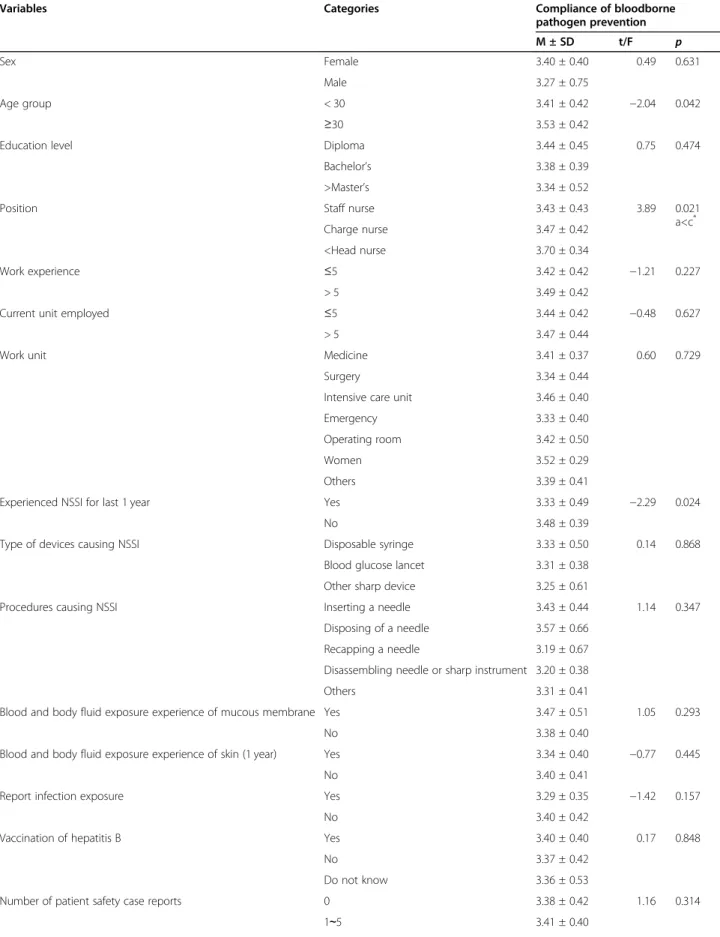
According to the participants’ demographic character- istics, compliance with practices promoting prevention of bloodborne pathogens was higher in participants older than 30 (F = − 2.04, p = 0.042), head nurses and those in higher positions (F = 3.89, p = 0.021), and par- ticipants without NSSI experience (t = − 2.29, p = 0.024) (Table 2).
A significant correlation was found between awareness of patient safety culture and compliance with blood- borne pathogen prevention (r = 0.36, p < 0.010). In terms of sub-categories, leadership had the highest cor- relation (r = 0.85, p < 0.010), followed by teamwork (r = 0.82, p < 0.010), patient safety policy/procedures (r = 0.77, p < 0.010), knowledge and attitude toward patient safety (r = 0.76, p < 0.010), system to improve patient safety (r = 0.61, p < 0.010), and non-punitive environ- ment (r = 0.17, p < 0.050). Priority of patient safety, which was also a sub-category of patient safety culture awareness did not show a significant correlation (r = 0.07, p = 0.223) (Table 3).
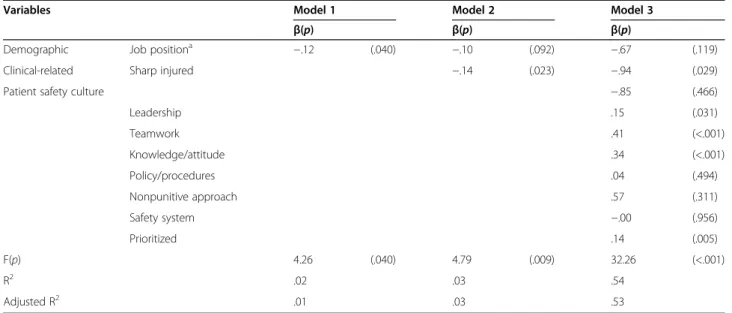
A hierarchical multiple regression analysis was con-
ducted to identify factors that influence compliance with
bloodborne pathogen prevention. In the analysis, job
position (demographic characteristic) and experience of
NSSI (clinical characteristic) were used as the dummy
variables, and patient safety culture and its sub-
categories were used as independent variables. Model 1,
which included job position, explained 1% (F = 4.26, p =
0.040) of compliance with practices promoting preven-
tion of bloodborne pathogens, and the explanatory
power increased by 2% in Model 2, which included NSSI
experiences (F = 4.79, p = 0.009). In Model 3, the follow-
ing sub-categories of patient safety culture awareness
Table 1 Demographic and clinical characteristics of the subjects (N = 284)
Characteristics Categories n (%)
Sex Female 275 (96.8)
Male 9 (3.2)
Age group < 30 202 (71.1)
≥30 82 (28.9)
Education level Diploma 72 (25.4)
Bachelor ’s 205 (72.1)
>Master ’s 7 (2.5)
Position Staff nurse 234 (82.4)
Charge nurse 31 (10.9)
Head nurse 19 (6.7)
Work experience ≤5 199 (70.1)
> 5 85 (29.9)
Current unit employed ≤5 234 (82.4)
> 5 50 (17.6)
Work unit Medicine (nonsurgical) 55 (19.4)
Surgery 52 (18.3)
Intensive care unit 46 (16.2)
Emergency 30 (10.6)
Operating room 27 (9.5)
Women 7 (2.5)
Others 67 (23.5)
Experienced NSSI for last 1 year Yes 63 (22.2)
No 221 (77.8)
Type of devices causing NSSI Disposable syringe 37 (58.7)
Blood glucose lancet 14 (22.2)
Other sharp device 12 (19.1)
Procedures causing NSSI Inserting a needle 5 (7.9)
Disposing of used items 10 (15.9)
Recapping a needle 8 (12.7)
Disassembling needle or sharp instrument 21 (33.3)
Others 19 (30.2)
Blood and body fluid exposure experience of mucous membrane Yes 31 (10.9)
No 253 (89.1)
Blood and body fluid exposure experience of skin Yes 35 (12.3)
No 249 (87.7)
Report infection exposure Yes 27 (9.5)
No 257 (90.5)
Vaccination for hepatitis B Yes 231 (81.3)
No 30 (10.6)
Do not know 23 (8.1)
Number of patient safety case reports 0 142 (50)
1 ∼5 135 (47.5)
6 ≤ 7 (2.5)
Education experience with bloodborne pathogen prevention Yes 259 (91.2)
were found to have significant effects on compliance with bloodborne pathogen prevention: leadership (β = 0.15), teamwork (β = 0.41), knowledge and attitude to- ward patient safety (β = 0.34), and priority of patient safety (β = 0.14). The model had an explanatory power of 53% (F = 32.26, p =< 0.001) (Table 4).
Discussion
The present study analyzed the relationship between pa- tient safety culture and nurses’ compliance with blood- borne pathogen prevention. When the participants’
compliance with the prevention of bloodborne patho- gens was analyzed according to their demographic and clinical characteristics, compliance was found to be higher among head nurses, those in higher positions, and participants who had not experienced a needlestick and sharps injury (NSSI) in the preceding year. This finding was in contrast with those of previous studies that found no difference in compliance with prevention of bloodborne pathogens based on job position. How- ever, the finding can be compared to those of previous research that reported that compliance was higher among those who had not experienced an NSSI than among those who had experienced an NSSI [16, 21, 22].
At the hospital where this study was conducted, head nurses and nurses in higher positions are responsible for the overall management of the unit, including monitor- ing of infection control, instead of providing direct care to patients; this might explain the results indicating higher awareness of infection prevention practices among higher-ranking nurses than among staff nurses.
Thus, to improve compliance with the prevention of bloodborne pathogens, education on NSSIs should be improved, and continuous monitoring of prevention compliance should be implemented.
A significant correlation was seen between the partici- pants’ patient safety culture and compliance with the prevention of bloodborne pathogens. In terms of patient safety culture, the subcategories of leadership, teamwork, patient safety policy, procedures, knowledge or attitude toward patient safety, patient safety improvement sys- tem, and priority of patient safety were significantly cor- related, whereas nonpunitive responses did not correlate
with compliance with prevention of bloodborne patho- gens. Although direct comparisons are difficult to make due to the limited number of similar studies, one study reported that perception of patient safety culture in hos- pital nurses was significantly related to compliance with standard precautions [23]. Thus, as shown in the present study, since patient safety culture, including standard precautions, can influence the prevention of bloodborne pathogens, it is necessary to understand and pay atten- tion to patient safety culture and relevant factors to pre- vent bloodborne infections [24].
According to a hierarchical regression analysis of fac- tors that influence compliance with bloodborne patho- gen prevention, experience with NSSIs and patient safety culture were found to be significant factors. Among the subcategories of patient safety culture, the significant factors were found to be teamwork, knowledge and atti- tude toward patient safety, leadership, and priority of pa- tient safety.
First, participants who had never experienced an NSSI were found to be more compliant with bloodborne pathogen prevention than those who had experienced an NSSI. This finding is in line with that of a previous study that reported higher compliance with practices promot- ing bloodborne infection control among those who had never experienced blood exposure [16]. Moreover, our finding also agrees with that of another study reporting higher compliance with standard precautions among those who had never experienced needle stick injuries [25]. This seems to be the case because nurses’ compli- ance with practices that protect them from infection would have prevented NSSIs, and the finding further in- dicates the importance of preventing exposure to blood.
Therefore, cases of bloodborne pathogen infections should be introduced in infection prevention training to emphasize the seriousness of the situation, and efforts should be made to help nurses habitually perform prac- tices promoting the prevention of infections. Moreover, nurse awareness should be improved to encourage them to prioritize their own protection when providing care in situations where bloodborne infections are possible [21].
NSSI is a major cause of bloodborne infections, and considering that more than half of nurses who Table 1 Demographic and clinical characteristics of the subjects (N = 284) (Continued)
Characteristics Categories n (%)
Sex Female 275 (96.8)
No 25 (8.8)
Educational institution for Bloodborne pathogen prevention College 17 (6.0)
Hospital 119 (41.9)
Both 123 (43.3)
Others 25 (8.8)
NSSI Needlestick and sharps injuries
Table 2 Compliance with bloodborne pathogen prevention according to subject characteristics (N = 284)
Variables Categories Compliance of bloodborne
pathogen prevention
M ± SD t/F p
Sex Female 3.40 ± 0.40 0.49 0.631
Male 3.27 ± 0.75
Age group < 30 3.41 ± 0.42 −2.04 0.042
≥30 3.53 ± 0.42
Education level Diploma 3.44 ± 0.45 0.75 0.474
Bachelor ’s 3.38 ± 0.39
>Master ’s 3.34 ± 0.52
Position Staff nurse 3.43 ± 0.43 3.89 0.021
a<c
*Charge nurse 3.47 ± 0.42
<Head nurse 3.70 ± 0.34
Work experience ≤5 3.42 ± 0.42 −1.21 0.227
> 5 3.49 ± 0.42
Current unit employed ≤5 3.44 ± 0.42 −0.48 0.627
> 5 3.47 ± 0.44
Work unit Medicine 3.41 ± 0.37 0.60 0.729
Surgery 3.34 ± 0.44
Intensive care unit 3.46 ± 0.40
Emergency 3.33 ± 0.40
Operating room 3.42 ± 0.50
Women 3.52 ± 0.29
Others 3.39 ± 0.41
Experienced NSSI for last 1 year Yes 3.33 ± 0.49 −2.29 0.024
No 3.48 ± 0.39
Type of devices causing NSSI Disposable syringe 3.33 ± 0.50 0.14 0.868
Blood glucose lancet 3.31 ± 0.38
Other sharp device 3.25 ± 0.61
Procedures causing NSSI Inserting a needle 3.43 ± 0.44 1.14 0.347
Disposing of a needle 3.57 ± 0.66
Recapping a needle 3.19 ± 0.67
Disassembling needle or sharp instrument 3.20 ± 0.38
Others 3.31 ± 0.41
Blood and body fluid exposure experience of mucous membrane Yes 3.47 ± 0.51 1.05 0.293
No 3.38 ± 0.40
Blood and body fluid exposure experience of skin (1 year) Yes 3.34 ± 0.40 −0.77 0.445
No 3.40 ± 0.41
Report infection exposure Yes 3.29 ± 0.35 −1.42 0.157
No 3.40 ± 0.42
Vaccination of hepatitis B Yes 3.40 ± 0.40 0.17 0.848
No 3.37 ± 0.42
Do not know 3.36 ± 0.53
Number of patient safety case reports 0 3.38 ± 0.42 1.16 0.314
1 ∼5 3.41 ± 0.40
experience an NSSI encounter repeated injuries [26, 27], it is important to prevent NSSIs in the first place. Fur- thermore, to improve compliance with the prevention of bloodborne pathogens, continued safety training on the safe use of syringes and NSSIs is necessary. In particular, in the present study, NSSIs were seen to occur most often in the process of disassembling needles or sharp instruments, mostly while disposing and washing used instruments and while recapping used needles.
Therefore, these specific cases should be included in periodic infection education for nurses, and further training should be provided on precautions while using sharp instruments. In addition, appropriate administra- tion or legislation should be implemented to prevent the recapping of used needles and to promote the wider use
of safe injection devices [16, 28]. Furthermore, we found that nurses received more infection education at hospi- tals than during their regular nursing curriculum at school. Infection education programs should be a part of nursing curricula. It is also crucial to provide access to continuing education in clinical settings [29, 30].
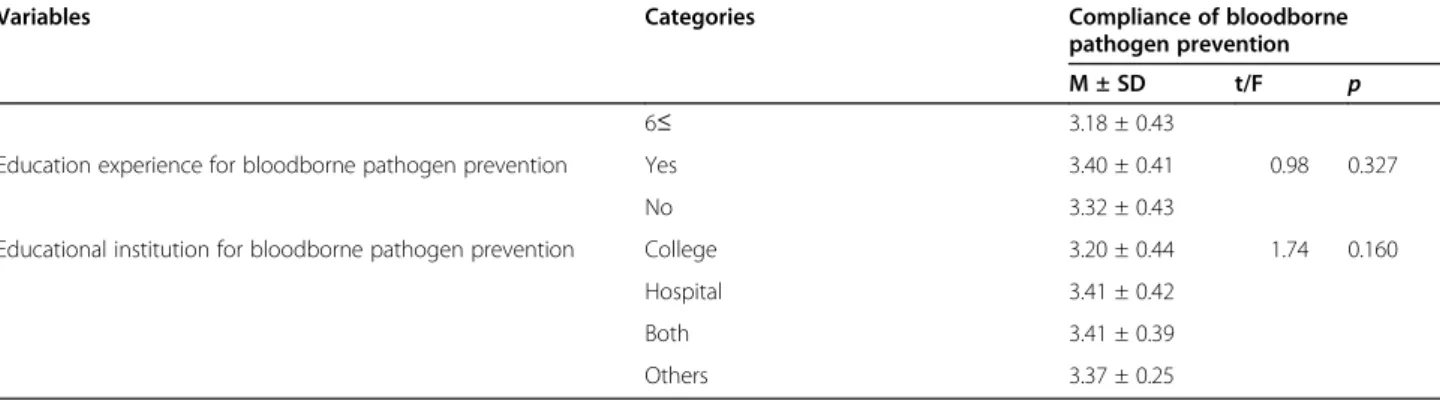
Second, within patient safety culture, the subcategories of knowledge and attitude toward patient safety, leader- ship, and priority of patient safety were found to have positive effects on bloodborne pathogen prevention. This result is comparable to previous research findings that suggest that those with higher perceptions of patient safety culture have higher compliance with standard pre- cautions [11] and compliance with practices promoting infection control [20]. These findings indicate that it is Table 2 Compliance with bloodborne pathogen prevention according to subject characteristics (N = 284) (Continued)
Variables Categories Compliance of bloodborne
pathogen prevention
M ± SD t/F p
6 ≤ 3.18 ± 0.43
Education experience for bloodborne pathogen prevention Yes 3.40 ± 0.41 0.98 0.327
No 3.32 ± 0.43
Educational institution for bloodborne pathogen prevention College 3.20 ± 0.44 1.74 0.160
Hospital 3.41 ± 0.42
Both 3.41 ± 0.39
Others 3.37 ± 0.25
Sheffe test
Table 3 Correlations of patient safety culture and bloodborne pathogen prevention (N = 284) Variables Patient
safety culture
Subcategory Compliance with
bloodborne pathogen prevention Leadership Teamwork Knowledge
/attitude
Policy /procedures
Nonpunitive responses
Improvement system
Prioritized
r(p) r(p) r(p) r(p) r(p) r(p) r(p) r(p) r(p)
Patient safety culture
1
Leadership .85(<.010) 1
Teamwork .82(<.010) .52(<.010) 1 Knowledge/
attitude
.76(<.010) .37(<.010) .30(<.010) 1
Policy/
procedures
.77(<.010) .58(<.010) .39(<.010) .36(<.010) 1
Nonpunitive responses
.17(<.010) .07(.192) .10(.066) −.01(.812) .13(<.050) 1
Improvement Safety system
.61(<.010) .41(<.010) .29(<.010) .26(<.010) .49(<.001) .11(.062) 1
Prioritized .07(.223) .14(<.050) .07(.188) .13(<.050) .14(<.050) .43(<.010) .11(.053) 1 Compliance with
bloodborne pathogen prevention
.36(<.010) .48(<.010) .59(<.010) .53(<.010) .38(<.001) .13(<.050) .26(<.010) .26(<.010) 1
important to cultivate a positive patient safety culture through leadership and that patient safety culture is an important factor in the prevention of bloodborne patho- gens. In terms of leadership in patient safety culture, a significant factor in the present study, it was found that leadership WalkRound programs aiming to change pa- tient safety culture awareness inside and outside of South Korea have led to improvement and are a mean- ingful way to improve patient safety culture [31, 32].
The present study is significant because it confirms how patient safety culture influences compliance with practices promoting the prevention of bloodborne path- ogens as a variable. In other words, the findings of the present study should be considered in developing pro- grams for HAI prevention and training on infections.
Moreover, this study used tools of Korean patient safety culture that were developed based on the consideration of Korean culture. A notable difference from the globally used Hospital Survey on Patient Safety Culture (HSOPSC) and Safety Attitudes Questionnaire (SAQ) [33–35] is the exclusion of questions from patient safety culture tools on the openness of communication, staff distribution, and handover. Instead, the Korean tools used in the present study added questions on policy or procedures, knowledge and attitude toward safety, and priority of patient safety [19]. The tools have different questions, probably because medical systems differ and the awareness of patient safety culture in Korea differs from that in other countries.
There are several limitations to this study: the data were collected through convenience sampling at a gen- eral hospital in one city, and it is difficult to generalize the findings due to regional bias. Moreover, the number of reports on patient safety incidents over the past year
exceeded that of NSSI incidents because the hospital’s reporting system includes NSSIs as well as exposure to pressure ulcers, falls, and near misses.
Conclusion
The present study analyzed the effects of hospital nurses’
patient safety culture on compliance with bloodborne pathogen prevention and found that an NSSI experience, leadership, and priority of patient safety were signifi- cantly related. Therefore, to increase the compliance of hospital nurses with practices promoting the prevention of bloodborne pathogens, it is necessary to carefully pre- vent NSSIs and to implement various programs that emphasize factors of patient safety culture, such as lead- ership, teamwork, and priority of patient safety.
Abbreviations
HAI: Healthcare-associated infections; NSSI: Needlestick and sharps injury;
HSOPSC: Hospital survey on patient safety culture; SAQ: Safety attitudes questionnaire
Acknowledgments
This research was supported by the Basic Science Research Program through the National Research Foundation of Korea (NRF) founded by the Ministry of Education (2017R1C1B1002351).
Authors ’ contributions
Conceptualization or/and Methodology: KJM, NYK. Data collection or/and Analysis: NYK, KJM. Writing: original draft or/and review & editing: KJM, NYK.
The author(s) read and approved the final manuscript.
Funding
The Ministry of Education, South Korea. “The funding bodies played no role in the design of the study and collection, analysis, and interpretation of data and in writing the manuscript ”.
Availability of data and materials
The datasets used and/or analysed during the current study available from the corresponding author on reasonable request.
Table 4 Factors influencing compliance with bloodborne pathogen prevention (N = 284)
Variables Model 1 Model 2 Model 3
β(p) β(p) β(p)
Demographic Job position
a−.12 (.040) −.10 (.092) −.67 (.119)
Clinical-related Sharp injured −.14 (.023) −.94 (.029)
Patient safety culture −.85 (.466)
Leadership .15 (.031)
Teamwork .41 (<.001)
Knowledge/attitude .34 (<.001)
Policy/procedures .04 (.494)
Nonpunitive approach .57 (.311)
Safety system −.00 (.956)
Prioritized .14 (.005)
F(p) 4.26 (.040) 4.79 (.009) 32.26 (<.001)
R
2.02 .03 .54
Adjusted R
2.01 .03 .53
a