Vol. 26, No. 2 (2016)
73
졸 - 겔공정 / 광증착법을 이용한 Ag-Doped TiO 2 합성 및 광촉매 특성
김병민·김정식
†서울시립대학교 신소재공학과
Photocatalytic Properties of the Ag-Doped TiO
2Prepared by Sol-Gel Process/Photodeposition
Byeong-Min Kim and Jung-Sik Kim
†Department of Materials Science and Engineering, University of Seoul, Seoul 02504, Korea
(Received December 18, 2015 : Revised December 30, 2015 : Accepted January 8, 2016)
Abstract
TiO2 nanoparticles were synthesized by a sol-gel process using titanium tetra isopropoxide as a precursor at room temperature. Ag-doped TiO2 nanoparticles were prepared by photoreduction of AgNO3 on TiO2 under UV light irradiation and calcinated at 400oC. Ag-doped TiO2 nanoparticles were characterized for their structural and morphological properties by X- ray diffractometry (XRD), scanning electron microscopy (SEM), energy dispersive spectroscopy (EDS), and transmission electron microscopy (TEM). The photocatalytic properties of the TiO2 and Ag-doped TiO2 nanoparticles were evaluated according to the degree of photocatalytic degradation of gaseous benzene under UV and visible light irradiation. To estimate the rate of photolysis under UV (λ = 365 nm) and visible (λ ≥ 410 nm) light, the residual concentration of benzene was monitored by gas chromatography (GC). Both undoped/doped nanoparticles showed about 80 % of photolysis of benzene under UV light. However, under visible light irradiation Ag-doped TiO2 nanoparticles exhibited a photocatalytic reaction toward the photodegradation of benzene more efficient than that of bare TiO2. The enhanced photocatalytic reaction of Ag-doped TiO2 nanoparticles is attributed to the decrease in the activation energy and to the existence of Ag in the TiO2 host lattice, which increases the absorption capacity in the visible region by acting as an electron trapper and promotes charge separation of the photoinduced electrons (e−) and holes (h+). The use of Ag-doped TiO2 nanoparticles preserved the option of an environmentally benign photocatalytic reaction using visible light; These particles can be applicable to environmental cleaning applications.Key words
photodeposition, sol-gel process, Ag-doped TiO2, photodegradation, photocatalytic reaction.1.
서 론이산화티타늄(TiO
2) 은 광촉매로 널리 사용되는 금속산 화물 중에서 가장 적합한 광촉매이며 높은 광반응성, 화 학적 안정성, 무독성, 친환경성, 낮은 비용의 장점을 가 진다. 자외선을 받으면 전자(electron)와 정공(hole)을 생 성하여 강한 산화력을 지니게 되고, 수중과 공기 중에 존재하는 각종 환경오염물질을 무해한 이산화탄소와 물 등으로 분해시킨다.
1-3)그러나, TiO
2는 wide bandgap semiconductor (3.2 eV for anatase) 로서 자외선(UV-light, λ ≤ 390 nm)의 흡수에
의해 광촉매 반응이 일어나지만 가시광선에서는 일어나 기 어렵다. 이러한 TiO
2의 한계를 극복하기 위해서 전자 - 정공 분리를 향상 시키면서, 가시광선 영역까지 빛의 흡 수범위를 확장시킬 수 있는 합성방법에 대한 연구가 진 행되고 있다. TiO
2에 금속 또는 비금속 이온을 결합,
4)TiO
2표면에 안료 감광,
5)TiO
2표면에 귀금속 증착
6)등 이 대표적인 연구이다. 특히, TiO
2표면에 귀금속 증착 에 관한 연구가 가장 활발히 진행되고 있다. 귀금속이 증착된 TiO
2는 접합면에서 높은 schottky barriers를 가 지고 있기 때문에 전자-정공 분리가 촉진되며, 가시광선 영역까지 빛의 흡수범위가 확장된다.
7)†Corresponding author
E-Mail : [email protected] (J.-S. Kim, UOS)
©Materials Research Society of Korea, All rights reserved.
This is an Open-Access article distributed under the terms of the Creative Commons Attribution Non-Commercial License (http://creative- commons.org/licenses/by-nc/3.0) which permits unrestricted non-commercial use, distribution, and reproduction in any medium, provided the original work is properly cited.
copy(TEM) 를 이용하여 물리적 특성을 고찰하였다. 또한, 자외선과 가시광원에서 TiO
2와 광분해 특성을 gas chro- matography(GC) 를 이용하여 비교 고찰하였다.
2.
실험 방법2.1 졸 - 겔공정을 이용한 TiO
2합성
TiO
2는 졸-겔공정을 이용하여 합성하였다. 출발원료는 TiO
2의 전구체인 TTIP(Titanium Isopropoxide, Ti[OCH(CH
3)
2]
4, Aldrich) 와 가수분해 촉매제인 H
2O, 용매인 C
2H
5OH (DUKSAN, 99.99 %) 를 사용하였다.
먼저 C
2H
5OH 10 mL 와 H
2O 15 mL 를 혼합한 용매에 TTIP 5 mL 를 첨가하고 35
oC 에서 1시간 동안 300 rpm 으로 교반하여 Ti-sol 용액을 제조하였다. 이후에는 Ti- sol 용액을 여과 및 세척을 하고, 100
oC 에서 2시간 건 조시켜서 TiO
2분말을 얻어 ball-milling하였다. TiO
2결 정화가 일어나도록, 최종적으로 400
oC 에서 4시간 열처 리하였다. Fig. 1에 졸-겔공정에 의한 TiO
2나노분말 합 성에 대한 공정순서도를 나타내었다.
2.2 광증착법으로 Ag 를 도핑시킨 Ag-doped TiO
2TiO
2광촉매 분말에 Ag 촉매금속의 도핑은 광증착법 을 이용하였으며, Ag 도핑의 전구체는 AgNO
3(DUKSAN, 99.8 %), pH 를 조절하는데 필요한 NH
4OH(DUKSAN, 25~30 %), 용매인 H
2O 를 출발원료로 사용하였다.
먼저 TiO
21 g 과 H
2O 500 mL 를 35
oC 에서 5분 동안 300 rpm 으로 교반하면서 혼합하였고, 5분 동안 상온에 서 sonication을 하였다. 그리고 AgNO
3를 AgNO
3:TiO
2= 1:10 과 같은 조성비(molar ratio)로 첨가하여 35
oC 에서 30 분 동안 300 rpm으로 교반하면서 혼합하였다. pH가 6 보다 낮은 경우 혼합한 용액에 존재하는 TiO
2입자표 면은 OH
2+상태이고, pH가 6보다 높은 경우 혼합한 용 액에 존재하는 TiO
2입자표면은 O
−상태이다; 후자의 경 우 TiO
2입자표면은 음전하를 띄기 때문에 Ag
+이온을 도
핑하는데 적합한 조건이다.
9)그리고 pH가 7, 10인 경우 Ag 가 TiO
2에 도핑된 상태는 다음과 같다
10):
TiO
2+ Ag
+→ TiO
2@(Ag
+) at pH = 7 (1) TiO
2(Ag
+) + BH
4−→ TiO
2@Ag at pH = 10 (2)
그래서 혼합한 용액에 NH
4OH 를 첨가하여 pH 10으로
조정하고, 15분 동안 교반하였다. 이후에는 Ag의 산화
를 방지하기 위해서 진공 상태에서 교반을 하고, 동시
에 자외선(λ = 250 nm)을 조사하여 Ag를 TiO
2에 도핑하
였다. 이렇게 제조된 용액을 여과공정을 통하여 수용액과
분말을 분리시키고, 100
oC 에서 12시간 건조시켜 잔류
H
2O 를 제거하였다. 그리고 최종적으로 Ag-doped TiO
2에
잔유 할 수 있는 유기불순물을 제거하기 위하여 400
oC
Fig. 1. Flow chart for the synthesis of TiO2 by sol-gel process.에서 6시간 동안 annealing하였다. Fig. 2에 Ag-doped TiO
2의 도핑공정인 광증착법의 공정순서도를 나타내었다.
시편의 결정구조는 X-ray diffractometry(New D8- Advance, Bruker-AXS) 로 분석하였고, 미세구조와 성분분
석은 scanning electron microscopy(Field Emission S- 4700, Hitachi) 및 energy dispersive spectroscopy(EDS, Oxford) 와 transmission electron microscopy(TECNAI F20 G
2, FEI) 로 관찰하였다. 광분해 반응은 gas chromatography (7890A, Agilent) 를 사용하여 VOCs 유해 가스의 주요 성 분 중 하나인 벤젠가스(C
6H
6) 에 대한 광분해 반응을 측 정하였다.
3.
결과 및 고찰3.1 결정구조 및 미세구조 분석
Fig. 3 은 졸-겔공정으로 합성한 TiO
2및 광증착법으로 Ag 를 도핑시킨 Ag-doped TiO
2의 XRD 패턴이다. 세 시 편에 대한 XRD 패턴이 거의 동일하고, 도핑된 Ag의 양 이 매우 작기 때문에 Ag에 대한 회절피크가 나타나지 않았다. TiO
2와 Ag-doped TiO
2는 anatase 상과 rutile 상 이 혼재되어 있다(JCPDS 21-1272 / JCPDS 76-1940).
Table 1 은 결정립의 크기 및 상의 분포를 나타내었다. 결 정립의 크기는 아래 식(3)의 Scherrer’s equation을 이용 하여 계산하였다.
11)(3)
D 는 평균결정립크기(nm), λ는 X선의 파장, k는 평형 상수이며 일반적으로 0.89라는 값을 가진다. β는 반가폭
D kλ
βcosθ ---
= Fig. 2. Flow chart for the Ag doping to TiO2 by photodeposition.
Table 1. Crystalline phase and crystallite size of the synthesized TiO2, Ag-doped TiO2 and Ag-doped TiO2 annealed at 400oC.
photocatalyst crystalline phase (%) crystallite size (nm)
TiO2 A : 78 % R : 22 % DA: 25 nm DR: 25 nm
Ag-doped TiO2 A : 77 % R : 23 % DA: 21 nm DR: 30 nm
Ag-doped TiO2 (annealed at 400oC) A : 75 % R : 25 % DA: 25 nm DR: 30 nm Fig. 3. XRD results of (a) TiO2, (b) Ag-doped TiO2 and (c) Ag- doped TiO2 annealed at 400oC.
(full width at half maximum), θ는 회절각도이다. 결정 상의 분포는 아래 식(4)를 이용하여 계산하였다.
12)(4)
I
A는 anatase (101) 회절피크의 intensity, I
R은 rutile (110) 회절피크의 intensity이다. 결정립의 크기는 21~30 nm, 상의 분포는 anatase 상이 75~78 %이고 rutile 상이 22~25 % 로 세 시편 모두 비슷한 크기와 분포를 보였다.
이는 TiO
2결정화를 위하여 모두 열처리를 400
oC 로 실 시해서 동일한 크기의 열에너지가 가해졌기 때문이다.
Fig. 4 는 TiO
2및 Ag-doped TiO
2를 SEM으로 관찰한 사진이다. 세 시편의 입자형상이 구형에 가까운 것을 확 인 할 수 있었다. 그리고 도핑된 Ag의 결정립 크기는 모재인 TiO
2에 비해서 매우 작기 때문에 SEM으로 관 찰 할 수 없었다. Fig. 5는 TiO
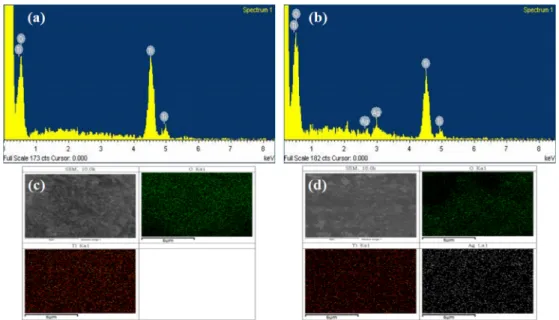
2의 Ag 도핑 유무에 따 른 EDS spectrum 및 mapping 이미지로서 Ti, O, Ag 원소의 피크 및 분포상태를 나타낸다. 이를 통해서 TiO
2에 도핑된 Ag를 확인 할 수 있었고, 균일하게 분포된 Ag 의 분포상태도 알 수 있었다. Fig. 6는 Ag-doped TiO
2를 TEM 으로 관찰한 사진으로서, Ag의 분포 상태를 명확히 보여준다. 광증착법은 TiO
2와 같은 복합체의 발색단이 빛 을 흡수하면 광 여기가 일어나고, 이때 생성된 전자(e
−) 와 정공(h
+) 에 의해서 금속을 상온에서 효율적으로 증착 시키는 방법이다.
13-17)따라서 광증착법에 의해서 TiO
2에 Ag 가 비교적 도핑이 잘 되었다고 사료된다.
3.2 벤젠가스 (C
6H
6) 에 대한 광분해 반응 분석 Fig. 7(a) 는 자외선(λ = 365 nm)하에서 Fig. 7(b)는 가시 광선(λ ≥ 410 nm)하에서 시간 변화에 따른 TiO
2및 Ag- doped TiO
2의 벤젠가스에 대한 광분해 반응을 측정한 그 래프이다. 가시광선 하에서 측정하는 경우에는 200-W 백 열전구에 자외선 차단 렌즈(UV-filter Lens, Kenko)를 부 착하여 자외선을 제거하였다. Fig. 7에서 그래프가 일정하 지 않은 이유는 실험적 오류로 인한 것으로 생각된다.
하지만 광분해도의 경향성에는 영향을 미치지 않았다.
Fig. 7 의 그래프 결과를 살펴보면 자외선과 가시광선 하
Rutile phase % 1001 0.8 IA IR
⎝ ⎠---- + ⎛ ⎞ ---
=
Fig. 5. EDS spectra of (a) TiO2 and (b) Ag-doped TiO2 and compositional mapping of (c) TiO2 and (d) Ag-doped TiO2.
에서 Ag-doped TiO
2는 TiO
2보다 광분해 속도가 빨랐다.
이는 TiO
2표면에 Ag와 같은 나노금속이 도핑되면 나노 금속은 낮은 페르미준위에 의해 분리된 전자의 임시 저 장소 역할을 하게 되고 전자(e
−)- 정공(h
+) 쌍(electron-hole pair, EHP) 의 분리효율을 향상시켜 주기 때문이다.
18-19)그 리고 TiO
2는 band gap이 3.2 eV(λ = 388 nm)이기 때문에 가시광선 하에서는 광분해가 일어나지 않고, Ag가 도핑 된 Ag-doped TiO
2시편은 광분해가 일어났다. 이는 Ag 가 도핑되면서 TiO
2의 흡수 스펙트럼이 가시광선 영역 대로 확장되기 때문이다.
20)TiO
2를 제외하고 Ag-doped TiO
2를 살펴보면 annealing하지 않은 시료보다 400
oC 에 서 annealing한 시료의 광분해 속도가 빨라졌다. 이는 annealing 하지 않은 시료는 광분해 속도를 저하시키는 흡 착수, 수산기, 불순물 등의 잔유물이 남아 있고, annealing 한 시료는 잔유물이 제거되었기 때문이다.
21)4.
결 론본 연구에서는 졸-겔공정을 이용하여 TiO
2를 합성하고,
합성한 TiO
2를 사용하여 광증착법으로 Ag를 도핑시켰 다. 또한, Ag 도핑과 annealing에 따른 결정구조 및 미 세구조 변화를 관찰하고 벤젠가스에 대한 광분해 반응 특성을 고찰하였다.
EDS 와 TEM을 통해서 TiO
2에 도핑된 Ag의 분포 상 태를 확인 할 수 있었다. 그리고 TiO
2와 Ag-doped TiO
2의 벤젠가스에 대한 광분해 특성을 측정한 결과, 자외 선 및 가시광선 하에서 TiO
2보다 Ag-doped TiO
2가 광 분해 속도가 빠르게 나타났다. 그 원인은 TiO
2표면에 Ag 와 같은 나노금속이 도핑되면 나노금속은 낮은 페르 미준위에 의해 분리된 전자의 임시 저장소 역할을 하게 되고 전자(e
−)- 정공(h
+) 쌍의 분리효율을 향상시켜 주기 때 문이다. 또한 TiO
2는 가시광선 하에서는 광분해가 일어 나지 않고, Ag가 도핑이 되면 광분해가 일어났으며, 이 는 Ag가 도핑되면서 TiO
2의 흡수 스펙트럼이 가시광선 영역대로 확장되었기 때문에 가시광선 하에서도 광분해 가 일어날 수 있었다. 400
oC 로 annealing한 경우는 유 기물, 수산기, 불순물 등의 잔유물이 제거되어 광분해 속
Fig. 7. Concentration variations of benzene gas with irradiation time for the TiO2 and Ag-doped TiO2: (a) under UV light irradiation and (b) visible light irradiation.Fig. 6. TEM images of (a) Ag-doped TiO2 and (b) Ag-doped TiO2 annealed at 400oC.
2. A. Fujishima and K. Honda, Bull. Chem. Soc. Jpn., 44, 1148 (1971).
3. A. Fujishima and K. Honda, Nature, 238, 37 (1972).
4. S. D. Mo and L. B. Lin, J. Phys. Chem. Solid., 55, 1309 (1994).
5. K. Vinodgopal, D. E. Wynkoop and P. V. Kamat, Environ. Sci. Tech., 30, 1660 (1996).
6. V. Vamathevan, R. Amal, D. Beydoun, G. Low and S.
McEvoy, J. Photochem. Photobiol. Chem., 148, 233 (2002).
7. J. M. Herrmann, J. Disdier and P. Pichat, J. Phys.
Chem., 90, 6028 (1986).
8. K. Shiba, H. Hinode and M. Wakihara, React. Kinet.
Catal. Lett., 64, 281 (1998).
9. G. Fu, P. S. Vary and C. T. Lin, J. Phys. Chem. B, 109,
(2007).
16. S. Scire, C. Crisafulli, S. Giuffrida, G. Ventimiglia, C.
Bongiorno and C. Spinella, J. Mol. Catal. Chem., 333, 100 (2010).
17. J. C. Scaiano, P. Billone, C. M. Gonzalez, L. Marett, M.
L. Marin, K. L. McGilvray and N. Yuan, Pure. Appl.
Chem., 81, 635 (2009).
18. A. L. Linsebigler, G. Lu and J. T. Yates, Chem. Rev., 95, 735 (1995).
19. D. Yang, S. E. Park, J. K. Lee and S. W. Lee, J. Cryst.
Growth, 311, 508 (2009).
20. C. Suwanchawalit, S. Wongnawa, P. Sriprang and P.
Meanha, Ceram. Int., 38, 5201 (2012).
21. D. Zhang, X. Song, R. Zhang, M. Zhang and F. Liu, Eur. J. Inorg. Chem., 2005, 1643 (2005).