Journal of the Korean Chemical Society 2013, Vol. 57, No. 4
Printed in the Republic of Korea
http://dx.doi.org/10.5012/jkcs.2013.57.4.489
-489-
Preparation of Highly Visible-Light Photocatalytic Active N-Doped TiO
2Microcuboids
Kang Zhao*, Zhiming Wu, Rong Tang, and Yadong Jiang
State Key Laboratory of Electronic Thin Films and Integrated Devices, School of Optoelectronic Information, University of Electronic Science and Technology of China (UESTC), Chengdu 610054, P.R. China
*E-mail: [email protected]
(Received April 3, 2013; Accepted June 26, 2013)
ABSTRACT. N-doped TiO2 microcuboids were successfully prepared by a simple one-pot hydrothermal method. The samples were characterized by X-ray diffraction, scanning electron microscopy, diffuse reflectance spectroscopy, and X-ray photoelectron spectroscopy. It was found that the N-doped TiO2 microcuboids enhanced absorption in the visible light region, and exhibited higher activity for photocatalytic degradation of model dyes. Based on the experimental results, a visible light induced photocatalytic mechanism was proposed for N-doped anatase TiO2 microcuboids.
Key words: Nitrogen-doping, TiO2 microcuboid, Visible photocatalyst, Mechanism
INTRODUCTION
Titanium dioxide (TiO2) is the most widely used pho- tocatalytic material since it exhibits non-toxic nature, high efficiency, chemical inertness, relatively low cost, and photostability.1−4 However, the main drawback is that TiO2 photocatalysts can only be excited by ultraviolet (UV) light due to their wide band gap. Therefore, many studies have been devoted to the efficiency improvement of TiO2
under visible light illumination.5−7
Over the past twenty years, there has been extensive research into extending the absorption profile of TiO2 into the visible region by doping with main group elements, in particular with nitrogen. Nitrogen doping is one of the simplest synthetic methods to engineer a visible photo- catalyst, and it can narrow the band gap of TiO2 to 2.6 eV, which consequently gives rise to visible light-driven pho- tocatalytic activity.8 Since then, N-doped TiO2 have been prepared by various methods, including sol-gel method,9 chemical vapor deposition method,10 hydrothermal method11 and calcination in ammonia gas.12 Among them, the hydrothermal route is an ideal technique for synthesizing N-doped TiO2 nanomaterials with high purity, narrow par- ticle size distribution, controlled morphology and high crystallinity.13 For example, Zhao14 and his coworkers prepared N-doped TiO2 hollow microspheres by a one- step hydrothermal method, and the prepared TiO2 micro- spheres showed excellent photocatalytic activities in degrading dyes under visible light irradiation. Liu et al.15 prepared N-doped TiO2 nanorods by a simple one-pot sol-
vothermal method using hydrazine hydrate and TiO2 col- loids as the starting materials, and the sample showed high catalytic activity of decomposing methyl orange and 4- chlorophenol under UV and visible light illumination.
Despite that several studies have succeeded in the prep- aration of N-doped TiO2 nanoparticles with various mor- phologies, no report, so far, synthesized the N-doped TiO2 microcuboids with high visible light photocatalytic activity.
In this article, we report a facile way to obtain N-doped TiO2 microcuboids with high photocatalytic property under UV and visible light irradiation. It was proven that the pre- pared N-doped TiO2 microcuboids significantly enhanced the photo absorption abilities and photocatalytic activities as compared to those of TiO2 samples under the same con- ditions.
EXPERIMENTAL DETAILS
All reagents were analytical grade and used without fur- ther purification. In a typical procedure, 2.37 g titanium n-butoxide was dissolved into 15 mL of ethanol. 0.05 g sodium dodecyl sulfate (SDS) and 2 mL of ammonia were added into 5 ml of deionized water and stirring continued for 30 min. After sufficient mixing, the mixed solution was added drop wise into the titanium n-butoxide solu- tion with constant stirring. Next, the autoclave was heated at 160oC for 12 h and allowed to cool down naturally. The product was centrifuged, washed several times with dis- tilled water and ethanol, and dried at 60 oC for 6 h. At last, the sample was then annealed at 450 oC for 3 h in air to
Journal of the Korean Chemical Society
490 Kang Zhao, Zhiming Wu, Rong Tang, and Yadong Jiang
prepare the final N-doped TiO2 microcuboids. For com- parison, the TiO2 samples were prepared using the same method.
The phase of the as-prepared products was determined by a Rigaku D/Max 2400 X-ray diffractometer (XRD) equipped with graphite monochromatized CuKα radia- tion. The morphology of the as-synthesized products was observed directly by a JEOL JSM-5600LV scanning elec- tron microscope (SEM) equipped with energy-dispersive X-ray spectroscopy (EDS). The UV-vis diffuse reflectance spectra (DRS) of the samples over a range of 200−800 nm were collected on a UV-2450 instrument.
The evaluation of photocatalytic activity of the prepared samples for the photocatalytic decomposition of RhB aqueous solution under 300 W mercury lamp as a UV source or 300 W Xe lamp served as a visible-light source with an ultraviolet cutoff filter, which allowed the trans- mission of visible-light with a wavelength longer than 420 nm (λ >420 nm). 50 mg photocatalyst was dispersed in a 50 mL aqueous solution of 1.0×10⁻⁵ M RhB. Before pho- todegradation, adsorption equilibrium of the dye on cat- alyst surface was established by mechanical stirring for 30 min.
After solar irradiation for some time (30 min), the reac- tion solution was filtrated to remove the suspended par- ticulates. Then, the concentration of RhB in solution was analyzed with an UV-visible spectrophotometer (UV-2550, Shimadzu, Japan).
RESULTS AND DISCUSSION
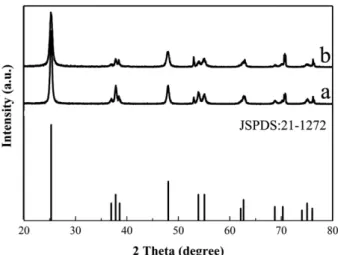
The typical powders XRD patterns of TiO2 sample and N-doped TiO2 microcuboids are shown in Fig. 1. The crystal structures of the N-doped TiO2 powders represent the anatase phases (JCPDS, card no: 21-1272), which are similar to pure TiO2 sample.
Fig. 2 shows typical SEM images of the N-doped TiO2 microcuboids fabricated by a one-pot hydrothermal method.
As shown in Fig. 2a, the overall morphology of the sam-
ple indicates that there exists a great deal of uniform cuboid- like microstructures in high yield. The microcuboids are in the length of about 400 nm, in the width of about 300 nm and in the height of about 250 nm. The corresponding EDS of N-doped TiO2 microcuboids also demonstrates the presence of Ti, O and N, and the atomic ratio of the N is about 16%.
Fig. 3 shows the corresponding UV-vis diffuse reflec- tance spectra of pure TiO2 samples and N-doped TiO2 microcuboids. The absorption edge of pure TiO2 samples is observed at about 380 nm, corresponding to the band- gap energy of 3.2 eV. After the N doping in the TiO2 sam- ples, the absorption spectrum shows that the absorption edge is shifted significantly toward the visible region with a band edge of 535 nm (Eg = 2.3 eV) (Fig. 3b). The remark- able absorbance for visible light is attributed to the for- mation of the O−Ti−N linkage, leading to the narrowing of the energy band gap. This phenomenon can also be explained in terms of the formation of an intra-band gap located above the valence band, due to substitution of oxide centers by nitride centers and/or to the interstitial Figure 1. XRD patterns of TiO2 samples (a) and N-doped TiO2 microcuboids (b).
Figure 2. SEM images (a, b) and EDS (c) of N-doped TiO2 microcuboids.
Preparation of Highly Visible-Light Photocatalytic Active N-Doped TiO2 Microcuboids 491
2013, Vol. 57, No. 4
introduction of nitride into the oxide lattice.16
Fig. 4 shows the N1s X-ray photoelectron spectroscopy spectrum of the N-doped TiO2 microcuboids prepared by hydrothermal process. In general, the peak of N1s from the XPS spectrum is mostly found in the range of 396−404 eV.
The N1s peak at 399.63 eV can be attributed to the nitro- gen in the form of a Ti–N–O linkage, and the low bonding energy component located at 398.23 eV is generally known as the N atom replacing the oxygen atoms in the TiO2 crys- tal lattice to form an N–Ti–N bond. The relative atomic con- centrations of N in the TiO2 sample is found to be 4.8 at.%
based on the XPS data.
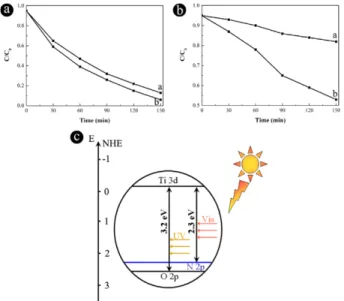
The photocatalytic activity of the TiO2 samples and N- doped TiO2 microcuboids was evaluated by measuring the rate of degradation of RhB under UV and visible light irradiation. Fig. 5(a) shows the degradation of RhB under UV irradiation for the two kinds of samples. After 150 min of UV irradiation, 87% of RhB is decomposed by TiO2 sam-
ples, whereas 94% of RhB is decomposed by N-doped TiO2 microcuboids. It indicates that N-doped TiO2 microcuboids exhibits superior photocatalytic capability in degrading RhB dye under the UV irradiation, and the photocatalytic enhancement is mainly attributed to the effective separa- tion of the photogenerated electron-holes pairs. Under UV light activation, the electrons of TiO2 are excited to the conduction band, the valence holes transferred from the valence band of TiO2 (O2p) to that of TiO2 (N2p). Thus, electron-hole pairs are effectively separated, which leads to the high photocatalytic activity of N-doped TiO2 microcuboids. However, under visible light activation, the 47% of RhB removal is obtained after 150 min, while only 18% of the RhB removal is obtained in the photocatilytic process with the same illumination time. It is therefore concluded that N-doping is very important to improve the visible light photocatalytic performance. It is speculated that the main reason is the narrowing of the band gap caused by the mixing of the N2p and O2p states, which resulted in high visible light photocatalytic activity.
CONCLUSION
In conclusion, N-doped TiO2 microcuboids were suc- cessfully fabricated by a facile one-pot hydrothermal method. The structure, optical and photocatalytic prop- erties of N-doped TiO2 microcuboids were discussed in Figure 3. UV-vis spectra of TiO2 samples (a) and N-doped TiO2
microcuboids (b).
Figure 4. N1s XPS patterns spectrum of N-doped TiO2 microcuboids.
Figure 5. The photocatalytic degradation of RhB over TiO2 sam- ples and N-doped TiO2 microcuboids under UV (a) and visible light (b) irradiation. A schematic illustration of electron migra- tion in N-doped TiO2 microcuboids under UV and visible light irradiation (c).
Journal of the Korean Chemical Society
492 Kang Zhao, Zhiming Wu, Rong Tang, and Yadong Jiang
detail, and the novel N-doped TiO2 microstructures greatly enhanced the visible light response and photocatalytic degradation of RhB. The enhanced photocatalytic prop- erties can be attributed to the extended absorption in the visible light region and the effective separation of pho- togenerated carriers resulting from N doping in the TiO2
crystals. This new type of photocatalyst that can harness both UV and visible light presents a promising candidate for applications in photocatalysis.
Acknowledgments. This work was financially supported by the National Natural Science Foundation of China (No.
61235006). And the publication cost of this paper was supported by the Korean Chemical Society.
REFERENCES
1. Yao, F.; Sun, Y.; Tan, C. L.; Wei, S.; Zhang, X. J.; Hu, X.
Y.; Fan, J. J. Korean Phys. Soc. 2011, 55, 932.
2. Chen, W. G.; Yuan, P. F.; Zhang, S.; Sun, Q.; Liang, E.;
Jia, Y. Physica B 2012, 407, 1038.
3. Ebrahimi, R.; Tarhandeh, G.; Rafiey, S.; Narjabadi, M.;
Khani, H. J. Korean Phys. Soc. 2011, 56, 92.
4. Zhao, H. M.; Wu, M. M.; Wang, Q.; Jena, P. Physica B
2011, 406, 4322.
5. Yan, X. M.; Kang, J. L.; Gao, L.; Xiong, L.; Mei, P. Appl.
Surf. Sci. 2013, 265, 778.
6. Nakajima, T.; Lee, C. Y.; Yang, Y.; Schmuki, P. J. Mater.
Chem. A 2013, 1, 1860.
7. Chen, K. S.; Feng, X. R.; Hu, R.; Li, Y. B.; Xie, K.; Li, Y.; Gu, H. S. J. Alloys Compd. 2013, 554, 72.
8. Liu, B. K.; Wang, D. J.; Zhang, Y.; Fan, H. M.; Lin, Y.
H.; Jiang, T. F.; Xie, T. F. Dalton Trans. 2013, 42, 2232.
9. Dunnill, C. W.; Ansari, Z.; Kazas, A.; Perni, S.; Morgan, D. J.; Wilson, M.; Parkin, I. P. J. Mater. Chem. 2011, 21, 11854.
10. Ku, Y.; Chen, W. J.; Hou, W. M. Sustain. Environ. Res.
2013, 23, 15.
11. Wang, D. H.; Jia, L.; Wu, X. L.; Lu, L. Q.; Xu, A. W.
Nanoscale 2012, 4, 576.
12. Wu, M. C.; Liao, H. C.; Cho, Y. C.; Tóth, G.; Chen, Y. F.;
Su, W. F.; Kordás, K. J. Mater. Chem. A 2013, 1, 5715.
13. Yang, G. D.; Jiang, Z.; Shi, H. H.; Xiao, T. C.; Yan, Z. F.
J. Mater. Chem. 2010, 20, 5301.
14. Pan, J. H.; Han, G.; Zhou, R.; Zhao, X. S. Chem. Com- mun. 2011, 47, 6942.
15. Gai, L. G.; Duan, X. Q.; Jiang, H. H.; Mei, Q. H.; Zhou, G. W.; Tian, Y.; Liu, H. Cryst. Eng. Commun. 2012, 14, 7662.
16. Li, M.; Zhang, J. Y.; Zhang, Y. Catal. Commun. 2012, 29, 175.