2013 KSDF 1229-0033/2013-06/94-101
ⓒ
〈Research Paper〉
1. Introduction
Among the various metal oxides, extensive efforts are given to the research on titanium dioxide (TiO
2) for its wide range of applications such as sunscreen, photocatalyst, sensor, solar cell, hydrogen storage, organic waste management etc.
1 5)‐. Recently, titanium dioxide (TiO
2) based photocatalysts have attracted much interest to the environmental scientist for their potential application in environmental remediation by degrading many organic pollutants
4 7)‐. Electrospinning of TiO
2nano- particles with polymer solution, such as polyacry- lonitrile (PAN) solution, is preferred to immobilize it on nanofibers in order to facilitate the photocatalyst recovery process, prevent particles agglomeration and increase the photocatalytic activity by increasing surface area which overcome the difficulties of applying pure TiO
2nanoparticles as a photocatalyst
4,8). Deposition of TiO
2nanoparticles on the surfaces of nanofibers by electrospinning allow them better exposure to radi- ation and consequently, increased their photocatalytic activity
8).
†
Corresponding author: Jeong Hyun Yeum ([email protected]) Tel.: +82-53-950-5739 Fax.: +82-53-950-6744
Good stability, superior fiber-forming and mechanical properties have made PAN a potential candidate for fabricating nanofibers in its pristine, blend or com- posite forms by electrospinning technique
4,8 10)‐.
Electrospinning is a widely used efficient technique to fabricate polymer nanofibers with excellent archi- tectures and advanced properties. These nanofibers have wide range of applications such as separation filters, sensors, protective clothing, catalysis reaction, wound dressing materials, tissue scaffold, drag delivery, etc.
11 16)‐. Though the principle of this process is simple but solution properties and process parameters have a great influence on the structures and properties of the electrospun nanofibers
17 21)‐.
In this work we have prepared PAN/TiO
2nano- fibers containing different amount of TiO
2and investi- gated their photocatalytic behaviors in degrading three organic dyes such as fluorescein, rhodamine B, and methylene blue. Effect of TiO
2content on the degra- dation process has been evaluated by using variable amount of TiO
2in PAN/TiO
2nanofibers. In addition, influence of hydrogen peroxide (H
2O
2) upon the cata- lytic performance of PAN/TiO
2has also been studied.
The morphologies and morphological changes of the Abstract: Poly(acrylonitrile) (PAN) nanofibers containing different amounts of titanium dioxide (TiO
2) have been prepared by electrospinning technique. Photocatalytic activity of these electrospun PAN/TiO
2nanofibers and the effect of TiO
2content on the photocatalytic efficiency of PAN/TiO
2nanofibers have been evaluated by monitoring the photodecomposition of fluorescein dye, rhodamine B and methylene blue under UV irradiation with respect to irradiation time. Moreover, the effect of hydrogen peroxide (H
2O
2) on the photocatalytic behavior of PAN/TiO
2nanofibers has also been investigated. The results showed that PAN/TiO
2nanofibers are effective photocatalyst and their photocatalytic efficiency increases with the increase of TiO
2content in the PAN/TiO
2nanofibers. It is also observed that the presence of H
2O
2significantly enhances the photocatalytic ability of PAN/TiO
2nanofibers. The morphology and the photocatalytic behavior of the PAN/TiO
2nanofibers containing different amounts of TiO
2nanoparticles have been investigated by field-emission scanning electron microscopy (FE-SEM) and UV/Visible spectroscopy, respectively.
Keywords: electrospinning, poly(acrylonitrile), titanium dioxide, nanofibers, photocatalysis
Photocatalytic Activity of Electrospun PAN/TiO 2 Nanofibers in Dye Photodecomposition
Byung Chul Ji, Sang Su Bae, Mohammad Mahbub Rabbani
1and Jeong Hyun Yeum
1,†Department of Textile System Engineering, Kyungpook National University, Daegu, Korea
1
Department of Bio-fibers and Materials Science, Kyungpook National University, Daegu, Korea
(Received: January 24, 2013 / Revised: February 27, 2013 / Accepted: June 17, 2013)
prepared PAN/TiO
2nanofibers varying TiO
2content were observed by field-emission scanning electron microscopy (FE-SEM). The photocatalytic performance of electrospun PAN/TiO
2nanofibers on the photodecom- position of above mentioned dyes under UV light were evaluated by UV-visible spectroscopy.
2. Experimental
2.1 Materials
Poly(acrylonitrile) (PAN), rhodamine B, fluorescein and methylene blue were purchased from Aldrich, N, N´-dimethyl formamide (DMF), hydrogen peroxide (H
2O
2) and methyl alcohol were obtained from Duksan Pure Chemicals Co. Ltd. and TiO
2nanoparticles (P- 25, average particle diameter = 30 nm) was collected from Degussa. All of the chemicals were used as received without further purifications.
2.2 Preparation of PAN/TiO
2blend solution for electrospinning
10 weight % of PAN was dissolved in DMF under magnetic stirring for 2 hours at room temperature.
Variable amounts of TiO
2were dispersed separately into the PAN solution and stirring was continued for another 1 hour for complete dispersion of TiO
2.
Different PAN/TiO
2mixing ratios were maintained during different experiments.
2.3 Electrospinning
During electrospinning, a high voltage power was applied to the PAN solution contained in a syringe via an alligator clip attached to the syringe needle.
The applied voltage was 15 kV. The solution was delivered to the blunt needle tip via syringe pump to control the solution flow rate. The electrospun nano- fibers were collected on an electrically grounded alum- inum foil placed at 15 cm vertical distance to the needle tip
22,23).
2.4 Characterization
The morphologies of the electrospun PAN/TiO
2nanofibers containing different amount of TiO
2nano-
particles were observed with a field-emission scanning electron microscope (FE-SEM) (JEOL, model JSM- 6380LV, Japan) after gold coating. Photocatalytic effi- ciency of the electrospun PAN/TiO
2nanofibers and TiO
2only nanoparticles were investigated by irradiating UV light (365 nm) from a 300 W lamp of a UV- visible Spectrophotometer (UV-1700, Simadzu Co., Japan).
Three organic dyes were used to perform photocatalytic experiment under UV-irradiation. 0.2 g of PAN/TiO
2nanofibers were placed into 200 ml of fluorescein dye solution (10
‐3mol/L) in methanol, rhodamine B dye solution (10
‐5mol/L) in water, and methylene blue solution (5 x 10
‐5mol/L) in methanol, separately. 0.1 g of TiO
2only nanoparticles were used to compare with the photocatalytic efficiency of the electrospun PAN/TiO
2nanofibers (1:1 w/w) in degrading fluor- escein dye solution (10
‐3mol/L) in methanol.
3. Results and Discussion
Figure 1 shows the FE SEM images of electrospun ‐ PAN/TiO
2nanofibers containing variable amount of TiO
2. The insets on each image represent their corre- sponding high magnification image and the frequency distribution in terms of average fiber diameters (nm).
The PAN concentration was 10 wt. % throughout the experiment. These images reveal the effect of TiO
2contents on the fiber’s morphology. Uniform PAN only nanofibers with smooth surface are observed in Figure 1 (a). Figure 1 (b) demonstrates that the fiber surfaces become rough when an equivalent amount (w/w) of TiO
2nanoparticles (PAN/TiO
2mixing ratio
= 1:1) is added and TiO
2nanoparticles remain clung
to the surfaces of PAN nanofibers. The fiber surface
become rougher and the average diameters increase
with the increasing amount of TiO
2nanoparticles
added. The huge amount of TiO
2nanoparticles causes
an aggregation and hence they stack on the surfaces
of nanofibers. Consequently, some parts of a fiber
become thick and some remains narrow like PAN
only nanofibers. These results indicate that mixing a
comparable amount (w/w) of PAN and TiO
2nano-
particles leads to the formation of PAN/TiO
2nano-
fibers with a regular size and shape.
Average diameter (nm) 0 100 200 300 400 500 600 700 800
Frequency distribution (%)
0 10 20 30 40
Average diameter (nm) 0 100 200 300 400 500 600 700 800
Frequency distribution (%)
0 10 20 30 40
Average diameter (nm) 0 100 200 300 400 500 600 700 800
Frequency distribution (%)
0 10 20 30 40
Average diameter (nm) 0 100 200 300 400 500 600 700 800
Frequency distribution (%)
0 10 20 30 40
Figure 1. FE SEM images of PAN/TiO ‐
2nanofibers which were electrospun with various PAN/TiO
2mixture ratios of (a) PAN/TiO
2= 1:0, (b) PAN/TiO
2= 1:1, (c) PAN/TiO
2= 1:2 and (d) PAN/TiO
2= 1:2.5 (PAN solution concentration = 10 wt. %, TCD = 15 cm and applied voltage = 15 kV).
A large excess of TiO
2nanoparticles causes an irregular morphology with a very uneven surface which is clearly seen in Figure 1 (c) and (d).
The photocatalytic performance of PAN/TiO
2com- posite nanofibers and TiO
2only nanoparticles were compared with fluorescein dye photocatalyzed by PAN/
TiO
2nanofibers and TiO
2only nanoparticles separately.
The results are compared by plotting the conversion rate of fluorescein dye with respect to exposure time in Figure 2 (upper part). In addition, the images of fluorescein dye with PAN/TiO
2nanofibers and TiO
2nanoparticles are compared in the bottom part of Figure 2. The amount of TiO
2in the PAN/TiO
2nano- fibers (1:1 w/w) is a fraction of total mass (0.2 g) so the amount of TiO
2in PAN/TiO
2nanofibers is assumed same (0.1 g) of pure TiO
2nanoparticles. It is observed from the Figure 2 that the PAN/TiO
2nanofibers show higher dye conversion efficiency than pure TiO
2nanoparticles. The conversion rate im- plies to the degradation of dye due to photocatalysis.
It can be seen from Figure 2 that about 90% of dye was degraded by PAN/TiO
2nanofibers in 3.5 h of
C onv er si on (% )
Time (min)
Figure 2. Photocatalytic degradation of fluorescein by TiO
2nanoparticles and PAN/TiO
2nanofibers (top), and image of fluorescein dye solution containing (a) PAN/TiO
2nanofibers and (b) TiO
2nanoparticles (bottom).
irradiation. The conversion caused by TiO
2nanoparti- cles is only 65% at the same time. The less photo- catalytic performance of TiO
2nanoparticles was because of high agglomeration tendency of TiO
2nanoparticles.
In PAN/TiO
2nanofibers TiO
2nanoparticles are rema- ining distributed within polymer matrix and conse- quently, show better photocatalytic performance due to the maximum exposure at expanded surface area.
These results indicate that PAN/TiO
2composite nano- fibers are more effective photocatalyst than TiO
2nanoparticles.
In order to understand the effect of TiO
2content on the photodecomposition rate, fluorescein dye was photocatalyzed by PAN/TiO
2nanofibers containing variable amounts of TiO
2nanoparticle (PAN/TiO
2mixing ratios = 1:0.5, 1:0.75 and 1:1 w/w) and the conversion rate of fluorescein dye with respect to exposure time is plotted in Figure 3. It can be seen that the conversion rate after 2.5 hours of photocatalysis is 65% while PAN/TiO
2(1:0.5) nanofibers were applied and it reaches up to 90% in case of PAN/TiO
2(1:1) nanofibers. The corresponding PAN/TiO
2mixing ratios are shown within the bracket. These results indicate that higher TiO
2content in PAN/TiO
2nanofibers accelerates the photocatalytic degradation process. It should be noted that higher amount of TiO
2only nanoparticles does not show better photocatalytic performance due to their agglomeration but as they remain distributed in PAN/TiO
2nanofibers so the amount of TiO
2could give an effect on the photo- catalytic degradation process.
The photocatalytic degradation of fluorescein dye by using PAN/TiO
2nanofibers under UV light has been investigated at different irradiation times and the corresponding time effluence of the absorption spectra of the degraded dye solution is shown in Figure 4 (a). The characteristic absorption peak intensities of fluorescein dye at 453 nm and 485 nm decreased gradually with the irradiation time elapsed. Also, a slight red shift is observed with the increasing irra- diation time. On the other hand, the color change of dye solution due to photocatalytic degradation has been shown by digital images taken at different irradiation
Conversion (%)
Time (min)
Figure 3. Photocatalytic degradation of fluorescein by PAN/TiO
2nanofibers containing different amount of TiO
2nanoparticles.
Figure 4. (a) Time effluence on photocatalytic degradation of fluorescein dye using PAN/TiO
2nanofibers under UV irradiation. (b) The digital photographs of dye solution at different irradiation times to show color change due to photocatalytic degradation of fluorescein.
time. The decoloration of dye solution with irradiation time is clearly seen in Figure 4 (b).
These results indicate that as a photocatalyst, PAN
/TiO
2nanofibers are effective enough to degrade fluor-
escein dye rapidly.
Rhodamine B dye was also photocatalyzed by PAN /TiO
2nanofibers containing variable amounts of TiO
2nanoparticle (PAN/TiO
2mixing ratios = 1:0.5, 1:0.75 and 1:1 w/w) to investigate the effect of TiO
2content on the photocatalytic degradation of rhodamine B.
Figure 5 demonstrates the conversion rate of rhoda- mine B dye with respect to exposure time. In case of rhodamine B, PAN/TiO
2(1:0.5) nanofibers containing lowest amount of TiO
2nanoparticles shows only 47%
conversion after 2.5 hours of photocatalysis.
Conversion (%)
Time (min)
Figure 5. Photocatalytic degradation of rhodamine B by PAN/TiO
2nanofibers containing different amount of TiO
2nanoparticles.
On the other hand, the conversion rate reaches to 87 % at the same time by PAN/TiO
2(1:1) nanofibers containing the highest amount of TiO
2nanoparticles in this work. These results indicate that like fluo- rescein dye, higher TiO
2content in PAN/TiO
2(1:1) nanofibers enhances the photodecomposition process.
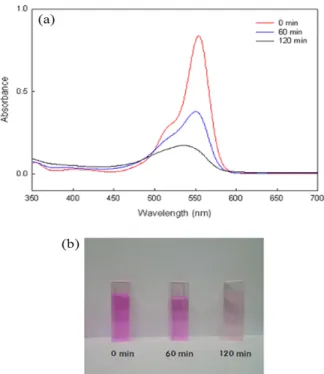
Time influence of the absorption spectra of the degraded rhodamine B dye is presented in Figure 6 (a). The characteristic absorption peak intensity at 552 nm significantly decreased within 2 hours of UV irra- diation. Also, a slight blue-shift is observed with the increasing irradiation time. On the other hand, the color change of dye solution at different irradiation time due to photocatalytic degradation has been shown in Figure 6 (b) by digital images. The degradation of rhodamine B dye is clearly understood from the color change of dye solution with irradiation time and it has been almost colorless within 2 hours of irradiation.
Figure 6. (a) Time effluence on photocatalytic degradation of rhodamine B using PAN/TiO
2nanofibers under UV irradiation. (b) The digital photographs of dye solution at different irradiation times to show color change due to photocatalytic degradation of rhodamine B.
These results indicate that PAN/TiO
2nanofibers degrade rhodamine B dye efficiently due to their excellent photocatalytic properties.
Photocatalytic degradation of methylene blue by PAN/TiO
2nanofibers has been conducted following the way mentioned above and the decrease of dye concentration with exposure time is plotted as con- version rate vs. irradiation time in Figure 7.
Conversion (%)
Time (min)