[논 문] 한국재료학회지 http://dx.doi.org/10.3740/MRSK.2012.22.5.249 Kor. J. Mater. Res.
Vol. 22, No. 5 (2012)
249
†Corresponding author
E-Mail : [email protected] (D. -S. Bae)
Synthesis and Characterization of Fe Doped TiO
2Nanoparticles by a Sol-Gel and Hydrothermal Process
Hyun-Ju Kim, Kwang-Jin Jeong and Dong-Sik Bae*
School of Nano & Advanced Materials Engineering, Changwon National University
(Received April 21, 2012 : Received in revised form May 14, 2012 : Accepted May 14, 2012)
Abstract Fe doped TiO2 nanoparticles were prepared under high temperature and pressure conditions by mixture of metal nitrate solution and TiO2 sol. Fe doped TiO2 particles were reacted in the temperature range of 170 to 200oC for 6 h. The microstructure and phase of the synthesized Fe doped TiO2 nanoparticles were studied by SEM (FE-SEM), TEM, and XRD.
Thermal properties of the synthesized Fe doped TiO2 nanoparticles were studied by TG-DTA analysis. TEM and X-ray diffraction pattern shows that the synthesized Fe doped TiO2 nanoparticles were crystalline. The average size and distribution of the synthesized Fe doped TiO2 nanoparticles were about 10 nm and narrow, respectively. The average size of the synthesized Fe doped TiO2 nanoparticles increased as the reaction temperature increased. The overall reduction in weight of Fe doped TiO2 nanoparticles was about 16% up to ~700oC; water of crystallization was dehydrated at 271oC. The transition of Fe doped TiO2 nanoparticle phase from anatase to rutile occurred at almost 561oC. The amount of rutile phase of the synthesized Fe doped TiO2 nanoparticles increased with decreasing Fe concentration. The effects of synthesis parameters, such as the concentration of the starting solution and the reaction temperature, are discussed.
Key words Fe-doped TiO2 nanoparticles, anatase, rutile, sol-gel process, hydrothermal process.
1. Introduction
TiO2 is used in wide range of environmental photo- catalyst because of its unique properties: it is a semicon- ductor with band gap about 3.0 eV possessing strong oxidative ability and non-toxicity. Titania is a well known n-type inorganic metal oxide semiconductor that is trans- parent to visible light and has a high refractive index.
Due to its unique optical property and chemical stability, titania may be used in the splitting of water1) and in the photooxidation2) processes. Solar cells demonstrating rather high photovoltaic efficiencies are studied in the frame of structures containing transparent conductive oxide (TCO)/
dye sensitized titania/electrolyte systems which include the dye-sensitized nanocrystalline TiO2 solar cell. However, there are some disadvantages of its use in photocatalytic applications, namely the light adsorption in UV light spec- trum region only and the high electron (e−) − hole (h+) recombination rate. In order to improve photoreactivity of TiO2-based photocatalysis, the e−, h+ recombination rate needs to be reduced.3) These disadvantages have been faced e.g. by doping TiO2 with transition metal ions or by special heat treatments.4) In many of these TiO2 device applications, suitable electronic properties (namely well pos- itioned band gap) are improved by controlled doping. It is generally recognized that the substitutional doping of
TiO2 with iron Fe (III) has a profound effect on the charge carrier recombination.5-8) The second role of iron doping is to decrease the activation energy of the anatase- to-rutile phase transition. The coordination environment of the dopants is affected not only by the nature of the dopant such as ionic radii and concentration but also by the synthesis method.9) In this work, Fe3+ were used as dopants for TiO2 based materials to improve their prop- erties, namely to extend the light absorption into the visible light region, to reduce the recombination of the photogenerated e− and h+ and to increase the surface area.
Iron-doped TiO2 powder has been obtained by sol-gel10) and hydrothermal method by a mixture from metal nitrates solution and TiO2 sol. Hydrothermal processes have the potential for the direct preparation of crystalline ceramic powders and offer a low-temperature alternative to con- ventional powder synthesis techniques in the production of oxide powders.11) This process can produce fine, high- purity, stoichiometric particles of single and multi-compon- ent metal oxides. Furthermore, if process conditions such as solute concentration, reaction temperature, reaction time and the type of solvent are carefully controlled, the desired shape and size of the particles can be produced.12) A uniform distribution of the particles is important for optimal control of grain size and microstructure to main- tain high reliability. It has been demonstrated that such powders are composed of much softer agglomerates and sinter much better than those prepared by calcination de- composition of the same oxides.13) These powders could
250 Hyun-Ju Kim, Kwang-Jin Jeong and Dong-Sik Bae
be sintered at low temperature without calcination and milling steps.14,15)
The object of this study was to prepare Iron-doped TiO2 nanoparticles by a combination of sol-gel and hydrother- mal method.
2. Experimental Procedure
Titanium(IV) isopropoxide (Ti[OCH(CH3)2]4, JUNSEI Chemicals, 98%), iron nitrate nonahydrate (Fe(NO3)3·9H2O, Sigma-Aldrich, 98%) and hydrochloric acid (HCl, Daejung Chemicals 35%) were used for the hydrothermal prepara- tion. First, TiO2 sol was prepared metal alkoxide hydrolysis and condensation. Titanium(IV) isopropoxide was used as a precursor. It was slowly added to the ethanol(99.9%) for as a solvent, with distilled water added for hydrolysis reaction. Finally, a small amount of hydrochloric acid was slowly added to the solution with stirring. After conden- sation reaction and crystallization, transparent suspended TiO2 sol was obtained. 0.16M Fe solution was prepared by dissolving of Fe(NO3)3·9H2O in distilled water. The weight percentage of the Fe:Ti precursor mixtures was kept to 50:150 and 10:190. The resulting suspension was placed in a 1,000 ml stainless steel pressure vessel. The vessel was then heated to the 170-200oC at a rate of 5oC/min for 6 h.
The resulting powder was washed with distilled water until pH 7 and then dried at 80oC for 24 h. The phase iden- tification of synthesized powders was recorded by X-ray diffractometer (Philips X’pert MPD 3040). The structure, size and morphology of the resulting particles were exam- ined by scanning electron microscopy (SEM, Jeol JSM- 5610). Thermal decomposition behavior of the synthesized powder was studied by TG-DTA analysis (TA5000/SDT 2960 DSC Q10).
3. Results and Discussion
Fig. 1 shows an X-ray diffraction pattern of the iron- doped TiO2 particles as a function of reaction temperature.
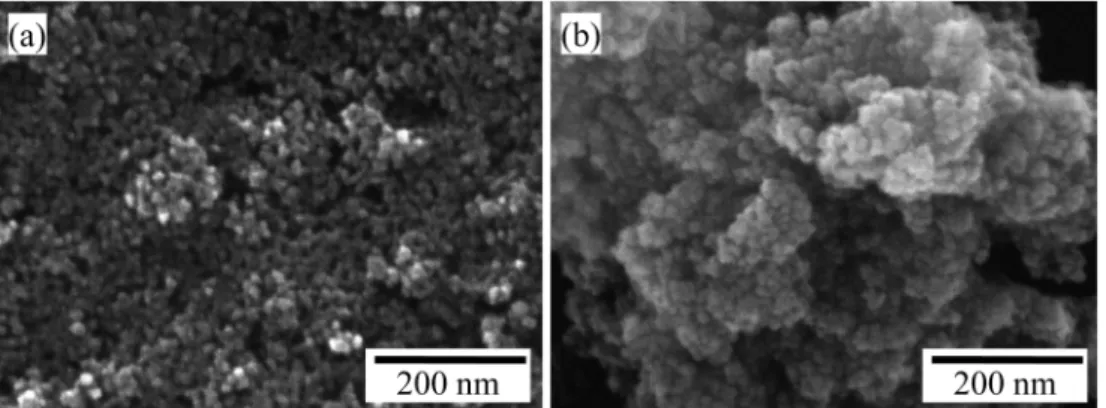
From the X-ray analysis, synthesized particles reveals the coexistence of anatase (JCPDS number 84-1286) and rutile (JCPDS number 01-1292), iron (JCPDS number 89-7194) phases in the reaction temperature from 170oC, 200oC for 6 h. The intensity of rutile phase on Iron- doped TiO2 particles increased with increasing reaction temperature. The microstructure of the synthesized iron- doped TiO2 particles as a function of reaction tempera- ture shows Fig. 2 (SEM) and Fig. 3 (TEM). The average size of the synthesized Iron-doped TiO2 particles increased with reaction temperature increased from 170 to 200oC.
The average size of the synthesized particles was about 10-15 nm. Fig. 4 shows the spectrum of Fe doped TiO2 nanoparticles by TEM-EDS analysis. The peak of titanium and iron shows on the spectrum. From the TG-DTA analysis (Fig. 5) of Iron-doped TiO2 nanoparticles, the overall reduction in weight was about 16% up to ~700oC and water of crystallization was dehydration at 271oC.
Also it shows that transition of phase from anatase to rutile at almost 561oC. Fig. 6 shows X-ray diffraction patterns
Fig. 2. SEM micrograph of the synthesized Fe doped TiO2particles by combination a sol-gel process and hydrothermal process: (a) 170oC 6 h and (b) 200oC 6 h.
Fig. 1. X-ray diffraction patterns of the synthesized Fe doped TiO2
powders with anatase (A) and rutile (R), Iron (Fe) peak identification by combination a sol-gel process and hydrothermal process (JCPDS number 84-1286, 01-1292, 89-7194) : (a) 170oC 6 h and (b) 200oC 6 h.
Synthesis and Characterization of Fe Doped TiO2 Nanoparticles by a Sol-Gel and Hydrothermal Process 251
of the synthesized particles as a function of Fe concentra- tion in solution. The amount of rutile phase on the synthe- sized particles increased with decreasing Fe concentration in solution because the less a content of the transposition metal, the easier to phase transition in the same temperature condition.
4. Conclusion
Fe doped TiO2 particles have been synthesized combin- ation by a sol-gel and hydrothermal process. Nanosized Fe doped TiO2 particles were obtained in the temperature range of 170 to 200oC for 6 h. The average size and distribution of the synthesized Fe doped TiO2 particle was about 10-15 nm and narrow, respectively. The average size Fig. 3. TEM micrographs of the synthesized Fe doped TiO2 particles by combination a sol-gel process and hydrothermal process: (a) 170oC 6 h and (b) 200oC 6 h.
Fig. 4. EDS (Energy Dispersive Spectroscopy) spectrum of the synthesized Fe doped TiO2 particles by combination a sol-gel process and hydrothermal process (at 200oC, for 6 h).
Fig. 6. X-ray diffraction patterns of the synthesized particles as a function of Fe concentration in TiO2 sol by combination a sol-gel process and hydrothermal process (200oC, 6 h): anatase (A) and rutile (R), Iron (Fe) peak identification (JCPDS number 84-1286, 01-1292, 89-7194).
Fig. 5. TG-DSC analysis of the synthesized Fe doped TiO2 nano- particles by combination a sol-gel process and hydrothermal process.
(Temperature: 700oC, holding time: 10 min).
252 Hyun-Ju Kim, Kwang-Jin Jeong and Dong-Sik Bae
of the synthesized particles increased with reaction tem- perature increased. The crystalline phase of the synthesized Fe doped TiO2 particles shows the coexistence of anatase and rutile reaction at the temperature range of 170 to 200oC for 6 h. The amount of rutile phase on the synthe- sized particles increased with decreasing Fe concentration in solution because the less a content of the transition metal, the easier to phase transition in the same tempera- ture condition
Acknowledgment
This study was financially supported by a Research Grant (2011-0004448) from the National Research Foun- dation, Korea.
Reference
1. M. V. Rao, K. Rajeshwar, V. R. P. Verneker and J.
DuBow, J. Phys. Chem., 84, 1987 (1980).
2. L. Palmisano, M. Schiavello, A. Sclafani, C. Martin, I.
Martin and V. Rives, Catal. Lett., 24, 303(1994).
3. X. H. Wang, J. -G. Li, H. Kamiyama and T. Ishigaki, Thin Solid Films, 506-507, 278(2006).
4. J. Nettleton-Hammond and M. A. Malati, React. Kinet.
Catal. Lett., 70, 325 (2000).
5. C. C. Trapalis, P. Keivanidis, G. Kordas, M. Zaharescu, M.
Crisan, A. Szatvanyi and M. Gartner, Thin Solid Films, 433, 186 (2003).
6. M. Sokmen, F. Candan and Z. Sumer, J. Photochem.
Photobiol. Chem., 143, 241 (2001).
7. I. Djerdj and A. M. Tonejc, J. Alloy. Comp., 413, 159 (2006).
8. J. Moser, M. Gratzel and R. Gallay, Helv. Chim. Acta, 70, 1596 (1987).
9. W. Li, A. I. Frenkel, J. C. Woicik, C. Ni and S. I. Shah, Phys. Rev. B, 72, 155315 (2005).
10. Y. H. Zhang and A. Reller, J. Mater. Chem., 11, 2537 (2001).
11. R. Gerhardt and Nowick, J. Am. Ceram. Soc., 69, 641 (1986).
12. S. Hirano, Am. Ceram. Soc. Bull., 66, 1342 (1987).
13. W. J. Dawson, Am. Ceram. Soc. Bull., 67, 1673 (1988).
14. S. B. Cho, S. Venigalla and J. H. Adair, Science, tech- nology and applications of colloidal suspensions, p. 139, edited by J. H. Adair, J. A. Casey, C. A. Randall and S.
Venigalla, American Ceramic Society, USA (1995).
15. K. Haberko and W. Pyda, Advances in Ceramics: Vol, 12 (Science and Technology of Zirconia II), p. 774, edited by N. Claussen, M. Ruhle and A. H. Heuer, American Ceramic Society, USA (1984).