1. INTRODUCTION
Titanium dioxide (TiO
2) has been well known to have strong photocatalytic characteristics, and widely used for the removal of organic pollutants (Bettinelli et al., 2007; Nakamura et al., 2004; Fujishima et al., 2000). Physical properties such as anatase, nanocry- stalline particles proved to be critical for effective photocatalytic reactions, and reported are various advantages such as strong oxidation/reduction power, relatively low expense, high stability under light and biological process (Cho et al., 2007; Murakami et al., 2007). However, photocatalytic activity using TiO
2only occurs under ultraviolet (UV) light intensity, due to its wide band-gap energy (3.2 eV), showing semi-
conducting characteristics. It is known that electrons and holes (e
-/h
++) are generated under UV irradiation on TiO
2, resulting in the formation of highly active radicals such as ∙OH, HO
2∙and O
2-
∙(superoxide
anion), which can initiate various decomposition re- actions (Konstantinou and Albanis, 2004).
Practically the natural solar energy radiates only 3~4% UV light onto the ground, that numerous in- vestigations have been recently conducted to develop metal or nonmetal-doped TiO
2photocatalysts, having strong absorption in the visible light region. Previous studies showed that doping of TiO
2with transition metal such as V, Cr, Fe, Ni or Mn seemed to retard the recombination of e
-/h
++pairs as demonstrated by diffuse reflection spectroscopy (Yang et al., 2007;
Yu et al., 2006). Particularly V-doping showed the highest absorption effectiveness in the red shift, which leads to higher photocatalytic activity. On the
Photocatalytic Degradation Characteristics of Organic Compound by Boron-doped TiO
2Catalysts
Chang-Mo Nam*
Division of Health and Science, Yeungnam College of Science and Technology, 274 Heunchungro, Namgu, Daegu 705-037, Korea
(Received 8 July 2010, revised 30 September 2010, accepted 14 October 2010)
Abstract
Boron-doped TiO
2photocatalysts were synthesized by a modified sol-gel method and their photocatalytic activities were performed and compared with those of pure synthetic and commercial TiO
2catalysts under UV or visible light conditions. Pure TiO
2itself exhibited very negligible photocatalytic performance under visible light conditions in the aspects of toluene decomposition reactions, although significant decomposition poten- tial was observed as expected with UV light conditions. However, boron doping over TiO
2significantly im- proved photocatalytic activity particularly under visible conditions, where over 95% degradation of toluene was achieved with 1wt% B-TiO
2within 2 hrs. All the decomposition reactions seemed to follow pseudo first- order kinetics. The effects of boron-doping and its characteristics are further discussed through the kinetic studies and comparison of results.
Key words : Photocatalytic, Visible light, Titanium dioxide, Degradation, Toluene
* Corresponding author.
Tel : +82-53-650-9284, E-mail : [email protected] J. KOSAE Vol. 26, No. 6 (2010) pp. 649~656 Journal of Korean Society for Atmospheric Environment
other hand, non-metal doping on TiO
2turned out to be promising for visible light active photocatalysts.
Asahi et al. (2001) reported that N-doped TiO
2shift- ed the absorption edge to a lower energy, thereby increasing the photocatalytic activity potential in the visible light region. Similarly, S-doped TiO
2has also proved to have strong photocatalytic activity under irradiation at wavelengths longer than 440 nm, com- pared with those of pure TiO
2(Yu et al., 2006; Ohno et al., 2003). It is noted that the dopants such as N or S are usually incorporated as anions replacing O sites or even cations for Ti sites in the lattice of TiO
2or placed in an interstitial position. Among various combinations, co-doping of TiO
2such as Zr,S-TiO
2proved to have been effective for photocatalytic acti- vities more than doping with sulfur or zirconium alone under visible light conditions. They insisted that zirconium increases not only the surface area and the thermal stability of TiO
2but also retards the e
-/h
++recombination, while sulfur was to reduce the band- gap energy of TiO
2, thus moving the absorption band toward the visible region (Kim et al., 2008; Umeba- yashi et al., 2003). More recently, many investiga- tions report that boron-doping is another promising alternative in gaseous and aqueous photocatalytic applications (Wu et al., 2010; Zaleska et al., 2009;
Bettinelli et al., 2007). Lambert and coworkers (2007) mentioned that low level of B-doping on TiO
2signi- ficantly increased visible light absorption and showed better photocatalytic activities for the degradation of methyl tert-butyl ether (MTBE) than those of undop- ed TiO
2. Similar studies show that boron doping ex- tends absorption edge to visible light region, increas- ing the degradation potential of toluene, phenol and other refractory dye compounds (Xu et al., 2009;
Khan et al., 2008).
This paper presents further experimental results concerning the syntheses of pure TiO
2and boron- doped TiO
2(B-TiO
2) catalysts as well as their photo- catalytic activities and physical properties. The pho- tocatalytic activity measurements are performed using a batch photoreactor and compared between pure TiO
2and B-TiO
2catalysts under UV and visible lights. Particularly, the photocatalytic activity using B-TiO
2is focused on the decomposition of toluene
through visible light application, and further dis- cussed through the kinetic studies.
2. EXPERIMENTAL
2. 1 Catalyst preparation
Titanium dioxide (TiO
2) and boron-doped TiO
2photocatalysts (B-TiO
2) were synthesized by a modi- fied sol-gel method, which particularly involved a gradual change of pH from 0.8 ~9.0 during the sol- gel transition. Titanium butoxide [Ti(OBu)
4] was initially precursored in ethanolic solution where a mixture of HCl/C
2H
5OH/H
2O was added and then NH
4OH added drop wise for TiO
2preparation. More detailed procedure was previously well described by Khan et al. (2008). Different B-doped TiO
2catalysts (1~3wt%) were prepared in the same manner as above where weighed amount of H
3BO
3as B-precur- sor was added, and particularly 1wt% B-TiO
2is fo- cused for the present study. The resulted dry powders were only calcined particularly at 500� C for 3 hr in air, known as the best calcination temperature to obtain the anatase nanocrystalline catalysts (Khan et al., 2008). Commercially available Degussa P-25 TiO
2(P25) is also provided for comparison of photo- catalytic activities.
2. 2 Photocatalytic activity measurement The photocatalytic activity was investigated by the photodegradation of gaseous toluene under UV and visible light irradiation using a closed circulation reactor (batch type) at ambient conditions (Fig. 1). A pyrex-glass tubular reactor with a volume of 1 L, containing the catalysts (300~1,200 mg) uniformly spread over the irradiation area, was connected to a peristaltic pump through tubing where the gas flow rate was around 320 cm
3/min. The reactor containing the catalyst was equipped with a UV lamp (Philips TUV 10 W/G10T8, 254 nm) and a visible lamp (Os- lam halogen lamp 150 W with 400 nm cutoff filter) as the light sources, which was housed in a black colored, rectangular glass box (30 cmD×42 cmW×
27 cmH). The photon flux emitted from these lamps
was determined actinometrically using the potassium
ferrioxalate method and found to be 1.47×10
-6Einstein/s for UV light and 3.9×10
-6Einstein/s for visible light. The distance between the lamp and the catalyst was fixed by 10 cm. To introduce toluene for photodegradation measurements, the reactor was connected to a glass mixing chamber, where the tem- perature was fixed at 70� C to ensure the evaporation of toluene, and the total volume of the circulation reactor was 1.3 L. The initial concentration of toluene used in all experiments reached about 145 ppm. The photoreactor was kept in the dark until the gas con- centration remained constant, which indicated that toluene resulted in the steady state between the ad- sorption and desorption on the catalyst surface. In order to monitor the degradation of toluene at regular interval, Gas Chromatograph (Shimadzu GC-17A, Shimadzu Corporation) equipped with a gas sampler operating with a flame ionization detector (FID) was connected to gas exiting the reactor. The rate of photodegradation was estimated to obey pseudo-first- order kinetics and hence the rate constant (k) was obtained from the first-order plot according to equa- tion (1),
ln mmm= C =-k∙t (1)
C
0where C
0is the initial concentration, C is the concen-
tration after a time (t) of the toluene degradation.
And here the half-life time ( τ) of the reactant is de- fined as the time required for the toluene concentra- tion to reach half of its initial value.
3. RESULTS AND DISCUSSION
3. 1 Effect of pure and B-doped TiO
2catalysts The photocatalytic activity tests were performed in order to compare the photocatalytic decomposition of toluene using commercially available P25, and synthetized TiO
2, and boron-doped TiO
2catalysts.
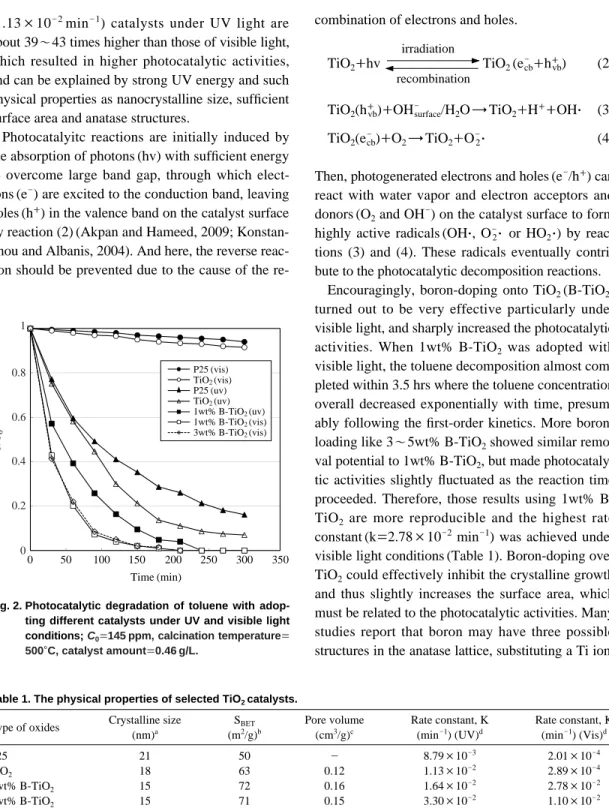
Fig. 2 shows the comparison of the photocatalytic decomposition potentials with adopting different catalysts under UV and visible light sources. With commercial P25 and TiO
2catalysts under UV light, the degradation efficiency of toluene with P25 in- creases with increasing reaction time, and reaches almost 60% within 2 hrs, which is further improved by adopting synthetic TiO
2catalysts up to 70%.
However, under visible light, those degradation effi- ciencies only reach less than 10%, and show little difference between commercial and synthetic TiO
2. As similar characteristics observed in Table 1, the rate constants of P25 (8.79×10
-3min
-1) and TiO
2GC (FID)
Data logging system Peristaltic
pump Pure TiO2 or Doped TiO2
Mixing chamber Heating
system
Toluene injection
Lamps
Pyrex glass reactor
Gas sampling valve
Fig. 1. A schematic diagram of the photocatalytic reactor for the degradation of toluene.
(1.13×10
-2min
-1) catalysts under UV light are about 39~43 times higher than those of visible light, which resulted in higher photocatalytic activities, and can be explained by strong UV energy and such physical properties as nanocrystalline size, sufficient surface area and anatase structures.
Photocatalyitc reactions are initially induced by the absorption of photons (hv) with sufficient energy to overcome large band gap, through which elect- rons (e
-) are excited to the conduction band, leaving holes (h
++) in the valence band on the catalyst surface by reaction (2) (Akpan and Hameed, 2009; Konstan- tinou and Albanis, 2004). And here, the reverse reac- tion should be prevented due to the cause of the re-
combination of electrons and holes.
irradiation
TiO
2++hv TiO
2(e
-cb++h
++vb) (2)
recombinationTiO
2(h
++vb)
++OH
-surface/H
2O → TiO
2++H
++++OH ∙ (3) TiO
2(e
-cb)
++O
2→ TiO
2++O
-2∙ (4)
Then, photogenerated electrons and holes (e
-/h
++) can react with water vapor and electron acceptors and donors (O
2and OH
-) on the catalyst surface to form highly active radicals (OH ∙, O
-2∙ or HO
2∙) by reac- tions (3) and (4). These radicals eventually contri- bute to the photocatalytic decomposition reactions.
Encouragingly, boron-doping onto TiO
2(B-TiO
2) turned out to be very effective particularly under visible light, and sharply increased the photocatalytic activities. When 1wt% B-TiO
2was adopted with visible light, the toluene decomposition almost com- pleted within 3.5 hrs where the toluene concentration overall decreased exponentially with time, presum- ably following the first-order kinetics. More boron- loading like 3~5wt% B-TiO
2showed similar remo- val potential to 1wt% B-TiO
2, but made photocataly- tic activities slightly fluctuated as the reaction time proceeded. Therefore, those results using 1wt% B- TiO
2are more reproducible and the highest rate constant (k= =2.78×10
-2min
-1) was achieved under visible light conditions (Table 1). Boron-doping over TiO
2could effectively inhibit the crystalline growth and thus slightly increases the surface area, which must be related to the photocatalytic activities. Many studies report that boron may have three possible structures in the anatase lattice, substituting a Ti ion,
Table 1. The physical properties of selected TiO2 catalysts.
Type of oxides Crystalline size SBET Pore volume Rate constant, K Rate constant, K (nm)a (m2/g)b (cm3/g)c (min-1) (UV)d (min-1) (Vis)d
P25 21 50 - 8.79×10⁻³ 2.01×10⁻⁴
TiO2 18 63 0.12 1.13×10⁻² 2.89×10⁻⁴
1wt% B-TiO2 15 72 0.16 1.64×10⁻² 2.78×10⁻²
3wt% B-TiO2 15 71 0.15 3.30×10⁻² 1.10×10⁻²
a: Measured by the Scherrer’s equation.
b: Measured by BET method.
c: Taken from the volume N2adsorbed at P/Po=0.995.
d: Calculated from the linear fitting of ln (C/C0) vs. reaction time with catalyst amount of 0.46 g/L*.
0 50 100 150 200 250 300 350
C/C0
Time (min) 1
0.8
0.6
0.4
0.2
0
P25 (vis) TiO2(vis) P25 (uv) TiO2(uv) 1wt% B-TiO2(uv) 1wt% B-TiO2(vis) 3wt% B-TiO2(vis)
Fig. 2. Photocatalytic degradation of toluene with adop- ting different catalysts under UV and visible light conditions; C0==145 ppm, calcination temperature== 500�C, catalyst amount==0.46 g/L.
and an O ion, or in an interstitial position. The copre- sence of boron substitutional to oxygen (BTi
3) and interstitial boron (BO
3or BO
4) is generally agreed, favoring the formation of B species, e.g. B
3++ions in B-TiO
2structure, while boron substitutional to Ti is energetically less favorable (Finazzi et al., 2009;
Chen et al., 2006). Substitutional and interstitial borons introduce new states in the midgap of the catalysts, believed to narrow the band gap energy, which shifts absorption edge to visible light region, increasing the degradation potential of toluene.
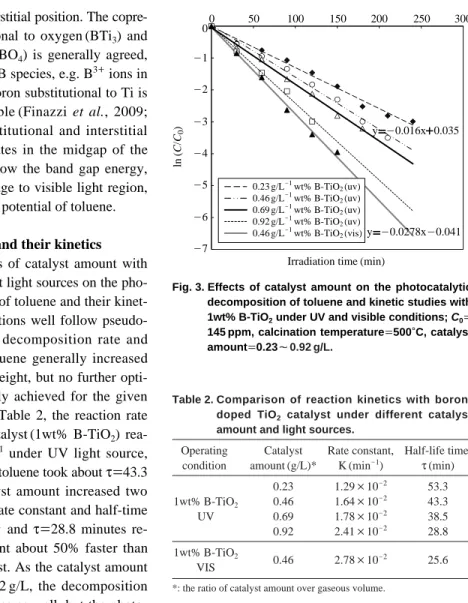
3. 2 Catalyst amount and their kinetics Fig. 3 shows the effects of catalyst amount with 1wt% B-TiO
2and different light sources on the pho- tocatalytic decomposition of toluene and their kinet- ics. It proves that all reactions well follow pseudo- first order kinetics. The decomposition rate and removal efficiency of toluene generally increased with increasing catalyst weight, but no further opti- mization was unfortunately achieved for the given range. More precisely in Table 2, the reaction rate constant with 0.46 g/L catalyst (1wt% B-TiO
2) rea- ched k= =1.64×10
-2min
-1under UV light source, where the half-life time of toluene took about τ= =43.3 minutes. When the catalyst amount increased two times up to 0.92 g/L, the rate constant and half-time were k= =2.41×10
-2min
-1and τ= =28.8 minutes re- spectively, which represent about 50% faster than those with 0.46 g/L catalyst. As the catalyst amount increases from 0.23~0.92 g/L, the decomposition rate proportionally increases as well, but the photo- catalytic activity and half-life time are inversely diminished. However, two folds of catalyst amount does not represent two times increase in the reaction rate, although the reactivity almost tends to depend on the catalyst amount. Thus, it is important that particles must be well dispersed uniformly to form possible active sites on the catalyst surface. As these trends compared with visible light conditions, the same amount of catalyst 0.46 g/L (1wt% B-TiO
2) with visible light was producing more degradation potential even than those of 0.92 g/L with UV light.
Consequently, this implies that B-doping on TiO
2is prominently effective in photocatalytic decomposi-
tion of organic pollutants.
Similar results can be found in previous studies (Ryu et al., 2006) where the photocatalytic degrada- tion rate of orange II became higher with increasing catalyst weight in a liquid batch reactor under UV conditions. Park (2007) and An et al. (2006) also reported in their practical formaldehyde decomposi- tion experiments that as the amount of catalyst coated on glass was fixed at 6 and 32.6 mg/cm
2through a dip coating process, the decomposition rate constants were 3.10×10
-3min
-1and 1.02×10
-1min
-1respec- tively. However, these results must remain effective
-7 -6 -5 -4 -3 -2 -1
00 50 100 150 200 250 300
ln(C/C0)
Irradiation time (min)
y= -0.016x+ 0.035
y= -0.0278x-0.041 0.23 g/L-1 wt% B-TiO2 (uv)
0.46 g/L-1 wt% B-TiO2 (uv) 0.69 g/L-1 wt% B-TiO2 (uv) 0.92 g/L-1 wt% B-TiO2 (uv) 0.46 g/L-1 wt% B-TiO2 (vis)
Fig. 3. Effects of catalyst amount on the photocatalytic decomposition of toluene and kinetic studies with 1wt% B-TiO2under UV and visible conditions; C0== 145 ppm, calcination temperature==500�C, catalyst amount==0.23~~0.92 g/L.
Table 2. Comparison of reaction kinetics with boron- doped TiO2 catalyst under different catalyst amount and light sources.
Operating Catalyst Rate constant, Half-life time, condition amount (g/L)* K (min-1) τ (min)
0.23 1.29×10⁻² 53.3
1wt% B-TiO2 0.46 1.64×10⁻² 43.3
UV 0.69 1.78×10⁻² 38.5
0.92 2.41×10⁻² 28.8
1wt% B-TiO2
0.46 2.78×10⁻² 25.6
VIS
*: the ratio of catalyst amount over gaseous volume.
in application systems, and thus increasing catalysts sometimes require too many layers of coatings from which active sites can be agglomerated to produce less activity. So there must be trade-off between cat- alyst amount and activities for which the previous studies had suggested the optimum catalyst amount as 30 mg/cm
2(Kwon et al., 2005; Esplugas et al., 2002).
3. 3 Visible light-active B-TiO
2characteristics The effects of dopants and their photocatalytic activities have been investigated concerning the de- composition of possible pollutants from many gase- ous and aqueous reaction conditions (Khan et al., 2008; Ling et al., 2008). Apart from gaseous organic pollutants, most of synthetic textile dyes in waste- water seem more resistant to be decomposed or de- colorized by traditional wastewater treatment techno- logies because of their chemical stability (Wu et al., 2010; Xu et al., 2009). Table 3 summerizes the com- parison of photocatalytic decomposition characteri- stics using various dopants of TiO
2catalysts with the present results, particularly showing visible light- active, optimum loaded B-TiO
2catalysts. Again, B- doped TiO
2catalysts turned out to be the most effec- tive for the photocatalytic degradation of most syn- thetic textile dyes. As mol% of boron increases, the degradation potential tends to increase more or less where 95% degradation of methylene blue was pho- tocatalytically achieved with 9mol% B-TiO
2. Simi- larly in gaseous toluene reactions, about 1wt% B loading seems to be located near the optimum B
range, which is compared with those of nonmetal dopants such as Zr, N, and S components. As men- tioned above, 1wt% B-TiO
2shows the best photoca- talytic decomposition performance of toluene (100%
in 3.5~4 hr), compared with those of N,S-TiO
2(64
%) and Zr,S-TiO
2(77%) catalysts. Consequently, this study again confirms that B-doped TiO
2is the most promising catalyst for the photocatalytic degra- dation of possible organic pollutants, particularly even for the lower energy band of the day-time and visible light applications.
4. SUMMARY
The present results show that under UV light con- ditions, pure TiO
2itself also shows significant photo- catalytic performance, which ranges from about 60~
70% degradation of toluene within 2 hrs, while those were negligible presumably under visible light con- ditions. However, boron doping over TiO
2significan- tly improved photocatalytic activity particularly und- er visible light irradiation, compared with those of pure TiO
2. Decomposition efficiency of toluene sharply increased more than 95% within 2 hrs, and complete decomposition was possible within several hours. The lower B doping (1wt%) seems to appro- ach optimum B loading, favoring the formation of B
3++species in B-TiO
2structure as discussed, which is believed to narrow the band gap energy, resulting in the increase of photocatalytic activity. All the de- composition reactions approached pseudo first-order
Table 3. Photocatalytic decomposition characteristics with various TiO2-based catalysts under visible light conditions.
Photocatalysts Decomposition Model pollutant Light source Rate constant
Reference (irradiation time) (concentration) (reaction) k, (min-1)
1wt% B-TiO2 100% (3.5 hr) Toluene (145 ppm) Visible (gaseous) 2.78×10⁻² This study 1wt% B-TiO2 100% (4 hr) Toluene (500 ppm) Visible (gaseous) 4.71×10⁻² Khan et al., 2008 N,S-TiO2 64% (3 hr) Formaldehyde (200 ppm) Daylight (gaseous) - Yu et al., 2006 3wt% Zr,S-TiO2 77% Toluene (530 ppm) Visible (gaseous) 0.60×10⁻² Kim et al., 2008 0.015mol% B-TiO2 53.6% (80 min) Azo-dye (50 mg/L) Visible (aqueous) 1.03×10⁻² Xu et al., 2009 9mol% B-TiO2 95% (4 hr) Methylene blue (19 mg/L) Visible (aqueous) - Bettinelli et al., 2007 0.01mol% B-TiO2-
52% (3 hr) Phenol (50 mg/L) Visible (aqueous) - Ling et al., 2008 Fe(0.01)/SiO2
1mol% B,C-TiO2 60% (3 hr) Acid orange 7 (20 mg/L) Visible (aqueous) - Wu et al., 2010
kinetics, having the rate constant of 2.78×10
-2min
-1with boron-doped TiO
2(0.46 g/L), which tends to increase with increasing the catalyst weight.
ACKNOWLEDGEMENTS
This work was supported by the Yeungnam Col- lege of Science & Technology Research Grants in 2008. The author would like to thank professor T.
G. Kim at the university of Kyungpook National University for helpful discussion on works.
REFERENCES
Akpan, U.G. and B.H. Hameed (2009) Parameters affecting the photocatalytic degradation of dyes using TiO2-based photocatalysts: A review, J. Hazard.
Mater., 170, 520-529.
An, S.W., I.Y. Cho, J.H. Park, S.W. Chang, and Y.G. Kim (2006) Degradation of formaldehyde in indoor air quality by TiO2 sol coated wall paper, J.
KSEE, 28(8), 872-877. (in Korean with English abstract)
Asahi, R., T. Morikawa, T. Ohwaki, K. Aoki, and Y. Taga (2001) Visible-light photocatalysis in N-doped titanium oxides, Science, 293, 269-271.
Bettinelli, M., V. Dallacasa, D. Falcomer, P. Fornasiero, V.
Gombac, T. Montini, L. Romano, and A. Speghi- ni (2007) Photocatalytic activity of TiO2 doped with boron and vanadium, J. Hazard. Mater., 146, 529-534.
Chen, D., D. Yang, Q. Wang, and Z. Jiang (2006) Effects of boron doping on photocatalytic activity and microstructure of TiO2nanoparticles, Ind. Eng.
Chem. Res., 45, 4110-4116.
Cho, D. H., J. H. Kim, G. S. Cha, G. S. Kim, B. H. Kim, and S. H. Ohk (2007) Photocatalytic characteri- stics of TiO2thin films deposited by PECVD, J.
Ind. Eng. Chem., 13(3), 434-437.
Esplugas, S., J. Ginenez, S. Contreras, and M. Rodriguez (2002) Comparison of different advanced oxida- tion process for phenol degradation, Ind. Eng.
Chem. Res., 42, 2273-2281.
Finazzi, E., C.D. Valentin, and G. Pacchioni (2009) Boron- doped anatase TiO2: pure and hybrid DFT cal-
culations, J. Phys. Chem. C. 113, 220-228.
Fujishima, A., T.N. Rao, and D.A. Tryk (2000) Titanium dioxide photocatalysis, J. Photochem. Photobiol.
C: Photochem. Rev., 1, 1-21.
Khan, R., S.W. Kim, T.J. Kim, and C.M. Nam (2008) Com- parative study of the photocatalytic performance of boron-iron co-doped and boron-doped TiO2 nanoparticles, Mater. Chem. and Phys., 112, 167- 172.
Kim, S.W., R. Khan, T.J. Kim, and W.J. Kim (2008) Syn- thesis, characterization and application of Zr, S co-doped TiO2as visible light active photocata- lyst, Bull. Korean Chem. Soc., 29(6), 1217-1223.
Konstantinou, I.K. and T.A. Albanis (2004) TiO2-assisted photocatalytic degradation of azo dyes in aqueous solution: kinetic and mechanistic investigations- A review, Appl. Catal. B: Environ., 49, 1-14.
Kwon, T., W. Roo, C. Lee, and W. Lee (2005) Preparation of wall paper coated with modified TiO2and their photocatalytic effects for removal of NO in air, Korean Chem. Eng. Res., 43, 1-8.
Ling, Q., J. Sun, Q. Zhou, H. Ren, and Q. Zhao (2008) Visible-light driven titania/silica photocatalyst co-doped with boron and ferrum, Appl. Surf.
Sci., 254, 6731-6735.
Murakami, Y., B. Kasahara, and Y. Nosaka (2007) Photo- electrochemical properties of the S-doped TiO2 film electrodes : characterization of the doped states by means of the photocurrent measure- ments, Chem. Lett., 36(2), 330-331.
Nakamura, R., T. Tanaka, and Y. Nakato (2004) Mechanism for visible light responses in anodic photocur- rents at N-doped TiO2film electrodes, J. Phys.
Chem. B, 108, 10617-10620.
Ohno, T., T. Mitsui, and M. Matsumura (2003) Photoca- talytic activity of S-doped TiO2photocatalyst under visible light, Chem. Lett., 32(4), 364-365.
Park, Y.G. (2007) The effect of TiO2film thickness on the photodegradation of formaldehyde, J. KSEE, 29(11), 1243-1250. (in Korean with English ab- stract)
Ryu, Y.B., G.D. Lee, S.S. Park, and S.S. Hong (2006) Syn- thesis of nanosized TiO2using a hydrothermal method and their photocatalytic activity, J. Ind.
Eng. Chem., 12(2), 289-294.
Umebayashi, T., T. Yamaki, S. Tanaka, and K. Asai (2003) Visible light-induced degradation of methylene blue on S-doped TiO2, Chem. Lett., 32(4), 330-
331.
Wu, Y., M. Xing, J. Zhang, and F. Chen (2010) Effective visible light-active boron and carbon modified TiO2photocatalytsts for degradation of organic pollutant, Appl. Catal. B: Environ., 97, 182-189.
Xu, J., Y. Ao, M. Chen, and D. Fu (2009) Low-temperature preparation of boron-doped TiO2by hydrother- mal method and its photocatalytic activity, J.
Alloys and Compounds, 484, 73-79.
Yang, X., C. Cao, K. Hohn, L. Erickson, R. Maghirang, D.
Hamal, and K. Klabunde (2007) Highly visible-
light active C- and V-doped TiO2for degradation of acetaldehyde, J. Catal., 252, 296-302.
Yu, J., M. Zhou, B. Cheng, and X. Zhao (2006) Preparation, characterization and photocatalytic activity of in situ N,S-codoped TiO2powders, J. Molecular Catalysis A: Chem., 246, 176-184.
Zaleska, A., E. Grabowska, J.W. Sobczak, M. Gazda, and J. Hupka (2009) Photocatalytic activity of boron- modified TiO2under visible light : the effect of boron content, calcinations temperature and TiO2
matrix, Appl. Catal. B: Environ., 89, 469-475.