Vol. 31, No. 1 (2021)
8
Anti-Fogging, Photocatalytic and Self-Cleaning Properties of TiO
2-Transparent Coating
Shielah Mavengere and Jung-Sik Kim
†Department of Materials Science and Engineering, The University of Seoul, Seoul 02504, Republic of Korea
(Received December 27, 2020 : Revised January 11, 2021 : Accepted January 11, 2021)
Abstract
Transparent, photocatalytic, and self-cleaning TiO2 thin film is developed by TiO2 sol-gel coating on glass and polycarbonate (PC) substrates. Acetyl acetone (AcAc) suppresses the precipitation of TiO2 by forming a yellowish (complex) transparent sol-gel. XPS analysis confirms the presence of Ti2p and O1s in the thin films on glass and PC substrates. The TiO2- sol is prepared by stabilizing titanium (IV) isopropoxide (TTIP) with diethylamine and methyl alcohol. The addition of AcAc- silane coupling solution to the TiO2-sol instantaneously turns to yellowish color owing to the complexing of titanium with AcAc.The AcAc solution substantially improves the photocatalytic property of the TiO2 coating layer in MB solutions. The coated TiO2 film exhibits super hydrophilicity without and with light irradiation. The TiO2 thin film stabilized by adding 8.7 wt% AcAc shows the highest photo-degradation for methylene blue (MB) solution under UV light irradiation. Also, the optimum photocatalytic activity is obtained for the 8.7 wt% AcAc-stabilized TiO2 coating layer calcined at 450oC. The thin-films on glass exhibit fast self-cleaning from oleic acid contamination within 45 min of UV-light irradiation. The appropriate curing time at 140oC improves the anti-fogging and thermal stability of the TiO2 film coated on PC substrate. The watermark-free PC substrate is particularly beneficial to combat fogging problems of transparent substrates.
Key words
sol-gel coating, transparent TiO2, self-cleaning, anti-forging, photocatalytic.1. Introduction
Antifogging and self-cleaning are classic properties for maintaining optical transparency and cleanliness on glass
1)and polycarbonate (PC) substrates.
2)The two materials are interchangeably used in construction of buildings or automobiles to create interiors with natural light for conserving energy. However, glass and PC surfaces without any protective coating are susceptible to fogging and dirt accumulation. The loss of transparency compromises safety, aesthetic beauty and rather necessitates frequent cleaning. Several researchers have reported on overcoming fogging and pollutant accumulation by coating with TiO
2sols to form protective thin-films.
3-5)TiO
2thin-film coating layer on glass or PC imparts hydrophilicity such that in presence of moisture, thin sheets of water forms.
6-8)Simultaneously, if the thin film is exposed to UV-light, TiO
2is activated to produce superoxide radicals which destroy organic and inorganic
pollutants.
9)The products of photocatalytic oxidation reactions are then washed away with rainwater keeping surfaces clean. This self-cleaning property eliminates glass cleaning agents which may induce more pollutants into the environment.
Titanium dioxide (TiO
2) semiconductor is merely known to decompose most volatile organic compounds (VOCs) and self-clean under ultraviolet (UV) light irradiation. Moreover, the low cost, chemical-photo stability and low toxicity characteristics are beneficial for the commercialization of TiO
2in mitigating pollution.
10–12)Thin film coating on glass or PC is prepared at ambient conditions followed by thermal treatment to crystallize TiO
2. However, borosilicate glass is capable to withstand at most 700
oC
13-15)unlike PC substrates which soften at 180
oC. Therefore, the substantial challenge in scarcely applying TiO
2-sol on PC substrates is precisely the inability to withstand heat higher than 150
oC. PC substrates are interchangeably used for automobile headlamps,
†Corresponding author
E-Mail : [email protected] (J.-S. Kim, The Univ. of Seoul)
©Materials Research Society of Korea, All rights reserved.
This is an Open-Access article distributed under the terms of the Creative Commons Attribution Non-Commercial License (http://creative- commons.org/licenses/by-nc/3.0) which permits unrestricted non-commercial use, distribution, and reproduction in any medium, provided the original work is properly cited.
safety shields and lenses application instead of glass due to exceptional shutter strength. Therefore, there is need to evaluate the anti-fogging property of TiO
2thin films on PC substrates.
In recent researches, anti-fogging tests were evaluated by visually examining the formation of fog at room temperature 25
oC after exposing coated PC or glass substrates chilling temperatures between -15
oC and -20
oC for an hour.
16)The other simplified test was accomplished by exposing substrates to vapor and monitoring the presence of fog at 25
oC room temperature.
17)In practical applications, the glass or PC substrates are exposed to prolonged frosty weather with humidity and temperature cyclic variations. There is need to evaluate both, cyclic anti-fogging and thermal stability of coatings on the glass or PC substrates.
In this study, anti-fogging transparent, self-cleaning and UV photoactive monolayer TiO
2thin films were prepared by the sol-gel method. The effects of acetyl acetone (AcAc) as an additive and titanium (IV) isopropoxide (TTIP) concentration were investigated. The TiO
2-sol was synthesized by sol-gel method at room temperature and uniformly coated on at least one side of glass and PC substrate.
2. Experimental Procedure 2.1 Experimental
The TiO
2coating solution was synthesized by the sol- gel technique. An acetyl acetone ethoxysilane (AcAc- silane) of coupling solution was prepared by mixing 3- glycidoxypropyl trimethoxysilane (98.0 %), methyltrieth- oxysilane (98.0 %), and cetyltrimethylammonium bromide (99.0 %) in a distilled H
2O in the ratio of 8.5:7.1:4.4:80 wt%, respectively. The pH of the AcAc-silane premix solution was adjusted to be 1.0 by adding an oxalic acid under magnetic stirring for 20 min at 70
oC. For com- parison, the concentration of AcAc (99.0 %) was varied from 0 to 8.7 wt%. Then, a TiO
2-sol was prepared by stabilizing titanium (IV) isopropoxide (TTIP, 97.0 %) with diethylamine (98.0 %) under magnetic stirring, followed by addition of methyl alcohol (99.5 %) in the ratio of 5:3.6:91.4 wt%, respectively. Finally, the AcAc-silane coupling solution was added to the TiO
2-sol; the solution instantaneously turned to be yellowish owing to the com- plexing of titanium with AcAc.
9)The glass substrate of 2×2 cm dimension was ultra- sonically cleaned with acetone, followed by rinsing with ethanol and distilled water. Subsequently, the clean substrate was dried with O
2compressed air blow gun and flow-coated with the TiO
2-sol. The coated samples were first dried in an oven at 100
oC and finally heat-treated in a muffle furnace at 350, 450 and 550
oC for 2 h; the samples
were named as T-350, T-450, and T-550, respectively.
The thin films for evaluating the effect of TiO
2self- cleaning property were prepared using similar experimental procedures but only TTIP concentration was varied at 0.02, 0.04 and 0.06 M with 8.7 wt% AcAc. The thin films on glass substrate were heat treated at 450
oC for 2 h. The PC substrate for evaluating anti-fogging and thermal stability was prepared as similar method. The PC substrate of 10 × 10 × 0.01 cm dimension was cleaned with ethanol, followed by rinsing with distilled water and drying with O
2compressed air blow gun. The clean PC substrate was coated with TiO
2-sol and further cured in an electric oven at 140
oC for 30 min and 1 h.
2.2 Characterization
The morphology of the thin films containing 8.7 wt%
AcAc stabilizer and 0.6 M TTIP was evaluated by scanning electron microscopy (SEM, Hitachi Field Emission S- 4300). X-ray photoelectron spectrometer (XPS) analyser (Nexsa, ThermoFisher Scientific) was used to evaluate the elemental composition of the thin films on glass and polycarbonate containing 8.7 wt% AcAc stabilizer and 0.6 M TTIP. As prepared thin films on glass and poly- carbonate substrates were analyzed by XPS without sputter pre-treatment. The optical transmittance spectrum was recorded using a UV/Vis diffuse reflectance spectro- photometer (UV-1601, Shimadzu). The hydrophilicity of the thin film was evaluated using a contact angle measuring analyzer (GSTD, ST-GTD-1010, SurfaceTech. Co., Ltd).
2.3 Self-cleaning with methylene blue pollutant The photocatalytic property of the TiO
2thin films was examined using methylene blue (MB) 2 ppm solution (95 %, Duksan Pure Chemical Co., Ltd) under UV irradiation. The TiO
2-coated glass substrates of 2 × 2 cm dimension were immersed in a beaker with 10 mL MB solution and soaked for 30 min to achieve adsorption equilibrium. Then, two 254 nm-germicidal lamps (Sankyo Denki Co., Ltd) fixed in a protective chamber were switched on, and the solution was constantly stirred for 3 h. The 3 h-UV light irradiated MB solution was examined for absorbance variation using a UV-vis spec- trophotometer (UV-3150 Shimadzu).
2.4 Self-cleaning with oleic acid contaminant
Self-cleaning property of TiO
2-thin films on glass
substrates after oleic acid contamination was determined
by Surface Tech Contact Angle Measuring Analyzer
(GSTD: ST-GTD-1010). Firstly, water contact angle of
clean TiO
2-thin film was measured before oleic acid con-
tamination. Oleic acid contaminant solution was prepared
from diluting 1 μL oleic acid in 10 mL acetone
18). TiO
2-
thin films were contaminated by drop-coating with 0.02
μL of dilute oleic-acetone solution. Then, the glass substrates were dried in the electric oven at 70
oC. Then, the water contact angle after oleic acid contamina- tion was determined and the thin films were exposed to UV-irradiation for TiO
2photo-activation. At every 15- minute interval, the variation of the water contact angle was measured on the Contact Angle Analyzer.
2.5 Anti-fogging tests
Anti-fogging tests were performed on bare or TiO
2-thin film coated polycarbonate substrate by exposing to 80
oC water vapor of 15 cm height for 60 s. After exposure to vapor, the PC samples were placed on a flat tile to dry at the ambient condition. The respective photographs of the bare and TiO
2-thin film coated PC substrates under fogging tests are compared. At that time, the anti-fog examined samples were dried in an electric oven at 100
oC.
Photographs of the samples were visually evaluated for cleanliness or existence of watermarks.
2.6 Thermal stability test
Four samples per thin film coating condition were evaluated for thermal stability and cleanliness after anti- fogging tests. Thermal reliability test of the TiO
2-coated PC substrate was evaluated by placing the samples in an electric oven at 100
oC for 8 h for 2 cycles. After one 8- h cycle, the hydrophilicity was evaluated by exposing the TiO
2-coated PC substrate on the top of a beaker with 50
oC water. Then, the samples were placed in an electric oven again for further 8 h cycle and the fogging property after the 2
ndcycle was evaluated. Finally, photographs of the thermally tested samples were evaluated for surface cleanliness.
3. Results and Discussion
Fig. 1 shows SEM micrographs for the 8.7 wt% AcAc-
stabilized TiO
2thin film on a glass substrate heat treated at 450
oC for 2 h. TiO
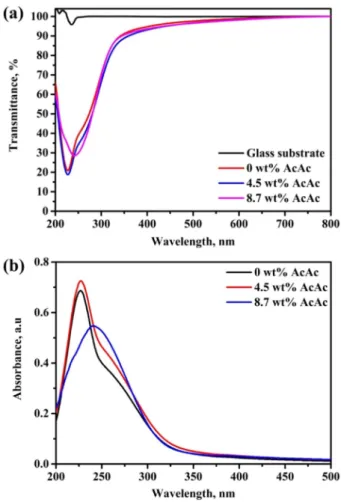
2nanoparticles were well distributed as nano-clusters along the coating layer. Fig. 2(a) shows the optical transparency of the coated films at various concentrations of AcAc added to the Ti-sol. The TiO
2- coated glass sample exhibit enhanced UV-vis absorption than the bare glass substrate, which is evident from the decrease in the transmittance at 200-600 nm. In Fig. 2(b) enlarged from 200 to 500 nm wavelengths, a shift in the absorption peak is observed in the 8.7 wt% AcAc-stabilized TiO
2thin film. This shift in the absorption peak is an indication that the nanoparticle thin films absorb lower energy photons. In detail, the existence of other doping elements such as C due to AcAc additions improves light sensitization as new energy states are imparted on the thin films. The absorption of lower energy levels is equally beneficial for improving photocatalytic performances.
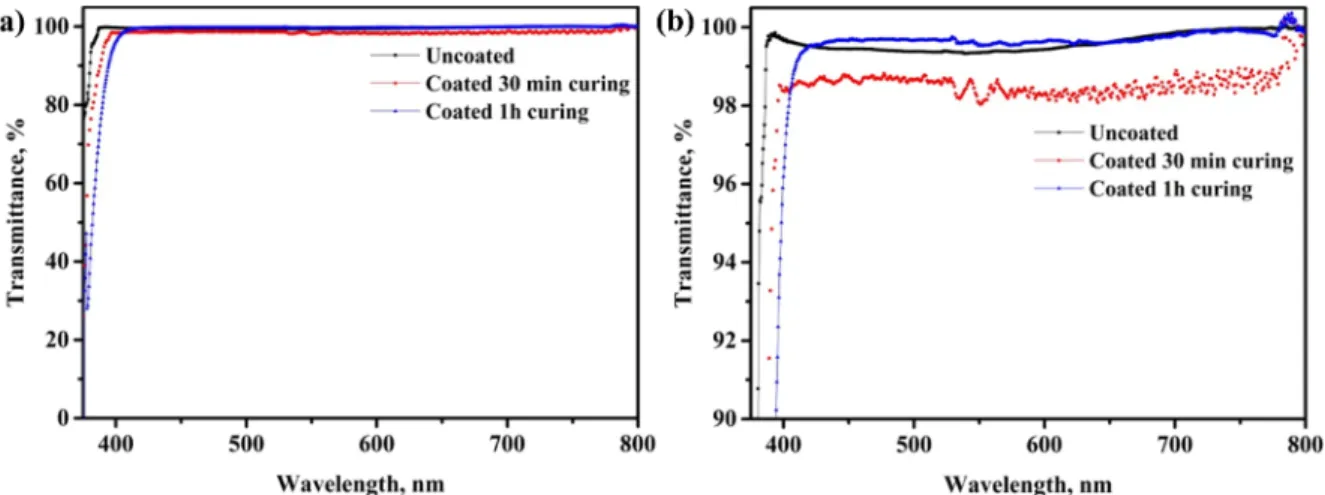
Fig. 3 shows UV-vis transparency spectra of the TiO
2- coated polycarbonate substrates cured at 140
oC. In Fig.
3(a) the three samples show high transparency above 90
% which is an indication that the thin-films were thin
Fig. 2. UV-Vis (a) transparency (red 0 wt%, blue 4.5 wt% and magneta 8.7 wt% AcAc) and (b) absorption spectra of the (black 0 wt%, red 4.5 wt% and blue 8.7 wt%) AcAc-stabilized TiO2 thin films on glass calcined at 450oC.
Fig. 1. SEM image of the 8.7 wt% AcAc-stabilized TiO2 thin film on glass substrate calcined at 450oC.
and allowing light to pass through. However, on enlarged y-axis on Fig. 3(b) the sample cured at 30 min has lower transparency than one cured for 1 h. Thus, longer curing time for coating enhances the crosslinking of TiO
2coating layer and decreases the scattering of light.
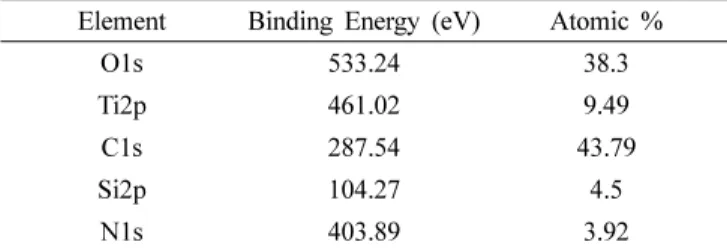
Fig. 4(a) shows the XPS survey spectra and deconvolu- tion peaks of (b) Ti2p (c) O1s and (d) C1s on polycar- bonate (PC) substrate. Table 1 shows the elemental com-
Fig. 3. UV-vis optical transparency of TiO2 coated polycarbonate substrates cured at 140oC (a) full scale and (b) enlarged at y-axis from 90 to 100%.1Fig. 4. (a) XPS survey spectra and deconvolution peaks of (b) Ti2p (c) O1s and (d) C1s on polycarbonate (PC) substrate.
position for presences of O1s, Ti2p, C1s, Si2p, N1s. Si2p of 4.5 atomic% originate from the silane stabilizer reagents.
The PC substrates still contained N- from the amine groups due to low thermal treatment temperatures. However, C content was the main component due to polycarbonate substrate. Ti2p peaks at 464 and 458 eV confirm the Ti
4+state. The deconvoluted O1s peak shows broader OH non-lattice peak than the TiO
2peak. This is owing to partial crystallization of TiO
2at low temperatures like 140
oC. The deconvoluted peaks for C1s in Fig. 4(d) show three distinct maxima at 284.8, 286.3 and 288.5 eV.
The highest C peak at 284.8 eV is non-oxygenated while the oxygenated C peaks are localized at 286.3 and 288.5 eV.
Fig. 5(a) exhibit the XPS survey spectra and decon- volution peaks of (b) Ti2p (c) O1s and (d) C1s on glass substrate. Table 2 shows the elemental composition for the presence of O1s, Ti2p, Na1s C1s, Si2p. The carbon peak maybe due to instrumental impurities, whilst Na and most of Si peaks of 7.36 atomic% emanated from the glass substrate and also from the silane coupling reagents. The dominant Si2p were referenced in other
Table 1. Elemental composition for TiO2-thin film on polycarbonatesubstrate.
Element Binding Energy (eV) Atomic %
O1s 533.24 38.3
Ti2p 461.02 9.49
C1s 287.54 43.79
Si2p 104.27 4.5
N1s 403.89 3.92
Fig. 5. (a) XPS survey spectra and deconvolution peaks of (b) Ti2p (c) O1s and (d) C1s on glass substrate.
Table 2. Elemental composition for TiO2-thin film on glass substrates.
Element Binding Energy (eV) Atomic %
O1s 532.88 50.34
Ti2p 461.02 16.55
Na1s 1073.14 7.81
C1s 287.38 17.95
Si2p 104.92 7.36
research to the borosilicate substrate.
15)Fig. 5(b) shows the deconvoluted Ti2p peaks at 464 and 458 eV for Ti2p
3/2and Ti2p
1/2. The TiO
2peak in Fig. 5(c) is defined with higher intensity than the non-lattice OH since 450
oC temperatures completely crystallize TiO
2on the glass substrates, unlike the PC substrates in Fig. 4(c).
The concentration control of reagents in a sol-preparation is critical, as in this work the optimized addition of AcAc and TiO
2/TTIP precursor were 8.7 wt% and 0.06 M, respectively. At the optimized condition, the Ti-sol solution exhibited precipitate free long term stability as reported in previous studies owing to AcAc cross-linking role.
9,19)TiO
2thin films on glass showed Si2p peaks in the XPS survey. Fig. 5(d) exhibit the deconvoluted peaks of C1s where the most prominent peak of non-oxygenated C is maxima at 284.8 eV followed by oxygenated C at 286.9 and 292.8 eV, respectively. The oxygenated C on glass substrates is lower than on PC substrates owing to high heat treatment procedures. Since the C detected on glass substrates is around 18 %, besides instrumental and handling contaminations, other researchers also referenced
the C originated from the acetyl acetone chelating com- plexes. The thin films on glass with significant C impurities were reported to exhibit enhanced photocatalysis due to the low energy levels of C on TiO
2surface.
20)Fig. 6(a) shows the photodegradation of the MB solutions with the TiO
2thin films on the glass substrate under UV-light irradiation. The photocatalytic reactivity improved with addition of AcAc in the TiO
2-sol, from 10 to 74 % with respect to the increase in the concentration of AcAc from 4.5 and 8.7 wt%, respectively. The improved photocatalytic reactivity is attributed to the increase in the degree of Ti-crosslinking with AcAc. As a result the transfer of electrons to the surface of the TiO
2thin films is improved through several sites. Additionally, the high C observed in 8.7 wt% AcAc glass thin films in (Table 2 and Fig. 5) possibly caused C-doping effect which improved TiO
2photocatalytic property. Fig. 6(b) exhibit the effect of calcination temperature on the photocatalytic degradation of 8.7 wt% AcAc-stabilized TiO
2thin films.
The T-450 thin films exhibited the highest photocatalytic activity followed by T-350 and T-550. Methylene blue dye pollutant was degraded efficiently by the TiO
2thin film heat treated at 450
oC. Thus, 450
oC is an optimum temperature as confirmed in other previous studies because of anatase TiO
2phase formed.
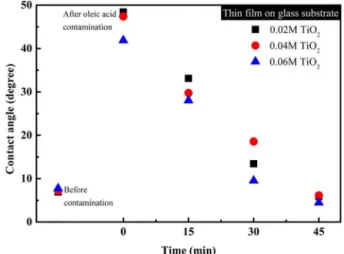
3)Fig. 7 shows variation of water contact angles with time under UV-light germicidal lamp. The contact angle of less than 10
oin the TiO
2-coated glass slides is an indication of the superhydrophilic property of TiO
2thin films. After contaminating the thin films with oleic acid, the contact angle was above 40
ofor all the samples.
However, the 0.06 M TiO
2-thin films showed lowest contact angle owing to high TiO
2-concentration. The TiO
2- thin films exhibited self-cleaning property by degrading oleic acid contaminant within 45-min cycle of UV-
Fig. 6. Effect of (a) AcAc concentration and (b) calcination temperature on the photocatalytic degradation of MB solutions with TiO2 thin films on glass substrates.
Fig. 7. Water contact angle variation on TiO2-thin films on glass substrates under UV-light.
irradiation. Therefore, the thin films recovered from olecic acid contamination within 45 min of UV-irradiation which is plausible for photoactive thin films. The TiO
2thin films on glass substrate exhibited self-cleaning property in the vicinity of the oleic acid pollutant by retaining the initial water contact angles after exposure to UV-light irradiation.
21)Acetyl acetone as a stabilizer in TiO
2-sols improved MB degradation efficiencies with increasing concentration. However, varying the amount of TiO
2(0.02, 0.04 and 0.06 M) in Ti-sol at fixed AcAc wt% of 8.7 wt%, thin films exhibited similar self- cleaning property. Therefore, crystalline TiO
2on thin- film is a vital for facilitating self-cleaning as long as a UV light irradiates.
Table 3 shows transparency, antifogging and thermal stability of TiO
2-thin films; where symbol (O) good (Δ) fair and (X) bad. The presence of permanent water stains on the on the four samples per thin film coating was evaluated as indicators for bad, fair or good. A good thin-film is the one which when exposed to vapour; it spreads along the surface without leaving water stains.
However, when a bad or fair thin film coating is exposed to vapour, droplets of water forms across the surface and on drying permanent marks appear on the substrate. This summary of coating performances elaborates that thermally stable, transparent and reusable thin films are obtained in coating solutions with more than 0.5 wt% TTIP. Whereas low TTIP in sol results in poor crosslinking in the thin-film structure hence fogging and transparency is unavoidable.
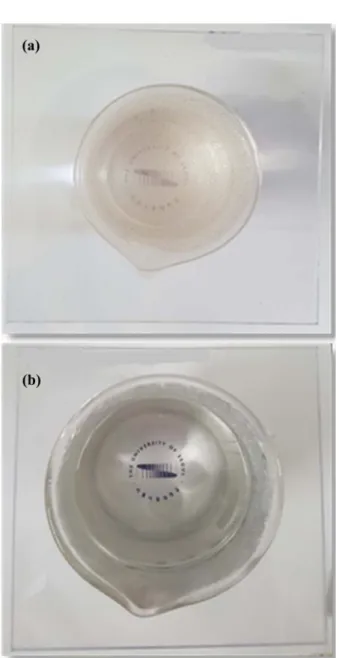
Fig. 8 show antifogging property of (a) bare PC substrate and (b) TiO
2-coated PC substrate on the top of a beaker with vapor. The bare substrate has hydrophobicity whereby water droplets accumulate and scatter light. As follows, Fig. 8(a) shows low transparency of the logo below the beaker. However, TiO
2coated PC substrate shows clearly the University of Seoul logo. Thus, TiO
2coating prevents the formation of water droplets instead it forms a thin film of water across the coated layer. Hence, high transparency is observed owing to the hydrophilic nature of TiO
2-thin films. Interestingly, the coated glass and polycarbonate substrate exhibited transparency above 90 %. However, in PC substrates longer treatment time improved the transparency due to crosslinking of the thin film. Although the TiO
2thin film heat treated below 200
oC contained a low crystallinity in other reference
22),
in our work above 90 % transparency at 140
oC on PC substrates is plausible for coatings. The TiO
2thin film on polycarbonate exhibited thermal resistance and good hydrophilicity or antifogging owing to the Ti-O linking confirmed by XPS analysis. In the vicinity of water vapor, the thin layer of water was formed across the TiO
2-coated PC substrate, instead of water droplets. This
Table 3. Transparency, antifogging and thermal stability of TiO2-thin films on polycarbonate substrates where symbol (O) good, (Δ) fair and (X) bad.Coating solution Transparency after
curing Anti-fogging test Water mark 25oC,
100oC Reusability Thermal stability 100oC/8 h
TTIP<0.5M O O Δ X X
TTIP>0.5M O O O O O
Fig. 8. Antifogging property of (a) bare PC substrate and (b) TiO2- coated PC cured at 140oC.
anti-fogging property is beneficial for keeping clean surfaces.
4. Conclusions
Anti-fogging and photo-reactive TiO
2coating films were developed by the sol-gel method. XPS analysis confirmed the presence of Ti and O in glass and polycar- bonate substrates. The addition of AcAc substantially improved the photocatalytic property of the TiO
2coating layer in MB solutions under UV light irradiation. The optimum photocatalytic activity was obtained for the 8.7 wt% AcAc-stabilized TiO
2coating layer calcined at 450
oC. The complexing property of AcAc improved the degree of Ti-Ti crosslinking in the TiO
2coating layer, promoting a broader shift in UV light absorption. This increased the generation of electron-hole pairs at the surface of the AcAc-stabilized TiO
2thin films. The TiO
2thin films on glass substrate exhibited self-cleaning property from oleic acid contamination within 45 min of UV-light irradiation. The anti-fogging and thermal stability of the TiO
2coated PC substrate was improved with extended curing time of 1 h at 140
oC. Therefore, the TiO
2monolayer coating with an appropriate addition of AcAc may protect glass or PC surfaces against dirt accumulation, pollutants and fogging problems.
Acknowledgements
This work was supported by the 2019 sabbatical year research grant of the University of Seoul.
References
1. X. Hu, Y. Yu, Y. Wang, Y. Wang, J. Zhou and L. Song, Mater. Lett., 182, 372 (2016).
2. H. Yaghoubi, N. Taghavinia and E. K. Alamdari, Surf.
Coat. Technol., 204, 1562 (2010).
3. H. M. Yadav and J.-S. Kim, J. Mater. Sci.: Mater.
Electron., 27, 10082 (2016).
4. H. K. Hakki, S. Allahyari, N. Rahemi and M. Tasbihi, Mater. Sci. Semicond. Process., 85, 24 (2018).
5. A. Tricoli, M. Righettoni and S. E. Pratsinis, Nanotech Conf. Expo 2009, Vol 3, Tech. Proc., 3, 192 (2009).
6. H. Sabbah, Mater. Express, 3, 171 (2013).
7. R. Fateh, A. A. Ismail, R. Dillert and D. W. Bahnemann, J. Phys. Chem. C, 115, 10405 (2011).
8. T. Zubkov, D. Stahl, T. L. Thompson, D. Panayotov, O.
Diwald and J. T. Yates, J. Phys. Chem. B, 109, 15454 (2005).
9. S. Okunaka, H. Tokudome, Y. Hitomi and R. Abe, J.
Mater. Chem. A, 3, 1688 (2015).
10. S. Morales-Torres, L. M. Pastrana-Martínez, J. L.
Figueiredo, J. L. Faria and A. M. T. Silva, Environ. Sci.
Pollut. Res., 19, 3676 (2012).
11. C. Han, V. Likodimos, J. A. Khan, M. N. Nadagouda, J. Andersen, P. Falaras, P. R. Lombardi and D. D.
Dionysiou, Environ. Sci. Pollut. Res., 21, 11781 (2014).
12. V. B. Koli, S. D. Delekar and S. H. Pawar, J. Mater. Sci.
Mater. Med., 27, 177 (2016).
13. I. I. Kabir, L. R. Sheppard, R. Shamiri, P. Koshy, R. Liu, W. Joe, A. Le, X. Lu, W. -F. Chen and C. C. Sorrell, J.
Mater. Sci., 55, 3774 (2020).
14. F. Oshani, R. Marandi, S. Rasouli and M. K. Farhoud, Appl. Surf. Sci., 311, 308 (2014).
15. P. Dulian, W. Nachit, J. Jaglarz, P. Zieba, J. Kanak and W. Zukowski, Opt. Mater. (Amst)., 90, 264 (2019).
16. P. Chevallier, S. Turgeon, C. Sarra-Bournet, R. Turcotte and G. Laroche, ACS Appl. Mater. Interfaces, 3, 750 (2011).
17. S. Park, S. Park, D. H. Jang, H. S. Lee and C. H. Park, Mater. Lett., 180, 81 (2016).
18. K. V. Radha, I. Regupathi, A. Arunagiri and T. Murugesan, Process Biochem., 40, 3337 (2005).
19. I. Kartini and G. Q. Lu, Indonesian J. Chem., 5, 15 (2005).
20. J. Spiridonova, A. Katerski, M. Danilson, M. Krichevskaya, M. Krunks and I. O. Acik, Molecules, 24, 4326 (2019).
21. S. Nishimoto, S. Tomoishi, Y. Kameshima, E. Fujii and M. Miyake, J. Ceram. Soc. Jpn., 122, 513 (2014).
22. V. B. Koli, S. Mavengere and J.-S. Kim, Appl. Surf. Sci., 491, 60 (2019).
Author Information Shielah Mavengere
서울시립대학교 박사후연구원 김정식서울시립대학교 교수