523 서 론
집약적인 어류 양식을 위해서는 양식 대상종의 성장이 빠르 고, 효율적인 사료가 이용되어야 하며, 사료 허실량을 최소화 시켜야 할 뿐 아니라 수확된 양식어의 크기를 일정하게 유지 하는 것이 바람직하다. 이러한 집약적 양식 운영을 위해서는 양식 대상종의 영양소별 요구량에 관한 자료 뿐만 아니라, 효 율적인 사료공급체계에 관한 정보가 필요하다(Jobling et al., 1995a).
사료는 어류의 체내 대사 및 성장에 영향을 미치는 가장 주 요한 요인 중에 하나이며, 사료비는 어류양식에 소요되는 비 용 중 다른 요소들에 비해 상대적으로 높은 비율을 차지하므로 중요하게 고려되어야 한다. 양식장 운영에 있어 환경이나 질병 은 양식기간 중에 인위적으로 쉽게 조절되지 않는 요인이지만, 사료공급은 양식현장의 양어가들에 의해 조절됨으로 양식 성
공의 주요한 변수이기도 하다. 즉, 어류의 성장단계 및 사육조 건을 고려하여 사료를 적정 시간에 알맞은 양을 공급하여야 성 장과 사료효율을 높일 수 있다. 만약 양식 대상종에 적합한 사 료공급체계가 확립되어 있지 않을 경우에는 사료가 과잉 또는 부족하게 공급되기 쉽다. 사료의 과잉 공급은 사료의 유실 뿐 만 아니라, 어체 내 사료의 비효율적인 이용으로 사료 허실을 초래하여 경제적인 손실과 수질 오염원을 증가시킬 수 있다.
이와 반대로 사료를 부족하게 공급하게 되면 어류의 최대 성 장에 필요한 영양소 요구량을 충족시키지 못하여 성장 저하를 초래할 수도 있다(Tsevis et al., 1992; Azzaydi et al., 2000). 이와 같이 사료 공급시간, 일일 사료 공급횟수와 공급량 및 주 별 사료 공급일수와 같은 사료 공급방법은 상업적인 양식장 운 영의 성공여부에 많은 영향을 미치는 요인이다(Jobling et al., 1995b).
국내 대부분의 넙치 양어가들은 1주일에 6일 동안 사료를 공
Article history;
Received 14 May 2012; Revised 26 September 2012; Accepted 17 October 2012
*Corresponding author: Tel: +82. 54. 232. 5423 Fax: +82. 54. 232. 5436 E-mail address: [email protected]
Kor J Fish Aquat Sci 45(5) 523-526, October 2012 http://dx.doi.org/10.5657/KFAS.2012.0523 pISSN:0374-8111
ⓒ The Korean Society of Fishereis and Aquatic Science. All rights reserved
사료 공급일수 및 공급율이 육성기 넙치(Paralichthys olivaceus)의 성장에 미치는 영향
김경덕* . 김강웅 . 배기민 . 손맹현1 . 안철민
Effects of Different Numbers of Feeding Days and Feeding Rate on Growth of Growing-out Flounder Paralichthys olivaceus
Aquafeed Research Center, National Fisheries Research & Development Institute, Pohang 791-923, Korea
1Aquaculture Management Division, National Fisheries Research & Development Institute, Busan 619-705, Korea This study evaluated the effects of the number of feeding days and feeding rate on the growth of growing-out flounder Paralichthys olivaceus. Three replicated groups of fish (141±1.9 g) were hand-fed a commercial feed under different feeding regimes for 9 weeks. Fish in group 6F-1S were fed to satiation twice daily for 6 consecutive days and starved for 1 day. Fish in groups 4F-1S and 3F-1S were fed to satiation twice daily for 4 and 3 days, respectively, and starved for 1 day. Fish in group 6F-90% were fed a diet of 90% of 6F-1S twice daily for 6 consecutive days and starved for 1 day. The weight gain, feed efficiency and daily feed intake of the fish groups in 4F-1S and 3F-1S were not significantly different from those of group 6F-1S. The weight gain and feed efficiency of fish in group 6F-90% were not significantly different from those of group 6F-1S. The results of this study suggest that the growth of growing-out flounder fed to satiation twice daily for 4 or 3 days after starving 1 day was similar to that of fish fed to satiation for 6 days, and that the proper feeding rate for growth could be lowered to 90% of satiation without growth suppression.
Key words: Feeding days, Feeding rate, Flounder, Growth
Kyoung-Duck Kim*, Kang-Woong Kim, Ki-Min Bae, Maeng Hyun Son1 and Cheul Min An
국립수산과학원 사료연구센터, 1양식관리과
Kor J Fish Aquat Sci 45(5),523-526,2012 한수지 45(5), 523-526, 2012
Note
김경덕 . 김강웅 . 배기민 . 손맹현 . 안철민 524
급하고, 1일을 절식시키는 사료공급 방법을 주로 실시하고 있 다. 기존에 수행된 넙치 배합사료 공급체계에 관한 연구로써 사료공급 일수 및 절식 일수를 다르게 하여 사육한 실험에서 주 별 연속적인 절식일수가 2일 및 3일 이상으로 증가할 경우, 넙 치의 성장 및 사료섭취량이 감소하는 결과를 보였다(Cho and Park, 2004; Cho, 2009). 그래서 본 연구에서는 절식 조건을 1일로 설정하고 사료 공급일수를 6일, 4일 및 3일로 달리하여 사료를 공급한 경우와 사료의 제한공급(만복의 90%)이 넙치의 성장과 등근육 조성에 미치는 영향을 조사하였다.
재료 및 방법 실험설계 및 사육관리
실험어는 2주간 예비 사육하다가 외형적으로 건강한 평균체 중 141±1.9 g의 육성어를 선별하여 총 12개의 원형수조(1800 L)에 50마리씩 사료 공급일수 및 제한 공급구별로 3반복 수 용하였다. 실험사료는 시판용 넙치 배합사료를 사용하였으며, 실험사료의 영양성분 분석결과를 Table 1에 나타내었다. 실험 사료의 조단백질은 49.5%, 조지질은 16.5%였으며, 기존에 수 행된 육성기 넙치의 단백질 및 지질 요구량 연구(Kim et al.,
2009a)를 토대로 하여 볼 때 육성기 넙치 사육을 위하여 단
백질 및 지질 함량은 적합하였다. 사료 공급일수 실험은 6일 간 사료를 1일 2회 만복으로 공급한 후 1일 절식시킨 대조구 (6F-1S), 4일간 사료를 만복으로 공급한 후 1일 절식시킨 실험 구(4F-1S) 및 3일간 사료를 만복으로 공급한 후 1일 절식시킨 실험구(3F-1S)를 설정하였다. 만복 실험구는 실험어가 사료를 먹지 않을 때까지 손으로 공급하였으며, 섭취되지 않은 사료는 사료 공급 종료 10분 후, 수거하여 사료섭취량에서 제외시켰 다. 제한 공급구(6F-90%)는 대조구(6F-1S)의 90%(어체중에 대한 일일사료섭취율 기준)로 설정하였으며, 대조구의 사료섭 취량을 기준으로 준비하여 1일 2회로 나누어 공급하였다. 사 육실험은 9주간 실시하였으며, 사육실험 3주 및 6주 후 각 수 조에 생존한 실험어의 전체 체중을 측정하였다. 제한 공급구의 일일 사료공급량은 최초 3주까지는 예비 사육기간의 사료효율 을 토대로 일일 증체율을 추정하여 준비한 후 1일 2회로 나누 어 공급하였으며, 사육실험 3주 이후부터의 일일 사료 공급량
은 중간 측정 시까지의 사료 섭취량과 사료효율을 추정하여 일 일 증체율을 계산하고 그에 따라 준비하였다. 자연 해수를 각 실험수조에 10 L/min로 흘려주었으며, 사육기간 동안의 수온 은 22.3±1.6℃(평균±표준편차)였다.
어체측정 및 성분분석
어체 측정은 측정 전일 절식시킨 후, 각 수조에 수용된 실험어 전체 무게를 측정하였다. 실험 종료시 각 실험수조에서 실험어 5마리를 취하여 냉동보관(-75℃)하였으며, 분석용 시료로 사 용하였다. 실험사료와 실험어 등근육의 수분은 135℃에서 2 시간 건조 후 측정하였으며, 조단백질(N×6.25)은 Auto Kjel- dahl System (Gerhardt VAP50OT/TT125, KG, Germany)을 사용하여 분석하였다. 조지방은 조지방추출기(Velp SER 148, Usmate, Italy)를 사용하여 ether로 추출한 후 측정하였으며, 회분은 550℃에서 4시간 동안 회화 후 측정하였다. 사료의 총 에너지량은 열량분석기(Parr-6200, Moline, IL, USA)를 사용 하여 분석하였다.
통계처리
결과의 통계처리는 SPSS (Version 11.5, USA) 프로그램을 사용하여 One-way ANOVA-test를 실시한 후 Duncan’s mul- tiple range test (Duncan, 1995)로 평균간의 유의성을 검정하 였다.
결과 및 고찰
효율적인 양식 운영을 위해서는 우선 대상 어종의 사육에 적 합한 질 좋은 사료를 개발하는 것이 일차적으로 중요하지만, 개발된 사료가 있더라도 이를 효율적으로 사용하지 않으면 양 식 생산성을 높일 수 없을 것이다. 그러므로 어류의 최대 성 장과 사료효율을 얻을 수 있는 적정 사료공급 방법을 결정하 는 것은 양식생산성의 향상을 위해 중요하다(Ng et al., 2000;
Mihelakakis et al., 2002).
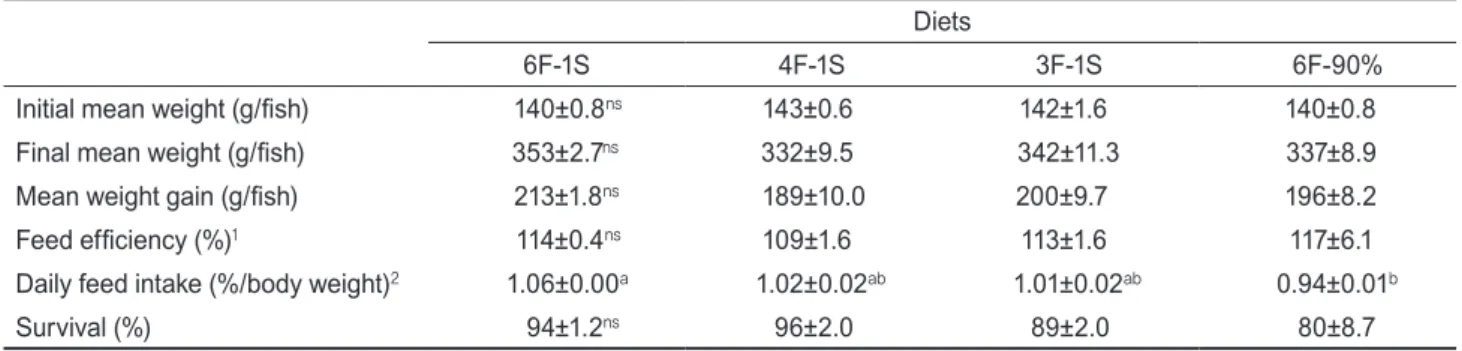
사료 공급일수 및 공급율을 달리하여 9주간 육성기 넙치를 사 육한 결과를 Table 2에 나타내었다. 생존율은 모든 실험구간 에 유의한 차이가 없었다. 6일간 1일 2회 사료를 만복공급 후 1일 절식시킨 실험구와 비교하여 4일 및 3일 만복공급 후 1일 절식시킨 실험구의 최종체중, 증체량, 사료효율 및 일일사료 섭취율은 유의한 차이를 보이지 않았다. 본 연구에서 4일 및 3 일 동안 1일 2회 사료를 만복 공급 후 1일 절식시킨 실험구는 6 일 만복 공급 후 1일 절식한 실험구와 비교하여 성장 및 사료효 율 및 사료섭취율이 유사한 결과를 보였다. 이와 같이 1일만 절 식시킬 경우에는 절식 전 사료 공급일수가 6일에서 4일 및 3일 로 감소하더라도 사료를 섭취하는 날의 일일 사료섭취량이 증 가하여 성장 및 사료효율이 감소하지 않는 결과를 보였다. Cho and Park (2004)은 주별 사료 공급일수를 6일 공급 후 1일 절 Table 1. Nutrient contents (dry matter basis) of the experi-
mental diet
Content
Moisture (%) 7.0
Crude protein (%) 49.5
Crude lipid (%) 16.5
Ash (%) 9.4
Crude fiber (%) 1.0
Gross energy (cal/g) 5079
넙치 사료 공급일수 및 공급율 525
식, 5일 공급 후 2일 절식 및 4일 공급 후 3일 절식시키는 사료 공급 방법으로 넙치 치어(최초 38 g)를 6주간 사육한 결과, 6일 공급 후 1일 절식한 실험구와 5일 공급 후 2일 절식한 실험구 간에는 성장 및 사료섭취량이 차이가 없었으나, 4일 공급 후 3 일 절식시킨 실험구는 성장 및 사료섭취량이 저하되었다고 보 고하였다. 절식일수와 사료 공급일수를 달리한 Cho (2009)의 연구에서도 주별 절식일수가 2일 및 3일 이상으로 증가할 경 우, 넙치의 성장 및 사료섭취량이 감소하는 결과를 보였다. 이 와 같이 주별로 2일 및 3일 이상을 연속으로 절식시킬 경우 사 료섭취량이 감소하게 되어 넙치의 성장이 감소하는 것으로 판 단된다. 따라서 넙치의 최대 성장을 위해서는 주별 연속적으로 2일을 초과하여 절식시키지 않는 것이 좋을 것으로 판단된다.
어류의 보상 성장은 어종, 사료조성 및 사료공급 방법 등에 따 라서 달라질 수 있다(Jobling et al., 1994; Gaylord and Gatlin, 2000). 단백질 및 지질 함량을 달리한 사료로 2주 및 4주 간격 으로 절식 및 사료공급을 실시하며 여름철에 넙치의 보상 성장 을 조사한 기존의 연구(Cho et al., 2010)에서 실험어의 성장은 사료공급 방법에는 유의한 영향을 받았으나 사료의 영양소 함 량에 따른 차이는 없었다. 이러한 결과로 볼 때, 본 연구에 사 용된 실험사료의 원료조성을 명확히 알 수는 없지만 각 실험구 의 사료효율이 109-117%로 상당히 양호하여 넙치 사육을 위 해서 적합하였으며, 사료의 원료조성, 소화율 및 가용에너지 함량에 따라서 다소 차이를 보일 가능성을 배제할 수는 없지 만 여름철 넙치 육성어의 최대 성장을 위해서는 본 연구에 적용
된 절식 및 사료공급방법을 적용하여도 좋을 것으로 판단된다.
본 연구에서 만복의 90%를 공급한 제한 공급구는 만복 공급 구와 비교하여 어체의 성장 및 사료효율에 차이를 보이지 않았 다. Kim et al. (2009b)은 여름철에 성어기 넙치(최초 535 g) 를 사료공급율을 달리하여 10주간 사육한 결과, 만복의 90% 공급구와 만복 공급구간에는 어체의 성장 및 비만도에 유의한 차이를 보이지 않았으나, 만복의 80% 및 70% 공급구는 만복 공급구에 비하여 성장 및 비만도가 감소하여 여름철에 넙치 성 어의 적정 성장 및 어체의 비만도 유지를 위해서는 만복 공급 의 90% 이상의 사료를 공급하는 것이 적합하다고 보고하였다.
그리고 Cho et al. (2007)은 사료 공급율을 달리하여 최초 체중 318 g의 넙치를 사육한 결과, 만복 공급구와 90% 만복 공급구 간에 성장에서 유의한 차이가 없었다고 보고하여 본 연구 결과 와 유사한 결과를 보였다. 그러나 치어기 넙치(3-18 g, 17-90 g)를 대상으로 한 기존의 연구들에서는 적정 사료공급율이 만 복의 95%로 나타나(Cho et al., 2006; Kim et al., 2007), 어체 크기에 따라 적정 사료공급율에 차이를 보였으며, 성장도가 빠 른 치어기가 육성기 및 성어기에 비하여 최대 성장을 위한 적정 사료공급율이 더 높게 나타났다.
사료 공급일수 및 공급율(만복의 90%)을 달리한 본 연구에 서 사료효율은 모든 실험구간에 차이가 없었는데, 기존의 연구 에서도 본 연구와 유사하게 사료 공급일수 및 공급량을 달리한 실험구간에 사료효율에 차이가 없는 것으로 보고되었다(Cho and Park, 2004; Seo et al., 2005). 그러나 Lee(1997)는 조피 Table 2. Growth performance of flounder Paralichthys olivaceus fed the diets
Diets
6F-1S 4F-1S 3F-1S 6F-90%
Initial mean weight (g/fish) 140±0.8ns 143±0.6 142±1.6 140±0.8
Final mean weight (g/fish) 353±2.7ns 332±9.5 342±11.3 337±8.9
Mean weight gain (g/fish) 213±1.8ns 189±10.0 200±9.7 196±8.2
Feed efficiency (%)1 114±0.4ns 109±1.6 113±1.6 117±6.1
Daily feed intake (%/body weight)2 1.06±0.00a 1.02±0.02ab 1.01±0.02ab 0.94±0.01b
Survival (%) 94±1.2ns 96±2.0 89±2.0 80±8.7
Values (mean±SE of three replications) in each row with a different superscript are significantly different (P<0.05).
nsNot significant (P>0.05).
1Fish wet weight gain×100/feed intake (dry matter).
2Feed intake (dry matter)×100/[(initial fish weight+final fish weight+dead fish weight)×days fed/2].
Table 3. Proximate composition of dorsal muscle in flounder Paralichthys olivaceus fed the diets Diets
6F-1S 4F-1S 3F-1S 6F-90%
Moisture (%) 74.6±0.04ns 74.2±0.18 74.1±0.16 74.3±0.29
Crude protein (%) 24.2±0.33ns 23.8±0.24 24.4±0.02 24.1±0.11
Crude lipid (%) 0.3±0.01ns 0.4±0.07 0.4±0.10 0.3±0.03
Values are mean±SE of three replications.
nsNot significant (P>0.05).
김경덕 . 김강웅 . 배기민 . 손맹현 . 안철민 526
볼락을 대상으로 사료공급율을 달리하여 15주간 사육 실험한 결과, 사료섭취율이 높을수록 사료이용률이 떨어진다고 보고 하여 본 연구와 차이를 보였다. 이러한 차이를 명확하게 설명 할 수는 없으나, 어종 및 소화기관의 구조나 소화효소 활성 등 에 따른 차이에 의한 것으로 판단된다.
사육실험 종류 후, 등근육의 일반성분은 사료 공급일수에 영 향을 받지 않았으며, 주별 사료 공급일수에 따라 어체 일반성 분의 차이를 보이지 않은 이전 연구결과(Cho and Park, 2004) 와 유사하였다.
이상의 결과로 볼 때, 여름철에 육성기 넙치를 시판 상품사 료(조단백질 49.5%, 조지질 16.5%)로 1일 2회 만복 공급하며 사육시에는 절식 일수를 1일로 설정할 경우, 4일 및 3일 간격 으로 절식시켜도 6일 간격으로 절식시킨 실험구에 비해 성장, 사료효율 및 사료섭취율에서 차이를 보이지 않았으며, 주별 6 일 사료를 공급할 경우 만복의 90% 공급하여도 좋을 것으로 판단된다.
사 사
본 연구는 국립수산과학원(친환경 실용배합사료 개발 및 품 질관리 연구, RP-2012-AQ-033)의 지원에 의해 운영되었습 니다.
참고문헌
Azzaydi M, Martines FJ, Zamora S, Sanchez-Valzquez and Ma- drid JA. 2000. The influence of nocturnal vs. diurnal feed- ing condition under winter condition on growth and feed conversion of European sea bass (Dicentrachus labrax L).
Aquaculture 182, 329-338.
Cho SH. 2009. Effects of different feeding regimes on the com- pensatory growth of olive flounder Paralichthys olivaceus.
Fish Aquat Sci 12, 299-304.
Cho SH and Park IS. 2004. Effect of feeding on different days of the week on growth and body composition of juvenile flounder, Paralichthys olivaceus. Kor J of Ichthyol 16, 210- Cho SH, Lee SM, Park BH and Lee SM. 2006. Effect of feed-214.
ing ratio on growth and body composition of juvenile olive flounder Paralichthys olivaceus fed extruded pellets during the summer season. Aquaculture 251, 78-84.
Cho SH, Lee SM, Park BH, Ji SC, Choi CY, Lee JH, Kim YC, Lee JH and Oh SY. 2007. Effect of daily feeding ratio on growth and body composition of subadult olive flounder Paralichthys olivaceus, fed an extruded diet during the summer season. J World Aquacult Soc 38, 68-73.
Choi SH, Kim CI, Park IS, Song YC, Park C and and Kim KD.
2010. Effect of dietary nutrient composition on growth of olive flounder (Paralichthys olivaceus) with different feed-
ing regimes. Fish Physiol and Biochem 36, 377-385.
Duncan DB. 1955. Multiple-range and multiple F tests. Bio- metrics 11, 1-42.
Gaylord TG and Gatlin DM. 2000. Assessment of compensa- tory growth in channel catfish Ictalurus punctatus R. and associated changes in body condition indices. J World Aquacult Soc 31, 326-336.
Jobling M, Meloy OH, Dos Santos J and Christiansen B. 1994.
The compensatory growth response of the Atlantic cod:
effects of nutritional history. Aquaculture International 2, 75-90
Jobling M, Arnesen AM, Baardvik BM, Christiansen JS and Jørgensen EH. 1995a. Monitoring voluntary feed intake under practical conditions; methods and applications. J of Appl Ichthyol 11, 248-262.
Jobling M, Arnesen AM, Baardvik BM, Christiansen JS and Jørgensen EH. 1995b. Monitoring feeding behaviour and food intake; methods and applications. Aquacult Nut 11, 248-262.
Kim KD, Kang YJ, Kim KW and Kim KM. 2007. Effects of feeding rate on growth and body composition of juvenile flounder Paralichthys olivaceus. J World Aquacult Soc 38, 169-173.
Kim KD, Kang YJ, Lee HY, Kim KW and Son MH. 2009a.
Effects of protein and lipid levels in extruded pellets on the growth and body composition of the olive flounder Parali- chythys olivaceus during the summer and winter seasons.
Fish Aquat Sci 12, 104-110.
Kim KD, Kang YJ, Lee JY, Kim KW, Lee HM, Jang MS, Choi SM, Nam MM and Lee SM. 2009b. Effects of feeding rate on growth and body composition of adult flounder Parali- chthys olivaceus during the summer season. J Aquaculture 22, 1-4.
Lee SM. 1997. Effects of feeding rates on growth feed efficien- cy and body composition of the juvenile Korean rockfish (Sebastes schlegeli). Kor J of Animal Nutrition Feed 21, 327-334.
Mihelakakis A, Tsolkas C and Yoshimatsu T. 2002. Optimiza- tion of feeding rate of hatchery-produced juvenile gilthead sea bream Sparus aurata. J World Aquacult Soc 33, 169- Ng WK, Lu KS, Hashim R and Ali A. 2000. Effects of feeding 175.
rate on growth, feed utilization and body composition of a tropical bagrid catfish. Aquaculture International 8, 19-29.
Seo JY, Lee JH, Kim GU and Lee SM. 2005. Effect of extruded and moist pellets at different feeding rate on growth and body composition of juvenile flounder, Paralichthys oliva- ceus. J Aquaculture 18, 26-30.
Tsevis N, Klaoudatos S and Conides A. 1992. Food conversion budget in sea bass Dicentracus labrax, fingerlings under two different feeding frequency patterns. Aquaculture 101, 293- 304.