43
Copyright © 2019 The Korean Society of Fisheries and Aquatic Science pISSN:0374-8111, eISSN:2287-8815
서 론
2017
년도대한민국넙치생산량은약41,207
톤으로전체어류양식생산량의
47.7%
를차지하고생산금액은약5,845
억원 에달한다(KOSIS, 2017a).
고부가가치를지닌만큼넙치양식 에대한체계적인지침이필요하다.
양어사료는어류양식의생산원가에약
49.6%
의비중을차지하는중요한요인중하나이다
(KOSIS, 2017b).
하지만국내에서의배합사료공급량과방법은양어장마다천차만별이다
.
넙치용배합사료의체계적인 공급방법확립을위해다양한연구가진행되어왔다(Kim et al., 2011; Oh et al., 2013; Kim et al., 2015a; Kim et al., 2015b).
해외수산선진국들은다양한어종에대한배합사료적정공급 량을이미정립하였다
(NRC, 2011).
국내에서는국립수산과학 원이2015
년도에‘
넙치배합사료공급프로그램’
을완성하였다.
하지만적정사료크기에대한연구는미흡한실정이다
.
국내대 부분의배합사료회사에서는넙치크기에따른적정사료크기를 명시한사료급여율표를제공하고있지만기초연구가미비하여 근거확립이필요한실정이다(Oh et al., 2013).
사료의크기는어류의성장과사료효율에 직접적인영향을
미치며소화관을통과하는시간과도밀접한연관이있다
(Dab-
rowski and Bardega, 1984; Hasan and Macintosh, 1992; Hos- sain et al., 2000).
큰사료는작은사료보다일반적으로소화흡 수율이낮다.
위산과효소에대한상대적표면적이작기때문이 다(Jobling, 1987).
하지만넙치의경우에는큰사료가작은사 료에비해사료섭취량을증가시킴으로써성장률을높일수있다는보고가있었다
(Heo, 2011).
큰사료는작은사료에비해한회섭취량이상대적으로높기때문이다
(Kim et al., 2015b).
어류는 성장단계에 따라 영양소 요구량이 다르다
(Webster
배합사료 크기가 성장단계별 넙치(Paralichthys olivaceus) 성장에 미치는 영향
김민기·신재형·이초롱·이봉주
1·김강웅
1·이경준*
제주대학교 해양생명과학과, 1국립수산과학원 사료연구센터
Effect of Extruded Pellet Size on Growth of Olive Flounder Paralichthys olivaceus at Three Different Growing Stages
Min-Gi Kim, Jaehyeong Shin, Chorong Lee, Bong-Joo Lee1, Kang-Woong Kim1 and Kyeong-Jun Lee*
Department of Marine Life Sciences, Jeju National University, Jeju 63243, Korea
1Aquafeed Research Center, National Institute of Fisheries Science, Pohang 37517, Korea
This study was conducted to investigate the effect of extruded pellet (EP) size on the growth performance of olive flounder Paralichthys olivaceus at the juvenile (Exp-I; 62.2±0.05), growing (Exp-II; 150±1) and sub-adult (Exp-III;
299±1) stages. In Exp-I (3, 4, 5 and 6 mm diets), Exp-II (4, 9, 11 and 13 mm diets) and Exp-III (9, 11, 13 and 16 mm diets), triplicate groups of fish were fed four EP diets of different pellet sizes. In Exp-I, larger pellet sizes were signifi- cantly better than the smallest pellet size (3 mm). In Exp-II, significantly improved feed and protein efficiency were observed with increasing pellet size. The feed conversion ratios of the fish fed the 4 and 9 mm diets were significantly lower than those of fish fed 11 and 13 mm diets. The dietary digestibility of protein and energy was higher in smaller EPs than in larger sizes. In Exp-III, the growth performance of fish was not affected by the pellet size. However, feed intake was significantly affected, increasing with increasing pellet size. Therefore, the optimum pellet sizes for olive flounder under the conditions in this study were 5 mm for 60-150 g fish and 9 mm for 150-500 g fish.
Key words: Olive flounder, Feed size, Growth stage, Water temperature, Growth performance
*Corresponding author: Tel: +82. 64. 754. 3493 Fax: +82. 64. 756. 3493 E-mail address: [email protected]
This is an Open Access article distributed under the terms of the Creative Commons Attribution Non-Commercial Licens (http://creativecommons.org/licenses/by-nc/3.0/) which permits unrestricted non-commercial use, distribution, and reproduction in any medium, provided the original work is properly cited.
Received 3 December 2018; Revised 3 January 2019; Accepted 9 January 2019 저자 직위: 김민기(대학원생), 신재형(대학원생), 이초롱(대학원생), 이봉주(
연구사), 김강웅(연구관), 이경준(교수) https://doi.org/10.5657/KFAS.2019.0043
Korean J Fish Aquat Sci 52(1), 43-48, February 2019
and Lim, 2002).
이전연구에서넙치의성장단계에따른적정 사료크기를알아보기위한연구가진행되었으나(Heo, 2011),
시판배합사료가실험사료로사용되었고,
실험사료의크기에 따라각영양소함량이달랐다.
결과적으로사료크기뿐만아니 라영양소의함량차이가실험결과에영향을미쳤다고판단된 다.
따라서,
이연구는영양소함량을동일하게배합한EP
배합 사료의크기가치어기,
육성기,
미성어기넙치의성장과육성 기넙치의소화율에미치는영향을조사하기위해수행되었다.
재료 및 방법
실험어 및 사육관리
각성장단계별사양실험에사용된넙치는제주시소재한라 수산에서구입되었다
.
실험어는2
주동안2000 L
사각수조에 서순치되었다.
순치된실험어는각성장단계별사양실험에사 용하였다.
실험
1
은치어기넙치를대상으로진행되었다.
실험에사용된 넙치평균무게는62.2±0.05 g
이었다. 12
개250 L
원형poly- propylene
수조에수조당30
마리씩각실험구마다3
반복으로 배치되었다.
사양실험은8
주간진행되었다.
실험
2
는육성기넙치를대상으로사료크기가성장과소화율 에미치는영향을알아보기위해진행되었다.
실험에사용된넙 치평균무게는150±1 g
이었다. 12
개2000 L
원형polypropyl- ene
수조에수조당36
마리씩각실험구마다3
반복으로배치되 었다.
사양실험은6
주간진행되었다.
실험
3
은미성어기넙치를대상으로 진행되었다.
실험에사 용된넙치의평균무게는299±1 g
이었다. 12
개2000 L
원형polypropylene
수조에수조당30
마리씩각실험구마다3
반복으로배치되었다
.
사양실험은6
주간진행되었다.
모든사양실험에서실험사료는
1
일2
회(9:00, 17:00)
에나누 어실험어가사료를섭이하지않을때까지만복으로공급되었 다.
사료공급후남아있는사료는회수되어건조후무게가측 정되었다.
사육수는모래여과된해수가사용되었다.
사육수온 은자연수온에의존하였다.
사양실험동안의평균수온,
최저수 온,
최고수온은Table 1
에나타내었다.
유수량은실험1
에서13 L/min,
실험2
와3
에서33 L/min
로조절되었다.
각실험수조마 다 공기발생기(aeration)
를 설치하여용존산소를 유지하였다.
광주기는형광등을이용하여
12L:12D
조건으로유지되었다.
실험사료
실험
1
에서는조단백질,
조지질,
조회분함량이동일한넙치용 시판배합사료(Flatfish Super, Suhyup feed, Korea) 4
종이사용 되었다.
실험2
와3
에서는국립수산과학원사료연구센터에서 압출성형기(ATX-2, Fesco, Pohang, Korea)
로성형한extruded pellet (EP)
형태의부상사료를제작하여사용하였다.
실험2
의 실험사료는사료내1%
의chromium oxide (Cr
2O
3, Sigma)
가 첨가되어제조되었다.
실험1, 2, 3
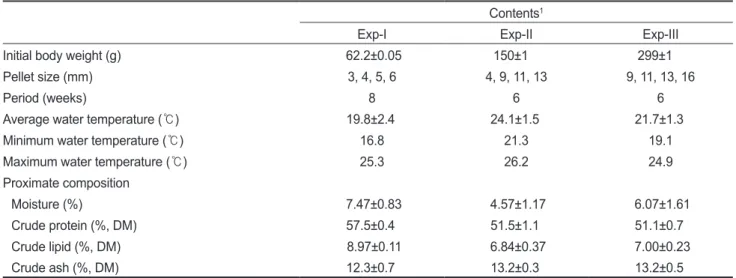
에사용된사료의크기와일 반성분분석결과는Table 1
에나타내었다.
어체측정
사양실험종료후증체율
,
일간성장률,
생존율을조사하기위 하여24
시간절식시킨후실험어의무게와마리수를측정하였 다.
어체측정후,
사료섭취량을조사하여사료전환효율과단백 질이용효율을계산하였다.
일반성분분석
실험사료와분의수분과조회분함량은
AOAC (2000)
방법을Table 1. Experimental condition and proximate composition of the experimental diets for olive flounder Paralichthy olivaceus (% of DM basis)
Contents1
Exp-I Exp-II Exp-III
Initial body weight (g) 62.2±0.05 150±1 299±1
Pellet size (mm) 3, 4, 5, 6 4, 9, 11, 13 9, 11, 13, 16
Period (weeks) 8 6 6
Average water temperature (℃) 19.8±2.4 24.1±1.5 21.7±1.3
Minimum water temperature (℃) 16.8 21.3 19.1
Maximum water temperature (℃) 25.3 26.2 24.9
Proximate composition
Moisture (%) 7.47±0.83 4.57±1.17 6.07±1.61
Crude protein (%, DM) 57.5±0.4 51.5±1.1 51.1±0.7
Crude lipid (%, DM) 8.97±0.11 6.84±0.37 7.00±0.23
Crude ash (%, DM) 12.3±0.7 13.2±0.3 13.2±0.5
1Three experiments were conducted at the juvenile (Exp-I), growing (Exp-II) and sub-adult (Exp-III) stage of olive flounder.
토대로상압가열건조법
(125℃, 3 h)
과직접회화법(550℃, 4 h)
으로분석되었다.
조단백질은자동조단백질분석기(Kejtec sys- tem 2300, Sweden)
를이용하여분석되었다.
조지방은Folch et al. (1957)
의방법을기반으로하여분석되었다.
외관상 소화율 측정
사료크기에따른소화율측정을위해평균무게
200 g
내외의넙치를이용하여외관상소화율을조사하였다
.
소화율측정실 험에사용된넙치는1
주동안400 L
소화율실험수조(Guelph
system)
에서실험사료로순치되었다.
사육수는 모래여과해수로카트리지필터를이용하여한번더여과한후사용되었다
.
실 험어는각사료실험구당50
마리씩배치되었다.
사료는분수집16
시간전에만복공급되었다.
사료공급30
분후,
분수집용실 험수조에남아있는사료찌꺼기및이물질을완전히제거하기 위해환수를하였다.
환수후,
각실험수조마다분수집병을설 치하였다.
익일오전에분수집을위해여과지를이용하여해 수를제거하고남아있는분을수집하였다.
수집된분은-40℃
저온냉동고에보관되었다
.
수집된분은동결건조되어분석에 사용되었다.
실험사료와분의chromium oxide (Cr
2O
3)
함량은Divakaran et al. (2002)
의방법으로분석되었다.
실험사료에대 한외관상소화율은아래의식으로계산되었다.
Apparent digestibility coefficient of dry matter
=100-100×(% Cr
2O
3in diet/% Cr
2O
3in feces) Apparent digestibility coefficient of nutrien
=100-100×(% Cr
2O
3in diet/% Cr
2O
3in feces)
×(% nutrient in feces/% nutrient in diet)
통계처리
완전확률계획법
(Completely randomized design)
으로 세가 지실험의실험구가배치되었다. SPSS (Version 12.0)
프로그램을이용하여
One-way ANOVA
로성장결과가통계분석되었다
.
결과값(mean±SD)
의유의차는Duncan’s multiple test (P≤0.05)
로비교분석되었다.
백분율값은arcsine
변형값으로 계산되어통계분석에이용되었다.
결 과
실험
1
에대한성장결과는Table 2
에나타내었다.
사료전환효 율과생존율은사료크기에유의적인영향을받지않았다.
증체 율과일간성장률은5 mm, 6 mm
실험구가3 mm
실험구보다 유의적으로높았다.
단백질전환효율은5 mm
실험구가3 mm
실험구보다유의적으로높았다.
사료섭취량은사료크기가커 짐에따라유의적으로증가하는경향을보였다.
실험
2
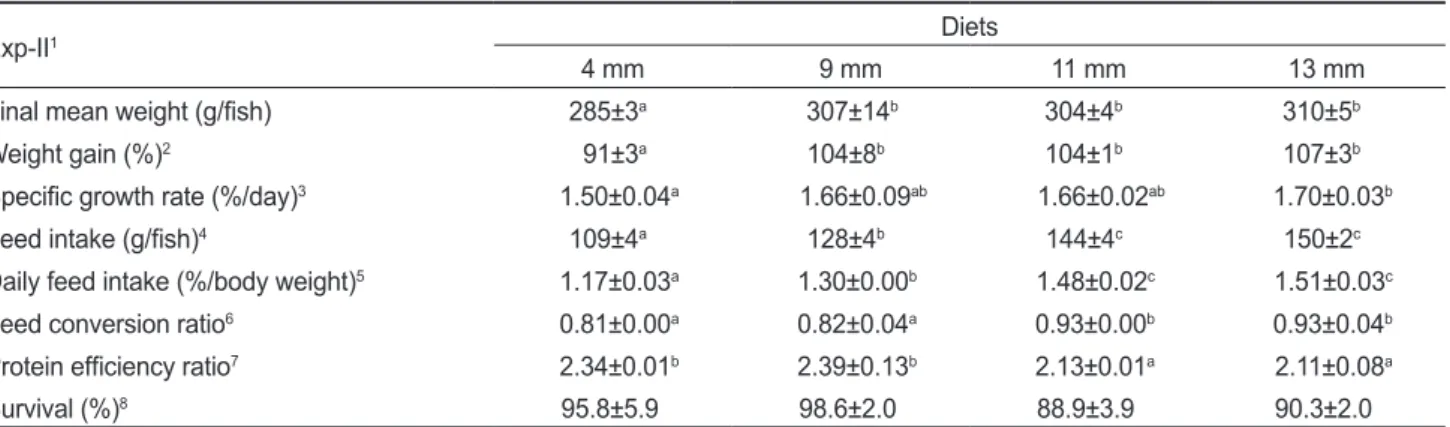
에대한성장결과는Table 3
에나타내었다.
생존율은모 든실험구에서유의적인차이를보이지않았다.
최종무게와증체율은가장크기가작은
4 mm
실험구가크기가큰타실험구들에비해유의적으로낮았다
.
일간성장률은4 mm
실험구에비해
13 mm
실험구가유의적으로높았다.
사료섭취량과일간사료섭취율은
4 mm
실험구가유의적으로가장낮았다.
사료의크 기가증가할수록사료섭취량도유의적으로증가하였다. 4 mm, 9 mm
실험구가11 mm, 13 mm
실험구에비해사료효율이유 의적으로높았다.
실험
2
의실험사료를이용한소화율실험결과는Table 4
에나 타내었다.
건물소화율은9 mm
실험구가가장낮았고, 4 mm
실 험구가가장높은값을나타내었다.
단백질소화율은사료의크Table 2. Growth performance of juvenile olive flounder Paralichthys olivaceus fed the commercial diets in different pellet sizes for 8 weeks in Exp-I
Exp-I1 Diets
3 mm 4 mm 5 mm 6 mm
Final mean weight (g/fish) 139±9a 149±9ab 160±7b 154±3b
Weight gain (%)2 123±14a 140±14ab 157±12b 147±5b
Specific growth rate (%/day)3 1.38±0.11a 1.51±0.11ab 1.62±0.08b 1.56±0.03b
Feed intake (g/fish)4 79.8±2.3a 86.1±3.3ab 90.3±5.3bc 93.8±3.2c
Daily feed intake (%/body weight)5 1.37±0.02a 1.40±0.01a 1.40±0.05a 1.49±0.05b
Feed conversion ratio6 1.05±0.09 0.99±0.07 0.93±0.04 1.02±0.05
Protein efficiency ratio7 1.66±0.14a 1.75±0.12ab 1.90±0.08b 1.73±0.08ab
Survival (%)8 94.4±6.9 96.7±3.3 97.8±1.9 98.9±1.9
1Experiment 1 was conducted at juvenile stage of olive flounder. 2Weight gain (%)=(final weight-initial weight)×100/initial weight. 3Specific growth rate (%/day)=[(loge final weight-loge initial weight)/days]×100. 4Feed intake (g/fish)=dry feed consumed (g)/fish. 5Daily feed intake (%/body weight)=100×feed intake×[(initial body weight+final body weight)/2]/days. 6Feed conversion ratio=feed intake/wet weight gain.
7Protein efficiency ratio=wet weight gain/total protein given. 8Survival=Number of fish at end of experiment/number of fish stocked×100.
Values are means from triplicate groups of fish where the values in each row with different superscripts are significantly different (P<0.05).
기가증가할수록단백질소화율값이감소하였다
.
에너지소화 율은사료크기가가장작은4 mm
실험구가타실험구에비해 유의적으로높았다.
지질소화율은각실험구간에유의적인차 이가없었다.
실험
3
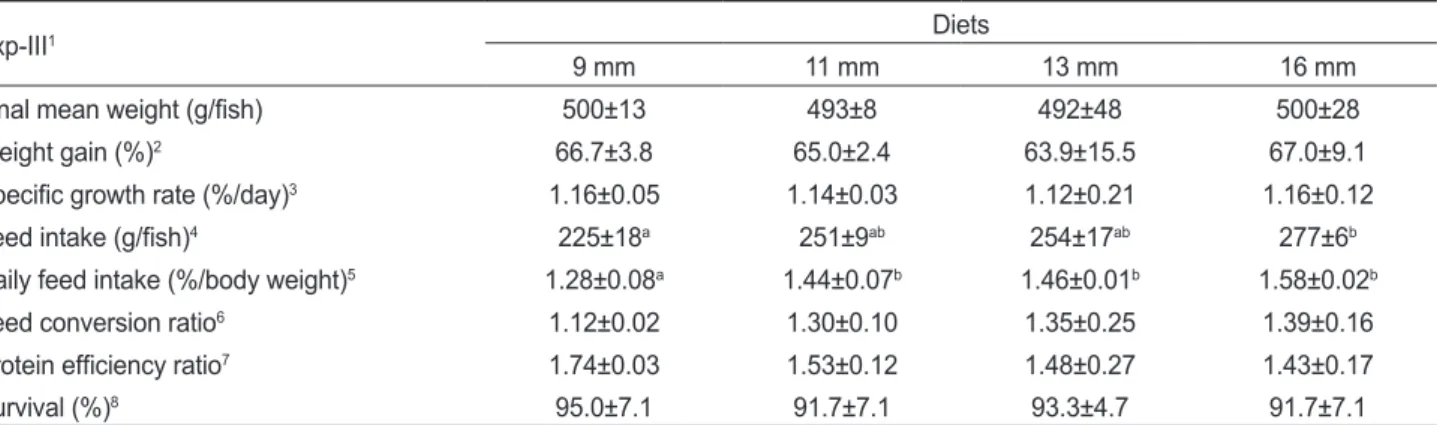
에대한성장결과는Table 5
에나타내었다.
실험어의 최종무게,
증체율,
일간성장률,
사료전환효율,
단백질전환효율,
생존율에서각사료크기에따른유의적인차이를보이지않았 다.
사료의크기가커질수록사료섭취량이증가하는경향을보였다
. 16 mm
실험구가9 mm
실험구에비해사료섭취량과일일사료섭취율이유의적으로높았다
.
고 찰
Heo (2011)
는치어기,
육성기,
미성어기넙치를대상으로한 연구에서사료의크기가증가함에따라성장률과사료효율이 증가된다고보고하였다.
북극곤들매기(Salvelinus alpinus)
와 대서양넙치(Hippoglossus hippoglossus)
를대상으로한연구 에서도실험사료의크기가증가될수록성장률과사료효율이증가하였다
(Tabachek, 1988; Helland et al., 1997).
반면,
조피볼 락(Sebastes schlegelii)
과무지개송어(Oncorhynchus mykiss)
를대상으로한연구에서는사료의크기가증가함에따라성장 률이감소하였다(Bailey and Alanärä, 2006; Oh et al., 2013).
타어종과넙치는다르게비교적큰사료를쉽게섭취할수있기 때문에사료크기가증가함에따라어류의성장이증가하는경 향이있다고보고되었다
(Kim et al., 2015b).
본연구결과에서 도실험1
과실험2
에서사료의크기가증가될수록넙치의성장 률이증가되는것으로나타났다.
수온은어류의먹이섭취량에직접적인영향을주며
,
적정수 온은어류의활동성을증가시켜대사율과사료섭취율을증가시킨다
(NRC, 2011).
반대로낮은수온에서는어류의활동성이줄어들게된다
.
넙치의최적사육수온은21-24℃
이다(Son et al., 2006).
저수온기(9-16℃)
에미성어기넙치를이용한이전연구 에서는사료의크기가증가할수록성장률이유의적으로증가하 는경향을보였다(Heo, 2011).
작은사료는큰사료에비해한 회섭취량이상대적으로적다.
저수온기에넙치는활동성이줄Table 3. Growth performance of growing olive flounder Paralichthys olivaceus fed the experimental diets in different sizes for 6weeks in Exp-II
Exp-II1 Diets
4 mm 9 mm 11 mm 13 mm
Final mean weight (g/fish) 285±3a 307±14b 304±4b 310±5b
Weight gain (%)2 91±3a 104±8b 104±1b 107±3b
Specific growth rate (%/day)3 1.50±0.04a 1.66±0.09ab 1.66±0.02ab 1.70±0.03b
Feed intake (g/fish)4 109±4a 128±4b 144±4c 150±2c
Daily feed intake (%/body weight)5 1.17±0.03a 1.30±0.00b 1.48±0.02c 1.51±0.03c
Feed conversion ratio6 0.81±0.00a 0.82±0.04a 0.93±0.00b 0.93±0.04b
Protein efficiency ratio7 2.34±0.01b 2.39±0.13b 2.13±0.01a 2.11±0.08a
Survival (%)8 95.8±5.9 98.6±2.0 88.9±3.9 90.3±2.0
1Experiment 2 was conducted wat growing stage of olive flounder. 2Weight gain (%)=(final weight-initial weight)×100/initial weight.
3Specific growth rate (%/day)=[(loge final weight-loge initial weight)/days]×100. 4Feed intake (g/fish)=dry feed consumed (g)/fish. 5Daily feed intake (%/body weight)=100×feed intake×[(initial body weight+final body weight)/2]/days. 6Feed conversion ratio=feed intake/wet weight gain. 7Protein efficiency ratio=wet weight gain/total protein given. 8Survival=Number of fish at end of experiment/number of fish stocked×100. Values are means from triplicate groups of fish where the values in each row with different superscripts are significantly dif- ferent (P<0.05).
Table 4. Apparent digestibility coefficients of dry matter, protein, lipid and energy of the experimental diets in different pellet sizes in grow- ing olive flounder Paralichthys olivaceus1
Experimental diets
4 mm 9 mm 11 mm 13 mm
Dry matter (%) 78.5±2.2c 62.9±0.6a 68.1±0.7b 68.6±0.9b
Crude protein (%) 94.2±1.3c 89.7±0.4b 88.9±.5ab 87.3±0.4a
Crude lipid (%) 99.2±0.1 98.7±0.3 98.8±0.2 98.9±0.0
Energy (%) 91.8±0.0b 89.7±.4a 89.3±1.1a 88.4±0.0a
1Values are means from triplicate groups of fish where the values in each row with different superscripts are significantly different (P<0.05).
어들어작은크기의사료를만복섭취하기는힘들다
.
작은크기 의사료는큰크기의사료에비해사료섭취량이상대적으로적 기때문에어류의성장률을더디게할수있다.
실험1
은최저수 온이16.8℃
로나타났으며,
평균수온은19.8℃
로나타났다.
성 장의차이가분명한이유는수온에영향을받았기때문으로판 단된다.
실험2
와실험3
은적정수온(24.1℃, 21.7℃)
에서수행 되었다.
실험2
에서크기가매우작은4 mm
실험구를제외한다 면9 mm-13 mm
사료크기에서는유의적인차이가없었다.
실 험3
은저수온기에이루어진Heo (2011)
의연구(423-530g)
와유사한크기
(299-500g)
로진행되었으나저수온기연구와는다르게성장률에서유의적인차이가나타나지않았다
.
적수온기 에서의넙치는비교적크기가작은입자의사료라도여러번섭 취함으로써성장에필요한에너지를충분히충족시킬수있음 을보여준다.
따라서사료크기에따른넙치의성장률에관한향 후의연구는수온과밀접하게연관시켜수행될필요가있을것 으로사료된다.
실험
1, 2, 3
에서사료섭취량은사료의크기가증가함에따라증가하였다
.
넙치는수조바닥에머물러있다가떠올라사료를 먹고다시바닥으로내려간다(Kim et al., 2015b).
작은크기의 사료공급은넙치가만복까지도달하기어렵고,
섭취시간과활 동량을증가시켜(Heo, 2011; Kim et al., 2015b)
에너지소비에 따른성장저하가일어날수있다.
사료크기가사료섭취량에미 치는영향은실험2
에서분명하게나타났다.
수협사료에서제 시한‘
권장급여율표’
에따르면실험2
의초기무게인150 g
넙치 의권장사료크기는7.3-7.8 mm
이다.
최종무게인300 g
넙치 의경우8.8-9.4 mm
이다.
실험2
에서의4 mm
실험구는권장사 료크기보다매우작은크기이다. Heo (2011)
는작은크기의사 료가큰크기의사료보다사료섭취시간이길게나타났다고보고하였다
. Grant (1993)
의연구에서는사료공급시간의증가가경쟁심이강한어류개체들
(competitive individuals)
에의한사 료의독점을야기시킨다고보고하였다.
몇몇특정개체의사료 에대한독점은다수의경쟁에뒤쳐지는개체를발생시켜전체 적인사료섭취량의감소가일어나는것으로판단된다.
소화율은 사료효율과 밀접한 관계가 있다
.
소화율이 낮은 경우사료효율도낮게나타난다(Kim et al., 2013; Kim et al.,
2018).
사료의크기는사료효율에영향을미친다고보고되었다
(Oh et al, 2013).
실험2
에서사료효율은4 mm
실험구가11
mm, 13 mm
실험구에비해유의적으로높았다.
이는사료의크기가증가할수록소화효소와의접촉및작용면적이감소하 여소화율이 저하되었기때문인것으로사료된다
(Sedanza et al., 2017).
본연구결과
,
저수온에서60-150 g
넙치는5 mm
크기의사료 가적절하다고사료된다.
적수온에서150-500 g
넙치는9 mm
크기의사료가적절하다고사료된다.
저수온에서는적수온에 서의적정사료크기보다비교적큰사료를공급하는것이넙치 의성장과사료효율을높일수있을것으로기대된다.
넙치에서 의보다정확한적정사료크기를알기위해서는다양한수온조 건하에서추가적인연구가필요할것이다.
본연구결과는향후 의넙치사육기술개발과배합사료공급체계를확립하는데있어 서매우중요한기초자료가될것으로사료된다.
사 사
이논문은국립수산과학원수산시험연구사업
(R2015016)
및 해양수산부의지원으로수행된연구이며연구비지원에감사드립니다
.
또한이논문은2018
제주대학교학술진흥연구비로수행되었습니다
.
Table 5. Growth performance of sub-adult olive flounder Paralichthys olivaceus fed the experimental diets in different pellet sizes for 6weeks in Exp-III
Exp-III1 Diets
9 mm 11 mm 13 mm 16 mm
Final mean weight (g/fish) 500±13 493±8 492±48 500±28
Weight gain (%)2 66.7±3.8 65.0±2.4 63.9±15.5 67.0±9.1
Specific growth rate (%/day)3 1.16±0.05 1.14±0.03 1.12±0.21 1.16±0.12
Feed intake (g/fish)4 225±18a 251±9ab 254±17ab 277±6b
Daily feed intake (%/body weight)5 1.28±0.08a 1.44±0.07b 1.46±0.01b 1.58±0.02b
Feed conversion ratio6 1.12±0.02 1.30±0.10 1.35±0.25 1.39±0.16
Protein efficiency ratio7 1.74±0.03 1.53±0.12 1.48±0.27 1.43±0.17
Survival (%)8 95.0±7.1 91.7±7.1 93.3±4.7 91.7±7.1
1Experiment 3 was conducted at sub-adult stage of olive flounder. 2Weight gain (%)=(final weight-initial weight)×100/initial weight. 3Specific growth rate (%/day)=[(loge final weight-loge initial weight)/days] ×100. 4Feed intake (g/fish)=dry feed consumed (g)/fish. 5Daily feed intake (%/body weight)=100×feed intake×[(initial body weight+final body weight)/2]/days. 6Feed conversion ratio=feed intake/wet weight gain.
7Protein efficiency ratio=wet weight gain/total protein given. 8Survival=Number of fish at end of experiment/number of fish stocked×100.
Values are means from triplicate groups of fish where the values in each row with different superscripts are significantly different (P<0.05).
References
AOAC (Association of Official Analytical chemists). 2000. Of- ficial Methods of Analysis. .Association of Official Analyti- cal Chemists, Arlington, VA, U.S.A.
Bailey J and Alanärä A. 2006. Effect of feed portion size on growth of rainbow trout, Oncorhynchus mykiss (Walbaum), Reared at different temperatures. Aquaculture 253, 728-730.
https://doi.org/10.1016/j.aquaculture.2005.09.026.
Dabrowski K and Bardega R. 1984. Mouth size and predicted food size preferences of larvae of three cyprinid fish spe- cies. Aquaculture 40, 41-46. https://doi.org/10.1016/0044- 8486(84)90214-X.
Divakaran S, Obaldo LG and Forster IP. 2002. Note on the meth- ods for determination of chromic oxide in shrimp fees. Agric Food Chem 50, 464-467. https://doi.org/10.1021/jf011112s.
Folch J, Lees M and Sloane-Stanley GH. 1957. A simple method for the isolation and purification of total lipids from animal tissues. J biol Chem 226, 497-509.
Grant JWA. 1993. Whether or not to defend? The influence of resource distribution. Mar Behav Physiol 23, 137-153.
https://doi.org/10.1080/10236249309378862.
Hasan MR and Macintosh DJ. 1992. Optimum food particle size in relation to body size of common carp. Aquac Res 23, 315- 325. https://doi.org/10.1111/j.1365-2109.1992.tb00774.x.
Helland SJ, Grisdale-Helland B and Berge GM. 1997. Feed intake and growth of Atlantic halibut (Hippoglossus hip-
poglossus L.) fed combinations of pellet sizes. Aquaculture
156, 1-8. https://doi.org/10.1016/S0044-8486(97)00073-2.Heo SB. 2011. Effects of extruded pellet size, feeding frequency and water addition on growth and body composition of ol- ive flounder Paralichthys olivaceus reared in different water temperature. PhD. Thesis, Pukyong National University, Busan, Korea.
Hossain MAR, Haylor GS and Beveridge MCM. 2000. The influence of food particle size on gastric emptying and growth rates of fingerling African catfish, Clarias gariepi-
nus Burchell, 1822. Aquac Nutr 6, 73-76. https://doi.org/10.
1046/j.1365-2095.2000.00131.x.
Jobling M. 1987. Influences of food particle size and dietary en- ergy content on patterns of gastric evacuation in fish: test of a physiological model of gastric emptying. J Fish Biol 30, 299-314. https://doi.org/10.1111/j.1095-8649.1987.
tb05754.x.
Kim KW, Kim KD, Lee BJ, Lee JH, Han HS, Koo JW, Choi YH and Bae SC. 2013. Dietary Fermented Soybean Meal as a Replacement for Fish Meal in Juvenile Olive Flounder
Paralichthys olivaceus. Korean J Fish Aquat Sci 46, 769-
776. https://doi.org/10.5657/KFAS.2013.0769.Kim KW, Hwang NY, Son MH, Kim KD, Lee JH, Yi L, Yun YH, Park GH, Kim SS, Lee KJ and Bai SC. 2011. Optimum feeding rates in juvenile olive flounder Paralichthys oliva-
ceus fed practical expanded pellet at low and high water
temperatures. Korean J Fish Aquat Sci 44, 345-351. https://doi.org/10.5657/KFAS.2011.0345.
Kim SS, Kim KW, Kim KD, Lee BJ, Han HS and Lee KJ.
2015a. Optimum feeding rates for growing and sub-adult olive flounder Paralichthys olivaceus fed practical extruded pellets at high water temperature. Korean J Fish Aquat Sci, 48, 681-687. https://doi.org/10.5657/KFAS.2015.0681.
Kim SS, Lee JH, Kim KW, Kim KD, Lee BJ and Lee KJ. 2015b.
Effects of feed particle size, stocking density, and dissolved oxygen concentration on the growth of olive flounder Para-
lichthys olivaceus. Korean J Fish Aquat Sci 48, 314-321.
https://doi.org/10.5657/KFAS.2015.0314.
Kim YJ, Shin JH, Kwon HW, Lee SY, Kim JM, Kim MG, Kim JD and Lee KJ. 2018. Evaluation of a Hydrolyzed Pig Bris- tle Meal as a Partial Fish Meal Replacer in Diets for Juvenile Olive Flounder Paralichthys olivaceus. Korean J Fish Aquat Sci 51, 148-156. https://doi.org/10.5657/KFAS.2018.0148.
KOSIS (Korean Statistical Information Service). 2017a. Survey on the Status of Fish Culture. Retrieved from http://kosis.
kr/publication/publicationThema.do?pubcode=JL on Jan 3, 2019.
KOSIS (Korean Statistical Information Service). 2017b. Ex- penditure per aquaculture. Retrieved from http://kosis.
kr/statHtml/statHtml.do?orgId=307&tblId=TX_30702_
A018&conn_path=I2 on Jan 3, 2019.
NRC (National Research Council). 2011. Nutrient requirements of fish and shrimp. The National Academy Press, Washing- ton DC, U.S.A.
Oh DH, Song JW, Kim MG, Kim KW, Han HS, and Lee KJ 2013. Effect of food particle size, stocking density and feed- ing frequency on the growth performance of juvenile Ko- rean rockfish Sebastes schlegelii. Korean J Fish Aquat Sci 46, 407-412. https://doi.org/10.5657/KFAS.2013.0407.
Sedanza MGC, Tumbokon BLM and Serrano Jr AE. 2017.
Reduction of particle size of Rhizoclonium riparium pro- tein concentrate improves digestibility, growth, and feed efficiency of Penaeus vannamei post larvae. Isr J Aquac IJA_69.2017.1349, 1-6.
Tabacheck JAL. 1988. The effect of feed particle size on the growth and feed efficiency of Arctic charr [Salveli-
nus alpinus (L.)]. Aquaculture 71, 319-330. https://doi.
org/10.1016/0044-8486(88)90201-3.
Webster CD and Lim C. 2002. Nutrient requirements and feed- ing of finfish for aquaculture. CABI Publishing, Walling- ford, U.K.