217 Corresponding author: [email protected]✽
배합사료 공급율 및 공급횟수가 겨울철에 사육된 육성기 넙치의 성장 및 체조성에
미치는 영향
김경덕✽・남명모1・김강웅・김동규・손맹현
국립수산과학원 사료연구센터, 1동해수산연구소
Effects of Feeding Rate and Frequency on the Winter Growth and Body Composition of
Olive Flounder, Paralichthys olivaceus
Kyoung-Duck Kim*, Myung-Mo Nam1, Kang-Woong Kim, Dong Gyu Kim and Maeng Hyun Son
Aquafeed Research Center, National Fisheries Research &
Development Institute, Pohang 791-923, Korea
1East Sea Mariculture Research Center, National Fisheries Research &
Development Institute, Uljin 767-863, Korea
Two 15-week feeding trials were conducted to investigate how the rate and frequency of feeding affected the winter growth of olive flounder (13℃). In the first experiment, triplicate groups of fish (initial mean weight 117±6.0 g) were fed extruded pellets twice a day at feeding rates of 0.1, 0.25, 0.4, 0.55, and 0.57%
(satiation) body weight per day (BW/d). The weight gain, specific growth rate, and feed efficiency increased significantly (P<0.05) with the feeding rates from 0.1 to 0.55% BW/d, but no significant differences in these parameters were found for fish fed diets of 0.55% BW/d and satiation. The moisture and ash contents of whole body of fish tended to decrease as the feeding rate increased, but the opposite trend was found for crude lipid content. In the second experiment, triplicate groups of fish (initial mean weight 117±6.3 g) were fed extruded pellets to apparent satiation at the three different feeding frequencies: one meal 2 days, one meal a day and two meals a day. The weight gain and specific growth rate of fish fed one meal 2 days were significantly (P<0.05) lower than those of fish fed one or two meals a day, whereas no significant differences in the weight gain and specific growth rate were found between fish fed one and those fed two meals a day. Feed efficiency and condition factor were not significantly affected by feeding frequency. Based on these results, a feeding rate of 0.3% BW/d is recommended as maintenance feeding level, and the optimum feeding frequency is one meal a day with satiation feeding for the growth of olive flounder (117-147 g) during winter (13℃).
Key words: Feeding rate, Feeding frequency, Olive flounder, Growth, Winter
서 론
사료는 어류의 체내 대사 및 성장에 영향을 미치는 가장 주요한 요인 중에 하나이며, 사료비는 어류 양식에 소요되는 비용 중 다른 요인들에 비해 상대적으로 높은 비율을 차지하 므로 양식장 환경 및 질병관리와 함께 가장 중요하게 고려되 어야 할 요인이다. 양식에 있어 환경이나 질병은 양식기간 중에 인위적으로 쉽게 조절되지 않는 요인이지만, 사료 공급 은 양식현장의 양어가들에 의해 조절됨으로 양식 성공의 중요 한 변수이기도 하다.
양식이 성립되기 위해서는 우선 대상 어종에 적합한 질 좋은 배합사료를 개발하는 것이 일차적으로 중요하지만, 배합 사료가 있더라도 이를 효율적으로 사용하지 않으면 양식 생산
성을 높일 수 없을 것이다. 즉, 어류의 성장단계 및 사육조건에 적합하게 적정량의 사료를 적절한 시간에 공급하여야 최대의 성장과 사료효율을 유도할 수가 있게 된다. 만약 양식 대상종 에 적합한 사료공급 체계가 확립되어 있지 않을 경우에는 사료가 부족 또는 과잉으로 공급되기 쉽다. 사료의 과잉 공급 은 사료의 유실과 어체내 사료의 비효율적인 이용으로 사료 허실을 초래하여 경제적인 손실과 수질 오염원을 증가시킬 수 있다. 이와 반대로 사료를 부족하게 공급하게 되면 어류의 최대 성장에 필요한 영양소 요구를 충족시키지 못하여 성장 저하를 초래할 수도 있다 (Tsevis et al., 1992; Azzaydi et al., 2000). 그러므로 어류의 최대 성장과 사료효율을 얻을 수 있는 적정 사료공급 횟수와 공급량을 결정하는 것은 양식생산성의 향상과 수질오염 감소를 위해 매우 중요하다 (Ng et al., 2000;
Mihelakakis et al., 2002).
넙치는 수온 20-25℃의 범위에서 성장이 잘 되는 어종으로 수온이 상승하는 여름철에는 사료 섭취율이 증가하게 되며 성장 속도도 상대적으로 증가한다 (Iwata et al., 1994). 일반적 으로 사료 공급횟수가 증가하게 되면 어류의 사료 섭취량은 증가하게 되지만, 일정 수준 이상의 잦은 사료 공급은 사료가 장에 머무르는 시간을 짧아지게 하여 사료의 소화율을 감소시 킬 수도 있으며, 사료 공급율도 일정수준 이상이 되면 어류의 사료이용율을 감소시킬 수 있다 (Liu and Liao, 1999). 그리고 수온 역시 어류의 성장에 영향을 미치는 중요한 환경인자 중의 하나로서 (Brett et al., 1979), 수온이 낮아지면 어류 체내 의 소화효소 활성 및 대사율이 감소하게 되어 (Fauconneau et al., 1983) 먹이 섭취량이 적어지고, 수온이 상승하게 되면 활동성 및 대사율 증가로 사료 섭취율도 증가하기 때문에 수온에 따른 적정 사료 공급율 및 공급횟수를 설정하는 것이 매우 중요하다. 넙치 사육을 위한 사료공급체계에 관한 연구 는 주로 넙치의 성장에 적합한 여름철에 대부분 수행되었으며 (Lee et al., 2000; Kim et al., 2007a; Kim et al., 2009a), 저수온기 의 경우 치어 및 미성어에 관한 연구가 일부 수행되었으나 (Kim et al., 2007b; Kim et al., 2009b), 육성기 넙치의 사료공급 체계에 관한 연구는 제한적인 실정이다. 그래서 본 연구에서 는 넙치 사육에 적합한 배합사료 공급체계를 설정하는데 필요 한 자료를 제공하기 위하여 겨울철에 배합사료 공급율 및 공급횟수가 육성기 넙치의 성장 및 체조성에 미치는 영향에 대하여 조사하였다.
Table 1. Nutrient contents (dry matter basis) of the experimental diet
Content
Moisture (%) 5.6
Crude protein (%) 54.8
Crude lipid (%) 12.1
Ash (%) 12.2
Gross energy (cal/g) 4708
재료 및 방법
실험어 및 사육관리
실험어는 2주간 예비 사육하다가 외형적으로 건강한 평균 체중 117±5.9 g의 실험어를 선별하여 총 21개 수조 (400 L)에 20마리씩 사료 공급율 및 공급횟수별로 3반복 수용하였다.
실험사료는 시판용 넙치 배합사료를 사용하였으며, 영양성분 분석결과를 Table 1에 나타내었다. 사료 공급율 실험은 사료 공급량을 만복, 어체중의 0.55%, 0.40%, 0.25% 및 0.10%로 설정하여 9주간 사육 실험하였으며, 사육실험 4주 후 각 수조 에 생존한 실험어의 전체 체중을 측정하였다. 만복실험구는 1일 2회 (09:00, 17:00) 실험어가 사료를 먹지 않을 때까지 손으로 공급하였으며, 섭취되지 않은 사료는 사료공급 종료 5분 후, 수거하여 사료섭취량에서 제외시켰다. 제한 공급구들 의 일일 사료공급량은 최초 4주까지는 예비 사육기간의 사료
효율을 토대로 일일 증체율을 추정하여 준비한 후 1일 2회로 나누어 공급하였으며, 사육실험 4주 이후부터의 일일 사료 공급량은 중간 측정 시까지의 사료 섭취량과 사료효율을 추정 하여 일일 증체율을 계산하고 그에 따라 준비하였다. 사료 공급횟수 실험은 2일 1회 (09:00), 1일 1회 (09:00) 및 1일 2회 (09:00, 17:00)로 사료 공급횟수를 설정하여, 매회 실험어가 먹을 때까지 만복 공급하였다. 자연 해수를 각 실험수조에 5 L/min로 흘려주었으며, 사육기간 동안의 수온은 13.2±1.6℃
(평균±표준편차)였다.
어체측정 및 성분분석
어체 측정은 측정 전일 절식시킨 후, 각 수조에 수용된 실험 어 전체의 무게를 측정하였다. 어체 비만도 측정을 위하여 실험 종료시 각 실험수조의 모든 실험어를 시료로 취하여 냉동보관(-75℃)하였으며, 각 수조별 5마리의 실험어를 분쇄 혼합하여 분석용 시료로 사용하였다. 실험사료와 실험어의 수분은 105℃에서 6시간 건조 후 측정하였으며, 조단백질 (N×6.25)은 Auto Kjeldahl System (Gerhardt VAP50OT/TT125, KG, Germany)을 사용하여 분석하였다. 조지방은 조지방추출 기 (Velp SER 148, Usmate, Italy)를 사용하여 ether로 추출한 후 측정하였으며, 조회분은 550℃에서 4시간 동안 회화 후 측정하였다. 사료의 총에너지량은 열량분석기 (Parr-6200, Moline, IL, USA)를 사용하여 분석하였다.
통계처리
결과의 통계처리는 SPSS 프로그램을 사용하여 One-way ANOVA-test를 실시하여 Duncan’s multiple range test (Duncan, 1955)로 평균간의 유의성을 검정하였다.
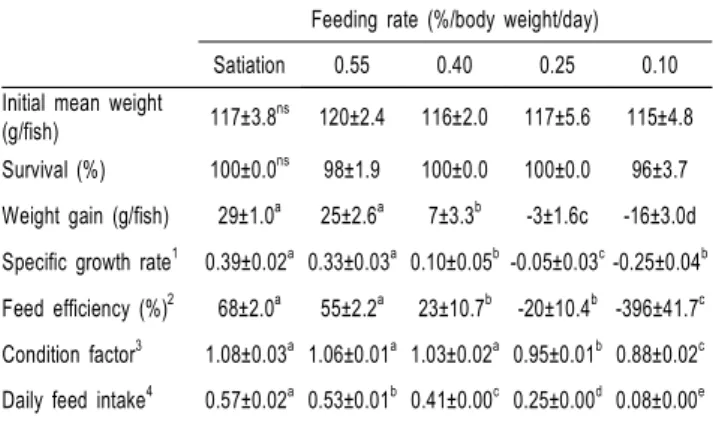
Table 2. Growth performance of grower flounder fed the extruded pellet with the different feeing rate for 9 weeks during the winter season
Feeding rate (%/body weight/day)
Satiation 0.55 0.40 0.25 0.10
Initial mean weight
(g/fish) 117±3.8ns 120±2.4 116±2.0 117±5.6 115±4.8 Survival (%) 100±0.0ns 98±1.9 100±0.0 100±0.0 96±3.7 Weight gain (g/fish) 29±1.0a 25±2.6a 7±3.3b -3±1.6c -16±3.0d Specific growth rate1 0.39±0.02a 0.33±0.03a 0.10±0.05b -0.05±0.03c-0.25±0.04b Feed efficiency (%)2 68±2.0a 55±2.2a 23±10.7b -20±10.4b -396±41.7c Condition factor3 1.08±0.03a 1.06±0.01a 1.03±0.02a 0.95±0.01b 0.88±0.02c Daily feed intake4 0.57±0.02a 0.53±0.01b 0.41±0.00c 0.25±0.00d 0.08±0.00e Values (mean±SE of three replications) in each row with a different superscript are significantly different (P<0.05).
1 (Ln final weight - Ln initial weight) × 100/days.
2 Fish wet weight gain × 100/feed intake (dry matter).
3 Fish weight × 100/total body length3.
4 Feed intake (dry matter) × 100/[(initial fish weight + final fish weight + dead fish weight) × days fed/2].
ns Not significant (P>0.05).
Fig. 1. Specific growth rate (SGR, %/day) of grower flounder fed a extruded pellet at the different feeding rate for 9 weeks during the winter season (13℃). Y=aX+b, where Y=specific growth rate, X=feeding rate, and a and b are constants.
Table 3. Growth performance of grower flounder fed the extruded pellet with the different feeing frequency for 9 weeks during the winter season
Feeding frequency One meal in
two day
One meal a day
Two meal a day Initial mean weight (g/fish) 117±5.2ns 117±3.3 117±3.8
Survival (%) 100±0.0ns 98±1.9 100±0.0
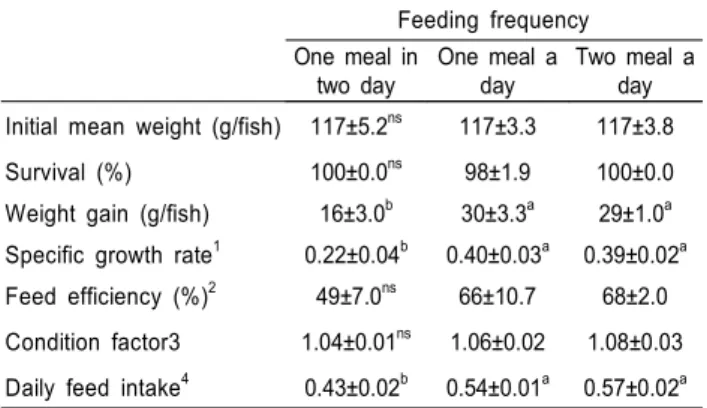
Weight gain (g/fish) 16±3.0b 30±3.3a 29±1.0a Specific growth rate1 0.22±0.04b 0.40±0.03a 0.39±0.02a Feed efficiency (%)2 49±7.0ns 66±10.7 68±2.0 Condition factor3 1.04±0.01ns 1.06±0.02 1.08±0.03 Daily feed intake4 0.43±0.02b 0.54±0.01a 0.57±0.02a Values (mean±SE of three replications) in each row with a different superscript are significantly different (P<0.05).
1 (Ln final weight - Ln initial weight) × 100/days.
2 Fish wet weight gain × 100/feed intake (dry matter).
3 Fish weight × 100/total body length3.
4 Feed intake (dry matter) × 100/[(initial fish weight + final fish weight + dead fish weight) × days fed/2].
ns Not significant (P>0.05).
결 과
겨울철에 육성기 넙치를 사료 공급율을 달리하여 9주간 사육한 실험결과를 Table 2에 나타내었다. 생존율은 모든 실험 구에서 96% 이상이었다. 증체량, 일간성장율 및 사료효율은 사료 공급율이 증가함에 따라서 증가하였으나 (Fig. 1), 만복공 급구와 어체중의 0.55%를 공급한 실험구간에는 유의한 차이 가 없었다.
어체 비만도 역시 사료 공급율이 증가함에 따라서 증가하였 지만, 만복공급구, 0.55% 및 0.4% 공급구간에는 유의한 차이 가 없었다.
사료공급 횟수를 달리하여 사육 실험한 결과 (Table 3), 생존 율은 모든 실험구에서 98-100%였다. 증체량 및 일간성장율은 2일 1회 공급구가 가장 낮았으며, 1일 1회 공급구와 1일 2회
공급구간에는 유의한 차이가 없었다. 사료효율 및 어체 비만 도는 실험구간에 유의한 차이가 없었다. 또한 각 실험구의 총에너지 섭취량은 증체량 (r=0.98) 및 어체 지질 함량 (r=0.82) 과 높은 상관관계를 보였다.
사료공급율 및 공급횟수를 달리하여 사육한 실험어 전어체 의 일반성분 분석 결과를 Table 4 및 5에 각각 나타내었다.
사료 공급율 실험의 경우, 전어체의 수분 및 조회분 함량은 사료 공급율이 증가함에 따라 감소하는 경향을 보였으나, 조 지질 함량은 이와 반대로 사료공급율이 증가함에 따라 증가하 였다. 조단백질 함량은 사료공급율에 유의한 영향을 받지 않 았다. 사료공급 횟수 실험의 경우, 전어체의 일반성분은 실험 구간에 유의한 차이가 없었다.
Table 4. Proximate composition of whole body of grower flounder fed the diet with the different feeing rate for 9 weeks during the winter season
Feeding rate (%/body weight/day)
Satiation 0.55 0.40 0.25 0.10
Moisture (%) 74.5±0.60bc 74.1±0.13c 75.2±0.79abc76.3±0.67ab 76.8±0.68a Crude protein (%) 16.9±0.38ns 17.2±0.15 17.3±0.13 16.3±0.26 16.7±0.41 Crude lipid (%) 3.4±0.57a 3.8±0.12a 3.3±0.31ab 2.0±0.49bc 1.2±0.28c Ash (%) 2.8±0.65b 3.0±0.32ab 3.4±0.26ab 3.8±0.19ab 4.0±0.15a Values (mean±SE of three replications) in each row with a different superscript are significantly different (P<0.05).
ns Not significant (P>0.05).
Table 5. Proximate composition of whole body of grower flounder fed the diet with the different feeing frequency for 9 weeks during the winter season
Feeding frequency One meal in two
day
One meal a day
Two meal a day Moisture (%) 75.0±0.53ns 75.8±0.14 75.2±0.79 Crude protein (%) 16.5±0.13ns 16.8±0.33 16.9±0.40 Crude lipid (%) 3.2±0.78ns 3.3±0.41 3.4±0.56
Ash (%) 3.4±0.32ns 1.1±0.02 2.8±0.62
Values are mean±SE of three replications.
ns Not significant (P>0.05).
고 찰
적정 사료공급량 및 공급횟수를 결정하는 것은 양식어의 성장 및 사료효율 향상뿐만 아니라 양식장 수질오염 감소를 위해서 주요한 사항이다. 이러한 관점에서 본 연구에서는 넙 치의 최적의 성장을 유도하며, 경제적이고 친환경적인 양식관 리 방안을 제시하기 위하여 육성기 넙치 배합사료의 적정 공급량 및 공급횟수에 대하여 조사하였다. 사료 공급율 및 공급횟수와 같은 사료공급 조건은 수온과 어체중의 변화에 따라 세분화되어야만 양식현장에서 활용이 가능할 것이다.
하지만 처음부터 모든 어체중과 수온을 대상으로 적정 사료
공급율을 찾아내기 위한 사육실험을 수행하는 것은 인력, 장 비 및 시설 등 여러면에서 불가능에 가까울 수 있다. 그래서 본 연구는 우선 적정 사료공급 조건의 전반적인 경향을 파악 하기 위해서 넙치의 어체 크기를 치어, 육성어 및 미성어로 구분하고, 수온도 저수온 및 고수온의 큰 범위로 나누어 수행 한 연구들의 세부 실험이다.
본 연구의 사료공급율 실험에서 만복 공급구 (0.57%)와 0.53% 사료공급구간에 증체량, 일간성장율, 사료효율 및 비만 도에서 차이를 보이지 않아, 겨울철 저수온기 (13℃)에 넙치 육성어 (115-146 g)의 적정 성장 및 사료효율 향상를 위해서는 어체중 당 일일 0.55% (만복의 93%) 이상의 사료를 공급하는 것이 적합할 것으로 판단된다. Kim et al. (2009a; 2009b)은 평균수온 12℃에서 미성어기 넙치 (270-350 g)의 적정성장을 위한 일일 사료공급량은 체중의 0.3%로 보고하였으며, 수온 19℃에서 성어기 넙치 (530-930 g) 사육을 위한 적정 일일 사료공급율은 체중의 0.6%였다. 또한, 평균수온 24℃에서 사 육된 넙치 치어 (3-18 g)의 일일 적정 사료 공급율은 2.6%로 보고되었다 (Kim et al., 2007a). 이와 같은 넙치 사육을 위한 적정 사료공급율의 차이는 어체의 크기 및 사육수온의 차이에 의한 것으로 판단되며, 일반적으로 타 어종에서도 어체중에 대한 백분율로 나타낸 적정 사료 공급율은 어체의 크기가 증가할수록 감소하고, 사육수온이 높을수록 증가하는 것으로 알려져 있다 (Brett, 1979). 또한, 본 연구 (13℃)의 적정 사료 공급율 0.53%는 만복공급량의 93%였으며, 수온 20℃ 전후에 서 사료 공급율을 달리하여 미성어기 (320-490 g) 및 성어기 (535-930 g) 넙치를 사육한 결과, 만복공급구와 90% 만복공급 구 간에 성장 및 비만도에서 차이를 보이지 않아, 본 연구와 유사한 결과를 보였다 (Cho et al., 2006; Kim et al., 2009a;
Kim et al., 2009b).
본 연구에서 일간성장율은 사료섭취율이 증가함에 따라서 직선적으로 증가하였으며, 일일 사료섭취율 (X, daily feed intake) 증가에 따른 일간성장율 (Y, specific growth rate) 변화는 아래와 같은 관계식을 나타내었다.
Y = 1.2894X - 0.3723 (r2 = 0.94)
위의 식을 토대로 하여 계산된 일간성장율 값이 0이 되는 체중유지 (Maintenance)에 필요한 일일 사료섭취율 값은 어체 중의 0.29%였다. 따라서 평균수온 13℃에서 넙치 육성어 (115-146 g)의 체중유지에 소요되는 일일 사료섭취율은 사료 조성 및 에너지 함량 등에 영향을 받을 수 있겠으나, 어체 중의 0.3% 전후로 판단된다. 또한 위의 관계식에서 사료섭취 율 값이 0 (절식)일 때의 일간성장율은 -0.38%로 나타났으며, 이는 평균수온 12℃에서 사육된 미성어기 넙치 (270-350 g)의 사료섭취율 값이 0일 때의 일간성장율 -0.21% (Kim et al., 2009b)와 비교하여 볼 때, 육성어의 체중감소율이 미성어에 비하여 더 큰 것으로 나타났다.
사료에 함유된 각 영양소 및 에너지는 어류의 성장, 생식 및 건강유지를 위하여 필수적이며, 영양소 및 에너지 섭취량
이 부족할 경우에는 어류의 성장저하 및 질병을 유발시킬 수 있다 (NRC, 1993). 본 연구에서 일일 사료섭취율이 0.3%
보다 적은 사료공급율 0.25% 및 0.1% 실험구의 경우, 사육실 험 종료시 실험어의 최종체중은 최초 실험어의 체중에 비하여 오히려 감소하였다. 이는 사료섭취량 감소로 인하여 사료에 함유된 영양소 및 에너지가 실험어의 성장보다는 호흡, 이온 및 대사산물 운송 등의 기초대사와 휴면활동 (Resting activity) 과 같은 유지 (Maintenance)를 위한 에너지원으로 사용되었기 때문인 것으로 판단되며, 섭취된 사료의 영양소들이 어류의 성장에 이용되기 위해서는 어류의 생명현상 유지와 같은 기초 대사 유지를 위한 에너지 요구량이 먼저 충족되어야 하기 때문이다. 또한 섭취된 영양소 및 에너지량이 유지 요구량보 다 적거나, 사료를 섭취하지 못할 경우에는 체내 조직의 축적 에너지를 소모함으로써 생명현상을 유지하며, 이러한 체조직 내의 저장 에너지 사용은 성장 감소로 나타날 뿐만 아니라, 어류의 체조성에 영향을 미칠 수 있다 (Weatherley and Gill, 1987).
사료섭취량에 따른 어류의 사료이용율은 어종에 따라서 차이를 보이는데, gilthead seabream (Mihelakakis et al., 2002), turbot (Van Ham et al., 2003) 및 channel catfish (Andrews, 1979)의 경우 만복공급보다 다소 적은 사료공급구에서 더 높 은 사료효율을 나타내었다. 그러나 무지개송어 (Alanara, 1994)와 Atlantic salmon(Storebakken and Austreng, 1987)의 경우, 사료효율은 사료섭취율이 증가함에 따라 일정 수준 (만 복의 50% 전후)까지 증가한 후, 그 이상의 사료섭취율에서는 더 이상 증가하지 않고 일정한 수준을 유지하는 결과를 보였 다. 넙치의 경우에도 사료섭취율이 증가함에 따라서 사료효율 도 증가하지만 일정 수준 이상의 사료섭취율에서 만복섭취율 까지는 더 이상 증가하지 않는 결과를 보였는데 (Cho et al., 2006; Kim et al., 2009a), 여름철 (24℃)에 넙치 치어 (3-19 g)에게 만복의 63% 이상의 사료를 공급한 실험구와 만복 공급 구간에는 사료효율에 차이를 보이지 않았으나 (Kim et al., 2007a), 겨울철 (12℃)에는 만복의 65%를 공급한 넙치 미성어 (270-350 g) 실험구가 만복 공급구에 비하여 사료효율이 감소 하였다 (Kim et al., 2009b). 따라서 사료섭취량이 상대적으로 낮은 겨울철에 넙치를 사육할 경우, 특히 사료효율 향상을 위해서는 사료를 만복에 가깝도록 공급하는 것이 좋을 것으로 판단된다.
사료 공급율 0.1-0.4% 실험구와 같이 사료섭취량이 제한된 실험구의 만복공급구에 비하여 사료효율이 감소하는 결과를 보였는데, 이는 섭취된 사료의 영양소 중 많은 비율이 기초대 사 유지를 위하여 사용되고, 대사유지 후 남은 상대적으로 적은 부분의 영양소들만이 성장을 위하여 사용되었기 때문으 로 판단된다 (Hung and Lutes, 1987; Kim et al., 2007a). 철갑상 어 및 gilthead sea bream과 같은 타 어종에서도 본 연구와 유사한 결과를 보였다 (Hung et al., 1989; Mihelakakis et al., 2002).
본 연구의 사료 공급횟수 사육실험 종료 후, 증체량, 사료효 율 및 비만도 결과를 고려하여 볼 때, 저수온기에 넙치 육성어
사육을 위해서는 1일 1회 사료를 만복 공급하는 것이 적합할 것으로 판단된다. 그러나 평균수온 11-12℃에서 치어기 넙치 (6-13 g, 45-53 g)를 대상으로 한 연구에서는 1일 2회로 만복 공급하는 것이 바람직하다고 보고되었으며 (Kim et al., 2005;
Kim et al., 2007b), 수온 12℃에서 미성어기 넙치 (270-350 g)의 경우, 적정 사료공급 횟수는 1일 1회로 나타나 (Kim et al. 2009b), 어체 크기에 따른 적정 사료공급 횟수에 차이를 보였으며 어체의 크기가 증가함에 따라서 감소하는 경향을 보였다. 어류의 최대 성장을 위한 적정 사료공급 횟수는 어체 크기 뿐 아니라, 어종, 사료의 영양소 함량 및 수온과 같은 사육환경 등에 의해서도 달라질 수 있는 것으로 알려져 있다 (Wang et al., 1998; Lambert and Dutil, 2001; Dwyer et al., 2002; Riche et al., 2004). Lee et al. (2000)은 에너지 함량이 다른 실험사료로 평균수온 22℃에서 일일 사료공급횟수를 달리하여 치어기 넙치 (3.5-15 g)를 사육한 결과, 적정 사료공 급횟수는 고에너지 사료를 섭취한 경우는 1일 2회, 저에너지 사료에서는 1일 3회로 나타나 사료 에너지 함량에 따른 차이 를 나타내었다고 보고하였다.
본 연구에서 전어체의 수분 및 조회분 함량은 사료공급율이 증가함에 따라 감소하였으나, 조지질 함량은 사료공급율과 같이 증가하는 경향을 보였다. Lee and Hur (1993)은 조피볼락 을 10주간 절식시키며 기간별로 전어체의 성분변화를 조사한 결과, 최초 어체에 비하여 수분 함량은 절식기간이 지남에 따라 증가한 반면, 단백질 및 지질 함량은 감소하였으며, 지질 의 감소비율이 단백질에 비하여 더 높았다고 보고하였다. 또 한 여름철에 치어기 넙치를 사료 공급율을 달리하여 사육 실험한 Kim et al. (2007a)의 연구에서도 전어체의 지질 함량은 일일 사료공급율 1.0% 실험구가 사료공급율 2.2-2.8% 실험구 에 비하여 낮은 결과를 보여 본 연구와 유사한 경향을 보였다.
본 연구 결과로 볼 때, 겨울철 (13℃)에 넙치 육성어 (116-147 g)의 체중유지에 소요되는 일일 사료섭취율은 어체 중의 0.3%이며, 적정 성장을 위해서는 배합사료를 1일 1회 만복으로 공급하는 것이 좋을 것으로 판단된다.
사 사
본 연구는 국립수산과학원(배합사료 기술개발, RP-2010- AQ-031)의 지원에 의해 운영되었습니다.
참고문헌
Alanara A. 1994. The effects of temperatue, dietary energy content and reward level on the demand feeding activity of rainbow trout (Oncorhynchus mykiss).
Aquaculture 126, 349-359.
Azzaydi M, Martines FJ, Zamora S, Sanchez-Valzquez and Madrid JA. 2000. The influence of nocturnal vs. diurnal feeding condition under winter condition on growth and feed conversion of European sea bass (Dicentrachus labrax L). Aquaculture 182, 329-338.
Brett JR. 1979. Environmental factors and growth. pp
599-675 in Hoar, W.S., D.J. Randall and J.R. Brett, editors. Fish Physiology. Bioenergetics and Growth, vol Ⅷ. Academic Press, New York, U.S.A.
Cho SH, Lee SM, Park BH and Lee SM. 2006. Effect of feeding ratio on growth and body composition of juvenile olive flounder Paralichthys olivaceus fed extruded pellets during the summer season.
Aquaculture 251, 78-84.
Duncan DB. 1955. Multiple-range and multiple F tests.
Biometrics 11, 1-42.
Dwyer K, Brown J, Parrish C and Lall C. 2002. Feeding frequency affects food consumption, feeding pattern and growth of juvenile yellowtail flounder (Limanda ferruginea). Aquaculture 213, 279-292.
Fauconneau B, Choubert G, Blanc D, Breque J and Luquet P. 1983. Influence of environmental temperature on flow rate of foodstuffs through the gastrointestinal tract of rainbow trout. Aquaculture 34, 27-39.
Hung SSO and Lutes PB. 1987. Optimum feeding rate of hatchery produced juvenile white sturgeon (Acipenser transmontanus) at 20℃. Aquaculture 65, 307-317.
Hung SSO, Lutes PB, Conte FS and Storebakken T. 1989.
Growth and feed efficiency of white sturgeon (Acipenser transmontanus) subyearlings at different feeding rates. Aquaculture 80, 147-153.
Iwata N, Kikuchi K, Honda H, Kiyono M and Kurokura H. 1994. Effects of temperature on the growth of Japanese flounder. Fish Sci 60, 527–531.
Kim GU, Jang HS, Seo JY and Lee SM. 2005. Effect of feeding frequency of extruded pellet on growth and body composition of juvenile flounder, Paralichthys olivaceus during the winter season. J Aquaculture 18, 31-36.
Kim KD, Kang YJ, Kim KW and Kim KM. 2007a. Effects of feeding rate on growth and body composition of juvenile flounder Paralichthys olivaceus. J World Aquacult Soc 38, 169-173.
Kim KD, Kim KM and Kang YJ. 2007b. Influences of feeding frequency of extruded pellet and moist pellet on growth and body composition of juvenile Japanese flounder Paralichthys olivaceus in suboptimal water temperatures. Fish Sci 73, 745-749.
Kim KD, Kang YJ, Lee JY, Kim KW, Lee HM, Jang MS, Choi SM, Nam MM and Lee SM. 2009a. Effects of feeding rate on growth and body composition of adult flounder Paralichthys olivaceus during the summer season. J Aquaculture 22, 1-4.
Kim KD, Nam MM, Kim KW, Lee HM, Hur SB, Kang
YJ and Son MH. 2009b. Effects of feeding rate and feeidng frequency on growth and body composition of sub-adult flounder Paralichthys olivaceus in suboptimal water temperature. Kor J Fish Aquat Sci 42, 262-267.
Lambert Y and Dutil J. 2001. Food intake and growth of adult Atlantic cod (Gadus morhua L.) reared under different conditions of stocking density, feeding frequency and size-grading. Aquaculture 192, 233- 247.
Lee SM. and Hur SB. 1993. Effects of dietary n-3 highly unsaturated fatty acids on growth and biochemical changes in the Korean rockfish Sebastes schlegeli
Ⅲ. Changes of body compositions with starvation.
J Aquqculture 6, 199-211.
Lee SM, Cho SH and Kim DJ. 2000. Effects of feeding frequency and dietary energy level on growth and body composition of juvenile olive flounder (Paralichthys olivaceus). Aquacult Res 12, 917-923.
Liu FG and Liao CI. 1999. Effect of feeding regimen on the food consumption, growth and body composition in hybrid stripped bass Morone saxitilis
× M. chrysops. Fish Sci 64, 513-519.
Mihelakakis A, Tsolkas C and Yoshimatsu T. 2002.
Optimization of feeding rate of hatchery-produced juvenile gilthead sea bream Sparus aurata. J World Aquacult Soc 33, 169-175.
Ng WK, Lu KS, Hashim R and Ali A. 2000. Effects of feeding rate on growth, feed utilization and body composition of a tropical bagrid catfish. Aquac Int 8, 19-29.
National Research Council. 1993. Nutrient Requirements
of Fish. National Academy Press, Washington, D.C., U.S.A.
Riche MD, Haley I, Oetker M, Garbrecht S and Garling DL. 2004. Effect of feeding frequency on gastric evacuation and the return of appetite in tilapia Oreochromis niloticus (L.). Aquaculture 234, 657- 673.
Storebakken T and Austreng E. 1987. Ration level for salmonids Ι. Growth, Survival, Body composition, and feed conversion in atlantic salmon fry and fingerlings. Aquaculture 60, 189-206.
Tsevis N, Klaoudatos S and Conides A. 1992. Food conversion budget in sea bass Dicentracus labrax, fingerlings under two different feeding frequency patterns. Aquaculture 101, 293-304.
Van Ham EH, Berntssen MHG, Imsland AK, Parpoura AC, Wendelaar Bonga SE and Stefansson SO. 2003.
The influence of temperature and ration on growth, feed conversion, body composition and nutrient retention of juvenile turbot (Scophthalmus maximus).
Aquaculture 217, 547-557.
Wang N, Hayward RS and Noltie DB. 1998. Effect of feeding frequency on food consumption, growth, size variation, and feeding pattern of age-0 hybrid sunfish.
Aquaculture 165, 261-267.
Weatherley AH and Gill HS. 1987. The biology of fish growth. 4. Protein, lipid and caloric contents.
Academic press, London, U.K., 139-146.
2010년 3월 23일 접수 2010년 5월 17일 수정 2010년 6월 10일 수리