Fish investigations have been performed with only catching fish by site in order to understand mainly fish fauna and distribution status in str- eams/rivers or reservoirs in Korea. Fundamental parameters of water quality such as water tem- perature, dissolved oxygen, pH, and conductivity with a portable analyzer are occasionally mea- sured in a sampling site, but preferences of physi- cal microhabitat on each species of fish are not considered due to limited time and labor (Seo et al., 2008a; Seo, 2009). Because physical, chemical, and biological factors in microhabitat are directly and indirectly related each other, fish community may be influenced by change of those factors.
Therefore, insufficient information about ecologi- cal characteristics on each species leads civil
engineers confused when they make a decision for ecological restoration or environmental flow with target species (Arthington et al., 2000; Bunn and Arthington, 2002; Lee et al., 2008; Seo et al., 2008b).
Fish, which is a top consumer in an aquatic ecosystem, is related with other organisms such as phytoplankton/periphyton and marcoinverte- brate, and it represents biodiversity in a habitat (Seo, 2005). Recently, artificial disturbances such as dam construction, dredging, and stream/river improvement for flood control and various water supply may cause change of fish community and further regional extinction of indigenous or riffle- benthic species (Brown et al., 1988; Nelson, 1993;
Waters, 1995; Yang et al., 1997; Christopher,
─
─ 495 ──
* Corresponding author: Tel: +82-42-870-7453, Fax: +82-42-870-7499, E-mail: [email protected]
Preference of Physical Microhabitat on the 1st-class Endangered Species, Gobiobotia naktongensis inhabiting
the Gam Stream, Tributary of the Nakdong River
Seo, Jinwon*, Heesung Kim, Hye Suk Yi and Sun A Jeong (Korea Institute of Water and Environment, K-water, Daejeon 305-730, Korea)
The study was conducted in 2007~~2008 in order to understand preference of physical microhabitat on the 1st-class endangered species, Gobiobotia naktongensis inhabiting the Gam Stream, tributary of Nakdong River. The total number of fish caught from the study sites was 3,671 representing 7 families 24 species. There were 8 Korean endemic species including Odontobutis platycephala, and 2 introduced species (Carassius cuvieri, Micropterus salmoides) were found. According to investigation and analysis of physical microhabitat on Gobiobotia naktongensis caught in the Gam Stream, a total of 57 individuals were found at shallow depth (0.14~~0.46 m) and run (0.239~~ 0.585 m sec--1). As a result of sieve analysis, stream beds consisted of about 1% gravel and 99% sand (83.4% coarse sand, 15.6% find sand). Therefore, Gobiobotia naktongen- sis seemed to inhabit shallow-run with coarse sand bed than deep-pool microhabitat.
The findings indicate preference of physical microhabitat on Gobiobotia naktongensis, and it is important to enhance efficiency of fish conservation and ecological restora- tion with understanding species-specific characteristics in microhabitat including protected species.
Key words : Gam Stream, physical microhabitat, Gobiobotia naktongensis, ecological restoration
2002). There are total 21 protected species of fishes, designated as natural monument and endangered species, and they have been constant- ly focused on increase of their population and distribution.
The species of Gobiobotia naktongensis, which was reported as new species by Mori (1935), is Korean endemic species belongs to Cyprinidae.
The species became the 1st-class endangered species in 2005 due to decreased population and distribution (Lee and Noh, 2006). There has been researches on taxonomic position (Choi et al., 1990; Zhu, 1995; Kim, 1997), morphological char- acteristics (Kim, 1997; Kim and Park, 2002; Chae, 2004), and habitat distribution (Jeon and Son.
1983; Choi, 1985, 1986, 1987; Jang et al., 2001).
However, there is scarcely information reported on characteristics of physical microhabitat (Kang et al., 2004).
Objectives of the study were to investigate fish community in the Gam Stream, tributary of the Nakdong River and to understand preference of physical microhabitat such as water depth, veloci- ty, and stream bed on the 1st-class endangered species, Gobiobotia naktongensis. It would be able to use as important information for habitat resto- ration of endangered species which their distr-
ibution gets reduced.
The study was conducted in the Gam Stream watershed, which is one of the 1st tributaries of the Nakdong River. The Gam Stream is 69.0 km long and its watershed area is 999.5 km2, which is 4.3% of whole watershed of the Nakdong River.
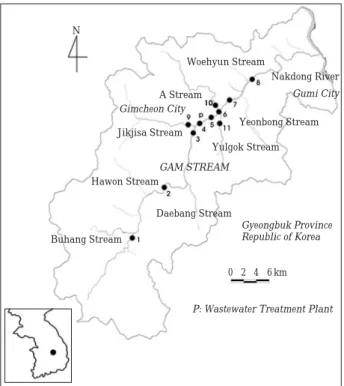
In order to determine fish fauna and distribution of the 1st-class endangered species, Gobiobotia naktongensis at 11 sampling sites including 3 tributaries of the Gam Stream, we collected fishes on May, June, August, and November in 2007 (Fig. 1). Thereafter, we focused an investigation on their preference of physical microhabitat at the 6 sites (St. 3~St. 8) of the Gam Stream on July and November in 2008. Administrative dis- tricts with geological position system by site are as follows;
The Gam Stream
St. 1: Dogok-Ri Jirea-Myeon, Gimcheon (N 35�
58′14′′ E 128�01′21′′)
St. 2: Gwangmyeong-Ri Guseong-Myeon, Gim- cheon (N 36�02′17′′ E 128�04′37′′)
St. 3: Gimcheon Bridge. Jijwa-Dong, Gimcheon (N 36�07′04′′ E 128�07′48′′)
St. 4: Sinum-Dong, Gimcheon (N 36�07′38′′ E 128�07′59′′)
St. 5: Gaeryeong-Myeon, Gimcheon (N 36�08′ 30′′ E 128�10′06′′)
St. 6: Gaeryeong-Myeon, Gimcheon (N 36�08′ 54′′ E 128�10′34′′)
St. 7: Daedong Bridge, Gaeryeong-Myeon, Gim- cheon (N 36�09′49′′ E 128�11′36′′)
St. 8: Gammun Bridge Gaeryeong-Myeon, Gim- cheon (N 36�11′23′′ E 128�13′57′′)
Tributaries of the Gam Stream
St. 9: Sinum-Dong, Gimcheon (Jikjisa Stream) (N 36�07′40′′ E 128�07′43′′)
St. 10: Gaeryeong-Myeon, Gimcheon (A Stream) (N 36�09′08′′ E 128�10′21′′)
St. 11: Nam-Myeon, Gimcheon (Yulgok Stream) (N 36�08′52′′ E 128�10′46′′)
Fish investigations were performed along the stream at each site of about 100 m distance dur- ing one hour in order to include various microha- bitats such as riffle, pool, and run (An et al., 2006;
Kim et al., 2007). For collecting fish, cast net (mesh size 7×7 mm) and kick net (mesh size 4×
4 mm) were used depending on a habitat type.
Collected fish were identified and counted by spe- cies in situ, and then most of them were released
Fig. 1. Sampling sites in the Gam Stream watershed.
Woehyun Stream N
Gimcheon City
Jikjisa Stream
Yulgok Stream Yeonbong Stream
GAM STREAM Hawon Stream
Buhang Stream
Daebang Stream
0 2 4 6 km Gyeongbuk Province Republic of Korea
Gumi City A Stream
Nakdong River
P: Wastewater Treatment Plant
immediately after fish sampling in a site. Some small-sized fish, which were not able to be identi- fied immediately, were fixed with 10% formalin solution and brought to a laboratory. The identifi- cation was performed according to Kim (1997) and Kim and Park (2002), and classification system was arranged by Nelson (1994).
A total length of Gobiobotia naktongensis was measured when caught. In order to determine preference of physical microhabitat on the species, water depth and velocity were measured in the
spot they were found immediately. In addition, substrates in the sites were sampled and brought to a laboratory, and then its composition was esti- mated based on sieve analysis.
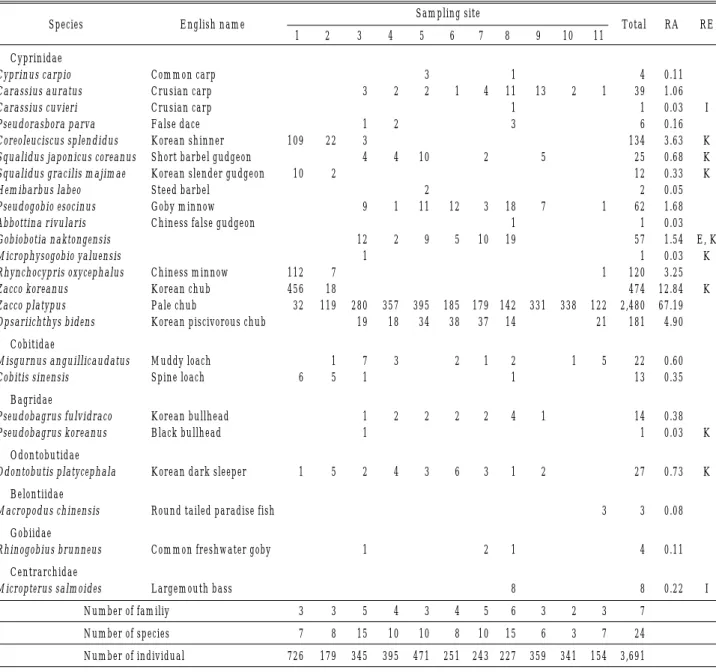
In the Gam Stream, total 3,691 of fish represen- ting 7 families 24 species were caught from the investigation period. Among them, Cyprinidae was dominant in species number (16 species, 66.7%) and relative abundance (3,599 individuals, 97.5%), whereas other 6 families had one or two species and less than 1.0% of relative abundance (Table
Table 1. A list of fish species and number of individuals caught from the sampling sites from 2007 to 2008.
Species English name Sampling site
Total RA RE
1 2 3 4 5 6 7 8 9 10 11
Cyprinidae
Cyprinus carpio Common carp 3 1 4 0.11
Carassius auratus Crusian carp 3 2 2 1 4 11 13 2 1 39 1.06
Carassius cuvieri Crusian carp 1 1 0.03 I
Pseudorasbora parva False dace 1 2 3 6 0.16
Coreoleuciscus splendidus Korean shinner 109 22 3 134 3.63 K
Squalidus japonicus coreanus Short barbel gudgeon 4 4 10 2 5 25 0.68 K
Squalidus gracilis majimae Korean slender gudgeon 10 2 12 0.33 K
Hemibarbus labeo Steed barbel 2 2 0.05
Pseudogobio esocinus Goby minnow 9 1 11 12 3 18 7 1 62 1.68
Abbottina rivularis Chiness false gudgeon 1 1 0.03
Gobiobotia naktongensis - 12 2 9 5 10 19 57 1.54 E, K
Microphysogobio yaluensis - 1 1 0.03 K
Rhynchocypris oxycephalus Chiness minnow 112 7 1 120 3.25
Zacco koreanus Korean chub 456 18 474 12.84 K
Zacco platypus Pale chub 32 119 280 357 395 185 179 142 331 338 122 2,480 67.19
Opsariichthys bidens Korean piscivorous chub 19 18 34 38 37 14 21 181 4.90
Cobitidae
Misgurnus anguillicaudatus Muddy loach 1 7 3 2 1 2 1 5 22 0.60
Cobitis sinensis Spine loach 6 5 1 1 13 0.35
Bagridae
Pseudobagrus fulvidraco Korean bullhead 1 2 2 2 2 4 1 14 0.38
Pseudobagrus koreanus Black bullhead 1 1 0.03 K
Odontobutidae
Odontobutis platycephala Korean dark sleeper 1 5 2 4 3 6 3 1 2 27 0.73 K
Belontiidae
Macropodus chinensis Round tailed paradise fish 3 3 0.08
Gobiidae
Rhinogobius brunneus Common freshwater goby 1 2 1 4 0.11
Centrarchidae
Micropterus salmoides Largemouth bass 8 8 0.22 I
Number of familiy 3 3 5 4 3 4 5 6 3 2 3 7
Number of species 7 8 15 10 10 8 10 15 6 3 7 24
Number of individual 726 179 345 395 471 251 243 227 359 341 154 3,691 E: Endangered species, K: Korean endemic species, I: Introduced species, RA: Relative abundance, RE: Remark
1). Pale chub (Zacco platypus, 2,480 individuals, 67.2%) was dominant species at all sites except St. 1, and subdominant species was Korean chub (Zacco koreanus, 474 individuals, 12.8%) mostly found at St. 1 (96.2%) in 2007.
The 1st-class endangered species, Gobiobotia naktongensis was caught in mid to lower region of the Gam Stream with 1.5% of relative abun- dance (Table 1). There were 8 Korean endemic species (33.3% in species number), higher than 25.9% indigenous frequency reported by Kim (1995). Five species (Coreoleuciscus splendidus, Squalidus gracilis majimae, Microphysogobio yaluensis, Zacco koreanus, and Pseudobagrus koreanus) were found mostly in upper region of the stream, whereas Squalidus japonicus coreanus and Gobiobotia naktongensis were caught in mid to lower region. The species of Odontobutis platy- cephala inhabited in most sites (Table 1). There were 2 introduced species (Carassius cuvieri, Micropterus salmoides) found in only St. 8. In par- ticular, only 8 individuals of Micropterus salmoi- des were caught even if we could see more than that. This species was classified as an ecological disturbing fish by the Ministry of Environment, Korea so that it is important to make a counter- measure for conserving fish community and popu- lation of Gobiobotia naktongensis from the species of fish having rapid propagation power.
Total 29 individuals of Gobiobotia naktongensis were collected in 2007. Among them, 13 indivi- duals were caught at St. 3, 5, 6, and 7 on May.
However, no one was found on June because of increased discharge by rainfall. Thereafter, there were 8 individuals caught at St. 3 and 7 on Augu- st, and then 8 of them were caught at St. 8 on November, which had very low discharge. As a result of measurement on physical microhabitat where they were found, it ranged from 0.14 to 0.49 m on water depth (mean: 0.30 m) and from 0.239 to 0.644 m s-1(mean: 0.437 m s-1) (Fig. 2).
In 2008, we concentrated investigation in mid- to lower region (St. 3~St. 8) of the Gam Stream, which the species were mostly caught in the pre- vious year.
There were total 28 individuals caught, and we also found the species at St. 4 which the species was not found in 2007. On July, 14 individuals were collected in broad region (St. 3~St. 7), where- as another 14 individuals were caught in lower region (St. 7~St. 8) on November. As a result of measurement on total length of the species caught
in 2008, size of the species on November (mean:
51 mm, range: 41~57 mm) was higher than mean on July (28 mm, 12~45 mm) so that the finding indicated their seasonal growth. Meanwhile, they inhabited from 0.12 to 0.68 m on water depth (mean: 0.29 m) and from 0.037 to 0.645 m s-1 (mean: 0.411 m s-1), and there was no relationship between the fish size and depth or velocity (Fig. 2).
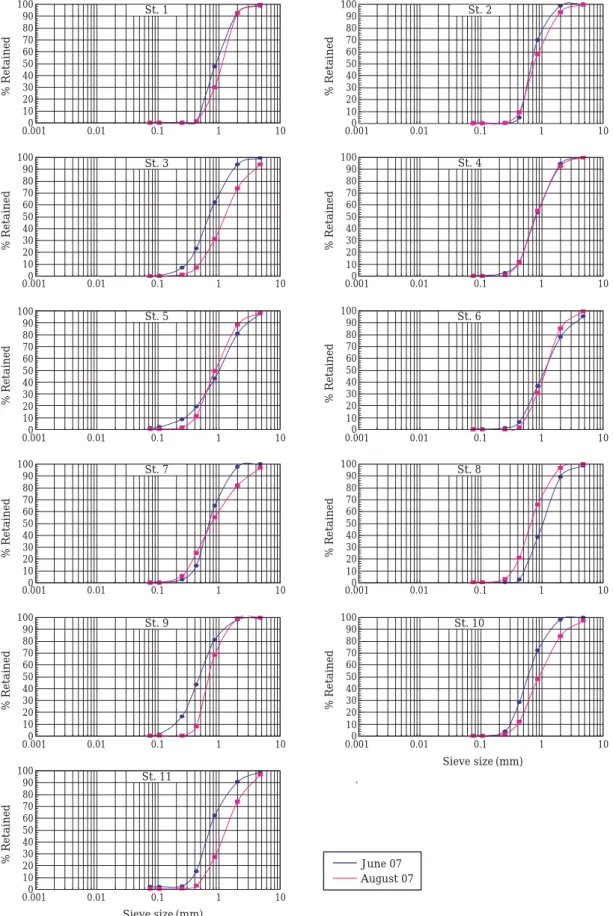
With sieve analysis of stream bed in the sam- pling sites, we determined substrate composition in the Gam Stream. Compared with the results on June and August 2007, there was no difference occurred in the upper region (St. 1~St. 2). Even though change of substrate composition could be caused in the mid- to lower region (St. 3~St. 8) of the stream due to fluctuation of water depth and velocity by rainfall, no drastic change of sub- strate composition was not found, overall. Mean- while, particle size on August in the tributaries (St. 9, 10, 11) seemed to be increased compared to the size on June (Fig. 3).
Based on the results of substrate composition and distribution of Gobiobotia naktongensis, the species seemed to prefer shallow run (0.14~0.46 m, 0.239~0.585 m s-1) microhabitat than deep pool. In addition, they prefer about 1% of gravel (¤4.74 mm), 83.4% coarse sand (¤0.425 mm), and 15.6% fine sand (¤0.075 mm), based on analysis of substrate composition that they were found.
The results are similar with general information provided by Kang et al. (2004). The species is bot- tom dwelling fish such as Goby minnow (Pseu- dogobio esocinus), which feeds on microorganism by filtering substrate material. According to the
Velocity (m s-1)
0.0 0.1 0.2 0.3 0.4 0.5 0.6 0.7
Water depth (m)
0.0 0.1 0.2 0.3 0.4 0.5 0.6 0.7 0.8
2007 2008
n 57
Fig. 2. Water depth and velocity of microhabitats Gobio- botia naktongensis inhabited in the Gam Stream.
100 90 80 70 60 50 40 30 20 10 0
100 90 80 70 60 50 40 30 20 10 0
100 90 80 70 60 50 40 30 20 10 0
100 90 80 70 60 50 40 30 20 10 0
100 90 80 70 60 50 40 30 20 10 0
100 90 80 70 60 50 40 30 20 10 0 100
90 80 70 60 50 40 30 20 10 0
100 90 80 70 60 50 40 30 20 10 0
100 90 80 70 60 50 40 30 20 10 0
100 90 80 70 60 50 40 30 20 10 0
100 90 80 70 60 50 40 30 20 10 0
0.001 0.01 0.1 1 10 0.001 0.01 0.1 1 10
0.001 0.01 0.1 1 10 0.001 0.01 0.1 1 10
0.001 0.01 0.1 1 10 0.001 0.01 0.1 1 10
0.001 0.01 0.1 1 10 0.001 0.01 0.1 1 10
0.001 0.01 0.1 1 10 0.001 0.01 0.1 1 10
0.001 0.01 0.1 1 10
% Retained % Retained% Retained% Retained% Retained% Retained
% Retained% Retained% Retained% Retained% Retained
Sieve size (mm)
Sieve size (mm)
St. 1 St. 2
St. 3 St. 4
St. 5 St. 6
St. 7 St. 8
St. 9 St. 10
St. 11
June 07 August 07
Fig. 3. Curves of particle size by sieve analysis in the sampling sites, Gam Stream.
results, we also found Pseudogobio esocinus in most sites Gobiobotia naktongensis were caught, but they are not always found simultaneously in other watersheds. The species may need more limited requirement on their microhabitat. There- fore, it is important to understand why they inhab- it shallow run with sandy bottom and furthermore to enhance efficiency of fish conservation and eco- logical restoration with understanding species- specific characteristics in microhabitat including protected species.
LITERATURE CITED
An, K.G., J.Y. Lee, D.Y. Bae, J.H. Kim, S.J. Hwang, D.H. Won, J.K. Lee and C.S. Kim. 2006. Ecological assessments of aquatic environment using multi- metric model in major nationwide stream water- sheds. Journal of Korean Society on Water Quality 22(5): 796-804.
Arthington, A.H., S.O. Brizga, S.C. Choy, M.J. Ken- nard, S.J. Mackey, R.O. McCosker, J.L. Ruffini and J.M. Zalucki. 2000. Environmental flow require- ments of the Brisbane River downstream from Wivenhoe Dam. South East Queensland Water Corporation, And Center for Catchment and In- Stream Research, Griffith University, Brisbane, Australia.
Brown, A.V., M.M. Lyttle and K.B. Brown. 1988.
Impacts of gravel mining on gravel bed streams, Transactions of the American Fisheries Society 127:
979-994.
Bunn, S.E. and A.H. Arthington. 2002. Basic principles and ecological consequences of altered flow regimes for aquatic biodiversity. Environmental Manage- ment 30: 492-507.
Chae, B.S. 2004. Status and protection counterplan of Gobiobotia naktongensis Mori (Cyprinidae, Pisces). 2004 Fall Conference of the Ichthyological Society of Korea, pp. 47-57.
Choi, K.C. 1985. Nature of Gyeonggi Province. Fresh- water fishes. Gyeonggi Provincial Board of Educa- tion, Jeongmun Publ.
Choi, K.C. 1986. Nature of Chungbuk Province. Fresh- water fishes. Chungbuk Provincial Board of Edu- cation, Jeongmun Publ.
Choi, K.C. 1987. Nature of Chungnam Province. Fresh- water fishes. Korea Foundation for the Advance- ment of Science and Technology, Jeongmun Publ.
Choi, K.C., S.R. Jeon, I.S. Kim and Y.M. Son. 1990.
Coloured illustrations of the freshwater fish of Korea. Hyangmoon Publ.
Christopher, M. 2002. Biology of freshwater pollution, 4th, Pearson Edu. Limited, Edinburgh Gate, pp.
387.
Jang, M.H., G.I. Cho and G.J. Joo. 2001. Fish fauna of the main channel in the Nakdong River. Korean Journal of Limnology 34(3): 223-238.
Jeon, S.R. and Y.M. Son. 1983. Studies on the distri- bution of Gobiobotia naktongensis Mori (Gobiobo- tinae, Cyprinidae) from Korea. Korean Journal of Limnology 16(1-2): 21-26.
Kang, Y.H., J.W. Seo, J.D. Keum and H.J. Yang. 2004.
The fish community structure in the middle of Nakdong River. Korean Journal of Limnology 37(2): 227-235.
Kim, I.S. 1995. Status of distribution and conservation on critical species of freshwater fish in Korea. Joint Symposium of the Ecological Society of Korea and the Ichthyological Society of Korea, pp. 31-50.
Kim, I.S. 1997. Illustrated encyclopedia of fauna and flora of Korea. Vol. 37. Freshwater fishes. Ministry of Education, pp. 235-236.
Kim, I.S. and J.Y. Park. 2002. Freshwater fishes of Korea. Kyo-Hak Publ., pp. 142-143.
Kim, J.H., J. Seo, Y.E. Na and K.G. An. 2007. Ecologi- cal health assessments on turbidwater in the downstream after a construction of Yongdam Dam.
Korea Journal of Limnology 40(1): 130-147.
Lee, H., Y. Kim, G. Lee, J. Seo, J. Yang and H. Kwon.
2008. Introduction of hydraulic field investigation method to utilize on the inhabitation environment definition at a river. Korean Journal of Limnology 41(4): 547-553.
Lee, W.O. and S.Y. Noh. 2006. Freshwater fishes in Korean peninsula-with looking characteristics.
Jisung Publ., pp. 137-139.
Mori, T. 1935. Descriptions of two new genera and seven new species of Cyprinidae From Chosen.
Annot. Zool. Japan 15(2): 169-171.
Nelson, K.L. 1993. Instream sand and gravel mining.
p. 189-196 In: Impacts on warmwater streams:
guidelines for evaluation. Southern Division, American Fisheries Society (Bryan C.F. and D.A.
Rutherford, eds.). Little Rock. Arkansas, USA.
Nelson, J.S. 1994. Fishes of the world (3rd ed.). John Wiley & Sons, New York, pp. 283-293.
Seo, J. 2005. Fish fauna and ecological characteristics of Dark chub (Zacco temminckii) population in the mid-upper region of Gam Stream. Korean Journal of Limnology 38(2): 196-206.
Seo, J. 2009. A study on fish community in Pyeonglim Stream-with water quality and stream health assessment in up- and downstream of Pyeonglim Dam. Journal of Environmental Impact Assess- ment 18(3): 151-160.
Seo, J., I.S. Lim, G.H. Kim and J.G. Kim. 2008b. Esta- blishment of fish monitoring technique for esti- mation of environmental flow and stream health assessment. 2008 Spring Conference Proceeding of the Korea Water Resources Association, pp. 96.
Seo, J., I.S. Lim, H. Kim and H.K. Lee. 2008a. Status of fish inhabitation and distribution of eight abun-
dant species in relation with water quality in streams and rivers, Ulsan City. Korean Journal of Limnology 41(3): 283-293.
Waters, T.F. 1995. Sediment in streams: sources, bio- logical effects, and control. American Fisheries Society Monograph 7, Bethesda. Maryland, USA.
Yang, H.J., B.S. Chae and S.O. Hwang. 1997. Ichthy- ofauna and fish community structure in the Imha-
Dam reservoir, Korea. Korean Journal of Limno- logy 30(2): 145-154.
Zhu, S.Q. 1995. Synopsis of freshwater fishes of China.
Jiangsu Sci. Tech. Pubi. House. Nanjing China.
(Manuscript received 10 November 2009, Revision accepted 4 December 2009)