www.jkfas.org
pISSN 1738-3757 eISSN 2288-8551 J Korean Foot Ankle Soc 2015;19(3):128-131 http://dx.doi.org/10.14193/jkfas.2015.19.3.128
MTP joint occurred with an insidious onset and aggravated during rowing activities. Differential diagnosis for a musculoskeletal injury to the 1st MTP joint included sprain/strain, infection, capsulitis, hallux rigidus, sesamoiditis, plantar fascia rupture, degenerative joint disease, dislocation, and fracture.
CASE REPORT
A 19-year-old female rower who sustained an overuse injury to her left 1st MTP joint was in her second year of competitive rowing and had no previous history of musculoskeletal injury to the fore- foot. She felt initial discomfort around the great toe during rowing and erging (indoor rowing machine), but did not recall a specific traumatic event or onset of discomfort. Pain gradually increased and became sharp and more localized over the 1st MTP joint.
On the initial visit, there was no obvious swelling or tenderness over the 1st MTP joint. Active ROM at the 1st MTP joint was within normal limits compared to the uninvolved side. Manual muscle testing of the great toe revealed 4+/5 during flexion and 4/5 dur- ing extension. First MTP valgus/varus stress tests were negative and did not reproduce any pain. A manual fracture test (percussion test) was also negative. And, no neurological symptoms (decreased sensation, altered reflexes) were observed.
Therefore, physiotherapy (cryotherapy, thermotherapy, electro- The 1st metatarsophalangeal (MTP) joint is a condyloid articula-
tion of the 1st metatarsal head and the base of the proximal pha- lanx.1) It is inherently unstable but a complex of soft tissue struc- tures include joint capsule ligament, collateral MTP joint ligament, plantar MTP joint ligament, and suspensory ligament, as well as extensor and flexor tendons and two sesamoid bones.2)
A capsuloligamentous sprain over the 1st MTP joint is common- ly referred to as “turf toe”.3) Hyperextension is the most common injury mechanism,1) and excessive flexion and valgus stress of the 1st MTP joint have also been implicated as possible mechanisms.4) The 1st MTP joint sprain usually occurs with rapid changes in direction, direct axial loading against a non-yielding solid object, and/or playing on the artificial turf.1) Symptoms include pain, swelling, tenderness, stiffness, and reduced range of motion (ROM) over the 1st MTP joint, thus patients report difficulty with or inabil- ity to bear weight on the injured foot during functional movements such as walking and running.1,4)
The injury case presented was unique because injury of the 1st Case Report
This is an Open Access article distributed under the terms of the Creative Commons Attribution Non-Commercial License (http://creativecommons.org/licenses/CC
by-nc/4.0) which permits unrestricted non-commercial use, distribution, and reproduction in any medium, provided the original work is properly cited.
Copyright 2015 Korean Foot and Ankle Society. All rights reserved.ⓒ
Capsuloligamentous injury at the first metatarsophalangeal (MTP) joint is a common traumatic injury during physical activity, particu- larly on artificial turf. Mechanism of injury include excessive flexion, extension, or valgus stress. We report a non-operatively treated capsuloligamentous injury at the first MTP joint, which did not occur traumatically but developed by a stress-related mechanism in a collegiate rower.
Key Words: First metatarsophalangeal joint, Turf toe, Overuse injury, Rower
Overuse Capsuloligamentous Injury of the First Metatarsophalangeal Joint: A Case Report
Jihong Park, Terry L. Grindstaff*
Athletic Training Laboratory, Department of Sports Medicine, College of Physical Education, Kyung Hee University, Yongin, Korea,
*Department of Physical Therapy, School of Pharmacy and Health Professions, Creighton University, Omaha, NE, USA
Received June 15, 2015 Revised July 8, 2015 Accepted July 24, 2015 Corresponding Author: Jihong Park
Athletic Training Laboratory, Department of Sports Medicine, College of Physical Education, Kyung Hee University, 1732 Deogyeong-daero, Giheung-gu, Yongin 17104, Korea
Tel: 82-31-201-2721, Fax: 82-31-204 -8117, E-mail: [email protected] Financial support: None.
Conflict of interest: None.
www.jkfas.org 129 Jihong Park, et al. Overuse Injury of the 1st MTP Joint
1st MTP capsulitis (capsuloligamentous sprain), corticosteroid in- jection into her 1st MTP joint was performed. It seemed to reduce symptoms (VAS; worst at 3/10 and best at 1.5/10) for 4 weeks which allowed her to complete the season. However, pain and discomfort was not completely resolved.
She was seen in the athletic training room five months after the initial treatment (two months after the last treatment) due to per- sisting pain in the same area. She was able to row and erg, but the symptom have continually been worse with practice and weight- lifting. Active and passive ROM at the 1st MTP joint was limited by pain (flexion at 30o and extension at 42o; uninvolved side: flexion at 45o and extension at 55o). To assess general function of her lower extremity, she was asked to complete the lower extremity functional scale (LEFS). The patient scored 59/80. Also, VAS was measured (worst at 8/10 and best at 2/10).
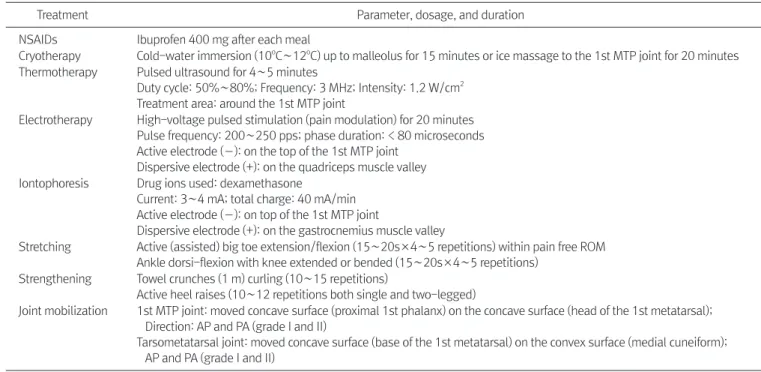
To control pain and increase ROM, therapeutic modalities and ROM exercises were done with active (assisted) big toe flexion/ex- tension and calcaneal tendon stretch. Grade I and II joint mobiliza- tion at the 1st MTP joint and grade III and IV tarsometatarsal joint mobilization to increase ROM was also applied (Table 1). Strength- ening exercises including towel (1 m) crunches for the toe flexors and active heel raises for plantar flexors were also performed (Table 1). A custom turf toe orthotics and turf toe taping were applied for activities of daily living and team practice (rowing, erging, and therapy, and iontophoresis) and oral non-steroidal anti-inflamma-
tory drugs (NSAIDs) were prescribed to address pain (Table 1).
Symptoms were slightly decreased (visual analogue scale, VAS;
worst at 5/10 and best at 1/10) over a treatment period of 4 weeks but she indicated pain continued to persist. Therefore, she was referred to the team orthopedic surgeon for further exam. Plain x-ray was obtained and indicated no fracture or abnormal bony malalignment (Fig. 1). Under the impression of insidious onset of Figure 1. The anteroposterior radiograph of the left foot revealed no abnormality at the first metatarsophalangeal joint.
Table 1. Summary of Therapeutic Interventions
Treatment Parameter, dosage, and duration
NSAIDs Ibuprofen 400 mg after each meal
Cryotherapy Cold-water immersion (10oC∼12oC) up to malleolus for 15 minutes or ice massage to the 1st MTP joint for 20 minutes Thermotherapy Pulsed ultrasound for 4∼5 minutes
Duty cycle: 50%∼80%; Frequency: 3 MHz; Intensity: 1.2 W/cm2 Treatment area: around the 1st MTP joint
Electrotherapy High-voltage pulsed stimulation (pain modulation) for 20 minutes Pulse frequency: 200∼250 pps; phase duration: < 80 microseconds Active electrode (―): on the top of the 1st MTP joint
Dispersive electrode (+): on the quadriceps muscle valley Iontophoresis Drug ions used: dexamethasone
Current: 3∼4 mA; total charge: 40 mA/min Active electrode (―): on top of the 1st MTP joint
Dispersive electrode (+): on the gastrocnemius muscle valley
Stretching Active (assisted) big toe extension/flexion (15∼20s×4∼5 repetitions) within pain free ROM Ankle dorsi-flexion with knee extended or bended (15∼20s×4∼5 repetitions)
Strengthening Towel crunches (1 m) curling (10∼15 repetitions)
Active heel raises (10∼12 repetitions both single and two-legged)
Joint mobilization 1st MTP joint: moved concave surface (proximal 1st phalanx) on the concave surface (head of the 1st metatarsal);
Direction: AP and PA (grade I and II)
Tarsometatarsal joint: moved concave surface (base of the 1st metatarsal) on the convex surface (medial cuneiform);
AP and PA (grade I and II)
NSAIDs: non-steroidal anti-inflammatory drugs, MTP: metatarsophalangeal, pps: pulse per second, ROM: range of motion, AP: anteroposterior, PA:
posteroanterior.
130 Vol. 19 No. 3, September 2015
fever or fatigue. Passive ROM at the 1st MTP joint provoked pain, which may indicate that joint capsule structure is inflamed. The patient also reported that she had more pain with resisting the 1st MTP joint during the drive phase compared to the recovery phase.
External load that had to be resisted during the drive phase may have increased intraarticular pressure at the 1st MTP joint, resulting in pain. We believe that repetitive flexion and extension at the 1st MTP joint may have been a contributing mechanism to this injury.
Additionally hypomobility at the 1st tarsometatarsal joint may have possibly aggravated inflammation at the capsuloligamentous struc- ture at the 1st MTP joint.
The patient’s 1st MTP joint active ROM was within normal limit on both sides at the initial examination. During the second visit, however, ROM at the 1st MTP joint had bilateral asymmetry. This ROM deficit in the involved side is thought to be from persistent pain at the same structure. A recent study suggested that low back pain may be related to ROM asymmetry at the hip joint in rowers.8) In our case, the 1st MTP joint injury may be a consequence of compensatory movements due to bilateral ROM asymmetry in low- er limb such as ankle or knee joint. For example, repetitive ankle dorsi- and plantar-flexion with a limited mobility and/or a weaker force production in involved side compared to the uninvolved side may have caused the 1st MTP joint in the ipsilateral side to com- pensate the deficits. It is unclear if this was the case in our patient since we did not obtain patient’s joint ROM and strength data. We suggest that clinicians and physicians should consider ROM and strength at the joint above and below of the injured structure.
Recently, a stress-related 1st MTP joint injury in an elite soccer player has been reported in a case report.6) The patient felt dis- comfort without swelling around the 1st MTP joint during a soccer game. Then, repetitive high intensity stress (playing soccer) to the 1st MTP joint caused a traumatic injury, finally resulting in a surgi- cal repair. This case was similar to ours in that the 1st MTP joint injury may be an atraumatic etiology. It appears that the 1st MTP joint injury with an overuse mechanism may be related to both closed-kinetic chain movements (dorsi- and plantar-flexion in our case) and a combination of open- and closed-kinetic chain move- ments (playing soccer).6)
Effectiveness of the interventions and rehabilitation programs were not clear. We treated the patient with typical 1st MTP joint treatments, which includes rest (modified activity), NSAIDs, cryo- therapy, thermotherapy (therapeutic ultrasound), electrotherapy, iontophoresis, joint mobilisation, stretching, strengthening exer- cise, orthotics, turf toe taping, and corticosteroid injection.9,10) We weight lifting). After four weeks, second corticosteroid injection
was then administered along with other therapeutic treatments (Table 1). A week after the injection, symptom improved (worst at 4/10 and best at 2/10) and pain free ROM increased (flexion at 35o and extension at 50o; uninvolved side: flexion at 45o and exten- sion at 55o). She was continuously treated with NSAIDs and other therapeutic modalities and exercises. At this point, thermotherapy (therapeutic ultrasound) and electrotherapy followed by stretching and strengthening exercises with grade III and IV joint mobiliza- tion were performed (Table 1). Two months after the second injection, she participated in team practice without subjective pain or discomfort. Active ROM at the 1st MTP joint returned to normal (flexion at 41o and extension at 55o; uninvolved side: flexion at 45o and extension at 55o). The LEFS also improved (77/80).
We obtained informed consent from the patient. Medical in- formation includes past medical history, clinical assessments, therapeutic interventions, and outcome measurements (VAS and LEFS).5)
DISCUSSION
Atraumatic injury to the 1st MTP joint with insidious onset is unusual.6) To understand the mechanisms of injury in this case, stroke mechanics in rowing should be addressed. The rowing stroke can be divided into recovery, catch, and drive phases.7) The recovery phase begins when a stroke is finished in the water. Dur- ing this phase, lower extremity joints and lower back increase flex- ion angles as shoulder and elbow joints extends until “catch” the water. During the drive phase, lower extremity joints and lower back are going towards to extension with upper extremity flexion, thus the oars push the water. During the recovery phase, the flex- or hallucis longus (FHL) may be relaxed or slightly eccentrically contracted while the extensor halluces longus may concentrically contract. The FHL tendon at the 1st MTP joint constantly contracts with plantar flexors and knee extensors during the drive phase.
The patient was diagnosed as the 1st MTP joint capsulitis. In- flammation in the soft tissue structure is confirmed with magnetic resonance imaging data, which we did not obtain for this particular injury. Radiograph images (Fig. 1) ruled out bone related injuries such as fracture, osteoarthritis, osteochondritis dissecans, or osteo- phytes. Joint infection (e.g., septic arthritis) may have been a pos- sible etiology. We assumed that this was not the case because joint infection is common in children and elderly adults, typically one large joint (e.g., knee) is affected, and our patient did not have
www.jkfas.org 131 Jihong Park, et al. Overuse Injury of the 1st MTP Joint
of the first metatarsophalangeal joint1 Mil Med1 2004;169:xix- xxiv1
31 Bowers KD Jr, Martin RB. Turf-toe: a shoe-surface related foot- ball injury1 Med Sci Sports1 1976;8:81-31
41 Faltus J, Mullenix K, Moorman CT 3rd, Beatty K, Easley ME. Case series of first metatarsophalangeal joint injuries in division 1 col- lege athletes1 Sports Health1 2014;6:519-261
51 Binkley JM, Stratford PW, Lott SA, Riddle DL. The Lower Ex- tremity Functional Scale (LEFS): scale development, measure- ment properties, and clinical application1 North American Orthopaedic Rehabilitation Research Network1 Phys Ther1 1999;79:371-831
61 Roche AJ, Calder JD. An atraumatic turf toe in an elite soccer player--a stress related phenomenon? Foot Ankle Surg1 2014;
20:71-31
71 Hosea TM, Hannafin JA. Rowing injuries1 Sports Health1 2012;4:
236-451
81 Buckeridge E, Hislop S, Bull A, McGregor A. Kinematic asym- metries of the lower limbs during ergometer rowing1 Med Sci Sports Exerc1 2012;44:2147-531
91 Brantingham JW, Chang MN, Gendreau DF, Price JL. The effect of chiropractic adjusting, exercises and modalities on a 32-year- old professional male golfer with hallux rigidus1 Clin Chiropr1 2007;10:91-61
101 Fabeck LG, Zekhnini C, Farrokh D, Descamps PY, Delincé PE.
Traumatic hallux valgus following rupture of the medial col- lateral ligament of the first metatarsophalangeal joint: a case report1 J Foot Ankle Surg1 2002;41:125-81
believe alleviation of the symptom and function improvement were from a combination of all treatments not significantly from one or two specific treatments or exercises.
This study is to report a unique case of the 1st MTP joint injury occurred in rowing. The possible mechanism of injury was repeti- tive rowing and erging motion with stiffness of the 1st tarsometa- tarsal joint. The symptoms lasted longer than a year even though appropriate therapeutic interventions were applied. The patient was treated with cryotherapy, therapeutic modalities, and NSAIDs to control pain. The patient performed stretching and joint mobili- zation to restore normal ROM. Corticosteroid injection was admin- istered to decrease inflammation in the joint. In addition, orthotics and taping were applied to support joint movements and function.
It took 16 months for the patient to return to normal function and competitive rowing without pain. The combination of all treat- ment modalities may have contributed to reduce pain and restore normal function.
REFERENCES
11 Kubitz ER. Athletic injuries of the first metatarsophalangeal joint1 J Am Podiatr Med Assoc1 2003;93:325-321
21 Allen LR, Flemming D, Sanders TG. Turf toe: ligamentous injury