• 검색 결과가 없습니다.

Refractory Vascular Spasm Associated with Coronary Bypass Grafting

N/A
N/A
Protected

Academic year: 2021

Share "Refractory Vascular Spasm Associated with Coronary Bypass Grafting"

Copied!
5
0
0

로드 중.... (전체 텍스트 보기)

전체 글

(1)

Departments of

1

Thoracic and Cardiovascular Surgery,

2

Anesthesiology, and

3

Division of Cardiology, Department of Internal Medicine, Inha University Hospital

Received: October 28, 2013, Revised: January 22, 2014, Accepted: January 29, 2014, Published online: October 5, 2014

Corresponding author: Wan Ki Baek, Department of Thoracic and Cardiovascular Surgery, Inha University Hospital, 27 Inhang-ro, Jung-gu, Incheon 400-711, Korea

(Tel) 82-32-890-2280 (Fax) 82-32-890-3099 (E-mail) [email protected]

C

The Korean Society for Thoracic and Cardiovascular Surgery. 2014. All right reserved.

CC

This is an open access article distributed under the terms of the Creative Commons Attribution Non-Commercial License (http://creative- commons.org/licenses/by-nc/3.0) which permits unrestricted non-commercial use, distribution, and reproduction in any medium, provided the original work is properly cited.

tient could not be weaned from the bypass. An emergency coronary angiography demonstrated a diffuse spasm of both native coronary arteries and grafts. CPB was switched to the femorofemoral extracorporeal membrane oxygen- ator (ECMO). Although he managed to recover from heart failure, his discharge was delayed due to the ischemic injury of the lower limb secondary to cannulation for ECMO. We reviewed the case and literature, placing em- phasis on the predisposing factors and appropriate management.

Key words: 1. Coronary vasospasm 2. Coronary artery bypass

CASE REPORT

A 42-year-old male patient, who was working for a high school as an administrative staff, was referred for coronary bypass grafting due to recurrent left main coronary disease.

Although he was physically active, he had been suffering from anginal pain for several years. Since coronary angiog- raphy taken at another center revealed no significant coronary lesion, no specific treatment was given. He also had a history of left carotid stent insertion due to repeated transient ische- mic attacks (TIA) three and a half years prior.

A year previous to admission, the patient had suddenly col- lapsed while playing football. He was resuscitated from car- diac arrest at a nearby community hospital. On electro-

cardiography, ST-T changes were shown on precordial leads, and bedside echocardiography revealed akinesia of the antero- lateral wall suggesting the acute coronary syndrome. The pa- tient was transferred to a tertiary medical center for further evaluation and appropriate management. Emergency coronary angiography was performed, and a tight left os lesion was managed with balloon angioplasty and stent insertion. After a month’s rehabilitation, he was discharged without sequelae.

One year later, a follow-up coronary angiography revealed

recurrent stenosis in the distal left main coronary artery that

was distal to the previous stenting site, extending to its bi-

furcation of the left anterior descending artery (LAD) and cir-

cumflex artery (Fig. 1). The patient was not obese; in fact, he

is rather slim, exhibiting neither hypertension nor diabetes.

(2)

Fig. 1. (A) Coronary angiogram taken before coronary bypass artery grafting (CABG) showing left main stenosis (arrowhead), (B–F) after

CABG while cardiopulmonary bypass is still running and (G, H) two months after operation. (B) The guide wire is passed into the left cor-

onary artery, but the whole left coronary system fails to be visualized from the os lesion (arrowhead). (C) Diffuse spasm of the right verte-

bral and RITA thoracic artery (arrowheads) is well documented with the interruption of the right internal thoracic artery (RITA) flow. (D) The

vein graft to the LAD is patent, but a diffuse spasm of the distal left anterior descending artery (LAD) is seen (arrowheads). The retro-

grade filling of the distal RITA is seen (white arrowheads). (E) The angiogram from left internal thoracic artery (LITA); LITA is patent but

the diffuse spasm of circumflex branches can be clearly observed (arrowheads). (F) Right coronary artery is also diffusely spasmodic. (G,

H) Relieved spasm of right coronary artery and left anterior descending artery with a widely patent vein graft.

(3)

Fig. 2. Angiogram of the lower extremity after removal of the femoral extracorporeal membrane oxygenator cannula. Diffuse spasm of the branches distal to the popliteal segment with the in- terruption of the flow can be clearly observed.

Further, bilateral internal thoracic artery (ITA) grafting was planned considering the patient’s age. While harvesting the right ITA after left ITA harvesting, a hemodynamic derange- ment developed suddenly. As the patient was unresponsive to a catecholamine infusion, cardiopulmonary bypass (CPB) was instituted hurriedly and a double bypass (left ITA to the left circumflex and right ITA to the left anterior descending) was carried out under standard hypothermic CPB and cold blood cardioplegia. The aortic cross clamp was released, but the heartbeat did not return. Intra-aortic balloon pump (IABP) support was begun, and an additional bypass with a vein graft was made to the distal LAD, but the situation pro- gressively worsened. The patient was rushed to the angio- graphic suite room, and the angiography revealed a diffuse coronary spasm, which was unresponsive to a nitrate infusion, although the bypass grafts were patent (Fig. 2). The CPB was switched to the femorofemoral venoarterial extracorporeal membrane oxygenator (ECMO). Since the heartbeat was so sluggish and weak, no one expected his recovery and he was put desperately on an immediate transplantation list. Surpri- singly, on the next day, signs of recovery were seen and car- diac contractility began to improve. A small perfusion cannu- la was connected to the arterial line of the circuit and in-

lower leg arteries (Fig. 3). His cardiac recovery was rather straight after ECMO weaning; IABP was weaned off the next day and the ventilator on the 7th postoperative day. He was transferred to the general ward on the 9th postoperative day.

To our surprise, the condition of his leg, which at first led to the belief that an amputation would be unavoidable, gradually improved. However, his postoperative hospital days were sig- nificantly prolonged due to repeated debridement and skin grafting of the leg. On the follow-up coronary angiography taken two months later, the spastic changes were subsided.

The vein graft was widely patent, but two ITAs were deemed occluded.

Currently, the patient is at the one-and-a-half-year fol- low-up point. Although his left foot drop has remained as a sequela, he has returned to work and is in a relatively fair condition. The latest transthoracic echocardiographic result shows an improved left ventricular ejection fraction (49%) and regional wall motion abnormality of the anterior wall and apex.

DISCUSSION

Although it occurs infrequently, a vascular spasm in associ- ation with CABG can bring about catastrophic results. A re- fractory vascular spasm has been reported to develop in 0.8%

to 1.3% of all CABG procedures [1,2], although transient na- tive coronary or implanted graft spasms have been shown to affect up to 11% of the patients undergoing an operation [3].

Usually, a spasm is confined to a single coronary artery or

graft, whereas it may occur in a more diffuse form charac-

terized by a dismal outcome in spite of intensive mana-

(4)

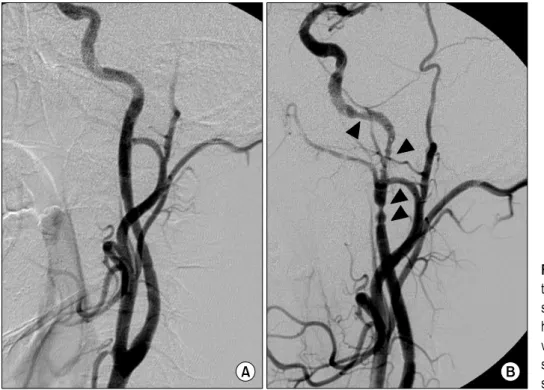
Fig. 3. Carotid angiogram showing the vascular spasm. (A) Before a stent insertion. (B) Spasm (arrow- heads) along the distal segment de- veloped shortly after the stent in- sertion necessitated an additional stent placement.

gement. Recently, Lorusso et al. [4] reported seven vascular spasms out of 5,762 isolated CABG procedures. During the same study period, they reported 18 patients with a perioper- ative single coronary or a grafted conduit. Out of these seven patients, the first five patients died due to rapidly evolving refractory cardiogenic shock and unresponsive cardiac arrest.

The remaining two patients of their series survived after ECMO, emphasizing the importance of the early institution of ECMO for optimal management.

The predisposing factors leading to a vascular spasm in- clude vascular damage, high levels of endogenous or ad- ministered vasoconstrictors, and oxidative stress, but no con- clusive agreement exists in this respect. Whether the isolated and diffuse patterns of a refractory spasm have different mechanisms in terms of predisposing or causative factors is also poorly understood [3]. Most spasms have been reported to occur within 8 h after the operation in the intensive care unit setting (range, 3 to 8 hours; mean, 5.6 hour) [4]. This case is peculiar in that it occurred during the operation at the time of graft harvesting and before any manipulation of the heart. On tracing the patient’s history, we came to know that there was also a spasmodic event at the time of carotid stenting. Furthermore, we could not exclude the possibility of

a vascular spasm in relation to the repeated TIA and the car- diac event leading to stent replacement at the left main branch. A severe spasm of the lower extremity arteries ini- tiated by the femoral ECMO cannula also reflects the pa- tient’s increased vascular tone and spasm-prone character- istics, which could not be defined clearly, although several insights on the mechanism and predisposing factors, including smoking, diabetes, lipid metabolic disorders, and gene ex- pression, have been proposed [5]. There are also reports from off-pump CABG suggesting that the constant administration of vasopressors needed to support low blood pressure can represent an additional vascular stimulus [6,7].

As for the management of the refractory vascular spasm,

an intracoronary direct injection of vasodilators has been

shown to be effective but may not be sufficient to overcome

profound cardiogenic shock or refractory cardiac arrest and to

face subsequent significant myocardial stunning. Coronary an-

giography should be performed at all events to identify and

confirm the etiology. The use of IABP, although usually ef-

fective in most cases of reduced coronary or CABG conduit

flows, is obviously insufficient or useless in this clinical set-

ting, calling for more effective cardiopulmonary support. The

efficacy of the prompt institution of ECMO in cases of un-

(5)

through hemofiltration [4,8].

Hence, we report a case of refractory vascular spasm that occurred during CABG and subsequently managed with ECMO, resulting in a life-salvaging outcome. Further studies are necessary to elucidate the perioperative or patient-specific condition that causes or predisposes the patient to such a catastrophic complication.

CONFLICT OF INTEREST

No potential conflict of interest relevant to this article was reported.

nary artery bypass surgery. Ann Thorac Surg 2012;93:545- 51.

5. Miwa K, Fujita M, Sasayama S. Recent insights into the mechanisms, predisposing factors, and racial differences of coronary vasospasm. Heart Vessels 2005;20:1-7.

6. Trimboli S, Oppido G, Santini F, Mazzucco A. Coronary ar- tery spasm after off-pump coronary artery by-pass grafting.

Eur J Cardiothorac Surg 2003;24:830-3.

7. Bittner HB. Coronary artery spasm and ventricular fi- brillation after off-pump coronary surgery. Ann Thorac Surg 2002;73:297-300.

8. Smith C, Akowuah E, Theodore S, Brown R. Diffuse coro-

nary artery spasm treated by extracorporeal membrane

oxygenation. Eur J Cardiothorac Surg 2009;36:208-9.

수치

Fig. 1. (A) Coronary angiogram taken before coronary bypass artery grafting (CABG) showing left main stenosis (arrowhead), (B–F) after  CABG while cardiopulmonary bypass is still running and (G, H) two months after operation
Fig. 2. Angiogram of the lower extremity after removal of the  femoral extracorporeal membrane oxygenator cannula
Fig. 3. Carotid angiogram showing  the vascular spasm. (A) Before a  stent insertion. (B) Spasm  (arrow-heads) along the distal segment  de-veloped shortly after the stent  in-sertion necessitated an additional  stent placement.

참조

관련 문서

Angiography showed a totally occluded mid-portion obstruction of the right coronary artery (RCA) and very good collaterals from the left coronary artery, filling retrogradely the

Postoperative coronary angiogram (about 2 hr after operation) shows severe spastic narrowing at grafted native coronary arteries (A, left anterior descending and left

Coronary angiography revealed no fixed stenosis expect for coronary artery anomaly which showed same origin of right coronary artery (RCA) and left circumflex artery (LCX),

Systematic preoperative coronary angiography and stenting im- proves postoperative results of carotid endarterectomy in patients with asymptomatic coronary artery disease: a

The patient underwent coronary angiography, revealing a severe concentric stenosis at distal portion of the LMCA and the ostium of the left anterior descending artery (LADA) with a

Internal thoracic artery; LAD=Left anterior descending coronary artery; OM=Obtuse marginal branch of left circumflex coronary artery; RA=Radial artery; RCA=Right

Coronary angiogram revealed very long bilateral tortuous coronary arteriovenous fistula from the left circumflex artery and right coronary artery to intercostal arteries, and

Purpose: Coronary artery bypass grafting (CABG) is the optimal treatment option for left main coronary artery disease (LMCAD).. However, LMCAD remains a con- stant topic of