• 검색 결과가 없습니다.

Left Carotid-to-Subclavian Artery Bypass Grafting for Recurrent Angina Caused by Coronary-Subclavian Steal Syndrome

N/A
N/A
Protected

Academic year: 2021

Share "Left Carotid-to-Subclavian Artery Bypass Grafting for Recurrent Angina Caused by Coronary-Subclavian Steal Syndrome"

Copied!
4
0
0

로드 중.... (전체 텍스트 보기)

전체 글

(1)

Korean J Thorac Cardiovasc Surg 2013;46:84-87 □ Case Report □ http://dx.doi.org/10.5090/kjtcs.2013.46.1.84 ISSN: 2233-601X (Print) ISSN: 2093-6516 (Online)

− 84 −

Departments of

1

Thoracic and Cardiovascular Surgery and

2

Nuclear Medicine, Seoul National University Hospital, Seoul National University College of Medicine

†This paper was presented in the 257th Monthly Case Conference of Seoul-Kyeonki District Chamber of The Korean Society for Thoracic and Cardiovascular Surgery.

Received: August 2, 2012, Revised: September 6, 2012, Accepted: September 11, 2012

Corresponding author: Ho Young Hwang, Department of Thoracic and Cardiovascular Surgery, Seoul National University Hospital, Seoul National University College of Medicine, 101 Daehak-ro, Jongno-gu, Seoul 110-744, Korea

(Tel) 82-2-2072-3020 (Fax) 82-2-764-3664 (E-mail) [email protected]

C

The Korean Society for Thoracic and Cardiovascular Surgery. 2013. All right reserved.

CC
This is an open access article distributed under the terms of the Creative Commons Attribution Non-Commercial License (http://creative- commons.org/licenses/by-nc/3.0) which permits unrestricted non-commercial use, distribution, and reproduction in any medium, provided the original work is properly cited.

Left Carotid-to-Subclavian Artery Bypass Grafting for Recurrent Angina Caused by Coronary-Subclavian Steal Syndrome

Min-Seok Kim, M.D.

1

, Jin Chul Paeng, M.D., Ph.D.

2

, Ki-Bong Kim, M.D., Ph.D.

1

, Ho Young Hwang, M.D., Ph.D.

1

A 60-year-old man visited the outpatient clinic due to one month of recurrent exertional chest pain. Eleven years earlier he had undergone off-pump coronary artery bypass grafting using bilateral internal thoracic artery (ITA) Y-composite grafts based on the left ITA. Preoperative coronary angiography showed patent distal graft anasto- moses and visualized the left ITA retrogradely. The arch aortography revealed near-total occlusion of the left sub- clavian artery at the level of the ostium. The patient underwent left carotid-to-subclavian artery bypass grafting us- ing a 6 mm vascular conduit. Postoperative computed tomographic angiography revealed a patent bypass conduit between the left common carotid artery and left subclavian artery. The patient was discharged on postoperative day 4 with no symptoms or signs of myocardial ischemia.

Key words: 1. Carotid-subclavian artery bypass 2. Angina

3. Coronary artery bypass surgery

CASE REPORT

A 60-year-old man presented to the hospital with exertional chest pain. Eleven years earlier he had undergone off-pump coronary artery bypass grafting (CABG) using a bilateral in- ternal thoracic artery (ITA) Y-composite graft based on the in situ left ITA. At that time there were no significant stenoses at both the right and left subclavian arteries. The left anterior descending artery and the first diagonal branch were sequen- tially anastomosed using the left ITA, and the posterolateral branch was revascularized using the right ITA.

Physical examination revealed a cold and pale left arm and

a weaker left radial pulse than the right. The blood pressure

in the right and left arms was 144/80 mmHg and 126/70

mmHg, respectively. Native coronary angiography showed

retrograde visualization of the distal grafts through the patent

distal anastomoses. Arch aortography demonstrated near-total

occlusion of the left subclavian artery (LSCA) at the level of

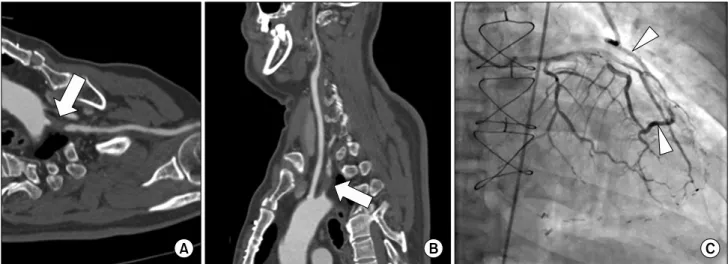
the ostium. Computed tomographic angiography also revealed

near-total occlusion of the LSCA at the level of the ostium

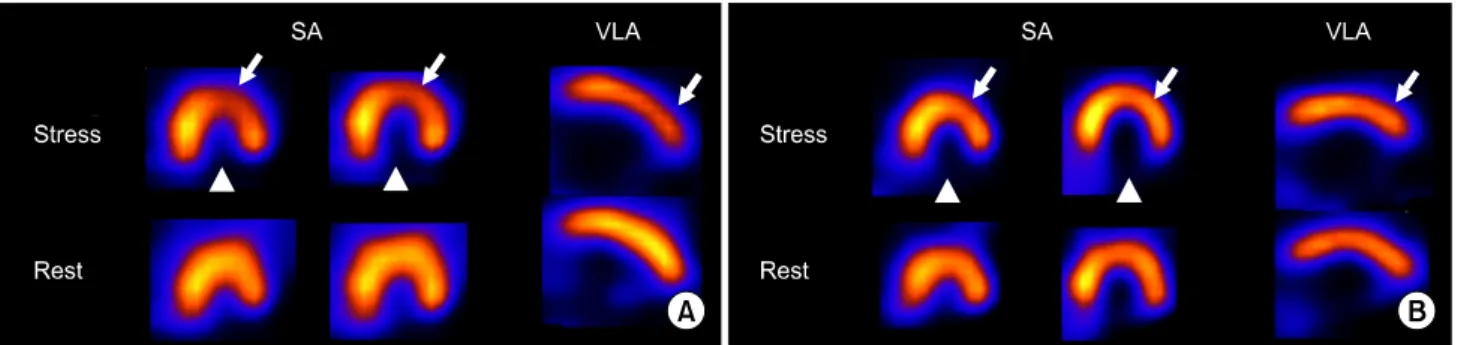
(Fig. 1). Myocardial single photon emission computed tomog-

raphy (SPECT) demonstrated a reversible perfusion decrease

in the apical to mid-anterior and mid-anterolateral walls, and

persistent perfusion defects in the apex, whole inferior,

(2)

Carotid-Subclavian Artery Bypass in Coronary-Subclavian Steal Syndrome

− 85 −

Fig. 1. (A, B) Preoperative computed tomographic angiography demonstrated near-total occlusion (arrow) at the ostium of the left sub- clavian artery. (C) Preoperative coronary angiography demonstrated retrograde visualization of the distal conduits (arrowheads) through patent distal anastomoses.

Fig. 2. Postoperative computed tomographic angiography. This re- vealed a patent bypass conduit between the left common carotid artery and left subclavian artery (arrow).

mid-basal inferoseptal, and inferolateral walls.

Bypass surgery of the left common carotid artery (LCCA) to the LSCA was performed using a 6 mm knitted vascular conduit (Hemashield; Boston Scientific Co., Wayne, NJ, USA) via a left supraclavicular incision. The patient was giv- en heparin (1 mg/kg) before clamping of the LCCA. After the proximal and middle sections of the LCCA were clamp- ed, the proximal section of the beveled vascular conduit was anastomosed to the side of the LCCA using a 6-0 poly- propylene continuous suture. Because cerebral oximetry has been reported to be accurate enough for detecting early changes in cerebral blood flow that might result in cerebral ischemia [1], we used continuous cerebral oximetry during the operation. Cerebral oximetry demonstrated 57% perfusion in both sides of the brain after anesthetic induction, and it re- mained at 57% and 55% in the right and left sides of the brain, respectively, during the LCCA clamping of 22 minutes.

The distal beveled conduit was anastomosed to the middle segment of the LSCA using a 6-0 polypropylene continuous suture.

The postoperative blood pressure in the right and left arms was 118/61 mmHg and 111/64 mmHg, respectively. Compu- ted tomographic angiography performed on the third post- operative day revealed that the bypass conduit between the LCCA and LSCA was patent, and that the left ITA was well perfused (Fig. 2). The patient underwent antiplatelet therapy

(Clopidogrel, 75 mg/day) until one day before surgery and re- sumed therapy on postoperative day 1. The patient was dis- charged on postoperative day 4 without any complications and was free of angina during the 2 months of follow-up.

Myocardial SPECT was performed two months after surgery

and demonstrated improved stress perfusion in the anterior

and anterolateral walls compared with the preoperative find-

ings (Fig. 3).

(3)

Min-Seok Kim, et al

− 86 −

Fig. 3. (A) Preoperative and (B) postoperative myocardial single photon computed tomography (SPECT). Postoperative myocardial SPECT demonstrated improved stress perfusion in the anterior and anterolateral walls when compared with the preoperative SPECT (arrows). SA, short axis; VLA, vertical long axis.

DISCUSSION

Myocardial revascularization using the left ITA has become the standard for surgical coronary revascularization due to its improved long-term patency and lower perioperative and post- operative mortality rates. Recurrent angina in patients who have previously undergone CABG may result from an oc- cluded or stenosed graft or from the progression of native atherosclerotic disease. Progression of LSCA stenosis has also been found to cause ischemia ever since using the left ITA for CABG had been widely adopted [2,3].

Coronary-subclavian artery steal syndrome is an uncommon phenomenon in which the coronary flow is diverted into the subclavian artery through the patent ITA conduit due to crit- ical subclavian stenosis. The prevalence of significant LSCA stenosis in patients referred for CABG was reported to be 0.2% to 6.8% [4]. Atherosclerotic disease of the proximal LSCA is the most common cause of coronary-subclavian ar- tery steal syndrome. However, several other pathologic proc- esses, such as Takayasu arteritis and radiation arteritis, can also compromise the subclavian artery flow. Furthermore, the absence of LSCA stenosis may cause coronary-subclavian ar- tery steal syndrome in association with an upper-extremity hemodialysis fistula [3]. Initial reports have described the in- cidence of coronary-subclavian artery steal syndrome as rare;

however, several recent reports have shown that coronary-sub- clavian artery steal syndrome is more common than initially appreciated. In a busy cardiothoracic program, approximately 2 to 4 cases per year may be found. This reflects an in-

creased awareness of the problem and an advent of more ef- fective diagnostic methods [3].

Treatment options of coronary-subclavian artery steal syn- drome include aorto-subclavian artery bypass, carotid-sub- clavian artery bypass, percutaneous interventions for the sub- clavian stenosis, and transposition of the ITA [3,5].

In the present study, LSCA occlusion was treated with LCCA-LSCA bypass grafting. Although some studies have suggested that performing percutaneous transluminal angio- plasty for subclavian stenosis and using the ITA for coronary revascularization could be an effective treatment in patients whose subclavian artery stenosis was diagnosed preoperatively [4,6], percutaneous transluminal angioplasty of the LSCA dur- ing the postoperative follow-up period may result in ob- struction of the left ITA by the stent itself, stent migration, or distal embolization. Aorto-subclavian artery bypass or transposition of the ITA seems beneficial in maintaining an adequate flow and long-term patency of the ITA. However, these strategies require redo-sternotomy and increase the risks of surgery. Therefore, we believe that carotid-subclavian ar- tery bypass surgery may be an ideal treatment option for pa- tients who develop postoperative coronary-subclavian artery steal syndrome due to progression of subclavian artery stenosis.

CONFLICT OF INTEREST

No potential conflict of interest relevant to this article was

reported.

(4)

Carotid-Subclavian Artery Bypass in Coronary-Subclavian Steal Syndrome

− 87 − REFERENCES

1. Casati A, Spreafico E, Putzu M, Fanelli G. New technology for noninvasive brain monitoring: continuous cerebral oxime- try. Minerva Anestesiol 2006;72:605-25.

2. Hennen B, Markwirth T, Scheller B, Schafers HJ, Wendler O. Impaired flow in left internal mammary artery grafts due to subclavian artery stenosis. Ann Thorac Surg 2001;72:917- 9.

3. Takach TJ, Reul GJ, Cooley DA, et al. Myocardial thievery:

the coronary-subclavian steal syndrome. Ann Thorac Surg

2006;81:386-92.

4. Hwang HY, Kim JH, Lee W, Park JH, Kim KB. Left sub- clavian artery stenosis in coronary artery bypass: prevalence and revascularization strategies. Ann Thorac Surg 2010;89:

1146-50.

5. Chung DA, Large SR. Relocation of the internal mammary artery graft in a case of coronary-subclavian steal. Thorac Cardiovasc Surg 2000;48:39-40.

6. Chang YJ, Lee JW, Jung SH, Je HG. A hybrid procedure

for coronary artery disease with left subclavian artery

stenosis. Korean J Thorac Cardiovasc Surg 2009;42:252-5.

수치

Fig. 1. (A, B) Preoperative computed tomographic angiography demonstrated near-total occlusion (arrow) at the ostium of the left sub- sub-clavian artery
Fig. 3. (A) Preoperative and (B) postoperative myocardial single photon computed tomography (SPECT)

참조

관련 문서

– 외경동맥(바깥목동맥 external carotid artery)의 안면 동맥(얼굴동맥 facial artery) 및 상인두동맥(오름인두 동맥 ascending pharyngeal

(1) Infuse fluid through a large vein: subclavian vein (high osmolarity) (2) Ensure proper placement of the line (chest X-ray after line insertion) (3) Precisely regulate

**In matches where Round 3 requires a drill to be done on the Right side for half the round and Left side for the other half of the round, there will be a 10 second

Cerebral Cerebral Cerebral angiography Cerebral angiography angiography angiography shows shows shows shows feeding feeding feeding artery feeding artery

The locations of aneurysms were middle cerebral artery in 15 patients, cerebral artery in 15 patients, cerebral artery in 15 patients, cerebral artery in

Pilot Confirm runway 09 left for landing. ATC gives you further instructions to turn right heading 310. On the radar display, there was an area to avoid which requires a

activation(electroencephalolgram: left alpha wave, right alpha wave, left sensory motor rhythm, right sensory motor rhythm, right mid-beta wave, left attention concentration

Sizes of left and right pupils Intensities of left and right pupils Ellipse ratios of left and right