Vol. 9, No. 2, p. 187−214, June 2005
The Cambrian-Ordovician stratigraphy of the Taebaeksan Basin, Korea:
a review
ABSTRACT: The lower Paleozoic sedimentary rocks in Korea, Joseon Supergroup, are mainly exposed in the Taebaeksan Basin.
The Joseon Supergroup is a siliciclastic-carbonate succession that ranges from late Early Cambrian to Middle Ordovician in age. It can be subdivided into the Taebaek, Yeongwol, Yongtan, Pyeo- ngchang, and Mungyeong groups, based on lithologic characteris- tics and geographic distribution. The stratigraphy of the Taebaek and Yeongwol groups is relatively well established due to prolific occurrence of trilobites and conodonts, whereas the latter three groups are poorly understood. The Taebaek Group comprises in ascending order the Jangsan/Myeonsan, Myobong, Daegi, Sesong, Hwajeol, Dongjeom, Dumugol, Makgol, Jigunsan, and Duwibong formations. The Cambrian-Ordovician boundary in the Taebaek Group can be drawn within the lowermost part of the Dongjeom Formation. The Yeongwol Group consists of the Sambangsan, Machari, Wagok, Mungok, and Yeongheung formations in ascend- ing order. The Cambrian-Ordovician boundary in the Yeongwol Group has been placed at the base of the Mungok Formation. The trilobite faunal assemblages of the Taebaek and Yeongwol groups display a profound contrast in faunal contents, which resulted in two separate biostratigraphic schemes. A total of 19 biozones are recognized in the Taebaek Group, whereas 17 zones in the Yeo- ngwol Group. The Taebaek Group comprises in ascending order the Redlichia, Elrathia, Mapania, Bailiella, Megagraulos, Soleno- paria, Olenoides, Stephanocare, Drepanura, Prochuangia, Chuan- gia, Kaolishania, Dictyites, Eoorthis, Pseudokainella, Asaphellus, Protopliomerops, Kayseraspis, and Dolerobasilicus zones. However, most of these biozones have not been well defined. On the other hand, the biostratigraphy of the Yeongwol Group is well established:
from oldest to youngest, the Metagraulos sampoensis, Megagraulos semicircularis, Tonkinella, Lejopyge armata, Glyptagnostus stoli- dotus, G. reticulatus, Proceratopyge tenuis, Hancrania brevilimbata, Eugonocare longifrons, Eochuangia hana, Agnostotes orientalis, Pseudoyuepingia asaphoides, Fatocephalus hunjiangensis, Yosimu- raspis vulgaris, Kainella euryrachis, Shumaridia pellizzarii, and Kayseraspis zones. Little attention has hitherto been paid to the Cam- brian-Ordovician chronostratigraphy of the Taebaeksan Basin. The Taebaek area includes the Iyeonnaeian and Homyeongian series for the Cambrian and the Mungogian and Yemisanian series for the Ordovician. Stages for the Cambrian-Ordovician of the Yeo- ngwol area are the Eodungolian, Deokuan, Bundeokchian, Gong- girian, Garamian, and Maepoan stages in ascending order. The refined biostratigraphy and chronostratigraphy provide an enhanced and more reliable correlation with coeval units elsewhere.
Key words: Taebaeksan Basin, Cambrian, Ordovician, Joseon Super- group, stratigraphy
1. INTRODUCTION
The Cambrian-Ordovician sedimentary rocks, Joseon Super- group, are distributed mainly in the Taebaeksan Basin in the central-eastern part of the Korean peninsula (Fig. 1). The Joseon Supergroup is a siliciclastic-carbonate succession that ranges from late Early Cambrian to Middle Ordovician in age and displays somewhat different stratigraphic suc- cessions from place to place. Kobayashi et al. (1942) first recognized five types of sequences within the Joseon Super- group, which have distinct lithologic successions and geo- graphic distribution: namely, the Duwibong-type, Yeongwol- type, Jeongseon-type, Pyeongchang-type, and Mungyeong- type sequences. To comply with the international strati- graphic guide (Salvador, 1994), Choi (1998a) refined the stratigraphic nomenclature of the Joseon Supergroup in pro- posing the Taebaek, Yeongwol, Yongtan, Pyeongchang, and Mungyeong groups to replace these types. The Taebaek and Yeongwol groups are stratigraphically relatively well defined by prolific occurrence of trilobites and conodonts, whereas the latter three groups are poorly fossiliferous.
The sedimentary rocks of the Joseon Supergroup under- went strong deformation and weak-to-moderate metamor- phism in the Mesozoic, which resulted in contrasting views on the stratigraphy and geologic age of the Joseon Super- group. Recent detailed investigation of the Joseon Super- group, focused on paleontology and sedimentology (Table 1), greatly enhances understanding the stratigraphy and geologic structures of the Taebaeksan Basin. This review attempts to compile up-to-date information on the Cam- brian and Ordovician stratigraphy of the Taebaeksan Basin.
It will also provide some valuable information on the paleo- geographic linkage of the Korean peninsula with China and Australia.
2. HISTORY OF THE STUDY
Gottsche (1884, 1886) was the first to recognize the Cam- brian strata in Korea, based on the occurrence of Cambrian trilobites in Chosan–Wiwon–Gojang area, northern Korea.
The trilobite fauna was later described in detail by Koba- yashi and Kim (1931). Inoue (1907) proposed the term
‘Joseon formation’ for the thick successions of sedimentary Duck K. Choi*
Sung Kwun Chough
}
School of Earth and Environmental Sciences, Seoul National University, Seoul 151-747, Korea*Corresponding author: [email protected]
rocks composed of quartzite, slate, and limestone in Pyeon- gan, Hwanghae, and Gangwon provinces. Later, Nakamura (1926) realized that the so-called ‘Joseon formation’ com- prises both the Precambrian and the lower Paleozoic strata, and subsequently separated the Precambrian rocks from the Cambrian-Ordovician, differentiating them into the Protero- zoic Sangwon and lower Paleozoic Joseon systems. In 1980s, the Joseon Supergroup replaced the Joseon System, following the suggestion of the International Subcommis- sion on Stratigraphic Classification (Hedberg, 1976).
The geologic study on the Joseon Supergroup of the Tae- baeksan Basin was initiated by the Japanese geologists in
early 20th century (Nakamura, 1924, 1926; Yamanari, 1926).
However, systematic studies on the rocks and fossils of the Joseon Supergroup were made by Teichi Kobayashi, who published a series of monographs entitled “The Cambro- Ordovician formations and faunas of South Korea” in ten parts from 1934 to 1971. The stratigraphy of the Joseon Supergroup was summarized comprehensively by Koba- yashi (1966).
In 1962, the Geological Investigation Corps of Taebaek- san Region (GICTR) remapped the Taebaeksan Basin and proposed a profoundly modified stratigraphy of the Joseon Supergroup. The Yeongwol-type Joseon Supergroup was Table 1. Compilation of paleontological and sedimentological studies on the Cambrian-Ordovician Joseon Supergroup in the Taebaeksan Basin, Korea since 1985.
Taebaek Group Yeongwol Group Other groups
General geology and stratigrapgy
Choi (1992, 1998a); Choi et al. (1996, 1997, 2001, 2003, 2004b); Chough et al. (2000); Lee B.S. (2001); Kim D.H.
et al. (2004); Lee B.S. and Seo (2004) Trilobites Choi and Lee Y.I. (1988); Kim K.H. et al.
(1991); Lee D.C. and Choi (1992, 1999); Choi and Lee D.C. (1993)
Kim I.S. et al. (1985); Choi et al. (1994, 1999, 2001, 2004a); Lee J.G. and Choi (1994, 1995, 1996, 1997, 1999); Park et al. (1994);
Choi and Lee J.G. (1995); Kim D.H. and Choi (1995, 1999, 2000a, 2000b, 2002); Choi (1998b); Hwang et al. (2000); Sohn et al.
(2001); Lee J.G. et al. (2001); Sohn and Choi (2002); Hong et al. (2003a, 2003b)
Lee D.Y. and Lee H.Y. (1985)
Conodonts Lee Y.N. and Lee H.Y. (1986);
Lee B.S. and Lee H.Y. (1988); Lee B.S.
(1989a, 1989b, 1989c, 1990, 1991a, 1991b;
1991c, 1992a, 1992b; 1994, 1996, 1997, 1998); Lee K. and Lee H.Y. (1990); Seo and Lee (1991); Seo et al. (1991, 1994); Lee H.Y.
et al. (1992a, 1992b); Lee B.S. and Lee J.D.
(1993); Seo (1997, 2000)
Lee H.Y. et al. (1986); Lee B.S. and Lee J.D. (1995, 1999)
Lee H.Y. (1985, 1987b); Lee H.Y. et al. (1993a, 1993b);
Lee B.S. et al. (1996);
Seo (1997)
Other invertebrates Choi and Kim K.H. (1989: plumulites); Choi (1990: Spheonthallus); Choi and Lee D.C.
(1992: plumulites); Lee E.H. et al. (1996:
ostracodes); Yun (1999a, 1999b, 2000, 2002, 2003: cephalopods); Lee D.J. (2000:
calathids); Lee D.J. et al. (2001: sponge);
Kwon et al. (2003: sponge); Lee S.B. et al.
(2004, 2005: stylophorans)
Choi and Jeong (1990: conulariids); Kim B.K. et al. (1990: Sphenothallus); Lee D.J.
and Yoo (1993: stromatoporoids); Kano et al. (1994: stromatoporoids); Kim J.Y. et al.
(2003, graptolites)
Trace fossils Kim J.Y. (1991) Kim J.Y. et al. (1992, 1993); Jeong and Choi (1993); Kim J.Y. (1994, 1997); Moon and Martin (1994)
Sedimentology and diagenesis
Paik (1985, 1987); Park (1985); Park and Han (1985, 1986, 1987a, 1987b); Park and Woo (1986); Park et al. (1985, 1987, 1994); Kim J.Y. and Cheong (1987); Lee Y.I. and Choi (1987); Lee Y.I. (1988); Woo (1989, 1992, 1999); Woo and Park (1989); Kim J.Y.
(1991); Hyeong and Lee Y.I. (1992); Kim J.C.
et al. (1992); Lee Y.I. and Kim J.C. (1992);
Park (1992); Kim J.C. and Lee Y.I. (1996, 1998); Kim Y. and Lee Y.I. (1999, 2000, 2004); Ryu et al. (1997); Chough et al. (2001);
Kwon et al. (2002); Lee Y.I. et al. (2001)
Paik and Lee Y.I. (1989); Woo et al.
(1990); Paik et al. (1991); Choi and Woo (1993); Choi Y.S. et al. (1993); Chung et al.
(1993); Woo and Choi (1993); Yoo et al.
(1994); Woo and Moore (1996); Chung and Land (1997); Lee Y.I. and Paik (1997);
Yoo and Lee Y.I. (1997, 1998); Kim D.H.
and Choi (2002)
redefined to comprise the Machari, Heungwolri (=Wagok), and Samtaesan (=Mungok) formations, while the Yeonghe- ung and Sambangsan formations were excluded from the supergroup. Cheong (1969) subdivided the Duwibong-type Joseon Supergroup into the Samcheok and Sangdong groups:
the Samcheok Group was applied to the Cambrian formations (Jangsan, Myobong, Daegi, and Hwajeol formations), whilst the Sangdong Group to the Ordovician ones (Dumugol, Makgol, and Duwibong formations). However, as pointed out by Choi (1998a), the Samcheok Group was preoccupied for the Tertiary strata in Donghae area (Kobayashi, 1947), and Choi (1998a) suggested the Jikdong Subgroup to replace the Samcheok Group. On the other hand, Son et al.
(1969) proposed a completely different lithostratigraphic scheme for the lower Paleozoic sequences in the Taebaek- san Basin. They subdivided the lower Paleozoic sequences into in ascending order the Samcheok, Sangdong, Yeong- wol, Chungju, Okcheon, and Wonnam groups. The Samcheok Group comprises the Jangsan, Myobong, and Daegi forma- tions, whereas the Sangdong Group includes the Sesong, Hwajeol, Dongjeom, Dumugol, and Makgol formations. There- fore, the Samcheok and Sangdong groups of Son et al.
(1969) differ from those of Cheong (1969). The Yeongwol Group of Son et al. (1969) was proposed for a number of formations in the Yeongwol, Yemi, and Jeongseon areas, which were considered to overlie the Makgol Formation.
The Chungju Group is named for the Gyemyeongsan and Hyangsanni formations, the Okcheon Group for the Dae-
hyangsan, Miwon, Munjuri, Seochangni, and Ungongni formations, and the Wonnam Group for the Pyeonghae, Giseong, Wonnam, Dongsugok, and Dueumni formations.
Kim O.J. et al. (1973) followed the stratigraphic scheme of Kobayashi (1966), but with slight modification: the enitire Yeongwol-type Joseon System was placed above the Daegi Formation; the Sambangsan and Machari formations were assigned to the Cambrian, whereas the Heungwolri, Sam- taesan, and Yeongheung formations to the Ordovician; and the Sambangsan Formation at the type area was considered equivalent to the Hongjeom Formation of Carboniferous age, which was reaffirmed by Kim O.J. et al. (1985). Dur- ing the last two decades, studies of the Joseon Supergroup have followed the lithostratigraphic scheme of Kobayashi (1966), with emphasis particularly on paleontology and sedimentology (Table 1).
3. GEOLOGIC SETTING
The Korean peninsula consists predominantly of Precam- brian metamorphic rocks which crop out widely in the Nangnim, Gyeonggi, and Yeongnam massifs (Fig. 1). The stratigraphy of the highly metamorphosed gneiss and schist groups which make up the massifs is not fully understood.
Most of these metamorphic rocks are of sedimentary origin.
The Upper Proterozoic to Paleozoic sedimentary basins and fold belts occur between these massifs. The Pyeongnam and Taebaeksan basins, presumably continental margin-type
Fig. 1. (A) Index map showing the tec- tonic divisions of the Korean peninsula and the location of the Taebaeksan Basin (I, Imjingang Belt; G, Gyeonggi Massif; N, Nangnim Massif; O, Okcheon Belt; P, Pyeongnam Basin;
Q–D, Qinling–Dabie Belt; S, Sulu Belt; T, Taebaeksan Basin; Y, Yeong- nam Massif). (B) Simplified geologic map of the Taebaeksan Basin (T in Fig. 1A), showing distribution of the Joseon Supergroup. (D, Deokpori thrust; S, Sangni thrust; SKTL, South Korean Tectonic Line) (modified from Chough et al., 2000).
depressions, were developed contiguous to the Nangnim and Yeongnam massifs, respectively in which the siliciclas- tic-carbonate marine sedimentation persisted throughout the early Paleozoic. These sediments constitute the Joseon Supergroup in the Taebaeksan Basin (Kobayashi, 1966;
Choi, 1998a) and Hwangju Supergroup in the Pyeongnam Basin (Paek et al., 1996). Sedimentation appears to have ceased in the entire Korean peninsula during the mid-Pale- ozoic and resumed in the late Carboniferous. The late Pale- ozoic sedimentation resulted in a thick clastic succession of shallow marine to non-marine environments, the Pyeongan Supergroup. This supergroup contains economically impor- tant coal measures of Permian age.
The Triassic Songnim Orogeny, a collision-related event between the Gyeonggi massif (part of the Yangtze block) and the Nangnim and Yeongnam massifs (part of the Sino- Korean block), formed piggy-back basins, where non-marine sediments of the Daedong Supergroup were accumulated.
The supergroup occurs as isolated basins within both the Taebaeksan and Pyeongnam basins, but also scattered over the Gyeonggi massif. The Daedong Supergroup of late Tri- assic to early Jurassic age is characterized by predominance of thick conglomerate and sandstone. These deposits indi- cate tectonic instability in the Triassic, which apparently reached its climax in the ensuing Daebo Orogeny in the Jurassic. These events caused significant deformation of the Paleozoic and older rocks.
In the latest Jurassic to earliest Cretaceous times, several sedimentary basins formed mainly in the southern part of the peninsula, in which accumulated were non-marine clas-
tic, volcaniclastic, and volcanic sediments of the Gyeong- sang Supergroup. Granitic rocks of late Cretaceous and early Tertiary age were emplaced in the southern part of the peninsula. Most of the important mineral deposits in Korea are related to this igneous activity. Small patches of Neo- gene marine and non-marine sedimentary basins occur along the east coast of the peninsula, formed by back-arc opening of the East Sea.
4. LITHOSTRATIGRAPHY
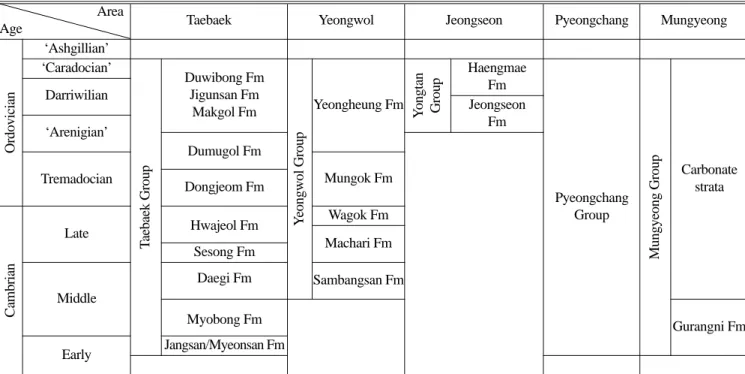
The Joseon Supergroup can be divided into five groups:
Taebaek, Yeongwol, Yongtan, Pyeongchang, and Mungyeong groups (Choi, 1998a) (Table 2). It rests unconformably on Precambrian granitic gneiss and metasedimentary rocks, and is overlain unconformably by post-Ordovician sedi- mentary rocks. The lower Paleozoic sedimentary rocks are shallow marine in origin and consist of carbonate rocks, sandstones and shales.
4.1. Taebaek Group
The Taebaek Group, so-called Duwibong-type Joseon Supergroup (GICTR, 1962; Kobayashi, 1966), has been proposed for the Cambrian-Ordovician strata that occur in the east of the Deokpori (=Gakdong) thrust (Choi, 1998a) (Fig. 1). It is further divided into the Jikdong and Sangdong subgroups: the Jikdong Subgroup consists primarily of the Cambrian successions (Jangsan/Myeonsan, Myobong, Daegi, Sesong, and Hwajeol formations), whereas the Sangdong
Table 2. Lithostratigraphic summary of the Cambrian-Ordovician Joseon Supergroup in the Taebaeksan Basin, Korea. (modified after Choi, 1998a)
Area
Age Taebaek Yeongwol Jeongseon Pyeongchang Mungyeong
Ordovician
‘Ashgillian’
‘Caradocian’
Taebaek Group
Duwibong Fm Jigunsan Fm
Makgol Fm
Yeongwol Group
Yeongheung Fm Yongtan Group
Haengmae Fm
Pyeongchang Group
Mungyeong Group
Carbonate strata Darriwilian
Jeongseon
‘Arenigian’ Fm
Dumugol Fm
Tremadocian Mungok Fm
Dongjeom Fm
Cambrian
Late Hwajeol Fm Wagok Fm
Machari Fm Sesong Fm
Middle
Daegi Fm Sambangsan Fm
Myobong Fm Gurangni Fm
Early Jangsan/Myeonsan Fm
Subgroup mostly comprises the Ordovician strata (Dongjeom, Dumugol, Makgol, Jigunsan, and Duwibong formations) (Cheong, 1969; Choi, 1998a) (Table 2). Recent sedimento- logical studies suggested that the Taebaek Group formed on a low-gradient, mixed carbonate-siliciclastic platform, influenced by sea-level fluctuations (Park et al., 1985; Park and Han, 1986; Paik, 1987; Woo and Park, 1989; Lee Y.I. and Kim J.C., 1992; Kim J.C. and Lee Y.I., 1998; Woo, 1999;
Chough et al., 2000; Lee Y.I. et al., 2001; Kwon et al., 2002).
4.1.1. Jangsan Formation
The Jangsan Formation is the basal unit of the Taebaek Group and has been known to be 40–200 m in thickness (Lee H.Y., 1987a). It rests unconformably on or in cases in fault contact with the Precambrian Yulli Group or granitic gneiss. It is exposed well along the southern margin of the Taebaeksan Basin stretching from Taebaek to Danyang, but occurs as isolated patches in the northern part of the Tae- baeksan Basin.
The formation comprises a rather monotonous lithology of milky white to light brown coarse-grained quartzites, with occasional cross-beds. The lower part is characterized by containing well-rounded gravels of quartzite, slate, and granitic gneiss. Gravels are generally less than 5 cm in diameter, but often reach up to 50 cm. Son and Cheong (1965) divided the formation in Dongjeom area into the three members: the lower conglomeratic quartzite member measures 4 m thick; the middle Jorok member (ca. 50 m thick) is an alternating interval of light gray fine-grained sandstone and siltstone beds; and the upper Jangsan mem- ber is a 150-m-thick sequence of milky white quartzites. No fossils have been reported from the formation.
Although Yun (1978) interpreted that the formation was formed in a nearshore beach environment, thick massive and horizontally stratified sandstone beds in the Jangsan Formation represent deposition in a shoreface environment where oceanic currents were prevalent.
4.1.2. Myeonsan Formation
The Myeonsan Formation (40–60 m thick) is stratigraph- ically contemporaneous with the Jangsan Formation to the west and occurs to the east of the Dongjeom fault (Cheong et al., 1973; Kim J.Y. and Cheong, 1987; Choi et al., 2004b).
The base of the Myeonsan Formation is recognized by the occurrence of a several-meter-thick disorganized conglom- erate bed, which unconformably overlies the Precambrian granite and granite gneiss, and grades upwards into a thick sandtone facies. The sandstone facies includes cross- or crudely-stratified sandstone, and massive to normally graded sandstone. The stratification is formed by alternation of coarse-grained sandstone and fine-grained sandstone layers.
The stratified sandstone bed is interlayered with massive sandstone or small pebble- to granule-grade conglomerate bed which occasionally exhibits normal grading. Dark-gray
mudstone layers are also intercalated with the sandstone facies. The lateral geometry and internal boundary of the sandstone beds are diffused and amalgamated. The mud- stone facies becomes dominant in the upper part of the for- mation, which represents a transitional facies to the overlying Myobong Formation. The mudstone is characterized by dark gray in color and wavy to parallel laminae of silt and fine sands. The laminated mud is interbedded with homo- geneous mud. Fine to coarse sands are scattered within the mudstone facies and occasionally form thin layers. The top of the formation is drawn at the base of dark gray, homo- geneous mudstone bed of the Myobong Formation. Kim J.Y. (1991) reported the occurrence of a trace fossil Skolithos in the formation.
The Myeonsan Formation formed in restricted shoreface environment where tidal currents were dominant. Tidal bed- ding and bi-directional tidal currents are indictive of dep- osition in restricted bay or basin margin environments.
4.1.3. Myobong Formation
The Myobong Formation is conformably underlain by the Jangsan or Myeonsan formations and measures 70–120 m in thickness. It is dominated by fine-grained clastic sedi- mentary rocks, composed largely of dark gray to greenish gray sandstone and mudstone (Choi et al., 2004b). The base of the formation has been conventionally recognized by the occurrence of dark gray slate, whereas its top was contro- versial in the past. Han (1969) divided the Myobong For- mation in Yeonhwa Mine area into three parts: the lower M1 member (150–200 m thick) is dominated by dark gray to greenish gray slate; the middle M2 member (4–10 m thick) is composed of limestone; and the upper M3 member (ca. 50 m thick) consists of alternating slate and limestone layers. On the other hand, Cheong (1969) restricted the Myobong Formation to include the lower M1 member only, while assigning the M2 and M3 members of Han (1969) to the Daegi Formation, which is followed in this study.
Mudstone facies of the Myobong Formation are inter- preted as deposits by hemipelagic settling of siliciclastic muds with sporadic input of siliciclastic or carbonate sands.
The hemipelagic sedimentation probably occurred in outer shelf environment.
4.1.4. Daegi Formation
The Daegi Formation comprises typically milky white to light gray, massive to thin-bedded limestone with some oolitic and dolomitic limestone (Cheong, 1969). The Daegi Formation roughly corresponds to the Pungchon Formation of GICTR (1962). The boundary between the Myobong and Daegi formations is gradational with an interval of alter- nating limestone and shale layers, but has been convention- ally drawn at the horizon where shale disappears (Han, 1969). In this study, the lower limestone-shale alternating interval is assigned to the Daegi Formation following the
proposal by Cheong (1969).
Han (1969) differentiated the Pungchon Formation in Dongjeom area into nine units, which led Yun (1978) to consider a shallow marine setting for depositional environ- ment of the formation. Cheong (1969) divided the forma- tion into the lower shale-limestone alternating member and the upper Pungchon member. The base of the Daegi For- mation is easily recognized by the occurrence of oncolitic grainstone bed, which overlies greenish gray slate of the Myobong Formation (Choi et al., 2004b). The lower part of the Daegi Formation comprises oncolitic grainstone, oolitic grainstone, anastomosing wackestone to packstone, lime- stone-shale couplet, nodular shale, massive mudstone, and laminated mudstone. The upper part of the Daegi Forma- tion is characterized by predominance of massive lime- stone, with occasional bioclastic and oolitic grainstone and anastomosing wackestone to packstone beds. Bioclastic limestone beds yield Middle Cambrian trilobites.
The Daegi Formation has been interpreted as deposits of shallow marine setting above the wave base (Yun, 1978;
Kim and Park, 1981) or tidal flat to slope environments (Park and Han, 1986, 1987a, 1987b; Park et al. 1987). The oncolitic and oolitic grainstone beds at the lowermost part of the Daegi Formation (Choi et al., 2004) represent subtidal shoal environments, whereas sedimentary facies of the upper part are indicative of shallow subtidal deposition.
4.1.5. Sesong Formation
Kobayashi (1930) established the Sesong Formation for the interval of purple to gray slate with intercalation of thin fine-grained sandstone and limestone beds in Sesong and Hwajeol areas, whereas GICTR (1962) and Cheong (1969) assigned the formation to the lowermost member of the Hwa- jeol Formation. The Sesong Formation is herein treated litho- logically distinctive enough to maintain its formational rank.
The Sesong Formation is dominated by dark gray slate with occasional sandstone and limestone layers. In places, the limestone conglomerates contain clasts of several cm (up to 20 cm) in maximum diameter. The formation mea- sures 10–70 m in thickness and is well traced in the south- ern part of the basin, although it is often difficult to recognize in the northern part of the basin.
Park et al. (1985) interpreted that the formation would represent ancient submarine fan deposits formed by turbid- ity currents and debris flows. Fine irregular laminations in the mudstone beds associated with sand layers are sugges- tive of prevalent density currents generated from the basin margin.
4.1.6. Hwajeol Formation
Kobayashi (1935) proposed the Hwajeol Group for the Upper Cambrian strata that are largely composed of alter- nating limestone and shale beds, and recognized five Upper Cambrian biozones (Prochuangia, Chuangia, Kaolishania,
Dictyites, and Eoorthis zones in ascending order) within the group. GICTR (1962) lowered its rank to the formation and Cheong (1969) divided the formation into three members:
the lower member (up to 100 m in thickness) is character- ized by an alternation of limestone and marlstone/shale, showing a conspicuous banded structure; the middle mem- ber (ca. 20 m thick) is an alternating sequence of sandstone and limestone with occasional limestone conglomerate beds; and the upper member (ca. 60 m thick) is also an alternating succession of limestone, marlstone/shale, and limestone conglomerate beds.
Reedman and Um (1975) considered its depositional environment as shallow marine with intermittent subaerial exposures. On the other hand, Yun (1978) postulated that the alternating units of shale and limestone beds represent deposition in deep-sea environment. Kim J.Y. and Park (1981) also suggested that the Hwajeol Formation was deposited in deeper environments, although Park (1985) and Park and Han (1985) interpreted that the limestone con- glomerates and limestone-shale couplets were formed below storm-wave base. Bioturbated fabric and centimeter- scale alternation of shale and lime-mudstone or wackestone beds represents subtidal deposition in ramp environments (e.g., Markello and Read, 1981).
4.1.7. Dongjeom Formation
The Dongjeom Formation is characterized by quartzite, forming prominent ridges or cliffs (Cheong, 1969; Park, 1992). In general, the boundary between the Hwajeol and Dongjeom formations has been poorly defined. The Hwa- jeol Formation has been known to comprise worm-eaten limestone, ribbon limestone, or rhythmite (Cheong, 1969;
Park, 1985), whereas the Dongjeom Formation is composed almost exclusively of quartzite (Cheong, 1969; Park, 1992).
The Dongjeom Formation is well exposed along the south- ern margin of the Taebaeksan Basin, but is rarely recog- nized in the northern part of the basin. The thickness of the formation ranges from less than 50 m (Kobayashi, 1966) to 100 m (Choi et al., 2004b).
The Dongjeom Formation is composed predominantly of dark gray to light brown sandstone, with occasional inter- calations of shale and limestone conglomerate layers. The quartzites are generally massive, but also show parallel- to cross-stratification. In the Seokgaejae section (Choi et al., 2004b), the formation is divided into the three members.
The lower member comprises an alternating interval of fine-grained sandstone and dark gray mudstone beds. The sandstone beds are generally massive, but often show nor- mal grading or thin lamination. The middle member repre- sents the typical lithology of the formation composed largely of coarse-grained sandstone. The upper member is characterized by fine- to medium-grained sandstone with infrequent limestone layers.
Detailed sedimentological studies of the Dongjeom For-
mation have not been made yet, although some diagenetic studies on the quartzites (Park, 1992; Kim Y. and Lee Y.I., 1999, 2000, 2004) assumed their deposition in the shallow marine environments.
4.1.8. Dumugol Formation
The Dumugol Formation was originally designated as
‘Tomkol shale’ (Yamanari, 1926) and the first systematic study on the Dumugol fauna was made by Kobayashi (1934b). In the past, the boundary between the Dumugol and Makgol formation was generally placed at the upper- most occurrence of shale facies in the Dumugol Formation.
However, the occurrence of shale beds across the putative formational boundary is highly variable from section to sec- tion. In this study, the definition of the Dumugol Formation is followed that of Choi et al. (2004b) who proposed to include the cyclic succession of shale- and carbonate-dom- inant facies for the Dumugol Formation. The Dumugol For- mation can be easily distinguished from the overlying Makgol Formation which is characterized by dolostone- dominant facies. The formation measures 150–270 m in thickness.
The Dumugol Formation was divided into five units in the Dongjeom section (Kim J.C., 1995): the lowest unit 1 consists of sandstone-mudstone couplet, limestone con- glomerate, and wackestone/packstone; unit 2 is an alternat- ing sequence of ribbon rock and limestone conglomerate;
unit 3 is dominated by thick-bedded marlstone and shale with occasional ribbon rock, limestone conglomerate, bio- clastic grainstone layers; unit 4 is characterized by nodular to planar-bedded ribbon rock with limestone conglomerate and bioclasticn grainstone beds; and the uppermost unit 5 is a thick (ca. 100 m) sequence of thick-bedded, bioturbated limemudstone/wackestone, marlstone/shale, ribbon rock, limestone conglomerate, and grainstone. On the other hand, the Dumugol Formation in the Seokgaejae section (Choi et al., 2004b) is differentiated into three members: the lower member (73 m thick) is dominated by shale facies with occasional limestone-shale couplet, nodule-bearing shale, and limestone conglomerate layers; the middle member (ca.
60 m thick) is characterized by cyclic alternation of lime- stone and shale facies; and the upper member (ca. 70 m thick) is composed predominantly of limestone facies with intercalation of thin shale and limestone-shale couplet beds.
Sponge bioherms in the uppermost part of the upper mem- ber are made up of lithistid sponges (Archaeoscyphia), receptaculid algae (Calathium) and stromatolites, indicating a shallow subtidal environment (Kwon et al., 2003).
The limestone conglomerates of the Dumugol Formation were interpreted to have been deposited in a shallow marine ramp setting, generated by frequent storm activities (Lee Y.I. and Kim J.C., 1992). On the other hand, Kwon et al.
(2002) suggested that most of the limestone conglolemrates are not a product of storm activities, but are pseudocon-
glomerates formed by diagentic autoconglomeration (Chough et al., 2001).
4.1.9. Makgol Formation
The Makgol Formation (250–400 m thick) is confined to the interval of dolostone or peritidal limestone facies with sedimentary structures indicating frequent subaerial expo- sures. The Makgol Formation in the Seokgaejae section is divided into four members. The basal member (about 45 m thick) consists largely of dark gray massive dolostone, occa- sionally intercalated with bioturbated wackestone/grainstone and limestone conglomerate. The succeeding lower member (about 80 m thick) is composed of a variety of lithology including bioturbated wackestone/grainstone, stromatolitic lime mudstone, massive to laminated grainstone, finely- laminated dolomitic lime mudstone, laminated dolostone, grainstone-mudstone couplet, dark gray massive dolostone, limestone conglomerate, and dolostone breccia. The middle member (about 85 m thick) consists of bioturbated wack- estone/grainstone, stromatolitic lime mudstone, laminated grainstone, finely-laminated dolomitic lime mudstone, mas- sive dolostone, and dolostone breccia. The upper member (about 60 m thick) is lithologically similar to the lower member and comprises bioturbated wackestone/grainstone, stromatolitic lime mudstone, massive to laminated grain- stone, laminated dolostone, grainstone-mudstone couplet, massive dolostone, limestone conglomerate, and dolostone breccia.
The Makgol Formation is characterized by cyclic sedi- mentation of meter-scale shallowing-upward units in a per- itidal environment (Paik, 1987; Woo, 1999). Extensive bioturbaed limestone facies suggest shallow marine environments, whereas intertidal to supratidal facies are represented by stromatolites, desiccation cracks, bird’s-eye structures, and evaporitic mineral casts (Paik, 1987). Brecciated beds of supratidal dolostone are also indicative of widespread sub- aerial exposure (Paik, 1987; Woo, 1999; Choi et al., 2004b).
4.1.10. Jigunsan Formation
The Jigunsan Formation was first named by Yamanari (1926) and is well known to yield abundant and well-pre- served invertebrate fossils. The Jigunsan fauna was studied in detail by Kobayashi (1934a), who described 89 species of invertebrate fossils and correlated them with the Lland- eilian of Europe. On the other hand, GICTR (1962) failed to recognize the uppermost three units of the Taebaek Group (Makgol, Jigunsan, and Duwibong formations) and collectively put them together into the ‘Makdong Forma- tion’. However, subsequent paleontological studies con- firmed that the Jigunsan Formation is lithologically distinct and laterally well traceable in the southern part of the Tae- baeksan Basin (Lee Y.N. and Lee H.Y., 1986; Lee K. and Lee H.Y., 1990; Lee D.C. and Choi, 1992). The conodont studies (Lee Y.N. and Lee H.Y., 1986; Lee K. and Lee H.Y.,
1990) suggest that the formation is of Darriwilian (or Llan- virnian) age.
The Jigunsan Formation (30–60 m thick) is characterized by black shale facies and abundant invertebrate fossils. The lower part of the formation is an alternating sequence of dark gray shale and limestone, while its upper part com- prises mainly black shale. The boundary between the Makgol and Jigunsan formations has not been well established. A recent detailed examination across the boundary interval between the Makgol and Jigunsan formations at the Seok- gaejae section (Choi et al., 2004b) reveals a short (ca. 5 m thick) transitional interval consisting of alternating thin- bedded dark gray calcareous mudstone and lime mudstone layers. The base of the Jigunsan Formation is drawn at the first occurrence of dark gray calcareous shale bed, which is underlain by the oncoid/ooid packstone/grainstone of the Makgol Formation.
The good exposure at the Seokgaejae section enables to subdivide the formation into the lower, middle, and upper members (Woo, 2004): i.e., the lower member (ca. 10 m thick) comprises mainly dark gray homogeneous mudstones with pyritic calcareous nodules; the middle member (ca. 20 m thick) is an alternating interval of laminated calcisiltites and dark gray homogeneous mudstones or greenish gray homogeneous mudstones; and the upper member (about 15 m in thickness) is composed of greenish gray homogeneous mudstones, with some massive packstone/grainstone and limestone con- glomerate beds.
The lower part of the Jigunsan Formation was formed in a basinal to shallow subtidal environment of mixed carbon- ate-siliciclastic platform where deposition was largely influ- enced by storms. The platform gradually shallowed and transformed into a higher energy shallow subtidal platform during the transgressive and the following stillstand phase of relative sea-level rise in the Middle Ordovician (Darri- wilian) (Woo, 2004).
4.1.11. Duwibong Formation
The Duwibong Formation, the uppermost unit of the Tae- baek Group, rests conformably on the Jigunsan Formation and is overlain unconformably by the upper Paleozoic Pyeongan Supergroup. Kobayashi (1934a) described diverse invertebrate fossils from the formation and, based on faunal contents, correlated the formation with the Toufengian of North China, Caradocian of Europe, and Blackriverian- Trentonian of North America. On the other hand, Lee Y.N.
and Lee H.Y. (1986) and Lee K. and Lee H.Y. (1990) rec- ognized two Darriwilian (or Llanvirnian) conodonts zones within the formation.
The Duwibong Formation consists largely of massive grainstone/wackstone and calcareous shale with intercala- tion of thin limestone conglomerate beds. A sedimentolog- ical study suggested that the formation was deposited on a storm-influenced open-marine platform (Lee Y.I., 1988).
The formation in the Seokgaejae section measures about 75 m in thickness and consists of oncoid/ooid grainstone, massive packstone/grainstone, flaser wackestone/packstone, bioturbated wackestone/grainstone, limestone-shale cou- plet, and dark gray massive dolomite (Choi et al., 2004b).
The base of the formation is defined by the occurrence of oncoid/ooid grainstone bed, above which siliciclastic sedi- ments are lacking. The lower part of the formation is dom- inated by thick oncoid/ooid grainstone bed, whereas the middle and upper parts comprise massive to bioturbated wackestone to grainstone with lesser amounts of limestone- shale couplet.
The Duwibong Formation was deposited either on a storm-influenced open-marine environment (Lee Y.I., 1988) or shallow subtidal environments ranging from oolitic shoal to restricted lagoon in peritidal environments (Lee Y.I. et al., 2001).
4.2. Yeongwol Group
The Yeongwol Group is divided into the Sambangsan, Machari, Wagok, Mungok, and Yonghung Formations (Koba- yashi, 1966; Choi, 1998a) (Table 2). The lowermost Sam- bangsan Formation consists exclusively of siliciclastic sediments, whereas the upper four formations are com- posed largely of carbonates. The Yeongwol Group occupies the western half of the Taebaeksan basin, bounded princi- pally to the east by the Deokpori (=Gakdong) thrust and its distribution is also strongly controlled by thrust faults (Fig. 3).
Of notable is the Machari thrust, which divides the Yeong- wol area into the western part characterized by a series of imbricated thrust sheets of exclusively Cambrian-Ordovi- cian rocks and the eastern part composed of the upper three formations of the Yeongwol Group and the Permo-Carbon- iferous Pyeongan Supergroup. The geologic age of the group ranges from the middle Middle Cambrian to Middle Ordovician (Choi, 1998a).
4.2.1. Sambangsan Formation
The Sambangsan Formation is the lowermost unit of the Yeongwol group and consists of purple to greenish gray siltstone and shale in the lower part, and greenish to yel- lowish gray, fine-grained, micaceous sandstone in the upper part. Sandstones are mainly composed of fine to very fine quartz, feldspar, mica, clay and opaque minerals. Quartz grains constitute 70–80% of framework grains and are sub- angular to subrounded in outline.
The formation has been known to range in thickness from ca. 420 m (Yosimura, 1940) to over 750 m (Reinemund, 1956), but the unexposed base of the formation and frequent incur- sions of thrust faults and folds within the formation hinder to estimate its full thickness with certainty. Trilobites occur commonly in the upper part of the formation (Choi et al., 1999).
4.2.2. Machari Formation
The Machari Formation has been known to yield well- preserved Middle to Upper Cambrian trilobites with some brachiopods and gastropods, the ‘Machari fauna’ (Koba- yashi, 1962). It crops out in narrow belts within the thrust sheets west of the Machari thrust fault. Yosimura (1940) suggested the thickness of the formation to be 400 m, whereas Lee J.G. (1995) estimated it not to exceed 200 m.
The base of the formation is recognized by the occur- rence of dark-gray argillaceous limestone and thick-bedded bioclastic grainstone/packstone beds which contain well- preserved Middle Cambrian trilobites such as Tonkinella, Olenoides, Dorypyge, and Peronopsis. These beds are under- lain by yellowish gray micaceous sandstone of the Sam- bangsan Formation and are succeeded by a sequence of dark gray dolomitic limestone, shale, and lime breccia, which characterizes the lower part of the Machari Forma- tion. Recently Hong et al. (2003a) recognized the Lejopyge armata Zone from the dolomitic limestone beds. The mid- dle part is dominated by laminated dark gray to black shale with occasional intercalations of thin dolomitic limestone beds and is very fossiliferous. The upper part is poorly fos- siliferous, but shows a typical banded appearance, formed by alternating units of thin-bedded, light gray dolomitic limestone and black shale beds (Lee J.G., 1995). The banded structure becomes obscure in the uppermost part and grades into massive dolostone of the Wagok Formation.
Although the depositional environment of the Machari For- mation has not been studied in detail, the predominance of laminated black shale facies and the abundant occurrence of cosmopolitan trilobite taxa in the formation suggest deposition in a dysaerobic deep-water environment (Chough et al., 2000).
4.2.3. Wagok Formation
The Wagok Formation is characterized by a monotonous sequence of light gray to gray massive dolostone and is poorly fossiliferous. It is mainly exposed in the thrust sheets west of the Machari thrust fault, but also occurs in the vicin- ity of Yeongwol east of the Machari thrust. The formation has been known as thick as 500 m (Lee H.Y., 1987a), but may not exceed 250 m in thickness (Park et al., 1994). The age of the formation has been assigned to the uppermost Cambrian (Kobayashi, 1966).
The massive dolostone facies may be originally com- posed of peloids, bioclasts, or ooids, although it is difficult to recognize the nature of original grains due to dolomiti- zation. The thick succession of dolostone facies suggests a shallow marine environment above the wave base such as carbonate shoals where persistent grain mobility can be maintained by water turbulence or tidal activity.
4.2.4. Mungok Formation
The Mungok Formation (140–210 m thick) is composed predominantly of carbonate with minor amounts of shale,
indicating a shallow marine environment. In northern Yeo- ngwol, the formation is divided into four members based on the association of dominant lithofacies such as ribbon rock, grain- to packstone, limestone conglomerate, and marlstone to shale facies (Kim D.H. and Choi, 2000b).
The basal Garam Member (30–55 m thick) consists mainly of ribbon rock and grainstone/packstone with local interca- lations of thin limestone conglomerate beds and chert lay- ers. The thick (>10 m) interval of chert-layer-bearing grainstone/packstone beds occurs in the middle part of the Garam Member and is very useful in recognizing the Garam Member in the field. The superjacent Baeiljae Mem- ber (30–35 m thick) is a monotonous sequence of light gray to gray, massive to crudely-bedded dolostone, which is indistinguishable from the Wagok Formation based solely on lithology. The Jeommal Member (30–50 m thick) is an alternating unit of ribbon rock and limestone conglomerate beds, and the uppermost Dumok Member (40–77 m thick) comprises ribbon rock, grainstone/packstone, limestone conglomerate, and marlstone to shale, and is distinguished from other members by the occurrence of greenish gray marlstone to shale beds. Trilobites occur in three strati- graphically separated intervals: the Yosimuraspis vulgaris Zone in the lowermost Garam Member, Kainella euryra- chis Zone from the lowermost bed of the Jeommal Member, and the Shumardia pellizzarii Zone within the Tumok Member (Kim D.H. and Choi, 2000b).
The Mungok Formation has been interpreted to represent a shallow subtidal environment comprising lagoonal/restricted marine, shoal, inner shelf, and outer shelf facies (Kim and Choi, 2002).
4.2.5. Yeongheung Formation
The Yeongheung Formation is the least understood for- mation within the Yeongwol Group. It has been generally known to consist of massive to thick-bedded, light to dark gray dolostone in its lower part and bluish gray limestone in its upper part (Lee H.Y., 1987a). However, both the base and the top of the formation are not well established and further its lithologic succession varies from section to sec- tion. Nevertheless, Choi and Woo (1993) and Yoo et al.
(1994) recognized diverse lithofacies within the formation, indicationg a supratidal to subtidal environment. It is gen- erally poorly fossiliferous, but has been reported to yield tri- lobites, brachiopods, cephalopods (Kobayashi, 1966), conulariids (Choi and Jeong, 1990), stromatoporoids (Lee D.J. and Yoo, 1993; Kano et al. 1994), and conodonts (Lee S.J., 1989). The formation is estimated to be ca. 400 m (Yosimura, 1940) and 750 m (Reinemund, 1956).
4.3. Yongtan, Pyeongchang, and Mungyeong Groups 4.3.1. Yongtan Group
The Yongtan Group is proposed to replace the Jeongseon-
type Joseon Supergroup, which is exposed mainly in the Jeongseon area (Choi, 1998a) and has been divided into the Jeongseon and Haengmae formations (Cheong et al., 1979b) (Table 2). However, the stratigraphy of the Yongtan Group and its relationship to other groups of the Joseon Super- group is still unclear. The Jeongseon Formation comprises mainly gray to bluish gray limestone and dolomitic lime- stone and yields Darriwilian to Caradocian conodonts (Lee H.Y., 1985). The Haengmae Formation consists of light brown conglomeratic limestone and milky white to gray limestone and is overlain unconformably by the Silurian Hoedongni Formation.
The Yongtan Group was first studied by Hisakoshi (1943) who recognized the stratigraphy of the Jeongseon area dif- ferent from that of the Taebaek-Samcheok area. GICTR (1962) assigned the carbonate sequence of the Jeongseon area to the Jeongseon Limestone, which was supposed to rest conformably on the Makgol Formation of the Taebaek Group, whereas Kim O.J. et al. (1973) considered that the Jeongseon Limestone of GICTR (1962) would represent the structural repetition of the Hwajeol, Tumugol, and Makgol formations of the Taebaek Group. On the other hand, Son and Jeong (1976) subdivided the lower Paleozoic strata of Jeongseon area into the Makgol, Jeongseon, and Hangmae formations in ascending order and further suggested that the Haengmae Formation rest unconformably on the former two formations. Cheong et al. (1979b) interpreted that the Joseon Supergroup of Jeongseon area consists of the Jeong- seon Limestone and Hangmae Formation, the geologic age of which is confined within the Ordovician.
4.3.2. Pyeongchang Group
The name Pyeongchang Group was first employed for part of siliciclastic-carbonate sequence exposed in Pyeo- ngchang area (Son and Jeong, 1971). The Pyeongchang Group was redefined to comprise the putatively lower Pale- ozoic sequence exposed in Pyeongchang and adjacent areas (Choi, 1998a; Table 2) and is however poorly understood.
No fossils have been recovered from the formation.
The Joseon Supergroup in Pyeongchang area was first studied by Hukasawa (1943) who subdivided it into the Songbong Schist, metamorphosed Great Limestone Series, and Dunjeon Formation in ascending order. Kobayashi (1966) correlated the Songbong Schist with the Jangsan and Myobong formations and the Dungjeon Formation with the Sesong, Hwajeol, Dongjeom, and Dumugol formations. On the other hand, Son and Jeong (1971) presented a pro- foundly different lithostratigraphic scheme for the Pyeo- ngchang area: (1) the Songbong Schist was renamed as the Bangnim Group and was assigned to the Precambrian; (2) the Anmiri and Pyeongchang [sensu stricto Son and Jeong (1971)] groups were considered to rest unconformably on the Bangnim Group; (3) the Haenghwadong and Banghak- dong formations of the Anmiri Group were correlated with
the Jangsan and Myobong formations, respectively; and (4) the Pyeonchang Group of Son and Jeong (1971) supposedly underlain by the Anmiri Group was treated to be younger than the Joseon Supergroup. Cheong et al. (1979a) subdi- vided the Pyeongchang-type Joseon Supergroup into the Jangsan, Myobong, Pungchon, Daehari, Iptanni, and Jeong- seon Formations in ascending order, suggesting its lateral equivalence with the Taebaek and Yongtan groups.
4.3.3. Mungyeong Group
The Mungyeong Group was proposed for the Cambrian- Ordovician strata of the Mungyeong-type Joseon Super- group exposed in Mungyeong area (Son, 1971). The Mungyeong- type Joseon Supergroup was bounded to the east by the Seokhyun thrust and to the west by the Sangnaeri thrust (Kobayashi et al., 1942).
The Mungyeong Group has been divided into the Gurangni, Maseong, Hanaeri, Seokgyori, Jeongni, and Dotanni forma- tions in ascending order (Aoti, 1942). The Gurangni For- mation consists of purple to dark gray shale, whereas the overlying formations are dominantly of carbonates. Koba- yashi (1961) reported the occurrence of an Early Cambrian trilobite Redlichia from the Gurangni Formation (cf. Lee D.Y. and Lee H.Y., 1985), Middle to Late Cambrian trilo- bites from the Maseong and Hanaeri formations, and Ordovician fossils from the Dotanni Formation. However, later workers failed to confirm the lithostratigraphy estab- lished by Aoti (1942), and generally subdivided it into the Gurangni Formation in the lower and undifferentiated carbon- ate strata in the upper (Um et al., 1977; Lee H.Y., 1987b; Lee H.Y. et al., 1993a, 1993b; Choi, 1998a) (Table 2).
5. BIOSTRATIGRAPHY
The biostratigraphy of the Joseon Supergroup has been independently explored by trilobites and conodonts. In this section, the trilobite biostratigraphy of the Taebaeksan Basin will be exclusively treated (Table 3). The conodont biostratigraphy of the Taebaeksan Basin has recently been summarized by Lee B.S. and Seo (2004).
Kobayashi (1933) introduced the first biozonation for the Upper Cambrian strata in Korea, which was followed by proposal of three Lower Ordovician zones within the Dumugol and Makgol formations (Kobayashi, 1934b): i.e., the Asaphellus, Protopliomerops, and Clarkella zones in ascending order. The subsequent studies on the trilobite fau- nas (Kobayashi, 1935, 1960a, 1960b, 1961, 1962) formed a basis for establishment of the Cambrian-Ordovician bios- tratigraphic zonation of the Taebaek and Yeongwol groups (Kobayashi, 1966). The contrasting faunal contents of the Taebaek and Yeongwol groups resulted in two separate bio- stratigraphic schemes for the Cambrian-Ordovician of the Taebaeksan Basin (Kobayashi, 1966). Over 20 zones and fossiliferous horizons were recognized in the Taebaek Group,
whereas eleven zones were established in the Yeongwol Group. This biostratigraphic zonation had been widely used, until recently trilobites of the Yeongwol Group were re-examined in detail (Lee J.G. and Choi, 1994, 1995, 1996;
Kim D.H. and Choi, 1995, 1999, 2000a, 2000b; Sohn and Choi, 2002; Hong et al., 2003a; Choi et al., 2004a). The revised trilobite biostratigraphy of the Yeongwol Group (Table 3) provides a more reliable correlation with the Cam- brian-Ordovician biostratigraphic zones established else- where (cf., Geyer and Shergold, 2000). On the other hand, the Cambrian trilobites of the Taebaek Group have not been re-evaluated in detail. Most of the biozones of the Taebaek Group will be summarized based on the information pro- vided by Kobayashi (1966) with a slight modification.
5.1. Taebaek Area
The biostratigraphy of the Taebaek area is briefly sum- marized relied primarily on Kobayashi (1966), but also includes recent suggestions made by Kim K.H. et al. (1991) and Choi et al. (2003). The faunal assemblages of the Tae- baek Group have provided the establishment of 19 biozones:
in ascending order, the Redlichia, Elrathia, Mapania, Bailiella, Megagraulos, Solenoparia, Olenoides, Stephano- care, Drepanura, Prochuangia, Chuangia, Kaolishania, Dic- tyites, Eoorthis, Pseudokainella, Asaphellus, Protopliomerops, Kayseraspis, and Dolerobasilicus zones (Table 3).
5.1.1. Redlichia Zone
This is the lowermost biozone established in the Taebaek Group and Redlichia saitoi is the only trilobite species reported from the Myobong Formation of Dongjeom area (Kobayashi, 1966). In addition, two brachiopod species, Obo- lella aff. asiatica and Salterella (?) orientalis were recov- ered from Dongjeom area. The Redlchia Zone was also documented from Mungyeong area (Kobayashi, 1961) and has been correlated with that of the Longwangmiaoan Stage (upper Lower Cambrian; Mantou Formation) of North China.
5.1.2. Elrathia Zone
The Elrathia Zone from the Myobong Fomration com- prises a trilobite Elrathia taikiensis and a brachiopod Nisu- sia cooperi (Kobayashi, 1935) and has been correlated with the Shantungaspis acilis Zone of the Maozhuangian Stage Table 3. Lithostratigraphic and biostratigraphic summary of the Taebaek and Yeongwol groups, Taebaeksan Basin, Korea.
Age Taebaek Group Yeongwol Group
Formation Biozone Formation Biozone
Ordovician
Ashgillain
‘Caradocian’
Darriwilian
‘Arenigian’
Tremadocian
Diwibong
Yeongheung
Kayserapsis Jigunsan Dolerobasilicus
Makgol
Dumugol
Kayseraspis Protopliomerops
Asaphellus Mungok
Shumardia pellizzarii Kainella euryrachis Yosimuraspis vulgaris Dongjeom Pseudokainella
Cambrian
Furongian Hwajeol
Eoorthis Dictyites Kaolishania
Chunagia Prochuangia
Wagok Fatocephalus hunjiangensis
Machari
Pseudoyuepingia asaphoides Agnostotes orientalis
Eochuangia hana Eugonocare longifrons Hancrania brevilimbata
Proceratopyge tenuis Glyptagnostus reticulatus
Middle
Sesong Drepanura
Stephanocare Glyptagnotus stolidotus
Lejopyge armata Tonkinella Daegi
Olenoides Solenoparia Megagraulos
Sambangsan Megagraulos semicircularis Metagraulos sampoensis Myobong
Bailiella Mapania Elrathia Redlichia Early Jangsan/Myeonsan
(lower Middle Cambrian; Mantou Formation) of Shandong, China (cf. Zhang, 1988).
5.1.3. Mapania Zone
Kobayashi (1935) proposed the Mapania Zone based on the occurrence of Mapania beihoensis from Dongjeom.
However, the occurrence of Mapania from the Myobong Formation was discredited by Zhang (1988) on account of that Mapania is a characteristic element of much younger Amphoton Zone (upper Middle Cambrian; Zhanxian Stage) of North China.
5.1.4. Bailiella Zone
The Bailiella Zone was established based on the occur- rence of Bailiella angusta. It was reported to occur in the lowermost Daegi Formation (Kobayashi, 1960b), but later, without any explanation, was put into the uppermost zone of the Myobong Fomration (Kobayashi, 1966). The genus Bailiella has been known from the Bailiella-Lioparia Zone (middle Middle Cambiran; Xuzhuangian Stage) of North China, with which this zone may be correlatable.
5.1.5. Megagraulos Zone
The Megagraulos Zone comprises two trilobite species, Megagraulos coreanicus and Kootenia damesi, recovered from Dongjeom (Kobayashi, 1935). The genus Megagrau- los was also reported from the Sambangsan Formation of Yeongwol (Choi et al., 1999). The Megagraulos Zone may be correlated with the Crepicephalina Zone (Zhanxian Stage) of North China where Megagraulos coreanicus was docu- mented (Zhang and Jell, 1987).
5.1.6. Solenoparia Zone
The Solenoparia Zone of Kobayashi (1966) has a high species diversity including 16 trilobite and two brachiopod species. Recently, Kang (2004) reported that Solenoparia occurs in a slightly higher horizon than Crepicephalina in the lowermost part of the Daegi Formation, Seokgaejae sec- tion, but correlated the faunal assemblage with the Crepi- cephalina Zone of North China. In North China, Solenoparia has been known to cover a long stratigraphic interval rang- ing from the Kochaspis Zone (lower Middle Cambrian) to the Amphoton Zone (middle Middle Cambrian) (cf., Zhang and Jell, 1987).
5.1.7. Olenoides Zone
The Olenoides Zone from the Daegi Formation was originally improperly defined, as Kobayashi (1935) pro- vided neither illustration nor description of the constitu- ent taxa of the zone. Kang (2004) also failed to recognize Olenoides in the Daegi Formation, but instead recovered its closely related genus Dorypyge which occurs rather consistently from the lower to middle part of the Daegi Formation.
5.1.8. Stephanocare Zone
This zone was recognized by the occurrence of Stepha- nocare richthofeni, Pseudagnostus douvilleri, and Eodiscus (?) sp. from the lower part of the Sesong Formation (Koba- yashi, 1966), and was compared with the Blackwelderia Zone (Gushanian Stage) of North China.
5.1.9. Drepanura Zone
The Drepanura Zone from the upper part of the Sesong Formation has been known to yield 15 trilobite species with some brachipods and gastropods (Kobayashi, 1966), but has not since been relocated in the Taebakesan Basin. It can however be easily correlated with the Drepanura Zone of North China.
5.1.10. Prochuangia Zone
The Prochuangia Zone has been known to occupy the lowermost zone of the Hwajeol Formation and contains Prochuangia mansuyi, P. posterospina, and Pseudoliostracina monkei. Kobayashi (1935, 1966) placed the Prochuangia Zone below the Chuangia Zone in the Taebaek Group, whereas Shergold (1980) doubted that the latter might have preceded the former in reference to the faunal succession in Australia. The Prochuangia Zone appears to be seldom employed in later publications, but is occasionally located below the Chuangia Zone in North China (Qian, 1994;
Zhang and Zhu, 2000).
5.1.11. Chuangia Zone
Kobayashi (1935, 1966) listed ten trilobite, four brachi- opod and three gastropod species from the Chuangia Zone of the Hwajeol Formation. The Chuangia Zone has also been well documented from the Gushan Formation of North China (Sun, 1935; Qian, 1994).
5.1.12. Kaolishania Zone
The Kaolishania Zone has a relatively diverse trilobite fauna, comprising 15 trilobite and five brachiopod species (Kobayashi, 1966) and can be easily traced into many local- ities in North China (Zhang, 1988).
5.1.13. Dictyites Zone
This zone has been characterized by containing a number of trilobites (42 species) and brachiopods (seven species) (Kobayashi, 1966). The genus Dictyites has been synony- mized with Tsinania by Zhang and Jell (1987) and thus the Dictyites Zone may be roughly correlated with the Ptychas- pis-Tsinania Zone of North China. However, a recent pre- liminary investigation (Choi et al., 2003) has shown that Tsinania is associated with Quadraticephalus in the upper part of the Hwajeol Formation. This implies that the ‘Dic- tyites’ Zone can be better accommodated with the Qua- draticephalus Zone than the Ptychaspis-Tsinania Zone of North China. A detailed study on the Upper Cambrian
interval is needed to clarify the biostratigraphic correlation of the Taebaeksan Basin with the lower Paleozoic basins of North China.
5.1.14. Eoorthis Zone
The Eoorthis Zone is rather ambiguously defined in com- prising both typical Cambrian and putatively Ordovician (Pseudokainella) trilobites (Kobayashi, 1966). Choi et al.
(2003) documented successive occurrence of saukiid- and kainellid-dominated faunal assemblages from the interval across the Hwajeol and Dongjeom formations in the Seok- gaejae section, which may provide a more reliable bios- tratigraphy for the Cambrian-Orodvician boundary interval within the Taebaek Group.
5.1.15. Pseudokainella Zone
The Pseudokainella Zone was established based on the sole occurrence of Pseudokainella iwayai from the Dongjeom Formation (Kobayashi, 1953). However, the holotype, the only known specimen of the species, is so poorly preserved that its assignment to Pseudokainella seems doubtful.
Recently Choi et al. (2003) suggested that the Cambrian- Ordovician boundary in the Taebaek Group may be placed within the kainellid-dominated interval of the Dongjeom Formation.
5.1.16. Asaphellus Zone
The Asaphellus Zone was originally erected by Koba- yashi (1934b) and was confirmed by Kim K.H. et al. (1991).
This zone is easily recognized by the common occurrence of Asaphellus from the lower half of the Dumugol Forma- tion. Asaphellus is a cosmopolitan trilobite genus in the Lower Ordovician, especially Tremadocian, which provides a basis for correlation of the Asaphellus Zone with the upper Tremadocian biozones of North China (Zhou and Fortey, 1986), South China (Peng, 1990), and Australia (Shergold, 1975).
5.1.17. Protopliomerops Zone
The Protopliomerops Zone was also established by Koba- yashi (1934b) and was maintained by Kim K.H. et al. (1991).
However, it should be admitted that the Protopliomerops Zone has not been not well defined due to sporadic occurrence of the trilobites in the middle part of the Dumugol Formation.
Nonetheless the occurrence of Apatokephalus and Hystri- curus in the Gumunso section (Kim K.H. et al., 1991) sug- gests that this zone can be bracketed within the upper Tremadocian.
5.1.18. Kayseraspis Zone
The Kayseraspis Zone (Kim K.H. et al., 1991) was pro- posed to replace the Clarkella Zone of Kobayashi (1934b).
Although Kobayashi (1966) put the Clarkella Zone to the lowermost zone of the Makgol Formation, Kim K.H. et al.
(1991) recognized the occurrence of Kayseraspis and Asapho- posoides from the upper part of the Dumugol Formation and assigned the Kayseraspis Zone to the Arenigian. Closely allied faunas to the Kayseraspis Zone were documented in Danyang (Choi, 1998b), North China (Zhou and Fortey, 1986), South China (Peng, 1990), and other parts of the world.
5.1.19. Dolerobasilicus Zone
Trilobites of the Jigunsan Formation were first studied by Kobayashi (1934a) who described a total of seventeen spe- cies. Lee H.Y. et al. (1980) added five new species to the list. However, Lee D.C. and Choi (1992) based on re-eval- uation of the Jigunsan trilobite fauna concluded that only four species are recognizable within the formation: they are Dolerobasilicus yokusensis, Basiliella kawasakii, Basiliella typicalis, and Ptychopyge dongjeomensis. Choi et al. (2001) proposed the Dolerobasilicus Zone for the fossiliferous interval of the Jigunsan Formation. The conodont faunal assemblage (Lee Y.N. and Lee H.Y., 1986) suggested a Llanvirnian (Darriwilian) age for the formation.
5.2. Yeongwol Area
Recent extensive trilobite studies on the Yeongwol Group provided a refined biostratigraphic scheme different mark- edly from that suggested by Kobayashi (1966). A total of 17 biozones have been recognized within the group (Table 3): from oldest to youngest, Metagraulos sampoensis and Megagraulos semicircularis zones of the Sambangsan For- mation (Choi et al., 1999); Tonkinella, Lejopyge armata, Glyptagnostus stolidotus, Glyptagnostus reticulatus, Pro- ceratopyge tenuis, Hancrania brevilimbata, Eugonocare longifrons, Eochuangia hana, Agnostotes orientalis, and Pseudoyuepingia asaphoides zones of the Machari Forma- tion (Lee J.G. and Choi, 1994, 1995, 1996; Lee J.G., 1995;
Choi and Lee J.G. 1995; Hong et al., 2003a, 2003b; Choi et al., 2004a); Fatocephalus hunjiangensis Zone (Sohn and Choi, 2002); Yosimuraspis vulgaris, Kainella euryrachis, and Shumardia pellizzarii zones of the Mungok Formation (Choi et al., 1994; Kim D.H. and Choi, 1995, 1999, 2000a, 2000b); and Kayseraspis Zone (Choi, 1998b).
5.2.1. Metagraulos sampoensis Zone
The Metagraulos sampoensis Zone is recognized by the exclusive occurrence of the nominal species in the lower part of the Sambangsan Formation exposed in the Eodungol section, Yeongwol (Choi et al., 1999). The genus Meta- graulos has so far been documented from the Metagraulos Zone of the Xuzhuangian Stage of North China (Zhang and Jell, 1987) and hence the Metagraulos sampoensis Zone can be assigned to the middle Middle Cambrian in age.
5.2.2. Megagraulos semicircularis Zone
The Metagraulos semicircularis Zone is defined by the
first occurrence of the eponymous species in the upper part of the Sambangsan Formation exposed in the Eodungol sec- tion, Yeongwol, but Megagraulos sampoensis is also observed in the lowermost horizon of the zone (Choi et al., 1999). The occurrence of Megagraulos suggests that this zone is comparable to the Megagraulos Zone of the Tae- baek Group (Kobayashi, 1966) and partly to the Crepiceph- alina Zone (early Zhangxian Stage) of North China (Zhang and Jell, 1987).
5.2.3. Tonkinella Zone
The Tonkinella Zone was established by Kobayashi (1962) based on the prolific occurrence of Tonkinella, Ole- noides, Kootenia, and Peronopsis in the lowermost part of the Machari Formation. This zone has been recognized at the lowermost 12-m-thick interval of the Machari Forma- tion in the Eodungol section (Lee J.G., 1995), but has not been systematically studied. The Tonkinella Zone has no intimate faunas in China, but comparable faunas have been known from the Ehmaniella Zone (middle Middle Cam- brian) of the Great Basin, North America (Sundberg, 1994).
5.2.4. Lejopyge armata Zone
The Lejopyge armata Zone is recognized at the lower part of the Eodungol section, located ca. 30 m above the base of the Machari Formation in the section (Hong et al., 2003a). It yields Lejopyge armata, Lisogoragnostus corean- icus, agnostid genus and species indeterminate, ammagnos- tid genus and species indeterminate, clavagnostid genus and species indeterminate, Cyclolorenzella sp., and Eoshengia? sp.
The Lejopyge armata Zone shows a close affinity with upper Middle Cambrian faunas of South China, in sharing some genera such as Lejopyge, Lisogoragnostus, Cycloloren- zella, and Eoshengia (Yang, 1978; Zhang, 1981; Yang et al., 1991, 1993; Peng and Robison, 2000). In particular, Lejopyge armata was widely documented from upper Mid- dle Cambrian strata in Sweden (Westergård, 1946), Green- land (Robison, 1984, 1988), Siberia (Lermontova, 1940), Kazakhstan (Ergaliev, 1980), western Canada (Pratt, 1992), the Great Basin (Robison, 1984), the Himalaya (Jell and Hughes, 1997), South China (Peng and Robison, 2000), Queensland (Öpik, 1967), Tasmania (Jago, 1976), and Ant- arctica (Cooper et al., 1996). In South China, L. armata first appears in the upper Goniagnostus nathorsti Zone and ranges up into the Lejopyge laevigata and Proagnostus bul- bus zones (Peng and Robison, 2000). In North America and Greenland, L. armata is known from the upper part of the L. laevigata Zone (Robison, 1984). Lisogoragnostus is a long-ranging genus reported from the middle Middle Cam- brian (Acidusus atavus Zone) to the middle Upper Cam- brian of China (Yang et al., 1991, 1993; Peng and Robison, 2000), Idamean (G. reticulatus to Proceratpyge cryptica zones) of Australia (Jago, 1976; Shergold, 1982), Middle Cambrian of Kazakhstan (Ergaliev, 1980; Lisogor et al.,
1988), Marjuman to Steptoean of Laurentia (Rasetti, 1967;
Pratt, 1992; Robison, 1994), and Upper Cambrian of Korea (Lee J.G. and Choi, 1995). Cyclolorenzella has mainly been reported from the upper Middle Cambrian (Paradamesops jimaensis-Cyclolorenzella tuma Zone) to the lower Upper Cambrian (Gushanian; Blackwelderia and Drepanura zones) of China (Chu, 1959; Yang, 1978; Yin and Li, 1978; Zhang and Jell, 1987; Zhu and Wittke, 1989; Zhang et al., 1995) and Korea (Kobayashi, 1935, 1960). Eoshengia was exclu- sively known from the upper Middle Cambrian (Wangcu- nian) of South China (Yang, 1978; Zhang, 1981; Yang et al., 1991, 1993; Peng et al., 2001), until recently Jell and Hughes (1997) described a species from the Himalaya questionably assigned to Eoshengia.
5.2.5. Glyptagnostus stolidotus Zone
The Glyptagnostus stolidotus Zone of the Machari For- mation (Lee J.G. and Choi, 1994; Choi and Lee J.G., 1995) comprises only two agnostoid species, G. stolidotus Öpik, 1961 and Pseudagnostus josepha (Hall, 1863). The Glyptagnostus stolidotus Zone has been well established in Australia (Öpik, 1961, 1963, 1967), South China (Jegorova et al., 1963; Lu and Lin, 1989; Peng and Robison, 2000), Tarim (Wang et al., 1985), Siberian Platform (Lazarenko, 1966), and Kazakhstan (Ergaliev, 1980). Glyptagnostus stolidotus has also been documented from the Crepiceph- alus Zone of North America (Palmer, 1962).
5.2.6. Glyptagnostus reticulatus Zone
The succeeding Glyptagnostus reticulatus Zone com- prises six trilobite species: Glyptagnostus reticulatus, Asp- idagnotus stictus, Innitagnostus innitens, Peratagnostus obsoletus, Olenus asiaticus, and Proceratopyge sp. cf. P.
tenuis (Lee J.G. and Choi, 1994, 1997). The Glyptagnostus reticulatus Zone has been widely recognized throughout the world including South China (Jegorova et al., 1963; Lu, 1964; Lu and Lin, 1989; Peng, 1992; Peng and Robison, 2000), Australia (Öpik, 1961, 1963, 1967; Henderson, 1976; Shergold, 1982), Tarim (Wang et al., 1985), Kaza- khstan (Ergaliev, 1980), the Siberian Platform (Lazarenko, 1966), and Mackenzie Mounatins of Canada (Pratt, 1992).
In addition, the occurrences of Glyptagnostus reticulatus were documented in Scandinavia, the United States, Great Britain, and Antarctica.
5.2.7. Proceratopyge tenuis Zone
The Proceratopyge tenuis Zone occupies a rather poorly- fossiliferous interval between the Glyptagnostus reticulatus and the overlying Hancrania brevilimbata zones and com- prises four trilobite species: Peratoagnostus obsoletus, Pseudagnostus josepha, Proceratopyge tenuis, and Erixa- nium sp. (Lee J.G. and Choi, 1995). It can be correlated with the Proceratopyge fenghwangensis Zone or Innitag- nostus inexpectans-Proceratopyge protracta Zone of South