서 론
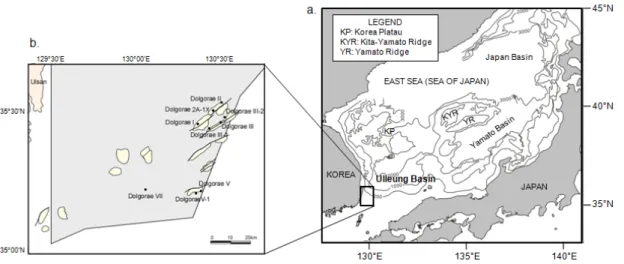
돌고래 III-1과 III-2 시추공은 석유탐사를 위하여 동해의 울릉분지 VI-1 공구에서 시추된 8개의 시추공 중 2개의 시추공이다(Fig. 1). 울릉분지(Ulleung Basin)는 동해의 동남쪽에 위치하고 있는 퇴적분지로서 쓰시마 분지(Tsushima Basin; Frazier et al., 1976; Hyun et al., 1980) 또는 울릉도 분지(Ulleung-do Basin)로 불리 기도 하였다(Kim, 1976). 울릉분지는 동해 남부에 위치하고 있으며, 수심은 약 200-2300 m에 이른다. 주변 에 후포 뱅크(Hupo Bank), 한국대지(Korean Plateau), 오키 뱅크(Oki Bank) 등과 인접하며, 북동쪽으로 야 마토 해령(Yamato Ridge) 그리고 기타-야마토 해령(Kita-Yamato Ridge) 등으로 연결된다(Chough, 1983;
Hirayama, 1991). 탄성파 탐사자료에 의하면 울릉분지는 제3기 후기 및 제4기에 형성된 저탁암(turbidite) 및 원양성(hemipelagic) 퇴적물이 10 km 이상의 두께로 발달하고 있다(Chough and Barg, 1987). 이들 퇴적물 에서는 유공충과 와편모조류 등을 비롯한 다양하고 풍부한 미화석들이 산출하는 것으로 보고되어 있다(한국 석유공사, 1999). 울릉분지 남부 수심 200-1500 m해역의 대륙붕과 대륙사면에 위치한 VI-1 광구는 지구조 적으로 역단층을 경계로 하여 변형되지 않은 남서부와 변형된 북동부로 나뉘어 진다(Inoue, 1982; Chough and Barg, 1987; Park, 1992). 1973년 돌고래 I호공을 시작으로 한국석유개발공사가 8개의 시추를 시행하였 으며, 그 중 돌고래 II 구조와 돌고래 III 구조에서 가스가 발견되었으나, 경제성이 낮은 것으로 평가되었다(이 호영, 1994).
유공충(Foraminifera)은 전세계적으로 널리 그리고 유용하게 이용되는 미화석으로서 특히, 석유개발을 위 한 탐사 및 연구에 있어서 대상 퇴적암의 고환경(paleoenvironment) 및 생층서(biostratigraphy)를 규명하는 데 매우 유용하게 이용되고 있다. 저서성 및 부유성 유공충은 해양의 모든 심도와 환경에서 서식하며 심도별,
*Corresponding author E-mail: [email protected]
돌고래 III-1과 돌고래 III-2 (동해 울릉분지) 시추공의 유공충 생층서 및 고환경: REVIEW
강소라1,*․변현숙2․박순옥2․이병수3․정철환4․박명호5
1부산대학교 산업자원지질재해연구소, 609-735, 부산시 금정구 부산대학로 63번길 2
2(주)자연사연구소, 305-701, 대전시 유성구 문지동 103-6, 카이스트 ICC F710
3전북대학교 지구환경과학과, 561-756, 전북 덕진구 덕진동 1가 664-14
4순천대학교 한국경관지질연구소, 540-742, 전남 순천시 매곡동 315
5한국석유공사 석유개발연구원 CCS 전담반, 431-711, 경기도 안양시 동안구 관양동 1588-14
요 약: 동해 울릉분지의 돌고래 III-1과 돌고래 III-2 시추공에서 산출되는 유공충 군집을 분석하여 유공충 생층 서대(biozone)를 설정하고 고환경을 복원하였다. 돌고래 III-1 시추공은 하부로부터 Cylclammina-Haplophragmoides Zone(중기 마이오세)/Rare to Barren Zone(후기 마이오세)/Elphidium Zone(플라이오세)으로 분대되었다. 이 시기 동안 고해양환경은 상부 반심해(upper bathyal)-육상 연안(coastal)-천해(neritic)로 변화한 것으로 해석된 다. 돌고래 III-2 시추공은 하부로부터 Cyclammina-Haplophragmoides Zone(중기 마이오세)/Barren Zone(후 기 마이오세)/Cassidulina yabei Zone(플라이오세)/Globorotalia truncatulinoides Zone(플라이스토세)으로 분대되었으며, 각각 상부 반심해(upper bathyal)-육상 연안(coastal)-외천해(outer neritic)-내천해(inner ner- itic)의 환경에서 형성되었다. 플라이오세~플라이스토세 동안 울릉분지에는 난류와 한류가 혼합되는 해역이 형 성되었다.
주요어: 울릉분지, 돌고래 시추공, 유공충, 생층서대, 고환경
수온별로 특징적으로 분포하고 있기 때문에, 고분지 발달사나 고수심, 고환경 추정에 이용되고 있다 (Kennett, 1982). 따라서 유공충 화석을 이용한 퇴적암의 연구는 퇴적암의 생성 시기와 생성 당시의 고수심, 고수온, 고기후 등의 고환경을 알 수 있게 해주며, 이러한 연구 결과는 퇴적분지의 형성과 변화에 관한 분지 발달사 연구에 매우 유용한 정보를 제공한다.
최근 CO2 지중저장 사업을 위한 연구로 인하여 울릉분지에 대한 기존의 연구들이 재해석되고 재평가되고 있다. 그러나 석유탐사 시추공을 이용한 연구는 그동안 보고서와 학위논문으로만 발간되었으며, 학술적인 연 구 논문은 부족한 실정이다. 이 논문은 이러한 최근 연구의 일환으로서, 한국석유공사에서 발간한 보고서 (1999)의 자료를 바탕으로 돌고래 III-1 및 돌고래 III-2 시추공에서 산출되는 유공충 군집을 분석하여 시추공 내 퇴적암의 표준 생층서대 설정 및 고환경의 변화를 재해석해 보고자 한다.
기존연구
동해의 퇴적층에서 수행된 지질학적 연구는 일본분지(Japan Basin)와 야마토 분지(Yamato Basin)에서 이 루어진 DSDP (Deep Sea Drilling Project)의 Leg 31에서의 연구(1975)와 ODP (Ocean Drilling Program)의 Leg 127과 Leg 128에서의 연구(1990, 1992)가 있다. 이들 연구를 통하여 부유성 및 저서성 유공충은 고환경 과 고해양학적으로 풍부한 정보를 제공하였다(Karig et al., 1975; Ingle et al., 1990; Pisciotto et al., 1992).
그러나 일본분지와 야마토 분지에서 획득한 시추공의 경우, 상부 Pliocene과 Quaternary 퇴적물을 제외하고 는 탄산염의 용해(dissolution) 및 속성작용(diagenesis)의 영향으로 석회질 유공충의 보존 상태가 비교적 불 량하여 Pliocene 이전의 지층에 대한 생층서와 고환경의 연구는 다소 불분명한 경우가 많다(Ingle et al, 1990).
VI-1 광구 돌고래 시추공에 대한 고생물학적 연구는 돌고래 I호공에 대하여 Keji and Trapman (1973)에 의하여 처음으로 이루어 졌으며, 한국동력자원연구소에 의해 재검토 되었다(이호영, 1994 & therein refer- ences). 이후, 이 지역에서의 시추탐사가 계속되어 돌고래 8개 공(돌고래 I, II, III, III-1, III-2, V, V-1, VII)과 고래 6개 공(고래 I, I-1, I-2, II, V, V-1) 등 총 14개 공을 시추하였다(한국석유개발공사 1989a, b, c; 1990a, b;
1991a, b; 한국석유공사, 1999). 이호영(1994)은 8개의 돌고래 시추공에서 산출된 저서성 및 부유성 유공충 을 분석하여 유공충 생층서대를 설정하고 퇴적 고환경을 분석하였다. Byun(1995)은 돌고래 III-1과 III-2 시 추공에서 산출되는 와편모 시스트의 생층서 연구를 수행하였다. Noble Energy(2003)는 돌고래의 5개 시추 공에 대하여 미화석 생층서 및 고환경 연구를 수행하였다.
Fig. 1. Physiographic map of the East Sea (a) and the location of the Dolgorae wells (b).
결과 및 토의
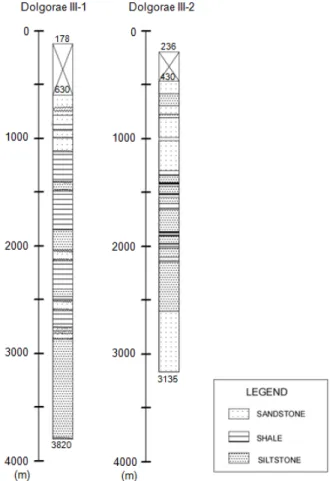
돌고래 III-1과 III-2 시추공의 길이 및 암상은 Fig. 2와 같다. 한국석유공사(1999)의 자료에 의하면 돌고래 III-1 시추공에서는 630~3820 m 구간에서 87개의 시료, 돌고래 III-2 시추공에서는 430~3135 m 구간에서 83개의 시료에 대하여 유공충 분석을 실시하였다.
저서성 유공충 산출
두 시추공의 유공충 산출양상에서 가장 특징적인 것은 산출량의 변화이다. 층후의 차이는 있지만 두 코아 모두 최하부 구간은 사질 유공충이 소량 산출되며, 그 상부 구간에서 사질 유공충의 산출량이 다소 증가한다.
이후 유공충이 거의 산출되지 않다가 코아의 최상부 구간에서 석회질 유공충의 산출이 급증한다.
돌고래 III-1 (Fig. 3)
시추공 최하부에서 심도 2350 m까지는 유공충의 산출량이 매우 적거나 거의 산출되지 않는다. 이 구간에 서는 최대 18개체의 저서성 유공충이 산출되며, 대부분이 Cyclammina와 Haplophragmoides로 주로 구성되 는 사질 유공충이다. 2320-1180 m 구간에서는 산출되는 전체 유공충 중 사질 유공충의 산출비율이 약 85%
이상을 차지한다. Haplophragmoides compressum과 H. renzi 등 Hplophragmoides 속이 가장 많이 산출되 며, Cyclammina 속과 Plectammina, Recurvoides 등이 수반된다. 자료에 의하면 많은 개체수의 사질 유공충
Fig. 2. Lithology of the Dolgorae wells (modified after Lee, 1994).
이 종 동정이 이루어지지 않았는데(Agglutinated miscellaneous로 기재), 이는 형태의 변형이 심하여 종수준 의 감별이 불가능하였기 때문으로 판단된다. 석회질 유공충으로는 Globobulimmina sp.와 Euuvigerina aki- taensis 등이 소량 산출되었다. 시추심도 1150-820 m 구간은 보존 상태가 좋지 않은 석회질 유공충 몇 개체만 이 산출되고, 그 외의 유공충은 거의 산출되지 않는 무화석대(Barren Zone)가 형성된다. 시추공 최상부 790-630 m 구간에서는 사질(agglutinated) 유공충의 산출은 거의 없으며, 석회질(calcareous) 유공충의 산출 이 풍부하며, 보존상태가 양호하다. Elphidium 속과 Ammonia beccarii, Buccella frigida, Bulimina margin- ata, Porosorotalia makiyamai, Pseudononion japonicum 등이 많이 산출되며, Cribroelphidium yabei와 Islandiella japonica는 630-640 m 구간에서 가장 많이 산출되는 종이다.
돌고래 III-2 (Fig. 4)
시추공 최하부 3135-1310 m 구간에서는 사질 유공충이 거의 100% 산출된다. Haplophragmoides와 Cyclammina 속이 우점하고 Spiroplectammina sp., Recurvoides sp. 등이 산출되며, 마찬가지로 대부분의 사 질 유공충은 변형이 심하여 동정이 어려웠던 것으로 추론된다. 1280-920 m 구간은 유공충이 전혀 산출되지 않는 무화석대이다. 시추공의 상부 880-430 m 구간에서는 사질 유공충이 거의 산출되지 않아 거의 100% 석 회질 유공충으로 구성된다. Elphidium advenum과 E. clavatum 등 Elphidium 속이 가장 우세하며, Ammonia beccarii, Buccella frigida, Cibicides lobatulus, Bulimina marginata, Cassidulina yabei, Porosorotalia ma- kiyamai, Rosalina spp. 등이 산출된다.
부유 유공충 산출
돌고래 III-1과 돌고래 III-2 시추공 모두 시추공의 최상부 구간을 제외하고는 부유성 유공충의 산출량이 거의 없다. 돌고래 III-1 시추공에서 부유성 유공충의 산출량은 0~11.2%이며, 전체적으로 보존 상태가 불량 Fig. 3. Foraminiferal occurrence of main species and foraminiferal biozone in the well Dolgorae III-1.
하다. Globigerina bulloides가 우점종이며, Globigerina falconensis, Globigerinita glutinata 등이 산출된다.
돌고래 III-2 시추공의 3135-850 m 하부 구간에서는 부유성 유공충이 거의 산출되지 않으며, 800 m 상부 구 간에서는 최대 26.5%를 차지한다. G. bulloides가 가장 우점하며, G. glutinata, Globigerinoides ruber, Neogloboquadrina 등이 산출된다.
유공충 생층서대와 지질시대
Blow(1969)는 마이오세 이후의 부유성 유공충 생층서대를 전기 마이오세 N4-N8, 중기 마이오세 N9-N15, 후기 마이오세 N15-N18, 플라이오세 N18-N21, 그리고 플라이스토세 N22-N23으로 구분하였다.
유공충을 이용한 생층서대 설정은 시대를 지시해주는 표준화석의 첫 출현 기록(First Occurrence Datum, FOD) 및 최후 출현 기록(Last Occurrence Datum, LOD)을 바탕으로 한다.
분석결과, 돌고래 III-1 및 돌고래 III-2 시추공 내의 대부분의 구간에서 시대를 지시하는 뚜렷한 종의 산출 이 많지 않다. 그러나 마이오세를 지시하는 사질유공충의 산출, Middle/Late Miocene의 부정합으로 인한 산 출량의 감소(이호영, 1994, 한국석유공사, 1999), 시대지시 부유성 유공충의 산출 등을 근거로 하여 두 시추 공의 생층서대와 지질시대를 구분하였다. 돌고래 III-1 및 돌고래 III-2 시추공에서 산출되는 시대지시 유공충 종들과 이들의 FOD 및 LOD는 다음과 같다(Asano, 1951; Postuma, 1971; Kennett and Srinivasan, 1983;
Srinivasan and Chaturvedi, 1992).
부유성 유공충
Orbulina (FOD: 15.2 Ma) Globigerina bulloides (FOD: N9) Globorotalia menardii (FOD: 13.4 Ma) Globigerinoides ruber (FOD: N15)
Neogloboquadrina acostaensis (FOD: 10.2 Ma) Globigerinoides extremus (FOD: N16; LOD: N21) Globorotalia crassaformis (FOD: 4.1 Ma) Pulleniatina obliquiloculata (FOD: N19) Globorotalia inflata (FOD: N20) Neogloboquadrina blowi (FOD: N20) Neogloboquadrina dutertrei (FOD: N21) Globorotalia truncatulinoides (FOD: 1.9 Ma) Berggrenia pumilio (FOD: N22)
저서성 유공충
Cyclammina ezoensis (LOD: Late Miocene) Cyclammina japonica (LOD: Late Miocene)
Haplophragmoides compressum (LOD: Late Miocene) Haplophragmoides renzi (LOD: Late Miocene)
돌고래 III-1
돌고래 III-1 시추공의 3820-1180 m 구간에서 산출되는 저서 유공충 Cyclammina ezoensis, C. japonica, Haplophragmoides compressum, H. renzi 등은 최후 출현기록(LOD)이 Late Miocene인 종으로, Pliocene 이 후로는 산출되지 않는다(Asano, 1951). 부유성 유공충 Globigerina bulloides와 Globorotalia menardii의 첫
출현(FOD)은 Middle Miocene 이후이며, Globigerinoides ruber와 Neogloboquadrina acostaensis의 FOD 는 Late Miocene이다(Kennett and Srinicasan, 1983; Srinivasan and Chaturvedi, 1992). N. acostaensis 한 개체가 1180m에서 산출되며, 시대지시 와편모 시스트의 산출과 비교해 볼 때, 이 심도 부근이 Middle/Late Miocene의 경계일 가능성이 있는 것으로 사료된다. 돌고래 III-1 시추공의 유공충 생층서대와 지질시대는 시 추공의 하부로부터 다음과 같다(Figs. 3, 8).
3820 m-1180 m: Cyclammina-Haplophragmoides Zone / Middle Miocene
유공충의 산출량이 매우 적으며, 사질 유공충이 대부분을 차지한다. Miocene 지시종인 Cyclammina ezoensis, C. japonica, Haplophragmoides compressum, H. renzi 등이 주요 구성종이다. LOD가 Middle Miocene인 와편모 시스트 Heteraulacacysta campanula (LOD:12Ma), Systematophorapla cacantha (LOD: 11.2Ma), Batiacasphaera sphaerica (LOD: 11.2 Ma) 등이 상부까지 산출된다(Byun, 1995). 이호영(1994)은 3620-2310 m 구간을 Cyclammina japonica Zone, 그리고 2300-1190 m 구간을 Martinotiella communis 구 간으로 분대하였다. 그러나 한국석유공사(1999)의 자료를 분석해보면, M. communis가 2170 m부터 산출되 기 시작하나, 산출량이 Cyclammina와 Haplophragmoides에 비하면 매우 적다. 따라서 이번 연구에서는 이 구간을 분대하지 않고 Cyclammina-Haplophragmoides로 설정하였다.
1150 m-820 m: Rare to Barren Zone / Late Miocene
유공충이 거의 산출되지 않는 무화석대로 설정된다. 사질 유공충과 부유성 유공충은 전혀 산출되지 않으 며, 재이동(reworking)된 천해성(neritic) 저서 유공충이 소량 산출된다. Late Miocene을 지시하는 와편모 시 스트 Dapsilidinium pseudocolligerum (LOD: 8Ma), Filisphaera filifera (FOD: 8Ma), Spiniferites elonga- tus (FOD: 8Ma), Pentadinium laticinctum (LOD: 6Ma) 등이 이 구간의 상부에서 산출된다(Byun, 1995).
790 m-630 m: Elphidium Zone / Pliocene
시추공의 하부에서 풍부하게 산출되는 사질 유공충은 전혀 산출되지 않으며, 석회질 저서성 유공충이 풍 부하고 부유성 유공충이 소량 산출된다. Elphidium advenum과 E. clavatum으로 대표되는 Elphidium 속이 가장 많이 산출되며, A. beccarii, B. frigida, B. marginata, P. makiyamai, P. japonicum 등이 산출된다. 이호 영(1994)은 870-630 m 구간을 Cassidulina laevigata Zone으로 설정하고 Pliocene으로 해석하였으나, 한국 석유공사(1999)의 자료와 마찬가지로 870-820 m 구간에서는 여전히 유공충의 산출량이 매우 적은 것으로 볼 때, 이 구간에서 산출되는 소량의 석회질 저서 유공충 C. laevigata, Elphidiella sp. A, Elphidium sp. A (이호영, 1994) 등은 재이동(reworking)된 것일 가능성이 있는 것으로 해석된다. 한국석유공사(1999)의 자료에서는 이 구간에서 지질시대를 지시하는 유공충 종이 산출되지 않았으나, 이호영(1994)은 690 m에서 Neogloboquadrina dutertrei의 산출을 보고하였다. 석회질 초미화석(nannofossil) 시대지시종인 Pseusoemiliania lacunosa (FOD: 4.2Ma)가 730 m에서 산출되었으며, Discoaster brouweri (LOD: 2Ma)가 이 구간의 상부까지 산출된 다(한국석유공사, 1999). LOD가 4Ma인 와편모 시스트 Spiniferites ellipsoideus가 740 m에서 산출되었으며, Hystrichosphaeropsis obscura (LOD: 3.4Ma), Capillicysta fusca (LOD: 3.4Ma), Spiniferites pachyderma (FOD: 3.4Ma)가 꾸준히 산출된다. Pliocene에 멸종된 것으로 알려진 개형충 Acuticythereis? sendaiensis가 630 m까지 산출된다(한국석유공사, 1999). 따라서 이 구간의 지질시대는 Pliocene으로 해석된다.
돌고래 III-2
돌고래 III-2 시추공의 3135-1310 m 구간에서도 Miocene을 지시하는 저서성 사질 유공충 Cyclammina ezoensis, C. japonica, Haplophragmoides compressum, H. renzi 등이 풍부하게 산출된다. 지질시대를 지시 하는 주요 부유성 유공충으로는 Globigerinoides extremus (FOD: N16 / LOD: N21), Globorotalia truncatu- linoides (FOD: 1.9Ma), Berggrenia pumilio (FOD: N22) 등이 있다. 돌고래 III-2 시추공의 유공충 생층서대
와 지질시대는 시추공의 하부로부터 다음과 같다(Figs. 4, 8).
3135 m-1310 m: Cyclammina-Haplophragmoides Zone / Middle Miocene
유공충의 산출량은 구간 내에서도 다소 변동을 보인다. Miocene 지시종인 사질 유공충 Cyclammina ezoensis, C. japonica, Haplophragmoides compressum, H. renzi가 주요 종이다. 이호영(1994)은 3140-1770 m 구간 을 Cyclammina japonica Zone, 그리고 1760-1310 m 구간을 Martinotiella communis Zone으로 분대하였다.
그러나 돌고래 III-1 시추공에서와 마찬가지로 한국석유공사(1999)의 자료에서는 M. connunis의 산출량이 Cyclammina 및 Haplophragmoides의 산출량에 비해 현저하게 적었다. 지질시대를 지시하는 와편모 시스트 Heteraulacacysta campanula (LOD: 12Ma), Systematophora palacacantha (LOD: 11.2Ma), Batiacasphaera sphaerica (LOD: 11.2Ma)가 상부에서 풍부하게 산출되고, Cribroperidinium giuseppei (LOD: 14Ma)가 217 0m까지 산출된다(Byun, 1995). 따라서 이 구간은 약 12Ma 이전의 Middle Miocene으로 해석된다.
1300 m-920 m: Barren Zone / Late Miocene
유공충이 전혀 산출되지 않는 무화석대이다. Late Miocene을 지시하는 와편모 시스트가 산출된다(Byun, 1995). 이호영(1994)은 1300-1000 m 구간을 화석빈곤대로 설정하였으며, 소량의 유공충이 산출되나, 한국 석유공사(1999)의 자료에서는 920 m까지 유공충 화석이 전혀 산출되지 않았다.
880 m-800 m: Cassidulina yabei Zone / Pliocene
유공충 산출량이 다소 적은 구간이며, 사질 유공충은 전혀 산출되지 않고, 부유성 유공충의 산출량도 매우 적다. Cassidulina yabei가 가장 많이 산출되며, A. beccarii, B. frigida, B. marginata 등이 구간의 최상부에 서 산출된다. LOD가 N21(Late Pliocene)인 부유성 유공충 Globigerinoides extremus가 800 m에서 산출된 Fig. 4. Foraminiferal occurrence of main species and foraminiferal biozone in the well Dolgorae III-2 (G, Globorotalia;
C. Cassidulina; N. dutertrei s.l., N. dutertrei+N. blowi+N. humerosa).
다. 이호영(1994)의 Cassidulina laevigata Zone에 대비되며, 지질시대는 late Pliocene으로 해석된다.
770 m-430 m: Globorotalia truncatulinoides Zone / Pleistocene
석회질 저서 유공충의 산출량이 매우 풍부하며, 부유성 유공충의 산출량도 증가한다. G. truncatulinoides (FOD: 1.9Ma)가 780 m에서 처음 산출되고(이호영, 1994), FOD가 N22 (Pleistocene)인 Berggrenia pumilio 가 710 m에서 산출된다. 석회질 초미화석 역시 Pleistocene을 지시한다(한국석유공사, 1999).
고환경
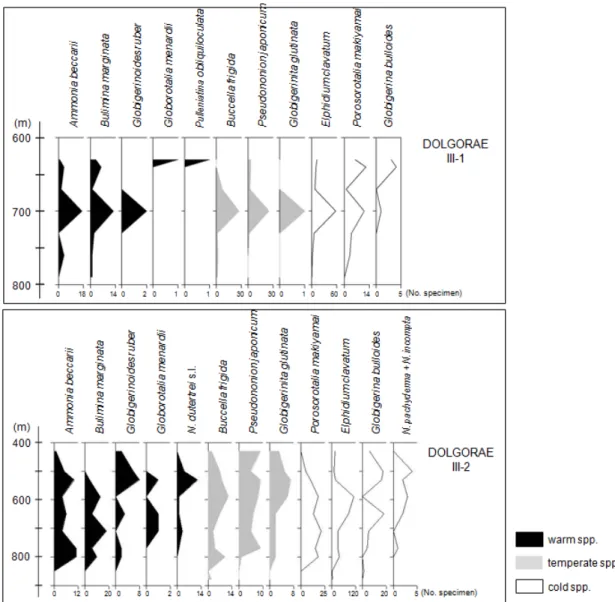
저서성 유공충은 해양의 모든 심도와 환경에서 서식하며 심도별, 수온별로 특징적으로 분포하고 있기 때 문에, 고분지 발달사나 고수심 등의 연구에 이용되며, 부유성 유공충은 수괴(water mass)의 특성 및 흐름의 변화를 연구하는데 매우 유용하다(Kennett, 1982). 돌고래 III-1 및 돌고래 III-2 시추공의 상부에서 주로 산 출되는 저서성 유공충 A. beccarii, B. frigida, B. marginata, E. advenum, E. clavatum, P. japonucum, P. ma- kiyamai 등은 대표적인 천해성 종이다(Matoba and Fukasawa, 1992; Kaiho and Hasegawa, 1986; Hasegawa, 1993). 시추공의 하부 구간의 주요종인 Cyclammina, Haplophragmoides, Spiroplectammina, Martinotiella, Recurvoides 등의 사질 유공충은 주로 중층수 (Intermediate water) 이하의 상부 반심해대 (upper bathyal)를 지시하는 종들이다(Kaiho, 1992; Kaiho and Nishimura, 1992; Kato, 1992). 한편, A. becarii, B. marginata 는 난류성 종으로 동해 및 일본 주변지역에서 Kuroshio Warm Current 및 Tsushima Warm Current 의 영향을 받는 지역에서 다산된다. 반면, E. clavatum과 P. makiyamai는 한류성 종이며, B. frigida, P. japonicum 등은 온대성(temperate) 종으로서, 동해 및 일본 주변 해역의 한류와 난류가 혼합되는 지역에서 다산된다(Matoba and Fukasawa, 1992; Kaiho and Hasegawa, 1986; Hasegawa, 1993). 부유성 유공충 G. bulloides는 동해에 서 용승류가 형성되는 냉수의 해역에서 다산하며, Neogloboquaerina pachyderma와 N. incompta 역시 동해 Fig. 5. Down-well variations of the paleobathymetry index species in the well Dolgorae III-1.
의 대표적인 한류종이다(Thompson, 1981; Oda and Takemoto, 1992; Ujiié et al., 2003). G. ruber, G. me- nardii, N. dutertrei, P. obliquiloculata 등은 난류 해역에서, G. glutinata는 한, 난류 혼합해역에서 산출되는 종이다(Thompson, 1981; Ibaraki, 1986). 이러한 유공충의 고환경적 특성을 바탕으로 하여 두 시추공의 각 지질시대별 고환경을 해석해 보았다(Figs. 5-8).
Middle Miocene: Upper Bathyal
두 시추공 모두 중기 마이오세 퇴적층에서는 반심해를 지시하는 사질 유공충이 주요 구성종이다. 와편모 시스트 역시 외양성(oceanic) 종들이 주를 이루고 있다(Byun, 1995). 주변 외대륙붕(outer shelf) 등에서 이동 되어진 것으로 보이는 Euuvigerina akitaensis, Globobulimina sp., Bulimina marginata 등도 소량 산출된다.
따라서 이 시기에 울릉분지 남서부는 상부 반심해대의 환경이었을 것으로 사료된다.
Late Miocene: Coastal
두 시추공 모두 유공충이 거의 산출되지 않는 무화석대를 형성한다. 석회질 및 규질, 유기질 성분의 다른 미화석들도 거의 산출되지 않는다(한국석유공사, 1999). 따라서 이 시기는 해양환경이 아닌 육상의 연안환경 일 것으로 해석된다. 시추공 내 중기/후기 마이오세 퇴적층의 경계에서 미화석의 산출이 급격하게 감소하는 변화는 결층 및 부정합으로 설명되며, 중기/후기 마이오세의 광역 부정합은 울릉분지의 다른 돌고래 시추공 (돌고래 I, II, III)에서도 인지된다(이호영, 1994; 한국석유공사, 1999).
Pliocene: Outer Neritic
저서성 유공충의 산출이 증가하며, 보존상태도 양호하다. 사질 유공충은 거의 산출되지 않으며, A. beccar- ii, B. frigida, E. advenum 등의 대표적인 천해성 종과 함께 C. yabei, I. japonica, Cribroelphidium, B. mar- Fig. 6. Down-well variations of the paleobathymetry index species in the well Dolgorae III-2.
ginata 등의 외해성 종이 수반되는 것으로 볼 때, 외천해의 환경으로 해석된다. 한류종과 난류종 및 온대종이 함께 산출되므로, 이 시기에 남쪽에서 유입된 난류와 동해 북부로부터 유입된 한류가 혼합되는 해양환경이었 을 것으로 추정된다.
Pleistocene: Inner Neritic
돌고래 III-2호공에서 인지되는 플라이스토세 지층에서는 A. beccarii, E. advenum, Cibicides lobatulus, Rosalina spp. 등의 천해성 난류종과 함께 B. frigida, P. japonicum, P. makiyamai 등의 온대 및 한류종이 함 께 산출된다. 부유성 유공충 또한 G. ruber, N. dutertrei 등의 난류종과 G. bulloides, N. pachyderma, N. in- compta 등의 한류종이 함께 산출된다. 따라서 이 시기에는 한류와 난류의 영향을 받는 내천해의 환경이었을 것으로 해석된다.
Fig. 7. Variations of paleotemperature indicator species in the upper part of the wells Dolgorae III-1 and Dolgorae III-2 (N, Neogloboquadrina; N. dutertrei s.l., N. dutertrei+N. blowi+N. humerosa).
결 론
동해 울릉분지의 돌고래 III-1과 돌고래 III-2 시추공에서 산출되는 유공충 군집을 분석하여 유공충 생층서 대(biozone)를 설정하고 고환경을 복원하였다. 저서성 및 부유성 유공충의 시대지시 종과 환경지시 종의 산 출을 분석한 결과, 돌고래 III-1 시추공은 하부로부터 Cylclammina-Haplophragmoides Zone(중기 마이오 세)/Rare to Barren Zone(후기 마이오세)/Elphidium Zone(플라이오세)으로 분대되었다. 이 시기 동안 고해양 환경은 상부 반심해(upper bathyal)-육상 연안(coastal)-천해(neritic)로 변화한 것으로 해석된다. 돌고래 III-2 시추공은 하부로부터 Cyclammina-Haplophragmoides Zone(중기 마이오세)/Barren Zone(후기 마이오세)/
Cassidulina yabei Zone(플라이오세)/Globorotalia truncatulinoides Zone(플라이스토세)으로 분대되었으며, 각각 상부 반심해(upper bathyal)-육상 연안(coastal)-외천해(outer neritic)-내천해(inner neritic)의 환경에서 형성되었다. 고수온(paleotemperature)을 지시하는 유공충의 산출을 분석한 결과, 플라이오세~플라이스토세 동안 연구해역에는 난류와 한류가 혼합되는 해역이 형성되었다. 유공충은 여러 미화석 중 돌고래 전 시추공 에서 산출되는 것으로 보고되어 있다(이호영, 1994). 따라서 유공충 분석 결과는 돌고래 전 시추공들 간의 대 비에 매우 유용하게 이용될 수 있을 것으로 기대되며, 나아가 울릉분지 주변의 다른 분지(예. 서해의 군산분 지, 포항분지 및 일본의 신생대 분지 등)와의 대비에도 기준이 될 수 있을 것이다.
감사의 글
본 논문의 연구는 한국석유공사 “CO2 폐기물 저장지역의 암층서 및 생층서 특성 연구(Lithostratigraphic and Biostratigraphic Studies of Carbon Storage in Korean Offshore Areas)“ 사업의 지원으로 수행되었으며, 협조해주신 관계자 여러분께 감사드립니다. 본 논문을 세심하게 심사하여 주신 익명의 심사위원분들께 깊이 감사를 드린다.
Fig. 8. Correlation of foraminiferal biozones and inferred geologic age and paleoenvironment between the wells Dolgorae III-1 and III-2.
FORAMINIFERAL BIOSTRATIGRAPHY AND PALEOENVIRONMENT OF THE WELLS DOLGORAE III-1 AND DOLGORAE III-2 (THE ULLEUNG BASIN, EAST SEA): REVIEW
Sora Kang1,*, Hyunsook Byun2, Sun-Ok Park2, Byung-Su Lee3, Chull-Hwan Chung4 and Myongho Park5
1Geologic Hazard & Industrial Resources Research Institute of Pusan National University, Busan, 609-735, Korea
2Natural History Research Institute Inc., Daejeon, 305-732, Korea
3Department of Earth Sciences Education, Chonbuk National University, Jeonju, 561-756, Korea
4Korea Landscape and Geology Institute, Sunchon National University, Chonnam, 540-742, Korea
5Technology Management Team & CCS TF Team, E&P Technology Institute, Korea National Oil Corporation. Anyang, 431-711, Korea
ABSTRACT: Foraminiferal biozones are established and paleoenvironments are inferred through the inves- tigation of the wells Dolgorae III-1 and III-2. Three foraminiferal biozones in ascending order for the well Dolgorae III-1 are Cylclammina-Haplophragmoides Zone (Middle Miocene) / Rare to Barren Zone (Late Miocene) / Elphidium Zone (Pliocene). During these period, the paleobathymetry has been changed from upper bathyal through coastal to neritic. For the Dolgorae III-2, four foraminiferal biozones in ascending order are Cyclammina-Haplophragmoides Zone (Middle Miocene) / Barren Zone (Late Miocene) / Cassidulina yabei Zone (Pliocene) / Globorotalia truncatulinoides Zone (Pleistocene). The paleobathymetry changed from upper bathyal through coastal to outer and inner neritic. During Pliocene to Pleistocene, the mixed current area of cold and warm currents was formed around the Ulleung Basin.
Key words: Ulleung Basin, Well Dolgorae, Foraminifera, Biozone, Paleoenvironment 참고문헌
이호영, 1994. 동해 울릉분지 남단부의 신제3기 유공충 생층서. 서울대학교 대학원 박사학위논문, 377 p, 11 pls.
한국석유개발공사. 1989a. VI-1광구 돌고래 II 시추공 시료분석 보고서.
한국석유개발공사. 1989b. VI-1광구 돌고래 III-2 시추공 시료분석 보고서.
한국석유개발공사. 1989c. VI-1광구 돌고래 III, III-1, III-2 시추공 시료분석 보고서.
한국석유개발공사. 1990a. VI-1광구 돌고래 V 시추공 시료분석 보고서.
한국석유개발공사. 1990b. VI-1광구 돌고래 V-1 시추공 시료분석 보고서.
한국석유개발공사. 1991a. VI-1광구 돌고래 VII 시추공 시료분석 보고서.
한국석유개발공사. 1991b. 국내대륙붕 유망광구 평가보고서. 한국자원연구소 용역보고서, 204 p.
한국석유공사. 1999. 국내 대륙붕 울릉분지 생층서 연구. 한국석유공사, 120 p.
Asano, K. 1951. Illustrated catalogue of Japanese Tertiary smaller foraminifera, Part 9, Ophthalmidiidae, Part 10, Lituolidae, Part 11, Trochamminidae, Part 12 Chilostomellidae, Part 13, Anomalinidae. Hosokawa Printing Co., Stach, L. W. (eds.), 19 p.
Blow, W.H. 1969. Late Middle Eocene to Recent Planktonic foraminiferal biostratigraphy; pp. 199-421 in Brönnimann P. and Renz H. (eds.), Proceedings of International conference of planktonic microfossils, 1st. Geneva, 1967.
Byun, H.S. 1995. Cenozoic dinoflagellate cysts from the Pohang Basin and southern margin of the Ulleung Basin, Korea. PH.D. thesis, Chungnam National University, 283 p.
Chough, S.K. and Barg, E. 1987. Tectonic history of Ulleung basin, East Sea (Sea of Japan). Geology 15:45-48.
Chough, S.K. 1983. Marine geology of Korean Seas. International Human Resources Development Corporation, Boston, U.S.A., 157 p.
Frazier, S.B., Choi, S.O., Kim, B.K. and Schwart. D. 1976. Marine petroleum exploration of Huksan Platform, Korea.
American Association of Petroleum Geologists Memoit 25:268-275.
Hasegawa, S. 1993. Distribution of recent benthic foraminifers as an indicator of thermal conditions of the seas around the Japanese Islands-An approach to reconstruction of Cenozoic oceanic condition-, Fossils 55:17-33 (in Japanese with English abstract).
Hirayama, J. 1991. Total sedimentary isopach maps offshore East Asia. Committee for co-ordination of joint pro- specting for mineral resources in Asian offshore areas (CCOP), Technical Bulletin 23, 116 p.
Hyun, B.K., Koo, J.H., Cho, K.J., Kwon, B.C., Lee, D.H., Cheong, S.H., Yang, S.J., Kim, S.W., Park, K.S., Yoon, H.S., Suh, S.Y., Park, K.P., Shin, S.C., Park, Y.S., Min, S.S., Shin, H.J., and Boo, S.J. 1980. Petroleum resources potential in the continental shelf of Korea. Korea Resources Research Report, 80-16, 210 p. (in Korean).
Ibaraki, M. 1986. Neogene planktonic foraminiferal biostratigraphy of the Kakegawa Area on the Pacific coast of cen- tral Japan. Reports of Faculty of Science, Shizuoka University 20:39-173.
Ingle, J.C., Jr., Suyehiro, K., von Breymann, M.T., et al. 1990. Proceedings of Ocean Drilling Program, Initial Reports 128: College Station, TX (Ocean Drilling Program).
Inoue, E. 1982. Geological problems on Cretaceous and Tertiary rocks in and around Tsushima-Korea Straits.
Committee for coordination of joint prospecting for mineral Resources in Asian offshore areas (CCOP), Technical Bulletin 15:85-121.
Kaiho, K. 1992. Eocene to Quaternary benthic foraminifers and paelobathymetry of the Izu-Bonin Arc, Legs 125 and 126; pp. 285-310 in Taylor, B., Fujioka, K. et al., (eds.), Proceedings of Ocean Drilling Program, Science Results, 126: College Station, TX (Ocean Drilling Program).
Kaiho, K. and Nishimura, A. 1992. Distribution of Holocene benthic foraminifers in the Izu-Bonin Arc; pp. 311-320 in Taylor, B., Fujioka, K., et al., Proceedings of Ocean Drilling Program, Science Results, 126: College Station, TX (Ocean Drilling Program).
Kaiho, K. and Hasegawa, S. 1986. Bathymetric distribution of benthic foraminifera in the bottom sediments off Onahama, Fukushima Prefecture, northeast Japan; pp. 43-52 in Studies on Cenozoic Benthic Foraminifera in Japan, Matoba, Y. and Kato, M. (eds.) (in Japanese).
Karig, D.E., Ingle, J.C., Jr., et al., 1975. Initial Report of the Deep Sea Drilling Project, 31. Washington (U.S.
Government Printing Office), 927 p.
Kato, M. 1992. Benthic foraminifers from the Japan Sea: Leg 128; pp. 365-392 in Pisciotto, K.A., Ingle, J.C., Jr., von Breymann, M.T., et al., Proceedings of Ocean Drilling Program, Science Results, 127/128, Pt. 1: College Station, TX (Ocean Drilling Program).
Keij, A. J. and Trapman, S. 1973. Stratigraphy of exploratopn well, Dolgorae-1, Korea. Shell International petroleum Maatschappoj B. V., The Hague, 5 p.
Kennett, J. P. and Srinivasan, M. S. 1983. Neogene planktonic foraminifera, A phylogenetic atlas. Hutchinson Ross Pub.
Co., 265 p.
Kennett, J. P. 1982. Marine Geology. Prentice-Hall, NY, 752 p.
Kim, C. S. 1976. Petroleum potential of Korean offshore. American Association of Petroleum Geologists Memoir 25:261-267.
Lee, H. Y. 1994. Neogene Foraminiferal Biostratigraphy of the Southern Margin of the Ulleung Basin, East Sea, Korea.
PH.D. thesis, Seoul National University, 377 p. (in Korean with English abstract)
Matoba, Y. and Fukasawa, K. 1992. Depth Distribution of Recent Benthic Foraminifera on the Continental Shelf and Uppermost Slope off Southern Akita Prefecture, Northeast Japan (The Eastern Japan Sea); pp. 207-226 in K. Ishizaki and T. Saito (eds.), Centenary of Japanese Micropaleontology, Terra Scientific Publishing Company, Tokyo.
Noble energy. 2003. Integrated Multidisciplinary Biostratigraphic Restudy of Eight Wells, Ulleung Basin, Block Vi-1 Offshore, Republic of Korea.
Oda, M. and Takemoto, A. 1992. Planktonic foraminifera and paleoceanography in the domain of the Kuroshio Current around Japan during the Last 20,000 years. The Quaternary Research 31(5); 341-357.
Park, K.S. 1992. Geological structure and seismic stratigraphy of the Southern part of Ulleung Basin; pp. 40-59 in Chough, S.K. (ed.), Sedimentary basis in the Korean Peninsular and abjacent Seas. Special Publication of the Korea Sedimentology Research Group. Hanliwon Publishers, Seoul, Korea.
Pisciotto, K.A., Ingle, J.C., Jr., von Breymann, M.T., et al., 1992. Proceedings of Ocean Drilling Program, Science Results, 127/128, Pt. 1: College Station, Tx (ocean Drilling Program). 776 p.
Postuma, J. A. 1971. Manual of planktonic foraminifera, Elsevier Pub. Co., 420 p.
Srinivasan, M.S. and Chaturvedi, S.N. 1992. Neogene planktonic foraminiferal biochronology of the DSDP Sites along the Ninetyeast Ridge, northern Indian Ocean; pp. 175-188 in K. Ishizaki and T. Saito (eds.), Centenary of Japanese Micropaleontology, Terra Scientific Publishing Company, Tokyo.
Taylor, B., Fujioka, K., et al., 1992. Proceedings of Ocean Drilling Program, Science Results, 126: College Station, Tx (ocean Drilling Program).
Thompson, P.R. 1981. Planktonic foraminifera in the western north Pacific during the past 150,000 years: comparison of modern and fossil assemblages. Palaeogeography, Palaeoclimatology, Palaeoecology 35; 241-279.
Ujiié, Y., Ujiié, H., Taira, A., Nakamura, T. and Oguri, K. 2003. Spatial and temporal variability of surface water in the Kuroshio source region, Pacific Ocean, over the past 21,000 years: evidence from planktonic foraminifera. Marine Micropaleontology 49; 335-364.
투고일 : 2011년 6월 2일, 심사일 : 2015년 6월 8일, 게재확정일 : 2011년 6월 16일