• 검색 결과가 없습니다.

IEG 환경지질연구정보센터

N/A
N/A
Protected

Academic year: 2021

Share "IEG 환경지질연구정보센터"

Copied!
5
0
0

로드 중.... (전체 텍스트 보기)

전체 글

(1)

Geosciences Journal

Vol. 12, No. 3, p. 227 − 231, September 2008 DOI 10.1007/s12303-008-0023-8

ⓒ The Association of Korean Geoscience Societies and Springer 2008

Taxonomic revisions of Upper Cambrian Granatodontus Chen et Gong, 1986 of the Dasytodus Lineage (Conodonta)

ABSTRACT: The Upper Cambrian conodont taxa of the Dasyt- odontus Lineage is particularly useful to divide strata near Cam- brian-Ordovician boundary. This lineage known only in Korea, China and Australia include many coniform paraconodonts and euconodonts with granulose, spinose or nodose ornaments, com- prising Granatodontus Chen et Gong, 1986. The generic and spe- cific concepts of Granatodontus are reviewed herein, with comments on its evolution, paleoecology and geographic distribution. Two new species are erected: Granatodontus asymmetrica sp. nov. and Granatodontus multicorrugata sp. nov.

Key words: Upper Cambrian, conodont taxonomy, Granatodontus of Dasytodus Lineage

1. INTRODUCTION

Relatively little has been known about the evolutionary development of the Cambrian conodonts until mid 1970’s.

Bengtson (1976, 1983a,b) proposed a conodont evolution- ary model on protoconodonts to paraconodonts to euconodonts.

Miller (1980) documented the Upper Cambrian euconodont evolutionary relationships, and suggested two important lin- eages: Teridontus and Proconodontus lineages. The Teridontus Lineage includes Hirsutodontus, Clavohamulus, Semiacon- tiodus, Monocostodus and Utahconus. The Proconodontus Lineage includes Cambrooistodus, Eoconodontus and Cordylo- dus. Miller (1984) erected one more lineage viz. Fryxel- lodontus Lineage previously regarded as a part of the Proconodontus Lineage (Miller, 1980).

Afterwards, Chen and Gong (1986) added one more lin- eage, the Dasytodus Lineage. They suggested that Dasyto- dus Chen et Gong, 1986 is derived from Granatodontus Chen et Gong, 1986.

The paraconodont and euconodont elements with papil- lose surface texture include Rotundoconus, Granatodontus, and Dasytodus. These are endemic ones which occur only in Korea, China and Australia, whereas Hirsutodontus and Clavohamulus are cosmopolitan genera which occur in North America, South America, Australia, Asia and Antarctica.

The genera and species of Dasytodus Lineage as well as Teridontus and Fryxellodontus lineages are excellent tools

for the zonation of worldwide uppermost Cambrian.

In Korea, Rotundoconus An et Zhang, Granatodontus Chen et Gong and Dasytodus Chen et Gong are abundant in Upper Cambrian Hwajeol Formation of Taebaeksan Basin (Lee, 1989a,b, 1990, 1992, 2002a,b, 2001a,b, 2004; Lee, B.

S. and Lee, H. Y., 1988; Lee, B. S. and Lee, J. D., 1993).

However, Hirsutodontus Miller is very rare (Lee, 2004), and Clavohamulus Furnish has been not recovered yet.

During last two decades, the similarity of the Lower Pale- ozoic environment has been given rise to serious compli- cations between conodont specialists of Korea and China in nomenclature of the Dasytodus Lineage, particularly in tax- onomy of endemic genus Granatodontus. Some unknown number of names of the Lower Paleozoic conodonts of China have been based on a single specimen. Fortunately, recent systematic studies reduced most of sustaining taxo- nomic feud.

The present study aims to re-evaluate and build on the definition of the genus Granatodontus, a member of the Dasytodus Lineage, and to describe new species, with com- ments on its evolution, paleoecology and paleogeographic distribution.

2. PREVIOUS WORK

The taxa of the Dasytodus Lineage of Chen and Gong (1986) are characterized by granulose surface ornaments.

Two member of this lineage is Rotundoconus and Granat- odontus. These taxa appear to be closely related in taxon- omy with spinous and nodose members of Teridontus lineage: Hirsutodontus, Clavohamulus and Dasytodus nodus.

Rotundoconus has granulose surface with bulbous tip, Granatodontus has granulose and/ or tiny spinose surface with sharp tip, Hirsutodontus has rather robust spines mainly on its anterior surface, and Clavohamulus is rela- tively small and is covered with many strong spines except posterior side. Four genera except Rotundoconus are eucon- odonts with cusp filled with white matter.

An and Yang (1980) first described a coniform conodont, Hirsutodontus primitivus An et al., without a differentiated cusp from the Upper Cambrian Fengshan Formation, China.

Byung-Su Lee* Department of Earth Science Education, Chonbuk National University, Jeonju 561-749, Korea

*Corresponding author: [email protected]

(2)

An et al. (1983) described two coniform conodonts: Hir- sutodontus bulbousus (Miller, 1969) with granulose surface and bulbousus tip, and Hirsutodontus aff. primitivus An et al., 1983 with granulose or spinous surface. Lee and Lee (1988) described some species of Hirsutodontus for the first time in Korea: H. primitivus, H. n. sp. A, H. n. sp. B and H. n. sp. C. They also reassigned Proconodontus transmu- tatus An et al., 1983 to Teridontus transmutatus (Xu et Xiang, 1983) on the ground of its sectional similarity to the latter genus. Chen and Gong (1986) reassigned Teridontus nakamurai nodus An et al., 1983 and Proconodontus trans- mutatus An et al., 1983 to the species under the genus Dasytodus Chen et Gong, 1986, because they have differ- entiated cusp and base, oval to rounded cross section, and nodose and spinose surfaces. They also reassigned Hirsut- odontus? ani Wang, 1985 to the new genus Granatodontus Chen et Gong, 1986 due to the lack of true cusp. Lee (2002) proposed two new species of Hirsutodontus hwajeolensis Lee, 2002 for the specimens of Hirsutodontus sp. nov. A of Lee and Lee (1988) and Rotundoconus bulousus Lee, 2002.

Elements of the Dasytodus Lineage range from the Pro- conodontus to Cambrooistodus minutus zones, but are dom- inant in the Proconodontus tenuiserratus Zone, China (An et al., 1983; Chen and Gong, 1986), and Proconodontus Zone, Korea (Lee and Lee, 1988; Lee, 2002, 2004).

3. EVOLUTION, PALEOECOLOGY AND GEOGRAPGIC DISTRIBUTION

General evolutionary trends of Upper Cambrian con- odonts include differentiation of the posterior edge of ele- ments, shortening of basal cavities, development of white matter and thickening of walls with reduction of basal cones. Differentiation of the posterior edge of elements rep- resents development of keels, costae, and adenticulate and denticulate processes.

Evolutionary relationships among early euconodont gen- era of Upper Cambrian are now well understood, and have been useful in generic classification. However, those among paraconodonts including Granatodontus are still poorly understood.

Major changes in euconodont evolution, as well as bio- facies adaptation and development of provincialism, coin- cided with sea-level fluctuations near the end of the Cambrian.

However, paraconodonts such as Westergaardodina, Fur- nishina and Granatodontus were flourished before this environmental changes, and then gradually disappeared and were replaced by new pelagic genus like Cordylodus.

Evolutionary relationships of Upper Cambrian conodonts are studied by some authors (Miller, 1980, 1984; An and Mei, 1994; Dong, 1997). Miller (1980, 1984) studied mainly on the euconodont lineage as stated above (see introduction), An and Mei (1994) studied on paraconodont lineages, and the derivation of euconodonts from paraconodonts. Dong (1997) studied on two paraconodonts of Gapparodus and Westergaardodina.

An and Mei (1994) are trailblazers in documentation on evolution of Cambrian conodonts. They proposed three paraconodont lineages viz. the Laiwugnathus-Westergaar- dodina, Dolabrodus-Furnishina and Prooneotodus lineages, and explained that early euconodonts are derived polyphyl- etically from genus Prooneotodus. Particularly, Hirsutodontus (=Granatodontus) ani is evolved from Prooneotodus by the granulation of the unit surface. Chen and Gong (1986) pointed out that Dasytodus was derived from Granatodon- tus on the ground of stratigraphic relationship and morpho- logic linkage.

In conclusion, Granatodontus was derived from Prooneoto- dus, and Granatodontus evolved into Dasytodus, and prob- ably into Hirsutodontus through the acquisition of spines and white matter in Late Cambrianon time. This recognition came from a number of the observation of Korean speci- mens from the Sesong Slate (lower Upper Cambrian), Hwa- jeol (middle to upper Upper Cambrian) and Machari (upper Middle Cambrian to middle Upper Cambrian) formations (Lee, B. S. and Lee, H. Y., 1988; Lee, 1989a,b, 1990, 1992, 2001a,b, 2002a,b, 2004; Lee, B. S. and Lee, H. Y., 1988;

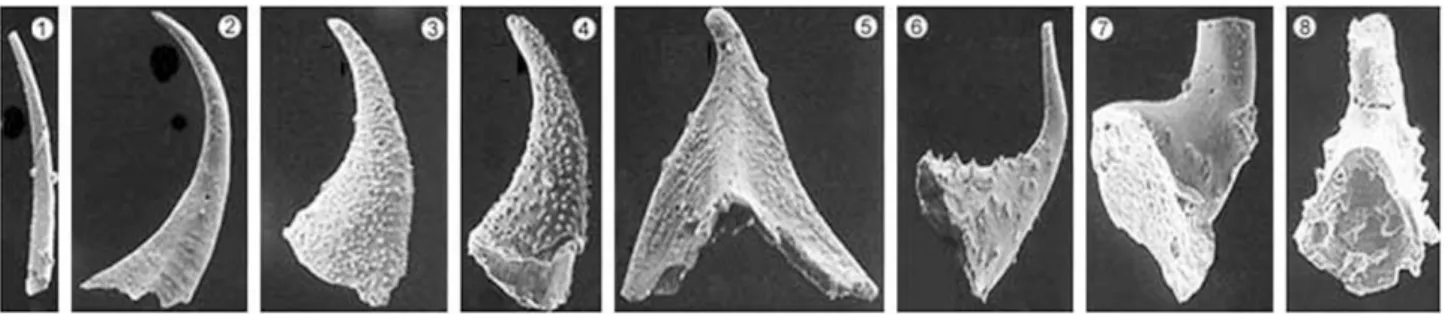
Lee et al., 1991; Lee, B. S. and Lee, J. D., 1993). This mor- phologic continuity among Korean specimens can be easily verificated by images (Fig. 1).

Protoconodonts and paraconodonts were probably pelagic and cosmopolitan based on the geographic distribution doc-

Fig. 1. Some Upper Cambrian conodonts showing evolutionary trend (from left to right). All specimen from Hwajeol Formation: 1,

Phakelodus tenuis, x100; 2, Prooneotodus rotundatus, x75; 3-4, Granatodontus ani, x160; 5, Rotundoconus jingxiensis, x86; 6, Dasy-

todus transmutatus, x90; 7, Dasytodus nodus, x180; Hirsutodontus hirsutus, x80 (Lee and Lee, 1988; Lee, 2004).

(3)

Taxonomic revisions of Upper Cambrian Granatodontus (Conodonta) umented by most of the reports on the Cambrian conodonts

(Müller, 1959, 1973; Müller, and Hinz, 1991; Miller, J. F., 1969, 1982, 1984; Druce and Jones, 1971; Miller, R. H. and Paden, E. A., 1976; An, 1982, 1987; An et al., 1983; Chen and Gong, 1986). However, the Dasytodus Lineage includ- ing Granatodontus has been recorded only in Asia (Korea, China) and Australia. Particularly, Granatodontus has been occurred only in Korea and China, and so is endemic.

Paraconodonts are common in the Swedish “stinkstones”

(Müller, 1959) deposited under anoxic conditions. From this environment, it can be deduced that the mode of life of paraconodonts were pelagic, tolerant of wide variations in water temperature or possibly depth, but were probably intolerant of elevated salinity.

Most of depositional environments containing paracon- odonts including Granatodontus are from platform facies (Warm Water Realm of Miller, 1984, 1988), although chal- lenge is raised (Landing et al., 2007). Conodonts from the Warm Faunal Realm are high in abundance and diversity compared with those from the Warm faunal Realm (Miller, 1988). The paleogeographic settings of the Hwajeol For- mation, Korea and Fengshan Formation, China are very similar to each other. Two areas are located within the Sino- Korean Carbonate Flatform at a paleolatitude of 30°N approximately (Chen et al., 1986), and the lithofacies con- sists mainly of a rhythmical sequence of fine-grained car- bonates deposited in a moderately deep outer shelf environment of quiet water below the normal storm wave base.

4. SYSTEMATIC PALEONTOLOGY

Conodont elements described herein were recovered from the Hwajeol Formation in the Seokgaejae section, Taebaek- san Basin. See Lee and Seo (2008) for conodont-related data.

Genus Granatodontus Chen et Gong, 1986

Type species.- Hirsutodontus? ani Wang in Chen et al., 1985 Granulose coniform paraconodonts with single elemental apparatus. Base and cusp are not differentiated, lacking white matter. Entire surface is sculptured with numerous granules (minute warts). Base is widely expanded, partic- ularly posteriorly in lower part. Basal cavity is wide and deep, extending nearly to the tip of cusp. Cross sections of the units are variable: oval to rounded, subtriangular, or multicarinated by modifying additional lateral carina (e), resulting in increase of asymmetricity of the element.

Granatodontus asymmetrica sp. nov.

Plate 1, Figures 2-3

Holotype.- Plate 1, Figure 3.

Derivation of name.- After its asymmetrical cross section.

Diagnosis.- Asymmetrical coniform paraconodonts with gran- ulose surface and very deep basal cavity, lacking white matter.

Description.- Granulose asymmetrical paraconodonts with very deep basal cavity, extending nearly to the tip of apex.

Cross section is asymmetrical, particularly in lower part.

Coniform conodonts, lacking white matter.

Remarks.- This new species is characterized by asym- metrical cross section. It can be easily distinguishable among species under the genus: Granatodontus ani Wang, 1985 has oval to rounded cross section, and Granatodontus mul- ticorrugata sp. nov. has four or more carinated cross section.

Occurrence.- Proconodontus Zone to Cambrooistodus minutus Zone of the Hwajeol Formation, Seokgaejae sec- tion, Taebaeksan Basin.

Material.- Thirty four elements.

Granatodontus multicorrugata sp. nov.

Plate 1, Figures 4-5

Plate 1. SEM micrographs of selected conodonts from the Hwajeol Formation in the Seokgaejae section, southeast Taebaeksan Basin (Lee and Seo, 2008). (1) lateral view of Granatodontus ani (Wang, 1985), KH 13 (x50). (2-3) lateral and posterolateral views of Granat- odontus asymmetrica sp. nov. KH 4 (x50), KH 14 (x100). (4-5) posterolateral and lateral views of Granatodontus multicorrugata sp.

nov., KH 4 (x50), KH 5 (x75). (6) lateral view of Rotundoconus bulbousus Lee, 2002, noncarinate element (KH 14, x100). (7) posterior

view of Granatodontus hwajeolensis (Lee, 2002), KH 4 (x50).

(4)

Holotype.- Plate 1, Figure 5.

Derivation of name.- Latin multi, many, and corrugate, fold, after the many carinated cross section.

Diagnosis.- Asymmetrical coniform paraconodonts with four or more carinae and very deep basal cavity.

Description.- Granulose, symmetrical to asymmetrical paraconodonts, lacking white matter. Base moderately expanded bilaterally. Cross section is tetracarinated or multicarinated by modifying additional lateral carina (e), giving usually asymmetrical appearance. Basal cavity is very deep, extending nearly to the tip of apex.

Remarks.- This newly erected species is characterized by tetracarinated or multicarinated cross section. The differen- tiation of the species under the genus is documented under the description of Granatodontus asymmetrica sp. nov.

Occurrence.- Proconodontus Zone to Eoconodontus notch- peakensis Zone of the Hwajeol Formation, Seokgaejae sec- tion, Taebaeksan Basin.

Material.- Nine elements.

ACKNOWLEDGMENTS: The writer would like to thank Miss Park, N. R. (KNU) for her assistance in laboratory work. We are grate- ful to anonymous reviewers for their constructive comments and sug- gestions.

REFERENCES

An, T. X., 1982, Study on the Cambrian conodonts from North and Northeast China. University of Tsukuba, Science Reports of the Institute of Geoscience, Section B, 3, 113 −159.

An, T. X., 1987, Lower Paleozoic conodonts of South China. Pub- lishing House of Beijing University, 238 p.

An, T. X. and Mei, S. L., 1994, On evolution of Cambrian conodonts.

Acta Palaeontologica Sinica, 33, 525 −548.

An, T. X. and Yang, C. S., 1980, Cambro-Ordovician conodonts in North China, with special reference to the boundary between the Cambrian and Ordovician Systems. In: Scientific Papers on Geology for International Exchange, Prepared for the 26

th

Inter- national Geological Congress, Part 4, Stratigraphy and Palaeon- tology. Publishing House of Geology, Beijing, p. 7 −14.

An, T. X., Zhang, F., Xiang, W., Zhang, Y., Xu, X., Zhang, H., Jiang, D., Yang, C., Lin, L., Cui, Z., and Yang, X., 1983, The conodonts of North China and adjacent regions. Science Publishing Com- pany, Beijing, 223 p. (in Chinese with English abstract).

Barnes, C. R., 1988, The proposed Cambrian-Ordovician global boundary stratotype and point (GSSP) in Newfoundland, Can- ada. Geological Magazine, 125, 381 −414.

Bengtson, S., 1976, The structure of some Middle Cambrian con- odonts, and the early evolution of conodont structure and func- tion. Lethaea, 9, 185 −206.

Bengtson, S., 1983a, A functional model for the conodont apparatus.

Lethaea, 16, 38.

Bengtson, S., 1983b, The early history of the Conodonta. Fossils and Strata, 15, 5 −19.

Chen, J. Y. and Gong, W. L., 1986, Conodonts. In: Chen, J. Y. (ed.), Aspects of Cambrian-Ordovician boundary in Dayangcha, China.

Prospect Publishing House, Beijing, pp. 93 −223.

Chen, J. Y., Qian, Y. Y., Lin, Y. K., Zhang, J. M., Wang, Z. H., Yin, L. M., and Erdtmann, B. D., 1986, Study on Cambrian-Ordov- ician boundary strata and its biota in Dayangcha, Hunjiang, Jilin, China. Contribution to the Calgary Cambrian-Ordovician Bound- ary Meeting, Prospect Publishing House, Beijing 138 p.

Chen, J. Y., Qian, Y. Y., Zhang, J. M., Lin, Y. K., Yin, L. M., Wang, Z. H., Wang, Z. Z., Yang, J. D., and Wang, Y. X., 1988, The rec- ommended Cambrian-Ordovician boundary stratotype of the Xiaoyangqiao section (Dayangcha, Jilin Province), China. Geo- logical Magazine, 125, 415 −444.

Dong, X., 1997, Evolutionary trends of paraconodonts. Geological Review, 43, 498 −502 (in Chinese with English abstract).

Druce, E. C. and Jones, P. J., 1971. Cambro-Ordovician conodonts from the Burke River structural belt, Queensland. Australian Bureau of Mines and Resources Bulletin, 110, 167 p.

Furnish, W. M., 1938, Conodonts from the Prairie du Chien beds of the Upper Mississippi Valley. Journal of Paleontology, 12, 318 − 340.

Landing, E., Kleppie, J. D., and Westrop, S. R., 2007, Terminal Cam- brian and lowest Ordovician of Mexican West Gondwana-biotas and sequence stratigraphy of the Teñu Formation. Geological Magazine, 144, 909 −936.

Lee, B. S., 1983, Stratigraphy and micropaleontology of the Hwajeol Formation and Dumugol Shale in Mureungri area, Jeongseon- gun, Kangweondo. Unpublished M.S. Thesis, Yonsei University, 65 p. (in Korean with English abstract).

Lee, B. S., 1989a, Conodonts from the Hwajeol Formation (Upper Cambrian-lowest Ordovician) in northern district of Taebaeg City, Kangweon-do, Korea. Journal of the Geological Society of Korea, 25, 322 −336.

Lee, B. S., 1989b, Provincialism of the Upper Cambrian conodonts- from the Samcheok Coalfield, Korea. Journal of the Paleonto- logical Society of Korea, 5, 53 −61 (in Korean with English abstract).

Lee, B. S., 1990, Conodont fauna of the Hwajeol Formation (Upper Cambrian-lowest Ordovician) in the Sabuk area, Kangweon-do and its implication on stratigraphy. Journal of the Geological Society of Korea, 26, 293 −303.

Lee, B. S., 1992, Additional conodonts from the Cambrian-Ordovi- cian boundary beds in the Baegunsan syncline. Journal of the Geological Society of Korea, 28, 590 −603.

Lee, B. S., 2001a, Conodonts from the Cambrian succession of South Korea. Journal of the Geological Society of India, 58, 319 −328.

Lee, B. S., 2001b, Conodont biostratigraphy of the Hwajeol Forma- tion (Upper Cambrian) in northern Taebaeg City, Korea.

Ameghiniana (Journal of the Paleontological Society of Argen- tina), 38, 441 −453.

Lee, B. S., 2002a, Revision of conodont zones of the Hwajeol For- mation (Upper Cambrian-Lower Ordovician), Kangweon-do, South Korea. Geology of the Pacific Ocean, Russian Academy of Sciences, 21, 18 −30.

Lee, B. S., 2002b, Conodonts from the Upper Cambrian Sesong and Hwajeol Formations in the Sabuk area, Korea. Acta Geologica Sinica (English edition), 76, 155 −165.

Lee, B. S., 2004, Late Cambrian conodonts from Cheunsan, Kang- weon Province, Korea. Alcheringa, 28, 53 −64.

Lee, B. S., Choi, D. K., and Lee, H. Y., 1991, Conodonts from the Machari Formation (Middle?-Upper Cambrian) in the Yeong- weol area, Kangweon-do, Korea. Journal of the Geological Soci- ety of Korea, 27, 394 −408.

Lee, B. S. and Lee, H. Y., 1988, Upper Cambrian conodonts from the

Hwajeol Formation in the southern limb of the Baegunsan syn-

(5)

Taxonomic revisions of Upper Cambrian Granatodontus (Conodonta) cline, eastern Yeongweol and Samcheog areas, Kangweon-do,

Korea. Journal of the Geological Society of Korea, 24, 195 −208.

Lee, B. S. and Lee, J. D., 1993, A reassessment on conodont bios- tratigraphy of the Cambrian-Ordovician boundary sections in the Paekunsan Syncline. Journal of the Paleontological Society of Korea, 9, 155 −165.

Lee, B. S. and Seo, K. S., 2008, Conodonts from the Hwajeol For- mation (Upper Cambrian) in the Seokgaejae area, southeast mar- gin of the Taebaeksan Basin. Geosciences Journal, 12, 233 −242.

Lee, H. Y., 1975, Conodonts from the Upper Cambrian formations, Kangweon-do, South Korea. Yonsei Nonchong (Yonsei Univer- sity Graduate School Bulletin), 12, 97 −110.

Lee, H. Y. and Lee, J. D., 1971, Conodont fauna from the Great Limestone Series in Dongjeom district, Samcheog-gun, Kang- weon-do and its stratigraphical significance. Journal of the Geo- logical Society of Korea, 7, 89 −101.

Miller, J. F., 1969, Conodont fauna of the Notch Peak Limestone (Cambro-Ordovician), House Range, Utah. Journal of Paleonte- ontology, 43, 413 −439.

Miller, J. F., 1980, Taxonomic revisions of some Upper Cambrian and Lower Ordovician conodonts with comments on their evo- lution. University of Kansas Paleontological Contributions, 99, 43 p.

Miller, J. F., Taylor, M. E., Stitt, J. H., Ethington, R. L., Hintze, L. F.

and Taylor. J. F., 1982, Potential Cambrian-Ordovician boundary stratotype section in the western United States, p. 155-180. In:

Bassett, M. G. and Dean, W. T. (eds.), The Cambrian-Ordovician Boundary: Sections, Fossil Distributions, and Correlations.

National Museum of Wales, Geological Series No. 3, Cardiff.

Miller, J. F., 1984, Cambrian and earliest Ordovician conodont evo- lution, biofacies, and provincialism. Geological Society of Amer- ica Special paper, 196, 43 −68.

Miller, J. F., 1988, Conodonts as biostratigraphic tools for redefini- tion and correlation of the Cambrian-Ordovician boundary. Geo- logical Magazine, 125, 349 −462.

Miller, R. H., and Paden, E. A., 1976, Upper Cambrian biostratig- raphy and conodonts from eastern California. Journal of Paleon- tology, 50, 590 −597.

Müller, K. J., 1959, Kambrische Condonten. Zeitschrift der Deut- schen Geologishen Gesellschaft, 111, 434 −485.

Müller, K. J., 1973, Late Cambrian and Early Ordovician from north- ern Iran. Geological Survey of Iran Report, 30, 70 p.

Müller, K. J. and Hinz, I., 1991, Upper Cambrian conodonts from Sweden. Fossils and Strata, 28, 1 −153.

Nicoll, R. S. and Shergold, J. H., 1991, Revised Late Cambrian (pre- Payntonian-Datsonian) conodont biostratigraphy at Black Moun- tain, Georgina Basin, western Queensland. BMR Journal of Aus- tralian Geology and Geophysics, 12, 93 −118.

Manuscript received January 16, 2008

Manuscript accepted August 11, 2008

수치

Fig. 1. Some Upper Cambrian conodonts showing evolutionary trend (from left to right)

참조

관련 문서

MP Yousef Al-Fadalah, Supervisor of Parliament Business Environment Committee declared that the Public Institution for Housing Care intends to dedicate nearly 150

The main objective of the Bi Regional Center for SMES Development is oriented towards generating the conditions of cooperation among the countries which

Current Tokyo is rich in green compared to other metro cities. In some parts, the greenery has been contributed by the many inherited gardens from the Edo era to today which

In a statement to Kuwait News Agency (KUNA) on the sidelines of a meeting of the Arab Parliament's Foreign Affairs Political and National Security

The meeting was attended by Assistant Foreign Minister for GCC Affairs, Ambassador, Nasser Al-Muzayyen, and Deputy Assistant Foreign Minister for the Office of the

“ Sheikh Nasser has a written message from HH the Amir, Sheikh Sabah Al-Ahmad Al-Jaber Al-Sabah to the Chinese President, Chi Gen Beng related to enhancing mutual

On his part, CEO of Express Roads Authority, Saud Al-Naqqi said that the heavy rains of the previous day led to clogging parts of the express

Kuwait will celebrate on Sunday the fourth anniversary of the UN honoring and proclamation of His Highness the Amir, Sheikh Sabah Al-Ahmad Al-Jaber Al-Sabah as