
IEG 환경지질연구정보센터
11
0
0
전체 글
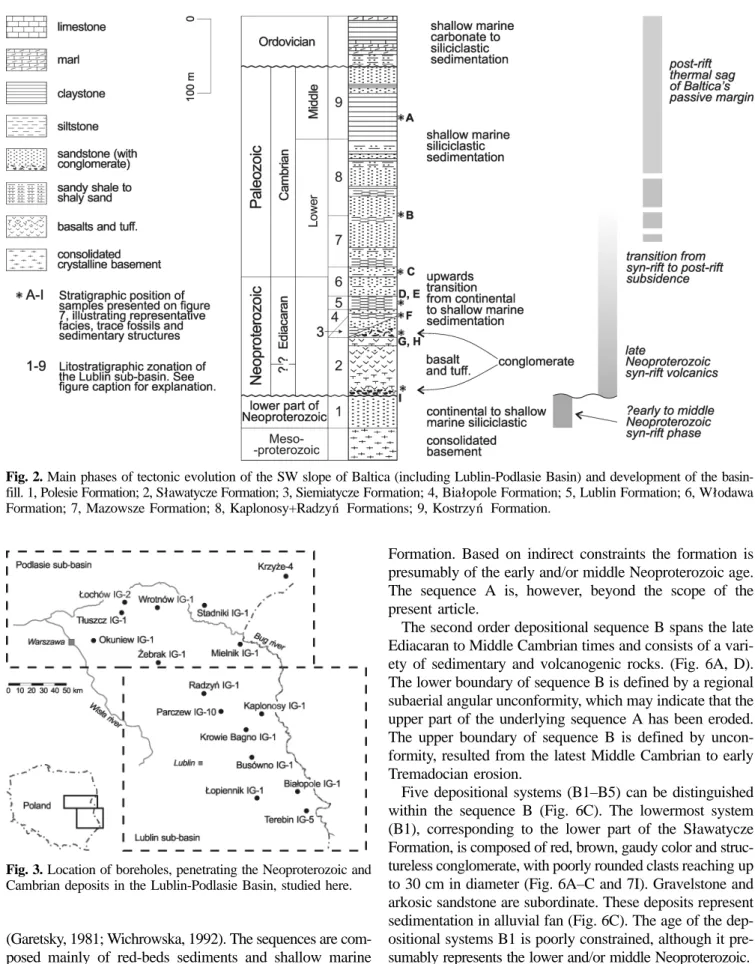
(2) 118. Jolanta Paczes´na and Pawe l Poprawa. Fig. 1. (A) Simplified tectonic map of the central and north-eastern Europe. LPB, Lublin-Podlasie Basin; OVA, Orsha-Volhyn Aulacogen; TESZ, Trans-European Suture Zone; EEC, East European Craton. (B) Sketch-map of the Polish part of the East European Craton showing location of the Lublin-Podlasie Basin, the Lublin and Podlasie zones and recent extent of the upper Ediacaran and Lower Cambrian deposits (after Lendzion, 1983; Moczyd l owska, 1991).. Podlasie zones (Fig. 1), which differ to some extent in their facies development. In both zones, developed on the Lowerto Mesoproterozoic crystalline basement (e.g., Ryka, 1984; Bogdanova et al., 1997), an unmetamorphosed succession of the sedimentary cover begins with terrigenous deposits probably belonging to the upper Neoproterozoic, passing upwards into the upper Neoproterozoic? volcanic and siliciclastic sediment succession (Are n´ , 1982) (Fig. 2). The later are partly missing in the Podlasie zone. The overlying Lower and Middle Cambrian sediments form a relatively uniform cover in both zones. The total thickness of the Neoproterozoic to Cambrian succession in the LPB increases generally from east to west. The lower part of the Lublin-Podlasie sedimentary succession has a poor stratigraphic control. The only exceptions are radiometric U–Pb and K–Ar datings of volcanic formation (Compston et al., 1995; Velicanov and Korenchuk, 1997). The upper part of the succession, i.e., clastic, marine succession, is characterized by acritarch and trilobite zonation (Lendzion, 1983; Moczyd lowska, 1991). The oldest sediments, i.e., Polesie Formation (Fig. 2), are represented by siliciclastic deposits (Are n´ , 1982). Further to the east of the LPB lateral equivalents of the Polesie Formation reach in tectonic grabens thicknesses of up to 1000 m (Mahnatsch et al., 1976). Origin of the grabens could be related to the early-middle Neoproterozoic rifting phase,. associated to Rodinia/Pannotia break-up (cf., Poprawa and Pacze s´ na, 2002). The Polesie Formation is unconformably covered by volcanogenic and clastic rocks of the S lawatycze Formation (Fig. 2). The latter consists of basalts, tuffs and autoclastic deposits in its upper part, as well as conglomerates and coarse-grained sandstones in the lower part (Fig. 2). It constitutes a small part of the large continental flood basalts province spreading from SE Poland, western Ukraine and Moldova through Belarus to Russia (Rozanov and Lydka, 1987; Bogdanowa et al., 1997). The overlying clastic deposits of the Siemiatycze, Bialopole, Lublin, Wlodawa, Mazowsze, Radzy n´ +Kaplonosy and Kostrzy n´ formations represent stratigraphic interval from the latest Ediacaran to Middle Cambrian (Fig. 2). Upper part of the Middle Cambrian and Upper Cambrian deposits are absent in the investigated basin and were removed by erosion before the Ordovician. Analysis of tectonic subsidence (backstripping), conducted for the Neoproterozoic and Lower Paleozoic succession of the LPB, revealed a pattern of subsidence systematically decreasing in time (see e.g., Fig. 5). This allowed to conclude, that the development of the basin was controlled by the late Neoproterozoic (to earliest Cambrian?) rifting event and subsequent Cambrian to Middle Ordovician post-rift thermal subsidence (Fig. 2) (Poprawa and Paczes´na, 2002). Such interpretation is coherent with results of facies analysis (op. cit.) The late Neoproterozoic extension in the LPB is a part of a rifting process that affected the western margin of Baltica (op. cit.) and was connected to the final stage of break-up of the Rodinia/Pannotia supercontinent (cf., Bond et al., 1984). Thermal sag stage of the system is presumably related to development of the passive margin along western Baltica (Poprawa et al., 1999; Poprawa and Paczes´ na, 2002). 3. DEPOSITIONAL SYSTEMS AND SEQUENCE STRATIGRAPHY The Neoproterozoic to Middle Cambrian sedimentary cover of the LPB is here subdivided into two second-order depositional sequences, referred to as A and B (Fig. 6D). The sequence A, at the base of sedimentary succession of the LPB, is defined by regional angular unconformities, both at the bottom and top. The lower unconformity represents a phase of intense, probably long lasting erosion of the crystalline basement. Along the unconformity a sedimentary cover of the uncertain age, however younger than 0.7 Ga if to accept indirect constraints from dating of detrital muscovite (e.g., Semenenko, 1968), overlie the Mesoproterozoic gneiss, granitoid, syenite, and gabro complexes (1.0–1.3 Ga according to Semenenko, 1968; Bogdanova et al., 1997; Velikanow and Korenchuk, 1997). The sequence A is build up of continental to shallow marine mostly arkosic sandstone, and silstone interbedded with claystone, referred to as the Polesie Formation (Fig. 6A).
(3) development of Neoproterozoic and Cambrian stratigraphic sequences of the Lublin-Podlasie Basin. 119. Fig. 2. Main phases of tectonic evolution of the SW slope of Baltica (including Lublin-Podlasie Basin) and development of the basinfill. 1, Polesie Formation; 2, Sl awatycze Formation; 3, Siemiatycze Formation; 4, Bia l opole Formation; 5, Lublin Formation; 6, W l odawa Formation; 7, Mazowsze Formation; 8, Kaplonosy+Radzyn´ Formations; 9, Kostrzy n´ Formation.. Fig. 3. Location of boreholes, penetrating the Neoproterozoic and Cambrian deposits in the Lublin-Podlasie Basin, studied here.. (Garetsky, 1981; Wichrowska, 1992). The sequences are composed mainly of red-beds sediments and shallow marine siliciclastics. According to Garetsky (1981) four individual sedimentary cycles can be recognized within the Polesie. Formation. Based on indirect constraints the formation is presumably of the early and/or middle Neoproterozoic age. The sequence A is, however, beyond the scope of the present article. The second order depositional sequence B spans the late Ediacaran to Middle Cambrian times and consists of a variety of sedimentary and volcanogenic rocks. (Fig. 6A, D). The lower boundary of sequence B is defined by a regional subaerial angular unconformity, which may indicate that the upper part of the underlying sequence A has been eroded. The upper boundary of sequence B is defined by unconformity, resulted from the latest Middle Cambrian to early Tremadocian erosion. Five depositional systems (B1–B5) can be distinguished within the sequence B (Fig. 6C). The lowermost system (B1), corresponding to the lower part of the Slawatycze Formation, is composed of red, brown, gaudy color and structureless conglomerate, with poorly rounded clasts reaching up to 30 cm in diameter (Fig. 6A–C and 7I). Gravelstone and arkosic sandstone are subordinate. These deposits represent sedimentation in alluvial fan (Fig. 6C). The age of the depositional systems B1 is poorly constrained, although it presumably represents the lower and/or middle Neoproterozoic. The next in ascending order depositional system (B2), comprising the upper part of the S lawatycze Formation,.
(4) Fig. 4. An example of a well section Okuniew IG-1, representative for the Podlasie zone, illustrating sedimentary environments and high-resolution sequence stratigraphy of the Lower and Middle Cambrian succession (after Pacze´sna, 2001, modified). Lithology: 1, coarse-grained sandstone; 2, medium-grained sandstone; 3, fine-grained sandstone; 4, mudstone; 5, claystone; 6, limestone; 7, diabase, 8, crystalline basement. Trace fossils: 1, Skolithos linearis; 2, Monocraterion isp.; 3, Rosselia isp.; 4, Treptichnus isp.; 5, Teichichnus isp.; 6, Planolites montanus; 7, Planolites beverleyensis; 8, Bergaueria major; 9, Escape structures; 10, Glossifungites ichnofacies. Sedimentary structures: 1, large-scale cross bedding; 2, small-scale cross bedding; 3, horizontal lamination; 4, flaser bedding; 5, surfaces of erosion; 6, intraclasts of mudstone. Sedimentary environments: 1, foreshore; 2, distal upper shoreface; 3, proximal lower shoreface; 4, proximal upper offshore; 5, distal upper offshore. Sequence stratigraphy: 1, sequence boundary; 2, parasequence boundary; 3, parasequences set boundary; 4, maximum flooding surface; 5, parasequences in transgressive system tract; 6, parasequences in highstand system tract. Biostratigraphy according to Lendzion (1983) and Moczyd l owska (1991).. 120 Jolanta Paczes´na and Pawe l Poprawa.
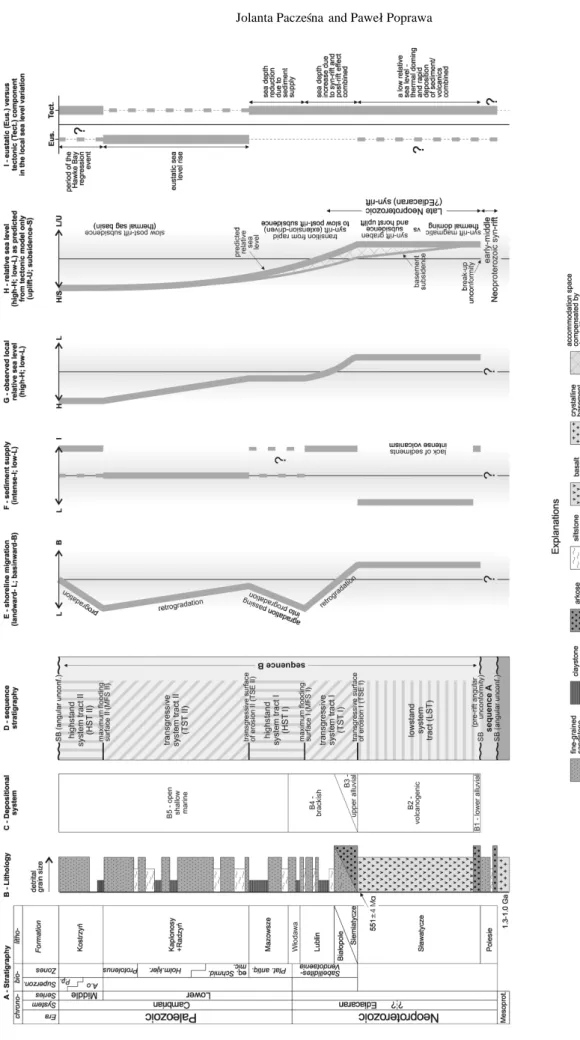
(5) development of Neoproterozoic and Cambrian stratigraphic sequences of the Lublin-Podlasie Basin. 121. Fig. 5. Examples of the late Ediacaran, Cambrian, and Ordovician tectonic subsidence histories and changes rate of deposition for two representatives sections: (A) Bial opole IG-1 and (B) L opiennik IG-1.. consists of continental flood basalt, sill and dike of gabbrodolerite, intercalated with pyroclastic and epiclastic units (Fig. 6A–C). Judging from the isotopic U–Pb and K–Ar datings this depositional system represents time span of approximately (?660–) 600–550 Ma (Compston et al., 1995; Velicanov and Korenchuk, 1997). Depositional systems B1 and B2 form together lowstand system tract (LST) of the sequence B (Fig. 6C, D). It is characterized by low erosion base level, being an expression of relative sea level fall (Fig. 6G). This was a result of both regional uplift due to thermal doming (Poprawa & Paczes´na, 2002) and fast deposition of sediments and basalts. The model of LST is additionally supported by lack of deposition and/or erosion in regions surrounding the spatially restricted depocenter of Slawatycze Formation. The low sea level represents an exceptionally long period of time, possibly 50–100 Ma. The next depositional system (B3) is represented by the Siemiatycze Formation (Fig. 6A–C). This formation is built up by fining upwards clastic coarse-grained sediments, with large-scale cross-bedded arkosic sandstone prevailing in the lower part and fine-grained sandstones dominating in the upper part (Fig. 7G, H). These sediments were deposited in an alluvial environment, mainly braided rivers and ephemeral streams. Depositional system B3 is of the latest Ediacaran age; it began approximately at 551 Ma (compare: Compston et al., 1995) and terminated before 542 Ma, i.e., at the Precambrian/Cambrian boundary (compare: Gradstein et al., 2004).. A succeeding depositional system B4 includes the Bialopole, Lublin, and Wlodawa formations (Fig. 6A–C). It is characterized by coastal to shallow marine, dominantly brackish sedimentary environments, including lagoon, embayment, tidal flat and shoreface, and contains abundant Vendotaenia algae (Paczes´na, 1996). A specific feature of the Bialopole and W lodawa formations is the presence of a large-scale cross-bedding, originated in tidal channels (Fig. 7C, F). The most characteristic feature of the Lublin Formation is the occurrence of fine-grained, finely laminated, heterolithic sediments with flaser, wave, lenticular, and parallel lamination (Fig. 7D), representing a tidal flat environments. Additionally, the presence of dewatering structures and convolute bedding indicates a high deposition rate. The Lublin Formation is also characterized by the first appearance of trace fossils, representing typical brackish, undifferentiated assemblage of ichnofauna (Paczes´na, 1996) (Fig. 7E). Due to diachronism of the transgression the marine Bialopole Formation is a lateral equivalent of the alluvial Siemiatycze Formation, and depositional system B4 is therefore partly coeval with the B3 system (Fig. 6A–C). Thus the development of the B4 system also began at approximately 551 Ma. The B4 terminated in the earliest Cambrian (the lowermost part of the Platysolenites antiquisissimus Zone). In the present model, the depositional systems B3 and the lower part of B4, correspond to a transgressive system tract (TST I) (Fig. 6C, D). Development of the TST I was controlled by local tectonic processes and an increase of sed-.
(6) Fig. 6. Relation between factors controlling development of the analysed depositional sequences of the Lublin zone, in the upper part (i.e., above Platysolenites antiquisissimus) valid also for the Podlasie zone. See text for discussion. Explanations for abbreviations: Plat. antiq., Platysolenites antiquisissimus; eq. Schmid. mic., equivalent Schmidtiellus mickwitzi; Holm. kjer., Holmia kjerulfi; A.o., Acadoparadoxides oelandicus; P.p., Paradoxides paradoxissimus; SB, sequence boundary. Biostratigraphy according to Lendzion (1983) and Moczyd l owska (1991).. 122 Jolanta Paczes´na and Pawe l Poprawa.
(7) development of Neoproterozoic and Cambrian stratigraphic sequences of the Lublin-Podlasie Basin. iments supply to the basin (Figs. 5 and 6F). Roughly at the transition from LST to TST I a major syn-rift extensional graben activity and flood basalt emplacement terminated. This led to onset of a post-rift thermal sag, resulting in increasing subsidence (Fig. 6H). Irrespective of relatively fast accumulation of sediments at that time, i.e., the end of Ediacaran (Figs. 5A, B and 6F), even faster subsidence (Figs. 5A, B and 6H) caused increase of accommodation space and a fast rise of local relative sea level (Fig. 6G). As a consequence, the stratigraphic architecture of the LPB during development of the TST I was dominated by retrogradation of parasequences (Fig. 6E). The upper boundary of the TST I is a maximum flooding surface (MFS I), marked by a maximal extent towards inland of the deepest sedimentary environment recognised in the succession, i.e., shoreface. The TST I corresponds to a constant and relatively rapid increase of relative sea level (Fig. 6G). The last depositional system (B5) is composed of the Mazowsze, Kaplonosy+Radzy n´ and Kostrzy n´ formations (Fig. 6A–C). These sediments were deposited in an open marine, shoreface and offshore sedimentary environments, and are characterized by the presence of intercalated thick complexes of sandstone and mudstone, with cross-bedding, flaser and lenticular lamination (Figs. 4 and 6B); however the B5 system lacks tidal heterolithes, typical for part of the B4. The most characteristic feature of B5 is a presence of a specific assemblage of ichnofauna, indicating open, shallow marine conditions (Paczes´na, 2001) (Fig. 7A). The depositional system B5 represents time span between the earliest Cambrian (the lowermost part of the Platysolenites antiquisissimus Zone) and Middle Cambrian (Paradoxides paradoxissimus Zone) (Fig. 6A, C), however its uppermost part was reduced by erosion. The upper part of depositional system B4 (above MFS I) together with the lower part of depositional system B5 constitutes a highstand system tract (HST I) (Fig. 6C, D). The HST I is documented of parasequences agradation passing into progradation (Fig. 6E). It represents a slow relative sea level rise (Fig. 6G), documented mainly by the development of by traces fossil assemblages (compare: Paczes´na, 1996). The development of the HST I is related to interaction between subsidence and deposition. At the time the supply of sediments to the basin was still relatively high and exceeded in rate a post-rift subsidence, which at that stage began to decelerate (Figs. 5A, B and 6F, H). The upper boundary of HST I is determined by the appearance of a ravinement surface (transgressive surface of erosion; TSE II) (Fig. 6D), revealed by ichnofacies analyses (Fig. 7B). The surface is a transgressivelly modified boundary of a lower, third order depositional sequence. Prior to modification the surface was a lateral equivalent of subaeral erosion, documented east of the LPB (compare: Mens, 1987) and in the western part of Podlasie zone (Paczes´na, 2001). The. 123. TSE II corresponds roughly to the top of the Platysolenites antiquisissimus Zone. It is also the lower boundary of another transgressive system tract (TST II). During development of the TST II the relationship between subsidence and sediment supply was similar to that of the HST I, i.e., the rate of subsidence continued to decrease, while deposition rate was still relatively high (Figs. 5A, B and 6F, H). The TST II is characterized by retrogradation of shoreline (Fig. 6E) and rapid relative sea level rise (Fig. 6G). It is terminated near the top of the Protolenus Zone at the second maximum flooding surface (MFS II) (Figs. 4 and 6D), indicated by similar features as in the MFS I. Above the MFS II another highstand system tract (HST II) developed, which comprises a set of packages of shoreface deposits, prograding against offshore deposits (Fig. 6D, E). At this time subsidence rate decreased while sediment supply locally increased (Figs. 5A, B and 6F, H). Further development of the sequence B cannot be recognised, because of the pre-Ordovician erosion which removed part of the Cambrian succession. This erosional surface therefore forms the upper boundary of both the HST II and the sequence B (Fig. 6D). 4. DEPENDENCE OF THE SEQUENCE DEVELOPMENT ON TECTONIC AND EUSTATIC EVENTS – DISCUSSION Sequence A (Fig. 6D) is the least recognised part of the Proterozoic to Cambrian sedimentary succession of western Baltica. For this reason it is difficult to reveal possible mechanisms of the sequence development. According to Mahnatsch et al. (1976) sediments of the sequence A were deposited in tectonic grabens. This is at least partly confirmed by the facies development. The grabens were presumably related to the early-middle Neoprotrozoic rifting (Fig. 2), being a part of the Rodinia/Pannotia break-up (Poprawa and Paczes´na, 2002). This indicates that local tectonic control could have had an important impact on the relative sea level of sequence A (Fig. 6I). A complex interplay between tectonic and eustatic processes is observed in the development of the following sequence B. According to tectonic model of the late Neoproterozoic rifting (Poprawa and Paczes´na, 2002), the basal unconformity in the Lublin-Podlasie Basin might be well explained by thermal doming predating the extensional tectonics and volcanism in the region. It implies that the development of sequence B was preceded by a period of a low relative sea level, which still continued during the deposition of the lowstand system tract (LST) sediments (Fig. 6G). The relative sea level of the LST was probably controlled mainly by local tectonics, such as regional thermal doming and rapid accumulation of alluvial siliciclastic and continental volcanogenic rock, fast enough to compensate the subsidence of extensional grabens (Fig. 6I)..
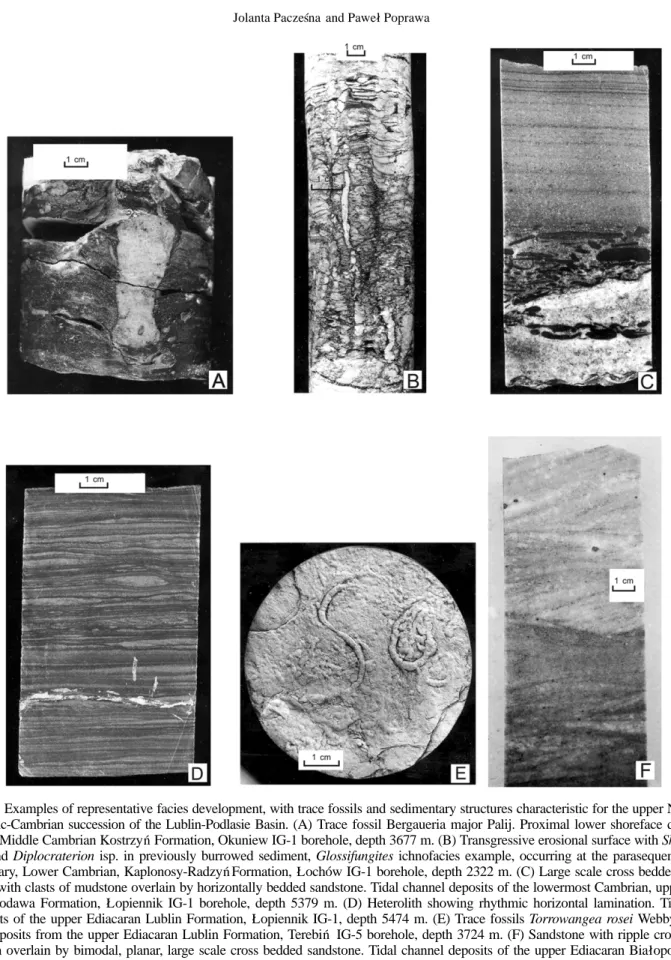
(8) 124. Jolanta Paczes´na and Pawe l Poprawa. Fig. 7. Examples of representative facies development, with trace fossils and sedimentary structures characteristic for the upper Neoproterozoic-Cambrian succession of the Lublin-Podlasie Basin. (A) Trace fossil Bergaueria major Palij. Proximal lower shoreface deposits of the Middle Cambrian Kostrzy n´ Formation, Okuniew IG-1 borehole, depth 3677 m. (B) Transgressive erosional surface with Skolithos isp. and Diplocraterion isp. in previously burrowed sediment, Glossifungites ichnofacies example, occurring at the parasequences set boundary, Lower Cambrian, Kaplonosy-Radzy n´ Formation, L ochów IG-1 borehole, depth 2322 m. (C) Large scale cross bedded sandstone with clasts of mudstone overlain by horizontally bedded sandstone. Tidal channel deposits of the lowermost Cambrian, upper part of W l odawa Formation, L opiennik IG-1 borehole, depth 5379 m. (D) Heterolith showing rhythmic horizontal lamination. Tidal flat deposits of the upper Ediacaran Lublin Formation, Lopiennik IG-1, depth 5474 m. (E) Trace fossils Torrowangea rosei Webby. Tidal flat deposits from the upper Ediacaran Lublin Formation, Terebin´ IG-5 borehole, depth 3724 m. (F) Sandstone with ripple cross lamination overlain by bimodal, planar, large scale cross bedded sandstone. Tidal channel deposits of the upper Ediacaran Bia l opole Formation, L opiennik IG-1 borehole, depth 5540 m..
(9) development of Neoproterozoic and Cambrian stratigraphic sequences of the Lublin-Podlasie Basin. 125. Fig. 7. Continued. (G) Fine-grained sandstone with large scale cross bedding. Braided fluvial deposits of the upper Ediacaran, Siemiatycze Formation, Kaplonosy IG-1 borehole, depth 1412 m. (H) Polymictic conglomerate, passing upwards into arkosic sandstone. Braided river deposits of the upper Ediacaran Siemiatycze Formation, Krzyz· e-4 borehole, depth 762 m. (I) Polymictic conglomerate with feldspathic clasts. Alluvial fan deposits of the lower part of the upper Neoproterozoic S l awatycze Formation, Kaplonosy IG-1 borehole, depth 1826 m.. Another important factor was climatic conditions in the late Neoproterozoic. Lack of vegetation, mechanical and chemical weathering caused a quick disintegration of exposed rocks. This could enhance production of a big mass volume of detritus, even without the participation of tectonic uplift (Eriksson et al., 1998). Similar processes operated in the LPB, evidenced by brown-gaudy colored sediments deposited in arid or semi-arid climate. However, taking into account the presence of continental sediments in some of the Ediacaran sections worldwide (e.g., Myrow, 1995; Walter et al., 1995; Crawford et al., 1997; Calver and Walter, 2000; Fedo and Cooper, 2001), a possibility that impact of local tectonics on the relative sea level of the LPB was enhanced by eustatic low sea level cannot be excluded. A relative sea level increase in the Lublin-Podlasie Basin marked the beginning of the development of TST I (Fig. 6G). The TST I, characterized by a landward migration of the shoreline (Fig. 6E) and relatively fast supply of detritus (Fig. 6F), coincides with a transition from syn-rift to postrift subsidence, typically resulting in a depth increase and lateral expansion of the basin (Fig. 6H). Agreement between the documented evolutions of the LPB with the above mentioned predictions from tectonic model is suggestive for dominance of local tectonics on relative sea level increase (Fig. 6I). Such interpretation is further confirmed by lack of clear evidence for a transgression at that time in most of other profiles of the Ediacaran at both Baltica (e.g., Vidal and Moczydlowska, 1995) and other paleocontinents (e.g., Simpson and Eriksson, 1989; Fedo and Cooper, 2001). At about the transition from TST I to HST I, the intrabasin fault activity terminated, and the structural architec-. ture of the LPB was thereafter controlled by decreasing thermal subsidence (Fig. 6H). During the development of HST I, the relative sea level remained high with no obvious changes (Fig. 6G). However, the tectonic model for the LPB suggests continuous transgression at this stage (Fig. 6H). Also development of the majority of the Lower Cambrian successions worldwide indicate that the global sea level might have been increasing at the time (e.g., Brasier, 1980; Simpson and Eriksson, 1990; Fedo and Cooper, 1990). If the latter is true, the development of the HST I of the Lublin-Podlasie Basin would be related to local, noneustatic factors (Fig. 6I). The following transgressive system tract II is characterized by still relatively high sediment supply and subsidence even slower than previously (Figs. 5A, B and 6F, H). Although the stratigraphic resolution does not allow to calculate the deposition rate separately for the HST I and TST II and therefore to compare it, the facies development confirms that sedimentation could be even faster during the development of the TST II then previously. Irrespective of continuing fast supply of detritus, accommodation space of the basin increased as a result of the relative sea level rise (Fig. 6G) and landward migration of shoreline (Fig. 6E). This may indicate that eustasy was a dominant factor controlling relative sea level at that time (Fig. 6I). The confirmation for such an interpretation might be a synchronous global transgression (e.g., Brasier, 1980; Simpson and Eriksson, 1990; Moczyd lowska, 1998). Also a rapid transition from HST I to TST II support rather the eustatic control, as the tectonic processes usually operate in a longer timescale. However, considering the difficulties in precise deter-.
(10) 126. Jolanta Paczes´na and Pawe l Poprawa. mining of sedimentation rates, one should not exclude a possibility that thermal sag subsidence could to some extent contribute to the observed relative sea level rise. The transition from the Lower to Middle Cambrian corresponds roughly to the beginning of highstand system tract II (HST II). During the development of HST II increase of local sea level became much slower then previously (Fig. 6G), and accommodation space decreased. However, the tectonic model for the LPB predicts still decelerating subsidence at that stage (Fig. 6H), while increase of sediment supply is observed only locally (Fig. 5A, B). It is also difficult to recognize in the LPB any clear expression of the possibly global Hawke Bay regression (c.f., Palmer and James, 1980; Vidal and Moczyd lowska, 1996). Based on the above, it is suggested here, that development of HST II might be related to local tectonic activity (Fig. 6I), although not resulting from the LPB rift evolution. The sedimentary record of the subsequent development of the sequence B was removed by erosion which took place in the time between of the end of Middle Cambrian and Early Tremadocian. It is likely that the regression led to the emergences of these sediments and contributed to the observed erosion. However it is difficult to infer if the regression could continue until the beginning of Ordovician. Taking into account the development of the Middle to Upper Cambrian in the Baltic Basin, neighboring the LPB from the NW, it is likely that the regression terminated in the Middle Cambrian, resulting in moderate erosion, and then the Late Cambrian-early Tremadocian transgressiveregressive cycle developed (Jaworowski, 2000). Similar stratigraphic extent of the erosion at the end of Middle Cambrian to Early Tremadocian and its moderate magnitude along relatively long south-western margin of Baltica point rather to the dominance of eustatic over local tectonic processes in its development. 5. CONCLUSIONS Two major factors controlled the development of the continuous upper Neoproterozoic to lower Middle Cambrian succession of the Lublin-Podlasie Basin. These are the synrift extension evolving into the post-rift thermal sag, and the global transgressive and regressive cycles. To evaluate relative importance of tectonic and eustatic processes on the development of depositional sequences, the predictions derived from rift model of the LPB were confronted with the relative sea level changes documented by the facies record. The development of sequence A, probably related to the early-middle Neoproterozoic rifting, was dominated by local tectonic factors. The lower part of sequence B, i.e., LST, TST I and HST I (late Neoproterozoic to the Platysolenites antiquisissimus biochron of the Early Cambrian), developed due to the interplay between local tectonic and eustasy-related pro-. cesses, with a clear dominance of the first one. This is associated to syn-rift, as well as to transition from syn-rift to post rift stage of the basin evolution. The development of transgressive system tract II (equivalent to the Schmidtiellus mickwitzi-Protolenus zones of the Lower Cambrian) was dominated by the eustatic sea level changes. This allows to explain a fast sediment supply coeval with retrogradation, and is consistent with a common presence of the transgression worlwide at that time. The development of HST II (Acadoparadoxides oelandicus-Paradoxides paradoxissimus zones of the Middle Cambrian), was controlled predominantly by a local tectonics, which prevailed over an influence of the coeval, presumably eustatic, Hawke Bay regression. It is difficult to reveal any eustatic sea level changes in the LPB during the syn-rift stage as well as the transition from syn-rift to post-rift stage. The eustasy began to influence noticeably the sequences’ development only with a decreasing tectonic activity at the post-rift stage. ACKNOWLEDGEMENTS: We gratefully acknowledge for constructive reviews from Ma lgorzata Moczyd lowska-Vidal and Per Ahlberg. We also thank Szczepan Pore˛bski for useful comments and suggestions. The present study was granted by the National Committee for Scientific Research in Poland (project 5T12B 05325).. REFERENCES Are n´ , B., 1982, Lithological and facies development of the upper Vendian in the eastern Poland. Przegla˛d Geologiczny, 5, 225– 230. (in Polish with English abstract) Bogdanova, S.V., Pashkevich, I.K., Gorbatschev, R. and Orlyuk, M.I., 1997, Riphean rifting and major Palaeoproterozoic crustal boundaries in the basement of the East European Craton: geology and geophysics. Tectonophysics, 268, 1–21. Bond, G.C., Nickeson, P.A. and Kominz, M.A., 1984, Breakup of a supercontinent between 625 Ma and 555 Ma: new evidence and implications for continental histories. Earth and Planetary Science Letters, 70, 325–345. Brasier, M., 1980, The Lower Cambrian transgression and glauconite-phosphate facies in western Europe. Journal of the Geological Society of London, 137, 695–703. Calver, C.R. and Walter, M.R., 2000, The Late Neoproterozoic Grassy Group of King Island, Tasmania: correlation and palaeogeographic significance. Precambrian Research, 100, 299–312. Compston, W., Sambridge, M.S., Reinfrank, R.F., Moczydlowska, M., Vidal, G. and Claesson, S., 1995, Numerical ages of volcanic rocks and the earliest faunal zone within the Late Precambrian of east Poland. Journal of the Geological Society of London, 152, 599–611. Crawford, A.J., Stevens, B.P.J. and Fanning, M., 1997, Geochemistry and tectonic setting of some Neoproterozoic and Early Cambrian volcanics in western New South Wales. Journal of the Geological Society of Australia, 26, 353–361. Eriksson, P.G., Condie, K.C., Tirsgaard, H., Mueller, W.U., Altermann, W., Miall, A.D., Aspler, L.B., Catuneanu, O. and Chiarenzelli, J.R., 1998, Precambrian clastic sedimentation systems. Sedimentary Geology, 120, 5–53. Fedo, C.M. and Cooper, J.D., 1990, Braided fluvial to marine tran-.
(11) development of Neoproterozoic and Cambrian stratigraphic sequences of the Lublin-Podlasie Basin. sition: the basal Lower Cambrian Wood Campon Formation, Southern Marble Mountains, Majave Desert, California. Journal of Sedimentary Petrology, 60, 220–234. Fedo, C.M. and Cooper, J.D., 2001, Sedimentology and sequence stratigraphy of Neoproterozoic and Cambrian units across a craton-margin hinge zone, southeastern California, and implications for the early evolution of the Cordilleran margin. Sedimentary Geology, 141–142, 466–501. Garetsky, R.G., ed., 1981, Geology of the western part of the EastEuropean Platform. Publishing Nauka i Tehnika, Minsk, 188 p. Garetsky, R.G., Zinovienko, G.V., Visnjakov, I.B., Glusko, V.V., Pomjanovskaja, G.M. and Lvov, G.M., 1987, Die perikratone BaltikDnestr-Senkungszone. Zeitschrift für angewandte Geologie, 33, 207–213. (in German) Gradstein, F.M., Ogg, J. and Smith, A.G., eds., 2004, A Geologic Time Scale. Cambridge University Press, Cambridge, 589 p. Jaworowski, K., 2000, Facies variability in the Cambrian deposits from the Ko´scierzyna and Gda n´ sk sections (Pomeranian Caledonides foreland, northern Poland): a comparative study. Geological Quarterly, 44, 249–260. Lendzion, K., 1983, Biostratigraphy of the Cambrian deposits from the Polish part of the East European Craton. Kwartalnik Geologiczny, 27, 669–694. (in Polish with English abstract) Mahnatsch, A.S., Weretennikov, N.W., Shkuratov, W.I. and Bordon, W.E., 1976, Riphean and Vendian of Belarus. Minsk, 358 p. (in Russian) Mens, K.A., 1987, Early Cambrian-Lontova Stage. In: Rozanov, A.YU. and L ydka, K. (eds.), Palaeogeography and Lithology of the Vendian and Cambrian of the western East-European Platform. Wydawnictwa Geologiczne, Warszawa, p. 32–37. Moczyd l owska, M., 1991, Acritarch biostratigraphy of the Lower Cambrian and the Precambrian-Cambrian boundary in southeastern Poland. Fossils and Strata, 29, 97 p. Moczyd l owska, M., 1998, Cambrian acritarchs from Upper Silesia, Poland–biochronology and tectonic implications. Fossils and Strata, 46, 121 p. Myrow, P.M., 1995, Neoproterozoic rocks of the Newfoundland Avalon Zone. Precambrian Research, 73, 123–136. Nikishin, A.M., Ziegler, P.A., Stephenson, R.A., Cloethingh, S.A.P.L., Furne, A.V., Foki, P.A., Ershov, A.V., Bolotov, S.N., Korotaev, M.V., Aleekseev, A.S., Gorbachev, V.I., Shipilov, E.V., Lankreijer, A., Bembinova, E.YU. and Shalimov, I.V., 1996, Late Permian to Triassic history of the East European Craton: dynamics of sedimentary basin evolution. Tectonophysics, 268, 23–63. Pacze´sna, J., 1996, Upper Vendian and Cambrian ichnocoenose from the Polish part of the East European Craton. Prace Pa n´ stwowego Instytutu Geologicznego, 152, 77 p. Pacze´sna, J., 2001, An application of trace fossils in the facies analysis and high-resolution sequence stratigraphy – an example from the Cambrian of the Polish part of the East European Craton. Przegla˛ d Geologiczny, 49, 1137–1146. (in Polish with English abstract) Palmer, A.R. and James, N.P., 1980, The Hawke Bay event: a circum. 127. Iapetus regression near the Lower-Middle Cambrian boundary. In: Wones, D.R. (ed.), The Caledonides in the USA. Virginia Polytechnic Institute State University Department of Geological Sciences Memoir, 2, p. 15–18. Poprawa, P. and Pacze´s na, J., 2002, Late Neoproterozoic to Early Paleozoic development of a rift at the Lublin-Podlasie slope of the East European Craton – analysis of subsidence and facies record. Przegl˛a d Geologiczny, 50, 49–61. (in Polish with English abstract) Poprawa, P., Šliaupa, S., Stephenson, R.A. and Lazauskiene· , J., 1999, Late Vendian-Early Palaeozoic tectonic evolution of the Baltic basin: regional implications from subsidence analysis. Tectonophysics, 314, 219–239. Poz· arski, W. and Kotañski, Z., 1979, Tectonic development of the Baikalian and Caledonian-Variscan foreland of the East European Platform in Poland. Geological Quarterly, 23, 7–19. (in Polish) Rozanov, A.YU. and L ydka, K., 1987, Palaeogeography and lithology of the Vendian and Cambrian of the western East European Platform. Wydawnictwa Geologiczne, Warsaw, 114 p. Ryka, W., 1984, Precambrian evolution of the East-European Platform in Poland. Biuletyn Instytutu Geologicznego, 347, 17–28. Semenenko, N.P., ed., 1968, Riphean volcanism and metallization of the western part of the Ukrainian Shield. Publishing Naukova Dumka, Kiev, 172 p. (in Russian) Simpson, E.L. and Eriksson, K.A., 1989, Sedimentology of the Unicoi Formation in southern and central Virginia: evidence for late Proterozoic to early Cambrian rift-to-passive margin transition. Journal of Geological Society of America, 101, 42–54. Simpson, E.L. and Eriksson, K.A., 1990, Early Cambrian progradational and transgressive sedimentation in Virginia: an example of the early history of a passive margin. Journal of Sedimentary Petrology, 60, 84–100. Velikanov, V.A. and Korenchuk, L.V., 1997, Phases of magmatism and their relation to the sediment deposition in the Late Precambrian (Riphean-Vendian) of the Volhyn-Podolia. Geologichny Journal, 1–2, 124–131. (in Russian) Vidal, G. and Moczyd l owska, M., 1995, The Neoproterozoic of Baltica – stratigraphy, palaeobiology and general geological evolution. Precambrian Research, 73, 197–216. Vidal, G. and Moczyd l owska, M., 1996, Vendian-Lower Cambrian acritarch biostratigraphy of the central Caledonian fold belt in Scandinavia and the palaeogeography of the Iapetus-Tornquist seaway. Norsk Geologisk Tidsskrift, 76, 147–168. Walter, M.R., Veevers, J.J., Calver, C.R. and Grey, K., 1995, Neoproterozoic stratigraphy of the Centralian Superbasin, Australia. Precambrian Research, 73, 173–195. Wichrowska, M., 1992, Riphean on cratonic area of Poland. Przegla˛ d Geologiczny, 2, 94–99. (in Polish with English summary) Manuscript received November 7, 2004 Manuscript accepted April 18, 2005.
(12)
수치


+3

관련 문서
ABSTRACT: Paleostress and tectonic sequence of the Jinan Basin have been reconstructed with minor fault tectonics based on the analyses of minor fault population from the selected
By this kind of the tectonic evolution Tertiary Pohang Basin was undergone by ENE-WSW to E-W compression regime (Fig. 1) Schematic block diagram showing the
Geosciences Journal Vol 9, No 2, p 173 − 186, June 2005 Facies distribution patterns and environment reconstruction of the upper member of the Láncara Formation in the Somiedo
