• 검색 결과가 없습니다.

IEG 환경지질연구정보센터

N/A
N/A
Protected

Academic year: 2021

Share "IEG 환경지질연구정보센터"

Copied!
6
0
0

로드 중.... (전체 텍스트 보기)

전체 글

(1)

Vol. 9, No. 2, p. 101 − 106, June 2005

Changing perspectives on Cambrian chronostratigraphy and progress toward subdivision of the Cambrian System

ABSTRACT: Important steps have been made toward global sub- division of the Cambrian System. The consensus of opinion is that the system should be subdivided into four series representing sub- equal spans of time. The lower two series will correspond approx- imately to the traditional Lower Cambrian, the third series will correspond approximately to the traditional Middle Cambrian, and the fourth series corresponds approximately to the traditional Upper Cambrian. The fourth series, called the Furongian Series, has been ratified by the International Union of Geological Sciences (IUGS). Selection of horizons representing evolutionary events that can be correlated on a global scale, and which can be used as stage or series boundaries, is much more difficult for the lower two series intervals of the Cambrian than it is for the upper two series intervals of the Cambrian. The most practical concept for subdi- viding the system into stages involves the establishment of two stages each for the first and second series, and establishment of three stages each for the third and fourth series. The lowermost stage of the Furongian, called the Paibian Stage, has been ratified by the IUGS, and the International Subcommission on Cambrian Stratigraphy (ISCS) is nearing decisions on the levels that will used to mark the bases of the upper two stages of the Furongian.

Concerning stage boundaries within the proposed third series of the Cambrian, the ISCS is close to decisions on two levels that will be used to mark boundaries.

Key words: Cambrian, chronostratigraphy, Furongian 1. INTRODUCTION

The International Subcommission on Cambrian Stratig- raphy (ISCS) is making progress toward the definition of Global Standard Stratotype-sections and Points (GSSPs) for all stages and series of the Cambrian System. Here, we summarize recent developments and current plans concern- ing the establishment of internationally recognizable stage and series boundaries for the Cambrian. As announced at the first special meeting of the International Commission on Stratigraphy (ICS) in Urbino, Italy, on June 14–16, 2002 (ICS website: News/Archive), the International Union of Geological Sciences (IUGS) and the ICS have set 2008 as the year by which all Phanerozoic GSSPs should be defined.

The ISCS, in association with the IX International Confer- ence of the Cambrian Stage Subdivision Working Group, met in Suanbo Spa, South Korea, on 20 September 2004 to discuss issues related to subdivision of the Cambrian System.

Subsequently, in ballots held in November and December, 2004, the Voting Members of the ISCS were asked to con- sider the issues of: 1, subdivision of the Cambrian System;

and 2, levels proposed as stage-level GSSP horizons. The conclusions presented here represent the consensus of opin- ion expressed among workshop participants, and the results of balloting among the Voting Members of the ISCS (including the results of the 2004 balloting).

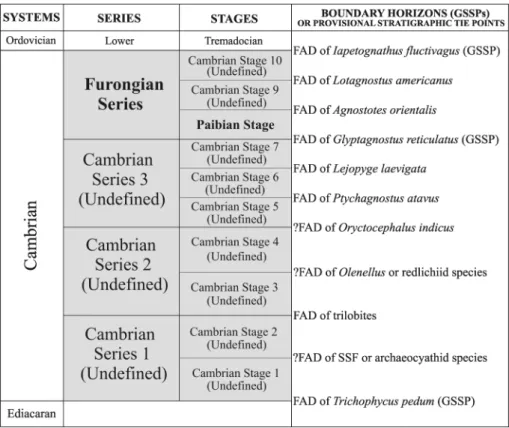
The most practical strategy for subdividing the Cambrian involves four series and ten stages (Fig. 1). In this plan, the lower two series would each contain two stages, and the upper two series would each contain three stages. To a large extent, this reflects the greater availability of correlation tools in the upper half of the Cambrian. Once agreement is reached on the biostratigraphic tools that will be used to define and characterize all of the boundaries, sections will be sought that will allow biostratigraphic tools to be cali- brated with other correlation techniques including chemos- tratigraphic, sequence-stratigraphic, magnetostratigraphic, and geochronometric techniques.

2. SUBDIVISION OF THE CAMBRIAN INTO SERIES Traditionally, the Cambrian has been divided into three series. However, addition of a thick pre-trilobitic interval to the system opens the possibility for division of the system into additional series. Current geochronologic dating suggests that the system represents about 53.7 million years (myr) of time (542.0–488.3 Ma; Gradstein and Ogg, 2004; Ogg, 2004; Gradstein et al., 2005). The Furongian Series repre- sents approximately 13 myr (501–488.3 Ma). The interval from the base of the traditional Middle Cambrian to the base of the Furongian (513–501 Ma) represents about 12 myr. Thus, the interval from the base of the Cambrian to the base of the traditional Middle Cambrian (542–513 Ma) rep- Loren E. Babcock*

Shanchi Peng Gerd Geyer John H. Shergold

Department of Geological Sciences, 125 South Oval Mall, The Ohio State University, Columbus, Ohio 43210, U.S.A.

Nanjing Institute of Geology and Palaeontology, Chinese Academy of Sciences, 39 East Beijing Road, Nanjing 210008, China

Institut für Paläontologie, Bayerische Julius-Maximillians-Universität, Pleicherwall 1, D-97070 Würzburg, Germany La Freunie, Benayes, 19510 Masseret, France

*Corresponding author: [email protected]

(2)

resents about 29 myr. At least two reasonable options are available for defining series within the Cambrian System: 1, division into three parts, one of which would represent more time than the other two series combined (and also would be more than twice the length of time of each of the other series); and 2, division into four series, each repre- senting approximately the same length of time. If four series are adopted, the placement of the pre-Furongian series boundaries would, ideally, be placed in positions cor- responding approximately to the first appearance datum (FAD) of trilobites, and the FAD of Oryctocephalus indicus or a comparative level (i.e., close to the traditional Lower- Middle Cambrian boundary). The unanimous opinion of participants at the ISCS workshop in South Korea was that four series should be established for the Cambrian. Voting members of the ISCS, in a ballot held during November and December, 2004, approved the concept of subdividing the Cambrian System into four series.

3. SUBDIVISION OF THE LOWER PART OF THE CAMBRIAN

Members of the ISCS favor dividing the traditional Lower Cambrian into two series based mainly on the premise that the lower Cambrian covers an interval of approximately 29 myr (542–513 Ma; Gradstein et al., 2005). As such, that interval is longer than the remainder of the Cambrian (ca.

25 myr; 513–488 Ma; Gradstein et al., 2005). The only gen- erally accepted subdivision of the lower Cambrian appears

to be subdivision into a sub-trilobitic series and a trilobitic series although alternative versions would be to place a series boundary: 1, at or about the FAD of archaeocyaths;

or 2, at the FAD of a small shelly fossil species.

Any version of a series boundary remains problematical for the moment and involves the dilemma that this level cannot be readily correlated on an intercontinental or global scale. Numerous scientists, over an interval of nearly two decades, examined options for placement of the basal Cam- brian (and basal Phanerozoic) GSSP. Ultimately, three options considered two decades ago as possible indicators of the Precambrian-Cambrian boundary (FADs of trilobites, archaeo- cyaths, and small shelly fossils), as well as other options, failed to receive common approval. Despite various impor- tant scientific advances as a result of that work, none of the three levels was recognized as suitable for reliable global correlation, so the lower boundary of the Cambrian was drawn at a much lower level defined by a considerable change in trace fossil associations. The GSSP in the section at Fortune Head, southeastern (Avalonian) Newfoundland, Canada, was marked by the FAD of Trichophycus pedum;

(Brasier et al., 1994; Landing, 1994) (Fig. 1). Recently, T. pedum has been reported from levels below the GSSP point in the stratotype section, leading to discussions on the significance of this level (Gehling et al., 2001; Geyer, in press).

Despite the recognized difficulties in correlating on a glo- bal scale, data accumulated by the Working Group (WG) on the Precambrian-Cambrian boundary in the 1970s and

Fig. 1. Chart showing the proposed subdivision of the Cambrian System.

Stages, series, and GSSP levels that

have been ratified by the ICS and

IUGS, as of December, 2004, are indi-

cated. Other proposed subdivisions are

identified as undefined units (with

numbers). Potential GSSP levels are

also indicated.

(3)

1980s, and additional data obtained since the 1980s, form a framework for correlation that can be refined by means of non-traditional techniques. Any of the three possible FAD

“events” appears to have nearly the same chance for rec- ognition as a series boundary but the FAD of trilobites, with its historic aspects, represents the classic approach to a series boundary. Such a distinction of two series for the tra- ditional Lower Cambrian has been introduced for Avalonia as the Placentian and Branchian Series, although the base of the Branchian clearly postdates the FAD of trilobites in a number of other regions (see Geyer and Shergold, 2000).

Nevertheless, regional traditions cannot play a significant role if the level to be identified should be the one best rec- ognizable on a global scale.

Fewer horizons having potential for intercontinental cor- relation exist within the lower half of the Cambrian System than exist within the upper half of the system. For the lower two series, subdivision of each series into two subequal stages is probably the most practical solution. It is also clear that once consensus is reached on each GSSP horizon, rec- ognition of each level in places other than the GSSP section will require an integrative approach. Biostratigraphic data will have to be supported by other information on global phenomena such as isotopic signatures, sea-level fluctua- tions, magnetostratigraphy, and geochronology.

The sub-trilobitic Cambrian represents an interval of approximately 18 myr according to current information (542–524 Ma; Gradstein and Ogg, 2004; Ogg, 2004; Grad- stein et al., 2005). Geochronologic data from western Ava- lonia (e.g., Landing, 1996; Landing et al., 1998) indicate that the time span from the earliest biomineralized fossils (other than cloudiniids) to the FAD of trilobites may equal approximately 11 myr (531–542 Ma) – an interval that includes the first unequivocal records of the origin and diversifica- tion of most of the important skeletonized metazoans. Sub- division of the lowermost Cambrian series should be based on this important event in animal evolution. However, it will be a difficult task to find methods and criteria that allow correlation of a stage boundary at the FAD of the ear- liest skeletonized metazoans on a global scale. As in the case of the FAD of trilobites, non-traditional methods will have to support the recognition of this level on almost all Cambrian continents.

Subdivision of the second Cambrian series also poses problems intercontinentally. A reasonable choice for this position, however, would be an horizon marked by the FAD of a trilobite recognizable widely across at least one pale- ocontinent. The FAD of either Olenellus (Laurentia) or redlichiids (Gondwana) could serve as the base of Cam- brian stage 4, although secondary correlation tools will be critical for identifying the horizon intercontinentally.

Carbon isotopes appear to promise some potential for reinforcing correlations based primarily on biotic criteria.

Multiple δ

13

C excursions were revealed from lower Cam-

brian rocks of Siberia and other areas such as Laurentia, South China, Australia, India, Iran, and Morocco. However, it remains to be resolved whether the positive “spikes”

(such as those at, or just below, the FAD of archaeocyaths and the FAD of trilobites) indeed reflect globally correlat- able phenomena rather than just regional burial of organic matter.

4. STAGE SUBDIVISION OF THE UPPER PART OF THE CAMBRIAN

4.1. General Considerations

Three important issues govern the choice of stage-level indicators for potential GSSPs in the upper part of the Cam- brian System: 1, the quality of levels in the upper half of the Cambrian as compared to those available in the lower half of the system; 2, the number of stages that should be estab- lished for each series; and 3, the length of time that should be represented by each stage. Presumably the number of stages per series should be a reflection of the quality of lev- els available. Ideally, the lengths of time represented by stages within each series should be subequal.

Many more horizons having potential for intercontinental correlation exist within the upper half of the Cambrian Sys- tem than exist within the lower half of the system (Geyer and Shergold, 2000). With so many levels available in the upper half of the system, it should be possible to subdivide the upper two series (assuming that a four-fold series sub- division is adopted) into three subequal stages in each series. This would allow for fine chronostratigraphic reso- lution globally.

4.2. Cambrian Series 3

If the Cambrian is to be divided into four subequal series, an horizon that defines the base of Cambrian series 3 and stage 5 should be placed at the FAD of the polymerid tri- lobite Oryctocephalus indicus or a comparable horizon.

This view has received general support from a majority of the Voting Members of the ISCS (Shergold and Geyer, 2001) even though O. indicus itself seems to have a rela- tively limited paleogeographic distribution. If the FAD of O. indicus is ultimately selected as the defining criterion for the base of the third Cambrian series, other correlation tech- niques will be important for tracing the horizon globally.

The base of series 3 has an inferred age of about 513 Ma (Gradstein et al., 2005).

4.3. Cambrian Stage 6

The FAD of the cosmopolitan agnostoid trilobite Pty-

chagnostus (or Acidusus) atavus represents one of the most

easily recognizable horizons in the Cambrian, and is an

(4)

excellent choice for a stage boundary. This opinion has received wide support from the Voting Members of the ISCS (Shergold and Geyer, 2001, 2003), and a GSSP pro- posal that will use the FAD of P. atavus as the defining cor- relation tool for the middle stage of the third Cambrian series is close to completion.

4.4. Cambrian Stage 7

The FAD of the cosmopolitan agnostoid trilobite Lejopyge laevigata would make a good indicator for the base of the upper stage of the third Cambrian series. This species has been recognized from all Cambrian paleocontinents, and is a superior guide fossil for open-shelf lithofacies. Lejopyge laevigata consistently appears after the first appearance of another congeneric species, Lejopyge armata. The bound- ary position corresponding to the FAD of L. laevigata can be constrained by the relatively narrow stratigraphic inter- val occupied by L. armata to the FAD of L. laevigata. This represents an ideal scenario for determining the FAD of L.

laevigata; it is similar to the Glyptagnostus stolidotus to Glyptagnostus reticulatus series that was used to define the base of the Furongian Series and Paibian Stage. Lejopyge laevigata is easily recognized, and easily differentiated from L. armata. Lejopyge armata possesses a pair of dis- tinctive, large marginal spines on the posterolateral corners of the cephalon and pygidium, whereas L. laevigata lacks marginal spines on the cephalon and commonly lacks spines on the pygidium. Rarely, L. laevigata has marginal spines on the pygidium, but they are tiny. Voting members of the ISCS approved the concept of using the FAD of L.

laevigata as the indicator of the base of Cambrian stage 7 in the 2004 balloting.

4.5. Furongian Series and Paibian Stage

The base of the fourth Cambrian series (Furongian) and the base of the lowermost stage of the Furongian Series (Paibian), both of which are marked by the FAD of the agnostoid trilobite G. reticulatus, have already been ratified by the ICS and the IUGS. Details of the GSSP and the tech- niques that allow the GSSP horizon to be correlated with precision globally were provided by Peng et al. (2004a, 2004b). The base of the Furongian Series has an inferred age of about 501 Ma (Gradstein et al., 2005).

4.6. Rationale for Subdividing the Furongian Series Previously, the FAD of the conodont Cordylodus proavus was considered a strong candidate horizon marking the uppermost stage of the Furongian (e.g., Geyer and Sher- gold, 2000; Miller et al., 2003). However, if three stages are adopted for the Furongian Series, the uppermost stage, whose base would be marked by the FAD of C. proavus,

would be quite short as compared to the two subjacent stages. The interval from the FAD of C. proavus to the base of the Ordovician System represents only two conodont biozones (Cooper et al., 2001), and represents a time inter- val of fewer than 2 myr. The majority opinion among ISCS members currently is that another horizon, an horizon below the FAD of C. proavus, would be a better choice for the base of the uppermost stage of the Furongian Series.

Subdivision of the Furongian Series into three subequal stages suggests that the base of the middle stage should be defined by the FAD of Agnostotes orientalis or Irvingella major, and that the base of the upper stage should be defined by the FAD of Lotagnostus americanus.

4.7. Cambrian Stage 9

If the Furongian is divided into three subequal stages, the base of the middle stage should be marked by the FAD of Agnostotes orientalis or Irvingella major or a comparable horizon. The agnostoid trilobite A. orientalis (Kobayashi, 1935) incorporates as junior synonyms Pseudoglyptagnos- tus clavatus Lu in Wang, 1964 (later referred to Agnostotes clavata) and Glyptagnostotes elegans Lazarenko, 1966 (see Peng and Babcock, 2005). A. orientalis and the polymerid trilobite I. major both have wide distributions among Cam- brian paleocontinents in open-shelf lithofacies. The known distribution of A. orientalis is wider than that of I. major.

Agnostotes orientalis is currently recognized from the South China Platform (Hunan, Zhejiang, and South Korea), Siberia, Kazakhstan, Laurentia (Mackenzie Mountains and southeastern British Columbia, Canada), and Australia. It is easily recognized by having a frontal sulcus on the anter- oglabella; a narrow anteroaxis and a greatly expanded pos- teroaxis on the pygidium; distinctive scrobiculae; narrow borders, and a pair of tiny marginal spines at the postero- lateral corners of the pygidium. Agnostotes orientalis is more easily differentiated from other related agnostoid tri- lobites than I. major is from other related species of Irvin- gella. Irvingella major is currently recognized from Laurentia, Siberia, and some other areas, where it is sometimes asso- ciated with Agnostotes. Species of Irvingella are in need of revision, and pending a full evaluation, the distribution of I.

major has yet to be completely documented. Voting mem- bers of the ISCS approved the concept of using the FAD of A. orientalis as the indicator of the base of Cambrian stage 9 in the 2004 balloting.

4.8. Cambrian Stage 10

If the Furongian Series is subdivided into three subequal

stages, the FAD of Lotagnostus americanus would be an

excellent choice for defining the base of the stage. The

agnostoid trilobite L. americanus (Billings, 1860) incorpo-

rates as junior synonyms Agnostus trisectus Salter, 1864,

(5)

Agnostus trisectus var. A. ornatus Salter, 1864 (in part), Agnos- tus trisectus mut. ponepunctus Matthew, 1903, Agnostus innocens Clark, 1924, Lotagnostus asiaticus Troedsson, 1937, Lotagnostus xinjiangensis Zhang, 1981, Lotagnostus punctatus Lu in Wang, 1964, Goniagnostus verrucosus Rus- coni, 1951, and Lotagnostus obscurus Palmer, 1955 (see Peng and Babcock, 2005). The species is widespread among Cambrian paleocontinents in open-shelf lithofacies. L.

americanus is easily identified by a variety of characters including a moderately wide axis that is distinctly divided into three parts longitudinally and transversely; distinctive scrobiculae on the pleural areas; and a pair of tiny marginal spines at the posterolateral corners of the pygidium. At present, we recognize the species to be distributed in east- ern Gondwana, the South China Platform (Hunan, Zhe- jiang, and Anhui), Northwest China (Kuruktagh, western part of the northern Tianshan), Siberia, eastern Avalonia (England and Wales), western Avalonia (eastern Newfound- land), Baltica, Australia (Tasmania), and Laurentia (Canada and Nevada). Voting members of the ISCS approved the concept of using the FAD of L. americanus as the indicator of the base of Cambrian stage 10 in the 2004 balloting.

ACKNOWLEDGMENTS: We are grateful to the many colleagues, too numerous to mention, who have offered advice concerning the subdivision of the Cambrian System. This paper has benefited from the helpful reviews of R. A. Robison and an anonymous reviewer. This work was supported in part by grants to L. E. Babcock from the U.S.

National Science Foundation (EAR 0106883, EAR OPP-0346829) and to S. C. Peng from the National Natural Science Foundation of China (40072003, 40023002, 40332018), the Chinese Academy of Science (KZCX2-SW-129), the Ministry of Technology and Science of China (2001 DEB20056, G2000077702), the State Laboratory of Paleobiology and Stratigraphy, Nanjing Institute of Geology and Palaeontology, the Chinese Academy of Sciences (No. 933114), and the National Geographic Society (No. 5819-96; 7151-01).

REFERENCES

Billings, E., 1860, On some new species of fossils from the limestone near Point Levi, opposite Quebec. Canadian Naturalist and Geol- ogist, 5, 301–324.

Brasier, M., Cowie, J. and Taylor, M., 1994, Decision on the Pre- cambrian-Cambrian boundary stratotype. Episodes, 17, 3–8.

Clark, T.H., 1924, The paleontology of the Beekmantown Series at Lévis, Quebec. Bulletins of American Paleontology, 10, 1–134.

Cooper, R.A., Nowlan, G. and Williams, S.H., 2001, Global strato- type section and point for base of the Ordovician System. Epi- sodes, 24, 19–18.

Gehling, J., Jensen, S., Droser, M.L., Myrow, P.M. and Narbonne, G.M., 2001, Burrowing below the basal Cambrian GSSP, Fortune Head, Newfoundland. Geological Magazine, 132, 213–218.

Geyer, G., in press, The Fish River Subgroup in Namibia–stratigra- phy, depositional environments and the Proterozoic-Cambrian boundary problem revisited. Geological Magazine.

Geyer, G. and Shergold, J.H., 2000, The quest for internationally rec- ognized divisions of Cambrian time. Episodes, 23, 188–195.

Gradstein, F.M. and Ogg, J.G., 2004, Geologic Time Scale 2004 – why, how, and where next! Lethaia, 37, 175–180.

Gradstein, F., Ogg, J. and Smith, A., 2005, A Geologic Time Scale 2004. Cambridge University Press, Cambridge, 610 p.

Kobayashi, T., 1935, The Cambro-Ordovician formations and faunas of South Chosen, Palaeontology, Part 3, Cambrian faunas of South Chosen with a special study on the Cambrian trilobite gen- era and families. Journal of the Faculty of Science, Imperial Uni- versity of Tokyo, Section II, 4, 49–344.

Landing, E.,1994, Precambrian-Cambrian boundary global stratotype ratified and a new perspective of Cambrian time. Geology, 22, 179–184.

Landing, E., 1996, Avalon: insular continent by the latest Precam- brian. In: Nance, R.D. and Thompson, M.D. (eds.), Avalonian related Peri-Gondwanan Terranes of the Circum-North Atlantic.

Geological Society of America Special Paper, 304, p. 29–63.

Landing, E., Bowring, S.A., Davidek, K.L., Westrop, S.R., Geyer, G.

and Heldmaier, W., 1998, Duration of the Early Cambrian: U-Pb ages of volcanic ashes from Avalon and Gondwana. Canadian Journal of Earth Sciences, 35, 329–338.

Lazarenko, N.P., 1966, Biostratigrafiya i nekotorye novye trilobity verkhnego kembriya Olenekskogo podnyatiya i Kharaulakhskikh gor [Biostratigraphy and some new trilobites of the Upper Cam- brian Olenek Rise and Kharaulakh Mountains]. Uchenie Zapisky Paleontologiya i Biostratigrafiya (NIIGA), 11, 33–78.

Lu, Y., 1964, Cambrian trilobites. In: Wang, Y. (ed.), A Handbook of Index Fossils of South China, Science Press, Beijing, p. 26–39.

(in Chinese)

Matthew, G.F., 1903, Report on the Cambrian rocks of Cape Breton.

Geological Survey of Canada, Ottawa, 246 p.

Miller, J.F., Evans, K.R., Loch, J.D., Ethington, R.L., Stitt, J.H., Holmer, L. and Popov, L.E., 2003, Stratigraphy of the Sauk III Interval (Cambrian-Ordovician) in the Ibex area, western Millard County, Utah and central Texas. Brigham Young University Geology Studies, 47, 23–118.

Ogg, J.G., 2004, Status of divisions of the International Geologic Time Scale. Lethaia, 37, 183–199.

Palmer, A.R., 1955, Upper Cambrian Agnostidae of the Eureka district, Nevada. Journal of Paleontology, 29, 86–101.

Peng, S. and Babcock, L.E., 2005, Two Cambrian agnostoid trilo- bites, Agnostotes orientalis (Kobayashi, 1935) and Lotagnostus americanus (Billings, 1860): Key species for defining global stages of the Cambrian System. Geosciences Journal, 9, 107–

115.

Peng, S., Babcock L.E., Lin, H., Chen, Y. and Zhu, X., 2004a, Global standard stratotype-section and point for the Paibian stage and Furongian Series of the Cambrian System. Journal of Stratigraphy, 28, 104–113.

Peng, S., Babcock, L.E., Robison, R.A., Lin, H., Rees, M.N. and Saltzman, M.R., 2004b, Global standard stratotype-section and point for the Paibian stage and Furongian Series (upper Cam- brian). Lethaia, 37, 365–379.

Rusconi, C., 1951, Trilobitas Cámbricos del Cerro Pelado (Men- doza). Boletín Paleontológico de Buenos Aires, 24, 1–4.

Salter, J.W., 1864, Figures and descriptions illustrative of British organic remains, Decade 11, Trilobites (chiefly Silurian). Mem- oirs of the Geological Survey of the United Kingdom, 64 p.

Shergold, J.H. and Geyer, G., 2001, The International Subcommis- sion on Cambrian Stratigraphy: progress report 2001. Acta Palae- ontologica Sinica, 40, p. 1–3.

Shergold, J.H. and Geyer, G., 2003, The Subcommission on Cam-

(6)

brian Stratigraphy: the status quo. In: Aceñolaza, G.F. (ed.), Advances in the knowledge of the Cambrian System. Geologica Acta, 1, p. 5–9.

Troedsson, G.T., 1937, On the Cambro-Ordovician faunas of western Quruq Tagh, eastern Tien-Shan. Palaeontologia Sinica, 2, 1–74.

Zhang, T., 1981, Trilobita. In: Palaeontological Atlas of Northwest

China, Xinjiang Uighur Autonomous Regions, Volume 1, Early Palaeozoic. Geological Publishing House, Beijing, p. 134–213.

(in Chinese)

Manuscript received January 7, 2005

Manuscript accepted April 6, 2005

수치

Fig. 1. Chart showing the proposed  subdivision of the Cambrian System.

참조

관련 문서

Geosciences Journal Vol 16, No 4, p 381 − 398, December 2012 DOI 10 1007/s12303 012 0037 0 ⓒ The Association of Korean Geoscience Societies and Springer 2012 Middle Furongian

The Journal of Engineering Geology, Vol 18, No 3, September, 2008, pp 321 330 울릉도의 화산층서와 단층에 대한 연구 김기범* 이기동 안동대학교 지구환경과학과 A

In the lower part of Western Shinyemi ore body two stages of skarn formation have been observed: the early, stage I (magnesian) skarn with Fe mineralization and the late,

자원환경지질, 제40권, 제4호, 473 490, 2007 Econ Environ Geol , 40(4), 473 490, 2007 한국 서해 대륙붕 군산분지 까치 1공의 층서 유인창* 김태훈 경북대학교 지질학과 Stratigraphy

Key words: Jindong Formation, Goseong Formation, Stratigraphy, Fluvial deposits, Over-filled lake basin, Dinosaur eggs, Angular unconformity In Sung Paik, Department of

Whereas shelly fossils from the Lower Cambrian are poorly known due to difficulty in extracting them, but also due to their limited occurrence and the current lack of research,

Geosciences Journal Vol 9, No 2, p 81 − 99, June 2005 The base of a revised Middle Cambrian are suitable concepts for a series boundary in reach? Gerd Geyer* Institut für

and Ryu, B.-J., 2003a, Stratigraphy of late Quaternary core sediments and comparative study of the tephra layers from the northwestern Ulleung Basin of the East Sea. and Ryu,