Introduction
MicroRNAs (miRNA) are small noncoding RNAs that regulate gene expression by degrading and/or suppressing the translation of target messenger RNA (mRNA) by bind- ing to partially complementary sites in the 3′-untranslated region (UTR) of mRNA (Calin et al. 2004, Esquela-Kersch- er and Slack 2006, Carletti and Christenson 2009). Recent- ly, miRNAs have been identified as important factors in cancer development and progression because it can act as both tumor suppressors and oncogenes (Johnson et al. 2005, Paranjape et al. 2009, Reddy et al. 2010). As global gene regulators, single nucleotide polymorphisms (SNPs) within miRNAs or miRNA binding sites can affect gene expres-
sion by interfering with microRNA and function and, there- by, result in various pathological processes and drug re- sponse (Sethupathy and Collins 2008, Yang et al. 2008, Mishra and Bertino 2009, Ratner et al. 2010).
The lethal-7 (let-7) was one of the first discovered miRNA families associated with various cancers (Johnson et al.
2005, Chin et al. 2008, Yang et al. 2008). And a SNP (rs61764370) in a let-7 complementary site (LCS) of the KRAS 3′-UTR has been reported to have an increased can- cer risk and poor prognosis by increasing KRAS expression especially in lung cancers (Christensen et al. 2009, Nelson et al. 2010, Paranjape et al. 2011, Pharoah et al. 2011). On the other hand, recent studies showed that let-7 lcs6 variant have a better outcome and good response to cetuximab (Smits et al. 2011). The frequency of KRAS let-7 lcs6 poly- morphism was studied in 2,433 samples representing 46 geographic populations by Chin et al. (2008). According to this study, it was only 5.8% of the world population and almost absent in East Asians and Native Americans, was uncommon in Africans. Because only 48 Korean samples
Evaluation of KRAS let-7 lcs6 Polymorphism in Korean Populations by Pyrosequencing
Jae-Ho Lee, Dae-Kwang Kim1,2
Department of Anatomy, School of Medicine, Keimyung University, Daegu, Korea
1Institute for Medical Science, School of Medicine, Keimyung University, Daegu, Korea
2Hanvit Institute for Medical Genetics, Daegu, Korea
(Received 20 August 2012, revised 21 September 2012, accepted 24 September 2011)
Abstract: A single nucleotide polymorphism (SNP) in the 3′-untranslated region of the KRAS oncogene (rs61764370) was recently reported to act as a genetic marker for increased risk of developing human cancers. The frequency of the variant allele is 5.8% in world population, however, there is no study in Korean population with large cases.
In present study, we evaluated the KRAS let-7 lcs6 SNP in Korean population for the first time.
Genotyping was performed in 178 randomized subjects. DNA was extracted and SNP was evaluated by using PCR and pyrosequencing to identify the T or G allele of the KRAS let-7 lcs6 SNP.
As a result, only T allele was found in all subjects and quantitative sequencing result showed that the proportion of G allele was extremely low.
This study confirmed that KRAS let-7 lcs6 have only one allele system in Korean population by sensitive and quantitative pyrosequencing for the first time. Its clinical significance should be studied further.
Keywords: KRAS, Single nucleotide polymorphism (SNP), let-7 lcs6
The author (s) agree to abide by the good publication practice guideline for medical journals.
The author (s) declare that there are no conflicts of interest.
Correspondence to : Dae-Kwang Kim (Department of Anatomy, School of Medicine, Keimyung University)
E-mail : [email protected]
Korean J Phys Anthropol Vol. 25, No. 3 (2012) pp. 131~136 Korean Journal of Physical Anthropology
were analyzed in this study, further study with larger sam- ples was needed to clarify its SNP status in Korean popula- tion.
In present article, we reevaluated a KRAS let-7 lcs6 poly- morphism in Korean population for the first time. Because clinical significance of this SNP has been focused increa- singly, its frequency in Korean population should be defi- nitively identified. To obtain more accurate result, pyrose- quencing method revealing the quantity of the alleles was used.
Materials and Methods
Subjects were selected randomly in Keimyung Human Bio-Resource Bank at Dongsan Medical Center between 1999 and 2003. The investigated population was recruited in the regions of Daegu, which exhibit the similarities in socio-economical conditions. Present study is ethnically homogenous population and therefore suitable for the de- termination of polymorphism. The institutional regional review board approved the research proposal (IRB No,10- 157), and informed consent was obtained from all indivi- duals involved in the study. Genomic DNA was prepared from 178 individuals using DNA absolute extraction kit (AbsoluteTMDNA extraction Kit, BioSewoom, Korea) according to manufacturer’s instructions. Primers for amplification and pyrosequencing were designed using Pyrosequencing Assay Design Software (Biotage AB, Sweden). The primers for polymerase chain reaction (PCR) and pyrosequencing were schematically described in Fig.
1. PCR was performed by using a thermal cycler (Applied Biosystems, USA) in the order as follows: 40 cycles of 30 sec at 94�C for denaturation, 30 sec at 55�C for annealing, and 60 sec at 72�C for extension. Final extension was per- formed at 72�C for 10 min. The pyrosequencing reaction was performed on a PyroMark Q24 instrument using the
Pyro Gold Q24 Reagents (Qiagen, Netherlands). The pyro- sequencing primers were used in a final concentration of 0.3μmol/L. Resulting data were analyzed and quantified with the PyroMark Q24 software version 2.0 (Qiagen, Netherlands).
SPSS 18.0 software for Windows (Chicago, USA) was used. Chi-square, Fischer’ exact tests, and Student’ t-test were used to analyze the relationship between variables.
A p value⁄0.05 was considered statistically significant.
Results
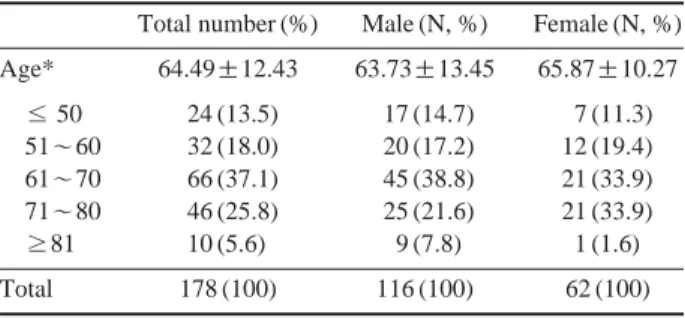
One hundred and seventy eight subjects were randomly selected and their lifestyle habits and possible exposure- related effects were recorded in detailed questionnaires and considered in the statistical analyses. There were no significant differences between age and sex distribution, suggesting that the matching based on these 2 variables was adequate. The characteristics of participant were sum- marized in Table 1. The PCR products were electrophoresed on an agarose gel to confirm the size of the bands (137 bp), and then, pyrosequencing was performed. The result of pyrosequencing showed that let-7 lcs6 polymorphism had only T allele in all Korean populations (Fig. 2). According to the quantitative measurement, proportion of mutated
Table 1. The characteristic of the participant in present study Total number (%) Male (N, %) Female (N, %)
Age* 64.49±12.43 63.73±13.45 65.87±10.27
‹ 50 24 (13.5) 17 (14.7) 7 (11.3)
51~60 32 (18.0) 20 (17.2) 12 (19.4)
61~70 66 (37.1) 45 (38.8) 21 (33.9)
71~80 46 (25.8) 25 (21.6) 21 (33.9)
›81 10 (5.6) 9 (7.8) 1 (1.6)
Total 178 (100) 116 (100) 62 (100)
*: years, Mean±SD.
Fig. 1. Pyrosequencing assay design. PCR amplifies a 137-bp fragment containing KRAS let-7 lcs6. The sequencing primer can detect poly- morphism site (T/G).
type DNA (G allele) was extremely low from 2% to 8%.
Discussion
This is the first evaluation of a let-7 lcs6 polymorphism in Korean population. Though the recent attention for let- 7 has been increased because of clinical importance of miRNAs, its polymorphism has not been mentioned and studied in Korean population. Chin et al. (2008) studied the frequency of KRAS let-7 lcs6 polymorphism in various populations and East Asians including Koreans, Oceanians, and Americans showed only T allele. However, Europeans and some Asians with G allele were found in about 10%
of the populations. Considering the spread of mankind and genetic association between Asians, we could not rule out the possibility of the presence of G allele in Korean popula- tion (Yoshiura et al. 2006, Martínez-Cruz et al. 2011, Peng et al. 2011). So, present study reevaluated a KRAS let-7 lcs6 polymorphism in Korean populations using pyrosequ- encing.
As a result, all participants showed wild-type TT geno-
type regardless gender and age. This result was in agreement with Chin et al. (2008) and it proves that there is only one allele type in Korean population. KRAS let-7 lcs6 genotype had cancer-related clinical significance according to prev- ious studies (Chin et al. 2008, Christensen et al. 2009, Nel- son et al. 2010, Ratner et al. 2010, Paranjape et al. 2011, Pharoah et al. 2011, Smits et al. 2011). Ratner et al. (2010) described that T/G or G/G genotype (G-allele) was asso- ciated with ovarian cancer risk and Chin et al. (2008) pre- sented that a SNP in this site increases non-small cell lung cancer risk. In breast and oral cancers, let-7 lcs6 polymor- phism was also associated poor prognosis or cancer risk (Christensen et al. 2009, Paranjape et al. 2011). On the other hand, Nelson et al. (2010) presented no association between KRAS let-7 lcs6 polymorphism and non-small cell lung cancer. Moreover, the patient with KRAS let-7 lcs6 variant showed a good prognosis in early-stage col- orectal cancer (Smits et al. 2011). However, it is confir- med that variant type was associated with increased tran- scription and translation of KRAS, increasing cell survival and proliferation by the effects of Ras activation (Schub- bert et al. 2007). Though the hypothesis that the KRAS- Fig. 2. Representative result of pyrosequencing analysis for KRAS let-7 lcs6 polymorphism in Korean population. All subjects showed a wild type (T allele) in this site and G allele was extremely low.
S G A T G C A
5
G A T G C A
5 T: 97%
G: 3%
variant increases the risk of developing various cancers is controversial, Korean population with wild type entirely may have low possibility of cancer development than the populations with T/G or G/G genotype.
Pyrosequencing is a quantitative sequencing method based on real-time monitoring of DNA synthesis by mea- suring the incorporation of each of the four nucleotides at each template position in an automated process (Ronaghi et al. 1998, Ramon et al. 2003, Ahmadian et al. 2006). So, the amount of each template present can be calculated with greater sensitivity and this study showed extremely low proportion of variant allele in let-7 lcs6 site. Therefore, this article confirmed that Korean population has only wild type of KRAS let-7 lcs6 for the first time by using pyrose- quencing.
References
Ahmadian A, Ehn M, Hober S : Pyrosequencing: history, bio- chemistry and future. Clin Chim Acta 363: 83-94, 2006.
Calin GA, Sevignani C, Dumitru CD, Hyslop T, Noch E, Yen- damuri S, Shimizu M, Rattan S, Bullrich F, Negrini M, Croce CM : Human microRNA genes are frequently located at fragile sites and genomic regions involved in cancers. Proc Natl Acad Sci USA 101: 2999-3004, 2004.
Carletti MZ, Christenson LK : MicroRNA in the ovary and fe- male reproductive tract. J Anim Sci 87: 29-38, 2009.
Chin LJ, Ratner E, Leng S, Zhai R, Nallur S, Babar I, Muller RU, Straka E, Su L, Burki EA, Crowell RE, Patel R, Kulkarni T, Homer R, Zelterman D, Kidd KK, Zhu Y, Christiani DC, Belinsky SA, Slack FJ, Weidhaas JB : A SNP in a let-7 microRNA complementary site in the KRAS 3′ untranslated region increases non-small cell lung cancer risk. Cancer Res 68: 8535-8540, 2008.
Christensen BC, Moyer BJ, Avissar M, Ouellet LG, Plaza SL, McClean MD, Marsit CJ, Kelsey KT : A let-7 micro RNA-binding site polymorphism in the KRAS 3′ UTR is associated with reduced survival in oral cancers.
Carcinogenesis 30: 1003-1007, 2009.
Esquela-Kerscher A, Slack FJ : Oncomirs: microRNAs with a role in cancer. Nat Rev Cancer 6: 259-269, 2006.
Johnson SM, Grosshans H, Shingara J, Byrom M, Jarvis R, Cheng A, Labourier E, Reinert KL, Brown D, Slack FJ : RAS is regulated by the let-7 microRNA family. Cell 120:
635-647, 2005.
Martínez-Cruz B, Vitalis R, Ségurel L, Austerlitz F, Georges M, Théry S, Quintana-Murci L, Hegay T, Aldashev A, Nasyrova F, Heyer E : In the heartland of Eurasia:
the multilocus genetic landscape of Central Asian populations. Eur J Hum Genet 19: 216-223, 2011.
Mishra PJ, Bertino JR : MicroRNA polymorphisms: the future of pharmacogenomics, molecular epidemiology and individualized medicine. Pharmacogenomics 10: 399- 416, 2009.
Nelson HH, Christensen BC, Plaza SL, Wiencke JK, Marsit CJ, Kelsey KT : KRAS mutation, KRAS-LCS6 poly- morphism, and non-small cell lung cancer. Lung Can- cer 69: 51-53, 2010.
Paranjape T, Heneghan H, Lindner R, Keane FK, Hoffman A, Hollestelle A, Dorairaj J, Geyda K, Pelletier C, Nallur S, Martens JW, Hooning MJ, Kerin M, Zelterman D, Zhu Y, Tuck D, Harris L, Miller N, Slack F, Weidhaas J : A 3′-untranslated region KRAS variant and triple- negative breast cancer: a case-control and genetic analysis. Lancet Oncol 12: 377-386, 2011.
Paranjape T, Slack FJ, Weidhaas JB : MicroRNAs: tools for cancer diagnostics. Gut 58: 1546-1554, 2009.
Peng MS, Palanichamy MG, Yao YG, Mitra B, Cheng YT, Zhao M, Liu J, Wang HW, Pan H, Wang WZ, Zhang AM, Zhang W, Wang D, Zou Y, Yang Y, Chaudhuri TK, Kong QP, Zhang YP : Inland post-glacial dispersal in East Asia revealed by mitochondrial haplogroup M9a’b.
BMC Biol 9;2, 2011.
Pharoah PD, Palmieri RT, Ramus SJ, Gayther SA, Andrulis IL, Anton-Culver H, Antonenkova N, Antoniou AC, Gold- gar D; BCFR Investigators, Beattie MS, Beckmann MW, Birrer MJ, Bogdanova N, Bolton KL, Brewster W, Brooks-Wilson A, Brown R, Butzow R, Caldes T, Caligo MA, Campbell I, Chang-Claude J, Chen YA, Cook LS, Couch FJ, Cramer DW, Cunningham JM, Despierre E, Doherty JA, Dörk T, Dürst M, Eccles DM, Ekici AB, Easton D; EMBRACE Investigators, Fasching PA, de Fazio A, Fenstermacher DA, Flana- gan JM, Fridley BL, Friedman E, Gao B, Sinilnikova O; GEMO Study Collaborators, Gentry-Maharaj A, Godwin AK, Goode EL, Goodman MT, Gross J, Han- sen TV, Harnett P, Rookus M; HEBON Investigators, Heikkinen T, Hein R, Høgdall C, Høgdall E, Iversen ES, Jakubowska A, Johnatty SE, Karlan BY, Kauff ND, Kaye SB, Chenevix-Trench G; kConFab Investi- gators and the Consortium of Investigators of Modifiers of BRCA1/2, Kelemen LE, Kiemeney LA, Kjaer SK, Lambrechts D, Lapolla JP, Lázaro C, Le ND, Leminen A, Leunen K, Levine DA, Lu Y, Lundvall L, Macgre- gor S, Marees T, Massuger LF, McLaughlin JR, Menon
U, Montagna M, Moysich KB, Narod SA, Nathanson KL, Nedergaard L, Ness RB, Nevanlinna H, Nickels S, Osorio A, Paul J, Pearce CL, Phelan CM, Pike MC, Radice P, Rossing MA, Schildkraut JM, Sellers TA, Singer CF, Song H, Stram DO, Sutphen R, Lindblom A; SWE-BRCA Investigators, Terry KL, Tsai YY, van Altena AM, Vergote I, Vierkant RA, Vitonis AF, Walsh C, Wang-Gohrke S, Wappenschmidt B, Wu AH, Zio- gas A, Berchuck A, Risch HA; Ovarian Cancer Asso- ciation Consortium : The role of KRAS rs61764370 in invasive epithelial ovarian cancer: implications for clinical testing. Clin Cancer Res 17: 3742-3750, 2011.
Ramon D, Braden M, Adams S, Marincola FM, Wang L : Pyro- sequencing trade mark: a one-step method for high resolution HLA typing. J Transl Med 1: 9, 2003.
Ratner E, Lu L, Boeke M, Barnett R, Nallur S, Chin LJ, Pelle- tier C, Blitzblau R, Tassi R, Paranjape T, Hui P, God- win AK, Yu H, Risch H, Rutherford T, Schwartz P, Santin A, Matloff E, Zelterman D, Slack FJ, Weid- haas JB : A KRAS-variant in ovarian cancer acts as a genetic marker of cancer risk. Cancer Res 70: 6509- 6515, 2010.
Reddy SD, Gajula RP, Pakala SB, Kumar R : MicroRNAs and cancer therapy: the next wave or here to stay? Cancer Biol Ther 9: 479-482, 2010.
Ronaghi M, Uhlén M, Nyrén P : A sequencing method based on real-time pyrophosphate. Science 281: 365, 1998.
Schubbert S, Shannon K, Bollag G : Hyperactive Ras in devel- opmental disorders and cancer. Nat Rev Cancer 7:
295-308, 2007.
Sethupathy P, Collins FS : MicroRNA target site polymorphisms and human disease. Trends Genet 24: 489-497, 2008.
Smits KM, Paranjape T, Nallur S, Wouters KA, Weijenberg MP, Schouten LJ, van den Brandt PA, Bosman FT, Weidhaas JB, van Engeland M : A let-7 microRNA SNP in the KRAS 3′ UTR is prognostic in early-stage colorectal cancer. Clin Cancer Res 17: 7723-7731, 2011.
Yang H, Dinney CP, Ye Y, Zhu Y, Grossman HB, Wu X : Eval- uation of genetic variants in microRNA-related genes and risk of bladder cancer. Cancer Res 68: 2530-2537, 2008.
Yoshiura K, Kinoshita A, Ishida T, Ninokata A, Ishikawa T, Kaname T, Bannai M, Tokunaga K, Sonoda S, Komaki R, Ihara M, Saenko VA, Alipov GK, Sekine I, Komatsu K, Takahashi H, Nakashima M, Sosonkina N, Mapen- dano CK, Ghadami M, Nomura M, Liang DS, Miwa N, Kim DK, Garidkhuu A, Natsume N, Ohta T, Tomita H, Kaneko A, Kikuchi M, Russomando G, Hirayama K, Ishibashi M, Takahashi A, Saitou N, Murray JC, Saito S, Nakamura Y, Niikawa N : A SNP in the ABCC11 gene is the determinant of human earwax type. Nat Genet 38: 324-330, 2006.
파이로시퀀싱을 이용한 한국인에서의 KRAS let-7 lcs6 유전자의 단일염기다형성 분석
이재호, 김대광1,2
계명대학교 의과대학 해부학교실, 1의학유전학연구소, 계명대학교 의과대학, 2한빛의학유전연구소
간추림 : KRAS 유전자의 3′-비해석부위의 단일염기다형성(rs61764370)은 암발생을 증가시키는 중요한 유전학적 표지자라고 보고되었다. 전세계적으로 이 부분의 다형성은 5.8%에서 나타나지만 한국인에서는 제대로 연구가 이루어지지 않았다. 따라서 본 연구에서 한국인에서 KRAS let-7 lcs6 유전자의 단일염기다형성을 분석해보도록 하겠다.
178명의 무작위로 추출된 한국인의 DNA를 이용하여 중합효소연쇄반응과 파이로시퀀싱을 해보았다. KRAS let-7 lcs6 다형성의 T 또는 G 유전자를 확인하기 위해서 파이로시퀀싱 연구를 설계하였다.
그 결과 모든 사람에서 T 유전자만이 관찰되었다. 또한 정량적 분석 결과, G 유전자는 매우 낮게 나타났다.
이 연구의 결과는 파이로시퀀싱을 이용하여 정량적 분석을 통해 한국인에서는 KRAS let-7 lcs6 유전자가 다형 성을 보이지 않고 오직 T 유전자만 나타나는 형태를 가진다는 것을 처음으로 확인하였다. 이에 대한 임상적 의 의에 대해서 더욱 많은 연구가 필요할 것으로 생각된다.
찾아보기 낱말 : KRAS, 단일염기다형성(SNP), let-7 lcs6
교신저자 : 김대광(계명대학교 의과대학 해부학교실) 전자우편 : [email protected]