DOI: http://dx.doi.org/10.4313/JKEM.2014.27.2.85
SiN x 층이 코팅된 Si Wafer에 바인더 종류에 따른 Ag 페이스트의 인쇄 특성
강재원
1,2
, 신효순1,
a, 여동훈1
, 정대용2
1 한국세라믹기술원 미래융합세라믹본부
2 인하대학교 신소재공학과
Printing Properties of Ag Paste with the Variation of Binder on the SiN x Coated Si Wafer
Jea Won Kang
1,2, Hyo Soon Shin
1,a, Dong Hun Yeo
1, and Dae Yong Jeong
21 Advanced Materials Convergence Division, Korea Institute of Ceramic Engineering and Technology, Seoul 153-801, Korea
2 Department of Materials Science and Engineering, Inha University, Incheon 402-751, Korea
(Received November 4, 2013; Revised November 19, 2013; Accepted December 18, 2013)
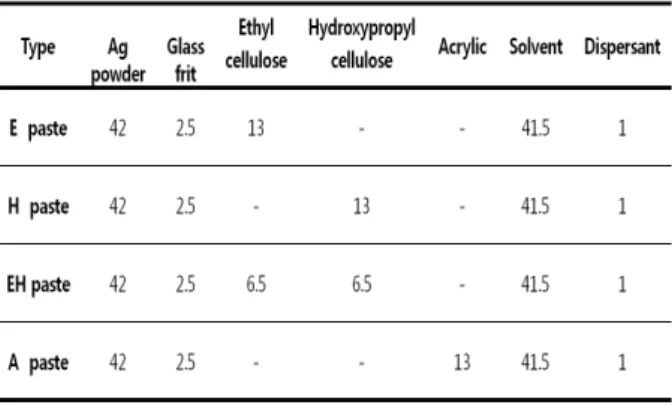
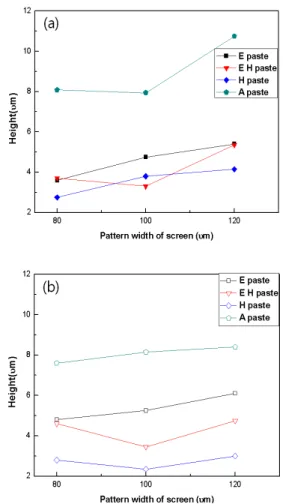
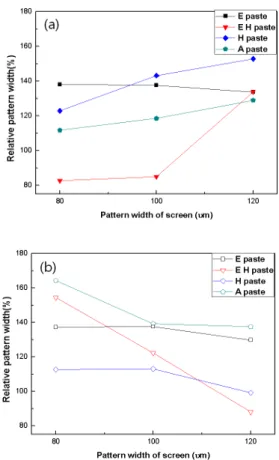
Abstract: Ag paste has been used in the front electrode of the Si-solar cell. It is composed by Ag powder, glass frit, binder, solvent and dispersant. The role of the binder and the solvent is to make a flow and a printing property. However, it was not enough to report the printing properties with the variation of binder in the controled viscosity. In this study, we selected 3 kinds of typical binder which were used as binder for the paste in the industry, such as Ethyl cellulose, Hydroxypropyl cellulose and Acrylic. Ag pastes using these were prepared, controled viscosity and printed on the SiNx coated Si wafer. In the ‘A paste’ used Acrylic binder, printed hight was highest and ‘H paste’ used Hydroxypropyl cellulose binder was lowest. Because ‘H paste’ was high viscosity due to the molecular weight, the solvent was added in the paste to control the viscosity. Therefore, the content of solid was lower in ‘H paste’. The relative pattern width which is related to the spreading of paste was the best in the case of ‘H paste’ and ’EH paste’ at 30℃. It is thought that the optimization of the relative pattern width is possible for a paste by the controling shear thinning phenomenon.
In the case of ‘A paste’, though printing hight was best, the pattern width was dependant on the temperature.
Keywords: Binder, Rheology, Ag paste, Front electrode