67
혈청학적 분석을 통한 돼지 생식기호흡기증후군의 농장단위 감염유형
박최규1,*·윤하정1·이창희2·정병열1·이경기1·김현수3
1국립수의과학검역원, 2경북대학교 자연과학대학 생명공학부, 3충남대학교 수의과대학 (게재승인: 2008년 1월 17일)
Infection patterns of porcine reproductive and respiratory syndrome virus by serological analysis on a farm level
Choi-Kyu Park
1,*, Hachung Yoon
1, Changhee Lee
2, Byeong-Yeal Jung
1, Kyoung-Ki Lee
1, Hyun-Soo Kim
31
National Veterinary Research and Quarantine Services, Anyang 430-824, Korea
2
College of Natural Sciences, Kyungpook National University, Daegu 702-701, Korea
3
College of Veterinary Medicine, Chungnam National University, Daejeon 305-764, Korea
(Accepted: January 17, 2008)
Abstract : Porcine reproductive and respiratory syndrome (PRRS) is the most economically important viral infectious disease in pig populations worldwide. This study was conducted to better understand the epidemic and dynamics of PRRS virus (PRRSV) on each farm and to evaluate the risk of PRRSV infection in Korea. Interviews with pig farmers were carried out to obtain PRRS vaccination programmes in 60 pig farms throughout Korea.
Blood samples were also collected from the 59 pig farms to investigate outbreak patterns of each farm. Vaccination against PRRS was performed in 16.7% farms for breeding pigs and 8.3% of farms for nursery pigs. According to the seroepidemiological analysis, 56 (94.9%) out of 59 farms were considered to be affected by PRRSV infection. The results revealed that 68.9% of sows tested were seroconverted and interestingly, gilt herds had the highest seropositive rate (73%), suggesting that gilts may play a key role in PRRSV transmission in sow herds.
Among the PRRS-affected piglet herds, 33 (55.9%), 14 (23.7%) and 6 (10.2%) farms were initially infected with PRRSV during the weaning, suckling and nursery period, respectively. It seems likely, therefore, that PRRSV infection predominantly occurs around the weaning period in piglet herds. Based on antibody seroprevalence levels in both sow and piglet groups, we were able to classify patterns of PRRSV infection per farm unit into 4 categories;
category 1 (stable sow groups and non-infected piglet groups), category 2 (unstable sow groups and non-infected piglet groups), category 3 (stable sow groups and infected piglet groups), and category 4 (unstable sow groups and infected piglet groups). Our data suggested that 43 (72.9%) farms were analysed to belong to category 4, which is considered to be at high-risk for PRRS outbreak. Taken together, our information from this study will provide insight into the establishment of an effective control strategy for PRRS on the field.
Keywords : ELISA, epidemiology, infection pattern, porcine reproductive and respiratory syndrome (PRRS)
서 론
돼지 생식기호흡기증후군
(porcine reproductive and respiratory syndrome, PRRS)
은1980
년대후반미국에서처음발생이보고된이후
,
유럽각국과한국을포함한 아시아등세계각국에서발생이확인되었으며,
현재는양돈산업이활발한거의모든나라에서발생하고있다
[1, 6, 12, 16, 23].
유행성(epidemic form)
의PRRS
는임*Corresponding author: Choi-Kyu Park
National Veterinary Research and Quarantine Services, Anyang 430-824, Korea [Tel: +82-31-467-1748, Fax: +82-31-467-1739, E-mail: [email protected]]
신돈의집단적인번식장애
,
허약자돈발생및모든일령의돼지에서호흡기질병을유발하는것이특징이다
[7,
22].
유행성으로경과한이후에는풍토성(endemic form)
으로전환되어
[18]
모돈군에서의반복적인번식장애와호흡기질병의증가및비육돈의성장저하등을유발하 며
,
최근문제시되고있는이유자돈의전신소모성증후 군(postweaning multisystemic wasting syndrome, PMWS)
이나 돼지 호흡기복합병
(porcine respiratory disease
complex, PRDC)
을유발하는주요요인중의하나로도주목받고있다
[13].
이와같이PRRS
는다양한질병피해를유발하면서미국에서만연간 약
6
억불의경제적 피해를주는것으로보고되는등현재까지보고된돼지 전염병중전세계양돈산업을위협하면서가장막대한경제적손실을주는질병이다
[4, 18].
PRRS
원인체인PRRS
바이러스(PRRSV)
는감염돼지와의접촉감염
,
콧물이나오줌을통한감염,
공기감염,
감염된웅돈의정액을통한전파등전파경로가다양하 며
,
전파속도또한매우빠르기때문에일단감염이이 루어진농장또는지역에서단기간에바이러스가확산되어만연하게된다
[10, 19, 21, 27].
또한감염된돼지로부터장기간바이러스가배설되기때문에바이러스의 순환감염고리를끊기가어려우며
,
뚜렷한임상증상을나타내지않는준임상형의감염이증가하고있어예방
및근절이곤란한질병이다
[9, 24].
PRRS
의효과적인방제대책을수립하기위해서는전국적
,
지역적인발생상황이나농장별발생유형등정확 한역학정보를수집하는작업이선행되어져야한다.
이를위해서는돼지혈청시료를대상으로
PRRSV
의특이항체의분포를파악하는것이매우유용할것으로판단
된다
.
이전에도우리나라양돈장에대한PRRSV
항체조사를통한분석이이루어진바있으나
[2, 3]
농장및개체단위의항체양성율을분석한것으로농장단위의
PRRSV
의감염유형을분석하는데는한계가있었다.
이연구에서는전국의양돈장을대상으로
PRRS
예방접종에대한설문조사와함께농장별로각산차별모돈 과사육단계별 자돈
,
육성및비육돈의혈액에대한PRRSV
항체검사를실시하여농장단위의PRRSV
감염유형을파악하였다
.
재료 및 방법
조사대상 양돈장
조사대상양돈장은
2005
년대한양돈협회주관으로전국양돈장질병실태조사시에선정된양돈장으로우리 나라전국의질병발생상황을대표할수있도록각도
별양돈농가수를고려하여
3~11
개농가씩총60
개의농가를선정하였다
.
모든농장은번식-
비육을실시하는일관사육농장으로각농장의돼지사육두수는
137
두~ 6,674
두로평균사육두수는2,110
두였다.
설문조사 및 공시재료
2005
년10
월양돈장질병실태조사를위한방문시에수의사가전국
60
개양돈장의경영주를대상으로PRRS
예방접종현황에대한설문조사를실시하였다
.
항체검 사를위한시료는60
개양돈장중59
개양돈장에서채취 하였으며,
농가별로후보돈, 1
산, 2
산, 3
산및4
산모돈과
30, 60, 90, 120, 150
일령의돼지등10
개군으로세분화하여각군별로평균
5
두씩채혈하여총2,888
두의혈청을확보하여실험에사용하였다
.
PRRS 항체검사
시판되고있는
PRRS
항체진단ELISA kit(Herdcheck PRRS virus antibody test kit; IDEXX, USA)
를사용하였 고,
제조회사의설명서에준하여실시한다음,
검사혈 청시료의sample to positive(S/P) ratio
을산출하여0.4
이상인경우양성으로판정하였다
.
각혈청시료에대한검 사결과를근거로모돈산차별및돼지성장단계별항체 양성율을산출하였으며,
농장별항체음성돈의분포상황을정리하였다
.
농장별 PRRS 혈청학적 감염 유형 분석 및 평가
농장별
PRRSV
의감염위험유형은모돈군의안정화여부와자돈군에서항체가상승에따른감염여부및정 도를고려하여분류하였다
.
모돈의안정화여부는전체모돈군이항체음성인경우또는전체모돈군이항체양 성이면서일정수준의면역을고르게보유하고있는경 우를안정화상태라고판단하였으며
,
산차별또는산차 간모돈군에항체음성및양성모돈이혼재해있을경 우에는비안정화상태라고판단하였다.
자돈군의감염여부는일반적으로모체이행항체가유지되는
30-60
일령이후항체가의재상승이없을경우에는감염이없는것 으로판정하였고
[11],
반면에30
일령이후평균항체가의 뚜렷한 상승이 나타나는 경우 해당시기 이전에
PRRSV
가감염이이루어지고있는것으로판단하였다.
즉
30
일령에항체가상승시는포유기감염, 60
일령에항체가상승시는이유기감염등으로판정하였다
.
결 과
설문조사를 통한 PRRS 예방접종 현황
60
개양돈장의PRRS
예방접종실시현황을조사한결과
,
모돈은10
개양돈장(16.7%)
에서그리고자돈은단5
개양돈장
(8.3%)
에서예방접종을실시한다고답변하여예방접종률은비교적저조한것으로조사되었다
.
PRRS 항체검사 결과 및 분석
59
개양돈장으로부터 채취한총2,888
두의돼지혈청 에대한PRRS
항체양성율은68.9%(n = 1,992)
로나타났 으며,
이중56
개양돈장(94.9%)
이PRRS
항체양성돈을보유하고있는것으로확인되었다
(Table 1).
모돈군의경우는후보돈의항체양성율이
73.0%(214/
293)
로가장높게나타났으며,
경산돈에서는1
산62.5%
(177/283), 2
산57.2%(159/278), 3
산58.2%(160/275)
및4
산58.4%(167/286)
로1
산차모돈이다소높게나타났 으나전반적으로 후보돈보다는낮은양성율을나타내었다
.
자돈군의 경우는30
일령 이하에서37.5%(101/
269)
의항체 양성율을나타내었고, 60
일령에서78.4%
(250/319)
로급격하게증가한 후,
일령이 증가함에따라
90
일령85.0%(255/300), 120
일령87.0%(261/300)
및150
일령87.0%(248/285)
로 그 증가폭이 둔화되었다(Table 1).
자돈단계에서의 PRRS 감염시기
59
개검사농가중비발생양돈장을제외한56
개양돈장을대상으로자돈단계에서의최초감염시기를분석한
결과
,
이유기(55.9%),
포유기(23.7%),
육성초기(10.2%)
순으로높게나타나이유기를전후하여집중적으로감 염되는것으로분석되었다
(Table 2).
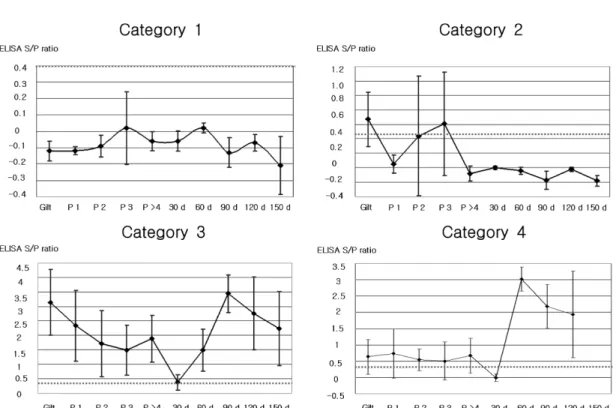
농장별 PRRS 항체 분포양상 및 유형 분석 각양돈장의돼지개체별항체검사에서얻어진모돈
및자돈군의성적을정리한결과
Fig. 1
과같은다양한유형의
PRRSV
항체분포양상이파악되었으며,
각유형에속하는양돈장의비율은
Table 3
과같다.
즉,
모돈군이항체음성으로안정화되어있으며
,
자돈군이모두항체음성으로
PRRSV
감염이없는농장(category 1)
이59
개양돈장중
2
개양돈장(3.4%),
모돈군은안정화되어있지않으나자돈군에서는항체가상승에따른감염징 후가없는농장
(category 2)
이1
개농장(1.7%),
모돈군이 일정수준의항체수준을보유하고있어안정화되어있으 나자돈군에서항체가상승에따른감염징후가있는농 장(category 3)
은13
개양돈장(22.0%)
및모돈군의항체 수준이안정화되어있지않으면서자돈군에서도항체 가상승에따른감염징후가있는농장(category 4)
이43
개농장
(72.9%)
으로분석되었다(Table 3).
이상의
59
개농장의분석결과를모돈군및자돈군으 로분류해보면 모돈군의경우감염이의심되는비안정화농장이
44
개농장(74.6%)
이었으며,
자돈군의경우감Table 1. Seroprevalences of porcine reproductive and respiratory syndrome in different age groups on 59 swine farms
Pig groups Total Piglets by age (day) Sows by parity (P)
< 30 60 90 120 150 Gilt P1 P2 P3 > P4
No. of tested pig 2,888 269 319 300 300 285 293 283 278 275 286
No. of seropositive pig 1,992 101 250 255 261 248 214 177 159 160 167
Seroprevalence (%) 68.9 37.5 78.4 85.0 87.0 87.0 73.0 62.5 57.2 58.2 58.4
Table 2. Estimation of the first infectious period in each farms based on the results of antibody tests for porcine reproductive and respiratory syndrome virus
Non-outbreak Suckling No. of farms distribution for infected period (%) Weaning Early grower Later grower Finisher Total
3 (5.1) 14 (23.7) 33 (55.9) 6 (10.2) 2 (3.4) 1 (1.7) 59 (100.0)
Table 3. Infection patterns of porcine reproductive and respiratory syndrome virus based on serological tests in 59 swine farms
Category Immune status of herds No. of farms in different categories
Sow groups Piglet groups No. of farms (n = 59) Percentage
1 stable not infected 2 3.4
2 not stable not infected 1 1.7
3 stable infected 13 22.0
4 not stable infected 43 72.9
염이의심되는항체가상승이관찰되는농장이
56
개농장
(94.9%)
으로나타났다.
고 찰
PRRS
는전세계적으로발생하고있으며,
다양한형 태의질병발생이야외상황에서보고되어져왔다[2, 25].
이질병이처음발생할당시에는모돈의유사산으로인 한 손실이 뚜렷하였으나
,
일단 농장내 상재화 되면PMWS
나PRDC
를포함한호흡기합병증을유도하는주요인으로작용하여많은경제적피해를유발하고있다
[11].
현재까지이질병의예방을위한효과적인해결책은제시되고있지않지만지난
20
여년동안미국을비롯한전세계양돈위생분야에서는
PRRS
란질병을이 해하고그방제대책을수립하기위하여끊임없이노력 하고있다.
현재까지여러요인들이
PRRS
예방및방제에영향을미치는것으로보고되어있으며
,
야외상황에서흔히마주치게되는문제는준임상형의감염
,
돈군내지속적인순환감염
,
감수성번식돈군의계속적인유입등이다[4, 23].
또한감염돼지는순환항체가있더라도상당기간동안바이러스혈증을나타내며
,
중화항체도방어수 준을형성할만큼높게형성되지않는다고보고되어지 고있다[12, 13, 18, 24].
더욱이PRRS
바이러스의유전적
,
항원적다양성은질병의진단과예방에더큰문제점으로작용하고있다
[7].
PRRS
를비롯한가축전염병에대한예방대책을시행하기전가장중요한단계는개별양돈장의감염상태를 파악하는것이다
.
본연구에서는국내PRRSV
백신접 종현황과감염위험도를조사하기위하여양돈장별설문조사와함께
ELISA
를이용한혈청학적검사를실시하였다
.
양돈장별혈청검사결과,
현재 자돈단계에서PRRSV
감염이진행되고있는농가가94.9%(n = 56)
임에도불구하고설문조사결과에서모돈이나자돈에대
한
PRRS
예방접종을실시한다는양돈장은각각16.7%
와
8.3%
에불과한것으로나타났다.
이는PRRS
예방백신에대한일선농가들의질병방제기대효과가낮거나 고가의예방약가격때문에백신접종을기피하고있다 는것을시사해준다
. 10
년전국내양돈장에대한혈청학적검사결과
,
약60%
의농장에서PRRSV
항체양성Fig. 1. Four different serological patterns of pig farms determined by ELISA for antibody to porcine reproductive and
respiratory syndrome virus (PRRSV) in groups of piglets and sows. A sample was classified as positive for PRRSV antibody
if the sample-to-positive (S/P) ratio was equal to, or greater than 0.4 (dot line). The mean S/P ratio (point) and standard
deviation (vertical line range) of each groups were drawn by a continuous line on the farm level.
돈을보유하고있으나나머지농장은
PRRSV
항체음성으로나타나당시만해도
PRRS
바이러스감염이없는양돈장이상당수존재하고있음이확인되었다
[3].
그러나본연구에서 조사된양돈장중단
3
개양돈장(5.1%)
만이자돈단계에서PRRS
감염이없는것으로나타나현재전국적으로
PRRS
가상재화된것으로확인되 었다.
대부분의양돈장에서
PRRS
의감염이진행되고있는 우리나라상황에서비발생농장들이계속PRRS
청정화 상태를유지하기위해서는후보돈이나정액을PRRS
비감염농장으로부터구입하는것은물론
,
외부로부터바 이러스의유입을방지하기위한기본적인차단방역조치 를철저히이행하여야된다.
그러나모돈산차별항체양성율이평균
68.9%
에달하며,
경산돈(57.2%-62.5%)
에비해후보돈
(73.0%)
이오히려높은것으로나타나(Table
1)
모돈특히후보돈의구입이PRRSV
전파에여전히중요한역할을하고있는것으로판단되므로종돈관리 에대한특별한대책이요구되고있다
.
PRRS
의발생양상은개별양돈장의상황에 따라매우다양하게나타나기때문에
PRRS
의피해를감소시키기위해서는개별양돈장의감염양상을파악하는것
이가장중요하다
[2, 11, 25].
본연구에서사용한 모돈군및자돈군의단계별혈청검사방법은개별양돈장 의감염양상즉
,
모돈군의안정화여부,
자돈군의감염 시기및감염구간등을파악할 수있으므로체계적인 방역대책을 수립하는데매우유용한 자료가 될수있 다.
이연구를통하여4
가지범주의감염유형을파악할수있었으며
(Table 3, Fig. 1),
개별농장이어떤유형에속하는지파악이 된다면 농장단위의적절한 방역대책 수립및적용이용이해질것으로판단된다
.
예를들어“Category 1(
모돈군 안정화/
자돈군 비감염)”
에속하는농장의 경우엄격한
biosecurity
조치를통하여비감염상태를유지하여야할것이며
, “Category 2(
모돈군비안정화
/
자돈군비감염)”
에속하는 농장의경우신속하게감염모돈을제거하는 검사
/
도태조치가이루어질수있을것이다
. “Category 3(
모돈군안정화/
자돈군감염
)”
에속하는 농장의 경우 자돈군에서all in/all out,
partial depopulation
또는예방접종등의대책을적용할수있을 것이며
, “Category 4(
모돈군비안정화/
자돈군감염
)”
에속하는농장은우선적으로모돈군의안정화를위한조치와함께
category 3
농장에준하는조치를통하여
PRRS
피해방지를위한대책적용이가능하다.
또한방역대책추진과정에있어이연구에서적용한방 법을이용하여시기별농장의감염유형을점검해본다 면방역대책추진에효율성을크게높일수있을것으 로생각된다
.
PRRSV
에감염된개별돼지는 항체형성여부와관계없이장기간바이러스를배설하여질병을전파할수
있으며
[17, 24],
이러한 돼지로인해일정규모이상의농장
(
모돈100-200
두)
에서는상재성으로감염이지속된다고보고하고있다
[17, 24, 25].
또한동일농장에서도다양한
PRRSV
가감염될수있다는점에서[8, 27]
항체검사결과만으로농장에감염되는
PRRS
바이러스의유형을파악하거나정확한감염시기및감염구간을분 석하는데는한계가있다
.
따라서향후이러한농장단위 감염유형분석에있어바이러스검사를병행한다면더 정확한분석이가능할것으로생각된다.
결 론
PRRSV
의농장단위감염유형을분석하기위하여전국
59
개농장으로부터50
두의돼지혈청즉,
후보돈, 1, 2, 3,
및4
산모돈과30, 60, 90, 120
및150
일령돼지혈액을각
5
두씩채혈하여총2,888
두에대하여PRRSV
항체검사를실시하였다
.
59
개농장2,888
두에대한PRRSV
항체양성율은개체양성율
68.9%(n = 1,992)
및농장양성율94.9%(n = 56)
로나타나대부분의농장이
PRRS
항체양성돈을보유하고있는것으로확인되었다
.
모돈군의경우평균항체 양성율이68.9%(n = 1,992)
이며,
후보돈73%(214/293), 1
산
62.5%(177/283), 2
산57.2%(159/278), 3
산58.2%(160/
275)
및4
산58.4%(167/286)
로나타나모돈군특히후보돈이
PRRSV
전파에중요한역할을하고있는것으로분석되었다
.
자돈군의경우30
일령37.5%(101/269), 60
일령
78.4%(250/319), 90
일령85.0%(255/300), 120
일령87.0%
(261/300)
및150
일령87.0%(248/285)
로30
일령이후60
일령에서크게증가한다음
,
그증가폭이둔화되는것으로분석되어이유기를전후하여농장내에서급속한전 파가이루어지는것으로판단되며
,
이러한결과는56
개농장에대한
PRRSV
의감염시기분석결과,
이유기(55.9%),
포유기
(23.7%),
육성초기(10.2%)
순으로이유기를전후하여집중적으로감염된다는분석결과와일치된다
.
각양돈장의모돈군및자돈군항체검사결과를이용 하여농장단위감염유형을분석한결과
, 4
가지의감염 유형(category 1-4)
이파악되었으며, “Category 1(
모돈군안정화
/
자돈군비감염)”, “Category 2(
모돈군비안정화/
자돈군비감염
)”, “Category 3(
모돈군안정화/
자돈군감염
)”, “Category 4(
모돈군 비안정화/
자돈군감염)”
에속하는농장은각각
3.4%(n = 2), 1.7%(n = 1), 22.0%(n = 13)
및
72.9%(n = 43)
으로분석되었으며,
이러한감염유형분석결과는농장별
PRRS
방제대책을수립,
적용하는데크게유용할것으로판단된다
.
참고문헌
1.
권창희,
권병준,
이한정,
조재진,
황의경,
신진호,
윤용덕
,
강영배,
안수환,
김용희,
허원,
전무형.
돼지생식기및호흡기증후군바이러스의국내분리주작성 에관한연구
.
대한수의학회지1994, 34 , 77-83.
2.
박최규,
김현수.
번식돈에서의돼지생식기호흡기증바이러스항체분포조사
.
한국가축위생학회지2004, 27 , 89-94.
3.
박최규,
장정호,
강영배,
이창희,
류영수,
김현수.
돼지생식기호흡기증후군 바이러스의항체분포및역 학조사