Veterinary Science
J. Vet. Sci. (2014), 15(1), 99-109
http://dx.doi.org/10.4142/jvs.2014.15.1.99
Received:12 Nov. 2012, Revised: 3 Jul. 2013, Accepted: 9 Jul. 2013
Original Article
*Corresponding author: Tel: +86-851-8298005; Fax: +86-851-8298003; E-mail: [email protected]
ⓒ 2014 The Korean Society of Veterinary Science.
This is an Open Access article distributed under the terms of the Creative Commons Attribution Non-Commercial License (http://creativecommons.org/licenses/by-nc/3.0) which permits
unrestricted non-commercial use, distribution, and reproduction in any medium, provided the original work is properly cited.
Positive effects of porcine IL-2 and IL-4 on virus-specific immune responses induced by the porcine reproductive and respiratory syndrome virus (PRRSV) ORF5 DNA vaccine in swine
Deyuan Tang
1,*, Jian Liu
1, Chunyan Li
1, Hua Zhang
2, Ping Ma
2, Xianfeng Luo
2, Zhiyong Zeng
1, Nining Hong
2, Xia Liu
2, Bin Wang
1, Feng Wang
1, Zhenlei Gan
1, Fei Hao
1
1
Department of Animal Science, Guizhou University, Guiyang 550025, China
2
Animal Disease Prevention and Control Center in Guizhou Province, Guiyang 550008, China
The purpose of this study was to investigate the effects of porcine interleukin (IL)-2 and IL-4 genes on enhancing the immunogenicity of a porcine reproductive and respiratory syndrome virus ORF5 DNA vaccine in piglets. Eukaryotic expression plasmids pcDNA-ORF5, pcDNA-IL-2, and pcDNA-IL-4 were constructed and then expressed in Marc-145 cells. The effects of these genes were detected using an indirect immunofluorescent assay and reverse transcription polymerase chain reaction (RT-PCR). Characteristic fluorescence was observed at different times after pcDNA- ORF5 was expressed in the Marc-145 cells, and PCR products corresponding to ORF5, IL-2, and IL-4 genes were detected at 48 h. Based on these data, healthy piglets were injected intramuscularly with different combinations of the purified plasmids: pcDNA-ORF5 alone, pcDNA-ORF5 + pcDNA-IL-2, pcDNA-ORF5 + pcDNA-IL-4, and pcDNA-ORF5 + pcDNA- IL-4 + pcDNA-IL-2. The ensuing humoral immune responses, percentages of CD4
+ and CD8
+ T lymphocytes, proliferation indices, and interferon-γ expression were analyzed. Results revealed that the piglets co-immunized with pcDNA-ORF5 + pcDNA-IL-4 + pcDNA-IL-2 plasmids developed significantly higher antibody titers and neutralizing antibody levels, had significantly increased levels of specific T lymphocyte proliferation, elevated percentages of CD4
+ and CD8
+ T lymphocytes, and significantly higher IFN-γ production than the other inoculated pigs (p < 0.05).
Keywords: IL-2, IL-4, immunogenicity, ORF5 DNA vaccine, porcine reproductive and respiratory syndrome virus
Introduction
Porcine reproductive and respiratory syndrome (PRRS) caused by porcine reproductive and respiratory syndrome virus (PRRSV) is a highly contagious disease mainly characterized by premature delivery, miscarriage, stillbirth, mummified fetuses in pregnant sows, severe respiratory symptoms in sucking piglets, increased mortality before weaning, dyspnea and growth retardation in growing pigs, and decreased libido and semen quality in boars [3,7]. PRRS is one of the most severe viral diseases of swine that is widely spread throughout all pig-producing countries worldwide and has resulted in immense economic losses to the swine industry since the late 1980s [22]. PRRSV has become one of the most important swine pathogens in mainland China since the first outbreak in 1995. PRRSV is an enveloped virus with a positive-stand RNA genome approximately 15 kb in length. The genome contains a 5 untranslated region (5´-UTR), and genes (ORF1a and ORF1b) encoding the viral nonstructural proteins (Nsps) that are located at the downstream of the 5´-UTR.
Additionally, genes (ORF1a, ORF1b, and ORF3 to ORF7) encoding viral structural proteins (GP2, E, GP3, GP4, GP5, M, and N) are located at the 3´ end of the genome. An additional structural protein, GP5a, composed of 43∼64 amino acids is encoded by an alternative ORF in the subgenomic viral mRNA encoding GP5, and is a novel structural protein recently discovered in all arteriviruses [11,17]. The genome also possesses a 3´-UTR tail and a poly (A) tail. Overall, ten open reading frames (ORFs) have been identified in the PRRSV genome.
PRRSV mainly invades porcine alveolar macrophages,
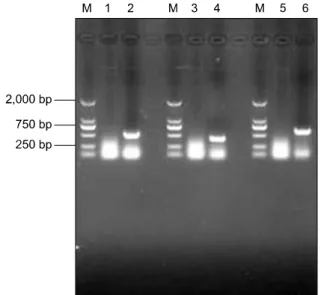
Fig. 2. RT-PCR results for the transfected cells. M, DL2000 DNA marker; Lanes 1, 3, and 5, RT-PCR products from cells transfected with pcDNA3.1(+); Lane 2, RT-PCR product from cells transfected with pcDNA-IL-2; Lane 4, RT-PCR product from cells transfected with pcDNA-IL-4; Lane 6, RT-PCR product from cells transfected with pcDNA-ORF5.
Fig. 3. Detection of recombinant proteins encoded by expression plasmids pcDNA-ORF5(A), pcDNA-IL-2 (B), and pcDNA-IL-4 (C) using Western blotting.
Table 2. Titers of neutralizing antibodies in sera from pigs immunized with the different vaccines
Immune groups 7 dpi 14 dpi 28 dpi 35 dpi Group 1
Group 2 Group 3 Group 4 Group 5 Group 6
<2
<2
<2
<2
<2
<2
<2
<3
<3
<3
<3
<3
<2 4.89 ± 0.12 6.02 ± 0.91 5.87 ± 0.73 8.02 ± 0.15 5.53 ± 0.24
<2 14.06 ± 0.23 16.23 ± 0.29 16.17 ± 0.26 19.28 ± 1.74 14.54 ± 0.52
Neutralizing antibody titers wereanalyzed 7, 14, 28, and 35 days
post-inoculation (dpi).
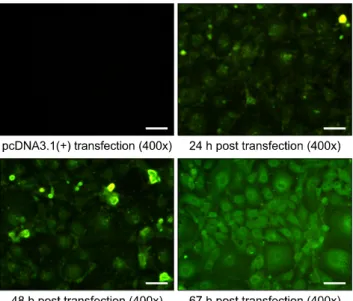
intensity. Fluorescence was found in roughly 92% of the cells, indicating that the recombinant eukaryotic expression plasmid pcDNA-ORF5 could be easily expressed in vitro.
Moreover, mRNA was extracted from the transfected Marc-145 cells and plasmid expression was verified by RT-PCR. As shown in Fig. 2, positive bands corresponding to IL-2, IL-4, and ORF5 were observed with sizes of approximately 526 bp, 411 bp, and 603 bp, respectively, as predicted. No band was found for the Marc-145 cells transfected with pcDNA3.1(+), confirming that the plasmids were expressed in Marc-145 cells.
SDS-PAGE and Western blotting analysis of the recombinant proteins
The cells transfected with pcDNA-ORF5, pcDNA-IL-2, and pcDNA-IL-4 were lysed for SDS-PAGE and Western blotting analysis. As shown in Fig. 4, bands 23 kDa (Fig.
3A), 18 kDa (Fig. 3B), and 15 kDa (Fig. 3C) in size were detected by Western blotting. The sizes of all bands were as predicted, proving that the foreign genes were truly expressed in the mammalian cells.
Specific anti-PRRSV IgG antibodies levels in piglets immunized with the DNA vaccines
Immunogenicity of the recombinant DNA vaccines was evaluated in piglets. As shown in Fig. 4, specific anti-PRRSV IgG antibodies in pigs from the different groups were detected with an ELISA using pcDNA3.1(+) as the negative control. The results showed that all inoculated pigs except for those in the control group
produced high levels of IgG antibodies specific for PRRSV. The antibody levels were significantly higher than those of the control group (p < 0.05). After 28 and 35 days post-inoculation, the antibody levels in pcDNA-ORF5 + pcDNA-IL-2 + pcDNA-IL-4 immune group was significantly higher than those in other five groups (p < 0.05). At 35 days, the antibody levels in both groups 3 and 4 were significantly higher than those in groups 2 and 6 (p
< 0.05).
Neutralization assay results
Sera from the inoculated pigs were tested for the ability to
neutralize PRRSV in Marc-145 cells. As shown in Table 2,
the titers of neutralizing antibody from group 5 pigs ranged
from 1 : 8.02 to 1 : 19.28, and were significantly higher
than those observed for the other groups (p < 0.05). These
results indicated that IL-2 and IL-4 can enhance the
immunogenicity of the PRRSV ORF5 gene vaccine. The
titers of neutralizing antibody from groups 3 and 4 were
higher than those of groups 2 and 6. No significant
difference (p > 0.05) was observed at 28 dpi, but this was
not the case at 42 dpi (p < 0.05). No serum neutralizing
antibody activity was observed for the negative control
group throughout the assay.