70 http://www.ecevr.org/
Augmented immune responses in pigs immunized with an inactivated porcine reproductive and respiratory syndrome virus containing the
deglycosylated glycoprotein 5 under field conditions
CLINICAL
EXPERIMENTAL VACCINE
RESEARCH
Introduction
The porcine reproductive and respiratory syndrome virus (PRRSV) is a swine patho- gen that generates major concerns as it causes significant economic losses in the swine industry worldwide [1]. The most realistic method to control PPRSV infection is through maintenance of herd immunity by vaccination. Currently, there are two types of commercially available porcine reproductive and respiratory syndrome (PPRS) vac- cines: inactivated vaccine and modified live virus (MLV) vaccine. The MLV vaccina- tion can be given at any stage of pig production, is generally programmed as one shot to pigs at nursery and growing stage, and as two shots to gilts and sows before breed- ing. While a major advantage of inactivated vaccines is its safety, their efficacy is rela- tively lower than MLV vaccine. It has been demonstrated that pigs vaccinated with the inactivated virus require more than two shots to reach the same enhanced immune
© Korean Vaccine Society.
This is an Open Access article distributed under the terms of the Creative Commons Attribution Non-Com- mercial License (http://creativecommons.org/licenses/
by-nc/3.0) which permits unrestricted non-commercial use, distribution, and reproduction in any medium, pro- vided the original work is properly cited.
K O R E A N V A C C I N E S O C I E T Y
K O R E A N K O R E A N A C C I N E O C I E T Y V
S
Clin Exp Vaccine Res 2016;5:70-74 http://dx.doi.org/10.7774/cevr.2016.5.1.70 pISSN 2287-3651 • eISSN 2287-366X
Jung-Ah Lee1,2, Nak-Hyung Lee1, Joong-Bok Lee1, Seung-Yong Park1, Chang-Seon Song1, In-Soo Choi1, Sang-Won Lee1
1College of Veterinary Medicine, Konkuk University, Seoul; 2Division of Vaccine Research, Korea National Institute of Health, Korea Centers for Disease Control and Prevention, Cheongju, Korea
Received: October 15, 2015 Revised: November 2, 2015 Accepted: December 3, 2015
Corresponding author: Sang-Won Lee, PhD College of Veterinary Medicine, Konkuk University, 120 Neungdong-ro, Gwangjin-gu, Seoul 05029, Korea
Tel: +82-2-450-0445, Fax: +82-2-3437-1941 E-mail: [email protected]
No potential conflict of interest relevant to this article was reported.
This study was supported by grant No. 610001- 03-1-SU000 from Technology Development Program for Agriculture and Forestry, Ministry for Food, Agriculture, Forestry and Fisheries, Republic of Korea. We acknowledge technical advice and support by Daesung Microbiological Labs Co., Ltd.
Purpose: Porcine reproductive and respiratory syndrome virus (PRRSV) leads to major eco- nomic losses in the swine industry. Vaccination is the most effective method to control the disease by PRRSV.
Materials and Methods: In this study, the efficacy of a glycoprotein (GP) 5-modified inactivat- ed vaccine was investigated in pigs. The study was performed in three farms: farm A, which was porcine reproductive and respiratory syndrome (PRRS)–negative, farm B (PRRS-active), which showed clinical signs of PRRS but had not used vaccines, and farm C (PRRS-stable), which had a history of endemic PRRS over the past years, but showed no more clinical signs after periodic administration of modified live virus vaccine.
Results: The inactivated vaccine induced great enhancement in serum neutralizing antibody titer, which was sufficient to protect pigs from further infections of PRRSV in a farm where pre- existing virus was circulating.
Conclusion: These results indicated that vaccination with the inactivated vaccine composed of viruses possessing deglycosylated GP5 would provide enhanced protection to pigs from farms suffering from endemic PRRSV.
Keywords: Porcine reproductive and respiratory syndrome virus, Inactivated vaccines, Neu- tralization test
responses as those immunized with the MLV vaccine [2].
A major concern of the MLV vaccine is its safety. Indeed, vaccine-derived PRRSV can be detected in both the serum and fecal samples of MLV vaccinated pigs due to viral shed- ding, which may lead to PRRSV outbreaks through pig-to-pig transmission [3]. The MLV strain can easily regain virulence and convert to a mutant strain by recombination with field strains [4]. In addition, the protective efficacy of the MLV vac- cine is generally genotype-specific. For example, MLV vac- cines consisting of the North American (NA) genotype can on- ly confer protection against NA strains, not European strains.
The commercially available inactivated vaccines are con- sidered ineffective in protection pigs against PRRSV, even when pigs are exposed by a homologous strain [5,6]. The inac- tivated vaccine has been used in PRRSV-positive farms for suppressing additional damage by pre-existing virus such as field strains or vaccine-like strains. The inactivated vaccine is also advantageous as a therapeutic vaccine as it can be used on infected pregnant sows and piglets.
Numerous studies have reported on the development of ef- fective PRRSV vaccines that improved immunogenicity and protection using techniques such as DNA vaccine, subunit vaccine, virus-like particle, and vectored vaccine [7-10]. It is critical to evaluate whether an immunogenicity-enforced in- activated vaccine can augment immune response in pigs un- der field conditions, thereby providing a vaccine that carries maximum benefit. In a previous study, deglycosylation of gly- coprotein (GP) 5, which contains major neutralizing epitopes, in the inactivated PRRSV vaccine was demonstrated to be suc- cessful in inducing neutralizing antibody responses as protec- tive level [11]. The aim of this study was to investigate the abili- ty of an inactivated vaccine with the deglycosylated PRRSV in pigs reared under farm conditions. The vaccine strain used in this study was a chimeric virus consisting of structural proteins of the dominant field virus found in Korea for assessment of its application under the Korean field condition [12].
Materials and Methods
For the animal trial, three farms were selected based on the following criteria; herd size, history of PRRS outbreak, herd immunity, vaccination, and current status of PRRSV infection (Table 1). The animal experiments were performed accord- ing to the guidelines of the Institutional Animal Care and Use Committee of Konkuk University. All pigs were kept on a sim- ilar single site-rearing system. Farm A was declared PRRSV
free over the past 2 years, and had not used PRRSV vaccine.
Farm B showed some clinical signs of PRRS, but refrained from vaccination due to concerns regarding side effects of commercial vaccines. Farm C had a history of endemic PRRS over the past year, but exhibited no obvious clinical signs af- ter periodic administration of the MLV vaccine.
The inactivated vaccine strain used for this study, K418/
GP5DM, lacked two potential N-glycosylation sites on GP5 [12]. The virus was inactivated using binary ethylenimine, and was mixed with the Montanide IMS1313 VG adjuvant (SEPPIC, Paris, France) in a 7:3 ratio. One dose of the inacti- vated vaccine contained 108 TCID50 of K418/GP5DM.
Forty-five 3-week-old piglets were individually identified by ear-tagging. Fifteen piglets in each farm were assigned to two groups: vaccinated (12 heads) and non-vaccinated con- trol (3 heads). Inactivated vaccine was administered to pigs in the vaccinated groups via intramuscular injection in the neck, followed by a booster vaccination 3 weeks later. Pigs in the control groups were mock vaccinated with phosphate buffered saline. All pigs were kept under regular manage- ment practices of each farm except for farm C, where the pigs in the experimental groups were not vaccinated with the MLV vaccine. Serum samples were collected at 0, and 7 weeks post-first vaccination for neutralization tests.
The polymerase chain reaction (PCR) and sequence analy- sis was performed with serum samples as previously described [13]. The GP5 region of PRRSV were amplified by reverse tran- scription PCR. The nucleotide sequences of the amplified PCR products were determined using Sanger sequencing.
The neutralization test was performed as previously de- scribed [14]. Briefly, 100 μL of the two-fold serially diluted se- ra were mixed with 300 TCID50/100 μL of the K418/GP5DM vaccine strain, and kept at 4°C for 48 hours. This was com- bined with 50 μL of the guinea pig complement (Life Tech- nologies, Gaithersburg, MD, USA), and was incubated at 37°C for 1 hour. The reaction mixture was added to a monolayer of Table 1. Summary of farms that participated in this study
Farm Herd size No. of pigs Vaccination Pre-existing PRRSV
A 1,500 15 - -
B 2,500 15 - + (LMY, VR2385)
C 4,500 15 MLVa) + (VR2332b))
PRRSV, porcine reproductive and respiratory syndrome virus; MLV, modified live virus.
a)The 15 pigs using in this study were not vaccinated with MLV vaccine.
b)The parental strain of MLV vaccine.
MARC-145 cells and incubated at 37°C for 5 days. The recip- rocal of the highest serum dilution factor that induced a cyto- pathogenic effect was determined to be the neutralizing anti- body titer of the sample. Neutralizing antibody titer was ana- lyzed using the Mann-Whitney U test. A value of p<0.05 was considered statistically significant.
Results
No abnormal condition was observed in any of the vaccinat- ed pigs. Growth performance of the vaccinated pigs was markedly improved, when it was compared to the non-vacci- nated group at the farm B, where a PRRSV outbreak occurred.
Sequence analysis revealed that the pre-existing PRRSVs in the farm B were the LMY, a strain of virus found predomi- nantly in Korea, and the VR2385 that is a highly virulent NA strain and shares 95% of nucleotide sequence identity of full- genome with the LMY. In the farm C, the VR2332 strain, which was used as MLV vaccine, has been detected due to the vaccine-derived virus spreading from vaccinated pigs.
These results indicate that pigs in the farm C used in this study were infected with the vaccine-derived virus although without MLV vaccination. All pigs used in this study were tested negative for porcine circovirus type 2 until the end of the experimental period using PCR (data not shown).
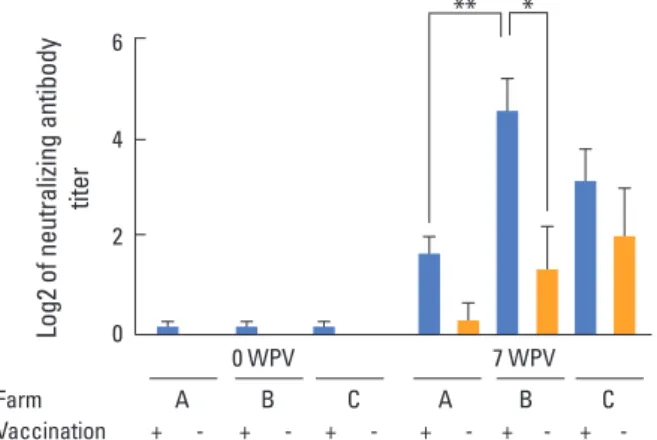
Prior to vaccinations, titer of neutralizing antibodies was measured to be negligible in all pigs across the three farms (Fig. 1). Vaccination with the inactivated K418/GP5DM virus
elicited a neutralizing antibody titer of less than 1:4 in the farm A, which was PRRSV-free. At the farm C, administration of the inactivated vaccine slightly increased neutralizing anti- body titer in both the vaccinated pigs and non-vaccinated pigs, indicating that the inactivated K418/GP5DM vaccine can accelerate the immune response. At the farm B, the neu- tralizing antibody titer was markedly enhanced as protection level in vaccinated pigs, but not in non-vaccinated pigs. This result indicates that the neutralizing antibody titers of experi- mental pigs in the farm B were highly affected by the inacti- vated vaccine, even though the pre-existing virus was LMY, a parental strain of the K418/GP5DM vaccine.
Discussion
Vaccination is recognized as the most practical way to control PRRSV because it may suppress an endemic outbreak by maintaining a stable level of herd immunity, and subse- quently protect pigs from new infections. Improved immu- nogenicity of an inactivated PRRSV vaccine through modifi- cation of the GP5 has been demonstrated to be a more effica- cious alternative to the current vaccines [11,15,16]. The inac- tivated vaccine has been preferred over the MLV vaccine de- spite defects of efficacy, since it could be used as a therapeu- tic to immunize pregnant sows and piglets that were infected with the virus [17].
In previous studies, the inactivated vaccine failed to reduce viremia, viral shedding, and clinical lesions in the lungs of PRRSV-negative pigs [18,19]. However, it improved growth performance such as farrowing rate and health status of lit- ters from PRRSV-infected sows [20]. These results indicate that the inactivated vaccine is more effective in farms with circulating PRRSV or farms vaccinated with MLV vaccine compared with efficacy of the inactivated vaccine in PRRSV- free farms. In the present study, usage of the inactivated vac- cine with deglycosylated GP5 showed great enhancement of neutralizing antibody titer, which was enough to protect pigs from further infections in a farm where pre-existing virus was circulating. Similar to previous observations, growth perfor- mance was improved in vaccinated pigs at the farm B, where circulating PRRSV field strain was present [21].
Concentration of the K418/GP5DM antigen used in this study was 108 TCID50. The neutralizing antibody response of pigs that were given 108 TCID50 of the inactivated virus was enhanced compared to those that were given a lower con- centration of the antigen (unpublished data).
Fig. 1. Serum neutralizing antibody titer of pigs from three different farms post-vaccination with the inactivated vaccine. Farm A was por- cine reproductive and respiratory syndrome–negative; farm B showed clinical signs of porcine reproductive and respiratory syndrome virus, but had not used modified live virus (MLV) vaccine; farm C had used periodic MLV vaccine in pigs since 1 week of age. WPV, weeks post- vaccination. Significant difference (*p<0.05 and **p<0.01).
6
4
2
Log2 of neutralizing antibody titer 0
0 WPV A
+ - +B- +C- +A - +B- +C-
Farm Vaccination
7 WPV
** *
In summary, the mutant strain of PRRSV with exposed neutralizing epitopes, K418/GP5DM was selected as an inac- tivated virus vaccine candidate due to similarities in its struc- tural proteins with the dominant field strains in Korea. This immunogenicity-enforced vaccine may not generate any im- mediate immune responses that are beneficial to clinically healthy pigs, but has shown significant impact on immune responses in pigs infected with field virus or vaccine-derived virus. This type of inactivated vaccine may therefore have the potential to be used as emergency vaccine for PRRSV-infect- ed pigs in order to improve their growth performance and health status within a short period of time.
ORCID
Jung-Ah Lee http://orcid.org/0000-0003-3699-3609 Nak-Hyung Lee http://orcid.org/0000-0002-4304-4949 Joong-Bok Lee http://orcid.org/0000-0003-1074-8162 Seung-Yong Park http://orcid.org/0000-0001-8104-8775 Chang-Seon Song http://orcid.org/0000-0002-4158-6402 In-Soo Choi http://orcid.org/0000-0001-7266-6571 Sang-Won Lee http://orcid.org/0000-0003-1956-7245
References
1. Neumann EJ, Kliebenstein JB, Johnson CD, et al. Assess- ment of the economic impact of porcine reproductive and respiratory syndrome on swine production in the United States. J Am Vet Med Assoc 2005;227:385-92.
2. Charerntantanakul W. Porcine reproductive and respira- tory syndrome virus vaccines: Immunogenicity, efficacy and safety aspects. World J Virol 2012;1:23-30.
3. Nielsen HS, Oleksiewicz MB, Forsberg R, Stadejek T, Bot- ner A, Storgaard T. Reversion of a live porcine reproduc- tive and respiratory syndrome virus vaccine investigated by parallel mutations. J Gen Virol 2001;82(Pt 6):1263-72.
4. Murtaugh MP, Stadejek T, Abrahante JE, Lam TT, Leung FC. The ever-expanding diversity of porcine reproductive and respiratory syndrome virus. Virus Res 2010;154:18-30.
5. Bassaganya-Riera J, Thacker BJ, Yu S, Strait E, Wannem- uehler MJ, Thacker EL. Impact of immunizations with porcine reproductive and respiratory syndrome virus on lymphoproliferative recall responses of CD8+ T cells. Viral Immunol 2004;17:25-37.
6. Kim H, Kim HK, Jung JH, et al. The assessment of efficacy of porcine reproductive respiratory syndrome virus inac-
tivated vaccine based on the viral quantity and inactiva- tion methods. Virol J 2011;8:323.
7. Plana Duran J, Climent I, Sarraseca J, et al. Baculovirus expression of proteins of porcine reproductive and respi- ratory syndrome virus strain Olot/91: involvement of ORF3 and ORF5 proteins in protection. Virus Genes 1997;14:19- 29.
8. Barfoed AM, Blixenkrone-Moller M, Jensen MH, Botner A, Kamstrup S. DNA vaccination of pigs with open reading frame 1-7 of PRRS virus. Vaccine 2004;22:3628-41.
9. Cruz JL, Zuniga S, Becares M, et al. Vectored vaccines to protect against PRRSV. Virus Res 2010;154:150-60.
10. Prieto C, Martinez-Lobo FJ, Diez-Fuertes F, Aguilar-Calvo P, Simarro I, Castro JM. Immunisation of pigs with a major envelope protein sub-unit vaccine against porcine repro- ductive and respiratory syndrome virus (PRRSV) results in enhanced clinical disease following experimental chal- lenge. Vet J 2011;189:323-9.
11. Lee JA, Kwon B, Osorio FA, et al. Protective humoral im- mune response induced by an inactivated porcine repro- ductive and respiratory syndrome virus expressing the hypo-glycosylated glycoprotein 5. Vaccine 2014;32:3617- 22.
12. Lee JA, Lee NH, Lee SW, et al. Development of a chimeric strain of porcine reproductive and respiratory syndrome virus with an infectious clone and a Korean dominant field strain. J Microbiol 2014;52:345-9.
13. Lee JA, Lee NH, Lee JB, et al. Genetic diversity of the Ko- rean field strains of porcine reproductive and respiratory syndrome virus. Infect Genet Evol 2015 Nov 3 [Epub].
http://dx.doi.org/10.1016/j.meegid.2015.11.001.
14. Yoon IJ, Joo HS, Goyal SM, Molitor TW. A modified serum neutralization test for the detection of antibody to porcine reproductive and respiratory syndrome virus in swine sera. J Vet Diagn Invest 1994;6:289-92.
15. Ansari IH, Kwon B, Osorio FA, Pattnaik AK. Influence of N-linked glycosylation of porcine reproductive and respi- ratory syndrome virus GP5 on virus infectivity, antigenici- ty, and ability to induce neutralizing antibodies. J Virol 2006;80:3994-4004.
16. Jiang W, Jiang P, Wang X, Li Y, Wang X, Du Y. Influence of porcine reproductive and respiratory syndrome virus GP5 glycoprotein N-linked glycans on immune responses in mice. Virus Genes 2007;35:663-71.
17. Mavromatis I, Kritas SK, Alexopoulos C, Tsinas A, Kyriakis SC. Field evaluation of a live vaccine against porcine re-
productive and respiratory syndrome in fattening pigs.
Zentralbl Veterinarmed B 1999;46:603-12.
18. Scortti M, Prieto C, Alvarez E, Simarro I, Castro JM. Fail- ure of an inactivated vaccine against porcine reproductive and respiratory syndrome to protect gilts against a heter- ologous challenge with PRRSV. Vet Rec 2007;161:809-13.
19. Zuckermann FA, Garcia EA, Luque ID, et al. Assessment of the efficacy of commercial porcine reproductive and respiratory syndrome virus (PRRSV) vaccines based on measurement of serologic response, frequency of gam- ma-IFN-producing cells and virological parameters of protection upon challenge. Vet Microbiol 2007;123:69-85.
20. Papatsiros VG, Alexopoulos C, Kritas SK, et al. Long-term administration of a commercial porcine reproductive and respiratory syndrome virus (PRRSV)-inactivated vaccine in PRRSV-endemically infected sows. J Vet Med B Infect Dis Vet Public Health 2006;53:266-72.
21. Kritas SK, Alexopoulos C, Kyriakis CS, Tzika E, Kyriakis SC. Performance of fattening pigs in a farm infected with both porcine reproductive and respiratory syndrome (PRRS) virus and porcine circovirus type 2 following sow and piglet vaccination with an attenuated PRRS vaccine. J Vet Med A Physiol Pathol Clin Med 2007;54:287-91.