• 검색 결과가 없습니다.

Change of Proximal Descending Aortic False Lumen after Conven-tional Repair of Acute Type I Dissection: Is It Always Unfavorable?

N/A
N/A
Protected

Academic year: 2021

Share "Change of Proximal Descending Aortic False Lumen after Conven-tional Repair of Acute Type I Dissection: Is It Always Unfavorable?"

Copied!
8
0
0

로드 중.... (전체 텍스트 보기)

전체 글

(1)

ISSN: 2233-601X (Print) ISSN: 2093-6516 (Online)

Department of Thoracic and Cardiovascular Surgery, Seoul National University Bundang Hospital, Seoul National University College of Medicine Received: September 12, 2014, Revised: October 2, 2014, Accepted: October 27, 2014, Published online: August 5, 2015

Corresponding author: Kay-Hyun Park, Department of Thoracic and Cardiovascular Surgery, Seoul National University Bundang Hospital, 82 Gumi-ro 173beon-gil, Bundang-gu, Seongnam 463-707, Korea

(Tel) 82-31-787-7139 (Fax) 82-31-787-4050 (E-mail) [email protected]

C

The Korean Society for Thoracic and Cardiovascular Surgery. 2015. All right reserved.

CC
This is an open access article distributed under the terms of the Creative Commons Attribution Non-Commercial License (http://creative- commons.org/licenses/by-nc/4.0) which permits unrestricted non-commercial use, distribution, and reproduction in any medium, provided the original work is properly cited.

Change of Proximal Descending Aortic False Lumen after Conven- tional Repair of Acute Type I Dissection: Is It Always Unfavorable?

Sue Hyun Kim, M.D., Jun Sung Kim, M.D., Ph.D., Yoon Cheol Shin, M.D., Dong Jung Kim, M.D., Cheong Lim, M.D., Ph.D., Kay-Hyun Park, M.D., Ph.D.

Background: Some patients show favorable changes in the descending aortic false lumen after conventional repair of acute type A dissection, although the incidence of favorable changes has been reported to be low. We aimed to investigate the incidence of positive postoperative changes in the false lumen and the factors associated with positive outcomes. Methods: In 63 patients who underwent surgery for type A acute dissection as well as serial computed tomography (CT) scanning, morphological parameters were compared between the preoperative, early post- operative (mean interval, 5.4 days), and late CT scans (mean interval, 31.0 months) at three levels of the descend- ing thoracic aorta. Results: In the early postoperative CT images, complete false lumen thrombosis and/or true lu- men expansion at the proximal descending aorta was observed in 46% of the patients. In the late images, complete thrombosis or resolution of the proximal descending false lumen occurred in 42.9% of the patients. Multivariate an- alysis found that juxta-anastomotic false lumen thrombosis was predictive of favorable early changes, which were in turn predictive of continuing later improvement. Conclusion: Even after conventional repair without inserting a frozen elephant trunk, the proximal descending aortic false lumen showed positive remodeling in a substantial number of patients. We believe that the long-term prognosis of type A dissection can be improved by refining surgical techni- que, and particularly by avoiding large intimal tears at the anastomosis site during the initial repair.

Key words: 1. Aortic dissection 2. Remodeling

INTRODUCTION

It has been reported that 20%–40% of patients require a second operation for aneurysmal dilatation of the descending aorta during the first five years after emergency surgical re- pair of acute type A dissection [1-5]. A patent false lumen, a large false lumen area, and a large initial diameter of the de- scending aorta have been identified as risk factors for aneur- ysmal dilatation of the descending aorta and, subsequently, a poor long-term prognosis [4,5]. Based on these observations,

the so-called frozen elephant trunk (FET) was introduced, and was shown to promote false lumen thrombosis in the aortic segment covered by a stent graft [6,7]. However, it is still controversial whether the FET technique should be applied to all type A dissection patients. Some advocates of the routine insertion of a FET assume that positive remodeling of the de- scending false lumen is extremely unlikely to occur after con- ventional surgery.

Some patients show favorable changes in the remaining false lumen after conventional repair of acute type A dis-

http://dx.doi.org/10.5090/kjtcs.2015.48.4.238

(2)

section, although the incidence of such favorable changes has been reported to be low. In our previous study, shrinkage or even complete resolution of the descending aortic false lumen was observed to have an incidence of 29.5%, which was higher than expected [8]. In this study, we aimed to inves- tigate early and late changes in the descending thoracic aortic false lumen after conventional surgery in which up-to-date surgical techniques and strategies were applied, although a FET was not inserted. This study also evaluated factors that may influence postoperative changes in the descending aortic false lumen.

METHODS

This study was approved by the institutional review board, which waived the requirement of obtaining consent from in- dividual patients (Seoul National University Bundang Hospital, B-1108/133-106).

1) Patients

Between January 2004 and December 2012, 146 patients underwent emergency surgical treatment for acute type A aortic dissection in Seoul National University Bundang Hospital. We excluded 12 cases of early mortality, 33 pa- tients in which dissection was limited to the ascending aorta and proximal aortic arch (DeBakey type II), and 14 patients with preoperative thrombosis of the entire false lumen (intramural hematoma). Moreover, patients for whom serial computed tomography (CT) scans were not available for retro- spective review from the preoperative stage through late fol- low-up were also excluded. A total of 63 patients were en- rolled in this study.

Our study population included 40 men and 23 women.

Their mean age was 50.5±13.6 years (range, 27–78 years). Of these patients, 13 (20.6%) showed phenotypic manifestations of Marfan syndrome. All operations were performed under deep hypothermic circulatory arrest. Aortic arch replacement was performed in 28 patients (44%), of whom 13 underwent total arch replacement and 15 underwent partial arch replace- ment. In nine patients with retrograde type A dissection, an intimal tear was not found in the surgical field.

2) Review of computed tomography images and data analysis

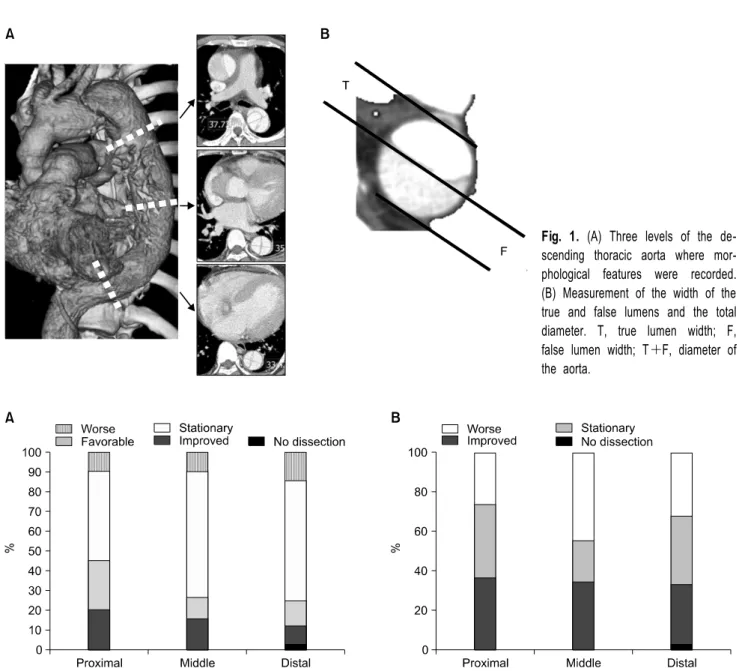
Serial CT images of each patient in the preoperative, early postoperative, and late follow-up stages were reviewed retro- spectively. Early postoperative CT was performed at a mean of 5.4±3.0 days postoperatively (range, 1–14 days), before the patient was discharged from the hospital. Late follow-up CT was performed at a mean of 31.0±20.7 months postoper- atively (range, 6–97 months). The morphological features of the true and the false lumens were measured at three planes, representing the proximal, middle, and distal descending tho- racic aorta (Fig. 1). At each level, the patency of the false lu- men was assessed, and the width of the true and false lumens was recorded.

Early postoperative changes were categorized as following.

A false lumen that was completely thrombosed and narrower than the true lumen was classified as improved. A false lu- men that was completely thrombosed but wider than the true lumen was defined as favorable, as were patent false lumens that were significantly narrower than observed preoperatively.

The presence of the following findings in comparison with the preoperative images led to a classification of the false lu- men as unfavorable: further collapse of the true lumen, a newly patent false lumen that had been thrombosed pre- operatively, and >5 mm of dilatation of the aortic diameter.

In the late postoperative findings, we defined improved change as complete false lumen thrombosis accompanied by a decrease of the aortic diameter, regression of the false lumen, or the new expansion of a previously narrow true lumen.

Postoperative findings were classified as unfavorable if the overall aortic diameter had increased by more than 10 mm, if the aortic diameter had increased more than 5 mm within the first year, or if further collapse of the true lumen occurred.

Statistical analyses were performed using SPSS ver. 15.0

for Windows (SPSS Inc., Chicago, IL, USA). Categorical var-

iables were compared using the chi-square test or Fisher’s ex-

act test, and numerical variables were compared using the

Student t-test. All p-values <0.05 were considered to in-

dicate statistical significance.

(3)

Fig. 1. (A) Three levels of the de- scending thoracic aorta where mor- phological features were recorded.

(B) Measurement of the width of the true and false lumens and the total diameter. T, true lumen width; F, false lumen width; T+F, diameter of the aorta.

Fig. 2. (A) Early and (B) late changes in the false lumen in the proximal, middle, and distal descending thoracic aorta.

RESULTS 1) Early postoperative outcomes

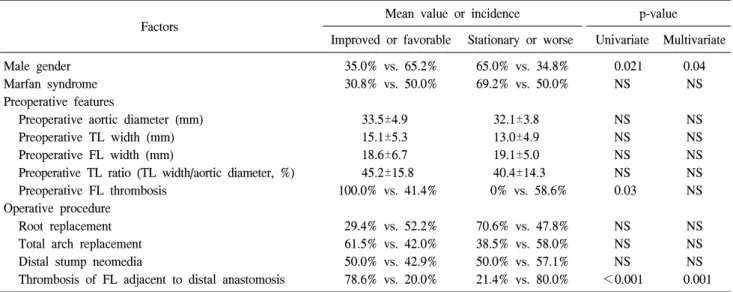
In the early postoperative period, 46.0% of the patients (29 of 63) showed improved or favorable changes in the false lu- men of the proximal thoracic aorta, which was significantly more frequent than favorable changes in the middle descend- ing thoracic aorta (27.0%, 17 of 63) or the distal descending thoracic aorta (22.2%, 14 of 63) (Fig. 2A). In univariate and multivariate analysis, preoperative features of the false lumen, arch replacement, and the presence of Marfan syndrome were

not associated with improved or favorable early postoperative changes. Preoperative false lumen thrombosis showed a sig- nificant positive association with improved or favorable out- comes in univariate analysis, but not in multivariate analysis.

The only factor found to show a significant positive associa-

tion with improved or favorable outcomes in both univariate

and multivariate analysis was thrombosis of the false lumen

adjacent to the distal anastomosis. The false lumen of the

proximal thoracic aorta showed favorable early changes in

78.6% of patients in whom a false lumen immediately distal

to the graft anastomosis (juxta-anastomotic false lumen) was

(4)

Table 1. Factors associated with favorable early changes in the proximal descending thoracic aorta after surgery for acute type A aortic dissection

Factors Mean value or incidence p-value

Improved or favorable Stationary or worse Univariate Multivariate

Male gender 35.0% vs. 65.2% 65.0% vs. 34.8% 0.021 0.04

Marfan syndrome 30.8% vs. 50.0% 69.2% vs. 50.0% NS NS

Preoperative features

Preoperative aortic diameter (mm) 33.5±4.9 32.1±3.8 NS NS

Preoperative TL width (mm) 15.1±5.3 13.0±4.9 NS NS

Preoperative FL width (mm) 18.6±6.7 19.1±5.0 NS NS

Preoperative TL ratio (TL width/aortic diameter, %) 45.2±15.8 40.4±14.3 NS NS

Preoperative FL thrombosis 100.0% vs. 41.4% 0% vs. 58.6% 0.03 NS

Operative procedure

Root replacement 29.4% vs. 52.2% 70.6% vs. 47.8% NS NS

Total arch replacement 61.5% vs. 42.0% 38.5% vs. 58.0% NS NS

Distal stump neomedia 50.0% vs. 42.9% 50.0% vs. 57.1% NS NS

Thrombosis of FL adjacent to distal anastomosis 78.6% vs. 20.0% 21.4% vs. 80.0% <0.001 0.001 NS, not significant; TL, true lumen; FL, false lumen.

Fig. 3. Late changes in the proximal descending false lumen ac- cording to early postoperative changes in the false lumen.

Fig. 4. Late thrombosis of the proximal descending false lumen according to early postoperative changes in the false lumen.

completely thrombosed. In contrast, favorable early changes occurred in only 20.0% of patients with a patent juxta-anasto- motic false lumen (Table 1).

2) Later improvement of the false lumen during follow-up

In the late follow-up CT images, 36.5% of the patients (23 of 63) showed improved changes in the false lumen of the proximal thoracic aorta, compared to 34.9% (22 of 63) in the middle thoracic aorta and 30.2% (19 of 63) in the distal thoracic aorta. In contrast, unfavorable late changes, reflecting

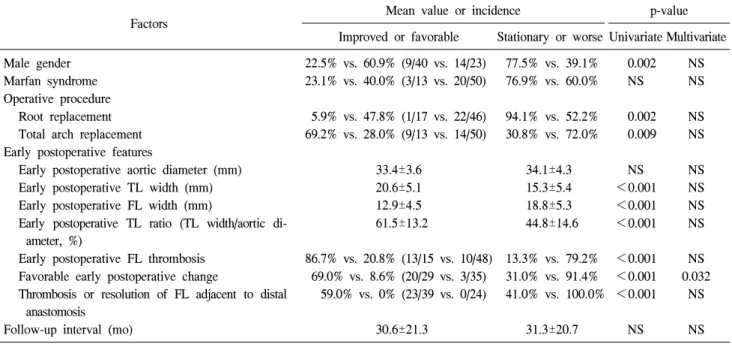
a rapid increase of the aortic diameter or further collapse of the true lumen, were found in 25.4% of the patients (16 of 63) in the proximal aorta, 44.4% (28 of 63) in the middle aorta, and 31.7% (20 of 63) in the distal aorta (Fig. 2B). If early postoperative changes were improved or favorable, the proximal descending thoracic aorta showed further late im- provement in 84.6% (11 of 13) and 56.3% (9 of 16) of the cases, respectively. In contrast, if early postoperative changes were stable or unfavorable, only 7.1% (2 of 28) and 16.7%

(1 of 6) of the patients showed further late improvement, re-

(5)

Table 2. Factors associated with late improvement of the false lumen in the proximal descending thoracic aorta after surgery for acute type A aortic dissection

Factors Mean value or incidence p-value

Improved or favorable Stationary or worse Univariate Multivariate

Male gender 22.5% vs. 60.9% (9/40 vs. 14/23) 77.5% vs. 39.1% 0.002 NS

Marfan syndrome 23.1% vs. 40.0% (3/13 vs. 20/50) 76.9% vs. 60.0% NS NS

Operative procedure

Root replacement 5.9% vs. 47.8% (1/17 vs. 22/46) 94.1% vs. 52.2% 0.002 NS

Total arch replacement 69.2% vs. 28.0% (9/13 vs. 14/50) 30.8% vs. 72.0% 0.009 NS Early postoperative features

Early postoperative aortic diameter (mm) 33.4±3.6 34.1±4.3 NS NS

Early postoperative TL width (mm) 20.6±5.1 15.3±5.4 <0.001 NS

Early postoperative FL width (mm) 12.9±4.5 18.8±5.3 <0.001 NS

Early postoperative TL ratio (TL width/aortic di- ameter, %)

61.5±13.2 44.8±14.6 <0.001 NS

Early postoperative FL thrombosis 86.7% vs. 20.8% (13/15 vs. 10/48) 13.3% vs. 79.2% <0.001 NS Favorable early postoperative change 69.0% vs. 8.6% (20/29 vs. 3/35) 31.0% vs. 91.4% <0.001 0.032 Thrombosis or resolution of FL adjacent to distal

anastomosis

59.0% vs. 0% (23/39 vs. 0/24) 41.0% vs. 100.0% <0.001 NS

Follow-up interval (mo) 30.6±21.3 31.3±20.7 NS NS

NS, not significant; TL, true lumen; FL, false lumen.

Fig. 5. Aneurysm-free survival rates for patients with early favor- able changes (solid line) versus those without early favorable changes (dotted line).

spectively (Fig. 3). Complete thrombosis or resolution of the proximal descending false lumen occurred in 42.9% of the patients in the late images (Fig. 4). Favorable early changes in the proximal thoracic aorta were the only factor that was found by multivariate analysis to have a statistically sig- nificant association with later improvement (Table 2). The

seven-year aneurysm-free survival rate was higher in patients with favorable early changes (78.0%) than in patients with stable or unfavorable early changes (63.6%) (Fig. 5).

DISCUSSION

Current discussions regarding the management of acute

type A dissection involve the following issues: (1) determin-

ing strategies and techniques for improving early outcomes,

including cerebral protection and hemostasis; (2) identifying

the optimal strategy for high-risk patients, such as patients

aged 80 years and older and patients with severe malperfu-

sion; and (3) determining what extent of surgical replacement

is necessary to ensure improved long-term prognoses. With

regard to issue (3), no compelling evidence supports the long-

term benefit of total arch replacement compared to less ex-

tensive replacement procedures such as replacement of the as-

cending aorta or hemiarch. However, many surgeons seem to

believe that more extensive replacement procedures are gen-

erally preferable. Even more controversy exists about whether

even more extensive surgical procedures, such as the FET

procedure, are generally beneficial. The basis for such debates

(6)

is the extremely unfavorable long-term prognosis of acute type A dissection. Approximately 20%–40% of patients have been reported to require a at least one more operation for a descending aortic aneurysm in the 5–10 year period after the initial repair of an acute type A dissection [1-5]. When pa- tients who did not undergo surgical intervention are included, the operation rate has been reported to be high as 60% with- in 10 years after the initial treatment [5].

Most previous studies have focused on unfavorable changes in the descending aorta, and the residual patent false lumen has been identified as a common risk factor for faster de- scending aortic dilatation [4,5,9-12]. In our previous study, we attempted to determine whether immediate postoperative characteristics are predictive of the later long-term outcome of the descending aortic false lumen. The data from that study showed not only a high incidence of descending aortic dilatation (45.7%) after repair of acute type A dissection, but also showed shrinkage or even the complete resolution of the thoracic false lumen in some patients (29.5%). Corresponding to the findings of other reports, early postoperative thrombo- sis of the false lumen was found to be a positive prognostic factor [8]. In the present study, favorable remodeling of the proximal descending false lumen occurred in more than one third of patients after conventional repair of acute type A dis- section without FET. For the most part, positive remodeling was found to begin with favorable early changes, which were significantly associated with thrombosis of the juxta-anasto- motic false lumen.

Bachet et al. [13] reported that the presence of Marfan syndrome favors secondary dilatation of the descending aorta independently from the presence of a patent false lumen.

Immer et al. [14] identified the following factors to be sig- nificantly predictive of secondary aortic dilatation: the extent of the aortic dissection, the involvement of supra-aortic branch- es or malperfusion, the presence of a patent false lumen, and an enlarged diameter of the descending aorta. In contrast, in the present study, preoperative aortic diameter, preoperative features of the false lumen, and the presence of Marfan syn- drome were not found to be statistically significant factors as- sociated with postoperative changes in the descending aorta.

The discrepancies between these two studies might have re- sulted from the following characteristics of our study pop-

ulation: (1) only a few patients had a large (diameter >40 mm) descending aorta preoperatively, (2) patients with ex- tensive preoperative thrombosis at the false lumen (intramural hematoma) were excluded, (3) the number of patients with Marfan syndrome was not large enough for an adequate stat- istical analysis.

Pressurization of the remaining false lumen and subsequent dilatation after surgical repair of type A dissection may be caused by the following factors: (1) a newly developed iatro- genic tear at the anastomotic site; (2) a persistent intimal tear remaining at the unresected aortic arch or the descending thoracic aorta; (3) a primary tear at the distal aorta in the case of retrograde type A dissection; and (4) a re-entry tear at the far distal aorta, most frequently observed around the visceral branches [15-19]. The experience of the surgeon as well as the specific surgical techniques employed could affect such factors, thereby altering the prognosis of the remaining false lumen. In order to avoid creating new iatrogenic intimal tears at the distal anastomosis site through large needle holes or cut-through of the intimal flap, we believe that attention should be paid to meticulous handling and the use of proper methods of buttressing the internal suture lines with inverted adventitia, Teflon felt, or strips of vascular graft. For total arch replacement, we prefer inserting a short sleeve of surgi- cal graft into the true lumen to exclude small intimal tears adjacent to the anastomosis [16]. In almost all patients in our series in whom this short surgical elephant trunk was used, the juxta-anastomotic and adjacent false lumen underwent fa- vorable postoperative changes, which corresponds to pre- viously reported results [18].

We believe that it is beneficial for the long-term prognosis to resect all tears found in the aortic arch and performing to- tal or partial arch replacement, as long as the surgeon is con- fident that the risk does not differ between ascending aorta replacement and total arch replacement [20-24]. As a shorter suture line made at a smaller stump may have less expansile surface tension, resulting in a lower chance of a new intimal tear, it is advisable to replace the entire ascending aorta, which is almost always dilated in patients with dissection.

For the same reason, we prefer partial arch replacement, with

an anastomosis made in the middle of the arch perpendicu-

larly to the long axis, for patients with an arch tear, even if

(7)

it is considered manageable by hemiarch replacement with a long suture line. We also tend to replace transverse arches larger than 3.5–4.0 cm, especially in young patients.

In the case of primary or re-entry tears located in the tho- racic part of the descending aorta, the FET technique can be beneficial. It has been reported that 90% or more of patients who underwent a FET procedure showed complete thrombo- sis of the proximal thoracic false lumen [6,7]. Favorable out- comes after the FET procedure may be attributable not only to the exclusion of re-entry tears, but also to a more hemo- static distal anastomosis, which also can be achieved using a short surgical elephant trunk. Despite the advantages of the FET technique in remodeling the descending false lumen, fur- ther risk-benefit analysis assessing the rate and severity of complications is needed before this technique is adopted as a routine procedure [25-27]. Intraoperative transesophageal echo- cardiography, intraoperative aortography in a hybrid operating room, and examination with an angioscope during circulatory arrest may be helpful in identifying the patients who can most benefit from the FET procedure.

The present study has several limitations. First, it is subject to all the limitations of a retrospective, nonrandomized study.

Second, the follow-up duration was not long enough to show long-term changes in the descending aorta. Third, the study population was relatively small. As the number of patients and the length of follow-up continue to increase, we expect that differences in the aneurysm-free survival rate depending on early postoperative changes in the proximal thoracic aorta may become more evident. Despite the above limitations, we conclude that favorable remodeling of the proximal descend- ing false lumen may occur in more than one third of patients after conventional repair of acute type A dissection, even without a FET. For the most part, positive remodeling started immediately after surgery and was associated with thrombosis of the juxta-anastomotic false lumen. This finding suggests that long-term outcomes may be significantly improved by re- finement of surgical techniques or strategies to avoid making or leaving large intimal tears at or adjacent to the anasto- mosis.

CONFLICT OF INTEREST

No potential conflict of interest relevant to this article was reported.

ACKNOWLEDGMENTS

This study was supported by SNUBH research grants 02- 2009-036 and 02-2010-028.

REFERENCES

1. Heinemann M, Laas J, Karck M, Borst HG. Thoracic aortic aneurysms after acute type A aortic dissection: necessity for follow-up. Ann Thorac Surg 1990;49:580-4.

2. Bachet J, Goudot B, Dreyfus GD, et al. Surgery for acute type A aortic dissection: the Hopital Foch experience (1977- 1998). Ann Thorac Surg 1999;67:2006-9.

3. Kirsch M, Soustelle C, Houel R, Hillion ML, Loisance D.

Risk factor analysis for proximal and distal reoperations af- ter surgery for acute type A aortic dissection. J Thorac Car- diovasc Surg 2002;123:318-25.

4. Immer FF, Krahenbuhl E, Hagen U, et al. Large area of the false lumen favors secondary dilatation of the aorta after acute type A aortic dissection. Circulation 2005;112(9 Suppl):

I249-52.

5. Yeh CH, Chen MC, Wu YC, Wang YC, Chu JJ, Lin PJ.

Risk factors for descending aortic aneurysm formation in medium-term follow-up of patients with type A aortic dis- section. Chest 2003;124:989-95.

6. Liu ZG, Sun LZ, Chang Q, et al. Should the “elephant trunk” be skeletonized?: total arch replacement combined with stented elephant trunk implantation for Stanford type A aort- ic dissection. J Thorac Cardiovasc Surg 2006;131:107-13.

7. Uchida N, Ishihara H, Shibamura H, Kyo Y, Ozawa M.

Midterm results of extensive primary repair of the thoracic aorta by means of total arch replacement with open stent graft placement for an acute type A aortic dissection. J Thorac Cardiovasc Surg 2006;131:862-7.

8. Park KH, Lim C, Choi JH, et al. Midterm change of de- scending aortic false lumen after repair of acute type I dis- section. Ann Thorac Surg 2009;87:103-8.

9. Halstead JC, Meier M, Etz C, et al. The fate of the distal aorta after repair of acute type A aortic dissection. J Thorac Cardiovasc Surg 2007;133:127-35.

10. Sueyoshi E, Sakamoto I, Hayashi K, Yamaguchi T, Imada T. Growth rate of aortic diameter in patients with type B aortic dissection during the chronic phase. Circulation 2004;

110(11 Suppl 1):II256-61.

(8)

11. Fattori R, Bacchi-Reggiani L, Bertaccini P, et al. Evolution of aortic dissection after surgical repair. Am J Cardiol 2000;86:868-72.

12. Bernard Y, Zimmermann H, Chocron S, et al. False lumen patency as a predictor of late outcome in aortic dissection.

Am J Cardiol 2001;87:1378-82.

13. Bachet JE, Termignon JL, Dreyfus G, et al. Aortic dis- section. Prevalence, cause, and results of late reoperations. J Thorac Cardiovasc Surg 1994;108:199-205.

14. Immer FF, Hagen U, Berdat PA, Eckstein FS, Carrel TP.

Risk factors for secondary dilatation of the aorta after acute type A aortic dissection. Eur J Cardiothorac Surg 2005;27:

654-7.

15. Guthaner DF, Miller DC, Silverman JF, Stinson EB, Wexler L. Fate of the false lumen following surgical repair of aortic dissections: an angiographic study. Radiology 1979;133:1-8.

16. Miyamoto S, Hadama T, Anai H, et al. Simplified elephant trunk technique promotes thrombo-occlusion of the false lu- men in acute type A aortic dissection. Ann Thorac Cardio- vasc Surg 2006;12:412-6.

17. Van Arsdell GS, David TE, Butany J. Autopsies in acute type A aortic dissection. Surgical implications. Circulation 1998;98(19 Suppl):II299-302.

18. Ando M, Takamoto S, Okita Y, Morota T, Matsukawa R, Kitamura S. Elephant trunk procedure for surgical treatment of aortic dissection. Ann Thorac Surg 1998;66:82-7.

19. Ergin MA, Phillips RA, Galla JD, et al. Significance of dis- tal false lumen after type A dissection repair. Ann Thorac Surg 1994;57:820-4.

20. Watanuki H, Ogino H, Minatoya K, et al. Is emergency total arch replacement with a modified elephant trunk technique justified for acute type A aortic dissection? Ann Thorac Surg 2007;84:1585-91.

21. Takahara Y, Sudo Y, Mogi K, Nakayama M, Sakurai M.

Total aortic arch grafting for acute type A dissection: analy- sis of residual false lumen. Ann Thorac Surg 2002;73:450-4.

22. Ando M, Nakajima N, Adachi S, Nakaya M, Kawashima Y.

Simultaneous graft replacement of the ascending aorta and total aortic arch for type A aortic dissection. Ann Thorac Surg 1994;57:669-76.

23. Bachet J, Teodori G, Goudot B, et al. Replacement of the transverse aortic arch during emergency operations for type A acute aortic dissection: report of 26 cases. J Thorac Car- diovasc Surg 1988;96:878-86.

24. Kazui T, Kimura N, Yamada O, Komatsu S. Total arch graft replacement in patients with acute type A aortic dissection.

Ann Thorac Surg 1994;58:1462-8.

25. Shimamura K, Kuratani T, Matsumiya G, et al. Long-term results of the open stent-grafting technique for extended aort- ic arch disease. J Thorac Cardiovasc Surg 2008;135:1261-9.

26. Usui A, Fujimoto K, Ishiguchi T, Yoshikawa M, Akita T, Ueda Y. Cerebrospinal dysfunction after endovascular stent- grafting via a median sternotomy: the frozen elephant trunk procedure. Ann Thorac Surg 2002;74:S1821-4.

27. Flores J, Kunihara T, Shiiya N, Yoshimoto K, Matsuzaki K,

Yasuda K. Extensive deployment of the stented elephant trunk

is associated with an increased risk of spinal cord injury. J

Thorac Cardiovasc Surg 2006;131:336-42.

수치

Fig. 1. (A) Three levels of the de- de-scending thoracic aorta where  mor-phological features were recorded
Table 1. Factors associated with favorable early changes in the proximal descending thoracic aorta after surgery for acute type  A aortic  dissection
Table 2. Factors associated with late improvement of the false lumen in the proximal descending thoracic aorta after surgery for acute  type A aortic dissection

참조

관련 문서

3. Specially, Va type these a lot of changes were seen. Va type and Ⅶ type were shown big change after 4 months. Depilation number increases if depilation is gone or it is

The positive change pattern of CK-MB according to time on acute myocardiac infarction patient.. The positive change pattern of troponin-T according to time on

factors: first, it is biased to the number of improved or abolished regulations; second, it did not seriously consider the cost and benefit of

ERCP im- age shows proximal cystic and distal fusiform dilatation of the common bile duct, an acute-angled pancreaticobil- iary ductal union (APB(T), and a short and slender

and an improvement set of extragradient-type iteration methods in [5], we in- troduce new iteration algorithms for finding a common of the solution set of an equilibrium problem

political or social cause-and-effect, but the type of a historical change of phase occurring within a great historical organism of definable compass at the point preordained

1 John Owen, Justification by Faith Alone, in The Works of John Owen, ed. John Bolt, trans. Scott Clark, "Do This and Live: Christ's Active Obedience as the

Sex (ref.. The improvement of disability after treatment according to the headache type... 긴장형 두통과 기타 두통에서도 편두통과 비슷한 경향을 보였다. 두 통