Adrenal Insufficiency in Patients with Rotator Cuff Tear:
Prevalence, Risk Factors and Influence on Outcome
Jung-Han Kim , Heui-Chul Gwak
Department of Orthopaedic Surgery, Busan Paik Hospital, Inje University College of Medicine, Busan, Korea
Background: This study measured the rate of adrenal insufficiency among rotator cuff tear patients, and determined the roles of steroid treatment and herbal medicine as specific risk factors of adrenal insufficiency.
Methods: We prospectively evaluated the 53 patients who agreed to participate in the study and underwent arthroscopic rotator cuff repair due to a chronic full-thickness tear from March 2012 to September 2013. The diagnosis of adrenal insufficieny was made by rapid adrenocortical hormone test before the operation. We collected information regarding their history of steroid and herbal medicine treat- ment within the last 12 months.
Results: The rate of adrenal insufficiency among the rotator cuff tear patients in our study was 18.9% (10 of 53 patients). Steroid treat- ment (p=0.034), frequency of local steroid injection (p=0.008), and herbal medicine treatment (p=0.02) showed significant association with the risk of adrenal insufficiency.
Conclusions: In this study, careful taking of a patient’s medical history, such as the use of steroids and herbal medicine, is important when investigating adrenal function before surgery.
(Clin Shoulder Elbow 2015;18(2):80-85)
Key Words: Intra-articular steroid injection; Herbal medicine; Adrenal insufficiency; Rotator cuff tear
Copyright © 2015 Korean Shoulder and Elbow Society. All Rights Reserved. pISSN 2383-8337
Clinics in Shoulder and Elbow Vol. 18, No. 2, June, 2015 http://dx.doi.org/10.5397/cise.2015.18.2.80
Received August 31, 2014. Revised December 28, 2014. Accepted December 29, 2014.
Correspondence to: Jung-Han Kim
Department of Orthopaedic Surgery, Busan Paik Hospital, Inje University College of Medicine, 75 Bokji-ro, Busanjin-gu, Busan 614-735, Korea Tel: +82-51-890-6996, Fax: +82-51-892-6619, E-mail: [email protected]
Financial support: None. Conflict of interests: None.
Introduction
Rotator cuff tears are a common cause of shoulder pain, with the reported incidence ranging from 5% to 40%.1,2) Patients with rotator cuff tears have many clinical manifestations, varying from mild discomfort and transient weakness to incapacitating pain and loss of shoulder function.3) Treatment options vary from conservative treatment to surgical repair of the rotator cuff tear.
Conservative treatment includes analgesics and anti-inflamma- tory medications, physical therapy, activity modification, and subacromial injections of corticosteroids.
Corticosteroids are powerful anti-inflammatory drugs, which may reduce local inflammation in rotator cuff tear patients.
However, corticosteroid treatment suppresses human tenocyte cell viability, cell proliferation, and collagen synthesis.4) Long-term treatment with corticosteroid injections can impair the mechani-
cal properties of tendons and result in a high rate of tendon rup- ture.5) In addition, a long duration and large doses of exogenous corticosteroids lead to suppression of the hypothalamic-pituitary- adrenal axis, resulting in iatrogenic adrenal insufficiency.6) Some studies have reported that development of iatrogenic adrenal in- sufficiency can occur following local corticosteroid treatment.7,8) However, no studies on adrenal insufficiency in patients with ro- tator cuff tears have been reported. The aim of this prospective study was to evaluate the percentage of adrenal insufficiency among rotator cuff tear patients, and to determine the roles of steroid treatment and herbal medicine as specific risk factors of adrenal insufficiency.
Our hypotheses were that steroid treatment and herbal medi- cine treatment are risk factors for adrenal insufficiency in rotator cuff tear patients.
Methods
Study Design and Participants
After obtaining approval from the Inje University Busan Paik Hospital Institutional Review Board (No. 2011-058), we prospectively evaluated 53 patients (24 males and 29 females;
58.94 ± 7.51 years) who agreed to participate in the study and underwent arthroscopic rotator cuff repair due to a chronic full- thickness tear from March 2012 to September 2013. Prior to the study, we explained its purpose and methods. All of the patients had full-thickness or medium-sized rotator cuff tears diagnosed by magnetic resonance imaging (MRI) or magnetic resonance arthrogram (MRA) preoperatively and confirmed at the time of the operation. Patients with glenohumeral arthritis, a previous shoulder operation, or a medication history of ketoconazole, megesterol, phenytoin, and rifampicin were excluded. We as- sessed the history of steroid treatment (including oral or locally injected corticosteroids) of 53 eligible participants and their history of herbal medicine treatment during the previous 12 months. Regarding steroid treatment, we collected information about the duration and the dose of the medication. In addition, the frequency of injections and the time interval between the first injection and the rapid adrenocortical hormone (ACTH) test were recorded.
Diagnosis of Adrenal Insufficiency
All 53 patients underwent an adrenal insufficiency test (a short and low-dose ACTH stimulation test) before the opera- tion. Before the rapid ACTH stimulation test, we checked the patients’ serum ACTH, cortisol, and aldosterone level (baseline level). After injection of a synthetic form of ACTH, we checked the serum cortisol and aldosterone levels. In healthy individuals, after 1 hour, the cortisol level should be over 20 μg/dl and more than 7 μg/dl than the baseline level (6.2–19.4 μg/dl). Individu- als with lower levels are diagnosed with adrenal insufficiency. In such cases, primary adrenal insufficiency can be distinguished from secondary adrenal insufficiency by checking the baseline serum ACTH level (normal: 7.2–63.3 pg/dl) and the serum al- dosterone level (normal: 7.5–150 ng/dl) after 30 minutes. We defined an increased serum ACTH level and stationary serum aldosterone level as primary adrenal insufficiency. A decreased serum ACTH level and more than a 5 ng/dl increase compared to the baseline level of aldosterone was defined as secondary adrenal insufficiency.
Statistical Analysis
The difference in the percentage of having been treated with steroid (oral or locally injected corticosteroid) between the ad- renal insufficient group and the normal adrenal function group was evaluated using Fisher’s exact test. The frequency of steroid injections and the duration of the steroid medication were eval-
uated using Wilcoxon’s rank sum test. The difference in the per- centage of having been treated with herbal medicine between the adrenal insufficient group and the normal adrenal function group was evaluated using Fisher’s exact test. Finally, a stepwise logistic regression analysis was performed to determine factors involved in rotator cuff tears in patients with adrenal insufficiency.
All statistical analyses were performed using the SAS software for Windows, version 9.0 (SAS institute, Cary, NC, USA), and the critical value for significance was set at p<0.05.
Results
The Rate of Adrenal Insufficiency among Rotator Cuff Tear Patients
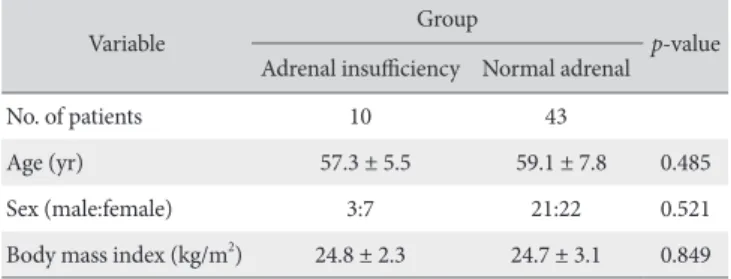
Of the 53 patients enrolled in this study, 10 patients (male:female=3:7; mean age 57.3 ± 5.5 years) had adrenal insufficiency in the rapid ACTH test, and 43 patients (male:
female=21:22; mean age 59.1 ± 7.8 years) showed normal adrenal function. The demographic characteristics of members of both groups are summarized in Table 1. The rate of adrenal insufficiency among the full-thickness rotator cuff tear patients who underwent surgery from 2012 to 2013 in our institution was 18.86%. In the positive rapid ACTH test group, the mean baseline serum ACTH, cortisol, and aldosterone levels were 5.52 pg/dl, 3.04 μg/dl, and 110.16 ng/dl, respectively, and af- ter the rapid ACTH test, 18.27 pg/dl, 281.61 μg/dl, and 58.9 ng/dl, respectively. In the normal rapid ACTH test group, the mean baseline serum ACTH, cortisol, and aldosterone levels were 11.01 pg/dl, 6.13 μg/dl, and 72.09 ng/dl, respectively, and after the rapid ACTH test, 20.14 pg/dl, 25.93 μg/dl, and 257.37 ng/dl, respectively (Table 2).
Comparison of Previous Steroid and Herbal Medicine Treatment between Adrenal Insufficient Group and Normal Adrenal Function Group
None of patients in the adrenal insufficient group received oral steroid medication, but 8 patients (80.0%) received a local steroid injection in the subacromial space. None of the patients in the normal adrenal function group received oral steroid medi-
Table 1. Demographic Characteristics between Adrenal Insufficient Group and Normal Adrenal Function Group
Variable Group
p-value Adrenal insufficiency Normal adrenal
No. of patients 10 43
Age (yr) 57.3 ± 5.5 59.1 ± 7.8 0.485
Sex (male:female) 3:7 21:22 0.521
Body mass index (kg/m2) 24.8 ± 2.3 24.7 ± 3.1 0.849 Values are presented as number only or mean ± standard deviation.
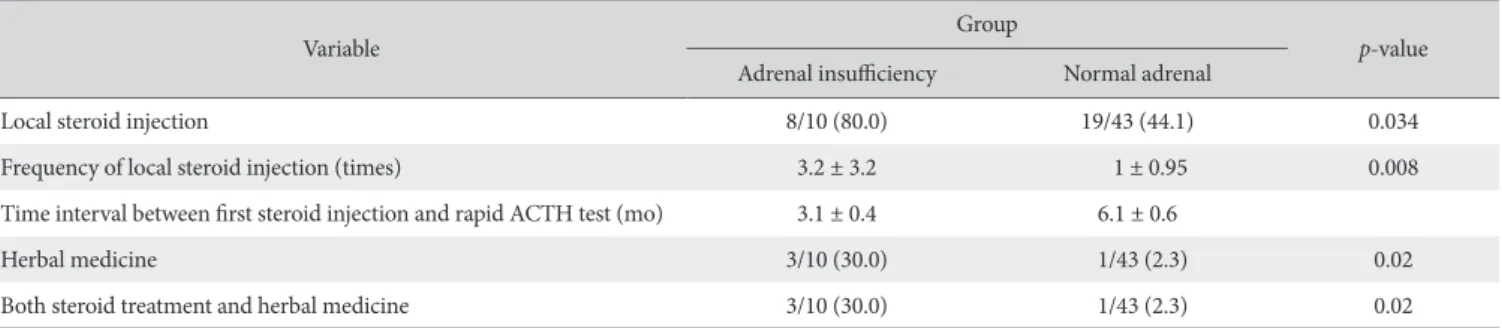
cation, but 19 patients (44.1%) received a local steroid injection in the subacromial space. A statistically significant difference in the percentage of having been treated with steroid was observed between the two groups (p=0.034). The mean frequency of local steroid injections was 3.2 ± 3.2 times in the adrenal in- sufficiency group, and 1 ± 0.95 times in the normal group. A significant difference in the frequency of local steroid injections was observed between the two groups (p=0.008). The mean time interval between the first injection and the rapid ACTH test was 3.1 ± 0.4 months in the adrenal insufficiency group, and 6.1
± 0.6 months in the normal group.
Three of 10 adrenal insufficient patients (30.0%) received herbal medicine. One of 43 patients (2.3%) in the normal group took herbal medicine. A statistically significant difference in the use of herbal medicine was observed between the two groups (p=0.02). In the adrenal insufficient patients, three patient
(30.0%) received both steroid treatment and herbal medicine si- multaneously. In the normal group, one patients (2.3%) received both steroid treatment and herbal medicine simultaneously. A statistically significant difference in the use of both treatments was observed between the two groups (p=0.02) (Table 3).
Logistic Regression Analysis of Risk Factors for Adrenal Insufficiency
In univariate analysis, steroid treatment (local steroid injec- tion), the frequency of local steroid injection, herbal medicine treatment, and the combined use of steroids and herbal medi- cine treatment showed significant association with the risk of adrenal insufficiency. The odds ratios for steroid treatment (local steroid injection) were 4.42 (95% confidence interval [CI]: 0.75–
26.1), 5 (95% CI: 0.611–40.09) for the frequency of local steroid injection, 17.56 (95% CI: 1.59–193.72) for herbal medicine Table 2. Comparison of Serum Level of ACTH, Cortisol and Aldosterone before and after ACTH Test between Positive and Normal Rapid ACTH Test Group
Variable Rapid ACTH test Serum ACTH (pg/dl) Serum cortisol (μg/dl) Serum aldosterone (ng/dl)
Baseline Positive 5.52 ± 4.85 3.04 ± 2.34 110.16 ± 124.9
Normal 13.06 ± 11.01 8.35 ± 6.13 133.4 ± 72.09
After ACTH test Positive 18.27 ± 1.9 281.61 ± 72.63 58.9 ± 7.51
Normal 20.14 ± 2.1 25.93 ± 5.45 257.37 ± 92.74
Values are presented as mean ± standard deviation.
ACTH: adrenocorticotropic hormone.
Table 3. Percentage and Frequency of Local Steroid Injection, and Time Interval between First Steroid Injection and Rapid ACTH Test, and Comparison of Percentage in Receiving Previous Herbal Medicine, and Both Steroid Treatment and Herbal Medicine between Adrenal Insufficient Group and Normal Adrenal Function Group
Variable Group
p-value Adrenal insufficiency Normal adrenal
Local steroid injection 8/10 (80.0) 19/43 (44.1) 0.034
Frequency of local steroid injection (times) 3.2 ± 3.2 1 ± 0.95 0.008
Time interval between first steroid injection and rapid ACTH test (mo) 3.1 ± 0.4 6.1 ± 0.6
Herbal medicine 3/10 (30.0) 1/43 (2.3) 0.02
Both steroid treatment and herbal medicine 3/10 (30.0) 1/43 (2.3) 0.02
Values are presented as number/total number (%) or mean ± standard deviation. p<0.05 was considered a statistically significant threshold.
ACTH: adrenocorticotropic hormone.
Table 4. Univariate Analysis of Local Steroid Injection, Frequency of Injection, Herbal Medicine Treatment Alone, and Both Herbal Medicine Treatment and Lo- cal Steroid Injection Between Adrenal Insufficient Group and Normal Adrenal Function Group
Variable Odd ratio 95% confidence interval p-value
Local steroid injection 4.42 0.75–26.1 0.02
Local steroid injection frequency 5 0.611–40.09 0.048
Herbal medicine treatment alone 17.56 1.58–193.72 0.019
Both herbal medicine treatment and local steroid injection 17.56 1.59–193.72 0.019
p<0.05 was considered a statistically significant threshold.
treatment, and 17.56 (95% CI: 1.59–193.72) for the combined use of the steroid (local steroid injection) and herbal medicine treatment (Table 4). Subsequent multivariate analysis of these results showed no significant risk associated with adrenal insuf- ficiency (Table 5).
Discussion
In our study, 10 of the 53 patients (18.9%) with degenerative rotator cuff tear who participated in the ACTH stimulation test before arthroscopic rotator cuff repair had adrenal insufficiency.
Adrenal insufficiency, the clinical manifestation of deficient pro- duction or action of steroid hormone, may be primary or sec- ondary. Primary adrenal insufficiency results from the inability of the adrenal gland to produce sufficient quantities of hormones.
Secondary adrenal insufficiency is due to inadequate ACTH for- mation or release.9,10) In the current study, the mean cortisol and ACTH levels were 3.04 μg/dl and 5.52 pg/dl, respectively. The mean cortisol and ACTH levels after the rapid ACTH test were 281.63 μg/dl and 18.27 pg/dl, respectively. Thus, all cases of adrenal insufficiency in our study had secondary adrenal insuf- ficiency. Secondary adrenal insufficiency may occur in associa- tion with panhypopituitarismas as a result of tumor growth or treatment with surgery or irradiation.9) It can also be caused by selective deficiency, as seen following exogenous corticosteroid treatment.11) In our study, more patients in the adrenal insuf- ficiency group had received steroid treatment compared with those in the normal adrenal function group: eight of 10 rotator cuff tear patients (80.0%) with adrenal sufficiency had received steroid treatment in the previous year, whereas 19 of 43 rotator cuff tear patients (44.2%) in the normal adrenal function groups had received steroid treatment.
Corticosteroids substantially decrease levels of inflammatory cytokines, and therefore have beneficial anti-inflammatory and analgesic properties on human tendons.12) Therefore, subacro- mial corticosteroid injections, which deliver corticosteroids lo- cally and result in less systemic spreading, are mostly used in the treatment of rotator cuff tendinosis.
Systemic corticosteroid therapy is more likely to suppress the hypothalamic-pituitary-adrenal axis than intra-articular, inhala-
tional, or topical corticosteroids. However, several studies have reported impaired adrenocortical reserve after local steroid treat- ment.13,14) In our study, more patients in the adrenal insufficient group received a local steroid injection compared with those in the normal adrenal function group (80.0% [8/10] in the adrenal insufficient group and 44.1% [19/43] in the normal group). This finding suggests that absorption of the corticosteroid preparation from the injection site into the systemic circulation may induce adrenocortical dysfunction by suppression of ACTH secretion.
Interestingly, in the current study, patients with adrenal insuf- ficiency received more frequent injections than normal patients (mean frequency of injection: 3.2 ± 3.2 times in patients with adrenal insufficiency; 1 ± 0.95 times in normal patients), and the mean time interval between the first injection and the rapid ACTH test was shorter in patients with adrenal insufficiency than in normal patients (mean time interval: 3.1 ± 0.4 months in ad- renal insufficient patients; 6.1 ± 0.6 months in normal patients).
Therefore, patients with adrenal insufficiency received more frequent steroid injections in a short time period compared with normal patients. In the current study, herbal medicine treatment for chronic shoulder pain showed significant association with adrenal insufficiency in patients with rotator cuff tear. Herbal medicine is a complementary and alternative treatment for the care of orthopedic patients. Several herbal remedies may reduce pain and inflammation by blocking the arachidonic pathway, an important mechanism for producing pain and inflammation.15) Taking Chinese formulated herbal medicine may reduce the serum cortisol level, thereby resulting in adrenal insufficiency.
Armanini et al.16) suggested that licorice, one of the oldest and most popular herbal medicines in the world, possesses many properties that potentiate the action of cortisol. Matsuda et al.17) speculated that glycyrrhizic acid from licorice exerts a direct stimulating effect on the adrenal cortex and inhibits the inacti- vation of corticosteroids in the liver and kidney. These effects would result in a continuously elevated plasma level of cortico- steroid. Although we do not know which herbs can directly in- duce adrenal insufficiency, we believe that some herbs, such as licorice, in formulated herbal medicine may act in the same way as synthetic corticosteroids and induce iatrogenic adrenal insuf- ficiency by elevating plasma cortisol levels.
Table 5. Multivariate Analysis of Local Steroid Injection, Frequency of Injection, Herbal Medicine Treatment Alone, and Both Herbal Medicine Treatment and Local Steroid Injection between Adrenal Insufficient Group and Normal Adrenal Function Group
Variable Odd ratio 95% confidence interval p-value
Local steroid injection 2.44 0.33–17.92 0.38
Local steroid injection frequency 1.17 0.81–1.69 0.42
Herbal medication treatment 6.87 0.49–96.17 0.15
Herbal medication treatment and local steroid injection 7.71 0.53–111.58 0.13
p<0.05 was considered a statistically significant threshold.
Our study has several limitations. First, the legal status of steroid treatment varies from country to country: Controls on their use or prescription are stricter in some countries than in others. Therefore, the rate of adrenal insufficiency among rota- tor cuff tear patients in this study may be not relevant to other countries. However, according to current estimates, nearly 1%
of the general population (2.5% of those who are more than 70 years) are treated with long-term regimens of synthetic steroids for inflammation-related chronic disease.11,18) Despite the low prevalence of adrenal insufficiency in general in our study, the higher incidence of this medical problem in patients with rotator cuff tears is meaningful. Second, the study lacks comprehensive information on the types of steroids taken by the patients. Born- stein11) found that many patients may be unaware of or reluctant to report exposure to corticosteroids and that the lack of aware- ness that continuous use of topical corticosteroids can suppress adrenal function is a widespread problem in daily practice.
Third, because tumor growth or other treatment like surgery or irradiation could result in secondary adrenal insufficiency, further evaluation except ACTH test might have been performed. Fi- nally, the number of patients included was low for high statistical power. Therefore, conduct of further studies will be necessary in order to confirm the results of our study with a greater number of participants. Fourth, we affirmed that all herbal medicine con- tains steroid. Actually, it is possible that the herbal medicine con- tains steroid; however, we cannot say that an herbal medicine always contains steroid with confidence. In addition, it is difficult to determine the components of all herbal medicines. Fifth, the bound of patients was limited to patients who underwent rota- tor cuff repair. The purpose of this study is to determine the role of steroid treatment and herbal medicine as specific risk factors of adrenal insufficiency in all rotator cuff tear patients. Therefore, study population should be expanded to patients diagnosed as rotator cuff tear.
Conclusion
To the best of our knowledge, this is the first study to inves- tigate the potential role of local steroid injections and herbal medicine as risk factors for adrenal insufficiency. Although this prospective study cannot conclude that previous intra-articular steroid injection and herbal medicine are important causative factors of adrenal insufficiency in rotator cuff tears, a statistically significant difference in the percentage of having been treated with steroid and the mean frequency of local steroid injections was observed between patients in the adrenal insufficient and normal groups. Careful taking of a patient’s medical history, such as the use of steroids and herbal medicine, is important when investigating adrenal function before surgery.
References
1. Matsen FA, Titelman RM, Lippitt SB, et al. Rotator cuff. In:
Rockwood CA, Matsen FA, Matsen FA III, Wirth MA, Lippitt SB, Fehringer EV, eds. The shoulder. Philadelphia: WB Saun- ders; 2004. 795-878.
2. Neer CS 2nd. Impingement lesions. Clin Orthop Relat Res.
1983;(173):70-7.
3. Bokor DJ, Hawkins RJ, Huckell GH, Angelo RL, Schickendantz MS. Results of nonoperative management of full-thickness tears of the rotator cuff. Clin Orthop Relat Res. 1993;(294):103-10.
4. Wong MW, Tang YN, Fu SC, Lee KM, Chan KM. Triamcino- lone suppresses human tenocyte cellular activity and collagen synthesis. Clin Orthop Relat Res. 2004;(421):277-81.
5. Hugate R, Pennypacker J, Saunders M, Juliano P. The effects of intratendinous and retrocalcaneal intrabursal injections of cor- ticosteroid on the biomechanical properties of rabbit Achilles tendons. J Bone Joint Surg Am. 2004;86(4):794-801.
6. Sacre K, Dehoux M, Chauveheid MP, et al. Pituitary-adrenal function after prolonged glucocorticoid therapy for systemic inflammatory disorders: an observational study. J Clin Endocri- nol Metab. 2013;98(8):3199-205.
7. Habib G, Artul S, Chernin M, Hakim G, Jabbour A. The effect of intra-articular injection of betamethasone acetate/beta- methasone sodium phosphate at the knee joint on the hypo- thalamic-pituitary-adrenal axis: a case-controlled study. J Investig Med. 2013;61(7):1104-7.
8. Mader R, Lavi I, Luboshitzky R. Evaluation of the pituitary- adrenal axis function following single intraarticular injection of methylprednisolone. Arthritis Rheum. 2005;52(3):924-8.
9. Arlt W, Allolio B. Adrenal insufficiency. Lancet. 2003;361(9372):
1881-93.
10. Oelkers W. Adrenal insufficiency. N Engl J Med. 1996;335(16):
1206-12.
11. Bornstein SR. Predisposing factors for adrenal insufficiency. N Engl J Med. 2009;360(22):2328-39.
12. Habib GS. Systemic effects of intra-articular corticosteroids.
Clin Rheumatol. 2009;28(7):749-56.
13. Lazarevic MB, Skosey JL, Djordjevic-Denic G, Swedler WI, Zgradic I, Myones BL. Reduction of cortisol levels after single intra-articular and intramuscular steroid injection. Am J Med.
1995;99(4):370-3.
14. Duclos M, Guinot M, Colsy M, et al. High risk of adrenal in- sufficiency after a single articular steroid injection in athletes.
Med Sci Sports Exerc. 2007;39(7):1036-43.
15. Rispler DT, Sara J. The impact of complementary and alterna- tive treatment modalities on the care of orthopaedic patients. J Am Acad Orthop Surg. 2011;19(10):634-43.
16. Armanini D, Fiore C, Mattarello MJ, Bielenberg J, Palermo M.
History of the endocrine effects of licorice. Exp Clin Endocrinol Diabetes. 2002;110:257-61.
17. Matsuda S, Oda K, Kawaguchi M, Hayashi H. Histochemical studies on the effect of glycyrrhizin on corticoid metabolism.
Nisshin Igaku Jpn J Med Prog. 1962;49:465-81.
18. van Staa TP, Leufkens HG, Abenhaim L, Begaud B, Zhang B, Cooper C. Use of oral corticosteroids in the United Kingdom.
QJM. 2000;93(2):105-11.