Shoulder and Elbow Injury Rates and Patterns in Korean Rookie Professional Baseball Pitchers
Jin-Young Park, Seung-Jun Lee1 , Yong-Il Kim2, Gu-Yeon Heo3
Global Center for Shoulder, Elbow & Sports at Neon Orthopaedic Clinic, Seoul, 1Department of Orthopaedic Surgery, Pusan National University Yangsan Hospital, Pusan National University School of Medicine, Yangsan, 2LG Twins Baseball Club, 3Baseball Development Executive Committee, Korea Baseball Organization, Seoul, Korea
Background: To investigate how many rookie pitchers suffered from injuries while playing in the amateur league without guidelines for prevention of excessive pitching, we analyzed their amateur pitching patterns based on the pitch count, use of breaking balls, and pitches during winter camp.
Methods: Forty-one rookie pitchers who graduated from high school or university in 2013 and joined professional baseball teams. Par- ticipants were interviewed by a trainer using our questionnaire. Injury inclusion criteria were 1) history of shoulder surgery, 2) history of elbow surgery, 3) shoulder pain requiring treatment, and 4) elbow pain requiring treatment.
Results: Mean number of pitches per game and warm-up pitches for practice was 84.5 pitches (range, 15 to 130 pitches) and 16.4 pitches (range, 2 to 210 pitches), respectively. Mean number of pitches during the last year was 906.9 (range, 80 to 2,000). Mean num- ber of maximal pitches was 127 pitches (range, 50 to 210 pitches). Fourteen pitchers had pitched over 150 pitches. Twenty-seven pitch- ers (65.9%) had pitched in spite of enduring pain. During winter training (mean 1.8 months), mean number of pitches per day was 162.5 pitches, and 20 pitchers (48.8%) had practiced pitching excessively despite the cold weather. Twenty-six rookies (63.4%) had shoulder pain or history of shoulder surgery, and 31 pitchers (75.6%) had elbow pain or history of elbow surgery. Only four participants (9.8%) did not have pain and history of surgery.
Conclusions: For young baseball pitchers, guidelines for prevention of excessive pitching and for regulating the winter training program may be needed.
(Clin Shoulder Elbow 2016;19(1):15-19)
Key Words: Pitch count; Winter camp; Youth pitcher; Guideline Clinics in Shoulder and Elbow Vol. 19, No. 1, March, 2016
http://dx.doi.org/10.5397/cise.2016.19.1.15
Received May 21, 2015. Revised July 12, 2015. Accepted October 21, 2015.
Correspondence to: Seung-Jun Lee
Department of Orthopaedic Surgery, Pusan National University Yangsan Hospital, 20 Geumo-ro, Mulgeum-eup, Yangsan 50612, Korea Tel: +82-55-360-2125, Fax: +82-55-360-2155, E-mail: [email protected]
Financial support: None. Conflict of interests: None.
Introduction
The professional baseball league has been one of the most popular professional sports leagues in Korea since it was estab- lished in 1982. Many star players in the professional league are the most beloved players and they have achieved remarkable performances. Some unanticipated rookie players, who gradu- ated from high school or university during the last year, occasion- ally show a brilliant exploit in their first season. Although field players require a period of adjustment due to the nature of their
position, some prominent rookie pitchers often stand out among the rookies. The rookies become famous pitchers in the league, and they acquire many fans for the league. However, recently there has not been a wonderful crop of rookie pitchers. Most promising rookie pitchers have missed their first season due to injuries. Because the pitchers who could join the professional team were the main players on their amateur teams, they had to throw more pitches than the other pitchers.
Overuse injuries are common in baseball pitchers.1,2) Many lit- erature studies have reported on the risk factors for shoulder and elbow injuries in youth baseball pitchers.3-8) Lyman et al.,9) who
followed youth baseball pitchers during a spring baseball season, reported a significant association between the number of pitches and both shoulder and elbow pain. Fleisig et al.4) reported that participants who pitched more than 100 innings in a year had a significantly increased risk of injury. The USA Baseball Medi- cal & Safety Advisory Committee published safety guidelines in 2004 for youth pitchers for preventing injuries in youth baseball pitchers. The USA Little League Baseball replaced inning limits with pitch counts in 2007, and the Japan Little League Baseball declared pitch count limits in 2010. However, the Korean Little League Baseball has not announced the pitch count limit as yet.
Consequently, many main pitchers in the Korean youth league pitch much more than American or Japanese youth pitchers.
We investigated how many rookie pitchers suffered from injuries while playing in the amateur league to assess the injury rate due to unregulated pitching practices in Korea.
Methods
This study received approval from the Konkuk University Hospital Institutional Review Board (KUH1060083). Forty-one participants who were rookie professional baseball pitchers who graduated from high school or university in 2013 and joined eight out of nine professional baseball teams in Korea were enrolled in this study. The mean age was 22.2 years (range, 20 to 25 years). All participants were interviewed using our ques- tionnaire, which included questions about pitch count, pitch inning, fastball velocity, use of breaking balls, history of catcher, winter training camp, history of shoulder and elbow surgery, and current status of the shoulder and elbow. Current status of the shoulder and elbow was recorded by a team trainer, and the other questions were designed by the participants. Pitch count and pitch inning included questions about 1) pitch count in the last year, 2) maximal pitch count and innings per game in his whole career, 3) annual innings in the past three years, and 4) pitch count in winter training camp. Pitch count in the last year consisted of mean pitch count per game, practice pitches before the game, and total pitch count in the last year. Both mean fast- ball velocity in the last year and maximal fastball velocity in the last year and at all times were recorded. To investigate the use of breaking balls, frequency of breaking balls, starting age, and the duration of breaking ball pitching were recorded. Injury inclu- sion criteria included 1) history of shoulder surgery, 2) history of elbow surgery, 3) shoulder pain requiring treatment, and 4) elbow pain requiring treatment.
Statistical Analyses
A paired t-test was used for comparison of injury rate with participants’ factors. Receiver operating characteristic curve analysis was used to compare the relationship of injured partici- pants with pitch count. The level of statistical significance was set
at p<0.05. IBM SPSS Statistics ver. 21.0 (IBM Co., Armonk, NY, USA).
Results
Pitch Count
In the last year, the mean pitch count per game, practice pitch count, and total annual pitch count were 84.5 pitches (range, 15 to 130 pitches), 16.4 pitches (range, 2 to 210 pitches), and 1,002.1 pitches (range, 248 to 2,000 pitches), respectively.
Mean maximal pitch count and maximal innings in a game were 127 pitches (range, 50 to 210 pitches) and 8.6 pitches (range, 4 to 12 pitches), respectively. After including the two pitchers with a pitch count of more than 200 in a game, 14 participants had pitched over 150 pitches in a game. Mean number of maximal innings was 8.6. Annual number of innings pitched in the first year, second year, and last year was 65.1, 40.5, and 74.7 pitch- es, respectively. The average number of games attended by the participants was 14.5 games per year and 2.1 games per week.
Winter Camp
Mean duration of the winter camp was 1.8 months, and mean pitch count per day was 162.5 pitches. In addition, 75.6%
of the participants (31 of 41) replied that they had performed sufficient warm-up exercises for shoulders and elbows before pitching, while the other participants could not perform suf- ficient strengthening exercises; 48.8% of participants (20 of 41) were forced to practice pitching against their will in severe cold weather.
Fastball Velocity
In the last year, mean fastball velocity and mean maximal fast- ball velocity was 138.6 km/h (86.1 miles/h) and 144.4 km/h (89.7 miles/h), respectively. Mean maximal fastball velocity at all times was 145.6 km/h (90.5 miles/h). There was a statistically signifi- cant maximal difference in the fastball velocity between the last year and at all times (p<0.01).
Breaking Balls
The mean proportion of breaking balls to the total pitch count was 39.1%. Although there were variations between par- ticipants, the mean proportion of curveball, slider, change-up, and forkball to the total pitch count was 14.1%, 25.5%, 13.2%, and 7.7%, respectively. Mean starting age for throwing curveball, slider, change-up, and forkball was 12.3 years, 16.2 years, 18.4 years, and 19.4 years, respectively. Mean duration of usage of breaking balls was 8 years (curveball), 5.7 years (slider), 3.4 years (change-up), and 3.0 years (forkball).
Injury
Four participants experienced pain during batting. Twenty-
seven participants practiced throwing balls despite the pain.
Although they were experiencing pain, 17 rookies (63.0%) will- ingly practiced pitching; however, ten pitchers (37.0%) had to practice pitching due to their coach’s commands.
Twenty six participants (63.4%) had a history of shoulder op- eration, shoulder disorders, or shoulder pain. Shoulder disorders were diagnosed by magnetic resonance imaging (MRI) in 19 participants including one pitcher who underwent arthroscopic superior labral anterior to posterior (SLAP) repair. Shoulder disor- ders in 19 participants included 7 cases of SLAP lesions, 8 cases of impingement syndrome, 2 cases with Bennett lesions, 1 case with a Bankart lesion, and 1 case of rotator cuff tendinosis. The other 7 participants who did not undergo radiologic evaluation or operation complained of shoulder pain.
Thirty-one participants (75.6%) experienced elbow pain or were diagnosed with elbow disorders. Twenty-seven participants underwent MRI, and there were 19 cases of medial ulnar col- lateral ligament tear, 6 cases of loose bodies, and 16 cases of valgus overload syndrome with olecranon spur. Among these 27 rookies, 17 participants had a history of operation; medial ulnar collateral ligament reconstruction in 12 cases and arthroscopic surgery in 9 cases. Among the 31 participants, 4 rookies who did not undergo radiological evaluation complained of elbow pain.
Only 4 rookies (9.8%) had healthy shoulders and elbows without pain or disorders.
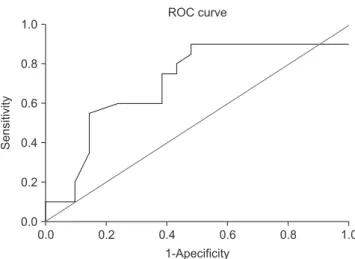
The pitch count had greater statistical significance in partici- pants with previous operation history compared to those without operation history (area under the curve, 0.710; standard error, 0.085; 95% confidence interval, 0.543–0.816; p=0.011) (Fig. 1).
Discussion
In their retrospective study of 140 adolescent pitchers, Olsen et al.7) reported that amount of pitching was the strongest risk factor for injury. Compared to the no injury group, the injury group reported pitching more months per year, innings per game, and pitches per game. More than 89 pitches per game almost quadrupled the risk of surgery (odds ratio=3.83), and pitching for more than 8 months per year increased the chance of surgery by five times (odds ratio=5.05). Pitchers who regu- larly pitched with a fatigued arm were 36 times more likely to have an elbow or shoulder injury requiring surgery (odds ratio=36.18). Our study also showed that most Korean rookie pitchers were exposed to injury due to too much pitching.
Pitch Count and Winter Camp
USA Baseball, Little League Baseball, Baseball Canada, American Sports Medicine Institute (ASMI), the American Orthopaedic Society for Sports Medicine, and the American Academy of Pediatrics have published guidelines for prevention of youth pitching injuries.10-13) The most important points in the guidelines are prevention of overuse injuries by limiting the pitch count and recommending an adequate period of rest on the ba- sis of age. The guidelines and literature recommend that youth pitchers should avoid pitching if they experience arm fatigue or pain.4,6,7,10-13) According to the guidelines, youth pitchers should refrain from throwing activities for at least 3 months a year;
and they should not play the position of catcher after pitching, should not pitch for 3 consecutive days, and should not pitch for more than one team.10-13) However, the mean Korean rookies’
maximal pitch count in a game was 127. The pitch count (127 balls) was more than the pitch count limit recommended by ASMI (106 balls) for youth pitchers aged from 17 to 18 years.11) If the pitchers were high school freshmen, the pitch count limit recommended by ASMI is only 91 balls.11) In the first year of high school, Korean rookies had already played more innings than those played in the junior year. Korean rookies played 8.6 innings, and therefore, on average, the participants had almost pitched a complete game (full nine innings). ASMI guidelines recommend that youth pitchers should avoid attending more than 2 games per week11); however, the participants attended 2.1 games per week. Korean rookies had a higher pitch count and took the mound more frequently compared to that recom- mended in the ASMI guidelines.
ASMI and other expert institutes11,13) also recommend that youth pitchers should avoid overhead throwing activities for at least 2 to 3 months per year (4 months was the preferred dura- tion). They also recommend no competitive baseball pitching for at least 4 months per year for prevention of injuries in youth pitchers. However, our participants did not take rest even during the winter season. Although youth pitchers can perform exer-
0.0 0.2 0.4 0.6 0.8
1.0 0.8 0.6 0.4 0.2
Sensitivity
1-Apecificity
0.0 1.0
ROC curve
Fig. 1. Comparison of receiver operating characteristic (ROC) curves for pitching count between previous operation history group and non surgery history group (area under the curve, 0.710; standard error, 0.085; 95% confi - dence interval, 0.543–0.816; p=0.011).
cises to strengthen the core, the rotator cuff and scapular stabi- lizers during preseason training, our participants had a very high baseball pitch count (mean number of pitches per day, 162.5) during winter camp. The duration of the winter camp was 1.8 months; consequently, Korean youth pitchers could take a break from baseball pitching for only one month per year.
Participants with operation history might be significant players on their amateur teams. Despite their previous operation history, they could not be protected even after surgery, and they per- formed more pitching compared with the non-operation group.
Fastball and Breaking Balls
Participants reported that maximal fastball velocity decreased in their last year. In the last year (final year), maximal fastball velocity was 144.4 km/h (89.7 miles/h), and the velocity was lower than their maximal velocity at all times of 145.6 km/h (90.5 miles/h). Decreased ball velocity in the last year might be due to fatigue. During the three years, the mean annual number of in- nings pitched varied. High school graduates pitched 65.1 innings in the freshman year. As a result, they suffered from arm fatigue which led to a decrease in the number of innings pitched (40.5 innings) in the second year. In their last year, they pitched many more (74.7 innings) to please the scouts. After freshman year, promising youth ace pitchers might find it difficult to remain in good shape.
Although the relationship between throwing curveballs at a young age and elbow injury is not proven,14) most experts suggest that change-up is the safest breaking ball. Guidelines recommend that for development of good throwing mechanics, youth pitchers should learn basic throwing, fastball pitching, and change-up pitching. However, the participants learned to throw a curveball at 12.3 years and change-up at 18.4 years. The pri- ority for learning to throw a breaking ball was reverse. When they entered high school (16.2 years), they learned slider pitch- ing prior to change-up pitching known as the safest breaking ball. Slider was the most commonly used breaking ball among the participants. For prevention of youth pitching injuries, youth pitchers should learn change-up pitching prior to learning to throw other breaking balls.
This study demonstrated that 37 pitchers (90.2%) among the 41 rookies suffered from injuries while playing in the amateur league in Korea. Although our study has a limitation that our data was based on verbal interview not on objective data, we obtained data as accurate as possible by repetitive interview with the aid of trainers. This injury rate was too high. Because most promising youth pitchers pitched excessively in the Korean youth league, concerns about injuries were proven to be cor- rect in this study. Unfortunately, there is no mention about pitch count limit for Korean youth baseball players. The Korean Base- ball Society has not published guidelines including pitch count limit for youth pitchers. Adoption of guidelines for pitch count
limit for youth pitchers and implementation in strict compliance is of utmost importance for prevention of youth pitching injuries in Koreans. Although the ASMI published the guidelines for pitch count limit for youth baseball pitchers in 2010, USA little league coaches could answer only 43% of questions regarding the pitch count and rest periods correctly.15,16) Preventing youth pitching injuries by good compliance could not be achieved easily even with the use of well-developed guidelines based on strong regu- lations in the USA.
Conclusion
We found that most of the professional rookie pitchers suf- fered from injuries while playing in the youth league. For pre- vention of youth pitching injuries, guidelines including pitch count limit and recommendation for rest for at least 3 months per year should be created and implemented.
References
1. Collins CL, Comstock RD. Epidemiological features of high school baseball injuries in the United States, 2005-2007. Pedi- atrics. 2008;121(6):1181-7.
2. Committee on Sports Medicine and Fitness. American Acad- emy of Pediatrics: risk of injury from baseball and softball in children. Pediatrics. 2001;107(4):782-4.
3. Dun S, Loftice J, Fleisig GS, Kingsley D, Andrews JR. A biome- chanical comparison of youth baseball pitches: is the curveball potentially harmful? Am J Sports Med. 2008;36(4):686-92.
4. Fleisig GS, Andrews JR, Cutter GR, et al. Risk of serious injury for young baseball pitchers: a 10-year prospective study. Am J Sports Med. 2011;39(2):253-7.
5. Fleisig GS, Weber A, Hassell N, Andrews JR. Prevention of elbow injuries in youth baseball pitchers. Curr Sports Med Rep. 2009;
8(5):250-4.
6. Lyman S, Fleisig GS, Andrews JR, Osinski ED. Effect of pitch type, pitch count, and pitching mechanics on risk of elbow and shoulder pain in youth baseball pitchers. Am J Sports Med. 2002;30(4):463-8.
7. Olsen SJ 2nd, Fleisig GS, Dun S, Loftice J, Andrews JR. Risk factors for shoulder and elbow injuries in adolescent baseball pitchers. Am J Sports Med. 2006;34(6):905-12.
8. Petty DH, Andrews JR, Fleisig GS, Cain EL. Ulnar collat- eral ligament reconstruction in high school baseball play- ers: clinical results and injury risk factors. Am J Sports Med.
2004;32(5):1158-64.
9. Lyman S, Fleisig GS, Waterbor JW, et al. Longitudinal study of elbow and shoulder pain in youth baseball pitchers. Med Sci Sports Exerc. 2001;33(11):1803-10.
10. American Orthopaedic Society for Sports Medicine. Youth baseball studies [Internet]. Rosemont (IL): American Orthopae-
dic Society for Sports Medicine; [cited 2012 Apr 11]. Available from: http://www.sportsmed.org/AOSSMIMIS/Members/Mem- bers/Research/Youth_Baseball_Studies.aspx.
11. American Sports Medicine Institute. Position statement for youth baseball pitchers [Internet]. Birmingham (AL): American Sports Medicine Institute; [cited 2012 Jun 13]. Available from: http://
www.asmi.org/research.php?page=research§ion=positio nStatement.
12. Baseball Canada. Rules governing pitch count in mosquito, pee wee, bantam (boys & girls), and midget division [Internet].
Ottawa (ON): Baseball Canada; [cited 2012 Apr 13]. Avail- able from: http://www.baseball.ca/files/2012%20Pitch%20 Count%201%20pager.pdf.
13. Rice SG, Congeni JA; Council on Sports Medicine and Fitness.
Baseball and softball. Pediatrics. 2012;129(3):e842-56.
14. Nissen CW, Westwell M, Ounpuu S, Patel M, Solomito M, Tate J. A biomechanical comparison of the fastball and curveball in adolescent baseball pitchers. Am J Sports Med.
2009;37(8):1492-8.
15. Fazarale JJ, Magnussen RA, Pedroza AD, Kaeding CC, Best TM, Classie J. Knowledge of and compliance with pitch count recommendations: a survey of youth baseball coaches. Sports Health. 2012;4(3):202-4.
16. Yukutake T, Yamada M, Aoyama T. A survey examining the correlations between Japanese little league baseball coaches’
knowledge of and compliance with pitch count recommenda- tions and player elbow pain. Sports Health. 2013;5(3):239-43.