Vol. 17, No. 11 pp. 86-93, 2016
SWOT분석을 통한 건설사업관리시스템 개발전략 수립에 관한 연구
김성진*, 옥현
한국건설기술연구원 ICT융합연구소
A Study of Establishing the Development Strategy of Construction Project Management System Using SWOT Analysis
SeongJin Kim
*, Hyun Ok
ICT Convergence and Integration Research Institute, Korea Institute of Civil Engineering and Building Technology
요 약 IoT, 빅데이터, 드론, 클라우드 등 정보기술이 등장하면서 정보화 사회가 지능화, 창조화사회로 변화되고 있으며, 건설분야에서도 이러한 정보기술을 접목하여 과거의 노동집약형 산업에서 융합형 첨단기술산업으로 변화를 도모하고 있다.
특히, 건설사업관리시스템은 1998년부터 5년마다 건설사업정보화 기본계획을 수립하여 기능개선 및 고도화를 진행하고 있 으며, 현재 2012년에 수립한 제4차 건설사업정보화 기본계획을 기반으로 시스템을 개선중에 있다. 그러나, 급변하는 정보기 술의 발전으로 웹호환성, 공간정보, 빅데이터, BIM, 윈도우10 등이 대두되면서, 시스템 개편을 위한 체계적인 계획 수립이 필요한 실정이었다. 따라서, 본 연구는 건설사업관리시스템을 기준으로 새로운 건설IT환경을 반영한 시스템 로드맵을 마련 하였다. 이를 위해 건설분야의 내·외부 환경요인을 조사·분석하고, 타 정보시스템의 개발현황과 건설사업관리시스템의 문제 점을 도출한 후 SWOT 분석기법을 이용하여 핵심성공요인을 도출하였다. 도출된 결과를 토대로 시스템의 비전, 목표, 추진 방향 및 전략, 중점·세부추진과제와 추진일정을 마련하고 델파이방법을 통해 최종적으로 4개 중점추진과제와 9개 세부추진 과제를 마련하였다. 이렇게 마련된 로드맵은 향후 건설사업관리시스템의 운영 지표로 활용되며, 건설분야 유관 정보시스템 의 향후 추진전략 수립시 참고자료로 활용될 수 있다.
Abstract Information technology, such as IoT, Big Data, Drone, Cloud etc., is evolving every year. Information Society is changing Intelligence Society and Creative Society. A new Construction Projects Management System Roadmap is required because it is difficult to reflect the current IT environments based on the CALS(Continuous Acquisition & Life-cycle Support) master plan, which is performed to establish every five years since 1998. This study was prepared for the Roadmap with a focus on Construction Management System based on the 4th CALS master plan, which was performed to establish the 2012 year. To this end, the construction environment and several information systems were investigated and analyzed. The problems of the construction project information system were derived using SWOT analysis, the vision, goal, direction, strategy, main tasks, specific tasks, and timetable of the Construction Project Management System are presented. This roadmap is designed to be used as operational indicators of a future construction project management system.
Keywords : CALS, Roadmap, PMIS, SWOT, CITIS
*Corresponding Author : Seong Jin Kim(Korea Institute of Civil Engineering and Building Technology) Tel: +82-10-4169-0039 email: [email protected]
Received July 13, 2016 Accepted November 10, 2016
Revised (1st September 29, 2016, 2nd October 26, 2016) Published November 30, 2016
1. 서론
기존의 정보화사회는 IoT, 빅데이터, 드론, 클라우드
등 정보기술을 기반으로 지능화, 창조화사회로 변화되고 있으며, 건설분야에서도 정보기술을 접목하여 과거 노동 집약형 산업에서 융합형 첨단기술산업으로 탈바꿈하고
Fig. 1. CALS Master Plans[2][3][4][5]
있는 중이다. 특히, 건설정보시스템 분야도 급변하는 정 보환경에 발맞추어 다양한 첨단기술을 도입하여 사용자 직관적인 지능화 시스템으로 개편하는 추세에 있다.
건설사업정보화(CALS:Continuous Acquisition &
Life Cycle Support)는 기획-설계-시공-유지관리 등 건설 사업 전단계에 걸쳐 발생되는 문서, 도면 등 각종 건설사 업정보를 디지털화하여 전산망을 통하여 교환하고 공유 하기 위한 정보화 전략으로서, Fig. 1과 같이 1998년부 터 5년마다 기본계획을 수립하고 건설사업정보시스템을 지속적으로 개선해 나가고 있다[1]. 지금까지 4차례에 걸쳐 기본계획이 마련되어 추진되었는데, 1차 기본계획 은 ‘업무절차’,‘인프라확충’,‘제도정비’ 등 3개 분야, 2차 기본계획은 ‘표준정보’,‘업무절차의 정보화’,‘DB확충’,
‘IT응용기술연구’,‘CALS지원체계강화’ 등 5개 분야, 3 차 기본계획은 ‘표준 글로벌화’,‘정보기술연구’,‘시스템 고도화’,‘정책지원’ 등 4개 분야에 걸쳐 추진되었다., 4 차 기본계획은 ‘표준 고도화’,‘확산’.‘시스템 융복합’ 등 3개 분야에 걸쳐 추진되어 오고 있다.
그러나, 급변하는 정보기술의 발전으로 웹호환성, 공 간정보, 빅데이터, BIM(Building Information Modeling), 윈 도우10 등이 대두되면서, Non-ActiveX 기반 정보시스템 으로의 개편이 불가피한 상황이 되었다. 따라서, 2013년 부터 진행되는 제4차 기본계획으로는 건설사업관리시스 템의 운영에 어려움이 있어, 건설IT환경을 반영한 새로
운 정보시스템 로드맵을 마련하고자 한다. 이를 위해 건 설분야의 환경분석과 타 정보시스템의 개발현황 조사·분 석 및 건설사업관리시스템의 문제점을 도출한 후 SWOT 분석기법을 이용하여 건설사업관리시스템의 비전, 목표, 추진방향 및 전략, 중점·세부추진내용 등을 마련하는 것 이 본 연구의 목적이다.
본 논문의 구성은 다음과 같다. 제2장에서는 건설사 업관리시스템의 내·외부 환경요인을 분석한다. 제3장에 서는 SWOT분석을 통한 핵심성공요인을 도출한다. 제4 장은 건설사업관리시스템의 비전, 중점 및 세부추진내용 등을 제시하고, 제5장에서 결론을 내리고자 한다.
2. 관련 연구 동향 조사
2.1 연구 동향
건설사업관리시스템 발전전략을 수립하기 위하여 정 부의 정보화로드맵과 전략수립 방법론 및 건설분야의 기 술수요를 조사하였다.
정부의 정보화관련 정책으로, 미래창조과학부(2013) 는 급변하는 ICT 산업과 기술, 그리고 국가적 미래수요 에 대응하기 위하여 ICT R&D의 미래비전과 전략을 수 립하였다. 콘텐츠, 플랫폼 등 5대 분야 10대 핵심기술을 개발하여 15대 미래서비스를 제시하였다[6]. 또한, 우리
Fig. 2. Concept of CALS Systems[12]
사회의 주요이슈를 분석하여 향후 10년내 활용가능한 핵심기술로서, 인공지능, 사물인터넷 등을 제시하였다 [7]. 국토교통부(2014)는 일자리창출, 세계선도기술 확 보, 안전사회구축을 목표로 4대 전략, 10대 중점프로젝 트를 마련하였다. 10대 프로젝트 내에는 이중 인공지능 국토공간, 지능형 인프라 자동관리 등이 포함되어 있다[8].
전략수립 방법론 연구에서는 류동현(2010)는 비전연 구 및 전략수립을 위해 공학적 시나리오기법을 활용하여 미래전략을 수립하는 방법을 제시하였다[9].
건설분야에 IT를 적용한 신규 기술 전략 연구로서, 김 유진(2012)은 미래 IT 니즈를 분석하였는데, 생활 자동 화중시형, 지능형 실감서비스중시형, 정보탐색 및 편의 중시형, 컨버전스 중시형 등 4가지 IT니즈 유형를 제시 하고 그중 지능형 실감중시형이 가장 건설 등 다양한 산 업분야별로 참여율을 제시하였다[10]. 또한, 전황수 (2008)는 건설IT를 적용하여 건설산업을 부가가치가 높 은 스마트 건설산업으로 탈바꿈하기 위해 건설프로세스 효율화/자동화, 가상건설/지능형 건설장비/건설물류 최 적화 등의 연구가 필요하다고 주장하였다[11].
기존 연구는 건설업무 전반에 걸쳐 최신 정보기술을
적용하기 위한 전략 및 방법을 제시한 데 비해, 공사관리 및 유지관리 관점에서 정보기술을 이용한 정보시스템 개 선방향 제시는 미흡한 실정이다. 따라서, 본 연구는 공사 관리 및 유지관리 관점에서 현재의 건설현장에 필요로하 는 정보시스템으로의 개편을 목적으로 한다. 이를 위해 최근의 건설분야 내·외부 환경요인을 조사하고 핵심성공 요인 도출하며 이를 토대로 건설사업관리시스템의 향후 추진방향을 마련하는 절차를 따른다.
2.2 건설사업정보화 및 정보시스템 현황 건설사업정보화는 건설사업의 기획, 설계, 시공, 유지 관리 등 시설물 생애주기에서 발생하는 문서, 도면 등 생 산정보를 발주자와 관련업체들이 전산망을 통하여 교환 하고 공유하기 위한 정보화 전략으로, 건설사업의 생산 성 향상과 업무처리의 투명성 제고를 위해 1998년부터 추진하여 왔다. 그 일환으로 구축된 건설사업정보시스템 은 Fig. 2와 같이 건설사업관리·용지보상·시설물유지관 리·건설인허가·건설사업정보포털 등 5개 정보시스템으로 구성되어 있다.
건설사업정보시스템 중 건설사업관리시스템은 건설
Fig. 3. Main implementation directions based on SWOT/CSF 공사의 기획, 설계, 시공단계에서 건설업체와 발주기관 간 발생하는 문서와 공사정보, 공정정보, 기성정보 등을 관리하는 시스템으로서, 국토교통부의 도로·하천 SOC건 설공사 현장에서 사용하고 있다[10].
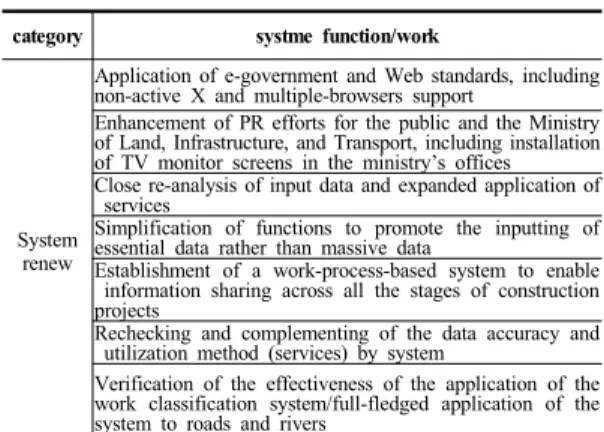
그러나, 전자정부 표준프레임워크, Non-ActiveX, 멀 티플렛폼 등 변화하는 정보환경에 맞게 시기적절한 시스 템 개편이 이루어지지 않아 정보서비스 질이 저하되고 있다. 또한, 건설 생애주기별로 발생되는 정보가 다음단 계에서 활용되고, 기획단계로 최종적으로 환류되는 선순 환체계가 미흡한 실정이다.
2.3 건설분야 내·외부 환경 요인 분석 본 연구는 건설사업관리시스템의 발전방향을 모색하 기 위하여 건설분야의 모바일, BIM, AR(Augmented Reality) 등 건설IT 정보화 동향분석자료를 근거로 Table 1과 같 이 건설분야 외부 환경을 조사하였으며, 건설사업관리시 스템의 운영 및 기능에 영향을 미치는 이슈사항들을 조 사하였다[11][13][14].
3. SWOT분석을 이용한 핵심성공요인 도출
Fig. 3과 같이 건설사업관리시스템의 핵심성공요인 (CSF:Critical Sucess Factor) 도출을 위해 SWOT 요인 을 분석하여 SO, ST, WO 및 WT를 마련하고, 13개의 CSF를 도출하였다.
강점 활용 CSF로는 사용자 맞춤형 정보서비스 개발, 건설사업관리 업무재분석을 통한 적용분야 확대 등이 있 으며, 약점 최소화 CSF는 ICT기술을 활용한 정보관리 다변화, 건설사업정보시스템의 성과지표/적용효과 재분 석 등이 있다.
그 결과, ‘건설사업정보 통합관리를 위한 건설사업정 보시스템 재개편’, ‘국가 건설사업정보 공유체계 구축’,
‘재해·재난·안전관리를 위한 ICT 기반의 건설사업정보·
시설물정보 관리체계 구축’, ‘건설분야의 BIM 기반 확 대 적용’ 등 4개의 핵심과제 추진방향을 수립하였다.
Area Content
Social
·Growing demand for the development of additional functions via Construction CALS when computerizing the works of the Ministry
·Growing demand for the development of a technology that is closely in line with people’s everyday living
·People growing tired of the deluge of information system initiatives by the Ministry
·ICT technologies such as wearable and mobile technologies being applied to people’s practical living
·Expanding application of ICT technologies to construction sites to ensure construction safety/disaster prevention
·Non-reflection in the system of the substantial part of the works at the time of the establishment of Construction CALS that has been changed
Technologic al
·Shifting demand from services for working-level staff to those for managers/decision-makers
·Eyeing the accomplishment of construction efficiency through the adoption of a cutting-edge technology with the advancement of the construction industry
·Rediscovery of the value of data in the wake of the arrival of an ultra-connected society
·Rapid growth of new ICT technologies such as IoT, cloud, big data, and mobile phones in the age of the data economy
·Emergence of a remote automation area with the rise of unmanned vehicles such as drones
·Growing demand for the application of the BIM environment to utilize BIM over the project life cycle in construction sites
·Increasement of information service systems utilizing spatial information such as GIS
Table 2. STEEP Analysis
Economic
·Growing awareness that the ROI in the Construction CALS project that lasted for over 16 years is less than satisfactory
·Falling additional costs required for storage and distribution thanks to the computerization of construction project data
·Minimization data exchange cost through the online standards in the work processing between the ordering agency and the competent authority
·Reduction social cost through the electronic documentation of construction project information
·Potential entry to the overseas market through packaged technology development in construction projects and in
the facility MOR sector
Environmen tal
·Growing demand for an SOC paradigm shift and for technology innovation to enhance the global competency of the construction industry
·Eco-friendly/energy-efficient/intelligent mega-structure dominant trends in the global construction industry
·Growing demand for a construction technology that integrates virtual construction, an intelligent construction technology, and the construction process
·Rapidly changing Internet environment due to the IE version-up by MS
·Growing demand for safety assurance in construction sites with the growing public safety awareness due to worrisome developments such as sinkholes
·Difficulty in providing systematic support due to the insufficient integrated management of the information stored by unit system
Political
·Urgent requirement of coming up with a development strategy to revitalize the construction economy amid the gloomy forecast about the country’s economic growth rate
·Growing demand for strategic investment through the anticipatory exploration of a future growth engine and a selection and focus strategy
·Growing demand for a compulsory institution to manage the construction project information
·Annually increasing R&D budget for ICT technology development and infrastructure establishment (from KRW1.004 trillion in 2014 to KRW1.0483 trillion in 2015)
·Strong will to construct an information system but less-than-satisfactory will for MRO and improvement
category systme function/work
System renew
Application of e-government and Web standards, including non-active X and multiple-browsers support
Enhancement of PR efforts for the public and the Ministry of Land, Infrastructure, and Transport, including installation of TV monitor screens in the ministry’s offices Close re-analysis of input data and expanded application of
services
Simplification of functions to promote the inputting of essential data rather than massive data
Establishment of a work-process-based system to enable information sharing across all the stages of construction projects
Rechecking and complementing of the data accuracy and utilization method (services) by system
Verification of the effectiveness of the application of the work classification system/full-fledged application of the system to roads and rivers
Table 3. Function/Work for Renewal of Construction
Project Management System
4. 비전 및 중점/세부 추진과제 수립
본 연구는 다음과 같은 절차에 따라 건설사업관리시 스템 개편을 위한 비전, 목표, 추진전략 및 추진과제를 도출하였다.
건설현장(설계,시공,건설사업관리단) 이해당사자, 발 주청 관계자, 건설사업관리시스템 개발자 등이 모여 중 점 및 세부추진과제를 도출하였다. 도출된 과제들은 IT 전문가, 건설현장 실무자, 건설정보 관계자 등 25명으로 구성된 실무팀을 중심으로 2달여 기간동안 3번의 반복 과정을 거치면서 과제별 중요도 분석 및 가중치를 정의 하고 과제내용 보완 및 연계성을 보완하였다. 또한, Table 2의 STEEP(Social,Technological,Economic, Environmental,Political) 분석 및 Table 3의 건설사업관 리시스템 문제점에 대한 개선사항을 도출하고 이를 토대 로 비전과 목표를 설정하였다.
Reorganization into a Korean-(Hangul)-based electronic document to enhance the use convenience
Integration of the Construction CALS operating environment by adopting a common DB management system of projects/work codes and agency codes Development of functions that would substitute for those of the ST developer
Enhancement of the visualization of CALS information by reflecting the latest IT trends, including GIS and mobile solutions
Establishment of a system capable of performing data input status check and data verification automatically Performance of the role of an integrated gateway, including SS0 for consolidated user management (consolidation of input channels)
Promotion of system utilization by linking with an accounting system (D-Brain)
Preparation of compulsory methods for activating system operation (inserting messages in other official notifications that encourage system utilization)
Introduction of a program certification system, such as a KOSCAD-to-KOSDIC conversion viewer
Anticipatory provision of service via Helpdesk
New Tech/
New Biz
Conduct of an advanced study for the application of the IoT or BIM technology and for the establishment of a safety management monitoring system
Exploration of new contents, such as cost reduction cases in construction projects, and expansion of their link with the civil information system
Improvement of the atypical document support function between ordering agencies and construction firms Provision of support for the decision-making process by referencing cost cases by project type in the past project planning
Improvement of the performance item management system in the pre-construction stage
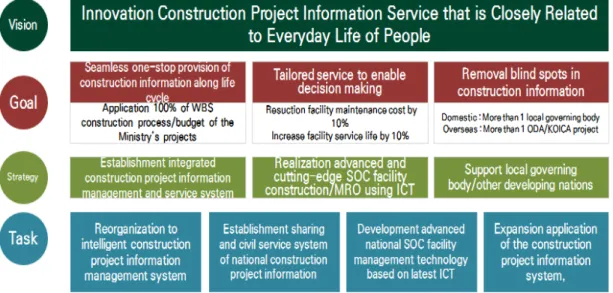
Fig. 4. Vision, Goal, Strategy, Task
본 연구에서는 Fig. 4와 같이 ‘국민생활 밀착형 서비 스로의 건설사업정보화 혁신’이라는 비전 아래, 3개의 목표를 설정하고 3개의 추진전략과 4개의 중점추진과제 를 수립하였다.
목표에는 ‘생애주기별 중단없는 건설정보의 원스톱
서비스’, ‘의사결정이 가능한 맞춤형 서비스’, ‘건설정보 사각지대 해소’ 등으로 설정하고, ‘건설사업정보 통합관 리 및 서비스체계 구축’, ‘ICT를 활용한 SOC 시설물 시 공/유지관리 고도화 및 첨단화’, ‘지자체/해외 개도국 지 원’ 등 3개의 추진전략을 수립하였다.
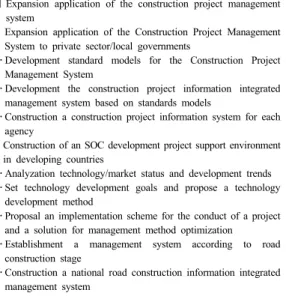
Table 4와 같이 4개의 중점추진과제별 세부 과제는 다음과 같다.
‘지능형 건설사업정보 관리체계 개편’ 부문은 다양한 정보환경에 활용가능한 Non-ActiveX 기반의 통합 건설 사업관리시스템을 재구축하며, 공간정보(GIS)를 적용하 여 시스템 고도화하기 위한 내용으로 구성하였다.
‘국가 건설사업정보 공유체계 구축 및 대국민 서비스’
부문은 건설 경쟁력 강화를 위한 다양한 국가자료 분석 및 정보 활용을 통해 빅 데이터 기반 통합 건설정보 서 비스 체계를 구축하고, 건설정보 표준화의 신규연구과제 를 발굴하기 위한 내용을 구성하였다.
‘최신ICT 기반의 국가 SOC 시설물관리 선진화 기술 개발’ 부문은 Infra 시설의 노후화 및 안전사고로 인한 인명사고 피해가 증가 추세에 있어 시설물의 수동형 유 지관리 체계를 자동화된 능동형 유지관리체계로 전환하 기 위해 IoT 기술을 활용한 스마트 Infra 관리 체계를 구 축하기 위한 내용으로 구성하였다.
‘건설사업관리시스템 확대 적용’ 부문은 국내·외 건설 사업 관련 기관에 건설사업관리시스템을 확대적용할 수 있는 체계를 마련하기 위한 내용으로 구성하였다.
■ Renovation the intelligent construction project information management system
- Establishment a consolidated database for a smooth flow of construction project information
․Renovation the system operation environment based on Web standards
․Construction the integrated Database ․Construction the integrated portal service
․Establishment general distribution and a sharing system for the construction technology information
- Establishment a spatial data-based construction project information service
․Establishment an information system plan
․Construction a spatial data-based construction project information service
․Establishment a GIS-based environment for the construction project management system
․Provision a GIS-based construction project information service
■ Establishment a national construction project information sharing system and providing a public service
- Open the construction project information service by using big data
․Establishment a big data utilization plan (ISP)
․Construction an integrated construction information service and perform a trial application
- Improvement standards and expand application cases to facilitate sharing of construction project information
․Expansion the development of construction information standards ․Development a design completion performance items
management system
․Development a construction information utilization system - Establishment an institutional base to strengthen the construction
project information service
․Preparation institutional support measures, including incentives to encourage construction project information system development ․Preparation a performance assessment system for construction
project information system development
․Preparation an institutional apparatus to activate the operation of a construction project information system
․Preparation an institutional support system to popularize and expand the system to the private sector or to overseas destinations
■ Developing technology for advanced SOC facility management based on latest ICT technology
- Develop smart SOC asset management technology
․Automation of IoT-based infrastructure diagnostic/
maintenance-repair equipment
․Development of self-repair technology for key national infrastructure and construction of a social safety infrastructure ․Develop system checks and a monitoring technology using IoT
technology
- Establishment of standards and policies for the safety assessment of infrastructure
․Establishment of a facility monitoring and maintenance anticipation system using IoT technology
․Pinpointing of a control target using GIS and IoT technology application
Table 4. Specific Task ■ Expansion application of the construction project management system
- Expansion application of the Construction Project Management System to private sector/local governments
․Development standard models for the Construction Project Management System
․Development the construction project information integrated management system based on standards models
․Construction a construction project information system for each agency
- Construction of an SOC development project support environment in developing countries
․Analyzation technology/market status and development trends ․Set technology development goals and propose a technology
development method
․Proposal an implementation scheme for the conduct of a project and a solution for management method optimization
․Establishment a management system according to road construction stage
․Construction a national road construction information integrated management system
5. 결론
건설사업관리시스템은 건설사업정보화 기본계획에 따라 기능 개발 및 개선을 수행해 왔으나, 급변하는 정보 환경의 변화와 건설IT 활용 증대로 인해 체계적인 계획 수립이 필요한 실정이었다.
이에 따라 건설사업관리시스템의 내·외부 환경요인을 조사 분석하였고, SWOT분석을 통한 핵심성공요인을 도 출하였다. 또한, 건설사업관리시스템의 비전과 중점 및 세부추진내용을 마련한 후 델파이방법을 통해 최종적으 로 4개 중점추진과제, 9개 세부추진과제를 제시하였다.
본 연구 결과물은 건설사업관리시스템이 통합 사업정 보서비스로 전환하는데 기초자료로 활용될 수 있다. 또 한, 건설분야의 정보시스템 운영 및 기능개선시 참고자 료로 활용되며, 매년 단위의 계획대비 실적을 파악함으 로서 보다 내실있는 건설사업관리시스템 개선 가이드로 활용될 수 있을 것이다.
향후, 통합 서비스, 공간정보 도입, 센서 네트워크 등 공사관리 및 유지관리업무 중심의 정보시스템 업무영역 을 확대하여 3차원 설계정보인 BIM 활용 등을 통한 도 면관리, 품질·안전, 보상, 인허가 등 건설사업 전반에 걸 쳐 정보시스템 적용을 위한 지속적인 노력이 필요할 것 이다.
References
[1] KICT, 15 Operation and Technical Improvement of Construction CALS System(
Ⅰ
), 2015.[2] Ministry of Land, Infrastructure and Transport, 1st CALS/EC Master Plan, 1998.
[3] Ministry of Land, Infrastructure and Transport, 2nd CALS/EC Master Plan, 2003.
[4] Ministry of Land, Infrastructure and Transport, 3rd CALS Master Plan, 2007.
[5] Ministry of Land, Infrastructure and Transport, 4th CALS Master Plan, 2012.
[6] Ministry of Science, ICT and Future Planning, ICT R&D long-term strategy(2013-2017), 2013.
[7] Ministry of Science, ICT and Future Planning, Future Issue&Analysis Report, 2015.
[8] Ministry of Land, Infrastructure and Transport, Land·Infrastructure·Transport R&D long-term strategy, 2014.
[9] DongHyun Ryu, JeongYoung Park, WooJin Lee,
“Scenario based Information Technology Future Strategy approach to Engineering”, The Korea Institute of Information and Communication Engineering vol. 14, no. 10, 2010.
DOI: http://dx.doi.org/10.6109/jkiice.2010.14.10.2171 [10] YouJin Kim, ByungSun Cho, “Analysis on the Types of
Future Keywords and IT Needs by Industry”, The Korea Contents Society vol. 12, no. 6, 2012.
DOI: http://dx.doi.org/10.5392/JKCA.2012.12.06.100 [11] HwangSoo Jeon, “Construction IT Fusion Technology
Trends”, IT SOC magazine vol. 26, no. 9, 2008.
[12] Hyun Ok, “Research on the Application of GIS-based Measures in the Advancement of the Construction Project Information System”, Smart media journal vol. 4, no. 4, pp. 70-79, 2015.
[13] JinUk Kim, “4th CALS Master Plan”, the Korea Institute of Construction Engineering and Management vol. 14, no. 1, 2013.
[14] OhSeong Kwon, “A Study on the Improvement of the Defect Management Process on Construction Site based on Image-matching and Mobile AR”, ChungAng Univ.
Master’s Thesis, 2013.
김 성 진(Seong-Jin Kim) [정회원]
•1995년 2월 : 계명대학교 산업공학 과(학사)
•2001년 2월 : 계명대학교 산업공학 과(석사)
•2001년 4월 ~ 현재 : 한국건설기 술연구원 수석연구원
<관심분야>
건설사업관리, PMIS, 전자문서표준, 건설정보화
옥 현(Hyun Ok) [정회원]
•1997년 2월 : 광주대학교 건축공학 과 (학사)
•2000년 2월 : 동국대학교 건축공학 과 (석사)
•2000년 4월 ~ 현재 : 한국건설기 술연구원 수석연구원
<관심분야>
건설정보 및 표준, 사후평가, 설계VE
![Fig. 1. CALS Master Plans[2][3][4][5]](https://thumb-ap.123doks.com/thumbv2/123dokinfo/5376811.201515/2.799.97.708.668.977/fig-cals-master-plans.webp)
![Fig. 2. Concept of CALS Systems[12] 사회의 주요이슈를 분석하여 향후 10년내 활용가능한 핵심기술로서, 인공지능, 사물인터넷 등을 제시하였다[7]](https://thumb-ap.123doks.com/thumbv2/123dokinfo/5376811.201515/3.799.110.693.580.976/사회의-주요이슈를-분석하여-활용가능한-핵심기술로서-인공지능-사물인터넷-제시하였다.webp)
![Fig. 3. Main implementation directions based on SWOT/CSF공사의 기획, 설계, 시공단계에서 건설업체와 발주기관 간 발생하는 문서와 공사정보, 공정정보, 기성정보 등을 관리하는 시스템으로서, 국토교통부의 도로·하천 SOC건설공사 현장에서 사용하고 있다[10].그러나, 전자정부 표준프레임워크, Non-ActiveX, 멀티플렛폼 등 변화하는 정보환경에 맞게 시기적절한 시스](https://thumb-ap.123doks.com/thumbv2/123dokinfo/5376811.201515/4.799.95.708.531.968/시공단계에서-건설업체와-시스템으로서-국토교통부의-soc건설공사-표준프레임워크-멀티플렛폼-정보환경에.webp)