Validation of the MAGGIC (Meta-Analysis
Global Group in Chronic Heart Failure) heart
failure risk score and the effect of adding
natriuretic peptide for predicting mortality
after discharge in hospitalized patients with
heart failure
Sayma Sabrina Khanam1☯, Eunhee ChoiID2☯, Jung-Woo Son1, Jun-Won Lee1, Young
Jin YounID1, Junghan Yoon1, Seung-Hwan Lee1, Jang-Young Kim1, Sung Gyun AhnID1, Min-Soo Ahn1, Seok-Min Kang3, Sang Hong BaekID4, Eun-Seok Jeon5, Jae-Joong Kim6,
Myeong-Chan ChoID7, Shung Chull Chae8, Byung-Hee Oh9, Dong-Ju Choi10, Byung-Su YooID1
*
1 Department of Cardiology, Wonju College of Medicine, Yonsei University, Wonju, Republic of Korea, 2 Smith Center for Outcomes Research in Cardiology, Beth Israel Deaconess Medical Center, Harvard Medical School, Boston, MA, United States of America, 3 Yonsei University College of Medicine, Seoul, Korea, 4 The Catholic University of Korea, Seoul, Korea, 5 Sungkyunkwan University College of Medicine, Seoul, Korea, 6 University of Ulsan College of Medicine, Seoul, Korea, 7 Chungbuk National University College of Medicine, Cheongju, Korea, 8 Kyungpook National University College of Medicine, Daegu, Korea, 9 Department of Internal Medicine, Seoul National University Hospital, Seoul, Korea, 10 Seoul National University Bundang Hospital, Seongnam, Korea
☯These authors contributed equally to this work.
Abstract
Background
In clinical practice, a risk prediction model is an effective solitary program to predict progno-sis in particular patient groups. B-type natriuretic peptide (BNP)and N-terminal pro-b-type natriuretic peptide (NT-proBNP) are widely recognized outcome-predicting factors for patients with heart failure (HF).This study derived external validation of a risk score to pre-dict 1-year mortality after discharge in hospitalized patients with HF using the Meta-analysis Global Group in Chronic Heart Failure (MAGGIC)program data. We also assessed the effect of adding BNP or NT-proBNP to this risk score model in a Korean HF registry population.
Method and results
We included 5625 patients from the Korean acute heart failure registry (KorAHF) and excluded those who died in hospital. The MAGGIC constructed a risk score to predict mor-tality in patients with HF by using 13 routinely available patient characteristics (age, gender, diabetes, chronic obstructive pulmonary disorder (COPD), HF diagnosed within the last 18 a1111111111 a1111111111 a1111111111 a1111111111 a1111111111 OPEN ACCESS
Citation: Khanam SS, Choi E, Son J-W, Lee J-W,
Youn YJ, Yoon J, et al. (2018) Validation of the MAGGIC (Meta-Analysis Global Group in Chronic Heart Failure) heart failure risk score and the effect of adding natriuretic peptide for predicting mortality after discharge in hospitalized patients with heart failure. PLoS ONE 13(11): e0206380.
https://doi.org/10.1371/journal.pone.0206380 Editor: Pablo Garcia de Frutos, Institut
d’Investigacions Biomediques de Barcelona, SPAIN
Received: March 14, 2018 Accepted: October 11, 2018 Published: November 28, 2018
Copyright:© 2018 Khanam et al. This is an open access article distributed under the terms of the
Creative Commons Attribution License, which permits unrestricted use, distribution, and reproduction in any medium, provided the original author and source are credited.
Data Availability Statement: The data used in this
study have been restricted by various institutional Internal Review Boards and Ethics Committees in order to protect patient privacy. The authors of this study accessed this data by submitting their study proposals to these bodies. Other researchers could potentially request access to the data as well. These IRBs and Committees may be contacted using the following information: Wonju College of Medicine, Yonsei University, Wonju, Republic of
months, current smoker, NYHA class, use of beta blocker, ACEI or ARB, body mass index, systolic blood pressure, creatinine, and EF). We added BNP or NT-proBNP, which are the most important biomarkers, to the MAGGIC risk scoring system in patients with HF. The out-come measure was 1-year mortality. In multivariable analysis, BNP or NT-proBNP indepen-dently predicted death. The risk score was significantly varied between alive and dead groups (30.61±6.32 vs. 24.80±6.81, p<0.001). After the conjoint use of BNP or NT-proBNP and MAGGIC risk score in patients with HF, a significant difference in risk score was noted (31.23±6.46 vs. 25.25±6.96, p<0.001).The discrimination abilities of the risk score model with and without biomarker showed minimal improvement (C index of 0.734 for MAGGIC risk score and 0.736 for MAGGIC risk score plus BNP or NT-proBNP, p = 0.0502) and the calibration was found good. However, we achieved a significant improvement in net reclassification and integrated discrimination for mortality (NRI of 33.4%,p<0.0001 and IDI of 0.002, p<0.0001).
Conclusion
In the KorAHF, the MAGGIC project HF risk score performed well in a large nationwide con-temporary external validation cohort. Furthermore, the addition of BNP or NT-proBNPto the MAGGIC risk score was beneficial in predicting more death in hospitalized patients with HF.
Introduction
Heart failure (HF) imposes a great health problem worldwide. The associated risks of HF are particularly vulnerable in countries with aging populations where diagnosis, treatment, and
prevention of re-hospitalization are difficult [1]. Hospitalized patients with HF have poor
prognosis, but re-hospitalization rates are increasingly, consequently elevating the in-hospital and post-discharge mortality rates. The prognosis of HF remains poor, and repeated
hospitali-zation exerts a huge cost on national health care budgets and threatens quality of life[2–5].
Therefore, taking urgent measures to predict a patient’s clinical course as early as possible is necessary by selecting evidence-based management strategies to improve care of patients with
HF. To date, risk stratification in these patients is a challenge [6].
Risk prediction models are frequently used to triage patients and ease treatment decisions, helping physicians estimate prognosis in a more neutral manner and interpret the
conse-quence of prognosis studies[7,8].Among all the datasets, the most eminently prognostic
infor-mation could facilitate appropriate implication of monitoring and treatment that improves the
standard of nursing and outcomes of hospitalized patients with HF[7]. Several predictors are
applied in a prediction model to assess the risk of occurrence of a specified event (death,
re-hospitalization) in the future[9].
Recently, the Meta-analysis Global Group in Chronic Heart Failure (MAGGIC) has per-formed a literature-based meta-analysis by collecting each patient data from 30studies includ-ing six randomized clinical trials. These data consist of important prognostic variables, such as demographics, medical history, medical treatment, symptom status, clinical variables,
labora-tory variables, and outcome[10,11]. Hence, a risk score was established to predict mortality in
patients with HF from 13 regularly available patient characteristics at a baseline level, and an
easily accessible online calculator was made available (www.heartfailurerisk.org).Tracing risk
stratification depicts a prospective outcome and is beneficial for patients with advanced HF
Korea (http://165.132.228.106/newhome/index_e. html)([email protected]). Yonsei University College of Medicine, Seoul, Korea (https://medicine. catholic.ac.kr/eng/index.jsp)([email protected]). The Catholic University of Korea, Seoul, Korea (https:// medicine.catholic.ac.kr/eng/index.jsp)
([email protected]). Sungkyunkwan University College of Medicine, Seoul, Korea (http://www.skkumed.ac.kr/eng/index.asp) ([email protected]). University of Ulsan College of Medicine, Seoul, Korea (http://www. medulsan.ac.kr/)([email protected]). Chungbuk National University College of Medicine, Cheongju, Korea (http://medweb.chungbuk.ac.kr/www/ english/index.html)([email protected]). Kyungpook National University College of Medicine, Daegu, Korea (http://med.knu.ac.kr/eng/) ([email protected]). Department of Internal Medicine, Seoul National University Hospital, Seoul, Korea (https://www.snubh.org/dh/en/) ([email protected]).
Funding: This work was supported by Research of
Korea Centers for Disease Control and Prevention [2010-E63003-00, 2011-E63002-00, 2012-E63005-00, 2013-E63003-00, 2013-E63003-01, 2013-E63003-02, and 2016-ER6303-00]. The funders had no role in study design, data collection and analysis, decision to publish, or preparation of the manuscript."
Competing interests: The authors have declared
(AHF) of multiple etiologies. Meanwhile, risk modeling serves as a comprehensive and conducive assessment for clinicians and plays a facilitating role to patients and health service provider to
achieve better recognition of likely outcomes[12].MAGGIC also provides an advantage for
deter-mining numerous individual risk factors, such as serum sodium, gender, and survival of patients
with HF with preserved or reduced LVEF[13–15].However, B-type natriuretic peptide(BNP), a
widely recognized outcome-predicting factor for patients with HF, has not been included in a risk
prediction model, as it was only available in less than 25% of the enrolled patients[16,17].BNP
and N-terminal pro-b-type natriuretic peptide (NT-proBNP) are valuable prognostic predictors
for grading severities and predicting mortality risk in patients with HF[18,19]. Measurement of
serum BNP is essential in guiding decision-making process and predicting patient status, as well
as in establishing therapeutic strategies[20–22]. Thus, considering a major risk factor in a risk
scoring system is necessary to predict important outcome. Although BNP and NT-pro BNP are of accurate prognosis-predictive ability for hospitalized patients with HF, other clinical factors may
also play pivotal roles in affecting outcomes [23].
An established, simple, cost-effective model with the highest accuracy, which consists of
selective number of predictors, is significant for use in other populations[8]. MAGGIC risk
score in HF was previously conducted and validated in a Swedish population, and an excellent
discrimination was obtained [9]. Nevertheless, the real-world performance of prediction
mod-els for new patient populations and original advancing target populations including Asians is
not consistent[24]. Therefore, in this study, we aimed to derive and externally validate a risk
score to predict 1-year mortality after discharge in hospitalized patients with HF using the MAGGIC program data. We also assessed the effect of adding BNP or NT-proBNP to this risk score model in a Korean heart failure registry population.
Methods
Study population
The Korean Acute Heart Failure (KorAHF) registry is a prospective multicenter cohort study designed to measure the outcomes of Korean patients admitted for HF. The registry data consist
of patient demographics, clinical characteristics, and evidence-based treatments[3,25]. Patients
who had signs or symptoms of HF and met one of the following criteria were eligible for this study: (1) lung congestion or (2) objective findings of left ventricular systolic dysfunction or struc-tural heart disease. Patients hospitalized for AHF from 10 tertiary university hospitals throughout the country were consecutively enrolled from March 2011 to February 2014. The patients were planned to be followed up until 2018. Data were collected by each site and entered into a web-based case-report form in the Clinical Data Management System from the Korea National Insti-tute of Health. Information about patient demographics, medical history, signs, symptoms, results of laboratory tests, electrocardiogram, echocardiography, medications, hospital course, and out-comes was collected at admission, discharge, and follow-up (30days, 90days, 180days, 1to 5years annually).Written informed consent was obtained from each patient. If patients were unable to give consent due to disease severity, informed consent was obtained from a relative or legal repre-sentative. In-hospital mortality and the mode of death have been adjudicated by an independent event committee. The mortality data for patients lost to follow-up were collected from the national insurance data or national death records. The study protocol was approved by the ethics commit-tee/institutional review board (IRB) at each hospital.
Measurement of BNP or NT-proBNP
Plasma BNP or NT-proBNP levels were measured at admission for acute HF. Blood sampling and tests were conducted as routine practice by laboratories at each center certified by the
Korean Association of Quality Assurance for Clinical Laboratories[26]. Measurement of NT-proBNP was performed with the electro-chemiluminescence immunoassay method using an Elecsys 2010 analyzer (Roche Diagnostics) or NT-proBNP assay for Dimension platform, Sie-mens Medical Solutions Diagnostics. Plasma was tested for BNP using the Biosite Triage assay, a point-of-care device that uses a fluorescence immunoassay technique (Biosite, San Diego,
CA, USA)[27].
Statistical analysis
Descriptive statistics are used to summarize demographic and clinical characteristics, clinical care during hospitalization, and outcomes of the patients. Continuous variables are presented
as mean± standard deviation (SD) and were analyzed with Student’s t-test to demonstrate the
statistical significance of the difference between two groups. Categorical variables are pre-sented as frequency (percentage) and were analyzed with Chi-square test. The logistic regres-sion model was applied to verify predictors of all cause mortality. Score discrimination and
calibration were evaluated by the c statistic and Hosmer-Lemeshow statistic [9,11]. To test the
incremental prognostic utility of B-type natriuretic peptide level (BNP) or N-terminal pro-B-type natriuretic peptide (NT-proBNP), we used the AUC comparison as DeLoog, net reclassifi-cation index (NRI) and integrated discrimination improvement (IDI). P-value less than 0.05 were considered statistically significant. All analyses were performed using SAS statistical soft-ware (version 9.4; SAS Institute Inc., Cary, NC).
Results
Demographic characteristics and clinical profiles
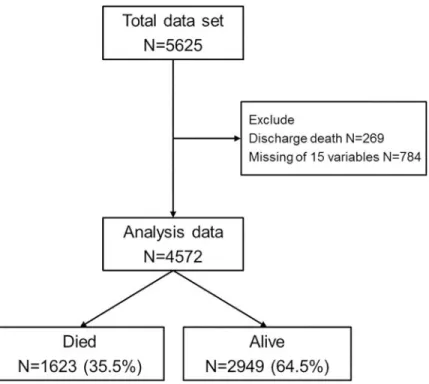
We enrolled 5,625 AHF subjects from 10 tertiary university hospitals in Korea. We excluded 269 patients who died in hospital, 784 patients with missing patient characteristics, and patients without death information. Finally, we analyzed 4572 patients including 1623 (35.5%)
dead and 2949 (64.5%) alive (Fig 1).
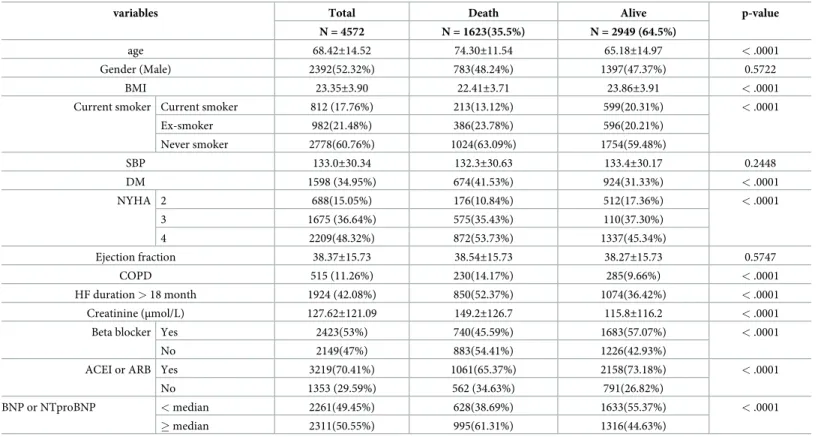
Descriptive statistics for patients who are still alive and patients who died during follow-up are
summarized inTable 1.The mean age was68.42±14.52 years, and 2392(52.32%)were men. The
overall 1-year mortality in the study population was 17.58%. Among the 13 variables, age, creati-nine (Cr), smoker and diabetes (41.53%),COPD(14.17%), HF duration > 18 month (52.37%) and NYHA 4(53.73%) as well as not taking medications (ACEI or ARB and beta blocker) were signifi-cantly higher in patients who died during follow-up compared with those who are alive. Addition-ally, body mass index (BMI)was almost similar between the 2 groups. However, male gender, systolic blood pressure (BP), and ejection fraction did not differ significantly between the two groups. High plasma BNP(>887.9) or NT-proBNP (>4751.05) according to the median value was significantly higher in the mortality group (61.31% vs 44.63%, p<0.0001), whereas low BNP or NT-proBNP was higher in the alive group (38.69% vs 55.37%, p<0.0001).
Predictors of mortality
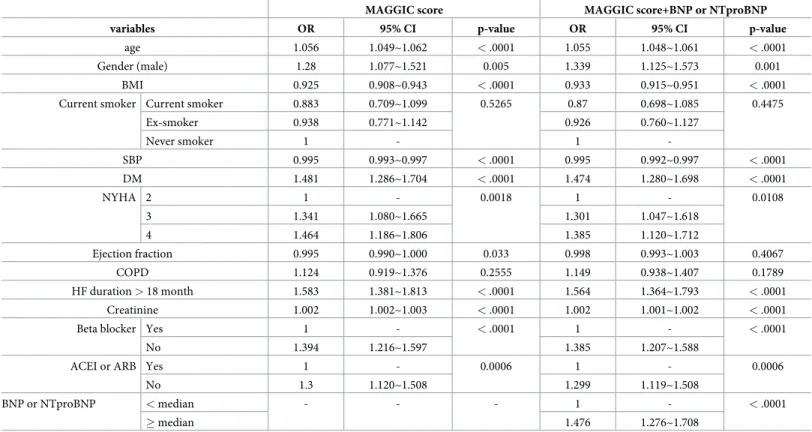
In multivariable analysis, 11 variable included in the MAGGIC score were associated with mortality. However, when BNP or NT-pro-BNP were associated with MAGGIC. ejection
frac-tion could not predict mortality (Table 2).Here 11variables(age, male sex, BMI,SBP, diabetes,
HF duration > 18 months, NYHA(2–4),Cr, ACEI or ARB, and beta blocker, along with high
BNP or NT-proBNP) were independent predictors in multivariable analysis(Table 2).
How-ever, smoker and COPD were non-significantly associated with mortality in both groups. The
24.80± 6.81, p<0.001). After the conjoint use of BNP or NT-proBNP and MAGGIC risk score
in patients with HF, the risk score was also significantly different (31.23± 6.46 vs. 25.25 ± 6.96,
p<0.001) (Table 3).There were strongly significantly difference between them [0.61
(0.59~0.64) for death group and 0.45 (0.43~0.47) for alive group].
Validation of the risk score models
In this study, we selected 13 predictor variables from the multivariable model to formulate a risk score. Good discrimination abilities were found,with a C-indexof 0.734 from the risk score model to predict 1-year mortality. Hosmer-Lemeshow goodness of fit test for risk score mortality indicated a good calibration (p = 0.5559) by plotting predicted versus observed
mor-tality using 10 groups (Fig 2). Additionally, the predicted mortality rates corresponded with
the observed mortality rates in each decile.
Effect of adding natriuretic peptide
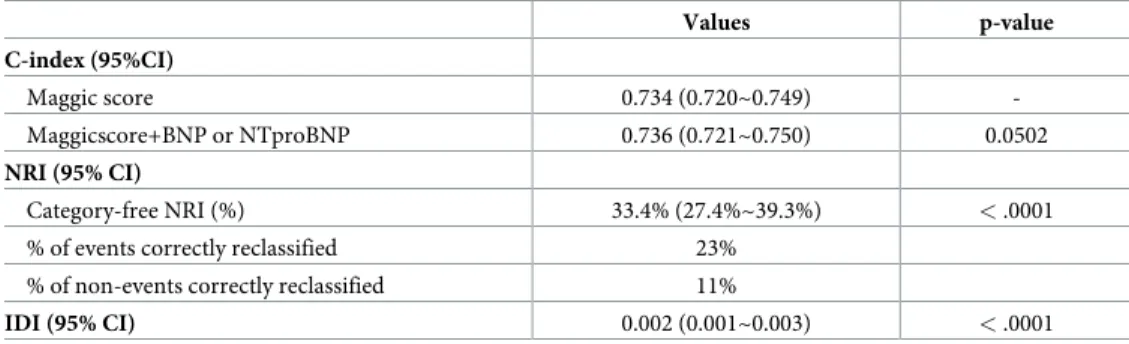
The addition of BNP or NT-proBNP to the MAGGIC risk score using the 13 variables resulted in minimal improvement(C index of 0.734 for MAGGIC risk score and 0.736 for MAGGIC risk score plus BNP or NT-proBNP, p = 0.0502).However, we achieved a significant improvement in net reclassification and integrated discrimination for mortality (NRI of 33.4%,p <0.0001 and IDI of 0.002, p <0.0001) (Table 4).
Discussion
This study demonstrates the performance of the MAGGIC project HF risk score using 13 vari-ables by external validation to predict 1-year mortality after discharge in Korean hospitalized
Fig 1. Selection of the study population. This study enrolled 5625 patients. We excluded 269patients who died in
hospital, 784 patients with missing patient characteristics, and patients without death information. Finally, we analyzed 4572 patients including 1623 (35.5%) dead and 2949 (64.5%) alive.
patients with HF. We found that the discrimination and calibration were good for the MAG-GIC risk score. This risk score is useful to predict mortality after discharge for hospitalized patients with HF. Furthermore, the addition of BNP or NT-proBNP to the MAGGIC risk score showed significant improvement in risk reclassification of patients and minimal improvement in discrimination ability.
HF is a complex and fatal medical condition that progresses rapidly with escalating aging population and causes considerable morbidity, mortality, and re-hospitalization, resulting in a
tremendous burden on the global healthcare system [28–30]. Physicians always need to
deter-mine the best therapy for high-risk patients and make estimation of risk in patients by
inte-grating patient characteristics, clinical signs, and laboratory tests[8].Prediction is naturally
inconsistent. Although a physician assigns a relative weight to each variable, which relies on his previous experiences, personal beliefs, clinical judgment, as well as current mood, it could be inaccurate and ambiguous. To determine an individual’s cardiac mortality risk score in daily clinical practice, adding points assigned for predictors that exist in a patient is only required. For this reason, the MAGGIC risk score is beneficial for busy clinicians and nurses. Using the 13 available baseline variables, including age, EF, NYHA class, serum Cr, diabetes, systolic BP, BMI, HF duration, current smoker, COPD, male gender, evidence-based medica-tion beta blocker, and ACE inhibitor or ARBs, can construct the risk score and identify the risks of hospitalized patients easily at low cost. In this MAGGIC score, each variable was inde-pendently associated with mortality, except COPD and smoker.
Table 1. Descriptive statistics for baseline variables.
variables Total Death Alive p-value
N = 4572 N = 1623(35.5%) N = 2949 (64.5%)
age 68.42±14.52 74.30±11.54 65.18±14.97 < .0001
Gender (Male) 2392(52.32%) 783(48.24%) 1397(47.37%) 0.5722
BMI 23.35±3.90 22.41±3.71 23.86±3.91 < .0001
Current smoker Current smoker 812 (17.76%) 213(13.12%) 599(20.31%) < .0001
Ex-smoker 982(21.48%) 386(23.78%) 596(20.21%) Never smoker 2778(60.76%) 1024(63.09%) 1754(59.48%) SBP 133.0±30.34 132.3±30.63 133.4±30.17 0.2448 DM 1598 (34.95%) 674(41.53%) 924(31.33%) < .0001 NYHA 2 688(15.05%) 176(10.84%) 512(17.36%) < .0001 3 1675 (36.64%) 575(35.43%) 110(37.30%) 4 2209(48.32%) 872(53.73%) 1337(45.34%) Ejection fraction 38.37±15.73 38.54±15.73 38.27±15.73 0.5747 COPD 515 (11.26%) 230(14.17%) 285(9.66%) < .0001 HF duration > 18 month 1924 (42.08%) 850(52.37%) 1074(36.42%) < .0001 Creatinine (μmol/L) 127.62±121.09 149.2±126.7 115.8±116.2 < .0001
Beta blocker Yes 2423(53%) 740(45.59%) 1683(57.07%) < .0001
No 2149(47%) 883(54.41%) 1226(42.93%)
ACEI or ARB Yes 3219(70.41%) 1061(65.37%) 2158(73.18%) < .0001
No 1353 (29.59%) 562 (34.63%) 791(26.82%)
BNP or NTproBNP < median 2261(49.45%) 628(38.69%) 1633(55.37%) < .0001
� median 2311(50.55%) 995(61.31%) 1316(44.63%)
Values are expressed as mean±standard deviation or n (%). BMI, body mass index; DM, diabetes mellitus; HTN, hypertension; HF, heart failure; COPD, chronic obstructive pulmonary disease; SBP, systolic blood pressure; EF, ejection fraction; creatinine;New York Heart Association (NYHA) BNP, brain natriuretic peptide. Angiotensin converting enzyme inhibitors (ACE inhibitors)angiotensin receptor blocker(ARB)
Several risk stratification models that are used to predict mortality in hospitalized patients with HF have limitations. For example, the Seattle Heart Failure Model and the CHARM-model use not readily available variables. The former requires lymphocyte count, uric acid, and total cholesterol, and the latter requires atrial fibrillation, cardiomegaly, and pulmonary edema. Meanwhile, in the HF-ACTION predictive risk score model, inclusion of exercise duration on the baseline cardiopulmonary exercise test and serum urea nitrogen, which
require difficult estimations, is necessary[31–33].Moreover, in assessing long-term mortality,
other predictive models are used, but included participants from clinical trials. The models also rely on not readily available variables in clinical care, such as peak exercise oxygen con-sumption for the Heart Failure Survival Score model; and hemoglobin, GGT, eGFR, 12-lead ECG, and 24-h Holter monitoring variables including non-sustained VT and frequent VPBs,
Table 2. Multivariate analysis using variables included in the MAGGIC score.
MAGGIC score MAGGIC score+BNP or NTproBNP
variables OR 95% CI p-value OR 95% CI p-value
age 1.056 1.049~1.062 < .0001 1.055 1.048~1.061 < .0001
Gender (male) 1.28 1.077~1.521 0.005 1.339 1.125~1.573 0.001
BMI 0.925 0.908~0.943 < .0001 0.933 0.915~0.951 < .0001
Current smoker Current smoker 0.883 0.709~1.099 0.5265 0.87 0.698~1.085 0.4475
Ex-smoker 0.938 0.771~1.142 0.926 0.760~1.127 Never smoker 1 - 1 -SBP 0.995 0.993~0.997 < .0001 0.995 0.992~0.997 < .0001 DM 1.481 1.286~1.704 < .0001 1.474 1.280~1.698 < .0001 NYHA 2 1 - 0.0018 1 - 0.0108 3 1.341 1.080~1.665 1.301 1.047~1.618 4 1.464 1.186~1.806 1.385 1.120~1.712 Ejection fraction 0.995 0.990~1.000 0.033 0.998 0.993~1.003 0.4067 COPD 1.124 0.919~1.376 0.2555 1.149 0.938~1.407 0.1789 HF duration > 18 month 1.583 1.381~1.813 < .0001 1.564 1.364~1.793 < .0001 Creatinine 1.002 1.002~1.003 < .0001 1.002 1.001~1.002 < .0001
Beta blocker Yes 1 - < .0001 1 - < .0001
No 1.394 1.216~1.597 1.385 1.207~1.588
ACEI or ARB Yes 1 - 0.0006 1 - 0.0006
No 1.3 1.120~1.508 1.299 1.119~1.508
BNP or NTproBNP < median - - - 1 - < .0001
� median 1.476 1.276~1.708
Values are expressed as mean±standard deviation or n (%). BMI, body mass index; DM, diabetes mellitus; HTN, hypertension; HF, heart failure; COPD, chronic obstructive pulmonary disease; SBP, systolic blood pressure; EF, ejection fraction; creatinine;New York Heart Association (NYHA) BNP, brain natriuretic peptide. Angiotensin converting enzyme inhibitors (ACE inhibitors)angiotensin receptor blocker (ARB)
https://doi.org/10.1371/journal.pone.0206380.t002
Table 3. Risk score according to death.
Death Alive p-value
N = 1623 (35.5%) N = 2949 (64.5%) Maggic score 30.61± 6.32 24.80± 6.81 < .0001 Maggicscore+BNP or NTproBNP 31.23± 6.46 25.25± 6.96 < .0001 Difference (95%CI) 0.61 (0.59~0.64) 0.45 (0.43~0.47) < .0001 Withinp-value < .0001 < .0001 https://doi.org/10.1371/journal.pone.0206380.t003
for the MUSIC risk score model[34,35]. Although these predictive models are informative and important for research purposes, their drawbacks limit their use in daily clinical practice. By contrast, the MAGGIC project HF risk score has several advantages and is superior to other HF mortality risk models. Itis targeted for a great number of population-based patients with manifold demographic characteristics regardless of LV systolic function and can be used for nationwide contemporary external validation cohort. Thus, this model is extensively pertinent and appealing as it contains nearly a modest number of variables regularly collected during
admission[9]. MAGGIC risk score can be calculated by entering admission data into an online
risk calculator (www.heartfailurerisk.org).This calculator can estimate1-year all-cause
mortal-ity for patients with HF. It is not only easily understandable and beneficial to physicians, but
also helpful for patients and relatives[11].
The MAGGIC projectincluded39,372 patients from 30 studies. Of these studies, 6 were ran-domized controlled trials (24,041 patients) and the remaining 24 were registries (15,331 patients).Approximately 40% of patients died during a median follow-up of 2.5 years.The six
largest studiescontributed76% of patients and 76% of deaths [11]. Recently, another study
per-formed the MAGGIC risk score in a Swedish population and found excellent discrimination. However, good calibration was not found as moderate increase in low-risk patients and
depre-ciation of high-risk patients accounted for the 3-year mortality risk[9]. In this present study,
we observed good discrimination and calibration for MAGGIC risk score in hospitalized patients with HF derived from the KorAHF after discharge. Discharge is often the first step of
Fig 2. Observed vs.Model-predicted 1-year mortality in risk groups: Hosmer-Lemeshow goodness of fit test for risk score mortality indicated a good calibration (p = 0.5559), the predicted mortality rates corresponded with the observed mortality rates in each decile.
https://doi.org/10.1371/journal.pone.0206380.g002
Table 4. Net reclassification improvement (NRI) and integrated discrimination improvement (IDI) for specific models using the BNP.
Values p-value C-index (95%CI) Maggic score 0.734 (0.720~0.749) -Maggicscore+BNP or NTproBNP 0.736 (0.721~0.750) 0.0502 NRI (95% CI) Category-free NRI (%) 33.4% (27.4%~39.3%) < .0001
% of events correctly reclassified 23%
% of non-events correctly reclassified 11%
IDI (95% CI) 0.002 (0.001~0.003) < .0001 https://doi.org/10.1371/journal.pone.0206380.t004
treatment progress and initial assessment for prediction of prognosis. We adopted the risk score to patients with HF after discharge from hospital.
This study is the first to use the MAGGIC risk score of patients with HFin a population in Korea, which is part of East Asia. Some differences exist in the baseline clinical characteristics
and co-morbidity between Western and East Asian countries[36].Several studies reported that
the analytical histories of IHD and hypertension in Koreawere45.4% and 43.6%, respectively,
which were considerably lower than in the high-income Western nations[37]. On the contrary,
the prevalence of hypertension as a co-morbidity of patients with HF is widely varied (39.2% to 77.6%) in Japan than in other studies, such as in the Acute Decompensated Heart Failure Syndromes registry (71%),the Organized Program to Initiate Lifesaving Treatment in
Hospi-talized Patients with Heart Failure (71%),and the Euro-Heart Failure Survey II (63%)[38–41].
Although the prevalence of HF is lower in Korea (1.53%) compared with that in the USA (2.2%) or other Western and European nations, the increase in aging population and adoption of a Western life style promote the growth of HF prevalence in East Asian countries, including
Korea, China, and Japan[37,42].With gender consideration, male is the most classic
demo-graphic risk factor for the development of HF, along with older age, ethnicity, and low
socio-economic state, in East Asia [43].The prevalence of overweight/obesity is much lower(21.6–
26.2%) in Southeast Asia than in the UK (66.7%) and USA (69.6%). However, the recent preva-lence of blood glucose/diabetes as a notable risk factor is higher in Asian countries than in the
UK and USA[44].During the follow-up period, the clinical effect of evidenced-based
medica-tion between Western and Asian countries was also different[45]. Therefore, establishment of
MAGGIC HF risk score model is not only important for Korean population but also for other Asian countries.
BNP and NT-proBNP are the most powerful prognostic factors; they are expected to serve as an important basis for diagnosis and play a crucial role in therapeutic decision-making
pro-cess[22]. High plasma BNP or NT-proBNP at admission predicts greater risk of outcomes in
hospitalized patients with HF[22,46]. On the contrary, we added BNP or NT-proBNP to the
MAGGIC risk score and found minimal improvement in discrimination (C index of 0.734 for MAGGIC risk score and 0.736 for MAGGIC risk score plus BNP or NT-proBNP, p = 0.0502). In multivariable analysis, we observed that high natriuretic peptide level was significantly asso-ciated with mortality. Furthermore, when we used new statistical analysis methods (NRI and IDI indices), BNP or NT-proBNP (NRI of 33.4%, p <0.0001 and IDI of 0.002, p <0.0001) showed the greatest increase in discrimination and net reclassification for mortality. Based on this study, we suggest that the validated risk score is readily generalizable, and the addition of BNP or NT-proBNPto the MAGGIC risk score was beneficial in predicting more death. There-fore, a quick and cost-effective important indicator is established to anticipate adverse events in patients with HF. This indicator supports the performing cardiologist and referring clini-cian to take direct care and improve communication with patients with HF about their prog-nosis[46].
Study limitations
This cohort study has several limitations. First, its design had several inherent limitations including selection bias and missing values. Second, we did not use MAGGIC risk score in-hospital patients with unstable health condition during admission. Thus, we excluded pital mortality, and analysis was considered after discharge of patients. Third, although in-hos-pital mortality and post-discharge mortality were confirmed by an independent event
committee, causes of post-discharge mortality are unknown. We could not differentiate car-diovascular mortality and causes of re-hospitalization, which were not validated. Fourth, we
did not perform the specific categories of BNP or NTproBNP levels to be widely used as a prognostic score. We could not also validate and compare MAGGIC risk score with other risk score such as 3C-HF score which is widely used to predict 1-year mortality using routinely available predictors. Finally, we evaluated short-term mortality (1-year mortality), and the bio-marker natriuretic peptide(BNP or NT-proBNP)was only used in this risk score. The measure-ment time and median value of BNP and NT-proBNP were different.
Conclusions
In the KorAHF, the MAGGIC project HF risk score performed well in a large nationwide con-temporary external validation cohort. Furthermore, addition of BNP or NT-proBNPto the MAGGIC risk score was beneficial in predicting more death in hospitalized patients with HF.
Author Contributions
Conceptualization: Myeong-Chan Cho, Byung-Su Yoo.
Data curation: Jung-Woo Son, Jun-Won Lee, Young Jin Youn, Jang-Young Kim. Formal analysis: Eunhee Choi.
Investigation: Sayma Sabrina Khanam, Jung-Woo Son, Jun-Won Lee, Young Jin Youn, Jang-Young Kim, Min-Soo Ahn, Jae-Joong Kim.
Supervision: Byung-Su Yoo.
Visualization: Junghan Yoon, Seung-Hwan Lee, Jang-Young Kim, Sung Gyun Ahn, Seok-Min Kang, Sang Hong Baek, Eun-Seok Jeon, Jae-Joong Kim, Myeong-Chan Cho, Shung Chull Chae, Byung-Hee Oh, Dong-Ju Choi.
Writing – original draft: Sayma Sabrina Khanam. Writing – review & editing: Byung-Su Yoo.
References
1. Bosseau C, Galli E, Donal E. Prognostic value of BNP in heart failure with preserved or reduced ejection fraction. Heart (British Cardiac Society). 2015; 101(23):1855–6.
2. Logeart DT, Jourdain G., Chavelas P., Beyne C., Beauvais P., Bouvier F., et al. Predischarge B-type natriuretic peptide assay for identifying patients at high risk of re-admission after decompensated heart failure. Journal of the American College of Cardiology. 2004; 43(4):635–41.https://doi.org/10.1016/j. jacc.2003.09.044PMID:14975475
3. Lee SE LH, Cho HJ, Choe WS, Kim H, Choi JO, Jeon ES, et al. Clinical profiles, management and out-come of acute heart failure in Korea: results from the Korean Acute Heart Failure Registry (KorAHF). Korean Circ J 2017 May; 47(3):341–353.https://doi.org/10.4070/kcj.2016.0419PMID:28567084
4. Lee SE, Cho HJ, Lee HY, Yang HM, Choi JO, Jeon ES, et al. A multicentre cohort study of acute heart failure syndromes in Korea: rationale, design, and interim observations of the Korean Acute Heart Fail-ure (KorAHF) registry. European journal of heart failFail-ure. 2014; 16(6):700–8.https://doi.org/10.1002/ ejhf.91PMID:24797348
5. Stewart S, MacIntyre K, Hole DJ, Capewell S, McMurray JJ. More ’malignant’ than cancer? Five-year survival following a first admission for heart failure. European journal of heart failure. 2001; 3(3):315–22. PMID:11378002
6. Noveanu M, Breidthardt T, Potocki M, Reichlin T, Twerenbold R, Uthoff H, et al. Direct comparison of serial B-type natriuretic peptide and NT-proBNP levels for prediction of short- and long-term outcome in acute decompensated heart failure. Critical care (London, England). 2011; 15(1):R1.
7. Peterson PN, Rumsfeld JS, Liang L, Albert NM, Hernandez AF, Peterson ED, et al. A Validated Risk Score for In-Hospital Mortality in Patients With Heart Failure From the American Heart Association Get With the Guidelines Program. Circulation: Cardiovascular Quality and Outcomes. 2009; 3(1):25–32.
8. Passantino A, Monitillo F, Iacoviello M, Scrutinio D. Predicting mortality in patients with acute heart fail-ure: Role of risk scores. World journal of cardiology. 2015; 7(12):902–11.https://doi.org/10.4330/wjc. v7.i12.902PMID:26730296
9. Sartipy U, Dahlstrom U, Edner M, Lund LH. Predicting survival in heart failure: validation of the MAGGIC heart failure risk score in 51,043 patients from the Swedish heart failure registry. European journal of heart failure. 2014; 16(2):173–9.https://doi.org/10.1111/ejhf.32PMID:24464911
10. Somaratne JB, Berry C, McMurray JJ, Poppe KK, Doughty RN, Whalley GA. The prognostic signifi-cance of heart failure with preserved left ventricular ejection fraction: a literature-based meta-analysis. European journal of heart failure. 2009; 11(9):855–62.https://doi.org/10.1093/eurjhf/hfp103PMID:
19654140
11. Pocock SJ AC, McMurray JJ, Maggioni A, Kober L, Squire IB, Swedberg K, Dobson J, Poppe KK, Whal-ley GA, Doughty RN. Predicting survival in heart failure: a risk score based on 39 372 patients from 30 studies. European Heart Journal (2013) 34, 1404–1413.https://doi.org/10.1093/eurheartj/ehs337
PMID:23095984
12. Ketchum ES, Levy WC. Multivariate risk scores and patient outcomes in advanced heart failure. Congestive heart failure. 2011; 17(5):205–12.https://doi.org/10.1111/j.1751-7133.2011.00241.xPMID:
21906244
13. Rusinaru D, Tribouilloy C, Berry C, Richards AM, Whalley GA, Earle N, et al. Relationship of serum sodium concentration to mortality in a wide spectrum of heart failure patients with preserved and with reduced ejection fraction: an individual patient data meta-analysis(dagger): Meta-Analysis Global Group in Chronic heart failure (MAGGIC). European journal of heart failure. 2012; 14(10):1139–46.
https://doi.org/10.1093/eurjhf/hfs099PMID:22782968
14. Martinez-Selles M, Doughty RN, Poppe K, Whalley GA, Earle N, Tribouilloy C, et al. Gender and sur-vival in patients with heart failure: interactions with diabetes and aetiology. Results from the MAGGIC individual patient meta-analysis. European journal of heart failure. 2012; 14(5):473–9.https://doi.org/ 10.1093/eurjhf/hfs026PMID:22402958
15. Berry C DR, Granger C, Køber L, Massie B, McAlister F, McMurray J, et al. The survival of patients with heart failure with preserved or reduced left ventricular ejection fraction: an individual patient data meta-analysis. European heart journal. 2012; 33(14):1750–7.https://doi.org/10.1093/eurheartj/ehr254
PMID:21821849
16. Fonarow GC, Adams KF Jr., Abraham WT, Yancy CW, Boscardin WJ. Risk stratification for in-hospital mortality in acutely decompensated heart failure: classification and regression tree analysis. Jama. 2005; 293(5):572–80.https://doi.org/10.1001/jama.293.5.572PMID:15687312
17. Spinar J, Parenica J, Vitovec J, Widimsky P, Linhart A, Fedorco M, et al. Baseline characteristics and hospital mortality in the Acute Heart Failure Database (AHEAD) Main registry. Critical care (London, England). 2011; 15(6):R291.
18. Braunwald E. Biomarkers in heart failure. The New England journal of medicine. 2008; 358(20):2148– 59.https://doi.org/10.1056/NEJMra0800239PMID:18480207
19. Wei BQ, Yang YJ, Zhang J, Dou KF, Zhang YH, Huang XH, et al. [Predictive value of admission amino-terminal pro-B-type natriuretic peptide on in-hospital mortality in patients with decompensated heart fail-ure]. Zhonghua xin xue guan bing za zhi. 2009; 37(6):481–5. PMID:19927625
20. Peterson PN, Rumsfeld JS, Liang L, Albert NM, Hernandez AF, Peterson ED, et al. A validated risk score for in-hospital mortality in patients with heart failure from the American Heart Association get with the guidelines program. Circulation Cardiovascular quality and outcomes. 2010; 3(1):25–32.https://doi.
org/10.1161/CIRCOUTCOMES.109.854877PMID:20123668
21. Gluba A, Bielecka-Dabrowa A, Mikhailidis DP, Wong ND, Franklin SS, Rysz J, et al. An update on bio-markers of heart failure in hypertensive patients. Journal of hypertension. 2012; 30(9):1681–9.https://
doi.org/10.1097/HJH.0b013e3283569a9cPMID:22828089
22. Huang YT, Tseng YT, Chu TW, Chen J, Lai MY, Tang WR, et al. N-terminal pro b-type natriuretic pep-tide (NT-pro-BNP) -based score can predict in-hospital mortality in patients with heart failure. Scientific reports. 2016; 6:29590.https://doi.org/10.1038/srep29590PMID:27411951
23. Altman DG, Royston P. What do we mean by validating a prognostic model? Statistics in medicine. 2000; 19(4):453–73. PMID:10694730
24. Kang SH, Park JJ, Choi DJ, Yoon CH, Oh IY, Kang SM, et al. Prognostic value of NT-proBNP in heart failure with preserved versus reduced EF. Heart (British Cardiac Society). 2015; 101(23):1881–8. 25. Choi H, Yoo BS, Doh JH, Yooh HJ, Ahn MS, Kim JY, et al. The optimal time of B-type natriuretic peptide
sampling associated with post-myocardial infarction remodelling after primary percutaneous coronary intervention. Cardiovascular journal of Africa. 2013; 24(5):165–70. https://doi.org/10.5830/CVJA-2013-024PMID:24217163
26. McMurray JJ, Stewart S. Epidemiology, aetiology, and prognosis of heart failure. Heart (British Cardiac Society). 2000; 83(5):596–602.
27. Chen J, Normand SL, Wang Y, Krumholz HM. National and regional trends in heart failure hospitaliza-tion and mortality rates for Medicare beneficiaries, 1998–2008. Jama. 2011; 306(15):1669–78.https:// doi.org/10.1001/jama.2011.1474PMID:22009099
28. Santas E, de la Espriella-Juan R, Mollar A, Valero E, Minana G, Sanchis J, et al. Echocardiographic pul-monary artery pressure estimation and heart failure rehospitalization burden in patients with acute heart failure. International journal of cardiology. 2017.
29. Pocock SJ, Wang D, Pfeffer MA, Yusuf S, McMurray JJ, Swedberg KB, et al. Predictors of mortality and morbidity in patients with chronic heart failure. European heart journal. 2006; 27(1):65–75.https://doi. org/10.1093/eurheartj/ehi555PMID:16219658
30. Levy WC, Mozaffarian D, Linker DT, Sutradhar SC, Anker SD, Cropp AB, et al. The Seattle Heart Fail-ure Model: prediction of survival in heart failFail-ure. Circulation. 2006; 113(11):1424–33.https://doi.org/10.
1161/CIRCULATIONAHA.105.584102PMID:16534009
31. O’Connor CM, Whellan DJ, Wojdyla D, Leifer E, Clare RM, Ellis SJ, et al. Factors related to morbidity and mortality in patients with chronic heart failure with systolic dysfunction: the HF-ACTION predictive risk score model. Circulation Heart failure. 2012; 5(1):63–71.https://doi.org/10.1161/
CIRCHEARTFAILURE.111.963462PMID:22114101
32. Aaronson KD, Schwartz JS, Chen TM, Wong KL, Goin JE, Mancini DM. Development and prospective validation of a clinical index to predict survival in ambulatory patients referred for cardiac transplant eval-uation. Circulation. 1997; 95(12):2660–7. PMID:9193435
33. Vazquez R, Bayes-Genis A, Cygankiewicz I, Pascual-Figal D, Grigorian-Shamagian L, Pavon R, et al. The MUSIC Risk score: a simple method for predicting mortality in ambulatory patients with chronic heart failure. European heart journal. 2009; 30(9):1088–96.https://doi.org/10.1093/eurheartj/ehp032
PMID:19240065
34. Rusinaru D TC, Berry C, Richards AM, Whalley GA, Earle N, Poppe KK, et al. MAGGIC Investigators. Relationship of serum sodium concentration to mortality in a wide spectrum of heart failure patients with preserved and with reduced ejection fraction: an individual patient data meta-analysis(†): Meta-Analysis Global Group in Chronic heart failure (MAGGIC). Eur J Heart Fail 2012 Oct; 14(10):1139–46.https:// doi.org/10.1093/eurjhf/hfs099PMID:22782968
35. Lee JH, Lim NK, Cho MC, Park HY. Epidemiology of Heart Failure in Korea: Present and Future. Korean circulation journal. 2016; 46(5):658–64.https://doi.org/10.4070/kcj.2016.46.5.658PMID:27721857
36. Mosterd A, Hoes AW. Clinical epidemiology of heart failure. Heart (British Cardiac Society). 2007; 93 (9):1137–46.
37. Kajimoto K, Sato N, Keida T, Mizuno M, Sakata Y, Asai K, et al. Association between length of stay, fre-quency of in-hospital death, and causes of death in Japanese patients with acute heart failure syn-dromes. International journal of cardiology. 2013; 168(1):554–6.https://doi.org/10.1016/j.ijcard.2013.
01.187PMID:23434007
38. Abraham WT, Fonarow GC, Albert NM, Stough WG, Gheorghiade M, Greenberg BH, et al. Predictors of in-hospital mortality in patients hospitalized for heart failure: insights from the Organized Program to Initiate Lifesaving Treatment in Hospitalized Patients with Heart Failure (OPTIMIZE-HF). Journal of the American College of Cardiology. 2008; 52(5):347–56.https://doi.org/10.1016/j.jacc.2008.04.028PMID:
18652942
39. Nieminen MS, Brutsaert D, Dickstein K, Drexler H, Follath F, Harjola VP, et al. EuroHeart Failure Survey II (EHFS II): a survey on hospitalized acute heart failure patients: description of population. European heart journal. 2006; 27(22):2725–36.https://doi.org/10.1093/eurheartj/ehl193PMID:17000631
40. Okamoto H, Kitabatake A. [The epidemiology of heart failure in Japan]. Nihon rinsho Japanese journal of clinical medicine. 2003; 61(5):709–14. PMID:12754992
41. Schocken DD, Benjamin EJ, Fonarow GC, Krumholz HM, Levy D, Mensah GA, et al. Prevention of heart failure: a scientific statement from the American Heart Association Councils on Epidemiology and Prevention, Clinical Cardiology, Cardiovascular Nursing, and High Blood Pressure Research; Quality of Care and Outcomes Research Interdisciplinary Working Group; and Functional Genomics and Transla-tional Biology Interdisciplinary Working Group. Circulation. 2008; 117(19):2544–65.https://doi.org/10.
1161/CIRCULATIONAHA.107.188965PMID:18391114
42. Lam CSP. Heart failure in Southeast Asia: facts and numbers. ESC Heart Failure. 2015; 2(2):46–9.
https://doi.org/10.1002/ehf2.12036PMID:28834655
43. Yoo BS, Oh J, Hong BK, Shin DH, Bae JH, Yang DH, et al. SUrvey of Guideline Adherence for Treat-ment of Systolic Heart Failure in Real World (SUGAR): a multi-center, retrospective, observational study. PloS one. 2014; 9(1):e86596.https://doi.org/10.1371/journal.pone.0086596PMID:24475154
44. Santaguida PL, Don-Wauchope AC, Oremus M, McKelvie R, Ali U, Hill SA, et al. BNP and NT-proBNP as prognostic markers in persons with acute decompensated heart failure: a systematic review. Heart failure reviews. 2014; 19(4):453–70.https://doi.org/10.1007/s10741-014-9442-yPMID:25062653
45. Ahn MS and Yoo BS. Serial Monitoring of B-Type Natriuretic Peptide in Heart Failure Patients. Korean Circulation J 2007 2007; 37: p 393–398.
46. Denardo SJ, Vock DM, Schmalfuss CM, Young GD, Tcheng JE, O’Connor CM.Baseline Hemodynam-ics and Response to Contrast Media During Diagnostic Cardiac Catheterization Predict Adverse Events in Heart Failure Patients. CirculationHeart failure. 2016; 9(7).