Environmental Science
Vol. 30, No. 4, pp. 393-404, November, 2014 http://dx.doi.org/10.7747/JFES.2014.30.4.393
Land Tenure Reform and Its Implication for the Forest. Case Study from Oromia Regional State of Ethiopia
Abrar Juhar Mohammed* and Makoto Inoue The University of Tokyo, Tokyo 113-8657, Japan
Abstract
With consideration of proximate and intricate relationships among rural livelihood, farm land and forestry; this paper examined impact of land tenure reform on local peoples’ forest dependency by taking Ethiopia as case study. The post 1975 major land tenure reform and associated activities such as land distribution and forest demarcation were found to be short of minimizing pressure on the forest as has been evidenced by percentage of new households established inside the forest and current level of dependency on the forest. With most of recently established households all making up the poor and very poor categories, together with overall of household composition which is dominated by dependent members coupled by current land tenure system that tie farmers with their land, future dependency on the already diminished forest seems to increase unabated. Reconsidering the existing land tenure system backed by policy for livelihood diversification, improvement in rural education and awareness on demographic issues can minimize future dependency on the forest.
Key Words: Land reform, rural socio-economics, forest dependency, Ethiopia
Received: January 7, 2014. Revised: April 10, 2014. Accepted: June 9, 2014.
Corresponding author: Abrar Juhar Mohammed The University of Tokyo, Tokyo 113-8657, Japan
Tel: 81-80-3242-7079, Fax: 81-3-5841-5235, E-mail: [email protected]
Introduction
It is estimated that about 86 percent of rural people in developing countries depend on agriculture as a major source of their livelihoods (World Bank 2007). Conse- quently, land tenure plays an important role in overall live- lihoods of rural population of developing nations (Holden and Yohannes 2002). Particularly, it is potent for people liv- ing in and around the forest most of whom are relatively very poor with minimum alternative livelihood oppor- tunities and highly depended on natural resource mainly on farmland and forest resources (Wunder 2001; Sunderlin et al. 2008). Therefore, land reforms together with specific forest related property right institutions play an important
role in rural people livelihoods in general and their inter- action with the forest in particular.
The issues of land tenure reform and its implication in minimizing pressure on the forest warrants great deal of emphasis particularly in Ethiopia. Access to land is an im- portant issue for the majority of its people who, one way or the other, depend on agricultural production for their in- come and subsistence. It is very much intertwined with the people's culture and identity (Nega et al. 2003). Conse- quently, land tenure issues continue to underlie issues of central importance, like poverty, food security and local re- source management (Helland 2002). It remains to be of central political and economic importance, as have been at several junctures in Ethiopia’s history especially during the
1970s revolution that resulted in regime change and con- sequent major land tenure reforms (Samuel 2006). In the meantime, the once large forest cover of the country de- clined to less than 2.3% by 1992 (EFAP 1994), of which 70% is believed to be highly degraded (Kidane 2002). The ongoing forest degradation is also of global importance as most of the remnant forests, alarmed by the rate they are be- ing disappearing, have been incorporated into global bio- diversity hot-spots by Conservation International (Mitter- meier et al. 2004; cited in Schmitt et al. 2010).
Despite the potency in salience of the implication of land tenure reform for forestland use changes (Futemma and Brondızio 2003), there is scarcity of researches to assess im- plication of land tenure for forest conservation. The paper is aimed to fill this gap with the following two objectives.
First, it will review the different tenure systems in the three distinctive political regimes, i.e. feudalism regime (prior to 1974), Socialist regime (between 1975-1991) and the cur- rent “democratic” regime (post 1991). Second, it shows the implication of land tenure reform for the forest by analyzing its implication on settlement pattern, land and other capital possession, household socio-economic characteristics and current dependency on the forest and other livelihood activities. Two major approached are utilized to achieve these objectives. Desktop research is used to review and summarize the different land tenure systems from secon- dary materials. Case study is conducted to supplement the review on different tenure system as well as to investigate the implication of land tenure reforms for minimizing pres- sure on the forest.
The next section wills theoretical details the relationship between land tenure reform and forest conservation. It also highlights intermediary factors that may have implication on the possible impact of land tenure on minimizing pres- sure on the forest. The third section reviews evolution of land tenure system in Ethiopia followed by research meth- odology for the case studies. The result section presents the outcomes from the data collection and analysis on settle- ment patterns, socio-economic and livelihood capitals of forest dependent people. In light of the result, discussion is made in the next section. The core findings of the study are summarized in conclusion section followed by policy im- plication on the way to forward.
Land Tenure Reform and Implication for the Forest: Theoretical Reviews
Land tenure is defined as a set of institutions and policies that determine locally how the land and its resources are ac- cessed; who can hold and use these resources; and for how long and under what conditions they may be used (Bruce et al. 2010). Land tenure reforms have the potential to serve as a palatable policy tool to minimize pressure on forests in developing nations. Especially considering that forest con- servation policies aimed at isolating the forest from human contact may not be feasible and acceptable in developing nations. These policies are not feasible given the ample ex- periences on failure of pursuing the fence and fine ap- proaches to conserve the forest by alienating people living in and around the forest (Smoke 2003; Balooni et al. 2008;
Pulhin and Inoue 2008).
On the other hand, even if it was feasible, it is not accept- able from moral and ethical perspective. This is because one of the major reasons mentioned for poverty of the poor in developing countries is their low level of access and rights over productive natural resources including land and forest (Baumann 2002). Consequently, it is argued that good for- est governance is one that, rather than restricting, it creates condition for the most vulnerable ones to have oppor- tunities to maintain or improve their wellbeing (Higman et al. 2005; Nath and Inoue 2010). Nonetheless, with the ex- isting diverse governance problems emerging from inside the rural community resource governance as well as outside from the external actors and their policies that restricts the poor from computing in political, economic and social ben- efits from the resource governance arena (Wunder 2001;
Mohammed and Inoue 2012; Mohammed and Inoue 2014); achieving such forest governance scheme is far- fetched in reality. Therefore, appropriate land tenure re- form can be considered as a pivotal tool to minimize the on- going forest dependency of rural households.
There are different ways that land tenure reform, partic- ularly pro-poor oriented land redistribution policy, can minimize pressure on the forest. It enhance access to farm- land i.e. reduce landlessness. It also creates incentive for rights holders to invest on farmland and use it sustainably (Adams et al. 1999). Land redistribution also minimizes in- equality among rural households’ interms of the most im-
portant production capital, i.e. land (Devereux et al. 2009).
By filing the missing production capital, i.e. by distributing land to households who have ample other production capi- tal such as labor and livestock for ploughing but lack land, it also improves rural livelihood. This is particularly im- portant in contexts where land sale and leasing is much re- stricted (Benin and Pender 2001).
Improved in access to and income from farm based live- lihood strategy also mean that comparative attraction of other livelihood strategies such as forest will shrink (Wunder 2001). This will minimize pressure on the forest in two ways, first by attracting people living inside the for- est, especially in condition where faming inside the forest is prohibited, to settle outside where they can practice farming. Secondly, it reduces dependency on the forest by providing alternative source of subsistence and income gen- eration from farming for the households (Sunderlin et al.
2008).
The post-independent land reforms enacted by Indian government, for example, were associated with poverty reduction. According to the authors, t here is robust evi- dence of a link between poverty reductions and land reform especially that of redistributive policy. In addition, land re- form was linked to improving the benefit to the landless by raising agricultural wages. Hence, land reform can also contribute for improvement of income from alternative non-farm livelihoods (Besley and Burgess 2000). Land re- form in Malawi named Community Based Rural Land Development Program (CBRLDP) has also been argued to have had a positive impact on local people livelihoods and agricultural investments by allowing greater access to land and complementary input (Chirwa 2008).
However, land tenure alone is not enough to guarantee the sought advantage of minimizing pressure on the forest by providing other lucrative livelihood strategies (Futemma and Brondızio 2003). Other factors such as households’ so- cio-economic circumstances also intervene and affects households decision which livelihood strategy to follow (Futemma and Brondızio 2003; De 2012). If growth rate of local people living in and around the forest, particularly those characterized by Malthus’ assumption of constant technology and fixed land resources, is high, they would be unable to yield enhanced food production on land already in cultivation to compensate for the increase in demand from
the inside household (Carr 2004). Hence such population increase without concomitant increase in the production capital, i.e. land and/ or productivity of the farming will off- set the possibility of reduced dependency on the forest through improvement in benefits from farming. Conse- quently, the household will continue to depend on the forest for income and/or subsistence. Other household character- istic such as education also affects possible future depend- ency on the forest. If the increased in household number is accompanied by improved education, the improvement in human capital can be utilized for diversification into other non-forest based livelihood strategies in the future.
Evolution and Status of Land Tenure in Ethiopia
The land tenure system of Ethiopia in general can be divided into three distinctive political eras, the feudalism era before 1975, the socialism or “Derg” era between 1975-1991 and the post 1991 “democratic” era (Beshah 2003).
Land tenure prior to 1975 (Feudal era)
In general, the relations between those who control the source of product and those who produced it and the social class of the former in controlling the political economy of the country were feudal in nature in this period (Desalegn 1984). Cleary understanding on the land tenure issue in this period, however, demands differentiating between the northern parts of the country, which is home to the ancient state formation and the southern parts, which were in- corporated into the expanding Ethiopian empire of Menelik II through various military campaigns during the colonial scramble for Africa at the end of the 19th century (Helland 2002).
Land tenure in the northern region
The northern part had two main tenure systems, Rist and Gult. (Beshah 2003; Jemma 2004). Under the rist system, kinship members hold the ownership of land while in- dividuals have independent user rights. Thus, in terms of property rights, individuals have exclusive rights to their farms. However, exchange and transfer to non-members was restricted (Beshah 2003). Gutl, on the other hand, is
not a right on the land, rather a right to tax the benefits from land. Until it was abolishment in 1966 and converted to sal- ary, gult denoted a fief granted by the Crown to secular vas- sals in lieu of salaries and expenses or as benefice to ecclesi- astical institutions (Jemma 2004). Gult is not transferable (Nega et al. 2003) and is temporary, lasting as long as he maintained his relationship with the ruling class (Beshah 2003). In the rare circumstances, however, the State per- mits gult to become inheritable by family members (along with the implied public service obligation), then this in- come right assumes the characteristic of permanence of the ownership right like rist-hence the label rist-gult (Jemma 2004).
Land Tenure System in the Southern Highland
The available rare but growing literature on the southern highlands suggests that the region boasted a diversity of ethnic groups and land tenure regimes. Most had clan or lineage ownership of land with the right of use granted to individual families. Some highland economies such as Jimma, Kefa, Wollaita, Hadiya, Wollega, and Harrar had managed to build despotic kingdoms (Berhanu 2004). In these societies, land in totality belongs to the ruling body.
Use of land has costs that must be borne by the users. For example, in the old Gibe State of the Oromo people, all land belonged to the king. Similarly, in the Kingdom of Keffa, the king owned the land (Beshah 2003).
After conquer of the south by the northern ethnics that commenced in 1855, gult became the dominant tenure system. The proportion of the land taken by the state ranged from virtually none to more than two-thirds. The government allocated state-held land to a variety of claim- ants (Maderia). The emperor retained a substantial portion of the most fertile land. Churches also received large amounts of land in the south as northern governors im- plemented the imperial policy of establishing Orthodox Christian churches in conquered territory and as northern clergy came in numbers to serve them. Each church re- ceived samon grants, according to which the church held the rights to tribute in perpetuity, and the tribute from those working the land went solely to the support of the church (or local monastery). The nobility, including the leaders of Menelik's conquering armies (many of whom became gov- ernors in the south), received gult or rist-gult rights over
large areas occupied by peasants. Remaining land was div- ided between the indigenous population and traditional leaders (balabats), who acquired some of the best land.
People who had been on the land thus became tenants (gebbars) (Thomas et al. 1991).
During this period, the natural forests in the central and southern part were taken by the monarchs and the church.
For example Chilimo forest was taken by the emperor which later was given to the empress as a gift in the early twentieth century. The empress got in venture with Italians to build sawmills in the forest. From that time the forest was used to supply logs to the sawmills. The exclusion and use right on the forest was held by the empress’s guards and the empress, respectively. Local people were not allowed to take logs from the forest. They could only get de jure use right by paying for it. Their participation in forest management was as paid laborers for logging and transporting logs from the forest to the sawmills (Mohammed and Inoue 2012).
Major Effects of the imposed tenure systems on the Peasants were: tenancy ranging between 39% in sidamo to 79% in Illubabor; sharecropping to where the landlord take the lions share of the output ranging from 1/4 to 2/3; evic- tion as landlords could discontinue their relations with their tenants at discretion and labor service without compensa- tion (Jemma 2004). These tax payers, also called Gabbars, were patronized because he was made to pay a tribute on what had been his own land (Beshah 2003). This situation was the backdrop as well as the main impetus behind the Ethiopian Revolution of 1974 and the sweeping Land Reform of 1975 (Helland 2002).
Land tenure between 1975-1991
By l974 it was clear that the archaic land tenure system was one of the major factors responsible for the backward condition of Ethiopia's agriculture and the onset of revolu- tion (Thomas et al. 1991). Under the slogan Meret lara- shu! (‘land for the tillers!’) (Beshah 2003), the revolution has led to the removal of the last Emperor and the monarch system to be replaced by the Socialist Derg regime. The re- sulting land reforms broke the relationship between the ten- ants and the landlords (Beshah 2003). On March 4, 1975, the Derg introduced a fundamental land tenure system, the Proclamation to Provide for Public Ownership of Rural Lands No.31, 1975 (Jemma 2004). It was the most im-
portant and the most far reaching social measure of the gov- ernment (Desalegn 1984).
According this proclamation, all rural lands shall be the collective property of the Ethiopian people and no person or business organization or any other organization shall hold rural land in private ownership. As to the distribution of land previously owned by the land lords, the proclamation stated that any person including the previous landlords who is willing to personally cultivate land shall be allotted rural land sufficient for his maintenance and that of his family.
The size of land to be allotted to any farming family was de- cided not to exceed 10 hectares and be equitable by consid- ering local condition and productivity of the land. Sale, ex- change, succession, mortgage, lease or otherwise transfer of land was abolished and the only means of legal land transfer was lineage inheritance. The same possessory right was giv- en to the nomads, lowlanders, and Rist owner.
Formation of Peasant Associations (PAs) with a mini- mum area of 800ha for the implementation of this procla- mation was declared. Membership to the PAs was re- stricted to tenant, a landless person, a hired agricultural worker or a landowner with less than 10 hectares of land while the previous landowners can be the member of the PAs after the land distribution is completed. Each peasant household is incorporated in a PA, and its rights of access to land and other resources in the PA are a condition of its membership in the organization. A peasant household can be a member of only one PA, and it is entitled to land in on- ly one PA. The rural areas are thus partitioned into in- numerable "corporate" units each by and large autonomous (Desalegn 1984; Jemma 2004).
In line with this Public Ownership of Rural Land Proclamation, forests of the previous monarchs and land- lords were also nationalized. The exceptions were forest areas on the peripheries of PAs in which local people were given use rights. However, this did not last long because the government started to implement the exclusionary pro- tected-area policy of UNESCO by establishing the National Forest Priority Areas (NFPAs) policy in the early 1980s. The forests were demarcated and local people right to utilize of the forest was demolished.
For the peoples of central, southern and western Ethiopia, the land reform brought undoubted benefits. It freed them from all sorts of feudal obligations and made it
possible for the peasants to become owners of the fruits of their labor. It also enabled them to boost their produce and improve their lives (Jemma 2004).
Post 1991 land tenure
After the overthrown of the derg regime in 1991, the cur- rent government promulgated a new constitution in 1995.
The constitution opted for public ownership of land and se- cured land issue as one of the articles of the constitution that require the full agreement of regional parliaments as well as a two-thirds majority in a nationwide referendum.
According to the constitution, right to own rural and urban land as well as natural resources belongs only to the state and the people. Land is an inalienable common property of the nations, nationalities and peoples of Ethiopia. Overall, however, the government has made only few substantive changes to the land rights held by Ethiopian farmers, with three exceptions: land issues were made a regional responsi- bility, implying that regional governments can enact laws regarding the nature of land rights, their transferability, and matters of land taxation; land redistribution was reduced or avoided; and finally, rentals have been officially allowed andlocal governments retain high levels of discretion that allow them to impose restrictions on such land transfers (Nega et al. 2003).
With respect to the forest, although the current govern- ment revised the 1975 Proclamation in 1994 and 2007 with Forestry Proclamation No. 94/1994 and Forestry Procla- mation No. 542/ 2007, respectively, natural forests re- mained nationalized. It delegated the authority for carrying out the exclusion responsibility on forests to guards and inspectors. According to the Proclamation, local people can use the forest in accordance with management plans devel- oped by the appropriate government agencies, by paying the appropriate fees, based on what they extract. However, no management plan was prepared for Chilimo forest. As such, there was no formal framework for local people’s in- volvement in managing and using the forest. Recently, how- ever, delegation and devolution of forest governance to semi autonomous organization and local people respectively have become important policy. Especially the latter one has im- proved local people property right on the forest significantly (Mohammed and Inoue 2013a; 2014).
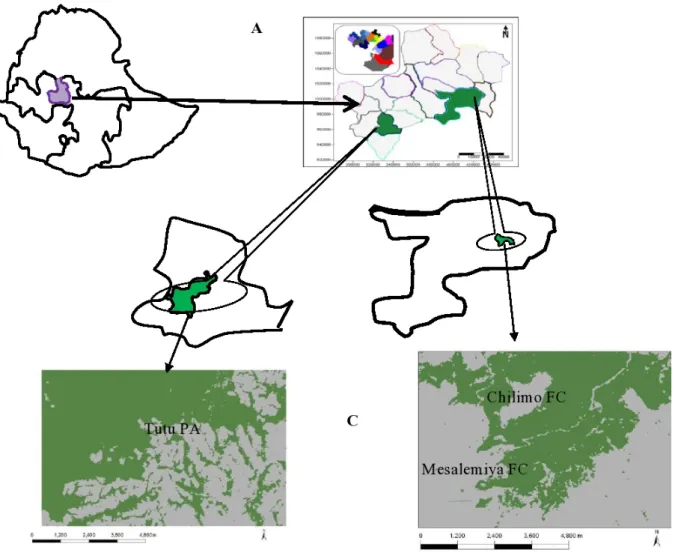
Fig. 1. Location of the study site. (A) Location of west shoa Zone in Ethiopia. (B) Location of Jibat and Dendi district in West Shoa Zone. (C) Location of Tutu PA and Chilimo and Mesalemia FC.
Methods for Case Study
Study site description
Two Peasant Association (PA), Gare Arera and Tutu, living in and around forest were selected from Oromia Regional State for the case study. Oromia Regional State is preferred for the study because it encompasses 70% of the natural high forest of the country. Gare Arera PA, contain- ing Chilimo Forest Cooperative (FC) and Mesalemiya FC, is located in and adjacent to Chilimo Forest while Tutu PA is located on the periphery of Jibat Forest (Fig. 1).
The total number of members/ households of Mesale- miya FC, Chilimo FC and Tutu PA are 119, 125 and 257 respectively. Chilimo FC is located inside Chilimo forest
while Mesalemiya FC and Tutu PA are located at the pe- riphery of Chilimo and Jibat forest respectively (Fig. 1).
Both Jibat Forest and Chilimo Forest are dry Afromontane forests that are part of the global biodiversity hot-spots as- signed by Conservation International. The two forests have more or less similar species compositions and potential live- lihood resources. The natural forest is dominated by Juniperus procera and Podocarpus falcatus (Mohammed and Inoue 2012).
Data collection and analysis
Open ended, semi structured as well as structured ques- tionnaire interview was used to collect data. Open ended in- terview was conducted with a total of 9 elderly, 3 from each
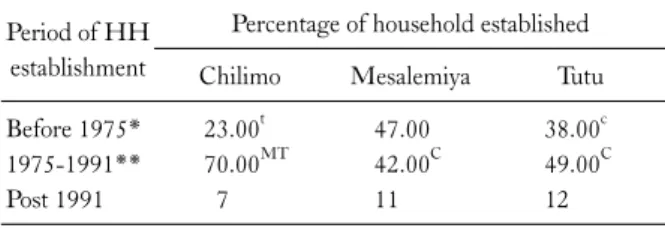
Table 1. Household establishment pattern under the three periods Period of HH
establishment
Percentage of household established
Chilimo Mesalemiya Tutu
Before 1975*
1975-1991**
Post 1991
23.00t 70.00MT 7
47.00 42.00C 11
38.00c 49.00C 12
*is significant difference among the villages at 0.1.
**is significant difference among the villages at 0.05.
M and m is significance difference between the PA/FC with Mesalemiya FC at 0.05 and 0.1 level respectively.
C and c is significance difference between the PA/FC with Chilimo FC at 0.05 and 0.1 level respectively.
T and t is significance difference between the PA/FC with Tutu PA at 0.05 and 0.1 level respectively.
FC/PA to collect historic data on land and forest tenure.
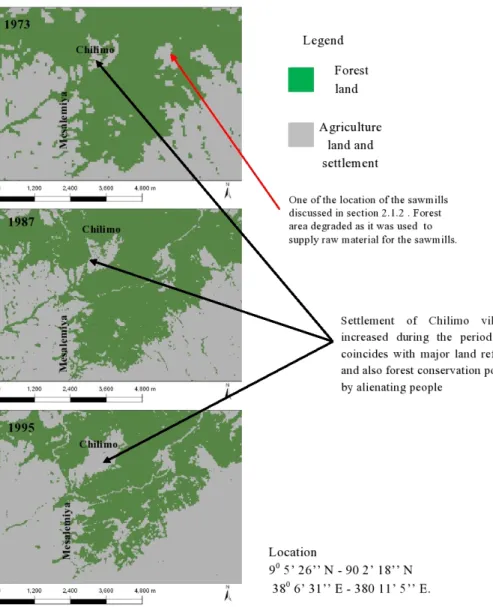
The semi structured and structured questionnaires were conducted for a total of 153 randomly selected households (about 30% of the total household) of which 36 are from Mesalemiya FC, 44 from Chilimo FC and 73 from Tutu PA. The household were categorized based on their estab- lishment year into three, i.e. the feudalism era (prior to 1975), socialist Derg era (1975-1991) and current regime, post 1991. In order to assess the wealth difference among household established in these different periods, the house- holds were divided into four wealth classes using simple wealth ranking. The simple wealth ranking has showed that local peoples’ valuations of wealth in all the three commun- ities are based on land and/or livestock and/or housing and availability of other income sources. The categorization of households using simple wealth ranking was also supple- mented by the households’ capital data collected by the structured questionnaire survey. The field data were col- lected in September and October 2011 and January and February 2012. In order to qualitatively asses the forest cover in relation to the three period of time, three satellite images (1973, 1987 and 1995) of Chilimo forest were utilized. The images were obtained from Multi-Spec- tral-Scanner (MSS) in 1973 and Thematic-Mapper (TM) in 1987 and 1995 of the United State Geological Survey database (USGS) (http://earthexplorer.usgs.gov/) data- base. Except for the 1973 image which is 60 pixel, all the other images are 30 m pixel.
Most of the data were analyzed using descriptive statics.
When deemed necessary, however, a one-way ANOVA was utilized to show the significance in variance among the three periods. The aforementioned data analyses were un- dertaken using the statistical software Stata 12. Satellite im- ages were analyzed using ArcGIS 10.
Results
The settle pattern, land distribution, household capital, socio-economic characteristics and current income sources of household established at the three periods is presented here to investigate whether the land reform resulted in min- imizing pressure on the forest.
Land reform and rural settlement pattern
Land reform is definitely expected to affect rural people settlement patter as it connotes the movement of population from one place to another in line with the changing tenure.
With respect to minimizing the pressure on the forest, if the reform had positive impact on the forest, then it is expected that the number of households established inside the forest to either be maintained or decline after the 1975 reform.
In contrary to the above assumption, the percentage of household established in Chilimo FC, which is located in- side the forest, during the major land reform period was significantly higher than the other PA/FC which are lo- cated outside the forest (p<0.05). Within Chilimo FC it- self, the number of household established during the land reform period were significantly higher than (p<0.05) than those established at the earlier and later period. The data also showed the ineffectiveness of, at least in this site, the demarcation of natural forests in to Forest Priority Area (FPA) in this period. Despite the demarcation of the forest and associate disincentive for local people living inside the forest to discourage the population growth, the total num- ber of household established in the village and associated increment in settlements inside the forest was found to be staggering (Table 1, Fig. 2).
Land reform and land distribution
The land reform has affected average land area per household as well as percentage of household possessing
Fig. 2. Forest cover of Chilimo be- tween 1973 (Feudal era), 1987 (Socialist era) and 1995 (Current regime).
land. The average land area per household of 17.6 hectare (ha) for households established before the land reform (feudal era) declined to 5.3 ha while the percentage of household possessing land increase from 46% to 93%. For the households established during the land reform, the land area remained the same probably because of fixed land area redistribution during implementation of the reform. The percentage of households possessing land, however, in- creased from 60% to 80%. The surprising result is that households established in the current regime has also in- creased their land area as well as percentage of household possessing land from 1.8 ha to 2ha and 31% to 69%
respectively. This is despite the fact that land redistribution
was more frequent during the Derg regime and has been mostly avoided since 1995 (Gebreselassie 2006). The possi- ble reason for this can be gradual encroachment in to forest as well as leasing land (Mohammed and Inoue 2013a;
2013b) (Table 2).
Current wealth status
Land reform, by re-distributing the major capital for the rural livelihood, i.e. land, is expected to affect the wealth in- equality which in turn will also affect the dependency on the forest. As shown in Table 3, however, household established at the earlier period have large proportion of the rich (16%) and middle (24%) classes as compared to those established
Table 2. Land area and land distribution for household established during the three periods
Period of HH establishment
Average land area (ha) Percentage of land holder Average of difference in land area and possession
Establishment Current Establishment Current Area (ha) Possession (%) Before 1975
1975-1991 Post 1991
17.6 2.8 1.8
5.3 2.8 2
64 60 31
93 80 69
-6.65 0.57 1.2
29 21 38
Table 4. Demographic and socio-economic characteristics of households established during the three periods
Period of HH establishment
Household members characteristics HH capitals Source of food
Avg. No. of
HH members Depended (%) Educated (%) Avg. no. of house possessed
Avg. no. of
livestock (TLU) Own farmland Share crop/
bought Before 1975
1975 -1991 Post 1991
6.36 6.29 3.63
63 67 50
35 39 22
1.47 1.21 1.06
6.36 5.00 4.06
68 53 44
32 47 56
Table 3. Current wealth status of household established during the three periods
Period of HH establishment
Proportion of household (%) Rich Middle Poor Very poor Before 1975
1975-1991 Post 1991
16 9 0
24 16 0
25 38 50
35 38 50
after the land reforms, i.e. Derg era and during current regime. The very interesting issue that came out from this data is that none of the household established after 1991 did make up for the rich and middle class. This is particularly frustrating as it also implies that the dependency on the for- est will increase with the emergence of new households (Table 3).
Household demographics and socio-economic characteristics
The average household size for households established before the land reform, during the land reform and after land reform are 6.36, 6.29 and 3.63 respectively. Sixty-three percent of the household members established before the land reform and sixty-seven percent of those during land reform were found to be dependent. This means that al-
though these categories of households have better land size and percentage of land possession (Table 2), the role that the land may play to minimize dependency on the forest is offsetted by the high fertility rate as well as high depend- ency rate. This is further strengthen by the data on source of food in which, despite claiming relatively larger land, the household established at the earlier stage still get portion (32%) of the food from sharecropping or buying. The pro- portion, nonetheless, was much lower than that of recently established households (56%) and those established during the land reform era (47%) (Table 4).
Current major livelihood activities
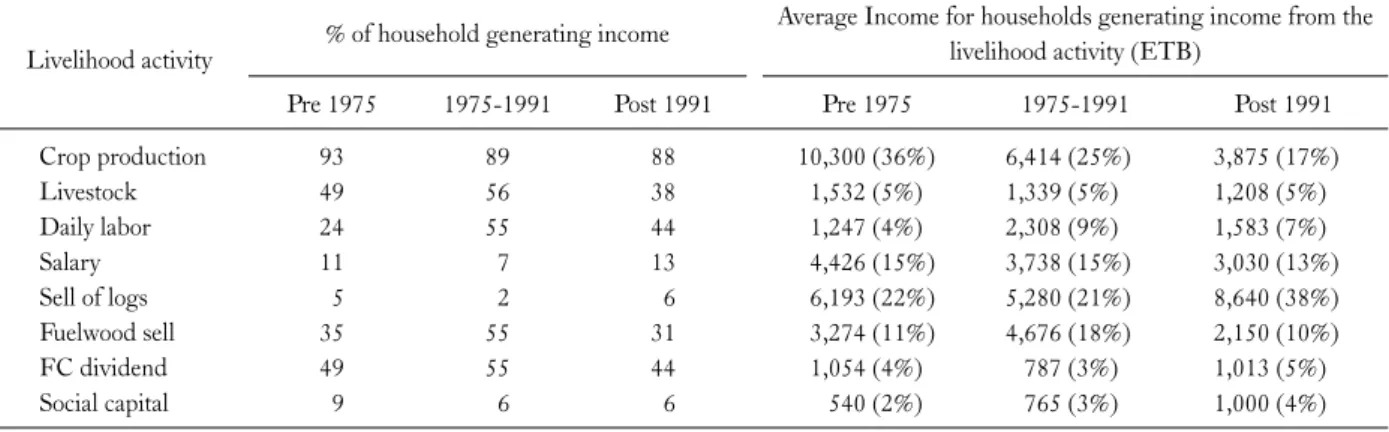
Crop production and forest based income are the two major sources of income for all household irrespective of their establishment period. The significance of crop pro- duction in terms of percentage of households that are gen- erating income from it decline as one move down the chro- nological time line. On the other hand, forest based income is particularly salient for household established after the land reform generating 53% of the total households’
income. It is also important income generating livelihood strategy for household established during and before land reform contributing for 42% and 37% of total income of the households respectively (Table 5).
Table 5. Current income sources for households established under the three periods
Livelihood activity % of household generating income Average Income for households generating income from the livelihood activity (ETB)
Pre 1975 1975-1991 Post 1991 Pre 1975 1975-1991 Post 1991
Crop production Livestock Daily labor Salary Sell of logs Fuelwood sell FC dividend Social capital
93 49 24 11 5 35 49 9
89 56 55 7 2 55 55 6
88 38 44 13 6 31 44 6
10,300 (36%) 1,532 (5%) 1,247 (4%) 4,426 (15%) 6,193 (22%) 3,274 (11%) 1,054 (4%) 540 (2%)
6,414 (25%) 1,339 (5%) 2,308 (9%) 3,738 (15%) 5,280 (21%) 4,676 (18%) 787 (3%) 765 (3%)
3,875 (17%) 1,208 (5%) 1,583 (7%) 3,030 (13%) 8,640 (38%) 2,150 (10%) 1,013 (5%) 1,000 (4%)
Discussion
Land tenure is one of the key factors that define patterns and change in land use (Futemma and Brondızio 2003).
The land tenure system of Ethiopia prior to the 1975 revo- lution, particularly that of the central and southern parts of the country, was characterized to be feudalistic, rooted in the exploitation of agrarian labor (tenants) by landed property. Forests were also owned by few monarchs and landlords in which local peoples’ access to the resource were mainly based on the good will of these elites (Mohammed and Inoue 2012). The 1970s revolution mainly inspired by failure of exploitive land tenure system of the feudal era wit- nessed a regime change to the socialist Derg era and con- sequent major land reform. The reform aimed to sig- nificantly alter the status quo by enabling previous tenants to have use right on the land. Although equity in land hold- ing was not achieved, the land reform was able to improve the distribution of land among rural agrarian society and al- so minimizes the gap in land holding area among them.
This change in availability of farmland for most of the agrarian household together with the forest policy and pro- clamation that restricted local peoples’ access to the forest was expected to minimize the pressure on the forest by local people. However, the outcome of these policies was otherwise.
One reason for such disparity is the continuous growth in population that has offseted the possible advantage that would have obtained by minimizing dependency on the for- est through improved livelihood capital. The overall agri- culture productivity of the country at 1.5% is much lower
than the 2.9 population growth (Stahl 1990). In addition, as household size change over time and new households ap- pear, there was also a need to redistribute land at later stages to improve or maintain the egalitarian distribution and to provide land to new landless households (Holden and Yohannes 2000). Consequently, individual holdings were frequently far smaller than the permitted maximum allot- ment (Thomas et al. 1991).
With respect to the forest policy, the reason for its failure can be attributed to the centralized and top down approach followed for the policy setting and its implementation with- out getting the consent of key actors, especially that of local people. Similar to findings in other countries discussed by Smoke 2003; Balooni et al. 2008; Pulhin and Inoue 2008;
the top down policy was not effective to minimize pressure on the forest. Consequently, despite the restrictive policy, household establishment in the village located inside the forest was significantly higher than that of outside (Table 1 and Fig. 2).
The future also looks doom looking at the current so- cio-economic condition of the country as a whole and households living in and around the forest. According to projections by Betru (2009), for example, the food of the country will grow by 2-2.5 times in 2030. The population growth which is estimated to be 130 million by 2030 will have twice more contribution to food demand, even after consideration of change in the rate of economic growth.
Hence, there might raise need for expansion of agriculture lands to other land uses including forests which will ulti- mately result in deforestation and shrink of their services (Betru 2009).
The socio-economic condition of the growing population is also frustrating. In the study site, for example, Irrespec- tive of when they are established or which wealth class they belong to, more than half of the household members are still dependents without any livelihood capitals. The level of de- velopment of human capital, i.e. education, which may pro- vide non-resource based livelihood opportunities such as employment, is quite low (Table 4). It means that the pres- sure for survival will ultimately push them to look at rela- tively easily accessible resource, i.e, the forest.
Moreover, the current land tenure which prohibits the alienation right over land also means that the farmers need to stay in their land. Even the improvement made with re- spect to renting seems not to contribute much in minimiz- ing pressure on the forest. This is because first, every land rental agreement allows a maximum of half a hectare per land transaction which forces the lessee to operate small farm sizes that could make difficult a sustainable and profit- able use of long term investment such as tree planting.
Secondly, because they are allowed to rent only half of their land to sustain their livelihoods, the policy forces sub- sistence farmers to tie to their land, hence to the forest, rath- er than contemplating alternative non-farm choices (Gebreselassie 2006).
Conclusion and Policy Implications
This study showed that major land reforms undertaken in Ethiopia did not contribute for minimizing local people pressure on the forest. The post 1975 land reform that re- distributed land, which was previously held by few mon- archs and landlords of the feudal era, to the peasant has minimized the land holding gap as well as improved per- centage of household possessing land. Forests also were de- marcated into Forest Priority Area during this period.
Although implementations of these two major policies were expected to have positive implication in reducing pressure on the forest, the result showed otherwise. The ongoing population growth which is unmatched by agriculture pro- ductivity improvement coupled by the existing poor land tenure system is expected to aggravate local people forest dependency in the future too. This surely will not also be helped by the land grabbing that is swallowing the farmers land in different part of the country.
The finding also implied that land tenure reforms will not bring the desired outcome in improving rural live- lihoods in general and forest dependent households in par- ticular unless accompanied by other policies such to im- prove agriculture productivity, livelihood diversification, education and stabilizing demographics. In addition, the current very sensitive issues of land grapping as well as the overall land tenure system of the country warrant imper- ative emphasis with respect to their implication on the al- ready endangered remnant forest of the country.
References
Abegaz B. 2004. Poverty Trap in a Tributary Mode of Production:
The Peasant Economy of Ethiopia. Working paper 6, College of William and Mary, Virginia.
Adams M, Cousins B, Manona S. 1999. Land Tenure and Economic Development in Rural South Africa: Constraints and Opportunities. Working paper 125, ODI, London.
Balooni K, Pulhin MJ, Inoue M. 2008. The effectiveness of de- centralization reforms in the Philippines’s forestry sector.
Geoforum 39: 2122-2131.
Baumann P. 2002. Improving Access to Natural Resources for the Rural Poor: A Critical Analysis of Central Concepts and Emerging Trends from a Sustainable Livelihoods Perspective.
Washington D.C: FAO.
Benine S, Pender J. 2001. Impact of land distribution on land man- agement in the Ethiopian highland. Land Degrad Dev 12:
555-568.
Beruk S, Mulatu A, Abebe G, Roth M. 2006. Removing Limitations of Current Ethiopian Rural Land Policy and Land Administration: Paper Presented at the Workshop on Land Policies & Legal Empowerment of the Poor. The World Bank, Washington DC.
Beshah T. 2003. Understanding Farmers: Explaining Soil and Water Conservation in Konso, Wolaita and Wello, Ethiopia.
Tropical Resource Management Papers, Wageningen.
Besley T, Burgess R. 2000. Land reform, poverty reduction and growth. Evidence from India. Q J Econ 115: 389-430.
Betru S. 2009. Food Security in Ethiopia: Analysis of cereal de- mand and supply: past trend and future prospect. PhD dissertation. The University of Tokyo, Tokyo, Japan.
Bruce JW, Wendland KJ, Naughton-Treves L. 2010. “Whom to pay?’ Key Concepts and Terms regarding Tenure and Property Rights in Payment-based Forest Ecosystem Conserva-tion.”
Land Tenure Center Policy Brief 15. http://www.nelson.wisc.
edu/ltc/.
Carr DL. 2004. Proximate Population Factors and Deforestation in Tropical Agricultural Frontiers. Popul Environ 25: 585-612.
Chirwa E. 2008. Land tenure, farm investments and food pro-
duction in Malawi. IPPG Discussion Paper Series No. 18.
University of Manchester, UK.
De UK. 2012. Livelihood, Dependence on Forestand Its Degradation: Evidence from Meghalaya. Environment and Natural Resources Research 2: 96-114.
Deininger K, Jin S, Adenew B, Gebre-Selassie S, Nega B. 2006.
Tenure security and land-related investment: Evidence from Ethiopia. European Economic Review 50: 1245-1277.
Desaleg R. 1984. Agrarian Land Reform in Ethiopia. Scandina- vian Institute of African Studies, Uppsala.
Devereux S, Teshome A, Sabates-Wheeler R. 2009. Too Much Inequality or Too Little? Inequality and Stagnation in Ethiopian Agriculture. IDS Bulletin 36: 121-126.
EFAP (1994) Ethiopian Forestry Action Plan. Synopsis report, Ministry of Natural Resources Development and Environmen- tal Protection. Addis Ababa.
Futemma C, Brond ES. 2003. Land Reform and Land-Use Changes in the Lower Amazon: Implications for Agricultural Intensification. Hum Ecol 31: 369-402.
Gebreselassie S. 2006. Land, land policy and smallholder agri- culture in Ethiopia: Options and scenarios. Paper prepared for the Future Agricultures Consortium meeting at the Institute of Development Studies, March 20-22, London.
Higman S, Mayers J, Bass S, Judd N, Nussbaum R. 2005. The Sustainable Forestry Handbook: A practical guide for tropical forest managers on implementing new standards. 2nd ed.
Earthscan, London.
Helland J. 2002. Pastoral Land Tenure in Ethiopia. In: Resource alienation, militarisation and development: case studies from east african drylands (Babiker M, ed). Proceedings of the Regional Workshops on East African Drylands, Addis Ababa, Ethiopia.
Holden S, Yohannes H. 2001. Land redistribution, tenure in- security and intensity of production: a study of farm household in southern Ethiopia. Land Econ 78: 573-590.
Jemma H. 2004. The Politics of Land Tenure in Ethiopia History:
Experience From the South Paper Prepared for XI World Congress of Rural Sociology, Trondheim.
Kebede B. 2006. Land Reform, Distribution of Land and Institutions in Rural Ethiopia: Analysis of Inequality with Dirty Data. CSAE WPS/2006/05.
Kidane M. 2002. Tropical secondary forest management in Africa:
Reality and perspectives. Ethiopia country paper presented in
workshop on tropical secondary forest management in Africa, Nairobi.
Mohammed AJ, Inoue M. 2012. Explaining disparity in outcome from community-based natural resource management (CBNRM): a case study in Chilimo Forest, Ethiopia. J Environ Plan Manag 55: 1248-1267.
Mohammed AJ, Inoue M. 2014. Linking outputs and outcomes from devolved forest governance using a Modified Actor- Power-Accountability Framework (MAPAF): Case study from Chilimo forest, Ethiopia. For Policy Econ 39: 21-31.
Mohammed AJ, Inoue M. 2013a. Exploring decentralized forest management in Ethiopia using Actor-Power-Accountability framework: Case study in West Shoa Zone. Environ Dev Sustain 15: 807-825.
Mohammed AJ, Inoue M. 2013b. Forest-dependent communities’
livelihood in decentralized forest governance policy epoch: case study from West Shoa zone, Ethiopia. J Nat Resour Pol Res 5:
49-66.
Nath TK, Inoue M. 2010. Impacts of Participatory forestry on livelihoods of ethnic people: experience from Bangladesh. Soc Nat Resour 23: 1093-1107.
Nega B, Adenew B, Gebre-Sellasie S. 2003. Current land policy is- sues in Ethiopia. Land Reform, Land Settlement, and Cooperatives 11: 103-124.
Pulhin JM, Inoue M. 2008. Dynamics of devolution process in the management of the Philippines forests. Int J Soc For 1: 1-26.
Schmitt CB, Denich M, Demissew S, Friis I, Boehmer HJ. 2010.
Floristic diversity in fragmented Afromontane rainforests:
Altitudinal variation and conservation importance. Appl Veg Sci 13: 291-304.
Smoke P. 2003. Decentralization in Africa: goals, dimensions, myths and challenges. Public Adm Dev 23: 7-16.
Stahl M. 1990. Environmental degradation and political con- straints in ethiopia. Disasters 14: 140-150.
Sunderlin WD, Dewi S, Puntodewo A, Müller D, Angelsen A, Epprech M. 2008. Why forests are important for global poverty alleviation: a spatial explanation. Ecol Soc 13: 24.
Thomas P, Ofcansky, Berry L. 1991. Ethiopia: a country study.
GPO for the Library of Congress, Washington.
World Bank 2007. World Development Report 2008: Agriculture for Development. The World Bank, Washington D.C.
Wunder S. 2001. Poverty Alleviation and Tropical Forests--What Scope for Synergies? World Dev 29: 1817-1833.