Environmental Science
Vol. 33, No. 3, pp. 197-201, August, 2017 https://doi.org/10.7747/JFES.2017.33.3.197
Interspecific Hybridization between Populus caspica L. × P. deltoids L 62/154 Using in vitro Embryo Development and Germination
Jafari mofidabadi Ali*, Kamandloo Mansooreh and Selamti Hamid
Agricultural Research, Education and Extension Organization (AREEO), Golestan Research Center of Agriculture and Natural Resources, Gorgan 4915677555, Iran
Abstract
Populus. caspica L. is an Iranian indigenous poplar species which naturally distributed in the northern part of country.
Unfortunately, overuse has removed many of the stems of better form, so that natural stands now usually appear small and crook. Therefore genetic variation for selection of new superior clone of this species is needed. Conventional hybrid- ization system is currently used to induce genetic variation in poplar species but incompatibility barriers have been observed between them. In vitro ovule embryo culture was used to overcome incompatibility obstacle for interspecific hybridization between Populus caspica L. with Populus deltoids L.62/75. Female flowers of Populus caspica L. have artificially been pollinated with pollen grain of P. deltoides 62/75 in one direction using twig and pot crossing system.
Ovaries at different ages (7, 14 and 21 days after pollination) were disinfected through 70% ethanol for 1 minute, 5% of sodium-hypochlorite solution for fifteen min followed by three time rising with sterile distil-water. Isolated ovaries were then transferred to MS hormone free medium containing 30 and 60 g/L sucrose for embryo development and germination. Collected data have been analyzed by two factorial experimental designs. The results indicated that there were significant differences between age of embryos for development and germination at =0.01%. Highest embryo germination (45%) was observed from 21 days old ovaries. No significant differences were observed between MS culture media containing 30 and 60 g/L for percentages of ovary-embryo germination and number of germinated embryo per ovary at =0.05%. Fourteen percentage of embryo germination obtained in MS medium supplemented with 60 g/L sucrose, while only 35% of isolated ovaries were able to germinate in MS containing 30 g/L sucrose. Induced plantlets in 4 cm height were transferred into pots containing soilless (1:1:1 peat, per lit and vermiculite) medium for acclimatization.
After successful acclimatization, plants were delivered to nursery.
Key Words: ovary, embryo culture, Populus deltoids L., Populus caspica L., age of embryo
Received: February 15, 2017. Revised: April 4, 2017. Accepted: April 24, 2017.
Corresponding author: Jafari mofidabadi Ali
Agricultural Research, Education and Extension Organization (AREEO), Golestan Research Center of Agriculture and Natural Resources, Gorgan 4915677555, Iran
Tel: +98173279063, Fax: +98173274240, E-mail: [email protected]
Introduction
Poplar is a fast growing tree (growing up to 30 m) and belongs to the silcaseae family (Poplar and Willows).
Among them Populus caspica L. is an Iranian indigenous
poplar species which naturally distributed in the northern part of country (Golestan, Mazandaran, and Guilan prov- inces). This species is being used for reforestation program in degraded plain of Hyrcanian Forests (Jalilli 1999).
Unfortunately, overuse has removed many of the stem
straightness individual from population (Jalilvand 1989).
Therefore genetic variation for selection of new superior clone of this species is argent task for wood production program. Poplar plants are not usually multiplied by seed, but propagated by cutting (Jalilvand 1989). Vegetative propagated tree are identical in genetic point of view and no genetic variation is to be respected. For genetic variation, overcoming sexual reproduction barrier of this species need before any breeding method has to be done. Hybridization is currently used to induce genetic variation and to achieve hybrid vigor in many crops and trees (Tabaii Aghdaii and Jafari mofidabadi 2000). In poplars, many species are capa- ble of hybridizing, but the hybridization rate depends on re- flect of phyllogenetic relationships. Intra-sectional crosses showed more successful than inter-sectional crosses (Fernando et al. 2005).
In general, the Populus caspica L. are unable to hybridize with Populus deltoids L. species through conventional approaches. During the last fifteen years, a number of ex- periments have been made on pollen-stigma interactions in interspecific crosses of Populus, with emphasis on the sec- tions Aigeiros, Leuce and tecamahaca (Willing and Pryor 1990; Rytter and Stener 2005; Lee et al. 2008). Many hy- bridization programs to improve the growth capacity of poplars have been carried out by several authors (Li et al.
1983; Li and Li 1985; Ahuja 1986; Raqiun and Trousard 1993; Jafari et al. 1999; Jafari Mofidabadi and Modir-Rahmati 2000; Calagari et al. 2003; Kevin 2004;
Pyamnour et al. 2013). Hybrids obtained from the cross between Populus euphratica Oliv. with_Populus alba L. have exhibited outstanding characters, such as increased growth rate and stem straightness (Jafari Mofidabadi and Modr-Rahmati 2000). Valuable hybrid has been reported by interspecific hybridization between Populus grandidentata and Populus alba (Ahuja 1986).
Although pollination between different poplar species can be done but due to post-zygotic barriers which are ex- pressed in the endosperm, embryo abortion has been ob- served (Zenkteler 1990; Sharma et al. 1996; Jafari Mofida- badi et al. 1999). Attempts have been done to interbreed the two species producing populations with intermediate char- acteristics between the two species but there are some re- productive barriers that may prevent successful hybrid- ization by conventional approaches. In vitro immature and
mature embryo culture has been suggested to overcome post zygotic barriers and developing interspecific hybrids in poplar trees.
Materials and Methods
Artificial pollination was made between female flowers of Populus caspica L. as a maternal plant with pollen grain of P.
deltoids L. (62/154) using twig and pot system (tap water culture) in one direction. Branches containing female flow- ers of Populus caspica L. collected from north forest of Golestan Province in Iran and put them in a pot containing tap water. In order to provide pollen grains, the male flow- ers of Populus deltoids L. (62/154) were forced to anthesis in green-house. The female inflorescence buds were covered with transparent papers before anthesis to avoid contamina- tion. Pollinations were then carried out on female inflo- rescence of Populus caspica L. stigma by high dusting of Populus deltoids L.62/154 pollen grain in isolated green- house. Catkins were then collected 7, 14 and 21 days after pollination (DAP). Closed capsules, still attached to the ax- is of the catkin, were disinfected in 70% (v/v) ethanol for 1 min followed by sodium hypochlorite solution (0.5 % active chlorine in water) for 15 min and finally rinsed three times in sterile distilled water. Isolated ovaries were aseptically transferred to surface of agar MS (Murashige and Skoog 1962) hormone free media supplemented with two different sucrose concentrations (30 and 60 g/L) for in vitro embryo development and germination. Media were autoclaved for 20 min at 120°C and then dispensed 40 ml in each sterile jar. PH was adjusted to 5.7 before autoclaving. Cultures were incubated at 24°C under a 16 h photoperiod with light provided by cool white 40-watt fluorescent lamps (4000-5000 lux). Collected data (percentage of germinated ovary and number of plant produced per isolated ovary) were analyzed using factorial experimental design with two factors (age of embryo and sucrose concentration) and 10 replications. Plantlets at 1-2 cm in height were transferred to jars containing the same medium and kept for two months under the same conditions before being acclimatized. The plantlets were subsequently transferred to the green-house in pot containing peat, perlit and ver- miculite in the ratio of 1:1:1 for hardening phase.
Table 1. Effect of age of ovary and MS medium supplemented with 30 and 60 g/L sucrose on % of germinated embryo and number of plantlets per ovary
Source of variation Df
MS
% of germinated ovary germination
No of plantlets/ovary
Age 2 3.9856** 70.4755**
Medium 1 0.1530 ns 7.2871 ns
Age * medium 2 0.0515 0.4182
Error 45 0.1195 6.5137
Total 59
Table 3. Effect of age (DAP) ovaries on the mean number of ger- minated embryo per isolated ovary
Duncan
grouping Mean N Age
A 2.31 20 21
A 2.06 20 14
B 1.10 20 7
Fig. 1. Fourteen days old hybrid embryo (Populus caspica L. × P. deltoides 62/154) germinated on in MS medium containing 30 g/L sucrose.
Table 2. Effect of age (DAP) ovaries on percentage of germinated embryo
Duncan
grouping Mean N Age
A 45 20 21
A 37.7 20 14
B 5 20 7
Results and Discussion
Effect of ovaries ages on embryo development and germination
All developed embryos from isolated capsules of P. casp- ica L. pollinated with P. deltoides L. 62/154 pollen grain started to germinate after one week on the surface of hor- mone free MS medium supplemented with both 30 and 60 g/L sucrose (Fig. 1). Analysis of collected data based on two factorial experimental design, indicated that there are highly significant differences between age (number of days after pollination) of isolated ovaries (7, 14 and 21 DAP) for mean percentage of ovary-embryo germination and mean number of germinated embryo per ovary at =0.01 level (Table 1). Highest mean percentages of embryos germina- tion (45%) and highest number of plantlets formation per ovary (2.31 averages) were observed from 21 days old em- bryo (Table 2 and 3). Due to formation of multi embryos of p. caspica L. capsule (ovary), often more than one plants were produced on one isolated ovary (Table 3). Twenty one
days old in vitro embryo development and germination have been previously reported for P. alba L. (Jafari Mofidabadi et al. 1999), P. nigra L. and P. caspica L. (Jafari Mofidabadi 2015).
In contrast to the report of (Li et al. 1983; Li and Li 1985), which white- cream, loose and friable callus were in- duced from three days old embryos (days after pollination), we were able to obtain plantlets from at least 7 days old iso- lated ovaries. Eight days old capsule of Salix viminalis L.
was necessary for in vitro ovule embryo germination in in- tergeneric crosses with P. alba L (Bangniewska et al. 2011) and for Salix aegyptica ovary culture when pollinated with Populus caspica L. pollen grain (Ahmedi et al. 2008).
Germination of P. euprahtica Oliv. ovary pollinated with P. alba L. was observed within 45 days after culture ini- tiation (Jafari Mofidabadi and Modir-rhmati 2000;
Calagari et al. 2003). This long term (45 days after pollina- tion) embryo development and germination of P. euprahtica Oliv., has been caused that the crossing has to be only done on mature tree instead of twig and pot breeding system (Jafari and Modir-rahmeti 2000).
Necroses ovaries (5.6%) and malformed plantlets (12.4%) were observed in ovary culture of p. caspica L. after two sub culture. The same phenomena were reported by Jafari Mofidabadi et al. (1998) for p. alba L. when used as a ma- ternal parent in Populus alba L. × P. euphratica Oliv.
hybridization.
Table 5. Effect o MS medium supplemented 30 and 60 g/L on the number of germinated embryo per ovary
Duncan
grouping Mean N Medium +
A 2.0086 20 60 g/L sucrose concentration A 1.9076 20 30 g/L sucrose concentration Table 4. Effect on MS medium supplemented 30 and 60 g/L on percentage of germinated embryo
Duncan
grouping Mean N Medium +
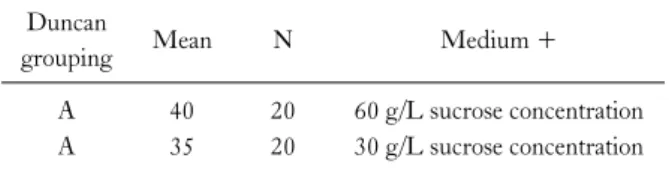
A 40 20 60 g/L sucrose concentration A 35 20 30 g/L sucrose concentration
Effect of sucrose concentration embryo develop- ment and germination
Analysis of collected data showed that there are no sig- nificant differences between MS medium containing 30 or 60 g/L sucrose concentration for mean percentage of ger- minated ovary and for average number of plantlets for- mation per ovary (Table 1). In spite of no significant differ- ences between sucrose concentrations, highest mean per- centage of germinated ovary (40%) and mean number of plantlets per isolated ovary (2.008) were observed in MS medium containing 60 g/L sucrose (Table 4 and 5). MS hormone free medium supplemented with 30 g/L sucrose were used for in vitro embryo nutrition in intra specific and inter specific hybridization of poplar (Jafari Mofidabadi et al. 1999; Jafari Mofidabadi and Modir-Rahmeti 2000;
Calagari et al. 2003; Kevin 2004; Ahmedi et al. 2008) and got nearly the same results. MS medium supplemented with different growth regulators hormone were used by sev- eral authors for intra and interspecific poplar tree hybrid- ization (Li et al. 1983; Li and Li 1985; Bangniewska et al.
2011). Half-MS supplemented with 3o g/L (3%) sucrose was used for immature embryo development and germina- tion of Salix viminalis L. as maternal species in crosses with P. alba L. (Bangniewska et al. 2011). In contrast with Bangniewska et al. 2011 who transferred germinated seed- ling into the MS medium containing 0.2 mg/L naphtalene-
acetic acid for plantlet growth, we used hormone free MS medium for further subculture.
Three percentage of sucrose was also used for in vitro embryo development and germination of intergeneric (Salix viminalis L. × P. alba L.) by Ahmedi et al. 2008., for interspecific (Populus euphratica Oliv × P. alba L.) by Jafari Mofidabadi et al. 2000., for interspecific (Populus euphratica Oliv × P. euphratica oliv.) hybrid production of different ecotypes by Calagari et al. 2003. Thirty one plantlets with morphological variation were successfully acclimatized in green house and transferred to the nursery. Due to highly vegetative propagation system in poplar trees, selected of any superior hybrid clones could be easily proliferated. The results of this article showed that conventional breeding and successful in vitro embryo development and germination of poplar made it possible to obtain new superior clones through sexual reproduction, intra and interspecific hy- bridization.
References
Ahmedi A, Azad-fer D, Jafari- Mofidabadi A. 2008. Embryo-res- cue as a tool in Inter generic in Salix famiy (Salix alba × Populus caspica) hybridization. Iranian Journal of Rangelands and Forestes Plant Breedling and Genetic Research 6: 149-157.
Ahuja MR. 1986. Aspen. In ‘Handbook of plant cell culture. Vol.
4. Techniques and pplications Evans DA., Eds WR Sharp, PVAmmirato, pp. 626-651.
Bagniewska Zadworna A, Zenkteler M, Zenkteler E, Wojciecho- wicz MK, Barakat A, Carlson JE. 2011. A successful applica- tion of the embryo rescue technique as a model for studying crosses between Salix viminalis and Populus species. Aust J Bot 59:
382-392.
Calagari M, Jafari Mofidabadi A, Taberri M, Hossein SM. 2003.
Interspecific hybridization of P. euphratica Olive. Through em- bryo rescue. Pajoohesh & Sazandegi 61: 6-9.
Fernando DD, Long SM, Sniezko RA. 2005. Sexual reproduction and crossing barriers in white pines: the case between Pinus lam- bertiana (sugar pine) and P. monticola (western white pine). Tree Genetics & Genomes 1: 143-150.
Jafari Mofidabadi A, Modir-Rahmati A, Tavassoli A. 1999.
Application of ovary and ovule culture in Populus alba L. X.
P.euphratica Olive. Silvae Genetica 47: 332-334.
Jafari Mofidabadi A, Modir-Rahmati A. 2000. Production Populus euphratica Olive. Xp. alba L. hybrid poplar through ovary and ovule cultures. Plant Genetic Newsletter 122: 13-15.
Jafari Mofidabadi A. 2015. Production of inter-specific hybrid be- tween Populus caspica and P.nigra using mature embryo culture.
Iranian Journal of Rangelands and Forests Plant Breeding and Genetic Research 23: 1-23.
Jalili A, Jamzad Z. 1999. Red book of Iran. Iranian Research Institute of Forest and Rangeland, Tehran, pp 748.
Jalilvand H. 1989. Investigation of Popolus caspica L. geographical distribution and ecological condition in north forests of Iran.
MS thesis. Tarbiat Modaress University, pp 139.
Kevin DF. 2004. Extent and patents of hybridization among three species of Populous that constitute the riparian forest of southern Alberta, Canada. Can J Bot 82: 253-264.
Lee CB, Page LE, Mcclure BA, Holtsford TP. 2008. Post-pollina- tion hybridization barriers in Nicotiana section Alatae. Sex Plant Reprod 21: 183-195.
Li W, Li J. 1985. In vitro culture of hybrid ovules in Populus. Sci Sliv 21: 339-346.
Li W, Wang R, Zhu X. 1983. On the embryo development and ov- ule culture of interspecific hybrids between Populus simonii and P.
pyramidalis Barkh. Acta Bot Sin 25: 409-417.
Murashige T, Skoog F. 1962. A revised medium for rapid growth and bioassays with tobacco tissue culture. Physiology Plant 15:
473-479.
Pyamnour V, Hashemi S, Jafari Mofidabadi A, Ahmedi A. 2013.
Interspecific hybridization in Salicaceae (Populus nigra × P. del- toids and P. nigra × Salix alba) using an embryo rescue tech- niques. Agriculture & Forestry 59: 59-65.
Raquin C, Troussard L, Villar M. 1993. In-ovary embryo culture as a tool for poplar hybridization. Can J Bot 71: 1271-1275.
Rytter L, Stener LG. 2005. Productivity and thinning effects in hy- brid aspen (Populus tremula L. × P. tremuloides Michx.) stands in southern Sweden. Forestry 78: 285-295.
Sharma DR, Kaur R, Kumar K. 1996. Embryo rescue in plants-a review. Euphytica 89: 325-337.
Tabaii Aghdaii R, Jafari Mofidabadi A. 2000. Introduction to Forest Tree Improvement. Published by Institute of Forests and Rangelands Research. pp 252.
Willing RR, Pryor LD. 1976. Interspecific hybridisation in Poplar.
Theoret Appl Genetics 47: 141-151.
Zenkteler M. 1990. In vitro fertilization and wide hybridization in higher plants. Critical Reviews in Plant Sciences 9: 267-279.