INTRODUCTION
A signal in pharmacovigilance was defined by the World Health
Organization Uppsala Monitoring Centre (WHO-UMC) as a
“Reported information on a possible causal relationship be- tween an adverse event (AE) and a drug, the relationship be- ing unknown or incompletely documented previously.”1
Data mining, a signal detection method, uses a spontaneous reporting system to detect AE signals and has had an impor- tant role in pharmacovigilance for the last four decades.2 Phy- sicians, pharmacists and consumers are recommended to re- port AEs that are suspected to be AEs to a spontaneous re- porting system.3 Quantitative analysis methods, such as the reporting odds ratio (ROR), proportional reporting ratio (PRR), and Bayesian confidence propagation neural network (BCPNN) analysis, could reveal important signals by analyzing dispro- portionately collected reports about drugs and clinical events.4
Signal Detection of Imipenem Compared to Other Drugs from Korea Adverse Event
Reporting System Database
Kyounghoon Park
1, Mick Soukavong
1, Jungmee Kim
1, Kyoung-eun Kwon
1, Xue-mei Jin
1, Joongyub Lee
2, Bo Ram Yang
2, and Byung-Joo Park
11Department of Preventive Medicine, Seoul National University College of Medicine, Seoul;
2Medical Research Collaborating Center, Seoul National University Hospital, Seoul National University College of Medicine, Seoul, Korea.
Purpose: To detect signals of adverse drug events after imipenem treatment using the Korea Institute of Drug Safety & Risk Man- agement-Korea adverse event reporting system database (KIDS-KD).
Materials and Methods: We performed data mining using KIDS-KD, which was constructed using spontaneously reported ad- verse event (AE) reports between December 1988 and June 2014. We detected signals calculated the proportional reporting ratio, reporting odds ratio, and information component of imipenem. We defined a signal as any AE that satisfied all three indices. The signals were compared with drug labels of nine countries.
Results: There were 807582 spontaneous AEs reports in the KIDS-KD. Among those, the number of antibiotics related AEs was 192510; 3382 reports were associated with imipenem. The most common imipenem-associated AE was the drug eruption; 353 times. We calculated the signal by comparing with all other antibiotics and drugs; 58 and 53 signals satisfied the three methods.
We compared the drug labelling information of nine countries, including the USA, the UK, Japan, Italy, Switzerland, Germany, France, Canada, and South Korea, and discovered that the following signals were currently not included in drug labels: hypokale- mia, cardiac arrest, cardiac failure, Parkinson’s syndrome, myocardial infarction, and prostate enlargement. Hypokalemia was an additional signal compared with all other antibiotics, and the other signals were not different compared with all other antibiotics and all other drugs.
Conclusion: We detected new signals that were not listed on the drug labels of nine countries. However, further pharmacoepide- miologic research is needed to evaluate the causality of these signals.
Key Words: Imipenem, KIDS-KAERS database, signal, pharmacovigilance, pharmacoepidemiology
pISSN: 0513-5796 · eISSN: 1976-2437
Received: June 10, 2016 Revised: October 29, 2016 Accepted: November 29, 2016
Corresponding author: Dr. Byung-Joo Park, Department of Preventive Medicine, Seoul National University College of Medicine, 103 Daehak-ro, Jongno-gu, Seoul 03080, Korea.
Tel: 82-2-740-8325, Fax: 82-2-747-4830, E-mail: [email protected]
•The authors have no financial conflicts of interest.
© Copyright: Yonsei University College of Medicine 2017
This is an Open Access article distributed under the terms of the Creative Com- mons Attribution Non-Commercial License (http://creativecommons.org/licenses/
by-nc/4.0) which permits unrestricted non-commercial use, distribution, and repro- duction in any medium, provided the original work is properly cited.
Yonsei Med J 2017 May;58(3):564-569 https://doi.org/10.3349/ymj.2017.58.3.564
Imipenem is a member of the carbapenem class of antibiot- ics. It is known to have a wide spectrum of activity, and there- fore, has commonly been used for Gram-positive and -nega- tive, aerobic, and anaerobic bacteria.5 In US Food and Drug Administration (FDA) drug label information, imipenem pres- ents severe adverse drug reactions (ADRs), such as potential seizure (0.2%). It also presents common ADRs, such as nausea (2.0%), vomiting (1.5%), diarrhea (1.8%), rash (0.9%), and so on.6 The drug label information regarding imipenem ADRs from the Ministry of Food and Drug Safety (Korea) is similar to that of the FDA.7 In Korea, however, signal detection associ- ated with imipenem using the Korean spontaneous AEs re- porting system database has never been conducted. Therefore, we first analyzed the Korean spontaneous reporting system database regarding imipenem and compared it with the drug label information of 8 other countries to detect signals that are not currently listed in the labels.
MATERIALS AND METHODS
Korea Institute of Drug Safety & Risk Management- Korea adverse event reporting system database The Korea Institute of Drug Safety & Risk Management-Korea adverse event reporting system database (KIDS-KD) includes AE data from December 1988 to June 2014. The data were sc- reened for detection of input error, logical error and assigned code by drug information and AEs before performing statistical analysis. This database is managed by KIDS, and anyone au- thorized by KIDS can use the data, and it is composed of pa- tient information, drug information, AE information, serious- ness of AE, reporter information, primary causality assessment, and disease history. These data have information about sus- pected AEs coded with the WHO Adverse Reaction Terminolo- gy (WHO-ART) codes-Preferred Term level (PT).8 These codes were developed 30 years ago by the WHO and have been wide- ly used.9 We use the combination of drug ingredients and WHO- ART PT codes (PT) to find signals. It should be noted that in- formation from the KIDS-KD is reported regardless of causal relationship. Thus, AE information from other countries and as-
sessment of patient’s underlying disease or medical records are needed.8
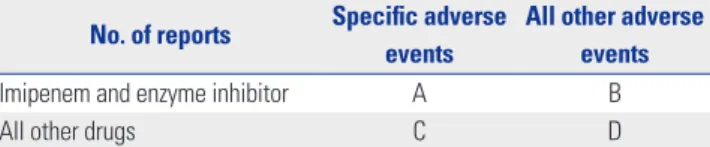
Disproportionality measurement for signal detection Disproportionality measurement is one of the techniques used to detect adverse drug event signals, and Netherlands Phar- macovigilance Foundation, the UK Yellow Card database, and WHO-UMC use this method to find AE signals.10 To make a 2×2 table, we classified rows with imipenem and other drugs, except imipenem, and categorized columns with specific AEs and all other AEs (Table 1).
We calculated the PRR, ROR, and information component (IC) of BCPNN to detect signals. The criteria of signal detection was a PRR and ROR of at least 2, chi-squared value of at least 4 and 3 or more cases,11 and that for IC was a larger than zero lower limit of the 95% confidence interval of IC (Table 2).12 Statistical analysis
We used three methods for signal detection. Nevertheless, there is no ‘gold standard’ method for signal detection.13 We applied three methods to target imipenem and all other antibiotics and drugs. In general, the disproportionality calculating measure compares imipenem with all other drugs.14,15
A signal was defined when it satisfied all three methods (PRR, ROR, and IC). We also analyzed the number of AEs reported from imipenem use, all drugs and all antibiotics per year and the characteristics of imipenem AE reports. Finally, we com- pared the drug label informations from South Korea, Canada, the USA, the UK, Japan, Germany, Switzerland, Italy, and Fr- ance. All signals have the possibility for disease spill-over (code of treated disease as ADRs), therefore, we considered the clinical aspects.16 All statistical analyses were performed using SAS (Release 9.4, SAS Institute, Inc., Cary, NC, USA) and Micro- soft Excel 2010.
RESULTS
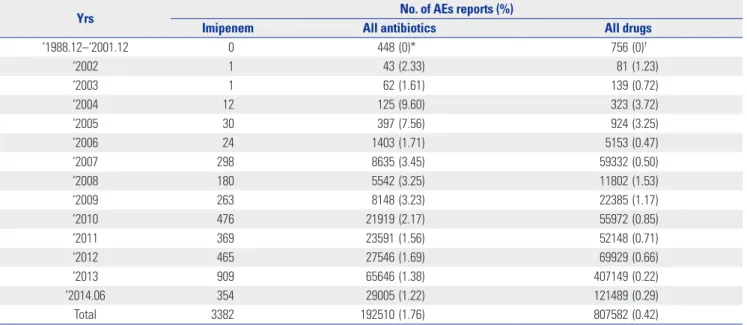
The total number of suspected AE reports to the KIDS-KD from December 1988 to June 2014 was 807582. During the same period, the number of AE reports with all antibiotics was 192510 and with imipenem was 3382. The number of reports contin- ued to increase year after year (Table 3).
The characteristics of reports in KIDS-KD are presented in Table 4. They are presented by gender of the patient, suspect- ed AEs, type of reports, identification of reporter, and report- Table 1. 2×2 for Measures of Disproportionality of Imipenem
No. of reports Specific adverse events
All other adverse events
Imipenem and enzyme inhibitor A B
All other drugs C D
Table 2. Definition and Signal Detection Criteria of Disproportionality Calculating Method
Calculating method Definition in 2×2 table Criteria of signal detection
PRR [A/(A+B)]/[C/(C+D)] PRR≥2, chi-squared≥4 and case≥3
ROR (A/B)/(C/D) ROR≥2, chi-squared≥4 and case≥3
IC Log2 P (ADRs, drug)/P (ADRs) P (drug) IC lower limit of 95% confidence interval≥0 PRR, proportional reporting ratio; ROR, reporting odds ratio; IC, information component; ADRs, adverse drug reactions.
Table 3. The Number of AEs Reports in KIDS-KD by Year from December 1998 to June 2014
Yrs No. of AEs reports (%)
Imipenem All antibiotics All drugs
‘1988.12–‘2001.12 0 448 (0)* 756 (0)†
‘2002 1 43 (2.33) 81 (1.23)
‘2003 1 62 (1.61) 139 (0.72)
‘2004 12 125 (9.60) 323 (3.72)
‘2005 30 397 (7.56) 924 (3.25)
‘2006 24 1403 (1.71) 5153 (0.47)
‘2007 298 8635 (3.45) 59332 (0.50)
‘2008 180 5542 (3.25) 11802 (1.53)
‘2009 263 8148 (3.23) 22385 (1.17)
‘2010 476 21919 (2.17) 55972 (0.85)
‘2011 369 23591 (1.56) 52148 (0.71)
‘2012 465 27546 (1.69) 69929 (0.66)
‘2013 909 65646 (1.38) 407149 (0.22)
’2014.06 354 29005 (1.22) 121489 (0.29)
Total 3382 192510 (1.76) 807582 (0.42)
AEs, adverse events; KIDS-KD, Korea Institute of Drug Safety & Risk Management-Korea adverse event reporting system database.
*Proportions of imipenem for all antibiotics, †Proportions of imipenem for all drugs.
Table 4. Characteristics of Imipenem AEs Reports in KIDS-KD
Characteristics of reports* No. of AEs reports (%)
Imipenem All antibiotics All drugs
Gender
Male 1871 (55.3) 93618 (48.6) 391326 (48.5)
Female 1440 (42.6) 94976 (49.3) 407825 (50.5)
Unknown 71 (2.1) 3916 (2.0) 8431 (1.0)
Type of report
Spontaneous reports 73454 (38.2) 154695 (19.2)
Research (including review) 1491 (44.1) 55060 (28.6) 510885 (63.3)
Literature 47 (1.4) 1279 (0.7) 2704 (0.3)
Unknown 1107 (32.7) 62717 (32.6) 139298 (17.2)
Missing 737 (21.8)
Identification of the reporter
Physician 1178 (34.8) 67919 (35.3) 473114 (58.6)
Pharmacist 229 (6.8) 14715 (7.6) 34903 (4.3)
Nurse 323 (9.6) 38195 (19.8) 73743 (9.1)
Consumer 832 (0.4) 1632 (0.2)
Unknown 285 (8.4) 18139 (9.4) 50838 (6.3)
Missing 1367 (40.4) 52710 (27.4) 173352 (21.5)
Reporting institution
RPVC 1538 (45.5) 119923 (62.3) 256772 (31.8)
Manufacturer 1759 (52.0) 61904 (32.2) 530530 (65.7)
Medical institution 78 (2.3) 9363 (4.9) 17620 (2.2)
Pharmacy 3 (0.1) 522 (0.3) 1158 (0.1)
Public health center 35 (0.0) 56 (0.0)
Consumers 333 (0.2) 888 (0.1)
Unknown 4 (0.1) 428 (0.2) 553 (0.1)
Missing 2 (0.0) 5 (0.0)
Total 3382 (100.0) 192510 (100.0) 807582 (100.0)
RPVC, regional pharmacovigilance center; AEs, adverse events; KIDS-KD, Korea Institute of Drug Safety & Risk Management-Korea adverse event reporting sys- tem database.
*All of the characteristics were different between imipenem and all of the antibiotics and between imipenem and all of the drugs (p value<0.001).
ing institution (Table 4). All of the characteristics are different between imipenem and all of the antibiotics, and between imi- penem and all of the drugs (p value<0.001). Drug eruption ac- counted for highest number of AEs reported with imipenem, 353 (10.4%), followed by nausea (207 reports, 6.1%), sepsis (156 reports, 4.6%), and pneumonia (145 reports, 4.3%) (Supple- mentary Table 1, only online). We calculated imipenem AEs signals compared with all antibiotics and drugs. Compared with all antibiotics, the number of signals detected by the PRR method was 58, 58 by ROR method, 154, and in more than 3 qualified cases by IC method, and 76 by IC method. Compared to all of the other drugs, the number of signals detected by the PRR method was 53, 53 by ROR method, 143, and in more than 3 qualified cases by IC method, and 71 by IC method. Finally, 58 and 53 signals satisfied all three methods.
We found imipenem signals, compared with all other antibi- otics and drugs, in the KIDS-KD. Additionally, the signals that satisfied all three indices in the KIDS-KD were compared with the labels from 9 countries (Table 5 and 6).
DISCUSSION
This study describes signal detections after treatment with imi- penem, based on KIDS-KD data. A great deal of research to
detect individual adverse effects, such as seizure,5,17 digestive side effects, electrolyte abnormality, and hematopoietic abnor- mality, including anemia, have been reported.18,19 Babinchak, et al.20 indicated imipenem-associated cardiovascular system AEs. In their study, one each case of angina pectoris and left cardiac failure were reported among 12 imipenem AE cases.
Torres found that cardiac arrest occurred in one patient among 34 patients using imipenem.21 However, cardiac arrest, cardiac failure, myocardial infarction, Parkinson’s syndrome and pros- tate enlargement were detected for the first time when the sig- nal detection methods were used. The exact mechanism of heart disease by imipenem is not clear, but electrolyte exchange, a known ADR of imipenem, is a significant adjuvant marker of acute myocardial infarction.22 Furthermore, seizure, a serious ADR of imipenem, is associated with an increased risk of sud- den cardiac death,23 and bradycardia or tachycardia is includ- ed in the drug label information in some countries. Therefore, the ADRs associated with cardiac problems are thought to be worthy of further study. In the present study, Parkinson’s syn- drome and prostate enlargement, which have never been re- ported, were detected as signals, therefore, further AE studies are needed to evaluate the causality of this signal.
The number of detected signals by IC was more than de- tected by the ROR or PRR criteria. This difference mostly re- sults from the minimum number of cases included in the cri- Table 5. AEs Contained in Any One of the Drug Labels about Imipenem AEs Signals Compared with All Other Antibiotics in the KIDS-KD
AEs WHO-ART
code (PT)
No. of
reports PRR ROR Chi-squared IC 95% LCI AEs in drug label (9 countries)*
Hypokalemia 0391 22 2.78 2.79 23.89 0.87 Korea, Japan
Tachycardia 0224 15 2.13 2.14 8.73 0.42 Korea, USA, UK, Italy, Canada, France
Cardiac arrest 0437 12 6.05 6.06 45.63 1.73 None
Cardiac failure 0496 9 6.45 6.47 37.19 1.73 None
Parkinson’s syndrome 0106 4 8.28 8.29 22.32 1.76 None
Prostate enlargement 1926 3 5.41 5.42 9.84 1.18 None
Myocardial infarction 0428 3 5.79 5.79 10.76 1.25 None
AEs, adverse events; WHO-ART code (PT), World Health Organization Adverse Reaction Terminology code-Preferred Term level; PRR, proportional reporting ratio;
ROR, reporting odds ratio; IC 95% LCI, information component lower limit of 95% confidence interval; KIDS-KD, Korea Institute of Drug Safety & Risk Manage- ment-Korea adverse event reporting system database.
*9 countries: Korea, USA, UK, Germany, Italy, Switzerland, Canada, France, Japan.
Table 6. AEs Contained in Any One of the Drug Labels about Imipenem AEs Signals Compared with All Other Drugs in the KIDS-KD
AEs WHO-ART
code (PT)
No. of
reports PRR ROR Chi-squared IC 95% LCI AEs drug label (9 countries)*
Tachycardia 0224 15 3.16 3.17 21.91 1.01 Korea, USA, UK, Italy, Canada, France
Cardiac arrest 0437 12 5.73 5.75 45.78 1.79 None
Cardiac failure 0496 9 5.36 5.38 31.26 1.62 None
Parkinson’s syndrome 0106 4 4.90 4.91 12.17 1.28 None
Prostate enlargement 1926 3 4.46 4.46 7.90 1.08 None
Myocardial infarction 0428 3 3.40 3.40 5.00 0.70 None
AEs, adverse events; WHO-ART code (PT), World Health Organization Adverse Reaction Terminology code-Preferred Term level; PRR, proportional reporting ratio;
ROR, reporting odds ratio; IC 95% LCI, information component lower limit of 95% confidence interval; KIDS-KD, Korea Institute of Drug Safety & Risk Manage- ment-Korea adverse event reporting system database.
*9 countries: Korea, USA, UK, Germany, Italy, Switzerland, Canada, France, Japan.
teria. Lindquist, et al.24 developed the BCPNN method, which detected signals with 44% positive predictive values and 85%
negative predictive values, indicating that BCPNN is a valu- able tool to find early signals. ADR information was derived from data obtained from preclinical studies and clinical trials, however, it may not include rare ADRs, which are caused by interactions with other existing drugs or ADRs observed after a long exposure.25 Therefore, observational studies using a large computerized database for a long time period after mar- keting should be encouraged.
Our present study employed disproportionality methods not only to compare imipenem with all other drugs, but also to compare it with all other antibiotics. We found that the re- sults were different when using disproportionality methods were used to compare impenem with the same drug class and all other drugs. Compared with all other antibiotics, signals detected were more than when compared to all other drugs.
However, since there is the possibility of a false positive, a va- lidity evaluation is required.
This study has the following strengths. First, this study is fo- cused on imipenem, which has been used in more than 26 mil- lion patients26 and is a part of the carbapenem family, whose worldwide usage increased by 40 percent between 2000 and 2010. This is a large increase compared to all other antibiotics used, which increased by 30 percent during the same period.27 For many complicated bacterial infections, the use of the car- bapenem class of antibiotics is considered to be a “last re- sort”.28 Furthermore, this study is important, since the imipen- em-associated adverse effects will likely continue to increase in the future. Second, this is the first study to analyze imipen- em signal detection using the KIDS-KD: this database con- tains all of the AEs spontaneously reported from December 1988 to June 2014 in Korea.
Like many other studies of AEs using spontaneous report- ing systems, our present study has some limitations. First, by using a spontaneous AE reporting system, the detected signals may not have a causal relationship. KIDS-KD contains infor- mation of causality assessment. However, causality assessment information of imipenem dealt only 53% and that of all drugs only 47%. Therefore, it is difficult to evaluate causality of the KIDS-KD in terms of content or format, and additional phar- macoepidemiologic (PE) studies are needed to evaluate the causal relationship. Second, the present study has various de- grees of underreporting, therefore, the true incidence of sig- nals cannot be estimated.29 Third, delays in reporting and in- complete information are also factors that degrade the quality of signals from spontaneous reporting systems.30 Fourth, the WHO-ART codes (PT) and the actual disease may not match.
WHO-ART codes (PT) are selected as the preferred term by the user.31 For example, symptoms with the same morpholog- ical aspect, but different clinical aspects cannot be processed appropriately by the WHO-ART system.32 Fifth, there is no in- formation about the total number of patients who prescribed
the drug. Thus, it is necessary to conduct PE studies, including a cohort study, considering the actual number of patients who prescribed the drug.
Early detection of signals is very important to secure patients for drug safety. Recently, the number of reported AEs in South Korea has grown explosively. Academies, pharmaceutical com- panies and institutions need to cooperate actively to effectively detect signals using the KIDS-KD.
In conclusion, we found signals that have not been men- tioned previously. If necessary, a causality assessment is re- quired by conducting well designed PE studies, including a cohort study, case-control study, or case crossover study. Cli- nicians and pharmacists are expected to be able to better care for patients based on the scientific evidence unraveled in these studies.
ACKNOWLEDGEMENTS
We thank the Korea Institute of Drug Safety & Risk Management.
REFERENCES
1. World Health Organizaion-Uppsala Mornitoring Centre. What is a signal? 2013 [accessed on 2015 August 18]. Available at: https://
www.who-umc.org/research-scientific-development/signal-de- tection/what-is-a-signal/.
2. Trifirò G, Pariente A, Coloma PM, Kors JA, Polimeni G, Miremont- Salamé G, et al. Data mining on electronic health record databases for signal detection in pharmacovigilance: which events to moni- tor? Pharmacoepidemiol Drug Saf 2009;18:1176-84.
3. van Puijenbroek E, Diemont W, van Grootheest K. Application of quantitative signal detection in the Dutch spontaneous reporting system for adverse drug reactions. Drug Saf 2003;26:293-301.
4. Egberts AC, Meyboom RH, van Puijenbroek EP. Use of measures of disproportionality in pharmacovigilance: three Dutch examples.
Drug Saf 2002;25:453-8.
5. Hornik CP, Herring AH, Benjamin DK Jr, Capparelli EV, Kearns GL, van den Anker J, et al. Adverse events associated with merope- nem versus imipenem/cilastatin therapy in a large retrospective cohort of hospitalized infants. Pediatr Infect Dis J 2013;32:748-53.
6. National Institutes of Health-U.S. National Library of Medicine.
Label: imipenem and cilastatin- imipenem and cilastatin sodium injection, powder, for solution. 2012 [accessed on 2015 August 18].
Available at: http://dailymed.nlm.nih.gov/dailymed/drugInfo.
cfm?setid=6ab0ca9e-9a79-4cab-9f09-470eda06952e.
7. Ministry of Food and Drug Safety. Imipenem-precautions. 2013 [accessed on 2015 August 1]. Available at: http://drug.mfds.go.kr/
html/bxsSearchDrugProduct.jsp?item_Seq=200500891.
8. Korea Institute of Drug Safety and Risk Management. User guide:
Korea Institute of Drug Safety and Risk Management-Korea ad- verse event reporting system database (KIDS-KD). 2014 [accessed on 2015 August 1]. Available at: https://www.drugsafe.or.kr/iwt/
ds/ko/openinfo/DrugAdrDataProc.do.
9. Ye X, Fu Z, Wang H, Du W, Wang R, Sun Y, et al. A computerized system for signal detection in spontaneous reporting system of Shanghai China. Pharmacoepidemiol Drug Saf 2009;18:154-8.
10. Wilson AM, Thabane L, Holbrook A. Application of data mining techniques in pharmacovigilance. Br J Clin Pharmacol 2004;57:
127-34.
11. Seong JM, Choi NK, Jung SY, Kim YJ, Lee JY, Park BJ. Signal detec- tion of sildenafil in Korean spontaneous adverse event reports. J Pharmacoepidemiol Risk Manag 2009;2:38-44.
12. Gould AL. Practical pharmacovigilance analysis strategies. Phar- macoepidemiol Drug Saf 2003;12:559-74.
13. Bate A, Lindquist M, Orre R, Edwards IR, Meyboom RH. Data-min- ing analyses of pharmacovigilance signals in relation to relevant comparison drugs. Eur J Clin Pharmacol 2002;58:483-90.
14. Li C, Xia J, Deng J, Chen W, Wang S, Jiang J, et al. A web-based quantitative signal detection system on adverse drug reaction in China. Eur J Clin Pharmacol 2009;65:729-41.
15. Bate A, Evans SJ. Quantitative signal detection using spontaneous ADR reporting. Pharmacoepidemiol Drug Saf 2009;18:427-36.
16. Grundmark B, Holmberg L, Garmo H, Zethelius B. Reducing the noise in signal detection of adverse drug reactions by standardiz- ing the background: a pilot study on analyses of proportional re- porting ratios-by-therapeutic area. Eur J Clin Pharmacol 2014;70:
627-35.
17. Cannon JP, Lee TA, Clark NM, Setlak P, Grim SA. The risk of sei- zures among the carbapenems: a meta-analysis. J Antimicrob Che- mother 2014;69:2043-55.
18. Chen Z, Wu J, Zhang Y, Wei J, Leng X, Bi J, et al. Efficacy and safety of tigecycline monotherapy vs. imipenem/cilastatin in Chinese pa- tients with complicated intra-abdominal infections: a randomized controlled trial. BMC Infect Dis 2010;10:217.
19. Drusano GL, Standiford HC, Bustamante CI, Rivera G, Forrest A, Leslie J, et al. Safety and tolerability of multiple doses of imipenem/
cilastatin. Clin Pharmacol Ther 1985;37:539-43.
20. Babinchak T, Ellis-Grosse E, Dartois N, Rose GM, Loh E; Tigecy- cline 301 Study Group; Tigecycline 306 Study Group. The efficacy and safety of tigecycline for the treatment of complicated intra-ab- dominal infections: analysis of pooled clinical trial data. Clin In- fect Dis 2005;41 Suppl 5:S354-67.
21. Torres A, Bauer TT, León-Gil C, Castillo F, Alvarez-Lerma F, Mar- tínez-Pellús A, et al. Treatment of severe nosocomial pneumonia:
a prospective randomised comparison of intravenous ciprofloxa- cin with imipenem/cilastatin. Thorax 2000;55:1033-9.
22. Ramasamy R, Murugaiyan SB, Gopal N, Shalini R. The prospect of serum magnesium and an electrolyte panel as an adjuvant cardiac
biomarker in the management of acute myocardial infarction. J Clin Diagn Res 2013;7:817-20.
23. Bardai A, Lamberts RJ, Blom MT, Spanjaart AM, Berdowski J, van der Staal SR, et al. Epilepsy is a risk factor for sudden cardiac ar- rest in the general population. PLoS One 2012;7:e42749.
24. Lindquist M, Ståhl M, Bate A, Edwards IR, Meyboom RH. A retro- spective evaluation of a data mining approach to aid finding new adverse drug reaction signals in the WHO international database.
Drug Saf 2000;23:533-42.
25. Bandekar MS, Anwikar SR, Kshirsagar NA. Quality check of spon- taneous adverse drug reaction reporting forms of different coun- tries. Pharmacoepidemiol Drug Saf 2010;19:1181-5.
26. Finkelsztejn A, Cabral L, Bragatti JA, Silva AV, Schuh AF. Imipen- em-associated encephalopathy: alert to physicians. Arq Neurop- siquiatr 2010;68:137-9.
27. Gelband H, Miller-Petrie M, Pant S, Gandra S, Levinson J, Barter D, et al. The State of the World’s Antibiotics, 2015 [accessed on 2015 September 18]. Available at: http://cddep.org/publications/state_
worlds_antibiotics_2015#sthash.RrXl4cFU.dpbs.
28. Papp-Wallace KM, Endimiani A, Taracila MA, Bonomo RA. Car- bapenems: past, present, and future. Antimicrob Agents Chemoth- er 2011;55:4943-60.
29. van Puijenbroek EP, Egberts AC, Meyboom RH, Leufkens HG. Sig- nalling possible drug-drug interactions in a spontaneous report- ing system: delay of withdrawal bleeding during concomitant use of oral contraceptives and itraconazole. Br J Clin Pharmacol 1999;
47:689-93.
30. Lindquist M, Edwards IR, Bate A, Fucik H, Nunes AM, Ståhl M.
From association to alert--a revised approach to international sig- nal analysis. Pharmacoepidemiol Drug Saf 1999;8 Suppl 1:S15-25.
31. World Health Organizaion-Uppsala Monitoring Centre. WHO- ART: Structure [accessed on 2015 September 9]. Available at:
http://www.umc-products.com/DynPage.aspx?id=73558&mn1=
1107&mn2=1664&mn3=6043.
32. Alecu I, Bousquet C, Mougin F, Jaulent MC. Mapping of the WHO- ART terminology on Snomed CT to improve grouping of related adverse drug reactions. Stud Health Technol Inform 2006;124:
833-8.