Signal Detection of Adverse Drug Reaction of Amoxicillin Using the Korea Adverse Event Reporting System Database
We conducted pharmacovigilance data mining for a β-lactam antibiotics, amoxicillin, and compare the adverse events (AEs) with the drug labels of 9 countries including Korea, USA, UK, Japan, Germany, Swiss, Italy, France, and Laos. We used the Korea Adverse Event Reporting System (KAERS) database, a nationwide database of AE reports, between December 1988 and June 2014. Frequentist and Bayesian methods were used to calculate disproportionality distribution of drug-AE pairs. The AE which was detected by all the three indices of proportional reporting ratio (PRR), reporting odds ratio (ROR), and information component (IC) was defined as a signal. The KAERS database contained a total of 807,582 AE reports, among which 1,722 reports were attributed to amoxicillin. Among the 192,510 antibiotics-AE pairs, the number of amoxicillin-AE pairs was 2,913. Among 241 AEs, 52 adverse events were detected as amoxicillin signals. Comparing the drug labels of 9 countries, 12 adverse events including ineffective medicine, bronchitis, rhinitis, sinusitis, dry mouth, gastroesophageal reflux, hypercholesterolemia, gastric carcinoma, abnormal crying, induration, pulmonary carcinoma, and influenza-like symptoms were not listed on any of the labels of nine countries. In conclusion, we detected 12 new signals of
amoxicillin which were not listed on the labels of 9 countries. Therefore, it should be followed by signal evaluation including causal association, clinical significance, and preventability.
Keywords: KAERS Database; Amoxicillin; Adverse Event; Data Mining;
Pharmacovigilance; Patient Safety Mick Soukavong,1 Jungmee Kim,1
Kyounghoon Park,1 Bo Ram Yang,2 Joongyub Lee,2 Xue-Mei Jin,1 and Byung-Joo Park1
1Department of Preventive Medicine, Seoul National University College of Medicine, Seoul, Korea;
2Medical Research Collaborating Center, Seoul National University Hospital and Seoul National University College of Medicine, Seoul, Korea Received: 24 December 2015
Accepted: 29 May 2016 Address for Correspondence:
Byung-Joo Park, MD
Department of Preventive Medicine, Seoul National University College of Medicine, 103 Daehak-ro, Jongno-gu, Seoul 03080, Korea
E-mail: [email protected]
http://dx.doi.org/10.3346/jkms.2016.31.9.1355 • J Korean Med Sci 2016; 31: 1355-1361
INTRODUCTION
Chemical synthesis of penicillin in the 1950s led to the use of ampicillin, which was replaced by amoxicillin in 1974 with a higher and more prolonged serum concentration (1). All of the above are members of the same family of β-lactam antibiotics, which act by inhibiting the synthesis of cell wall of Gram-posi- tive and of Gram-negative bacteria. Further members of this class include piperacillin, ticarcillin, and various others. Amoxi- cillin is frequently used for respiratory tract infections and is the first line treatment for middle ear infection. The common ad- verse drug reactions (ADR) of amoxicillin observed in clinical using were diarrhea, rash, vomiting, and nausea (2).
However, apart from the personal risks of ADR, there is much bigger influence on society due to the extensive use of antibiot- ics. The indiscriminate use of antibiotics has contributed to the occurrence of bacterial resistance, both in hospitals and in com- munity settings (3,4). In a study conducted in Italy, 31% of H.
pylori isolates were resistant to amoxicillin, resulting in only 17% cure rate (5). In Korea, prevalence of resistance in H. pylori isolates increased over time from 7.1% to 18.5% during 2003 to 2012 (6). In Japan, amoxicillin resistance rate for H. pylori was
reported as 13.6% (7), and a study in Brazil reported that 29% of patients were harboring strains resistant to this antibiotic (8).
Furthermore, a higher rate of antibiotic resistance was signifi- cantly correlated with higher consumption of antibiotics (9-11).
Korea is one of the countries with the highest antibiotic resis- tance rates, and ranked was the top seventh antibiotic-consum- ing country among 25 Organization for Economic Cooperation and Development (OECD) countries from 2005 to 2009 (12,13).
Even though Korea started the legislative separation of drug prescription and dispensing to reduce the misuse or overuse of antibiotics in 2000 (14), antibiotics are still commonly prescrib- ed in real clinical setting.
The importance of post-marketing surveillance is empha- sized because ADRs cannot be fully detected during the pre- marketing developing process. According to the World Health Organization (WHO), an ADR is defined as response to a drug that is noxious and unintended and occurs at doses normally used in man for prophylaxis, diagnosis, or therapy of disease or modification of physiological function. However, a signal is de- fined as reported information on a possible causal relationship between an adverse event (AE) and a drug, the relationship be- ing unknown or incompletely documented, which is consid-
ered necessary to evaluate further. We used a data mining ap- proach for detecting signals of amoxicillin in order to search for neglected or unknown ADRs using a nationwide AE database.
MATERIALS AND METHODS Database and study drug
We mined reported cases related to amoxicillin from the Korea Adverse Event Reporting System (KAERS) database. The KAERS database was developed by the Korea Institute of Drug Safety and Risk Management (KIDS) to manage adverse event (AE) reports effectively in 2012. The AE Reporting System was first launched in 1988 by the Korea Food and Drug Administration (KFDA), and since then nationwide spontaneous AE reports have been collected. This computerized AE reporting system includes voluntary reporting by health care workers, general public, and mandatory reporting by manufacturers for serious and unexpected events using a standardized form. The names of the drugs were coded according to the Anatomical Therapeu- tic Chemical Classification System (ATC Code) and AEs were coded according to the Preferred Terms (PTs) among WHO Ad- verse Reaction Terminology (WHO-ART). A total of 807,582 re- ports were accumulated from December 1988 until June 2014 in the KAERS database. In the present study, we chose the amox- icillin as the study drug and all the other antibiotics as the com- parison drugs.
Statistical analysis
Disproportionality analysis is regarded as a fundamental tool of analytic methods using for pharmacovigilance, which compares the proportion of occurring AEs between a specific study drug and all other drugs. When a specific drug is more likely to in- duce a specific AE than all other drugs, it would typically receive a higher score due to higher disproportionality (15).
Frequentist and Bayesian methods were used to calculate disproportionality by using proportional reporting ratio (PRR), reporting odds ratio (ROR), and information component (IC).
For the frequentist approach, we can produce a 2 × 2 contin- gency table by defining as row with amoxicillin and all other antibiotics, column with Specific AE and all other AE. The PRR is the ratio of reporting rate of one specific AE among all events for a given drug, the comparator being this reporting rate for all drugs in the database including the drug of interest. We defined signals of PRR were at least 2, at least 4 chi-squared value and three or more cases (16). ROR is applied by the Netherlands Pharmacovigilance Centre, Lareb, while the PRR was first used by Evans et al. (17). We defined the ROR as the ratio of the odds of reporting one specific AE versus all other events for a given drug compared to this reporting odds for all other drugs in the database (18). A signal is considered when the lower limit of the 95% confidence interval (CI) of the ROR is greater than one
(19). IC is the signal metric used in the Bayesian Confidence Propagation Neural Network (BCPNN) (20). If drug and event are statistically independent, the ratio of the joint probability of drug and event [P(AE,Drug)] to the product of the individual probabilities [P(AE)P(Drug)] will equal 1 and the IC will equal zero. The use of the logarithm of the ratio is derived from infor- mation theory. The AE which was detected by all the three indi- ces PRR, ROR, and IC was defined as a signal in this study. The signals detected in the KAERS database were compared with drug label information of Korea and 8 other countries; USA, UK, Japan, Germany, Swiss, Italy, France, and Laos. All statisti- cal analyses were performed by SAS 9.4 (SAS Institute Inc., Cary, NC, USA) and Microsoft EXCEL 2010.
Ethics statement
Since the present study used secondary healthcare data, it was exempted from review by the institutional review board of Seoul National University College of Medicine (IRB No. 1507-133-689), and receiving informed consent from patients was not required.
RESULTS
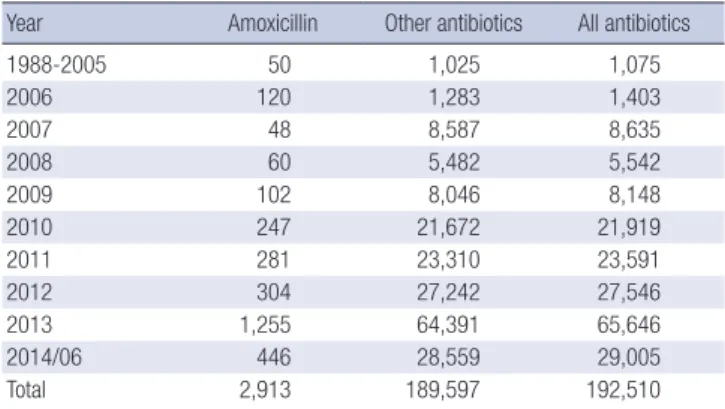
More than one AE can be included in one AE report of a specif- ic drug reported by one case patient, therefore resulting in more than one drug-AE pair for each AE report. The total number of drug-AE pairs associated with amoxicillin was 2,913, while the total number of AE reports of amoxicillin was 1,722, and among 241 types of AEs resulting from amoxicillin, 52 met the criteria of a signal. Among 192,510 antibiotics-AE pairs in the KAERS database, the number of amoxicillin pair was 2,913 (1.5%) and 189,597 were pairs by all the other antibiotics from December 1988 to June 2014. It is clear that the total number of AE reports by antibiotics has increased year by year (Table 1). The charac- teristics of reports of amoxicillin are presented in Table 2. Among the 1,722 reports attributed to amoxicillin, 660 (38.3%) were from male, and 853 (49.5%) were from female. The most fre- quent report by type was spontaneous reports (647, 37.6%). The
Table 1. Number of AE reports by amoxicillin and other antibiotics from December 1988 to June 2014
Year Amoxicillin Other antibiotics All antibiotics
1988-2005 50 1,025 1,075
2006 120 1,283 1,403
2007 48 8,587 8,635
2008 60 5,482 5,542
2009 102 8,046 8,148
2010 247 21,672 21,919
2011 281 23,310 23,591
2012 304 27,242 27,546
2013 1,255 64,391 65,646
2014/06 446 28,559 29,005
Total 2,913 189,597 192,510
Table 2. Characteristics of AE reports of amoxicillin from December 1988 to June 2014
Characteristics No. %
Gender Male Female Unknown
660 853 209
38.3 49.5 12.1 Age group
Pediatric Adolescent Adults Elderly Unknown
161 34 913 200 414
9.4 2.0 53.0 11.6 24.0 Report type
Spontaneous report Research (including review) Literature
Others
647 290 179 606
37.6 16.8 10.4 35.2 Report source by person
Doctor Pharmacist Nurse Customers Others Unknown
505 256 148 23 309 481
29.3 14.9 8.59 1.34 17.9 27.9 Report source by affiliation
Regional pharmacovigilance center Pharmaceutical company Medical institutions Pharmacy Consumer Others
1,009 599 92 9 7 6
58.6 34.8 5.3 0.5 0.4 0.4
Total 1,722 100
Table 3. Frequently reported AEs associated with amoxicillin
Adverse events No. %
Rash 331 11.4
Urticaria 193 6.6
Ineffective medicine 174 6.0
Diarrhea 170 5.8
Pruritus 143 4.9
Pharyngitis 105 3.6
Bronchitis 90 3.1
Rhinitis 84 2.9
Nausea 67 2.3
Fever 67 2.3
Vomiting 66 2.3
Taste perversion 66 2.3
Angioedema 58 2.0
Dyspepsia 53 1.8
Dyspnea 46 1.6
Dizziness 44 1.5
Abdominal pain 44 1.5
Otitis media 43 1.5
Allergy 41 1.4
Pneumonia 34 1.2
Others 994 34.1
Total 2,913 1,000
Table 4. Detected 52 signals of amoxicillin fulfilling the criteria for signal by three data mining indices
Adverse events No.* PRR ROR IC
95% LCI
Urticaria 193 1.29 1.31 0.16
Ineffective medicine 174 24.51 26.01 3.93
Pharyngitis 105 6.25 6.44 2.25
Bronchitis 90 11.44 11.77 2.99
Rhinitis 84 5.71 5.85 2.10
Taste perversion 66 19.09 19.51 3.53
Angioedema 58 3.48 3.53 1.38
Dyspepsia 53 1.6 1.61 0.29
Otitis media 43 10.40 10.55 2.75
Allergy 41 2.320 2.34 0.76
Upper respiratory tract Infection 33 2.62 2.64 0.89
Anaphylactic reaction 31 3.58 3.61 1.30
Sinusitis 30 10.85 10.95 2.72
Dermatitis 28 17.19 17.35 3.23
Face edema 24 3.43 3.45 1.19
Dry mouth 22 4.76 4.79 1.61
Edema 22 1.82 1.83 0.30
Stevens Johnson Syndrome 16 4.84 4.87 1.55
Gastroenteritis 15 6.30 6.33 1.87
Periorbital Edema 15 3.77 3.78 1.20
Generalized Edema 14 3.25 3.27 0.98
Allergic reaction 13 2.41 2.42 0.55
Bullous eruption 12 3.28 3.29 0.95
Somnolence 12 1.78 1.78 0.11
Malaise 12 1.64 1.65 0.00
Conjunctivitis 9 2.18 2.18 0.31
Nervousness 9 3.15 3.16 0.82
Epistaxis 9 4.07 4.08 1.16
Respiratory disorder 9 5.01 5.02 1.43
Anaphylactic shock 9 3.15 3.16 0.82
Fixed eruption 8 8.68 8.70 2.08
Injection site inflammation 8 3.03 3.03 0.73
Gastritis 6 2.96 2.96 0.62
Gastroesophageal reflux 6 6.97 6.99 1.73
Periodontal destruction 6 20.55 20.59 2.92
Epidermal necrolysis 5 6.14 6.15 1.51
Sputum disorder 5 2.23 2.23 0.18
Genital pruritus 4 18.60 18.62 2.67
Rash pustular 4 2.99 3.00 0.52
Gastrointestinal hemorrhage 4 2.89 2.90 0.47
Hypercholesterolemia 4 2.28 2.29 0.16
Gastric carcinoma 4 9.30 9.31 1.94
Crying abnormal 4 7.04 7.05 1.61
Induration 3 5.01 5.01 1.11
Tooth Disorder 3 9.76 9.77 1.90
Gastrointestinal disorder NOS 3 10.85 10.86 2.02
Flatulence 3 2.79 2.79 0.35
Gastric ulcer 3 2.33 2.33 0.11
Asthma 3 3.10 3.10 0.49
Pulmonary carcinoma 3 3.00 3.01 0.45
Halitosis 3 13.02 13.03 2.21
Influenza-like symptoms 3 10.28 10.29 1.96
PRR, proportional reporting ratio; ROR, reporting odds ratio; IC, information compo- nent; NOS, not otherwise specified.
*Number of countries containing adverse events on drug labels among Korea, USA, UK, France, Italy, Japan, Switzerland, and Germany.
most frequent report source by person was doctors (505, 29.3%), and the most frequent report source by affiliation was regional pharmacovigilance center (1,009, 58.6%), followed by pharma-
and bronchitis (Table 3). The detected signals for amoxicillin by fulfilling the criteria for signal by three data mining indices were 52 AEs, among which the frequent AEs were urticaria, ineffec- ceutical companies (599, 34.8%).
The frequent AEs associated with amoxicillin included rash, urticaria, ineffective medicine, diarrhea, pruritus, pharyngitis,
Table 5. Existence of the information of 52 detected signals on the drug labels of 9 countries
Adverse events No. Korea USA UK France Italy Japan Switzerland Germany Laos
Urticaria 193 Y Y Y Y Y Y Y Y Y
Ineffective medicine 174 - - - - - - - - -
Pharyngitis 105 - - - Y Y - Y Y -
Bronchitis 90 - - - - - - - - -
Rhinitis 84 - - - - - - - - -
Taste perversion 66 - Y - - - Y - Y -
Angioedema 58 Y Y Y Y Y Y Y Y Y
Dyspepsia 53 Y - - - Y - Y Y -
Otitis media 43 - - Y Y Y - Y Y -
Allergy 41 Y Y Y Y Y Y Y Y Y
Upper respiratory tract Infection 33 Y - - - - - - - -
Anaphylactic reaction 31 Y Y Y Y Y Y Y Y Y
Sinusitis 30 - - - - - - - - -
Dermatitis 28 Y Y Y Y Y Y Y Y Y
Face edema 24 - Y Y Y Y Y Y Y -
Dry mouth 22 - - - - - - - - -
Edema 22 - Y Y Y Y Y Y Y -
Stevens Johnson Syndrome 16 Y Y Y Y Y Y Y Y -
Gastroenteritis 15 Y Y Y - Y - Y Y -
Periorbital Edema 15 - Y Y Y Y Y Y Y -
Generalized Edema 14 - Y Y Y Y Y Y Y -
Allergic reaction 13 Y Y Y Y Y Y Y Y Y
Bullous eruption 12 Y Y Y Y Y Y Y Y -
Somnolence 12 Y Y - - Y - Y Y -
Malaise 12 Y - Y - - - - Y -
Conjunctivitis 9 - - Y Y Y Y Y Y -
Nervousness 9 Y Y - - - Y - Y -
Epistaxis 9 Y Y Y Y Y - Y Y -
Respiratory disorder 9 Y - Y Y Y Y Y Y -
Anaphylactic shock 9 Y Y - - Y - Y Y Y
Fixed eruption 8 Y Y Y Y Y Y Y Y Y
Injection site inflammation 8 Y Y Y - - - - Y -
Gastritis 6 Y - - - Y - - - -
Gastroesophageal reflux 6 - - - - - - - - -
Periodontal destruction 6 Y Y Y Y Y - Y Y -
Epidermal necrolysis 5 Y Y Y Y Y Y Y Y -
Sputum disorder 5 Y - - - - - - - -
Genital pruritus 4 Y Y Y Y Y Y Y Y Y
Rash pustular 4 Y Y Y Y Y Y Y Y Y
Gastrointestinal hemorrhage 4 Y Y Y - Y - Y Y -
Hypercholesterolemia 4 - - - - - - - - -
Gastric carcinoma 4 - - - - - - - - -
Crying abnormal 4 - - - - - - - - -
Induration 3 - - - - - - - - -
Tooth Disorder 3 Y - - - Y - Y Y -
Gastrointestinal disorder NOS 3 Y - - - Y - - - -
Flatulence 3 - Y Y - Y - Y Y -
Gastric ulcer 3 Y Y Y Y Y Y Y Y -
Asthma 3 - Y Y Y Y - Y Y -
Pulmonary carcinoma 3 - - - - - - - - -
Halitosis 3 Y - Y - Y - Y Y -
Influenza-like symptoms 3 - - - - - - - - -
Y, the adverse events contained in drug labels; -, the adverse events not contained in drug labels.
tive medicine, pharyngitis, bronchitis, rhinitis, taste perversion, angioedema, dyspepsia, otitis media, and allergy (Table 4). A total of 12 AEs including ineffective medicine, bronchitis, rhini- tis, sinusitis, dry mouth, gastroesophageal reflux, hypercholes- terolemia, gastric carcinoma, crying abnormal, induration, pul- monary carcinoma, and influenza-like symptoms were not list- ed on any of the drug labels of 9 countries (Table 5).
DISCUSSION
We identified 12 AEs as new signals associated with amoxicillin which were not listed on drug labels of 9 countries. Among them, ineffective medicine was the most frequent report, and one of the possible explanations for this might be due to partial adher- ence of patients for taking amoxicillin. Some patients may not follow the advice of medical professionals about the required duration needed to take the drug. Poor adherence to medica- tion is known to induce substantial worsening of morbidity and mortality and increased financial costs (21-23). In addition, poor medication adherence is a major cause of medication-related hospital admission from 33% to 69% (24,25). It is clear that if patients adhere and follow the prescription of their doctors cor- rectly, the result of treatment will be most effective (25). There- fore, it is important to educate and inform patients to keep high adherence to physician’s prescription.
Adverse events such as bronchitis, sinusitis and rhinitis are those of the indications of amoxicillin (26). This might be the result of being unaware of the indication of the medication from the patients. Sometimes patients use antibiotics incorrectly in terms of time, either early or later than their physician’s expect- ed use. One previous study suggests that amoxicillin provides little symptomatic benefit for patients visiting primary care clin- ics for acute lower-respiratory-tract infection (27). Moreover, since H. pylori infection is a common chronic gastric infection in worldwide, H. pylori resistance for amoxicillin could be one of the reasons for treatment failures of amoxicillin (5). In line with the literature (28-31), it was found that chronic atrophic gastritis associated with H. pylori infection increases risk of gas- tric carcinoma. In case of hypercholesterolemia, some case re- port found H. pylori associated protein-losing hypertrophic gas- tropathy with hypercholesterolemia (32).
Even though the adverse events such as gastric carcinoma, abnormal crying, gastroesophageal reflux and pulmonary car- cinoma are not listed in the drug label, the symptoms of these diseases do appear in the label. For example, in case of gastric carcinoma, its symptoms such as abdominal pain, vomiting, and bloody stool are indicated as the adverse effects of amoxi- cillin. Besides that, several symptoms of pulmonary carcinoma such as difficult breathing, coughing, and chest pain were in- cluded in the drug label of amoxicillin. Particularly, asthma is not labeled in Asian countries but is on all drug labels of west-
ern countries. This might explain the unknown ethnic effect of amoxicillin.
Differently from other countries in our study, Laos had fewer adverse effects listed on the drug label. This might be due to the absence of AE reporting system in Laos. Even though drug safe- ty monitoring and evaluation was one of the thirteen elements of Lao National Drug Policy since 1992 (33), spontaneous AE reports have not been collected until now, and regulatory ac- tions responding drug safety issues were passively done in re- sponse to other developed countries’ safety alert and commu- nications. Drug safety monitoring including AE reporting and product surveillance is an essential component of safe drug use by the people in Laos, therefore sufficient budget should be pro- vided to activate spontaneous AE reporting system in Laos like the one in Korea.
The most crucial limitation of this study derives from the fact that KAERS database is a result of spontaneous AE reporting system. AEs are usually underreported in any spontaneous AE reporting system in the world. The reporting rate can vary with the particular adverse event, but average is approximated about 6% (34). Since the knowledge and opinion of health profession- als are significant determinants of spontaneous reporting (35), it is less likely for the unknown AEs to be reported. Under-re- porting of AEs could reduce sensitivity because it underesti- mates the frequency and thereby the impact of a given ADR.
Also, the absence of an unexposed control group, lack of infor- mation on denominator of a suspected drug exposure do not allow the quantification of risk and a definite association can- not be provided, which requires complementary post-market- ing safety assessment method such as cohort or case-control study (36). Although data mining is being applied for detecting signals early and effectively for fulfilling the purpose of phar- macovigilance, early signals may be equivocal. Nevertheless, this study was the first attempt to detect amoxicillin signals us- ing the KAERS database, a nationwide source of information for hypothesis generation in drug safety. Early detection of seri- ous and unexpected signals is significantly meaningful in phar- macovigilance, which can help to protect people from the haz- ard of drugs.
In conclusion, we detected signals of amoxicillin and com- pared those information among the labels of 9 countries, and found that 12 AEs were not listed on the drug labels of any of the 9 countries. Therefore, it should be followed by signal evalu- ation including causal association, clinical significance and pre- ventability.
DISCLOSURE
The authors have no conflicts of interest to disclose.
AUTHOR CONTRIBUTION
Conception and design: Soukavong M, Park BJ. Analysis and interpretation: Soukavong M, Kim J, Park K, Yang BR, Lee J, Park BJ. Writing or revision of the manuscript: Soukavong M, Kim J, Park K, Park BJ. Study supervision and approval of final manu- script: all authors.
ORCID
Mick Soukavong http://orcid.org/0000-0003-2958-7936 Jungmee Kim http://orcid.org/0000-0002-1955-843X Kyounghoon Park http://orcid.org/0000-0001-5800-917X Bo Ram Yang http://orcid.org/0000-0002-8771-8829 Joongyub Lee http://orcid.org/0000-0003-2784-3772 Xue-Mei Jin http://orcid.org/0000-0003-1132-7271 Byung-Joo Park http://orcid.org/0000-0003-4630-4942 REFERENCES
1. Klein JO. Amoxicillin/clavulanate for infections in infants and children:
past, present and future. Pediatr Infect Dis J 2003; 22: S139-48.
2. Gillies M, Ranakusuma A, Hoffmann T, Thorning S, McGuire T, Glasziou P, Del Mar C. Common harms from amoxicillin: a systematic review and meta-analysis of randomized placebo-controlled trials for any indication.
CMAJ 2015; 187: E21-31.
3. Pechère JC. Patients’ interviews and misuse of antibiotics. Clin Infect Dis 2001; 33 Suppl 3: S170-3.
4. Arias CA, Murray BE. A new antibiotic and the evolution of resistance. N Engl J Med 2015; 372: 1168-70.
5. Dore MP, Piana A, Carta M, Atzei A, Are BM, Mura I, Massarelli G, Maida A, Sepulveda AR, Graham DY, et al. Amoxycillin resistance is one reason for failure of amoxycillin-omeprazole treatment of Helicobacter pylori infection. Aliment Pharmacol Ther 1998; 12: 635-9.
6. Lee JW, Kim N, Kim JM, Nam RH, Chang H, Kim JY, Shin CM, Park YS, Lee DH, Jung HC. Prevalence of primary and secondary antimicrobial resis- tance of Helicobacter pylori in Korea from 2003 through 2012. Helicobacter 2013; 18: 206-14.
7. Nishizawa T, Suzuki H, Tsugawa H, Muraoka H, Matsuzaki J, Hirata K, Ike- da F, Takahashi M, Hibi T. Enhancement of amoxicillin resistance after unsuccessful Helicobacter pylori eradication. Antimicrob Agents Che- mother 2011; 55: 3012-4.
8. Mendonça S, Ecclissato C, Sartori MS, Godoy AP, Guerzoni RA, Degger M, Pedrazzoli J Jr. Prevalence of Helicobacter pylori resistance to metronida- zole, clarithromycin, amoxicillin, tetracycline, and furazolidone in Brazil.
Helicobacter 2000; 5: 79-83.
9. Goossens H, Ferech M, Vander Stichele R, Elseviers M; ESAC Project Group.
Outpatient antibiotic use in Europe and association with resistance: a cross- national database study. Lancet 2005; 365: 579-87.
10. Jensen US, Muller A, Brandt CT, Frimodt-Møller N, Hammerum AM, Mon- net DL; DANRES study group. Effect of generics on price and consump- tion of ciprofloxacin in primary healthcare: the relationship to increasing resistance. J Antimicrob Chemother 2010; 65: 1286-91.
11. Song YA, Jung SI, Chang MO, Ban HJ, Jin NC, Kim HK, Park KH, Shin JH, Bae SY. Relationship between antibiotic use and antibiotic resistance in major nosocomial pathogens at a university hospital. Chonnam Med J 2008; 44: 137-43.
12. Lee YS, Kwon JW, Oh OH, Sohn HS. Temporal decrease in overall antibi- otic consumption accompanying antibiotic prescribing rate disclosure policy: evidence from analysis of national health insurance claims data in South Korea. Arch Pharm Res 2014; 37: 1295-300.
13. Song JH, Jung SI, Ko KS, Kim NY, Son JS, Chang HH, Ki HK, Oh WS, Suh JY, Peck KR, et al. High prevalence of antimicrobial resistance among clin- ical Streptococcus pneumoniae isolates in Asia (an ANSORP study). An- timicrob Agents Chemother 2004; 48: 2101-7.
14. Kim HJ, Ruger JP. Pharmaceutical reform in South Korea and the lessons it provides. Health Aff (Millwood) 2008; 27: w260-9.
15. Zorych I, Madigan D, Ryan P, Bate A. Disproportionality methods for phar- macovigilance in longitudinal observational databases. Stat Methods Med Res 2013; 22: 39-56.
16. Seong JM, Choi NK, Jung SY, Kim YJ, Lee JY, Park BJ. Signal detection of sildenafil in Korean spontaneous adverse event reports. J Pharmacoepi- demiol Risk Manag 2009; 2: 38-44.
17. Evans SJ, Waller PC, Davis S. Use of proportional reporting ratios (PRRs) for signal generation from spontaneous adverse drug reaction reports.
Pharmacoepidemiol Drug Saf 2001; 10: 483-6.
18. Poluzzi E, Raschi E, Piccinni C, De Ponti F. Data mining techniques in pharmacovigilance: analysis of the publicly accessible FDA adverse event reporting system (AERS) [Internet]. Available at http://www.intechopen.
com/books/data-mining-applications-in-engineering-and-medicine/
data-mining-techniques-in-pharmacovigilance-analysis-of-the-publicly- accessible-fda-adverse-event-re [accessed on 8 May 2016].
19. van Puijenbroek EP, Bate A, Leufkens HG, Lindquist M, Orre R, Egberts AC. A comparison of measures of disproportionality for signal detection in spontaneous reporting systems for adverse drug reactions. Pharmaco- epidemiol Drug Saf 2002; 11: 3-10.
20. Hauben M. A brief primer on automated signal detection. Ann Pharma- cother 2003; 37: 1117-23.
21. McDonnell PJ, Jacobs MR. Hospital admissions resulting from prevent- able adverse drug reactions. Ann Pharmacother 2002; 36: 1331-6.
22. Rodgers PT, Ruffin DM. Medication nonadherence: part II--a pilot study in patients with congestive heart failure. Manag Care Interface 1998; 11:
67-9.
23. Senst BL, Achusim LE, Genest RP, Cosentino LA, Ford CC, Little JA, Ray- bon SJ, Bates DW. Practical approach to determining costs and frequency of adverse drug events in a health care network. Am J Health Syst Pharm 2001; 58: 1126-32.
24. Levy G, Zamacona MK, Jusko WJ. Developing compliance instructions for drug labeling. Clin Pharmacol Ther 2000; 68: 586-91.
25. Osterberg L, Blaschke T. Adherence to medication. N Engl J Med 2005;
353: 487-97.
26. Gonzales R, Malone DC, Maselli JH, Sande MA. Excessive antibiotic use for acute respiratory infections in the United States. Clin Infect Dis 2001;
33: 757-62.
27. Little P, Stuart B, Moore M, Coenen S, Butler CC, Godycki-Cwirko M, Mi- erzecki A, Chlabicz S, Torres A, Almirall J, et al. Amoxicillin for acute low- er-respiratory-tract infection in primary care when pneumonia is not sus- pected: a 12-country, randomised, placebo-controlled trial. Lancet Infect
Dis 2013; 13: 123-9.
28. Ohata H, Kitauchi S, Yoshimura N, Mugitani K, Iwane M, Nakamura H, Yoshikawa A, Yanaoka K, Arii K, Tamai H, et al. Progression of chronic atrophic gastritis associated with Helicobacter pylori infection increases risk of gastric cancer. Int J Cancer 2004; 109: 138-43.
29. Haruma K, Komoto K, Kamada T, Ito M, Kitadai Y, Yoshihara M, Sumii K, Kajiyama G. Helicobacter pylori infection is a major risk factor for gastric carcinoma in young patients. Scand J Gastroenterol 2000; 35: 255-9.
30. Parsonnet J, Friedman GD, Vandersteen DP, Chang Y, Vogelman JH, Orent- reich N, Sibley RK. Helicobacter pylori infection and the risk of gastric car- cinoma. N Engl J Med 1991; 325: 1127-31.
31. Sierra López R, Bértoli F, Peñafiel EF. Helicobacter pylori infection and the risk of gastric carcinoma. Report of a case. Rev Med Panama 1994;
19: 48-54.
32. Kapsoritakis AN, Potamianos S, Matrella E, Koukouraki S, Oeconomaki E, Tzardi M, Karkavitsas N, Kouroumalis EA. Helicobacter pylori-associated protein-losing hypertrophic gastropathy with hypercholesterolemia. Dig Dis Sci 1999; 44: 1843-7.
33. Paphassarang C, Tomson G, Choprapawon C, Weerasuriya K. The Lao national drug policy: lessons along the journey. Lancet 1995; 345: 433-5.
34. Hazell L, Shakir SA. Under-reporting of adverse drug reactions: a system- atic review. Drug Saf 2006; 29: 385-96.
35. Lopez-Gonzalez E, Herdeiro MT, Figueiras A. Determinants of under-re- porting of adverse drug reactions: a systematic review. Drug Saf 2009; 32:
19-31.
36. Bate A, Evans SJ. Quantitative signal detection using spontaneous ADR reporting. Pharmacoepidemiol Drug Saf 2009; 18: 427-36.