Neurorestoration Induced by Mesenchymal Stem Cells:
Potential Therapeutic Mechanisms for Clinical Trials
Jung Hwa Seo
1,2and Sung-Rae Cho
1,2,31Department and Research Institute of Rehabilitation Medicine, Yonsei University College of Medicine, Seoul;
2Program of Nano Science and Technology, Yonsei University Graduate School, Seoul;
3Brain Korea 21 Project for Medical Science, Yonsei University, Seoul, Korea.
Received: January 4, 2012 Revised: January 22, 2012 Accepted: February 1, 2012
Corresponding author: Dr. Sung-Rae Cho, Department of Rehabilitation Medicine, Yonsei University College of Medicine, 50 Yonsei-ro, Seodaemun-gu, Seoul 120-752, Korea.
Tel: 82-2-2228-3715, Fax: 82-2-363-2795 E-mail: [email protected]
∙ The authors have no financial conflicts of interest.
© Copyright:
Yonsei University College of Medicine 2012 This is an Open Access article distributed under the terms of the Creative Commons Attribution Non- Commercial License (http://creativecommons.org/
licenses/by-nc/3.0) which permits unrestricted non- commercial use, distribution, and reproduction in any medium, provided the original work is properly cited.
Stem cells are emerging as therapeutic candidates in a variety of diseases because of their multipotent capacities. Among these, mesenchymal stem cells (MSCs) de- rived from bone marrow, umbilical cord blood or adipose tissue, comprise a popu- lation of cells that exhibit extensive proliferative potential and retain the ability to differentiate into multiple tissue-specific lineage cells including osteoblasts, chon- drocytes, and adipocytes. MSCs have also been shown to enhance neurological re- covery, although the therapeutic effects seem to be derived from an indirect para- crine effect rather than direct cell replacement. MSCs secrete neurotrophic factors, promote endogenous neurogenesis and angiogenesis, encourage synaptic connec- tion and remyelination of damaged axons, decrease apoptosis, and regulate inflam- mation primarily through paracrine actions. Accordingly, MSCs may prevail as a promising cell source for cell-based therapy in neurological diseases.
Key Words:
Mesenchymal stem cells, paracrine effect, cell-based therapy
INTRODUCTION
Stem cells are emerging as therapeutic candidates in a variety of disease because
of their multipotent capacities. Embryonic stem cells are pluripotent and can dif-
ferentiate into all specialized cell types derived from the three embryonic germ
layers. Nevertheless, both ethical and technical considerations limit the clinical
availability of these cells. Other potential cell sources, especially for central ner-
vous system (CNS) repair, include fetal neural stem cells (NSCs) and neural pre-
cursor cells (NPCs). NSCs can be expanded over multiple passages and do not re-
quire the recapitulation of early developmental signals to induce neuroectodermal
commitment, as they are already neuralized and committed to a CNS cell fate.
1However, transplantation of fetal NSCs into the adult brain encompasses numer-
ous ethical and scientific hurdles.
1-3Because of their plastic ability to survive as
undifferentiated cells in ectopic perivascular niches,
4NPCs have been tested in an-
imal models of neurological diseases. These cells also release paracrine factors
that foster survival and proliferation of endogenous neural progenitor cells. How-
ever, the application of terminal differentiation of NPCs into neural-lineage cells to
ocytes and skeletal muscle,
23although there is a lack of definitive evidence as to the functionality of these differen- tiated cells.
26,27Nevertheless, MSCs have considerably con- tributed to tissue repair in myocardial infarction (MI),
28stroke,
29,30meniscus injury,
31and limb ischemia.
32In this review, we will discuss the therapeutic mecha- nisms of MSCs for neurorestoration and neural regenera- tion. Thereafter, we will review the published reports of clinical trials for a variety of neurological diseases includ- ing stroke, traumatic brain injury, spinal cord injury, Parkin- son’s disease (PD), amyotrophic lateral sclerosis (ALS), and multiple sclerosis (MS).
THERAPEUTIC MECHANISMS OF MSC
SFOR NEURORESTORATION
Secretion of neurotrophic factors
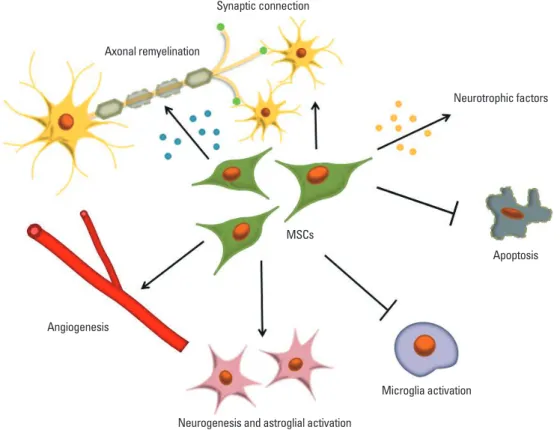
MSCs secrete a variety of cytokines and growth factors that promote endogenous neuronal growth, neurogenesis and angiogenesis, encourage synaptic connection and remyelin- ation of damaged axons, decrease apoptosis, and regulate inflammation primarily through paracrine actions (Fig. 1).
replace damaged cells remains controversial.
5In contrast, adult stem cells, responsible for maintaining the homeostasis of a specific tissue with fewer ethical prob- lems. One of the most extensively studied populations of multipotent adult stem cells is mesenchymal stem cells (MSCs), which are derived from bone marrow (BM). They can also be isolated from other tissues such as umbilical cord blood,
6synovium,
7periosteum,
8peripheral blood,
9adi- pose tissue,
10skeletal muscle,
11and placental tissue.
12MSCs are an excellent candidate for cell therapy because they are easily accessible; can be easily isolated and expanded rapid- ly in vitro;
13are multipotent;
14,15involve minimal loss of po- tency;
16,17form supportive stroma for hematopoiesis and support stem cell engraftment;
18may not require immune suppression;
19,20seem to be largely immunologically inert, paving the way for allogeneic transplantation;
21secrete nu- merous trophic factors that modulate inflammation and apoptosis.
22The large body of work that has accumulated since the discovery of human MSCs has convincingly shown that MSCs from diverse sources retain the ability to differentiate into the mesodermal lineage cells including os- teoblasts, chondrocytes and adipocytes.
23,24They also ex- hibit the ability to differentiate into neurons-like cells,
25my-
Fig. 1. Potential therapeutic mechanisms of neurorestoration using mesenchymal stem cells. MSCs secrete a variety of neurotrophic fac- tors that promote endogenous neuronal growth, induce angiogenesis, neurogenesis and astroglial activation, encourage synaptic con- nection and axonal remyelination, decrease apoptosis, and regulate microglial activation primarily through paracrine actions. MSCs, mesenchymal stem cells.
Synaptic connection Axonal remyelination
Neurotrophic factors
MSCs
Apoptosis
Microglia activation Angiogenesis
Neurogenesis and astroglial activation
able functional recovery obtained with the administration of MSCs in experimental models of stroke as well as spinal cord injury.
43,44Immunomodulatory effect
MSCs were shown to exert immunomodulatory properties
in vitro.45These features were exploited by researchers in the treatment models of MS and experimental autoimmune encephalomyelitis.
46,47In PD, MSCs act as neuroprotectors via an anti-inflammatory response to regulate the activity of microglia and to protect dopaminergic neurons.
48,49In isch- emic brain, MSCs were also useful as an immunomodula- tor.
50MSCs reduced the numbers of Iba-1
+and ED1
+in- flammatory cells.
39In our previous study, intravenously transplanted MSCs did not only decrease the level of pro-in- flammatory cytokine IL-1β and the proportion of activated microglia, but also increased the level of anti-inflammatory cytokine IL-10, potentially suggesting that early immuno- modulation by MSCs was an underlying mechanism of functional recovery in spinal cord injured rats.
51Induction of angiogenesis
MSCs secrete a number of growth factors and cytokines, which normally support the proliferation of hematopoietic stem/progenitor cells.
22In experimental models of cardio- vascular diseases such as MI and limb ischemia, the secre- tion of multiple angiogenic cytokines such as hepatocyte growth factor, basic fibroblast growth factor, insulin-like growth factor 1 and vascular endothelial growth factor was induced from MSCs.
52-56Existing evidence suggests that these cells can ameliorate ischemic tissue injury, produce appropriate cytokine milieu to promote angiogenesis, and possibly differentiate into endothelial cells.
54,55,57The evi- dence seems to point toward the theory that a complex set of trophic factors secreted by MSCs significantly contrib- utes to injury repair in vivo by stimulating angiogenesis.
Host cell effects stimulated by MSC transplantation
MSCs are believed to secrete neurotrophic factors, immuno- modulatory cytokines, pro-angiogenic factors, extracellular matrix molecules and so on. Thus, the therapeutic effects of transplanted MSCs seem to be derived from paracrine ef- fects rather than direct cell replacement. It is conceivable that MSCs or host brain cells stimulated by grafts may pro- duce such proteins to induce functional recovery and reorga- nization.
58MSC-induced secretion of beneficial cytokines by host cells in subjects with neurological diseases such as Human MSCs are known to secrete neurotrophic factors in-
cluding brain-derived neurotrophic factor (BDNF), ciliary neurotrophic factor, glial cell line-derived neurotrophic fac- tor (GDNF), and nerve growth factor (NGF). After direct transplantation in an animal model of stroke, human MSCs were shown to integrate into host brain, survive, differenti- ate into neurons and astrocytes, and induce neurobehavioral improvement.
33BM-derived MSCs can secrete various tro- phic factors, the secretion of which is enhanced under post- ischemic conditions.
34,35In our previous study using a rat model of spinal cord injury, neurally induced cells derived from umbilical cord blood also exhibited better functional recovery in vivo and secreted more NGFs in vitro.
36 Induction of neurogenesis and astroglial activationMSCs induce the proliferation of endogenous neural stem/
progenitor cells in the subventricular zone (SVZ) and are critical to the survival of newborn cells.
37They have been shown to be directly involved in neural differentiation after engraftment into damaged tissue and migrate to the CNS to a limited extent.
38Of particular note, genetically modified MSCs expressing Neurogenin1, a proneuronal gene that di- rects neural differentiation, increased the therapeutic effects of MSCs in ischemic brain.
39In addition, MSCs promote the plasticity of damaged neurons and activate astroglial cells to secrete neurotrophins such as BDNF, GDNF and NGF.
34In an animal model of stroke, intravenous transplan- tation of BM stromal cells improved functional outcomes by promoting endogenous repair.
29Axonal sprouting and synaptic connection
Previous study suggested that extracellular matrix compo- nents derived from MSCs can enhance nervous system re- pair.
40For example, fibronectin prominently performs es- sential roles in neuronal survival, axonal sprouting and synaptogenesis following cerebral ischemia.
41Moreover, extracellular matrix molecules and cell adhesion molecules such as integrin, cadherin, and selectin can promote axonal growth and regeneration.
42Anti-apoptotic effect
Reportedly intravenous transplantation of MSCs reduced
apoptotic cells stained with terminal deoxynucleotidyl trans-
ferase-mediated dUTP nick-end labeling in an animal model
of middle cerebral artery occlusion.
29This anti-apoptotic ef-
fect, together with the previously described capacity to re-
lease neurotrophic molecules, may well explain the remark-
1 year, and trends towards increased functional recovery.
71This group also reported as a long-term follow-up study for 5 years no serious adverse effects following MSC treat- ment.
72Direct administration of MSCs to an injured region following traumatic brain injury has also been performed without adverse events. Briefly, seven patients each re- ceived up to 10
9expanded MSCs as part of a cranial repair operation. The patients were followed up for six months and demonstrated significant improvements in neurological function.
73,74MSC in spinal cord injury
Depending on the severity and location of injury, patients present with a varying range of functional impairments, aris- ing from both damage to the local circuitry of the spinal cord and disruption of the ascending and descending fiber tracts.
75,76All groups who have tested the safety of the trans- plantation of BM-derived mononuclear cells and stromal cells, or adipose tissue-derived MSCs in patients with spinal cord injury indicate that administration of these cells does not cause any serious adverse effects.
77-80Geffner, et al.
77in- vestigated the improvement in quality of life and bladder function without pain or tumor up to 2 years. Syková, et al.
78reported that five patients who received cells intra-arterially showed improvement up to 1 year.
MSC in parkinson’s disease
PD is a progressive neurodegenerative disease whose dopa- minergic neurons selectively degenerate in the substantia nigra. Although a variety of drugs such as L-dopa are avail- able, they only remain effective for a certain period in most patients. The limitation of pharmacologic agents increases the need for cell-based therapy as a restorative strategy. In a study recently reported by Li, et al.,
81two subjects with PD who underwent transplantation of fetal mesencephalic do- paminergic neurons, which had survived for over 10 years, but later developed α-synuclein-positive Lewy bodies in the engrafted donor neurons, suggesting that the disease can propagate from host to graft cells. On the other hand, when autologous BM-derived MSCs were transplanted into the SVZ by stereotaxic surgery, the results suggested the treat- ment to be safe, and no serious adverse events occurred af- ter transplantation in PD.
82Additionally, when patients with multiple system atrophy (MSA) were treated with MSCs, greater improvement was noted on the unified MSA rating scale than in untreated control patients, and no delayed ad- verse effects related to MSC infusion occurred during the stroke
29as well as spinal cord injury
33,44,59would be a more
plausible mechanism given that activation of recipient host cells after cell transplantation has been previously described in other disease models such as MI and ischemic vascular disease.
60,61CLINICAL TRIALS IN NEUROLOGICAL DISEASES
Several clinical reports on MSC-based treatments have been published in the past decade, and evoked great excitement for therapeutic candidates for several diseases.
62As early as the 1990s, cultured MSCs have already been supplemented to reduce acute and chronic graft-versus-host disease among patients receiving allogenic hematopoietic stem cell trans- plantation, as well as to ameliorate clinical symptoms in os- teogenesis imperfecta and glycogen storage disease.
62-64Currently, the effective therapeutic benefits of MSCs have been supported by increasing numbers of clinical trials on various disorders such as MI, cancer, diabetes mellitus, and Crohn’s disease.
65-68We will discuss the role of MSCs in neurological diseas- es, spanning the clinical trials on stroke, spinal cord injury, PD, ALS, and MS. A summary of the cell source, route of delivery, number of patients, study design, dose of trans- plant, outcome measures and main results for each thera- peutic application of MSCs is provided in Table 1.
MSC in stroke and traumatic brain injury
Neuronal and astroglial damages can occur in cerebrovas- cular disease resulting from the blockage of blood flow in selected brain areas, leading to motor, sensory and cogni- tive dysfunctions.
3It has been shown that stroke-induced endogenous neurogenesis and migration of neural stem or progenitor cells into regions of ischemic damage occurs in humans, but the extent to which neurogenesis is able to re- place lost neurons or contributes to functional improvement in stroke patients is largely limited.
3,69,70The limited thera- peutic efficacy of endogenous repair processes has encour- aged clinicians to incorporate MSCs or BM-derived cells in restorative strategies.
Clinical trials for MSC transplantation to treat stroke and
traumatic brain injury are currently ongoing. In patients
with middle cerebral artery infarction, the use of autologous
MSCs derived from BM has indicated no safety concerns
for death, stroke recurrence, or serious adverse events up to
Table 1. A Summary of the Clinical Trials That Used Autologous Mesenchymal Stem Cells in Treatment of Neurological Diseases Route of deliveryNumber of patientsStudy designDose of transplantMain resultsCommentsReference StrokeIntravenousTreatment 5; control 25Phase 1-2 randomized, controlled safety, efficacy5×107 cells in two dosesSafety: no death, stroke recurrence, or serious adverse events after 1 year Efficacy: trend towards increased functional recoveryMiddle cerebral artery infarctsBang, et al.71 IntravenousTreatment 16; control 36Phase 1-2 randomized, controlled safety, efficacy5×107 cells in two dosesSafety: no death, stroke recurrence, or serious adverse events after 5 years Efficacy: trend towards increased functional recoveryMiddle cerebral artery infarctsLee JS, et al.72 Traumatic brain injuryDirectly to injured area or intravenousTreatment 7Phase 1, open, safety1st 107 -109 cells 2nd 108 -1010 cellsSafety: no death, cell-related serious AE, no toxicity related to MSC within 6 monthsZhang, et al.73 Spinal cord injury (SCI) IntrathecalTreatment 30Phase 1-2a, open, safety, efficacy1×106 cells/kgSafety: no serious adverse events Efficacy: no change in ASIA scale; improvement in Barthel’s index in thoracic injury occurred within 6 months
Patients with complete SCI at cervical or thoracic levelPal, et al.79 IntravenousTreatment 8Phase 1, open, safety4×108 cellsNo serious adverse eventsAdipose tissueRa, et al.80 Spinal cord, spinal canal, intravenousTreatment 8 (4 acute, 4 chronic)Phase 1, open, safety4×108 mononuclear cellsNo tumors or pain, improvement in quality of life and bladder functionGeffner, et al.77 Intra-arterial or intravenousTreatment 20 (7 acute, 13 chronic)Phase 1, open, safety104±55.3×10⁸ mononuclear cellsNo complications up to 1 year, 5 patients treated intra-arterially showed improvementOnly 1 chronic SCI reported improvementSyková, et al.78 Parkinson’s diseaseIntra-ventricleTreatment 7Phase 1, open, safety1×106 cells/kgSafe and no serious adverse events for 12-36 months.Feasibility studyVenkataramana, et al.82 Amyotrophic lateral sclerosis
Intra-spinal cordTreatment 10Phase 1, open, safety11.4-120×106 cellsPain (n=7), localized sensory impairment (n=5), localized tingling sensation (n=1)Feasibility study, two-five injectionsMazzini, et al.87 Intra-spinal cordTreatment 9Phase 1, open, safety57×106 cellsTransient pain (n=4), transient sensory disturbances (n=6)Mazzini, et al.86 Intrathecal, intrathecal plus intravenousTreatment 19Phase 1-2a, open, safety, efficacy23.4-54.7×10⁶ cellsSafety: no major adverse events Efficacy: neurological disorders unchanged during 6 months
Fever (n=11), headache (n=5), dyspnea (n=1)Karussis, et al.85 Multiple sclerosis (MS)
IntrathecalTreatment 10Phase 1-2a, open, safety, efficacy8.73×106 cellsSafety: iatrogenic meningitis (n=2), headache (n=9) Efficacy: EDSS unchanged (n=4), worsened (n=5), improved (n=1), MRI showed no change (n=7), increased lesion (n=2), decreased lesion (n=1) Progressive MS with baseline EDSS <6.0 mean follow- up of 19 months
Mohyeddin, et al.88 IntrathecalTreatment 10Phase 1-2a, open, safety, efficacy32-100×106 cellsSafety: encephalopathy, seizure Efficacy: clinical improvement (n=6), worsening of MRI (n= 2)EDSS 4.0-7.5Yamout, et al.89 Intrathecal, intrathecal plus intravenousTreatment 15Phase 1-2a, open, safety, efficacy24.5-63.2×10⁶ cellsSafety: fever (n=10), headache (n=10), aseptic meningitis (n=1), no serious adverse events Efficacy: reduction of EDSS
Active MS that did not respond to treatmentsKarussis, et al.85 MSC, mesenchymal stem cells; AE, adverse event; EDSS, expanded disability status scale.
ACKNOWLEDGEMENTS
This study was supported by grants from National Research Foundation (NRF-2010-0020408; 2010-0024334), Yonsei University College of Medicine (6-2011-0078), and Stem Cell Research Center of the 21st Century Frontier Research Program (SC-4160) funded by the Ministry of Science and Technology, Republic of Korea.
REFERENCES
1. Gogel S, Gubernator M, Minger SL. Progress and prospects: stem cells and neurological diseases. Gene Ther 2011;18:1-6.
2. Lovell-Badge R. The regulation of human embryo and stem-cell research in the United Kingdom. Nat Rev Mol Cell Biol 2008;9:
998-1003.
3. Mathews DJ, Sugarman J, Bok H, Blass DM, Coyle JT, Duggan P, et al. Cell-based interventions for neurologic conditions: ethical challenges for early human trials. Neurology 2008;71:288-93.
4. Uccelli A, Laroni A, Freedman MS. Mesenchymal stem cells for the treatment of multiple sclerosis and other neurological diseases.
Lancet Neurol 2011;10:649-56.
5. Martino G, Pluchino S. The therapeutic potential of neural stem cells. Nat Rev Neurosci 2006;7:395-406.
6. Erices AA, Allers CI, Conget PA, Rojas CV, Minguell JJ. Human cord blood-derived mesenchymal stem cells home and survive in the marrow of immunodeficient mice after systemic infusion. Cell Transplant 2003;12:555-61.
7. De Bari C, Dell’Accio F, Tylzanowski P, Luyten FP. Multipotent mesenchymal stem cells from adult human synovial membrane.
Arthritis Rheum 2001;44:1928-42.
8. Fukumoto T, Sperling JW, Sanyal A, Fitzsimmons JS, Reinholz GG, Conover CA, et al. Combined effects of insulin-like growth factor-1 and transforming growth factor-beta1 on periosteal mes- enchymal cells during chondrogenesis in vitro. Osteoarthritis Car- tilage 2003;11:55-64.
9. Villaron EM, Almeida J, López-Holgado N, Alcoceba M, Sán- chez-Abarca LI, Sanchez-Guijo FM, et al. Mesenchymal stem cells are present in peripheral blood and can engraft after alloge- neic hematopoietic stem cell transplantation. Haematologica 2004;89:1421-7.
10. Zuk PA, Zhu M, Mizuno H, Huang J, Futrell JW, Katz AJ, et al.
Multilineage cells from human adipose tissue: implications for cell-based therapies. Tissue Eng 2001;7:211-28.
11. Cao B, Zheng B, Jankowski RJ, Kimura S, Ikezawa M, Deasy B, et al. Muscle stem cells differentiate into haematopoietic lineages but retain myogenic potential. Nat Cell Biol 2003;5:640-6.
12. Parolini O, Alviano F, Bagnara GP, Bilic G, Bühring HJ, Evange- lista M, et al. Concise review: isolation and characterization of cells from human term placenta: outcome of the first international Workshop on Placenta Derived Stem Cells. Stem Cells 2008;26:
300-11.
13. Sekiya I, Larson BL, Smith JR, Pochampally R, Cui JG, Prockop DJ. Expansion of human adult stem cells from bone marrow stro- ma: conditions that maximize the yields of early progenitors and
12-month study period.
83MSC in amyotrophic lateral sclerosis
ALS involves a pathology that causes a selective loss of motor neurons leading to a progressive decline in muscle function and poor prognosis. When Nagano, et al. complet- ed a small double-blind clinical trial to assess the effect of intrathecal administration of IGF-1 on disease progression in nine patients with ALS, the high-dose treatment slowed the decline of motor functions, but not bulbar function or vital capacity.
84On the other hand, both intravenous and in- trathecal administration of autologous MSCs were well tol- erated, with some preliminary evidence of efficacy in pa- tients with ALS.
85-87However, large controlled clinical studies are needed to assess possibility for this therapeutic strategy.
MSC in multiple sclerosis
Most phase 1 studies for the safety of MSCs have been conducted in MS.
85,88,89As a result, Mohyeddin, et al.
88re- ported iatrogenic meningitis and headache; Yamout, et al.
89reported transient encephalopathy and seizure; and Karus- sis, et al.
85reported fever, headache and aseptic meningitis.
Although serious adverse events related with cell transplan- tation are likely to be extremely uncommon in MS, the therapeutic efficacy in regards to clinical improvement re- mains controversial.
85,88,89CONCLUSIONS
Experimental evidence in preclinical models of neurological diseases suggests that MSCs are a promising candidate for achieving neural repair and protection. However, current data do not support the possibility that most of the reported effects occur as a result of direct cell replacement. Instead, indirect paracrine mechanisms, including a potent anti-in- flammatory capacity, the release of anti-apoptotic and neu- rotrophic factors, and the ability to induce proliferation of local neural stem/progenitor cells, are likely to promote neu- rorestoration. Despite tremendous advancements, major un- resolved issues concerning therapeutic application still exist.
Especially, transplanted MSCs suffer from poor survival and
engraftment into host tissue. Further studies are necessary to
evaluate in depth the efficacy and safety of MSC-based ther-
apy and whether such treatment would involve a high bene-
fit-to-risk ratio in neurological diseases.
33. Nagai A, Kim WK, Lee HJ, Jeong HS, Kim KS, Hong SH, et al.
Multilineage potential of stable human mesenchymal stem cell line derived from fetal marrow. PLoS One 2007;2:e1272.
34. Li Y, Chen J, Chen XG, Wang L, Gautam SC, Xu YX, et al. Hu- man marrow stromal cell therapy for stroke in rat: neurotrophins and functional recovery. Neurology 2002;59:514-23.
35. Qu R, Li Y, Gao Q, Shen L, Zhang J, Liu Z, et al. Neurotrophic and growth factor gene expression profiling of mouse bone mar- row stromal cells induced by ischemic brain extracts. Neuropa- thology 2007;27:355-63.
36. Cho SR, Yang MS, Yim SH, Park JH, Lee JE, Eom YW, et al.
Neurally induced umbilical cord blood cells modestly repair in- jured spinal cords. Neuroreport 2008;19:1259-63.
37. Yoo SW, Kim SS, Lee SY, Lee HS, Kim HS, Lee YD, et al. Mes- enchymal stem cells promote proliferation of endogenous neural stem cells and survival of newborn cells in a rat stroke model. Exp Mol Med 2008;40:387-97.
38. Kopen GC, Prockop DJ, Phinney DG. Marrow stromal cells mi- grate throughout forebrain and cerebellum, and they differentiate into astrocytes after injection into neonatal mouse brains. Proc Natl Acad Sci U S A 1999;96:10711-6.
39. Kim SS, Yoo SW, Park TS, Ahn SC, Jeong HS, Kim JW, et al.
Neural induction with neurogenin1 increases the therapeutic ef- fects of mesenchymal stem cells in the ischemic brain. Stem Cells 2008;26:2217-28.
40. Maltman DJ, Hardy SA, Przyborski SA. Role of mesenchymal stem cells in neurogenesis and nervous system repair. Neurochem Int 2011;59:347-56.
41. Sakai T, Johnson KJ, Murozono M, Sakai K, Magnuson MA, Wieloch T, et al. Plasma fibronectin supports neuronal survival and reduces brain injury following transient focal cerebral isch- emia but is not essential for skin-wound healing and hemostasis.
Nat Med 2001;7:324-30.
42. Giger RJ, Hollis ER 2nd, Tuszynski MH. Guidance molecules in axon regeneration. Cold Spring Harb Perspect Biol 2010;2:
a001867.
43. Akiyama Y, Radtke C, Honmou O, Kocsis JD. Remyelination of the spinal cord following intravenous delivery of bone marrow cells. Glia 2002;39:229-36.
44. Satake K, Lou J, Lenke LG. Migration of mesenchymal stem cells through cerebrospinal fluid into injured spinal cord tissue. Spine (Phila Pa 1976) 2004;29:1971-9.
45. Uccelli A, Moretta L, Pistoia V. Mesenchymal stem cells in health and disease. Nat Rev Immunol 2008;8:726-36.
46. Zappia E, Casazza S, Pedemonte E, Benvenuto F, Bonanni I, Ger- doni E, et al. Mesenchymal stem cells ameliorate experimental autoimmune encephalomyelitis inducing T-cell anergy. Blood 2005;106:1755-61.
47. Gerdoni E, Gallo B, Casazza S, Musio S, Bonanni I, Pedemonte E, et al. Mesenchymal stem cells effectively modulate pathogenic immune response in experimental autoimmune encephalomyelitis.
Ann Neurol 2007;61:219-27.
48. Kim YJ, Park HJ, Lee G, Bang OY, Ahn YH, Joe E, et al. Neuro- protective effects of human mesenchymal stem cells on dopami- nergic neurons through anti-inflammatory action. Glia 2009;57:
13-23.
49. Chao YX, He BP, Tay SS. Mesenchymal stem cell transplantation attenuates blood brain barrier damage and neuroinflammation and protects dopaminergic neurons against MPTP toxicity in the sub- stantia nigra in a model of Parkinson’s disease. J Neuroimmunol evaluate their quality. Stem Cells 2002;20:530-41.
14. Pittenger MF, Mackay AM, Beck SC, Jaiswal RK, Douglas R, Mosca JD, et al. Multilineage potential of adult human mesenchy- mal stem cells. Science 1999;284:143-7.
15. Phinney DG, Prockop DJ. Concise review: mesenchymal stem/
multipotent stromal cells: the state of transdifferentiation and modes of tissue repair--current views. Stem Cells 2007;25:2896- 902.
16. Lee MW, Yang MS, Park JS, Kim HC, Kim YJ, Choi J. Isolation of mesenchymal stem cells from cryopreserved human umbilical cord blood. Int J Hematol 2005;81:126-30.
17. Kotobuki N, Hirose M, Takakura Y, Ohgushi H. Cultured autolo- gous human cells for hard tissue regeneration: preparation and characterization of mesenchymal stem cells from bone marrow.
Artif Organs 2004;28:33-9.
18. Dazzi F, Ramasamy R, Glennie S, Jones SP, Roberts I. The role of mesenchymal stem cells in haemopoiesis. Blood Rev 2006;20:
161-71.
19. Rasmusson I, Ringdén O, Sundberg B, Le Blanc K. Mesenchymal stem cells inhibit the formation of cytotoxic T lymphocytes, but not activated cytotoxic T lymphocytes or natural killer cells.
Transplantation 2003;76:1208-13.
20. DelaRosa O, Lombardo E. Modulation of adult mesenchymal stem cells activity by toll-like receptors: implications on therapeu- tic potential. Mediators Inflamm 2010;2010:865601.
21. Le Blanc K, Tammik C, Rosendahl K, Zetterberg E, Ringdén O.
HLA expression and immunologic properties of differentiated and undifferentiated mesenchymal stem cells. Exp Hematol 2003;31:
890-6.
22. Caplan AI, Dennis JE. Mesenchymal stem cells as trophic media- tors. J Cell Biochem 2006;98:1076-84.
23. Bernardo ME, Locatelli F, Fibbe WE. Mesenchymal stromal cells.
Ann N Y Acad Sci 2009;1176:101-17.
24. Vemuri MC, Chase LG, Rao MS. Mesenchymal stem cell assays and applications. Methods Mol Biol 2011;698:3-8.
25. Bae KS, Park JB, Kim HS, Kim DS, Park DJ, Kang SJ. Neuron- like differentiation of bone marrow-derived mesenchymal stem cells. Yonsei Med J 2011;52:401-12.
26. Horwitz EM, Le Blanc K, Dominici M, Mueller I, Slaper-Corten- bach I, Marini FC, et al. Clarification of the nomenclature for MSC: The International Society for Cellular Therapy position statement. Cytotherapy 2005;7:393-5.
27. Bianco P, Kuznetsov SA, Riminucci M, Gehron Robey P. Postna- tal skeletal stem cells. Methods Enzymol 2006;419:117-48.
28. Laflamme MA, Murry CE. Regenerating the heart. Nat Biotech- nol 2005;23:845-56.
29. Chen J, Li Y, Katakowski M, Chen X, Wang L, Lu D, et al. Intra- venous bone marrow stromal cell therapy reduces apoptosis and promotes endogenous cell proliferation after stroke in female rat. J Neurosci Res 2003;73:778-86.
30. Li Y, Chen J, Zhang CL, Wang L, Lu D, Katakowski M, et al. Gli- osis and brain remodeling after treatment of stroke in rats with marrow stromal cells. Glia 2005;49:407-17.
31. Murphy JM, Fink DJ, Hunziker EB, Barry FP. Stem cell therapy in a caprine model of osteoarthritis. Arthritis Rheum 2003;48:
3464-74.
32. Rosová I, Dao M, Capoccia B, Link D, Nolta JA. Hypoxic pre- conditioning results in increased motility and improved therapeu- tic potential of human mesenchymal stem cells. Stem Cells 2008;
26:2173-82.
66. Loebinger MR, Eddaoudi A, Davies D, Janes SM. Mesenchymal stem cell delivery of TRAIL can eliminate metastatic cancer. Can- cer Res 2009;69:4134-42.
67. Aguayo-Mazzucato C, Bonner-Weir S. Stem cell therapy for type 1 diabetes mellitus. Nat Rev Endocrinol 2010;6:139-48.
68. Pistoia V, Raffaghello L. Potential of mesenchymal stem cells for the therapy of autoimmune diseases. Expert Rev Clin Immunol 2010;6:211-8.
69. Minger SL, Ekonomou A, Carta EM, Chinoy A, Perry RH, Bal- lard CG. Endogenous neurogenesis in the human brain following cerebral infarction. Regen Med 2007;2:69-74.
70. Ekonomou A, Ballard CG, Pathmanaban ON, Perry RH, Perry EK, Kalaria RN, et al. Increased neural progenitors in vascular de- mentia. Neurobiol Aging 2011;32:2152-61.
71. Bang OY, Lee JS, Lee PH, Lee G. Autologous mesenchymal stem cell transplantation in stroke patients. Ann Neurol 2005;57:874-82.
72. Lee JS, Hong JM, Moon GJ, Lee PH, Ahn YH, Bang OY; START- ING collaborators. A long-term follow-up study of intravenous autologous mesenchymal stem cell transplantation in patients with ischemic stroke. Stem Cells 2010;28:1099-106.
73. Zhang ZX, Guan LX, Zhang K, Zhang Q, Dai LJ. A combined procedure to deliver autologous mesenchymal stromal cells to pa- tients with traumatic brain injury. Cytotherapy 2008;10:134-9.
74. Joyce N, Annett G, Wirthlin L, Olson S, Bauer G, Nolta JA. Mes- enchymal stem cells for the treatment of neurodegenerative dis- ease. Regen Med 2010;5:933-46.
75. Schwab ME. Repairing the injured spinal cord. Science 2002;295:
1029-31.
76. Sahni V, Kessler JA. Stem cell therapies for spinal cord injury. Nat Rev Neurol 2010;6:363-72.
77. Geffner LF, Santacruz P, Izurieta M, Flor L, Maldonado B, Auad AH, et al. Administration of autologous bone marrow stem cells into spinal cord injury patients via multiple routes is safe and im- proves their quality of life: comprehensive case studies. Cell Transplant 2008;17:1277-93.
78. Syková E, Homola A, Mazanec R, Lachmann H, Konrádová SL, Kobylka P, et al. Autologous bone marrow transplantation in pa- tients with subacute and chronic spinal cord injury. Cell Transplant 2006;15:675-87.
79. Pal R, Venkataramana NK, Bansal A, Balaraju S, Jan M, Chandra R, et al. Ex vivo-expanded autologous bone marrow-derived mes- enchymal stromal cells in human spinal cord injury/paraplegia: a pilot clinical study. Cytotherapy 2009;11:897-911.
80. Ra JC, Shin IS, Kim SH, Kang SK, Kang BC, Lee HY, et al. Safe- ty of intravenous infusion of human adipose tissue-derived mes- enchymal stem cells in animals and humans. Stem Cells Dev 2011;20:1297-308.
81. Li JY, Englund E, Holton JL, Soulet D, Hagell P, Lees AJ, et al.
Lewy bodies in grafted neurons in subjects with Parkinson’s dis- ease suggest host-to-graft disease propagation. Nat Med 2008;14:
501-3.
82. Venkataramana NK, Kumar SK, Balaraju S, Radhakrishnan RC, Bansal A, Dixit A, et al. Open-labeled study of unilateral autolo- gous bone-marrow-derived mesenchymal stem cell transplantation in Parkinson’s disease. Transl Res 2010;155:62-70.
83. Lee PH, Kim JW, Bang OY, Ahn YH, Joo IS, Huh K. Autologous mesenchymal stem cell therapy delays the progression of neuro- logical deficits in patients with multiple system atrophy. Clin Pharmacol Ther 2008;83:723-30.
84. Nagano I, Shiote M, Murakami T, Kamada H, Hamakawa Y, Mat- 2009;216:39-50.
50. Ohtaki H, Ylostalo JH, Foraker JE, Robinson AP, Reger RL, Shio- da S, et al. Stem/progenitor cells from bone marrow decrease neu- ronal death in global ischemia by modulation of inflammatory/im- mune responses. Proc Natl Acad Sci U S A 2008;105:14638-43.
51. Seo JH, Jang IK, Kim HB, Yang MS, Lee JE, Kim HE, et al. Im- munomodulation from intravenous transplantation of mesenchy- mal stem cells promotes functional recovery in spinal cord injured rats. Cell Med 2011;2:55-67.
52. Gnecchi M, He H, Noiseux N, Liang OD, Zhang L, Morello F, et al. Evidence supporting paracrine hypothesis for Akt-modified mesenchymal stem cell-mediated cardiac protection and function- al improvement. FASEB J 2006;20:661-9.
53. Cai L, Johnstone BH, Cook TG, Liang Z, Traktuev D, Cornetta K, et al. Suppression of hepatocyte growth factor production impairs the ability of adipose-derived stem cells to promote ischemic tis- sue revascularization. Stem Cells 2007;25:3234-43.
54. Nakagami H, Maeda K, Morishita R, Iguchi S, Nishikawa T, Takami Y, et al. Novel autologous cell therapy in ischemic limb disease through growth factor secretion by cultured adipose tissue- derived stromal cells. Arterioscler Thromb Vasc Biol 2005;25:
2542-7.
55. Rehman J, Traktuev D, Li J, Merfeld-Clauss S, Temm-Grove CJ, Bovenkerk JE, et al. Secretion of angiogenic and antiapoptotic factors by human adipose stromal cells. Circulation 2004;109:
1292-8.
56. Sadat S, Gehmert S, Song YH, Yen Y, Bai X, Gaiser S, et al. The car- dioprotective effect of mesenchymal stem cells is mediated by IGF-I and VEGF. Biochem Biophys Res Commun 2007;363:674-9.
57. Miranville A, Heeschen C, Sengenès C, Curat CA, Busse R, Bou- loumié A. Improvement of postnatal neovascularization by human adipose tissue-derived stem cells. Circulation 2004;110:349-55.
58. Crigler L, Robey RC, Asawachaicharn A, Gaupp D, Phinney DG.
Human mesenchymal stem cell subpopulations express a variety of neuro-regulatory molecules and promote neuronal cell survival and neuritogenesis. Exp Neurol 2006;198:54-64.
59. Cho SR, Kim YR, Kang HS, Yim SH, Park CI, Min YH, et al.
Functional recovery after the transplantation of neurally differenti- ated mesenchymal stem cells derived from bone barrow in a rat model of spinal cord injury. Cell Transplant 2009;18:1359-68.
60. Cho HJ, Lee N, Lee JY, Choi YJ, Ii M, Wecker A, et al. Role of host tissues for sustained humoral effects after endothelial progen- itor cell transplantation into the ischemic heart. J Exp Med 2007;
204:3257-69.
61. Tateno K, Minamino T, Toko H, Akazawa H, Shimizu N, Takeda S, et al. Critical roles of muscle-secreted angiogenic factors in therapeutic neovascularization. Circ Res 2006;98:1194-202.
62. Si YL, Zhao YL, Hao HJ, Fu XB, Han WD. MSCs: biological characteristics, clinical applications and their outstanding con- cerns. Ageing Res Rev 2011;10:93-103.
63. Koc ON, Lazarus HM. Mesenchymal stem cells: heading into the clinic. Bone Marrow Transplant 2001;27:235-9.
64. Horwitz EM, Gordon PL, Koo WK, Marx JC, Neel MD, McNall RY, et al. Isolated allogeneic bone marrow-derived mesenchymal cells engraft and stimulate growth in children with osteogenesis imperfecta: implications for cell therapy of bone. Proc Natl Acad Sci U S A 2002;99:8932-7.
65. Dimmeler S, Zeiher AM, Schneider MD. Unchain my heart: the scientific foundations of cardiac repair. J Clin Invest 2005;115:
572-83.
Mareschi K, et al. Mesenchymal stem cell transplantation in amy- otrophic lateral sclerosis: A Phase I clinical trial. Exp Neurol 2010;223:229-37.
88. Mohyeddin Bonab M, Yazdanbakhsh S, Lotfi J, Alimoghaddom K, Talebian F, Hooshmand F, et al. Does mesenchymal stem cell therapy help multiple sclerosis patients? Report of a pilot study.
Iran J Immunol 2007;4:50-7.
89. Yamout B, Hourani R, Salti H, Barada W, El-Hajj T, Al-Kutoubi A, et al. Bone marrow mesenchymal stem cell transplantation in patients with multiple sclerosis: a pilot study. J Neuroimmunol 2010;227:185-9.
subara E, et al. Beneficial effects of intrathecal IGF-1 administra- tion in patients with amyotrophic lateral sclerosis. Neurol Res 2005;27:768-72.
85. Karussis D, Karageorgiou C, Vaknin-Dembinsky A, Gowda-Kur- kalli B, Gomori JM, Kassis I, et al. Safety and immunological ef- fects of mesenchymal stem cell transplantation in patients with multiple sclerosis and amyotrophic lateral sclerosis. Arch Neurol 2010;67:1187-94.
86. Mazzini L, Mareschi K, Ferrero I, Vassallo E, Oliveri G, Nasuelli N, et al. Stem cell treatment in Amyotrophic Lateral Sclerosis. J Neurol Sci 2008;265:78-83.
87. Mazzini L, Ferrero I, Luparello V, Rustichelli D, Gunetti M,