Stem cell therapy is considered a potential regenerative strategy for patients with neurologic deficits. Studies involving animal models of ischemic stroke have shown that stem cells trans- planted into the brain can lead to functional improvement. With current advances in the un- derstanding regarding the effects of introducing stem cells and their mechanisms of action, several clinical trials of stem cell therapy have been conducted in patients with stroke since 2005, including studies using mesenchymal stem cells, bone marrow mononuclear cells, and neural stem/progenitor cells. In addition, several clinical trials of the use of adult stem cells to treat ischemic stroke are ongoing. This review presents the status of our understanding of adult stem cells and results from clinical trials, and introduces ongoing clinical studies of adult stem cell therapy in the field of stroke.
Key Wordszz stroke, clinical trials, stem cells.
Clinical Trials of Adult Stem Cell Therapy in Patients with Ischemic Stroke
INTRODUCTION
Stroke is one of the leading causes of death and physical disability among adults, with one- quarter to half of stroke survivors being left with complete or partial dependence on oth- ers. Stem cell therapy is an emerging paradigm in the field of stroke treatment, and is con- sidered a potential regenerative strategy for patients with neurologic deficits. Studies involving animal models of ischemic stroke have shown that stem cells transplanted into the brain can lead to functional improvement.1 Various cell types have been used to improve function and the recovery after stroke, including embryonic stem cells (ESCs), immortalized plu- ripotent stem cells (iPSCs), neural stem/progenitor cells (NSCs), and nonneuronal adult stem cells such as mesenchymal stem cells (MSCs) and bone marrow mononuclear cells (MNCs). Most clinical trials involving patients with stroke have used adult stem cells, such as MSCs, MNCs, and NSCs. The International Cellular Medicine Society classifies culture- expanded autologous MSCs as a clinical cell line, unlike ESCs, iPSCs, and genetically modified stem cells. MSCs can migrate to injured brain regions (tropism) and self-renew, reportedly without inducing carcinogenesis. Sufficient numbers of MSCs can be easily ob- tained within several weeks of culture expansion.
This review presents the status of the current understanding regarding adult stem cells and the results from clinical trials. The most recent advances in preclinical studies are discussed, and ongoing clinical studies of adult stem cell therapy in the field of stroke are described.
MECHANISMS UNDERLYING STEM CELL ACTION IN STROKE RECOVERY
Stem cells aid stroke recovery via various mechanisms of action depending on the specific Oh Young Banga,b
a Department of Neurology, Samsung Medical Center, Sungkyunkwan University School of Medicine, Seoul, Korea
b Translational and Stem Cell Research Laboratory on Stroke, Samsung Medical Center, Seoul, Korea
pISSN 1738-6586 / eISSN 2005-5013 / J Clin Neurol 2016;12(1):14-20 / http://dx.doi.org/10.3988/jcn.2016.12.1.14
Received June 19, 2015 Revised July 16, 2015 Accepted July 16, 2015 Correspondence Oh Young Bang, MD, PhD Department of Neurology, Samsung Medical Center, Sungkyunkwan University, 81 Irwon-ro, Gangnam-gu, Seoul 06351, Korea Tel +82-2-3410-3599 Fax +82-2-3410-0052
E-mail [email protected]
cc This is an Open Access article distributed under the terms of the Creative Commons Attribution Non-Com- mercial License (http://creativecommons.org/licenses/by-nc/3.0) which permits unrestricted non-commercial use, distribution, and reproduction in any medium, provided the original work is properly cited.
JCN
Open Access REVIEWBang OY
JCN
cell type used. Transplanted ESCs, iPSCs, and NSCs can re- place the missing brain cells in the infarcted area, while non- neuronal adult stem cells, such as MSCs and MNCs, provide trophic support to enhance self-repair systems such as endog- enous neurogenesis. Most preclinical studies of stem cell ther- apy for stroke have emphasized the need to enhance self-re- pair systems rather than to replace lost cells, regardless of the type of cells used (MSC1 and iPSC2). A recent study found that although iPSC-derived NSCs induced neurogenesis, they enhanced endogenous neurogenesis via trophic sup- port, in a manner similar to adult nonneuronal stem cells (e.g., MSCs), rather than by cell replacement with exogenous iPSC-derived NSCs.2 In addition, there are hurdles associ- ated with using cell replacement to restore neuronal function after stroke. True neuronal substitution requires specific ana- tomic and functional profiles, such as the need for biode- gradable scaffolds (longitudinal channel-like structures for axonal connections) and topologic transplantation of differ- ent types of stem-cell-derived neurons (cortical neurons, in- terneurons, and oligodendrocytes).3
The above-described features mean that adult stem cells such as MSCs may be a good choice for stroke therapy be- cause they secrete a variety of bioactive substances—includ- ing trophic factors—into the injured brain, which may be associated with enhanced neurogenesis, angiogenesis, and
synaptogenesis.4-7 Besides trophic factors, MSCs release extra- cellular vesicles to deliver functional proteins and microR- NAs to NSCs or neuronal cells.8 In addition, MSCs exert their actions by attenuating inflammation,9,10 reducting scar thick- ness (which may interfere with the recovery process),11 en- hancing autophagy,12 and normalizing microenvironmen- tal/metabolic profiles13 in various brain diseases. Preclinical studies have found that most injected stem cells disappear within a few weeks, which makes it unlikely that the trans- planted stem cells were functionally integrated into the brain.14,15 However, it was also reported that subpopulations of MSCs (e.g., multilineage differentiating stress-enduring cells) were able to differentiate into neuronal cells, and were integrated into the peri-infarcted cortex and acted as tissue repair cells.16 Thus, MSCs are thought to play multiple roles (Fig. 1).
CLINICAL TRIALS OF STEM CELL THERAPY IN PATIENTS WITH STROKE
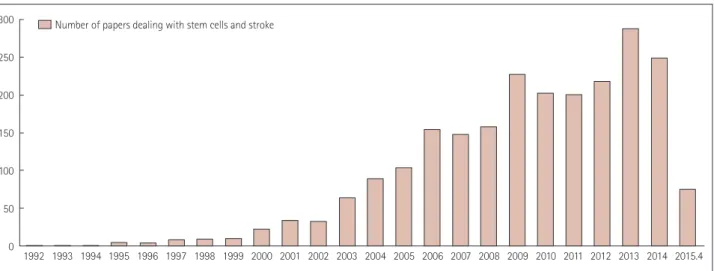
The number of studies of stem cells in stroke has increased markedly recently (Fig. 2). With current advances in the understanding of the effects of introducing stem cells and their mechanisms of action, several clinical trials of stem cell therapy have been conducted in patients with stroke since
Fig. 1. Mechanisms of action of mesenchymal stem cells in stroke recovery.
Clinical Trials of Stem Cell Therapy for Stroke
JCN
2005, including studies using MSCs,17-20 MNCs,21-26 and NSCs (Table 1).27,28
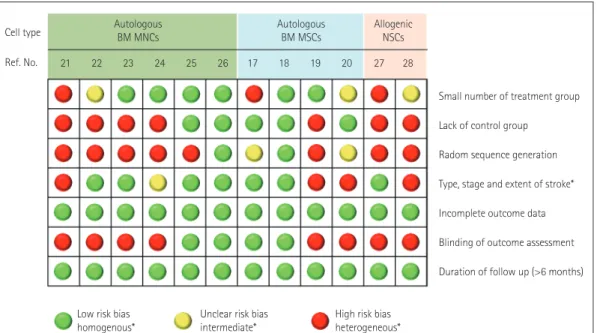
For stem cell therapy to be useful in augmenting the re- covery after stroke, it needs to be safe and effective, applica- ble to a broad spectrum of patients with stroke, and cost-ef- fective.29 Most clinical trials using various types of stem cell have demonstrated that stem cell therapy following stroke is both feasible and safe, and may improve recovery. However, these trials varied in terms of the patient characteristics, cell therapy timing, dose and type of cells delivered, and mode of treatment. In addition, many factors that could be critical to the transplantation success, including the location and the extent of lesions, were not adequately considered. More- over, the assessments of functional improvement, adverse effects, and pretreatment screening tests for safety have var- ied greatly among the studies. None of the studies aimed to determine the efficacy of MSC therapy in patients with stroke. All of the studies aimed to assess the feasibility and safety of stem cell treatments, and most were small series and did not include a control group. While stem cells appeared to be of some benefit in several studies, there was significant bias in subsequent studies (Fig. 3). A recent multicenter ran- domized controlled clinical trial (RCT) of intravenous in- fusion of autologous bone marrow MNCs failed to show any effectiveness.26
Presently, rigorous reasoning is required to replicate ex- perimental results in patients with stroke. The Stem cell Ther- apies as an Emerging Paradigm in Stroke (STEPs) committee recently suggested guidelines for bridging the gap between basic and clinical studies,30 early stage clinical trials,31 and phase II/III trials32 of stem cell therapies in stroke. Accord- ing to these recommendations, studies should be RCTs. After randomization, experimental procedures may not be blind-
ed, because applying stereotaxic sham surgery or bone mar- row sham aspiration to control patients may increase the risk of adverse effects. Patient selection and a cell dose that is equiv- alent to that used in animal studies should be used. Patients with stroke in the middle cerebral artery territory (or anteri- or circulation) and those with moderately severe neurologic disabilities could be ideal candidates. The mode of applica- tion of stem cells may significantly influence the number of cells delivered to target regions, as well as the incidence of adverse effects. For example, one study demonstrated that intra-arterial transplantations resulted in superior delivery of stem cells in the ischemic brain compared to intravenous infusions,33 but this may cause arterial occlusion, resulting in stroke.33,34 There have been relatively few studies directly comparing the efficacy of intravenous and intra-arterial de- livery of MSCs.35 The mode of treatment should be based on the severity and location of lesions, and the timing of ap- plication. In addition to the clinical outcomes measured, lab- oratory and neuroimaging findings should be used as sur- rogate markers of efficacy. Advanced technologies such as multimodal magnetic resonance imaging (MRI; e.g., resting- state functional MRI or diffusion-tensor imaging) can be used to monitor the response to restorative therapy.36,37 Fi- nally, patients should be followed for more than 90 days.
Long-term monitoring (>6 months) is likely to be unneces- sary because autologous MSCs are a clinical cell line and die within days or weeks of administration.31
ONGOING CLINICAL TRIALS
Among the various adult stem cells, MSCs have been most commonly used in the clinical trials for patients with stroke.
There have been several recent efforts to improve the effects
300 250 200 150 100 50
0 1992 1993 1994 1995 1996 1997 1998 1999 2000 2001 2002 2003 2004 2005 2006 2007 2008 2009 2010 2011 2012 2013 2014 2015.4 Years
Number of papers dealing with stem cells and stroke
Fig. 2. Number of papers on stem cells and stroke.
Bang OY
JCN
of MSC therapy. For example, MSCs can be isolated from various tissues, such as umbilical cord, endometrial polyps, menses blood, adipose tissue, and bone marrow.38 While a long culture period is required to obtain sufficient stem cells from the patient’s own bone marrow, allogeneic MSC ther- apy can form the basis of ‘off-the-shelf’ products. In addition, MSCs are heterogeneous with respect to their developmen- tal potential and trophic supports. The use of functionally distinct subpopulations of MSCs was found to improve their effects.39 Finally, presenting appropriate stimuli to cells may promote a transient adaptive response (preconditioning) so that injury resulting from subsequent exposure to a harm- ful stimulus is reduced. Anoxic preconditioning of stem cells has been tested for the promotion of cell survival after trans-
plantation in ischemic disease conditions.40,41
It is interesting that earlier clinical trials (i.e., performed during 2005–2010) used autologous naïve MSCs, whereas several recent trials performed since 2011 have examined allogeneic or manipulated MSCs, including by isolating functional subpopulations or the preconditioning of stem cells (Fig. 4). At the time of writing, we were aware of at least 15 active clinical trials using adult stem cells to treat ischemic stroke (http://clinicaltrials.gov) (Supplementary Table 1 in the online-only Data Supplement). It should be noted that seven of these trials were RCTs that aimed to determine the efficacy of MSC therapy, five tested the efficacy and safety of allogeneic MSCs in patients with stroke, and four studies used manipulated (conditioned or selected) MSCs. In the Table 1. Clinical trials of stem cells in patients with stroke
Ref. Study design control:cell group
Characteristics of stroke
Manipulation
(cell dose) Route Efficacy Adverse
effects Autologous bone marrow mononuclear cells
21 None:5 patients 1-year f/u
Chronic Ischemic or ICH
Isolation using normal saline IC N/A None
22 None:6 patients 6-month f/u
Subacute MCA infarct
Isolation using human albumin- containing normal saline (0.6–5×10⁸)
IA N/A Seizure after
200 days 23 None:10 patients
6-month f/u
Acute
Large MCA infarct
Isolation using human albumin- containing normal saline (0.6–5×10⁸)
IV Limited study design
None
24 None:20 patients 6-month f/u
Acute
Nonlacunar infarct
Isolation using human albumin- containing normal saline (0.6–5×10⁸)
IA Limited study design
None
25 40:60 patients 6-month f/u
Acute ICH
Isolation using normal saline (1.33×10¹³)
IC NIHSS and BI improved
None
26 60:60 patients Subacute MCA/ACA infarct
Isolation using normal saline (2.8×10⁸)
IV BI and mRS at day 180
Similar in the two groups Autologous bone marrow-derived mesenchymal stem cells
17 25:5 patients 1-year f/u
Subacute Large MCA infarct
Ex vivo culture expansion using fetal bovine serum (1×10⁸)
IV BI improved at 3 months
None
18 36:16 patients 5-year f/u
Subacute Large MCA infarct
Ex vivo culture expansion using fetal bovine serum (1×10⁸)
IV mRS 0–3, increased in MSC group
None
19 None:12 patients 1-year f/u
Subacute to chronic Variable
Ex vivo culture expansion using autologous serum (1×10⁸)
IV Limited study design
None
20 6:6 patients 24-week f/u
Chronic Ischemic or ICH
Ex vivo culture expansion using serum-free media (5–6×10⁷)
IV Modest increase in FM and mBI
None
Allogeneic neural stem/progenitor cells 27 None:5 patients
Terminated early
Chronic
MCA infarct affecting striatum
Ex vivo culture expansion of NSCs obtained from primordial porcine striatum
IC Limited study design
Seizure, aggravation of hemiplegia 28 None:8 patients
2-year f/u
Subacute to chronic MCA/ACA infarct
Ex vivo culture expansion of NSCs obtained from fetal brain
IC Limited study design
Transient low-grade fever only ACA: anterior cerebral artery, BI: Barthel index, FM: Fugl-Meyer score, f/u: follow-up, IA: intra-arterial, IC: intracerebral, ICH: intracerebral hemorrhage, IV: intravenous, mBI: modified Barthel index, MCA: middle cerebral artery, mRS: modified Rankin Score, MSC: mesenchymal stem cell, N/A: not avail- able, NIHSS: national Institutes of Health Stroke Scale, NSCs: neural stem/progenitor cells.
Clinical Trials of Stem Cell Therapy for Stroke
JCN
STem cell Application Research and Trials In NeuroloGy-2 (STARTING-2) trial, we are incorporating ischemic precon- ditioning using ischemic serum, blood-brain-barrier manip- ulation, and strict selection of candidates in order to improve the therapeutic effects and safety of MSCs.42
CONCLUSIONS
It is too early to conclude whether MSC therapy can im- prove functional outcomes in patients with stroke. A recent meta-analysis in the field of cardiology concluded that trans- planting adult bone marrow cells improved left ventricular function, infarct size, and remodeling in patients with isch- emic heart disease compared with standard therapies. This conclusion was reached after analyzing data from 50 studies (involving 2,625 patients), in which patients received echo-
cardiographic evaluations and long-term follow-up.43 In the field of hematology, a developmental history of 60 years was required to develop the first successful stem cell therapy—
the transplantation of hematopoietic stem cells. This suggests that development of a dramatically new therapy will require patience and constant dialogue between basic scientists and the physicians performing the clinical trials.44 More evidence from RCTs is needed. Further advances at both the bench and bedside would advance the understanding of the basic mechanisms underlying stem cell therapy as well as improve the therapeutic efficacy and safety of applying stem cells to patients with stroke.
Supplementary Materials
The online-only Data Supplement is available with this arti- cle at http://dx.doi.org/10.3988/jcn.2016.12.1.14.
Fig. 3. Summary table for the risk of bias from different items for each clinical trial of stem cells in patients with stroke. BM: bone marrow, MNCs:
mononuclear cells, MSCs: mesenchymal stem cells, NSCs: neural stem/progenitor cells.
Small number of treatment group Lack of control group
Radom sequence generation Type, stage and extent of stroke*
Incomplete outcome data Blinding of outcome assessment Duration of follow up (>6 months) Cell type
Ref. No.
Autologous BM MNCs
Low risk bias
homogenous* Unclear risk bias
intermediate* High risk bias heterogeneous*
21 22 23 24 25 26 17 18 19 20 27 28
Autologous
BM MSCs Allogenic NSCs
Fig. 4. Number and types of stem cells in clinical trials for patients with stroke. allo: allogeneic, auto: autologous, BM: bone marrow, MSCs: mes- enchymal stem cells, SC: stem cell.
10 9 8 7 6 5 4 3 2 1
0 Hematopoietics SC 2005–2010 2011–2015
Neural progenitor/
SC
BM mononuclear
cells Naïve MSC-auto Naïve MSC-allo MSC-conditioned/
selected
Bang OY
JCN
Conflicts of Interest
The author has no financial conflicts of interest.
Acknowledgements
We thank Dr. Eun Hee Kim, Samsung Biomedical Research Institute, for their advice and assistance in preparing the manuscript.
This study was supported by the Korea Health Technology R&D Proj- ect, the Ministry of Health & Welfare (HI14C16240000).
REFERENCES
1. Chopp M, Li Y. Treatment of neural injury with marrow stromal cells.
Lancet Neurol 2002;1:92-100.
2. Chang DJ, Lee N, Park IH, Choi C, Jeon I, Kwon J, et al. Therapeutic potential of human induced pluripotent stem cells in experimental stroke. Cell Transplant 2013;22:1427-1440.
3. Dihné M, Hartung HP, Seitz RJ. Restoring neuronal function after stroke by cell replacement: anatomic and functional considerations.
Stroke 2011;42:2342-2350.
4. Chen X, Li Y, Wang L, Katakowski M, Zhang L, Chen J, et al. Isch- emic rat brain extracts induce human marrow stromal cell growth factor production. Neuropathology 2002;22:275-279.
5. Li WY, Choi YJ, Lee PH, Huh K, Kang YM, Kim HS, et al. Mesen- chymal stem cells for ischemic stroke: changes in effects after ex vivo culturing. Cell Transplant 2008;17:1045-1059.
6. Liu Z, Li Y, Zhang RL, Cui Y, Chopp M. Bone marrow stromal cells promote skilled motor recovery and enhance contralesional axonal connections after ischemic stroke in adult mice. Stroke 2011;42:740- 7. Song M, Mohamad O, Gu X, Wei L, Yu SP. Restoration of intracorti-744.
cal and thalamocortical circuits after transplantation of bone marrow mesenchymal stem cells into the ischemic brain of mice. Cell Trans- plant 2013;22:2001-2015.
8. Lai RC, Chen TS, Lim SK. Mesenchymal stem cell exosome: a novel stem cell-based therapy for cardiovascular disease. Regen Med 2011;
6:481-492.
9. Lee ST, Chu K, Jung KH, Kim SJ, Kim DH, Kang KM, et al. Anti-in- flammatory mechanism of intravascular neural stem cell transplan- tation in haemorrhagic stroke. Brain 2008;131(Pt 3):616-629.
10. Kim YJ, Park HJ, Lee G, Bang OY, Ahn YH, Joe E, et al. Neuropro- tective effects of human mesenchymal stem cells on dopaminergic neurons through anti-inflammatory action. Glia 2009;57:13-23.
11. Shen LH, Li Y, Chen J, Zacharek A, Gao Q, Kapke A, et al. Therapeu- tic benefit of bone marrow stromal cells administered 1 month after stroke. J Cereb Blood Flow Metab 2007;27:6-13.
12. Shin JY, Park HJ, Kim HN, Oh SH, Bae JS, Ha HJ, et al. Mesenchy- mal stem cells enhance autophagy and increase β-amyloid clearance in Alzheimer disease models. Autophagy 2014;10:32-44.
13. Paik MJ, Li WY, Ahn YH, Lee PH, Choi S, Kim KR, et al. The free fat- ty acid metabolome in cerebral ischemia following human mesenchy- mal stem cell transplantation in rats. Clin Chim Acta 2009;402:25-30.
14. Borlongan CV, Hadman M, Sanberg CD, Sanberg PR. Central ner- vous system entry of peripherally injected umbilical cord blood cells is not required for neuroprotection in stroke. Stroke 2004;35:2385-2389.
15. Rosenblum S, Wang N, Smith TN, Pendharkar AV, Chua JY, Birk H, et al. Timing of intra-arterial neural stem cell transplantation after hy- poxia-ischemia influences cell engraftment, survival, and differentia- tion. Stroke 2012;43:1624-1631.
16. Yamauchi T, Kuroda Y, Morita T, Shichinohe H, Houkin K, Dezawa M, et al. Therapeutic effects of human multilineage-differentiating stress enduring (MUSE) cell transplantation into infarct brain of mice.
PLoS One 2015;10:e0116009.
17. Bang OY, Lee JS, Lee PH, Lee G. Autologous mesenchymal stem cell transplantation in stroke patients. Ann Neurol 2005;57:874-882.
18. Lee JS, Hong JM, Moon GJ, Lee PH, Ahn YH, Bang OY; STARTING collaborators. A long-term follow-up study of intravenous autologous mesenchymal stem cell transplantation in patients with ischemic stroke. Stem Cells 2010;28:1099-1106.
19. Honmou O, Houkin K, Matsunaga T, Niitsu Y, Ishiai S, Onodera R, et al. Intravenous administration of auto serum-expanded autologous mesenchymal stem cells in stroke. Brain 2011;134(Pt 6):1790-1807.
20. Bhasin A, Srivastava MV, Kumaran SS, Mohanty S, Bhatia R, Bose S, et al. Autologous mesenchymal stem cells in chronic stroke. Cerebro- vasc Dis Extra 2011;1:93-104.
21. Suárez-Monteagudo C, Hernández-Ramírez P, Alvarez-González L, García-Maeso I, de la Cuétara-Bernal K, Castillo-Díaz L, et al. Autol- ogous bone marrow stem cell neurotransplantation in stroke patients.
An open study. Restor Neurol Neurosci 2009;27:151-161.
22. Battistella V, de Freitas GR, da Fonseca LM, Mercante D, Gutfilen B, Goldenberg RC, et al. Safety of autologous bone marrow mononucle- ar cell transplantation in patients with nonacute ischemic stroke. Re- gen Med 2011;6:45-52.
23. Savitz SI, Misra V, Kasam M, Juneja H, Cox CS Jr, Alderman S, et al.
Intravenous autologous bone marrow mononuclear cells for ischemic stroke. Ann Neurol 2011;70:59-69.
24. Friedrich MA, Martins MP, Araújo MD, Klamt C, Vedolin L, Garico- chea B, et al. Intra-arterial infusion of autologous bone marrow mono- nuclear cells in patients with moderate to severe middle cerebral ar- tery acute ischemic stroke. Cell Transplant 2012;21 Suppl 1:S13-S21.
25. Li ZM, Zhang ZT, Guo CJ, Geng FY, Qiang F, Wang LX. Autologous bone marrow mononuclear cell implantation for intracerebral hemor- rhage-a prospective clinical observation. Clin Neurol Neurosurg 2013;
115:72-76.
26. Prasad K, Sharma A, Garg A, Mohanty S, Bhatnagar S, Johri S, et al.
Intravenous autologous bone marrow mononuclear stem cell therapy for ischemic stroke: a multicentric, randomized trial. Stroke 2014;45:
3618-3624.
27. Savitz SI, Dinsmore J, Wu J, Henderson GV, Stieg P, Caplan LR. Neu- rotransplantation of fetal porcine cells in patients with basal ganglia infarcts: a preliminary safety and feasibility study. Cerebrovasc Dis 2005;20:101-107.
28. Qiao LY, Huang FJ, Zhao M, Xie JH, Shi J, Wang J, et al. A two-year follow-up study of cotransplantation with neural stem/progenitor cells and mesenchymal stromal cells in ischemic stroke patients. Cell Transplant 2014;23 Suppl 1:S65-S72.
29. Adams HP Jr, Nudo RJ. Management of patients with stroke: is it time to expand treatment options? Ann Neurol 2013;74:4-10.
30. Stem Cell Therapies as an Emerging Paradigm in Stroke Participants.
Stem Cell Therapies as an Emerging Paradigm in Stroke (STEPS):
bridging basic and clinical science for cellular and neurogenic factor therapy in treating stroke. Stroke 2009;40:510-515.
31. Savitz SI, Chopp M, Deans R, Carmichael T, Phinney D, Wechsler L;
STEPS Participants. Stem Cell Therapy as an Emerging Paradigm for Stroke (STEPS) II. Stroke 2011;42:825-829.
32. Savitz SI, Cramer SC, Wechsler L; STEPS 3 Consortium. Stem cells as an emerging paradigm in stroke 3: enhancing the development of clinical trials. Stroke 2014;45:634-639.
33. Pendharkar AV, Chua JY, Andres RH, Wang N, Gaeta X, Wang H, et al. Biodistribution of neural stem cells after intravascular therapy for hypoxic-ischemia. Stroke 2010;41:2064-2070.
34. Yang B, Migliati E, Parsha K, Schaar K, Xi X, Aronowski J, et al. In- tra-arterial delivery is not superior to intravenous delivery of autolo- gous bone marrow mononuclear cells in acute ischemic stroke. Stroke 2013;44:3463-3472.
35. Eckert MA, Vu Q, Xie K, Yu J, Liao W, Cramer SC, et al. Evidence for high translational potential of mesenchymal stromal cell therapy to improve recovery from ischemic stroke. J Cereb Blood Flow Metab 2013;
33:1322-1334.
36. Thiel A, Vahdat S. Structural and resting-state brain connectivity of
Clinical Trials of Stem Cell Therapy for Stroke
JCN
motor networks after stroke. Stroke 2015;46:296-301.
37. Burke Quinlan E, Dodakian L, See J, McKenzie A, Le V, Wojnowicz M, et al. Neural function, injury, and stroke subtype predict treatment gains after stroke. Ann Neurol 2015;77:132-145.
38. Ding DC, Shyu WC, Lin SZ. Mesenchymal stem cells. Cell Transplant 2011;20:5-14.
39. Bakondi B, Shimada IS, Perry A, Munoz JR, Ylostalo J, Howard AB, et al. CD133 identifies a human bone marrow stem/progenitor cell sub-population with a repertoire of secreted factors that protect against stroke. Mol Ther 2009;17:1938-1947.
40. Wang JA, He A, Hu X, Jiang Y, Sun Y, Jiang J, et al. Anoxic precondi- tioning: a way to enhance the cardioprotection of mesenchymal stem cells. Int J Cardiol 2009;133:410-412.
41. Tang YL, Zhu W, Cheng M, Chen L, Zhang J, Sun T, et al. Hypoxic preconditioning enhances the benefit of cardiac progenitor cell ther-
apy for treatment of myocardial infarction by inducing CXCR4 ex- pression. Circ Res 2009;104:1209-1216.
42. Kim SJ, Moon GJ, Chang WH, Kim YH, Bang OY; STARTING-2 (STem cell Application Researches and Trials In NeuroloGy-2) col- laborators. Intravenous transplantation of mesenchymal stem cells preconditioned with early phase stroke serum: current evidence and study protocol for a randomized trial. Trials 2013;14:317.
43. Jeevanantham V, Butler M, Saad A, Abdel-Latif A, Zuba-Surma EK, Dawn B. Adult bone marrow cell therapy improves survival and in- duces long-term improvement in cardiac parameters: a systematic review and meta-analysis. Circulation 2012;126:551-568.
44. Prockop DJ, Prockop SE, Bertoncello I. Are clinical trials with mes- enchymal stem/progenitor cells too far ahead of the science? Lessons from experimental hematology. Stem Cells 2014;32:3055-3061.