243
목질진흙버섯 Phellinus linteus HN1009K의 항산화 활성 과 항염증효과
강희완
1,2*·이만휘
3·서건식
41한경대학교 미래융합기술대학원, 2한경대학교유전공학연구소, 3경북대학교 수의과대학, 4한국농수산대학 특용작물학과
Antioxidant and Anti-inflammatory Effects of Phellinus linteus HN1009K
Hee-Wan Kang
1,2*, Man Hyee Lee
3and Geon-Sik Seo
41Graduate School of Future Convergence Technology, Hankyong National University, Ansung 456-749, Korea
2Institute of Genetic engineering, Hankyong National University, Ansung 456-749, Korea
3College of Veterinary Medicine, Gyeongpuk National Univ., Daegu 702-701, Korea
4Korea National College of Agricultural and Fisheries, Bongdam, Hwaseong 445-760, Korea
ABSTRACT : Novel Phellinus linteus HN1009K (HK1009) has been characterized on speedy mycelial growth and yearly artificial cultivation. In this study, antioxidant and anti-inflammatory activities of ethanol extract from mycelium and fruiting body of P.
linteus HN1009K (HK1009) were compared to those of P. linteus (PL, Korea Sangwhang) and P. baumii (PB, Jangsu Sanghwang) as controls. HK1009 extract showed higher DPPH free radical scavenging activity in both mycelial and fruiting body samples than those of PL and PB. However, in xanthine oxidase assay, antioxidant effect was highly measured on mycelial samples of PL and HK1009. Mycelial extract of HK1009 induced high inhibitory effect on LPS-induced nitric oxide (NO) production in RAW264.7 cells comparing to PL and PB without toxicity on the cells. The results suggest that P. linteus HN1009K possesses superior antioxidant activity and anti-inflammatory effects.
KEYWORDS : Antioxidant and anti-inflammatory activities, Phellinus linteus HN1009K
서 론
목질진흙버섯(Phellinus linteus)은 분류학적으로 소나무 비늘버섯과(Hymenochaetaceae). 진흙버섯속(Phellinus)에 속하는 백색부후균으로, 대(stipe)가 없고 주로 다년생의 자 실체를 형성한다. 진흙버섯류는 세계적으로 48종에 달하며,
국내에서는 지금까지 8종이 자생하는 것으로 알려져 있다 (Choi et al., 1996). 목질진흙버섯인 P. linteus는 상황버섯으 로도 불리고 있으며 자실체 추출물에서는 96.7%의 매우 강 력한 종양 저지율(Ikekawa et al., 1968)이 알려지면서 세계 적으로 많은 연구자에 의하여 주목을 받기 시작하여 항종 양작용, 면역조절 효과(Chung et al., 1993; Kim et al., 1996; Lee et al., 1996)등 약리활성 연구가 활발히 진행되어 왔다. 그러나 P. linteus는 재배조건이 까다롭고 재배기간이 장기간(3~4년) 소요되어 안정적인 경제적 생산 공급이 어 려운 실정이다. 따라서, 유사종인 P. baumii(장수상황버섯) 가 국외로부터 도입되어 일반농가에서 재배, 시중 판매되 고 있으나 자실체의 형태와 기능성에서 P. linteus와 많은 차이를 보이고 있다.
사람의 생명유지에 필수 성분 중의 하나인 산소는 전자 전달계의 최종 전자 수용체가 되며 체내의 각종대사 과정 에서 super oxide anion (·O2-), hydroxyl radical (·OH), peroxy radical (ROO·), alkoxyl radical (RO·) 등의 활성 (reactive oxygen species, ROS) 산소들이 생성된다(Frido-
*Corresponding author E-mail: [email protected] Received October 22, 2013 Revised October 23, 2013 Accepted October 23, 2013
This is an Open Access article distributed under the terms of the Creative Commons Attribution Non-Commercial License (http://
creativecommons.org/licenses/by-nc/3.0/) which permits unrestricted non-commercial use, distribution, and reproduction in any medium, provided the original work is properly cited.
Kor. J. Mycol. 2013 December, 41(4): 243-247 http://dx.doi.org/10.4489/KJM.2013.41.4.243 pISSN 0253-651X
© The Korean Society of Mycology
vich, 1989). 이들 활성 산소들은 체내에서 끊임없이 생성되 지만 항상성 유지 측면에서 체내에서 이들 활성산소들이 소거되지 않으면 일시적 혹은 영구적으로 생체 조직에 손 상을 주어 최근에 많은 문제가 되고 있는 동맥경화증이나 암 등의 질환들을 일으킬 수 있는 것으로 보고되었다(Vi- dela and Fermandez, 1988).
최근 기존의 연구에서 보고된 Phellinus 종에 비하여 균사 생장이 월등히 빠르고 항암 및 면역력 증강효과가 우수한 Phellinus sp. KACC 93057P가 개발, 보고된 바 있으며 (Kang, 2010) 이 균주는 자실체의 형태적 특성에 따라 P.
linteus HN1009K로 동정되었으나 배양적, 유전적 특징이 기존의 P. linteus와 다른 것으로 나타났다(Kim et al., 2012). P. linteus HK1009는 원목에 종균을 접종한 후 1년 이내에 자실체 생산이 가능하여 목질진흙버섯의 대량생산 이 기대되고 있다. 특히, Phellinus sp. KACC93057P (P.
linteus HN1009K)의 균사체로부터 신규 항산화물질인 sty- rylpyrones계통의 Phellinins A1과 A2가 분리 정제되어 화 학적 구조도 밝혀진 바 있다(Lee et al., 2009).
한편, NO, HNO2, ONOO와 같은 활성질소(reactive ni- trogen species, RNS)는 염증반응 시 대식세포 호중구 및 다른 면역 세포들의 면역반응으로 인해 다량 생성되며, 이 때 활성산소(ROS)도 같이 생성된다(Brune et al., 2003;
Delanty and Dichter, 1998). 따라서 염증반응이 지속되면 ROS와 RNS가 과다하게 생성되어 영구적인 유전자 변형이 유발될 수 있다.
본 연구에서는 P. linteus HN1009K의 항산화 효능과 RAW 264.7 cell에 대한 항염증 효과를 국내 일반농가에서 재배중 인 P. linteus(상품명, 고려상황), P. baumii(상품명, 장수상 황) 등과 비교분석하였으며 그 결과를 보고하는 바이다.
재료 및 방법
공시균주 배양 및 추출
P. linteus HN1009K의 자실체(HK009F)는 원목재배에 의 해서 확보하였으며 P. baumii 자실체(PBF)와 P. linteus 자 실체(PLF)는 경북안동 상황버섯농장에서 구입하여 파쇄하 여 사용하였다. 버섯분말 10 g을 물 100 ml에 넣고 호모게 나이저로 2,500 rpm에서 혼합한 후 에탄올 400 ml를 첨가 하여 에탄올 추출하였다. 에탄올추출액을 회전증발농축기 에서 에탄올을 증발시켜 잔존하는 건조물을 본 실험에 사 용하였다. 균사체시료는 PDA에서 생장시킨 상황버섯 균사 체를 절단하여 120 ml의 YGM(1% malt extract, 0.4% glu- cose, 0.4 % yeast extract/D.W. 1 L) 액체배지에 접종하고 25일 동안 정치배양 하였으며 P. linteus는 생장이 늦어 10 일동안 추가적으로 배양하였다. 배양액으로부터 균사체를 회수하여 건조한 10g을 분말화하여 상기의 자실체 처리 방 법에 준하여 에탄올 추출 건조물 10 mg/ml로 희석하여 사 용하였다. 샘플은 P. linteus HN1009K 유래 추출물은 HK
1009, P. linteus 유래 추출물은 PL, 그리고 P. baumii 유래 추출물은 PB으로 표시하여 실험에 사용하였다.
전자공여능 측정
전자공여능은 Blois(1958)의 방법에 따라 DPPH free ra- dical 소거법으로 측정하였다. P. linteus HN1009K, P. lin- teus, 그리고 P. baumii의 균사체 및 자실체로부터 추출한 건조물을 증류수로 20 mg/ml로 녹인 다음 75 µl를 첨가하 고 (최종 농도 200 µg/ml) 에탄올에 녹인 0.3 M DPPH 용 액 750 µl, 그리고 acetate buffer 675 µl를 섞어 vortex하였 으며 대조군은 추출시료 대신 75 µl의 증류수를 첨가하고 실온에서 암상태로 20분간 반응시킨 후 517 nm에서 흡광 도를 측정하였다. 전자공여능은 다음의 식에 의해서 산출 하였다.
전자공여능(%) = [(대조군의 흡광도 − 반응구의 흡광도) / 대조군의 흡광도] × 100
Xanthine oxidase 저해효과측정
Noro 등(1983)의 방법에 따라 기질로서 Xanthine를 사용 하여 Xanthine oxidase 의 활성은 측정하였다. 상황버섯 균 사체와 자실체에서 추출한 각각의 추출물 75 µl (100 µg/
ml)에 1,365 µl의 phosphate buffer(pH 7.4)를 첨가하여 잘 섞은 후 흡광도 측정용 cuvette에 xanthine 용액(174 µg/
ml)을 30 µl 넣고, xanthine oxidase 용액 (250 mUnit/ml) 30µl를 첨가하였다. 대조군에는 시료 대신 증류수를 첨가 하였다. 흡광도의 차이는 295 nm에서 3분간 측정하였으며, 효소 저해도는 다음과 같이 산출하였다.
저해도(%) = (대조군의 흡광도 − 반응군의 흡광도 / 대조 군의 흡광도) × 100
항염증분석(Nitrate oxidation assay)
RAW264.7 세포를 96 well plate (4×10⁴개/well)에 200 µl 씩 분주하여 37oC, 5% CO2 조건에서 24시간 배양한 후 자 실체와 균사체의 추출물을 각 각 100 µg/ml로 첨가하였다.
접종 후 37oC, 5% CO2 조건에서 30분간 배양한 후 LPS (Lipopolysaccharide)를 0.1 µg/ml 농도가 되도록 첨가하여 염증을 유발시키고 18시간 후 NO assay를 실시하였다. 배 양시킨 세포를 꺼내어 각 well에서 상층액을 100 µl씩 96 well plate에 옮겨 Greiss reagent [Griess reagen A (0.1%
NEDHC 수용액), griess reagent B (5% H3PO4, 1% Sulfa- nilamide 혼합수용액)를 각각 1:1비율로 혼합]를 동량첨가 하였다. 실온에서 반응 후 microplate reader를 사용하여 540 nm에서 흡광도를 측정하고 그 값을 NaNO2를 사용하 여 만든 표준(standard) 용액을 통해 표준값(대조군)을 얻 은 후 표준값들의 직선 그래프에 대한 상대값(y = ax + b일 때, x' = (y' − b) / a, x'는 NO 생성값(uM), y'는 비교군 측정
값)으로 계산하여 나타냈다.
세포생존율측정(MTT saasy)
추출물의 세포독성은 Green 등(1983)의 방법에 따라 3- 3(4,5-dimethyl-2-thiazolyl)-2,5-diphenyl-2H-tetrazolium bromide (MTT)를 사용하여 측정하였다. RAW264.7 cell의 배양은 상기의 항염증분석과 동일하게 하였고 균사체 추출 물을 원액을 희석하여 200 µg/ml의 농도로 첨가하였다. 배 양한 세포 배지에 MTT(-20oC, 2 mg/ml) 용액을 well마다 50µl씩 넣어 세포가 formazan을 형성하도록 4시간 동안 위와 동일한 조건에서 다시 배양하였다. 4시간 후 배지의 상층액을 천천히 모두 제거하고 DMSO를 150 µl씩 각 well 에 넣고 shaker에서 30분 이상 충분히 formazan을 녹인 후 Microplate reader에서 540 nm로 흡광도를 측정하였다. 결 과는 세포 생존능 (Viability, %) = (비교군 측정값) / (대조 군 평균값) × 100으로 계산하였다.
결과 및 고찰
항산화효과
P. linteus HN1009K과 농가에서 재배하고 있는 상황버섯 (P. linteus 및 P. baumii)의 균사체 및 자실체의 항산화활성 효과를 조사하기 위하여 전자공여능(electron donating abi- lity)과 xanthine oxidase 저해효과를 측정하였다. DPPH의 전자공여능 측정방법은 식품 등에서 물질의 free radical을 소거하는 능력을 측정하는데 널리 사용하는 방법으로 항산 화제는 안정된 자유 라디칼인 DPPH를 DPPH-H로 환원시 켜 DPPH의 색을 보라색에서 노란색으로 바꾸고 DPPH 라 디칼의 흡광도를 낮추는 결과를 가져오며 또한, 색의 변화 또는 흡광도의 변화는 공여한 전자의 수와 비례하는 것으 로 알려져 있다(Kim et al., 2010). PB, PL 그리고 HK1009 의 균사체 추출물 M군과 자실체 추출물 F군을 최종농도가 200µg/ml로 하여 전자공여능을 조사한 결과 세 가지 시료 모두다 F군이 M군보다 전자공여능이 높게 측정되었다. 그 중 HK1009 균사체 추출물이 저해율 24%, 자실체 추출물 이 46%로 농가에서 재배하고 있는 P. linteus와 P. baumii에 서 추출한 PB와 PL시료에 비하여 높게 나타났다(Fig. 1).
Xanthine oxidase는 활성산소(ROS)를 발생시키는 효소로 hypoxanthine을 xanthine으로 산화시키고 더 나아가 xan- thine의 요산으로 산화를 촉매하는 효소이다(Noro et al., 1983). 따라서 xanthine oxidase에 의해 산화되는 xanthine, 즉 요산의 양을 비교함으로써 효소저해효과를 측정한 결과 는 Fig 2와 같다. 균사 추출물 원액(200 µg/ml)을 2배, 4배, 8배 희석하여 모두 4가지 농도로 실험한 결과 세 종류의 추 출물 모두 2배 희석한 농도에서 DPPH전자공여능이 가장 높은 것으로 나타났다. 원액에서는 PBEX가 50%, PLEX 79%, HK1009EX 70%의 항산화 활성을 보였지만 2배 희석 한 시료에서 극대화되어 PLEX와 HK1009EX에서 대조구
에 비하여 100%의 높은 항산화활성을 보였으나 4배, 8배 희석한 경우에는 항산화활성이 감소하는 경향을 보였다. 또 P. linteus 유래 HK1009EX와 PLEX는 비슷한 활성을 보였 으며 P. baumii 유래 PBEX에 비하여 다소 높게 나타났다 (Fig. 2).
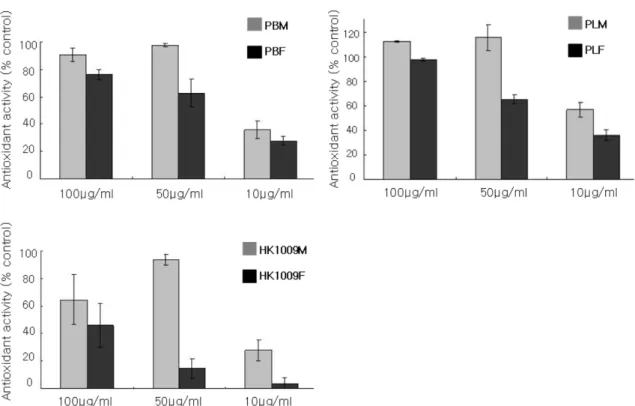
Fig. 3은 PL, PB 그리고 HK1009 시료의 균사체(M)과 자 실체(F)로부터의 추출물을 각각 10 µg/ml, 50 µg/ml, 100 µg/ml의 세 가지 농도로 희석하여 xanthine oxidase 저해효 과 비교한 결과이다. M군에서는 모두 50 µg/ml, 100 µg/ml, 10µg/ml 순으로 효과가 좋았으나 F군에서는 농도의존성을 보였다. DPPH의 전자공여능과는 반대로 세 가지 시료 모 두 다 M군이 F군보다 효소 저해 효과가 높게 측정되었다.
항염증효과 및 세포독성
PB, PL 그리고 HK1009 균사체 및 자실체 추출물의 염증 억제 기전을 알아보기 위해 NO assay를 시행하였다. 먼저, NO assay는 포유 세포의 면역 기전에서의 주요 산물인 nit- ric oxide의 생성을 측정하는 방법으로 macrophage(대식세 포)인 RAW264.7 세포주를 사용하여 측정하였다. Lipopoly- Fig. 1. DPPH radical scavenging activities of PB, PL and HK 1009. Acetate buffer and 200µg/ml concentration of each com- pound were mixed. After adding ethanolic DPPH solution (300µM), the absorbance at 517 nm was monitered. Results are means±S.D. of triplicate data.
Fig. 2. Antioxidant effects of extracts of PB, PL and HK1009 in xanthine oxidase assay. The difference of the enzyme acti- vity was calculated with reference at 295 nm for 3 min. Results are means±S.D. of triplicate data.
saccharide (LPS)를 넣어주면 tool-like receptor 4를 경유하 여 대식세포에 activating signal을 주고 inducible NO syn- thase (iNOs)의 발현에 영향을 주어 NO를 합성한다. LPS 는 Gram 음성세균의 세포벽을 구성하는 성분으로 염증 유 발원으로 알려져 있다(Yun et al., 1996). 이때 생성된 NO2
−
와 NEDHC, sulfanilamide를 반응시키면 azo coupling을 이 루는데 이 두 개의 링 구조가 540 nm의 파장에서 최대의 흡광도 값을 가진다. 그러므로 이 값을 측정하여 간접적으
로 NO의 생성을 정량할 수 있다(Kim et al., 2010).
RAW264.7 세포를 이용한 상황버섯 균사체 추출물 PB (EX), PL(EX), HK1009(EX) 시료의 NO assay 결과는 PB, PL, HK1009 모두 농도 의존적으로 원액 200 µg/ml에서는 7~8µM 정도로 염증 억제 효과가 인정되었다(Fig. 4). 이어 서 항염증에 사용된 RAW264.7세포의 상황버섯 균사체 추 출물에 대한 독성여부를 MTT assay로 조사하였다. MTT assay는 세포 내의 미토콘드리아가 대사활동을 통해 수용성 Fig. 3. Antioxidant effects of M and F compound of PB, PL and HK1009 in xanthine oxidase assay. The difference of the enzyme activity was calculated with reference at 295 nm for 3 min. Results are means±S.D. of triplicate data.
Fig. 4. Anti-inflammatory activity in macrophage cell (RAW 264.7) of ethanol extracts from Phellinus linteus HN1009K (HK1009), P. linteus (PL) and P. baumii (PB). Results are means
±S.D. of triplicate data.
Fig. 5. Cytotoxicity of macrophage cell (RAW 264.7) of ethanol extracts from Phellinus linteus HN1009K (HK1009), P. linteus (PL) and P. baumii (PB). Results are means±S.D. of triplicate data.
기질인 MTT tetrazolium을 청자색의 불용성 물질인 MTT formazan (3-(4,5-dimethylthiazol-2-yl)-2,5-diphenyl-tetra- zolium bromide)으로 환원하는 능력을 이용하여, 살아있는 세포가 형성시킨 formazan의 농도를 측정함으로 살아 있는 세포 수를 간접적으로 측정하는 방법이다. 이는 세포 독성 (cell toxicity)이나 생존능(viability) 측정에 널리 이용되는 방법이다(Green et al., 1984). 항염성 실험을 실시한 RAW 264.7 세포 plate를 사용하여 측정한 MTT assay 결과에서 PB(EX), PL(EX), HK1009(EX) 추출물의 원액처리구에서도 세포의 생존능이 70% 이상을 유지되어 세포 독성을 거의 가지지 않으면서 항염증 효과를 나타내는 것으로 판단되 었다(Fig. 5).
적 요
최근 농가에서 재배하고 있는 상황버섯 종에 비하여 균 사생장이 빠르고 자실체 발생과 생육이 빠른 P. linteus HN1009K (HK1009)가 개발되었다. 본 연구는 HK1009의 균사체와 자실체 에탄올 추출물의 항산화 및 항염증효과를 기존에 재배되고 있는 P. linteus (PL, Korea Sangwhang) 과 P. baumii (PB, Jangsu Sanghwang)를 대조구로 하여 비 교분석 하였다. HK1009는 균사체와 자실체 추출물 모두 PL과 PB에 비하여 항산화 활성이 높았으며 xanthine oxi- dase분석에서는 PL, HK1009, PB순으로 항산화 활성이 높 게 나타났다. RAW264.7세포를 이용한 상황버섯 균사체 추 출물 PB(EX), PL(EX), HK1009(EX)시료의 NO assay 결과 는 PB, PL, HK1009 모두 농도 의존적으로 원액 200 µg/ml 에서는 7~8 µM 정도로 염증 억제 효과가 뛰어났다. RAW 264.7 세포에 대한 MTT assay 결과에서 PB(EX), PL(EX), HK1009(EX) 추출물의 원액처리구 에서도 세포의 생존능 이 70% 이상을 유지하여 세포 독성이 없는 것으로 판단되 었다.
감사의 글
본 연구는 농림수산식품기술기획평가원(IPET) 생명산 업 기술개발사업(111163031SB010)에 의하여 이루어진 결과의 일부분이며 이에 감사드립니다.
참고문헌
Blois, M. S. 1958. Antioxidant determinations by the use of a stable free radical. Nature 181:1199-1200.
Brune, B., Zhou, J. and Knethen, A. V. 2003. Nitric oxide, oxidative stress and apoptosis. Kidney Int. Suppl. 84:4-22.
Choi, J. H., Ha, T. H. and Rho, Y. D. 1996. Studies on the main factors affecting the mycelial growth of Phellinus linteus. Kor.
J. Mycol. 24:214-222. (in Korean).
Chung, K .S., Kim, H. S., Kim, K. Y. and Han, M. W. 1993. Effect of kp, an antitumor protein-bound polysaccharide from my- celial culture of Phellinus linteus on the humoral immune res- ponse of tumor-bearing ICR mice to sheep red blood cells.
Arch. Pharm. Res. 16:336-338.
Delanty, N. and Dichter, M. A. 1998. Oxidative injury in the ner- vous system. Acta Neurol. Scand. 98:53-145.
Fridovich, I. 1989. Superoxide dismutase an adaption to paramag- netic gas. J. Biol. Chem. 264: 7761-7762.
Green, L. M., Reade, J. L. and Ware, C. F. 1984. Rapid colometric assay for cell viability: Application to the quantitation of cyto- toxic and growth inhibitory lymphokines. J. Immunol. Methods 70:257.
Ikekawa, T., Nakanishi, M., Uehara, N. and Chihara G. 1968. Anti- tumor action of some basidomycetes, especially Phellinus lin- teus. Gann. 59:155-157.
Kang, H. W. 2010. Novel Phellinus sp. KACC93057P producing polysaccharide of high immune and antirumor activity. Ko- rean patent 10-1069683.
Kim, H. H., Park, G. H., Park, K. S., Lee, J. Y. and An, B. J. 2010.
Anti-oxidant and anti-inflammation activity of fractions from Aster glehni Fr. Kor. J. Microbiol. Biotechnol. 38:434-441 (in Korean).
Kim, H. M., Han, S. B., Oh, G. T., Kim, Y. H., Hong, D. H., Hong, N. D. and Yoo, I. D. 1996. Stimulation of humoral and cell mediated immunity by polysaccharide from mushroom Phel- linus linteus. Int. J. Immunopharmacol. 18:295-303.
Kim., J. K. and Kang, H. W. 2012. Taxonomy, cultural characteris- tics and bioactive efficacy of novel Phellinus linteus strain HN 00K9. Abstr. of International Meeting of Korean Microbiolo- gical Society. pp. 171. Seoul, Korea (In Korean).
Lee, I. K., Jung, J. Y., Kim, Y. H. and Yun, B. S. 2009. Phellinins A1 and A2, new styrylpyrones from the culture broth of Phel- linus sp. KACC93057P: II. Physicochemical properties and structure elucidation. J. Antibiotics 62:635-637.
Lee, I. K., Seo, G. S., Jeon, N. B., Kang, H. W. and Yun, B. S. 2009.
Phellinins A1 and A2, new styrylpyrones from the culture broth of Phellinus sp. KACC93057P: I. Fermentation, taxono- my, isolation and biological properties. J. Antibiotics 62:631- 634.
Lee, J. H., Cho, S. M., Song, K. S., Han, S. B., Kim, H. M., Hong.
N. D. and Yoo, I. D. 1996. Immunostimulating activity and characterization of polysaccharide from mycelium of Phellinus linteus. J. Microbiol. Biotechnol. 6:213-218.
Noro, T., Oda, Y., Miyase, T., Ueno, A. and Fukushima, S. 1983.
Inhibitors of xanthine oxidase from the flowers and buds of Daphne genkwa. Chem. Pharm. Bull. 31:3984-3987.
Videla, L. A. and Fermandez, V. 1988. Biochemical aspects of cel- lular oxidative stress. Archivos de Biologia Y Medicina Experi- mentales 21:85-92.
Yun, H. Y., Dawson, V. L. and Dawson, T. M. 1996. Neurobiology of nitric oxide. Crit. Rev. Neurobiol. 10:291-316.