https://doi.org/10.9721/KJFST.2019.51.3.207
207
©The Korean Society of Food Science and Technology
Antioxidant contents and activities of twelve varieties of vegetable sprouts
Hyunjeong Park1, Youngjae Shin1, and Young-Jun Kim2,*1Department of Food Engineering, Dankook University
2Department of Food Science and Technology, Seoul National University of Science and Technology
Abstract This study was conducted to investigate the antioxidant contents and activities of twelve vegetable sprouts (broccoli, red radish, radish, mizuna, kale, taatsai, pak choi, Chinese cabbage, turnip, rapeseed, chicory, and alfalfa). The total flavonoid contents of the broccoli, red radish, and radish sprout were 25.36±0.13, 25.26±1.80, and 25.16±1.25 mg CE/100 g FW, respectively, and were significantly higher than those of the other tested vegetables. Radish sprouts had the highest total phenolic content (112.42 mg GAE/100 g FW), followed by red radish and broccoli sprouts. The main polyphenols in the vegetable sprouts were epicatechin and chlorogenic acid, but they varied across sprout varieties. The correlation between total flavonoids and total phenolics for the 12 vegetable sprouts was very high (r=0.926). The total antioxidant activity (DPPH and ABTS radical scavenging activities) was also highly correlated with total flavonoids and total phenolics.
Keywords: vegetable sprouts, flavonoids, phenolics, antioxidant, correlation
Introduction
In recent years, food consumption patterns have changed as living standards have improved. Social structure changes resulting from various factors, such as the economy, society, and population, have led to a rapid increase in one-person households (Kim and Lee, 2010). As a result, one-person households are becoming important consumers and the food consumption pattern has changed to favor simpler and smaller products (Lee et al., 2015). In addition, recent food consumption patterns show that the consumption of fruits, vegetables, and other fresh foods are rapidly increasing compared to those of processed food products (Jun et al., 2012). Moreover, the consumption of seeds and vegetable sprouts is increasing worldwide, as modern people have become interested in healthy and safe food (Paśko et al., 2009; Waje et al., 2009) and vegetable sprouts are known to lower the risk of various diseases and have health-promoting effects in addition to their nutritional value.
In general, vegetable sprouts are defined as the stage of vegetables one week post seed germination. They are called microgreens or seed sprouts and are collectively referred to baby leaf vegetables (Lee et al., 2014; Lee, 2018). Compared with other vegetables, vegetable sprouts have a short growth period; thus, can be cultivated without pesticides. Therefore, there are few safety issues regarding their consumption. They are also environmentally friendly, functional, clean vegetables growing only with water. They can be consumed year-round regardless of season. They also
contain a large amount of enzymes and are characterized as easily digestible foods (Shin et al., 2014). In addition, seeds of vegetable sprouts contain a large amount of nutrients which aid in overcoming the external environment until seeds grow to fully mature vegetables. The sprouts germinated using the energy of these seeds contain approximately three to more than one hundred times more nutrients than seeds and fully mature vegetables (Han et al., 2013; Kim et al., 2008a; Kim and Lee, 2010; Lee et al., 2014; Shin et al., 2014). For example, in a study which compared and analyzed the content of sulforaphane in broccoli by the growth period into sprouts, baby leaves, and mature broccoli, a higher amount of sulforaphane was measured in vegetable sprouts than in mature broccoli (Lim, 2007). In addition, in a study by Lee and Kim (2008), the content of rutin in buckwheat increased throughout the cultivation period.
According to Jun et al. (2012), customers mainly purchased vegetable sprouts for their nutritional value (52.8%) and they sought improved functionality of foods (31.4%). Therefore, in order to increase consumption of vegetable sprouts, it is necessary to diversify vegetable sprout items, increase functionality, and improve quality.
Previous studies have been mainly focused on the antioxidant activity of a single variety of vegetable sprouts and research is lacking on other varieties. Therefore, in this study, twelve varieties of vegetable sprouts that are highly consumed were selected and their antioxidant contents and activities were examined; in addition, the correlation between antioxidant contents and activities was evaluated.
Materials and Methods
Experimental materials
The twelve vegetable sprouts used in this experiment were broccoli (Brassica oleracea var. italica), red radish (Raphanus sativus L. var. sativus), radish (R. sativus), mizuna (B. juncea L. *Corresponding author: Young-Jun Kim, Department of Food
Sci-ence and Technology, Seoul National University of SciSci-ence and Technology, Seoul 01811, Korea
Tel: +82-2-970-6734 Fax: +82-2-976-6460
E-mail: [email protected]
Received May 13, 2019; revised May 24, 2019; accepted May 24, 2019
208 한국식품과학회지 제 51 권 제 3 호 (2019) Czern. var. Laciniata Makino), kale (B. oleracea L. var. acephala),
taatsai (B. narinosa), pak choi (B. campestris var. Chinensis), Chinese cabbage (B. rapa var. rapa L.), turnip (B. rapa var. glabra Regel), rapeseed (B. napus), chicory (Cichorium intybus), and alfalfa (Medicago sativa), which were all purchased from Aram Seed (Aram seed Co., Seoul, Korea). The purchased seeds were washed and immersed in 200 mL water for about 6 hours at room temperature. They were then placed in an automatic cultivator (SC-9000A, Sinchang INC, Osan, Korea) and cultivated for 7 days by spraying with distilled water for 1 minute in every 20 minutes. Two liters of distilled water were changed daily as the cultivation solution.
Sample extraction
The grown sprouts were pulverized with 80% ethanol three times using a blender (Classic blender, Oster, Milwaukee, WI, USA), twice for 3 minutes and once for 2 minutes. The pulverized solution was filtered through Whatman No. 2 filter paper using a filter under reduced pressure. The sample was then concentrated using a rotary evaporator under reduced pressure (N-1000, Eyela, Tokyo, Japan), and the extract was stored frozen at −20oC before
using in the experiment.
Analysis of total flavonoid content
The total flavonoid content of extracted vegetable sprout samples was measured by colorimetric assay (Meyers et al., 2003; Shin et al., 2008), and the reference material was (+)-catechin (Sigma-Aldrich, St. Louis, MO, USA). Four milliliter of distilled water and 1 mL of sample were mixed in a 15 mL tube, and 0.3 mL of 5% NaNO2 was added, vortexed, and allowed to stand at room temperature for 5 minutes. Next, 0.3 mL of 10% AlCl3 was added, vortexed, and allowed to stand at room temperature for 6 minutes. Two milliliter of 1 N NaOH and 2.4 mL of distilled water were added and vortexed. Absorbance was measured at 510 nm using a spectrophotometer (Optizen POP, Mecasys, Daejeon, Korea). The used units were mg catechin equivalent (CE)/100 g fresh weight (FW).
Analysis of total phenolic content
Total phenolics were measured by the Folin-Ciocalteu colorimetric method (Meyers et al., 2003; Singleton et al., 1999), and the reference material was gallic acid (Sigma-Aldrich). Distilled water (2.6 mL) and 0.2 mL sample were added to a 15 mL test tube, and 0.2 mL of Folin-Ciocalteu reagent was added, vortexed, and allowed to stand at room temperature for 6 minutes. Two milliliter of 7% Na2CO3 was added, vortexed, and allowed to stand at room temperature for 90 minutes in a dry and dark place. Absorbance was then measured at 750 nm using a spectrophotometer. The used units were mg gallic acid equivalent (GAE)/100 g FW.
Analysis of polyphenol by HPLC
The individual polyphenol was analyzed in accordance to the method of Chen et al. (2001). The extract was diluted with solution (KH2PO4:MeOH:D.W.=2:3:15) ten times, and then was filtered with a 0.45 mm syringe filter. The filtrate was separated on
an Eclipse XDB C-18 column (150×4.6 mm, 5 mm, Agilent, Palo Alto, CA, USA) at 40oC using HPLC-UV (Thermo Fisher UltiMate 3000, Thermo Scientific, Germering, Germany) by injecting 10 mL. The mobile phase applied was 3% acetic acid in distilled water and the detector was positioned at 280 nm at a flow rate of 1.0 mL/min. Chlorogenic acid, epicatechin, gallic acid, protocatechuic acid, catechol, catechin, epigallocatechin gallate, caffeic acid, syringic acid, 4-methylcatechol, epicatechin gallate, p-coumaric acid, ferulic acid, and rutin were used as reference material standards and the units were expressed in mg/100 g FW.
2,2-diphenyl-1-picrylhydrazyl (DPPH) radical scavenging activity The DPPH radical scavenging activity test was performed to measure the antioxidant activity of each vegetable sprout according to the methods of Brand-Williams et al. (1995) and Thaipong et al. (2006). The 100 mM of DPPH solution was prepared and diluted with 80% methanol at a wavelength of 517 nm, so that the absorbance value was 0.63-0.67. Then, 50 mL of the extracted sample was mixed with 2.95 mL of the diluted DPPH solution. The mixture was allowed to stand at room temperature for 30 minutes and the absorbance was measured at 517 nm using a spectrophotometer. Antioxidant activity was expressed as mg vitamin C equivalent (VCE)/100 g FW.
2,2-azinobis (3-ethylbenzothizoline-6-sulfonic acid) (ABTS) radical scavenging activity
ABTS radical scavenging activity was measured by a modification of methods outlined by Thaipong et al. (2006) and Kim et al. (2009). The 100 mL of PBS was added to 1 mM 2,2'-azobis (2-amidinopropane) dihydrochloride (AAPH) and 2.5 mM ABTS and stirred. The reaction was allowed to proceed in a water bath at 70oC for 40 minutes to prepare the ABTS radical solution. The sample was diluted with PBS to an absorbance value of 0.63-0.67, at a wavelength of 734 nm. The 20 mL of the extracted sample and 980 mL of ABTS solution were mixed and reacted at 37oC for 10 minutes and the absorbance was measured at 734 nm using a spectrophotometer. The units were expressed in mg VCE/100 g FW.
Statistical analysis
Analysis of variance was performed using SAS version 9.3 (SAS Institute, Inc., Cary, NC, USA) for the statistical analysis of each experiment. Significance was determined by Duncan’s multiple range test with p<0.05. The correlation was determined using Pearson’s correlation coefficient.
Results and Discussion
Total flavonoid content of vegetable sprouts
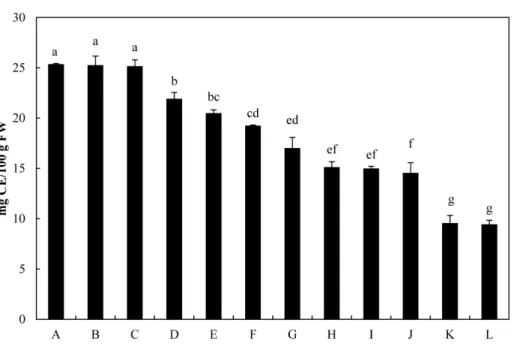
Flavonoids are widely distributed in plants and effectively remove reactive oxygen species in addition to conferring various physiological effects, such as antioxidant, anticancer, and anti-inflammatory properties (Kim et al., 2012a). The total flavonoid contents of vegetable sprouts are shown in Fig. 1. Among the twelve varieties, broccoli, red radish, and radish sprout showed
significantly high values (25.36±0.13, 25.26±1.80, and 25.16±1.25 mg/100 g fresh weight, respectively). On the contrary, chicory and alfalfa vegetable sprouts showed significantly lower values (9.56±1.53 and 9.44±0.82 mg/100 g FW) than the other varieties. According to Kim et al. (2014), the flavonoid content of broccoli stem extracted using ethanol was 2.76±0.00 mg/g DW, similar to that of the broccoli vegetable sprouts used in this experiment. According to a study by Goyeneche et al. (2015) which measured antioxidant contents and activities by dividing red radish into leaves and roots, the flavonoid content of red radish root was
267.47±6.38 mg quercetin/100 g DW, which was consistent with the result of the present study. These results suggest that vegetable sprouts contain similar amounts of flavonoids to fully mature vegetables and vegetable sprouts have nutritional value.
Total phenolic contents of vegetable sprouts
Like flavonoids, phenolics are abundant in plants and accumulate in plant bodies as secondary metabolites (Woo et al., 2007). In particular, the phenolic activity of antioxidants is derived through hydrogen donation by the -OH group and resonance stabilization Fig. 1. Total flavonoids content of vegetable sprouts. Error bars represent standard deviation and the different letter above the bar indicates significant differences based on Duncan’s multiple range test (p<0.05). A: Brassica oleracea var. italica, B: Raphanus sativus L. var. sativus, C: R. sativus, D: B. juncea L. Czern. var. Laciniata Makino, E: B. oleracea L. var. acephala, F: B. narinosa, G: B. campestris var. Chinensis, H: B. rapa var. rapa L., I: B. rapa var. glabra Regel, J: B. napus, K: Cichorium intybus, L: Medicago sativa.
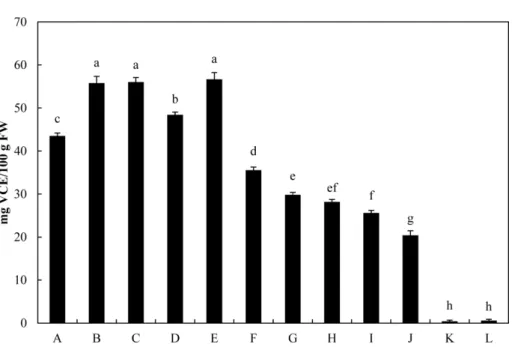
Fig. 2. Total phenolics content of vegetable sprouts. Error bars represent standard deviation and the different letter above the bar indicates significant differences based on Duncan’s multiple range test (p<0.05). A: Brassica oleracea var. italica, B: Raphanus sativus L. var. sativus, C: R. sativus, D: B. juncea L. Czern. var. Laciniata Makino, E: B. oleracea L. var. acephala, F: B. narinosa, G: B. campestris var. Chinensis, H: B. rapa var. rapa L., I: B. rapa var. glabra Regel, J: B. napus, K: Cichorium intybus, L: Medicago sativa.
210 한국식품과학회지 제 51 권 제 3 호 (2019) of the phenolic ring structure. Antioxidants are known to have
physiological activities such as anticancer and antibacterial effects (Shin et al., 2014). The total phenolic content of vegetable sprouts is shown in Fig. 2. Among the twelve varieties, radish sprout had the highest amount (112.42±3.79 mg/100 g FW), which was approximately five times higher than that of chicory vegetable sprouts (22.32±1.84 mg/100 g FW), the lowest amount. In addition, red radish vegetable sprouts had high phenolic content (102.10± 3.22 mg/100 g FW), followed by broccoli (84.16±5.93 mg/100 g FW), and kale vegetable sprouts (81.24±1.35 mg/100 g FW) (Fig. 2). According to Kim et al. (2008a), the phenolic content of vegetable sprouts ranked as follows, from highest to lowest: red radish (912.74 mg/L), broccoli (699.58 mg/L), red cabbage (576.22 mg/L), taatsai sprout (526.87 mg/L), radish (442.84 mg/L), and alfalfa (284.48 mg/L). These results were consistent with other results of the current study. Additionally, a study by Pajak et al. (2014) examined the phenol content of four vegetable sprouts. They found that the phenol contents of radish sprout and broccoli were approximatly 12 and 8 mg GAE/g DW, respectively, which were similar to our findings.
Polyphenol of vegetable sprouts
Among the fourteen individual polyphenols analyzed, chlorogenic acid and epicatechin were found as the main polyphenols (Fig. 3). Chlorogenic acid content was significantly higher in mizuna, Chinese cabbage, and radish sprouts (41.01±0.08, 36.40±0.22, and 32.67±0.38 mg/100 g, respectively). Epicatechin content was significantly high in red radish, and radish vegetable sprouts (62.96±5.00 and 65.80±3.39 mg/100 g). Pajak et al. (2014) measured the phenolic acid content of vegetable sprouts using HPLC and found that chlorogenic acid content of broccoli vegetable sprout was 11.49 mg/100 g DW, which was consistent with the results of this experiment. According to Wieslaw et al. (2014), the amounts of epicatechin in the cotyledon and hypocotyl regions of Hruszowska buckwheat vegetable sprout were 0.39±0.02 and 0.12±0.01 mg/g, respectively, which was similar to the results of this experiment.
DPPH free radical scavenging activity of vegetable sprout Measuring scavenging activity using DPPH, which has stable radical, is a method to measure antioxidant activity. Specifically, this technique measures the activity of an antioxidant that scavenges DPPH. DPPH, which is deep purple, is converted to be inactive when electrons or hydrogen is supplied to antioxidants, and gradually becomes decolorized, leading to an absorbance change. Thus, these properties of DPPH are useful in searching antioxidants (Kim et al., 2012b; Lee et al., 2007). The following twelve vegetable sprouts had high DPPH radical scavenging, in order from highest to lowest: red radish (55.78±3.12 mg/100 g FW), radish sprout (56.03±2.06 mg/100 g FW), and kale vegetable sprout (56.65±3.16 mg/100 g FW) (Fig. 4). According to a study by Alvarez-Jubete et al. (2010) on the antioxidant activity of four vegetable sprouts, the DPPH radical scavenging activity of buckwheat vegetable sprouts was 666±62.6 mg Trolox/100 g DW, which was similar to this study.
ABTS free radical scavenging activity of vegetable sprout ABTS free radical scavenging activity can be measured by applying the principle that the absorbance of the cation radical of ABTS is reduced by antioxidants and can be compared with ascorbic acid, a reference material (Lim, 2016). The ABTS radical scavenging activity of vegetable sprouts is shown in Fig. 5. Among all the vegetable sprouts analyzed, the highest activity was found in radish sprout and red radish vegetable sprouts (104.69± 5.56 and 100.85±4.50 mg/100 g FW), followed by kale (95.03±3.63 mg/100 g FW), mizuna (85.45±4.45 mg/100 g FW), broccoli (79.82±3.79 mg/100 g FW), taatsai (63.84±2.29 mg/100 g FW), pak choi (62.95±8.89 mg/100 g FW), Chinese cabbage (59.68±1.20 mg/100 g FW), turnip (50.99±2.08 mg/100 g FW), and rapeseed (41.92±6.68 mg/100 g FW). Chicory and alfalfa vegetable sprouts had the lowest scavenging activity (15.42±2.94 and 11.37±3.79 mg/100 g FW). According to a study by Pajak et al. (2014) on the Fig. 3. Polyphenol contents of vegetable sprouts (A; Chlorogenic acid, B; Epicatechin). Error bars represent standard deviation and the different letter above the bar indicates significant differences based on Duncan’s multiple range test (p<0.05). A: Brassica oleracea var. italica, B: Raphanus sativus L. var. sativus, C: R. sativus, D: B. juncea L. Czern. var. Laciniata Makino, E: B. oleracea L. var. acephala, F: B. narinosa, G: B. campestris var. Chinensis, H: B. rapa var. rapa L., I: B. rapa var. glabra Regel, J: B. napus, K: Cichorium intybus, L: Medicago sativa.
antioxidant activity of five vegetable sprouts, the ABTS radical scavenging activities of broccoli and mung bean vegetable sprouts were 11.33±0.34 and 12.33±0.27 mg Trolox/g DW, respectively, which was similar to the results of this experiment. The methods used to measure antioxidant activity in vegetables and fruits included DPPH, FRAP, and ORAC assays as well as the ABTS assay. Previous studies on these four methods showed that they were correlated well with each other (Thaipong et al., 2006).
Correlation between antioxidant contents and activities of vegetable sprouts
The correlation between antioxidant contents and activities of vegetable sprouts used in this experiment is shown in Table 1, and is high as in previous studies. The correlation between total phenolic content and total flavonoid content was also very high (r=0.926). Additionally, the correlation between epicatechin and total flavonoid content in vegetable sprouts was high (r=0.806), Fig. 4. DPPH free radical scavenging activities of vegetable sprouts. Error bars represent standard deviation and the different letter above the bar indicates significant differences based on Duncan’s multiple range test (p<0.05). A: Brassica oleracea var. italica, B: Raphanus sativus L. var. sativus, C: R. sativus, D: B. juncea L. Czern. var. Laciniata Makino, E: B. oleracea L. var. acephala, F: B. narinosa, G: B. campestris var. Chinensis, H: B. rapa var. rapa L., I: B. rapa var. glabra Regel, J: B. napus, K: Cichorium intybus, L: Medicago sativa.
Fig. 5. ABTS free radical scavenging activities of vegetable sprouts. Error bars represent standard deviation and the different letter above the bar indicates significant differences based on Duncan’s multiple range test (p<0.05). A: Brassica oleracea var. italica, B: Raphanus sativus L. var. sativus, C: R. sativus, D: B. juncea L. Czern. var. Laciniata Makino, E: B. oleracea L. var. acephala, F: B. narinosa, G: B. campestris var. Chinensis, H: B. rapa var. rapa L., I: B. rapa var. glabra Regel, J: B. napus, K: Cichorium intybus, L: Medicago sativa.
212 한국식품과학회지 제 51 권 제 3 호 (2019)
and total phenolic content highly correlated with DPPH and ABTS scavenging activity (r=0.921 and r=0.934). Although many studies have demonstrated a correlation between antioxidant contents and activities in fruits and vegetables in general, there has been a lack of research looking at this correlation in vegetable sprouts in particular. In a study by Sun et al. (2002) looking at antioxidant activity and anticancer effects in eleven fruits, the correlation between total phenolic content and antioxidant activity was high with R2=0.979. According to Kim et al. (2008b), the correlation between antioxidant activity and caffeic acid, and naringin in edible, and medicinal mushrooms was very high (r=0.99). In a study by Pasko et al. (2009), the correlation between antioxidant activities (DPPH and ABTS) of quinoa and amaranth was very high with R2=0.87, which was similar to the result of this experiment. Chon et al. (2013) stated that the correlation between total phenolic content and DPPH activity of cowpea sprout was high with r=0.6958, indicating that phenolic acid contributes to antioxidant activity.
Conclusion
This study investigated, compared, and analyzed antioxidant contents and activities in twelve vegetable sprouts that are highly consumed in Korea (broccoli, red radish, radish sprout, mizuna, kale, taatsai, pak choi, Chinese cabbage, turnip, rapeseed, chicory, and alfalfa sprouts). Broccoli, red radish, and radish sprouts showed significantly higher amounts of total flavonoids than the rest of the vegetable sprouts (25.36±0.13, 25.26±1.8, and 25.16± 1.25 mg CE/ 100 g FW). The highest amount of total phenolics was found in radish sprout (112.42±3.79 mg GAE/100 g FW). The amount of chlorogenic acid was highest in mizuna sprout (41.01± 0.08 mg/ 100 g). The epicatechin content was highest in red radish and radish sprouts. Antioxidant activity was measured by the DPPH radical assay and ABTS radical assay, and DPPH radical scavenging activity was significantly higher in red radish, radish sprout, and kale vegetable sprouts when compared to other vegetable sprouts. ABTS radical scavenging activity was high in red radish and radish sprouts (100.85±4.5 and 104.69±5.56 mg VCE/100 g FW). In addition, the correlations of antioxidant contents between flavonoid and phenol of vegetable sprouts as well as antioxidant activities between DPPH and ABTS of various vegetable sprouts were high (r=0.926 and r=0.989, respectively). Compared with widely distributed vegetables, the twelve vegetable sprout varieties in this study showed similar antioxidant contents and activities, indicating that they are highly applicable in terms of health benefit.
Acknowledgment
This study was supported by the Research Program funded by the SeoulTech (Seoul National University of Science and Technology).
References
Alvares-Jubete L, Wijngaard H, Arendt EK, Gallagher E. Polyphenol composition and in vitro antioxidant activity of amaranth, quinoa, buckwheat and wheat as affected by sprouting and baking. Food Chem. 119: 770-778 (2010)
Brand-Willams W, Cuvelier ME, Berset C. Use of free radical method to evaluate antioxidant activity. Lebensm. Wiss. Technol. 28: 25-30 (1995)
Chen H, Zuo Y, Deng Y. Separation and determination of flavonoids and other phenolic compounds in cranberry juice by high-perfor-mance liquid chromatography. J. Chromatogr. A. 913: 387-395 (2001)
Chon SU, Kim DK, Kim YM. Phenolics content and antioxidant activity of sprouts in several legume crops. Korean J. Plant Res. 26: 159-168 (2013)
Goyeneche R, Roura S, Ponce A, Vega-Galvez A, Quispe-Fuentes I, Uribe E, Scala KD. Chemical characterization and antioxidant capacity of red radish (Raphanus sativus L.) leaves and roots. J. Funct. Foods 16: 256-264 (2015)
Han JH, Moon HK, Chung SK, Kang WW. Comparison of antioxi-dant activities of radish bud (Raphanus sativus L.) according to extraction solvents and sprouting period. J. Korean Soc. Food Sci. Nutr. 42: 1767-1775 (2013)
Jun SY, Kim TH, Hwang SH. The consumption status and preference for sprouts and leafy vegetables. Korean J. Food Preserv. 19: 783-791 (2012)
Kim EJ, Choi JY, Yu MR, Kim YM, Lee SH, Lee BH. Total polyphenols, total flavonoid contents and antioxidant activity of Korean natural medicinal plants. Korean J. Food Sci. Technol. 44: 337-342 (2012a)
Kim DS, Lee KB. Physiological characteristics and manufacturing of the processing products of sprout vegetables. Korean J. Food Cookery Sci. 26: 238-245 (2010)
Kim MS, Lee YS, Kwon HY, Kim JS, Sohn HY. Antioxidative, anti-microbial, and anti-proliferative activities of the floret and stalk of broccoli (Brassica oleracea L.). Korean J. Microbiol. Biotech-nol. 42: 58-66 (2014)
Kim HS, Lee IS, Lee YJ, J Lee E, Choi MO. Antioxidative nutrients and nitrite scavenging ability of various vegetable seed sprouts. J. Hum. Ecol. 12: 109-117 (2008a)
Kim MY, Segun P, Ahn JK, Kim JI, Chun SC, Kim EH, Seo SH, Kang EY, Kim SL, Park YJ, Ro HM, Chung IM. Phenolic com-pound concentration and antioxidant activities of edible and medicinal mushrooms from Korea. J. Agric. Food Chem. 56: 7265-7270 (2008b)
Kim JP, Yang YS, Kim JH, Lee HH, Kim ES, Moon YW, Kim JY, Chung JK. Chemical properties and DPPH radical scavenging ability of sword bean (Canavalia gladiata) extract. Korean J. Food Sci. Technol. 44: 441-446 (2012b)
Table 1. Correlation of twelve varieties of vegetable sprouts between antioxidant compounds and activities
Parameters Phenolic Flavonoid DPPH ABTS Chlorogenic acid
Flavonoid 0.92621)*** - - -
-DPPH 0.9217*** 0.9228*** - -
-ABTS 0.9343*** 0.9388*** 0.9885*** -
-Chlorogenic acid 0.3267ns 0.3180ns 0.4276** 0.4330**
-Epicatechin 0.7177*** 0.8063*** 0.7565*** 0.7717*** 0.5914**
Kim YE, Yang JW, Lee CH, Kwon EK. ABTS radical scavenging and anti-tumor effects of Tricholoma matsutake Sing. (pine mush-room). J. Korean Soc. Food Sci. Nutr. 38: 555-560 (2009)
Lee HJ. Antioxidant activity of sesamum (Sesamum indicum L.) sprouts at different growth stages. MS thesis. Kyungpook National University, Daegu, Korea (2018)
Lee JM, Chang PS, Lee JH. Comparison of oxidative stability for the thermally-oxidized vegetable oils using a DPPH method. Korean J. Food Sci. Technol. 39: 133-137 (2007)
Lee KI, Hwang YJ, Ban HJ, Lim SJ. Impact of the growth of single-person households on the food market and policy tasks. Korea Rural Economic Institute, Naju, Korea (2015)
Lee EH, Kim CJ. Nutritional changes of buckwheat during germina-tion. J. Korean Soc. Food Cult. 23: 121-129 (2008)
Lee YJ, Kim JH, J Oh W, Shin GH, Lee JS, Cho JH, Park JJ, Lim JH, Lee OH. Antioxidant and anti-adipogenic effects of kohlrabi and radish sprout extracts. Korean J. Food Sci. Technol. 46: 531-537 (2014)
Lim SY. Changes in sulforaphane and sulforaphene content during their growth and development from Baemuchae (Brassica rapha-nus) and its parental lines. MS thesis. Chungang University, Seoul, Korea (2007)
Lim SJ. Effects of blueberry leaves from different harvest periods on skin whitening, anti-wrinkle and antioxidant activities. MS thesis. Dankook University, Cheonan, Korea (2016)
Meyers KJ, Watkins CB, Marvin PP, Liu RH. Antioxidant and anti-proliferative activities of strawberries. J. Agric. Food Chem. 51: 6887-6892 (2003)
Pajak P, Socha R, Galkowska D, Roznowski J, Fortuna T. Phenolic profile and antioxidant activity in selected seeds and sprouts. Food Chem. 143: 300-306 (2014)
Paśko P, Bartoñ H, Zagrodzki P, Pawel Z, Gorinstein S, Fo³ta M,
Zachwieja Z. Anthocyanins, total polyphenols and antioxidant activity in amaranth and quinoa seeds and sprouts during their growth. Food Chem. 115: 994-998 (2009)
Shin GH, Lee YJ, Kim JH, Kim YH, Kim DB, Lee JS, Lim JH, Lee OH. Antioxidant activities of commonly used Brassica spp. sprout vegetables in Korea. Korean J. Food Preserv. 21: 587-592 (2014)
Shin YJ, Ryu JA, Liu RH, Nock JF, Polar-cabera K, Watkins CB. Fruit quality, antioxidant contents and activity and antiprolifera-tive activity of strawberry fruit stored in elevated CO2 atmo-spheres. J. Food Sci. 73: 339-344 (2008)
Singleton VL, Rudolf O, Rosa ML-R. Analysis of total phenols and other oxidation substrates and antioxidants by means of folin-cio-calteu reagent. Methods Enzymol. 299: 152-177 (1999)
Sun J, Chu YF, Wu X, Liu RH. Antioxidant and antiproliferative activities of common fruits. J. Agr. Food Chem. 50: 7449-7454 (2002)
Thaipong K, Boonprakob U, Crosby K, Cisneros-Zevallos L, Byrne DH. Comparison of ABTS, DPPH, FRAP, and ORAC assays for estimating antioxidant activity from guava fruit extracts. J. Food Compos. Anal. 19: 669-675 (2006)
Waje CK, Jun SY, Lee YK, Moon KD, Choi YH, Kwon JH. Seed viability and functional properties of broccoli sprouts during ger-mination and postharvest storage as affected by irradiation of seeds. J. Food Sci. 74: C370-C374 (2009)
Wieslaw W, Dorota SN, Henryk D, Joanna M, Marcin H. Compari-son of flavonoids profile in sprouts of common buckwheat culti-vars and wild tartary buckwheat. Int. J. Food Sci. Technol. 49: 1977-1984 (2014)
Woo N, Song ES, Kim HJ, Seo MS, Kim AJ. The comparison of antioxidative activities of sprouts extract. Korean J. Food Nutr. 20: 356-362 (2007)